
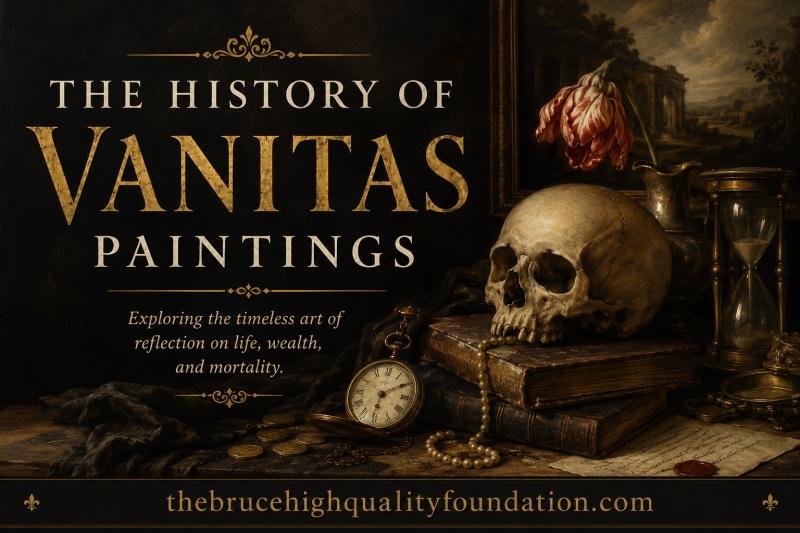
Skulls resting on leather-bound books. Petals dropping from wilting tulips. A candle flickering its last flame beside a half-empty wine glass. These haunting tableaux are the signature of vanitas paintings, one of the most intellectually rich genres in Western art history. The history of vanitas paintings stretches from the Protestant workshops of 16th-century Leiden to contemporary galleries where artists still wrestle with mortality, meaning, and the things we leave behind.
I have spent years studying Dutch Golden Age art, and vanitas still lifes remain some of the most rewarding paintings to unpack. Every object carries weight. Every shadow hides a sermon. In this guide, we will walk through where vanitas paintings originated, what their symbols mean, who painted them, and why they still matter in 2026. Whether you are an art history student, a painter working in still life, or simply someone who has stood in front of a vanitas painting and felt its strange pull, there is something here for you.
Table of Contents
What Does Vanitas Mean? Etymology and Origins
The word vanitas comes directly from Latin, where it means emptiness, futility, or worthlessness. But the term carries a much deeper cultural meaning thanks to its biblical roots. In the Latin Vulgate translation of Ecclesiastes, the opening verse reads “Vanitas vanitatum, omnia vanitas” — “Vanity of vanities, all is vanity.” This phrase became the philosophical backbone of an entire genre of painting that flourished across Northern Europe for over two centuries.
The preacher in Ecclesiastes surveys human achievement — wealth, wisdom, pleasure, power — and declares it all meaningless in the face of death. Vanitas painters took this ancient meditation and translated it into visual language. A skull, a fading flower, a ticking hourglass — each object became a word in a sermon painted on canvas. The biblical connection gave the genre its moral authority and its sense of urgency. This was not abstract philosophy. It was a direct command from scripture: stop, look, and reconsider how you are spending your brief time on earth.
Vanitas paintings originated in the Netherlands during the late 16th century, with the city of Leiden emerging as the undisputed center of the genre. Leiden was a Calvinist stronghold with a famous university, and its intellectual atmosphere proved fertile ground for art that combined moral philosophy with technical virtuosity. The earliest recognized vanitas paintings date to around 1550 to 1600, evolving from earlier medieval traditions of mortality imagery that had circulated in manuscripts, church carvings, and tomb sculpture for centuries.
Before vanitas became its own category, the medieval tradition of memento mori — literally “remember that you must die” — had already established a visual vocabulary of skulls, bones, and coffins. Vanitas painters inherited this vocabulary but added layers of meaning that went beyond simple reminders of death. They did not just remind viewers of mortality. They invited viewers to question the value of everything life offers — knowledge, beauty, wealth, pleasure, even art itself.
Vanitas and Memento Mori: Understanding the Connection
People often use the terms vanitas and memento mori interchangeably, but art historians draw an important distinction. Memento mori is the broader tradition — it encompasses any artwork designed to remind viewers of their mortality. This includes skull carvings on tombs, danse macabre woodcuts, and even jewelry featuring coffin-shaped lockets with skeletons inside. Vanitas is a specific subgenre within that tradition, one that focuses on the vanity or futility of worldly pursuits.
A memento mori painting might show a skull on its own, or a portrait with a hidden skull in the background. The message is straightforward: you will die. A vanitas painting goes further. It arranges objects — books, jewelry, musical instruments, exotic fruit — alongside the skull to make a broader point about the emptiness of earthly ambitions. The skull is not the endpoint of the message but the starting point.
Think of memento mori as the warning label and vanitas as the full instruction manual. Both point toward the same conclusion, but vanitas paints a richer picture of what is at stake. The genre emerged when Protestant artists in Northern Europe wanted moral, contemplative art that did not rely on Catholic saints or religious iconography. Instead of painting Christ on the cross, they painted a candle burning down beside a pile of books. Instead of the Virgin Mary, they showed an overturned goblet. The absence of overt religious figures made the work acceptable in Protestant homes while preserving its spiritual urgency.
This connection to Protestant thought is critical for understanding why vanitas developed where and when it did. Memento mori existed across Catholic and Orthodox traditions for centuries. Vanitas, by contrast, was distinctly shaped by the Reformation and the Calvinist worldview that dominated the Dutch Republic. The shift from church-commissioned religious art to privately owned still lifes mirrors the Protestant shift from institutional mediation to individual contemplation. Each viewer alone with a vanitas painting became both congregation and preacher, interpreting symbols and drawing moral conclusions without a priest to guide them.
The History of Vanitas Paintings During the Dutch Golden Age
The history of vanitas paintings reaches its fullest expression during the Dutch Golden Age, roughly spanning the 17th century. The Dutch Republic had won independence from Spain after decades of war. Amsterdam and Leiden were booming trade centers. The Dutch East India Company was bringing unprecedented wealth into the country from colonies and trading posts across Asia, Africa, and the Americas. And yet, alongside all this prosperity, artists produced some of the most somber, morally introspective paintings in European history.
This contrast is not accidental. Vanitas paintings flourished precisely because of the wealth around them. When merchants could fill their homes with imported spices, Chinese porcelain, and Turkish rugs, the moral message of vanitas hit differently. The genre functioned as a counterpoint to material excess — a painted reminder that every luxury would one day turn to dust. It asked uncomfortable questions of a society that was growing richer by the day: What is all this worth? What will remain when you are gone?
Leiden: The Heart of Vanitas Painting
Leiden deserves special attention in any history of vanitas paintings. This city produced more vanitas artists per capita than anywhere else in Europe. The reasons are both religious and intellectual. Leiden was a Calvinist stronghold, and its university — founded in 1575 by William of Orange as a reward for the city’s resistance during the Spanish siege — was one of the leading intellectual centers in Northern Europe. The university attracted scholars, theologians, and scientists who created a culture of serious inquiry.
David Bailly, one of the most important vanitas painters, spent his career in Leiden. His students and followers continued the tradition for decades after him. The city’s artistic culture prized precision, realism, and intellectual depth — all qualities that vanitas demanded. Painters in Amsterdam might specialize in lavish still lifes showing abundance and global trade, but Leiden artists gravitated toward the austere, meditative side of the genre. This regional difference tells us something important about vanitas: it was not just a style but a worldview, and Leiden provided the perfect soil for it to grow.
The Protestant Reformation and Calvinist Influence
The Reformation fundamentally changed how art functioned in Northern Europe. Protestant churches rejected religious imagery as idolatrous. Iconoclasm swept through Dutch cities in the 1560s, as crowds destroyed Catholic statues, altarpieces, and paintings in churches. This was not random vandalism — it was a theological statement about the proper role of images in worship. The result left artists without their traditional patron — the Church — and forced them to find new subjects and new buyers.
The emerging Dutch middle class became the new art market. Merchants, doctors, lawyers, and university professors wanted paintings for their homes. They wanted art that reflected their values: hard work, moral seriousness, intellectual curiosity, and religious devotion without idolatry. Vanitas paintings fit perfectly. They were secular enough to hang in a private home but religious enough to convey Protestant ethics. A skull beside a book was both an aesthetic arrangement and a statement of faith.
Calvinism taught that earthly wealth was temporary and that salvation came through faith, not works or worldly success. Vanitas paintings visualized this theology with remarkable directness. Every object — the skull, the hourglass, the fading flower — reinforced the Calvinist message that material possessions were temporary and spiritual concerns were eternal. In a society growing wealthy through trade and commerce, this was a countercultural message, and its popularity tells us that Dutch collectors wanted to be reminded of it regularly.
The Rise of Still Life as High Art
Before the Dutch Golden Age, still life was considered a lesser genre in the academic hierarchy of painting. History painting, portraiture, and religious scenes ranked higher. Still life was seen as mere copying — the artist reproducing what was in front of them without imagination or invention. But the Dutch market elevated still life to new heights. Collectors prized the technical skill required to render glass, metal, fabric, and organic matter with photographic precision, and they were willing to pay premium prices for it.
Within the still life category, vanitas occupied a special niche. Other subgenres — like pronkstilleven (ostentatious still life) or ontbijtje (breakfast piece) — celebrated abundance and the pleasures of the table. Vanitas did the opposite. It stripped away the excess and focused on what remains when everything perishable is gone. This made vanitas paintings some of the most philosophically ambitious works in Dutch art. They asked collectors to look at beautiful objects and see through them to the emptiness beyond.
Key Symbolism and Motifs in Vanitas Paintings
The symbolism in vanitas paintings follows a remarkably consistent visual language that developed over decades and was shared among painters, collectors, and viewers across the Netherlands. Once you learn to read these symbols, you can decode almost any vanitas still life from any painter. Here are the most common motifs and their meanings, drawn from the established iconographic tradition of the genre.
The Skull
The skull is the most recognizable symbol in vanitas art and appears in the vast majority of paintings in the genre. It represents the certainty of death and the ultimate equality of all people before mortality. Rich or poor, wise or foolish, powerful or powerless — everyone ends up as bone. The skull often sits at the center of the composition, dominating the arrangement the way death dominates human life. Some painters positioned the skull slightly off-center, looking directly at the viewer, as if to say: I am you, eventually.
Wilting Flowers and Drooping Petals
Flowers in vanitas paintings are never in full, healthy bloom. They droop, shed petals, or lean at exhausted angles. This represents the fleeting nature of beauty and youth. A tulip — the obsession of Dutch speculators during the tulip mania of the 1630s — carries extra meaning when shown wilting. It critiques the foolishness of investing earthly hope in something that will inevitably fade. The specific choice of flower mattered too: roses suggested love that would die, while poppies symbolized both sleep and oblivion.
Burning Candles, Hourglasses, and Clocks
Time is everywhere in vanitas paintings. A candle burning down signals the brevity of life — once the wick is spent, darkness follows. An hourglass turned on its side shows time running out. A pocket watch with its mechanism exposed reminds the viewer that life ticks toward its end without pause. These symbols are among the most emotionally effective in the vanitas vocabulary because everyone has felt time slipping away. They translate an abstract concept — mortality — into something visible and measurable.
Books, Scrolls, and Scientific Instruments
Books and instruments of learning show that even knowledge cannot save you from death. A globe, a compass, an astrolabe — symbols of human achievement and exploration — sit useless beside a skull. This was a pointed message in university cities like Leiden, where scholars prided themselves on their learning and where scientific discovery was celebrated. Vanitas reminded them that intellectual accomplishment, while admirable, was no substitute for spiritual preparation. The greatest mind in the world would still end up in the same grave as the simplest farmer.
Musical Instruments
Lutes, violins, and sheet music appear frequently in vanitas paintings. Music is the most ephemeral of the arts — a note sounds and then vanishes, leaving no trace. This made it a perfect symbol for the transience of pleasure and the fleeting nature of sensory experience. A lute with a broken string carries an additional message: earthly joy is fragile and can shatter without warning. The silent instrument beside the skull creates a stark contrast between the pleasure of music and the finality of silence.
Jewelry, Coins, and Crowns
Gold chains, pearl necklaces, silver coins, and royal crowns represent wealth and power. When placed beside a skull, they make a stark visual argument: riches cannot accompany you into the grave. This was a direct challenge to the materialism of the Dutch Golden Age, where fortunes were being made in global trade and the art market itself was thriving on commercial success. The irony would not have been lost on contemporary viewers — many of whom were wealthy merchants purchasing luxury paintings that warned against the love of luxury.
Soap Bubbles
Soap bubbles appear in many vanitas paintings, often floating above the other objects. They are beautiful, colorful, and literally empty. A bubble exists for a few seconds before popping into nothing. The Latin phrase homo bulla — “man is a bubble” — was a well-known vanitas motto that appeared in Renaissance emblems and humanist texts. The bubble symbolizes the fragility and ultimate meaninglessness of human life, and its translucent beauty makes the message all the more bittersweet.
Rotten and Half-Eaten Fruit
Fruit in vanitas paintings is never fresh. Lemons with peels hanging loose, apples with brown spots, peaches split open — all represent decay and the corruption that follows ripeness. Fruit also carries a subtle reference to the Garden of Eden and the fall of man. The message is layered: just as Adam and Eve lost paradise through desire, we lose ourselves by clinging to temporary pleasures. A half-peeled lemon was especially popular, its exposed flesh suggesting that even the act of enjoyment hastens decay.
Famous Vanitas Painters and Their Masterpieces
The history of vanitas paintings is also the story of remarkable artists who turned moral philosophy into visual poetry. These painters combined extraordinary technical skill with deep intellectual engagement, producing works that still command attention in museums around the world. Each brought a distinct approach to the shared visual vocabulary of the genre.
David Bailly (1584-1657)
David Bailly is often considered the father of Leiden vanitas painting. His masterpiece, Self-Portrait with Vanitas Symbols (c. 1651), is one of the most discussed vanitas paintings in art history. The painting shows the elderly artist surrounded by objects that reference his own mortality — a skull, a guttering candle, emptied wine glasses, and portraits of people who had already died. It is both a technical marvel and a deeply personal meditation on aging, loss, and the passage of time. The painting raises a haunting question: is the artist recording his own vanitas, or is he himself a vanitas symbol within the composition?
Bailly taught a generation of Leiden artists and helped establish the city as the center of vanitas production. His work is characterized by careful detail and a restrained, almost melancholy palette that suits the subject matter perfectly. He understood that the message of vanitas required not just the right objects but the right atmosphere — one of quiet gravity rather than theatrical excess.
Pieter Claesz (c. 1597-1660)
Pieter Claesz specialized in monochromatic vanitas still lifes that use a limited color palette to create an atmosphere of quiet sobriety. His Vanitas Still Life (1630) at the Mauritshuis in The Hague is a masterclass in the genre. A skull, an overturned wine glass, a watch, a pipe, and a book are arranged on a table with mathematical precision. The muted browns and grays make the scene feel like a whispered confession rather than a loud declaration.
What makes Claesz remarkable is his ability to render materials — glass, metal, bone, paper — with a realism that makes you want to reach out and touch them. His translucent wine glasses catch the light with photographic accuracy. His skulls have a weight and density that makes them feel genuinely present in the room. This technical skill was not just showing off. The more real the objects looked, the more real the moral message felt. A convincing skull was harder to dismiss than a stylized one.
Willem Claesz Heda (1594-1680)
Willem Claesz Heda (no relation to Pieter Claesz despite the similar name) was another Haarlem-based master of the vanitas still life. His Still Life with a Gilt Cup and his various breakfast pieces show a slightly more luxurious take on vanitas themes. Heda included expensive tableware and exotic foods alongside the standard skull and hourglass, suggesting that even the finest things money can buy will ultimately prove worthless.
Heda’s compositions are notable for their diagonal arrangements and dramatic lighting. He used light and shadow as moral metaphors — the candle illuminating the scene is the same candle that will soon go out. His handling of reflected light on pewter plates and silver cups remains some of the finest in all of Dutch painting, and the contrast between the beauty of the objects and the bleakness of their message gives his work a particular tension.
Harmen Steenwijck (1612-1656)
Harmen Steenwijck, a nephew of David Bailly, painted one of the most iconic vanitas images in existence. His Still Life: An Allegory of the Vanities of Human Life (c. 1640), now in the National Gallery in London, arranges a skull, a sword, a shell, a book, a flute, and a watch on a bare wooden table. The painting is almost minimalist compared to some Baroque excesses, but every element carries weight. The sword represents power, the shell represents wealth and rarity, the book represents knowledge, and the flute represents pleasure — all rendered irrelevant by the skull at the center.
Steenwijck’s work demonstrates how vanitas painters could say more with less. By limiting the number of objects and placing them against a simple background, he forced the viewer to confront each symbol individually rather than being overwhelmed by clutter. The result is one of the clearest and most powerful statements in the entire vanitas tradition.
Jan Davidsz de Heem (1606-1684)
Jan Davidsz de Heem bridged the gap between austere vanitas and the lavish pronkstilleven tradition. His paintings are often larger and more colorful than those of Claesz or Steenwijck, featuring abundant flowers, ripe fruit, and luxurious tableware arranged with operatic grandeur. But the vanitas elements are still present — a skull tucked among the blossoms, an insect crawling on a petal, a watch half-hidden beneath a vase.
De Heem’s approach highlights a fascinating tension within vanitas painting itself. His works are stunningly beautiful objects that warn against the dangers of being seduced by stunningly beautiful objects. This paradox — creating gorgeous art that condemns the love of gorgeous things — is one of the genre’s most compelling aspects. De Heem seems to have been fully aware of it, and his paintings invite viewers to enjoy their beauty while simultaneously questioning that enjoyment.
Juan de Valdes Leal (1622-1690): The Spanish Tradition
Vanitas was not exclusively a Dutch phenomenon. The Spanish painter Juan de Valdes Leal created some of the most dramatic vanitas images in Baroque art. His two paintings for the Charity Hospital in Seville — Au Ictu (In the Blink of an Eye) and Finis Gloriae Mundi (The End of Worldly Glory) — are visceral, unsettling works that show decomposing corpses in open coffins alongside symbols of worldly achievement: a bishop’s mitre, a crown, a bag of coins, a suit of armor.
The Spanish vanitas tradition tends to be more graphic and emotionally intense than its Dutch counterpart. Where Dutch painters favored quiet contemplation and symbolic subtlety, Spanish artists went for shock and visceral impact. Both approaches served the same purpose: forcing viewers to reckon with their mortality. The Spanish tradition deserves more attention than it typically receives, and its willingness to confront decay directly offers a counterpoint to the restrained elegance of Dutch vanitas.
Protestant Ethics and the Moral Message of Vanitas
The moral philosophy embedded in vanitas paintings cannot be fully understood without grasping the Protestant context that shaped them. Calvinism, the dominant form of Christianity in the Dutch Republic, emphasized the sovereignty of God, the sinfulness of humanity, and the futility of seeking salvation through earthly means. These were not abstract theological points — they were lived beliefs that shaped daily behavior, economic decisions, and cultural values across Dutch society.
Vanitas paintings translated these theological ideas into visual form with remarkable directness. A skull beside a pile of books says: your learning cannot save you. A wilting tulip beside gold coins says: your wealth will not last. A broken lute says: your pleasures are temporary. Each painting functioned as a private sermon, delivering its message without words and without the mediation of a priest. This was theology for the home — personal, direct, and impossible to ignore when hung on your dining room wall.
This is significant in the broader history of European art. Catholic art relied on saints, angels, and biblical narratives to convey spiritual lessons. Protestant art, stripped of these figures, turned to everyday objects as vessels of meaning. The result was a genre that felt both accessible and profound. Anyone could recognize a skull or a candle. Not everyone could decode a complex allegory involving obscure saints, but everyone could understand that a burning candle represents time running out.
There is also a deeper paradox at work that sophisticated collectors would have recognized. Vanitas paintings were luxury items. They were painted by highly skilled artists who commanded high prices, purchased by wealthy collectors, and displayed in well-furnished homes as signs of cultural refinement. The painting itself — an object of beauty and status — was exactly the kind of earthly treasure it warned against. Some art historians argue that collectors understood this irony and even enjoyed it. Owning a vanitas painting was a way to display moral awareness alongside material success, to have your cake and contemplate its transience too.
The Protestant work ethic also played a role in the genre’s appeal. Calvinists believed that hard work and modest living were signs of God’s favor, while idleness and excess were signs of spiritual weakness. Vanitas paintings reinforced this ethic by criticizing laziness, excess, and the pursuit of pleasure for its own sake. A painting that showed the emptiness of wealth was, in a sense, an argument for the Protestant values of diligence, restraint, and humility. It told the successful merchant: you may be rich, but remember what endures.
The Legacy of Vanitas in Modern and Contemporary Art
The history of vanitas paintings did not end in the 17th century. The genre’s central themes — mortality, transience, the tension between material success and spiritual meaning — are timeless. Contemporary artists continue to draw on vanitas traditions in surprising and inventive ways, proving that the visual vocabulary developed in Leiden workshops still speaks to the human condition in 2026.
Photography and Vanitas
Photographers have found vanitas to be a natural fit for their medium. The still life tradition translates easily into studio photography, where photographers can arrange objects with the same deliberate symbolism as a 17th-century painter. Contemporary photographers like Ori Gersht have created explosive vanitas images — literally freezing flowers with liquid nitrogen and then shattering them with a bullet — that update the genre’s themes for a modern audience. The destruction of something beautiful, captured at the moment of impact, is pure vanitas translated into a new medium.
The photographic medium adds its own layer of meaning to the vanitas tradition. A photograph captures a single moment in time, preserving it forever on paper or pixels. This tension between preservation and decay mirrors the central paradox of vanitas: creating a permanent image of something temporary. The photograph, like the painting, is an attempt to arrest time that ultimately proves futile — the moment is gone even as the image remains.
Contemporary Painters
Artists like Carlo Russo continue to paint vanitas still lifes in the traditional oil-on-canvas method, working directly from the same tradition that produced Bailly and Claesz. Russo’s work connects to the Dutch Golden Age through both technique and subject matter, using historical methods and even heritage tulip varieties that date back 400 years. This living link between past and present demonstrates that vanitas is not a museum piece but a continuing conversation about mortality that each generation joins on its own terms.
Other contemporary painters incorporate vanitas elements into figurative work, combining skulls and flowers with modern settings — a computer keyboard beside a skull, a smartphone screen showing a dying battery, a credit card next to a wilting rose. These adaptations show how flexible the vanitas vocabulary is and how easily it absorbs new symbols. A dying battery is functionally identical to a guttering candle: both show time running out.
Vanitas in Popular Culture
The influence of vanitas extends far beyond gallery walls. Fashion photography, album covers, film, and advertising all borrow vanitas imagery, often without realizing it. A perfume advertisement showing a flower dropping its petals against a dark background is a direct descendant of Dutch vanitas paintings. Music videos that juxtapose luxury goods with imagery of decay are working in the vanitas tradition, whether their creators know it or not. The visual language has become so embedded in Western aesthetics that we recognize it instinctively.
Even social media carries vanitas undertones that the original painters might appreciate. The curated perfection of Instagram feeds — beautiful, fleeting, ultimately empty — mirrors the soap bubble that vanitas painters used as a symbol of hollow vanity. The genre’s relevance in 2026 may be greater than ever, as digital culture accelerates the cycle of creation and disappearance. A story that vanishes after 24 hours is the soap bubble made literal.
Why Vanitas Still Matters
Vanitas paintings matter because they ask questions that never go out of date. What is truly valuable? What lasts? How should we live knowing that everything ends? These are not just 17th-century concerns or academic exercises for art historians. They are human concerns, and the best vanitas paintings address them with a directness and honesty that still resonates across four centuries.
In an age of unprecedented material abundance, vanitas paintings remind us that objects cannot fulfill us. In an era of rapid technological change, they remind us that knowledge has limits. In a culture obsessed with youth and beauty, they remind us that aging is not a failure but a reality. The history of vanitas paintings is, in the end, a history of humanity wrestling with its own impermanence — and finding something like wisdom in the process. That is why these paintings continue to stop visitors in museum hallways, why they reward repeated viewing, and why artists continue to return to their symbols century after century.
FAQs
Where did vanitas paintings originate?
Vanitas paintings originated in the Netherlands during the late 16th century, with the city of Leiden serving as the primary center of production. The genre grew out of the earlier medieval memento mori tradition and was shaped by Calvinist Protestant culture, which emphasized individual contemplation of mortality. The earliest recognized vanitas works date to approximately 1550 to 1600.
What do vanitas paintings symbolize?
Vanitas paintings symbolize the transience of earthly life and the futility of worldly pursuits. Each object carries specific meaning: skulls represent death, wilting flowers symbolize fading beauty, hourglasses and candles show the passage of time, books and instruments represent the limits of knowledge, and jewelry or coins represent the vanity of wealth. Together, these symbols encourage spiritual reflection and detachment from material concerns.
What is the point of vanitas paintings?
The point of vanitas paintings is to remind viewers of their mortality and encourage moral and spiritual contemplation. These works were designed to counter materialism and complacency by making the viewer confront the inevitability of death and the emptiness of worldly achievements. In the Protestant Dutch Republic, vanitas paintings served as private visual sermons that reinforced Calvinist values of humility and faith.
What is the difference between vanitas and memento mori?
Memento mori is the broader tradition of art that reminds viewers of death, encompassing everything from skull carvings to funeral monuments. Vanitas is a specific subgenre within that tradition that focuses on the vanity or futility of worldly pursuits, using arranged still life objects to make a broader philosophical point about the emptiness of earthly ambitions. All vanitas paintings are memento mori, but not all memento mori works are vanitas.
Why did vanitas paintings become popular in the Netherlands?
Vanitas paintings became popular in the Netherlands because of the unique combination of Protestant Calvinist culture, economic prosperity, and a thriving private art market during the Dutch Golden Age. The Protestant Reformation removed the Church as a primary art patron, and the wealthy Dutch middle class became the new buyers. Vanitas paintings reflected Calvinist values while serving as intellectually sophisticated decorations for private homes.
Conclusion
The history of vanitas paintings is a journey through some of the most intellectually ambitious art ever created. From the Latin text of Ecclesiastes to the workshops of Leiden, from the Calvinist values of the Dutch Republic to the galleries and studios of 2026, vanitas has asked the same unanswerable questions about mortality, meaning, and what we choose to value. The answers change with each generation, but the questions remain.
What makes vanitas paintings endure is not just their technical brilliance, though the best examples rival any art in history for sheer painting skill. It is their honesty. These paintings refuse to flatter. They do not pretend that wealth lasts or that beauty is permanent. They do not offer comfort in the face of death — only clarity. Instead of looking away, they ask us to look at a skull and a wilting flower and to find something worth seeing in the space between life and death.
If you want to experience these works in person, the Mauritshuis in The Hague, the National Gallery in London, and the Metropolitan Museum of Art in New York all hold outstanding collections of vanitas paintings. Standing in front of a Pieter Claesz or a David Bailly, seeing how light falls across a skull painted 400 years ago, is an experience that no reproduction can fully capture. The history of vanitas paintings lives on — in museums, in studios, and in every moment we pause to consider what truly matters.