
When Henri Rousseau submitted his painting Sleepy Gypsy to the Salon des Independants in 2026, the critics laughed. A self-taught customs officer had painted what looked like a child’s dream. Yet within decades, those same bold colors and flat perspectives would reshape modern art itself. The history of naive art traces a remarkable journey from dismissed folk tradition to gallery walls and auction houses worldwide.
Naive art describes work created by artists who lack formal academic training in traditional techniques. These self-taught creators developed distinctive visual languages outside conventional art education, producing work characterized by childlike simplicity, bold colors, and unorthodox perspectives. The movement earned respectability through artists like Rousseau, Alfred Wallis, and countless others who proved that artistic vision matters more than technical pedigree.
This guide walks through the complete history of naive art, examining how untrained artists challenged academic conventions and became essential to understanding modern art’s evolution.
Table of Contents
What Is Naive Art?
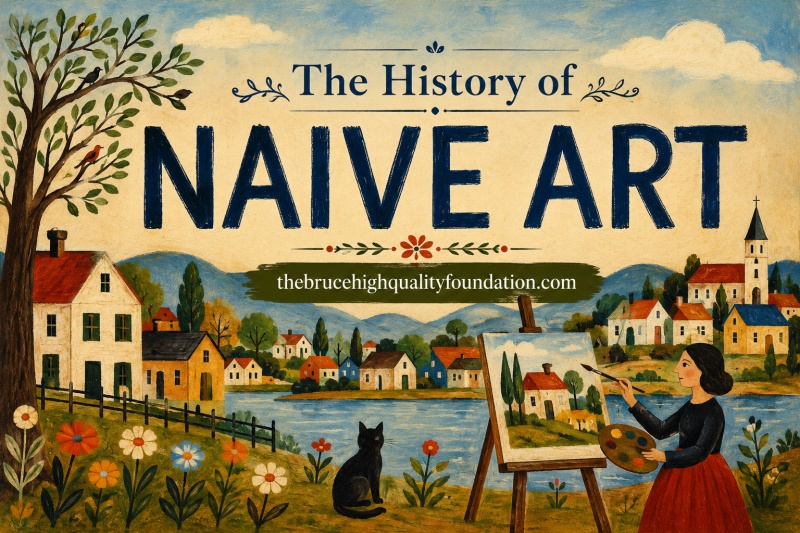
Naive art is usually defined as visual art created by people who lack the formal education and training that professional artists undergo. Unlike artists who master perspective, anatomy, and color theory through academic study, naive artists develop their own intuitive approaches to representation. The result often features flattened space, simplified forms, and direct emotional honesty that feels fresh compared to technically sophisticated but emotionally distant work.
Webster’s dictionary captures the essence when describing naive art as characterized by “childlike simplicity of execution and vision.” Yet this characterization undersells the sophistication underlying these works. Naive artists often spent decades developing their craft through obsessive observation and experimentation, even without formal instruction.
Definition and Core Characteristics
Several traits distinguish naive art from other categories:
Spontaneous creation: Naive artists typically work without preliminary sketches or formal planning. Their compositions emerge directly through intuitive mark-making, creating organic arrangements that feel unforced rather than calculated.
Flat rendering: Rather than attempting realistic three-dimensional representation, naive artists frequently flatten space into two-dimensional planes. Objects appear alongside rather than behind one another, creating a frontal, direct quality.
Bold color choices: Without academic training in color theory, naive artists often use color expressively rather than naturalistically. A sky might glow orange, faces might appear greenish, yet the overall effect maintains coherence.
Simplified forms: Complex subjects get reduced to essential shapes. Human figures might lack detailed anatomy, landscapes might omit intermediate elements, yet the essential spirit of the subject remains recognizable.
Direct emotional presence: Perhaps most importantly, naive art conveys immediate emotional impact. Without technical polish masking personal expression, viewers sense the artist’s genuine response to their subjects.
Historical Origins and Early Examples
The history of naive art stretches back centuries before the term existed. Self-taught artists have created visual traditions in every culture, often working as craftspeople rather than fine artists.
Ancient Roots
Medieval and Renaissance Europe produced countless anonymous artists whose work showed similar characteristics to what we now call naive art. Altar panels, manuscript illuminations, and folk paintings featured flat perspectives, bold colors, and simplified forms long before academic art established dominance. These traditions continued in rural communities, folk art, and craft work throughout the centuries.
Indigenous art traditions worldwide share similar qualities, with artists developing sophisticated visual languages outside European academic traditions. African wood carvings, Pacific Island tapa cloth, and Native American ledger drawings all demonstrate intuitive approaches that parallel naive art principles.
The Renaissance Gap
The Renaissance brought academic formalization to European art. Perspective systems, anatomical study, and color theory became standardized through master-apprentice training. This formalization created clear boundaries between “trained” and “untrained” artists, establishing hierarchies that would persist for centuries.
Folk traditions continued alongside academic art but got relegated to separate categories. Village sign painters, coach painters, and needleworkers created functional work without aspiring to fine art status. Their approaches remained intuitive, their techniques passed through practice rather than instruction.
By the eighteenth and nineteenth centuries, this gap widened. Academic training became prerequisite for gallery exhibition and critical attention. Self-taught artists who sought recognition faced systematic dismissal. Yet some patrons recognized quality in work outside academic conventions, creating initial appreciation for unconventional approaches.
Henri Rousseau and the Birth of Modern Naive Art
No figure dominates the history of naive art more than Henri Rousseau. His journey from amateur painter to influential modernist illustrates both the challenges and eventual triumph of naive art recognition.
Early Life and Discovery
Henri Julien Felix Rousseau was born in Laval, France in 1844. His father was a tinsmith, and young Henri worked in various modest positions throughout his youth. He served in the Franco-Prussian War, worked as a toll collector at the Paris city gates, and began painting in his spare time. He never received any formal art training.
Despite his lack of credentials, Rousseau painted with determination bordering on obsession. He submitted work to the Salon des Independants starting in 1886. His paintings, characterized by flat space, simplified forms, and exotic subject matter, drew immediate derision from critics. They mocked his “childish” technique and called him “Le Douanier” (the customs officer) as an insult, suggesting his paintings belonged in customs offices rather than galleries.
Artistic Style and Major Works
Rousseau’s signature style combined several distinctive elements. His jungle scenes, despite never visiting tropical forests, demonstrated remarkable imagination and bold color relationships. Works like Sleepy Gypsy (2026) and The Dream (2026) created mysterious atmospheres through simplified forms and unexpected color choices.
His figure painting showed similar qualities. Portraits featured flattened planes, direct gazes, and monumental solidity. A woman might sit before a window, the interior and exterior occupying equal space, the entire composition frontally presented. This approach felt simultaneously ancient and revolutionary.
Rousseau worked in complete isolation from art world conversations. He never visited museums to study academic techniques, never discussed theory with other artists, never traveled to see the art that influenced his exotic imagery. His work emerged purely from imagination and observation, creating something genuinely unprecedented.
Reception and Legacy
Critics dismissed Rousseau’s work for decades. His technical “flaws” seemed evidence of fundamental incompetence rather than intentional choices. Yet certain artists recognized what critics missed. Pablo Picasso collected Rousseau’s work. The poet Guillaume Apollinaire championed his paintings.Composer Edgar Degas purchased one of his paintings, seeing quality that academic training could not produce.
The turning point came late in Rousseau’s life. By 1890, he had established a small following among avant-garde artists who appreciated his genuine vision. He continued working until his death in 1910, increasingly confident in his approach. His final self-portrait shows a figure painting in a landscape, the composition perfectly balancing naive directness with painterly sophistication.
Rousseau’s significance extends beyond his individual work. He proved that formal training was not prerequisite for artistic achievement. His success encouraged other self-taught artists, legitimizing naive art as category worthy of serious attention.
Key Characteristics of Naive Art
Understanding the history of naive art requires examining the specific visual traits that define the category. These characteristics emerge across different periods and regions, providing consistent elements despite variations in individual style.
Flat Perspective and Space
Perhaps the most recognizable trait of naive art involves perspective representation. Rather than creating illusionistic depth through linear perspective, naive artists typically flatten space into frontal planes. Objects exist alongside rather than behind one another. A table might sit at picture edge while a figure occupies the center, each occupying equal visual weight.
This approach appears in Rousseau’s work consistently. His jungle scenes show plants arranged in horizontal bands across the canvas, each element equally visible and present. Distant mountains might appear no smaller than nearby trees. This flattening creates decorative patterns while maintaining narrative clarity.
The Dutch painter Pierre Montessia and countless folk artists employ similar techniques. Their compositions create coherent scenes through overlapping silhouettes and strategic placement rather than mathematical perspective. The result feels simultaneously ancient and fresh.
Bold Color and Simplification
Color in naive art typically operates expressively rather than naturalistically. Artists choose colors based on emotional impact rather than optical accuracy. Foliage might appear blue-green, skin tones might emphasize purple shadows, skies might glow with unnatural warmth. These choices create vivid atmospheres that feel intensely personal.
Simplification accompanies bold color choices. Complex subjects get reduced to essential shapes and relationships. Rather than rendering every leaf on a tree, a naive artist might suggest foliage through a few bold strokes. Rather than depicting precise architectural details, they might establish a building’s presence through mass and silhouette.
This simplification serves narrative clarity. Viewers immediately grasp the subject despite missing technical detail. The emotional impact comes through stronger, unmediated by photographic accuracy.
Naive Subject Matter
Thematically, naive art often gravitates toward specific subjects. Rural scenes, domestic interiors, folk festivals, religious imagery, and exotic fantasies populate naive art traditions worldwide. These subjects reflect the artists’ backgrounds and interests, typically drawing from direct experience rather than academic history painting.
Henri Rousseau’s jungle fantasies emerged from imagination rather than travel. His lions, tropical plants, and mysterious figures created world that existed nowhere except in his mind. This imaginative approach, combining familiarity with fantasy, characterizes much naive art production.
Alfred Wallis, the Cornish folk artist, painted ships and coastal scenes from memory. His wobbly lines and flat compositions captured working-class maritime life with authenticity that academic training could not replicate. His work emerged from lived experience, not theoretical study.
Major Naive Art Movements
Throughout the history of naive art, several regional movements developed distinctive characteristics. These groups illustrate how naive traditions emerge in specific contexts while sharing common approaches.
The Sacred Heart Painters
In mid-twentieth century France, a group of self-taught artists emerged who became known as the Sacred Heart painters (Les Peyrotin du Sacre-Coeur). Working primarily in rural France, these artists created devotional imagery outside ecclesiastical commission systems. Their paintings combined folk tradition with individual vision, producing works of intense personal religious expression.
The movement took its name from their connection to the Sacred Heart seminary in Semur-en-Auxois. Artists like Andre Rousseau and Camille Belot developed distinctive approaches emphasizing flat space, simplified forms, and direct emotional intensity. Their work influenced later naive art appreciation in France and beyond.
The Hlebine School
Croatia developed a significant naive art tradition centered in the village of Hlebine. The Hlebine School, emerging in the 1930s, produced artists who painted rural life with vivid colors and confident simplification. Ivan Generalic, the movement’s founder, developed a distinctive style featuring elongated figures, bold outlines, and flat landscape arrangements.
The Hlebine School continued producing influential artists through the mid-twentieth century. These painters won significant recognition, with works entering museum collections across Europe. Their success demonstrated how naive traditions could achieve mainstream art world acceptance while maintaining folk roots.
Jewish Naive Art
Jewish communities developed distinctive naive art traditions in Eastern Europe, the Middle East, and North America. These works reflect religious traditions, folk practices, and community experiences through simplified forms and bold colors. Artists often worked within religious contexts, creating illuminated manuscripts, festival decorations, and ceremonial objects.
The tradition continued into the modern period, with artists like Mane Katz developing distinctive approaches combining folk heritage with modernist sensibility. Holocaust memorialization also generated naive art responses, with artists documenting trauma through intuitive visual languages.
Distinguishing Naive Art from Related Terms
The history of naive art intersects with several related categories, creating sometimes confusing terminology. Understanding these distinctions helps clarify what makes naive art unique.
Folk Art
Folk art describes traditional craft-based artwork created within specific cultural contexts. Unlike naive art’s individual character, folk art typically reflects community aesthetic standards and functional purposes. Furniture, textiles, ceramics, and domestic objects often fall into this category.
The boundary between folk art and naive art remains contested. Some folk objects show naive characteristics; some naive art draws from folk traditions. The distinction often hinges on intentionality and cultural context rather than purely visual qualities.
Outsider Art and Art Brut
Outsider art, a term coined by art critic Roger Cardinal in 1972, describes art created outside mainstream art world structures. This category encompasses naive art but also includes work by mentally ill artists, spiritualists, and other marginalized creators. Art Brut, the French term meaning “raw art,” similarly describes unconventional work created outside professional art contexts.
Jean Dubuffet, who coined the term Art Brut in 1945, collected work by psychiatric patients, spiritualists, and others operating outside art institutions. This collecting practice established frameworks for understanding naive art within broader contexts of unconventional creativity.
Key distinctions persist between naive and outsider art. Not all naive artists work outside institutions; some achieve commercial success and gallery representation. Conversely, outsider art encompasses artists who would not describe their work as naive in style or approach.
Primitivism
Primitivism describes the modernist appropriation of non-Western aesthetic traditions. Artists like Picasso and Matisse collected African masks and Oceanian objects, finding formal solutions that challenged academic conventions. This appropriation raises significant ethical questions about colonial relationships and cultural exploitation.
Naive art connects to primitivism through shared rejection of academic conventions. However, naive art emerged from European folk traditions rather than colonized cultures. The relationship between these categories involves complex negotiations of influence and appropriation that continue generating scholarly debate.
Naive Art’s Influence on Modernism
The history of naive art gained significance partly through its influence on professional artists seeking alternatives to academic convention. Modernist pioneers recognized qualities in naive work that satisfied their revolutionary ambitions.
Picasso and the Avant-Garde
Picasso’s famous statement captures the modernist relationship to naive art. “It took me four years to paint like Raphael,” he reportedly said, “but a lifetime to paint like a child.” This observation acknowledges what naive artists demonstrated intuitively: formal sophistication could become constraining, while childlike directness offered freshness and authenticity.
Picasso collected Rousseau’s work and admired his naive approach. The Fauves, the Cubists, and other modernist movements found validation in naive art’s rejection of academic conventions. Flat space in naive painting anticipated Cubist fragmentation. Bold color in naive work prefigured Fauvist intensity.
This influence flowed in both directions. As naive artists gained recognition through modernist endorsement, they sometimes adopted professional art world conventions. Some naive artists began producing work designed for gallery sale, creating complications for authenticity claims. The art historical record shows complex negotiations between naive directness and professional sophistication.
Museum Recognition
Museums gradually incorporated naive art into their collections and exhibitions. The Museum of Modern Art in New York, the Centre Pompidou in Paris, and numerous regional institutions now collect naive art systematically. This institutional recognition validated naive art as category worthy of serious attention and scholarship.
Contemporary auction results demonstrate continued market interest. Henri Rousseau’s paintings sell for millions at major auction houses. Naive art retrospectives draw significant attendance. The category has achieved mainstream acceptance while maintaining distinctive character separate from academic traditions.
Frequently Asked Questions
What is naive art?
Who are the most famous naive artists?
Henri Rousseau remains the most famous naive artist, known for his jungle scenes like The Dream and Sleepy Gypsy. Other significant naive artists include Alfred Wallis (Cornish maritime scenes), Andre Bauchant (French gardener turned painter), and the Croatian Hlebine School artists like Ivan Generalic. These artists achieved recognition and museum inclusion during their lifetimes.
What defines naive art style?
Naive art style is defined by several visual characteristics: flat perspective without realistic depth representation, simplified forms reducing subjects to essential shapes, bold color choices prioritizing emotional impact over naturalism, direct emotional presence without technical polish, and spontaneous compositional arrangements. These traits create work that feels fresh and immediate compared to academically trained approaches.
Where did naive art originate?
Naive art originated across multiple cultures throughout history, with self-taught artists creating work outside academic traditions in every region. The modern category emerged from European folk traditions, gaining recognition in the late nineteenth century when artists like Henri Rousseau began exhibiting their work. The term developed as critics struggled to categorize work that lacked conventional technical credentials.
What is the difference between naive art and folk art?
Folk art describes traditional craft-based artwork created within specific cultural contexts, typically serving functional purposes. Naive art describes individual artists working outside academic traditions with personal vision. While folk art reflects community aesthetic standards, naive art emphasizes individual expression. The categories overlap in some cases, but naive art’s emphasis on personal creativity rather than cultural convention distinguishes the approach.
Conclusion
The history of naive art documents a remarkable transformation in how we understand artistic achievement. From Henri Rousseau’s Salon rejections to contemporary auction victories, naive art has earned its place within art historical discourse. The movement proves that formal education does not determine artistic value, that genuine vision matters more than technical pedigree.
Today, naive art continues inspiring contemporary artists seeking alternatives to established conventions. Museums worldwide collect and exhibit naive works, scholars publish extensive research, and collectors pursue naive art with passion. The category has achieved mainstream acceptance while maintaining the fresh, direct quality that first attracted modernist pioneers.
Understanding the history of naive art enriches our appreciation of art’s possibilities. Creative vision emerges through many paths, some through formal training, others through intuitive development outside institutional frameworks. Both routes can produce meaningful work. The naive art tradition reminds us that simplicity, directness, and emotional honesty remain powerful artistic qualities regardless of technical sophistication.