
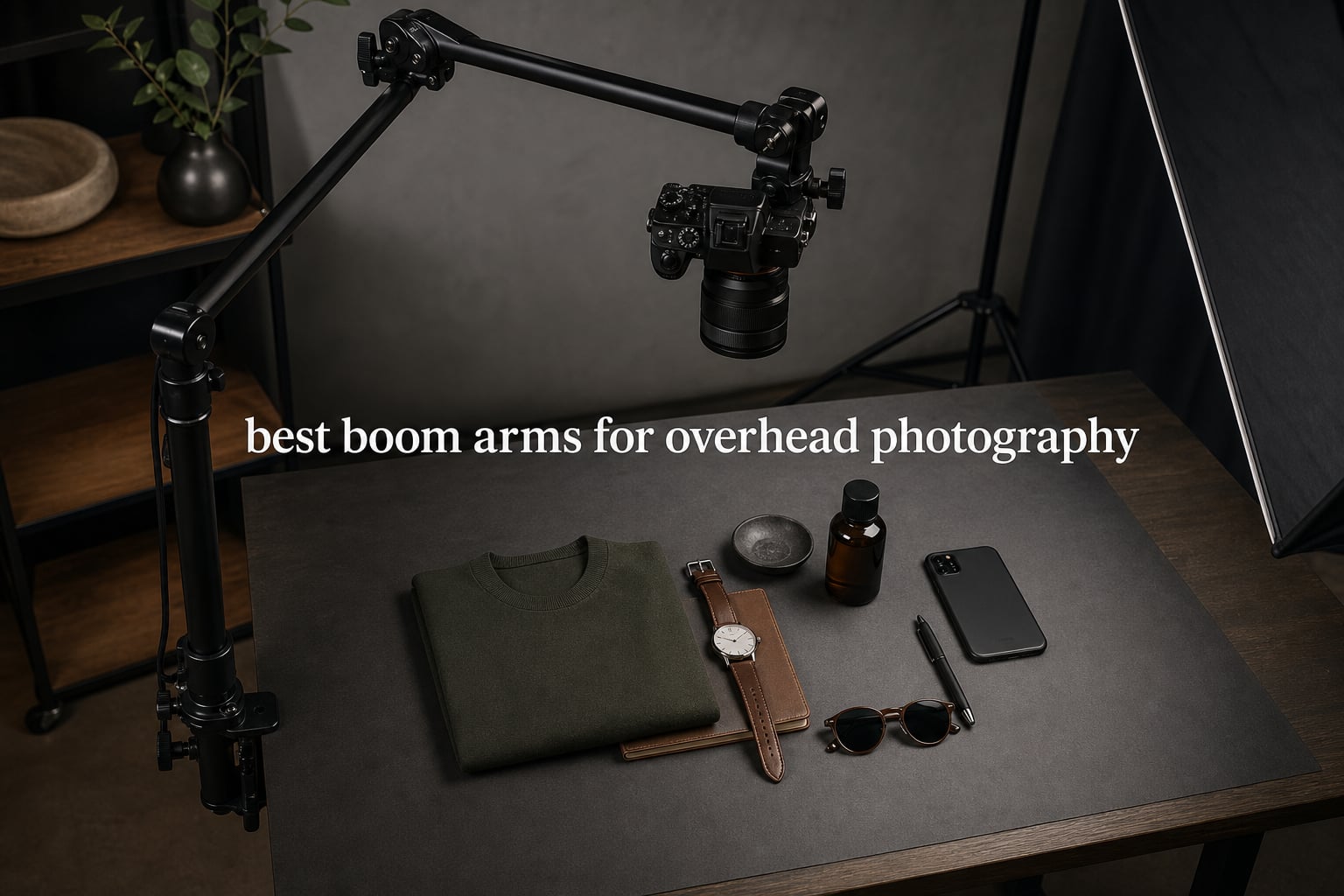
The best boom arms for overhead photography hold a camera in the same top-down position from shot to shot, freeing both hands for styling, cooking, drawing, unboxing, or demonstrating a product. The useful choices are camera supports first, not merely microphone arms with a camera added at the end.
I compared the stated load limits, reach, clamp fit, mounting threads, and adjustment systems for 10 desk-mounted camera boom arms. The practical split is simple: a phone or action camera can work on a light articulating arm, while a DSLR body and lens call for a mount with a stated camera-oriented capacity and a rigid base.
An overhead camera boom arm suspends a camera above the subject for top-down product photography, flat lays, food videos, and tutorials. It extends from a desk clamp, tripod, or C-stand, then holds position through joints, tension, or a counterbalanced support.
Every overhead setup deserves a safety check before a person or valuable object sits below it. Lock every joint, keep the camera within the maker’s stated limit, test for droop at the intended reach, and avoid treating a desk clamp as a substitute for a properly weighted stand when the load becomes serious.
For wider studio setups, our guide to best C-stands for photography studios is a useful companion. The picks below are specifically desk-mount solutions, so desk thickness and a stable work surface matter as much as camera weight.
Table of Contents
The top 3 picks answer three different overhead-camera needs
The SMALLRIG DTCK001 is my first stop for a compact DSLR or mirrorless camera on a normal desk because it combines a 2 kg stated limit with height adjustment and a retractable secondary arm. The SMALLRIG Triangle 4304 suits creators who want a braced desktop structure, while the SupeDesk FC200 is the choice to inspect first when a heavier stated capacity and adjustable spring tension are the priority.

SMALLRIG Camera Desk Mount DTCK001
- 2 kg stated capacity
- 360 degree ball head
- 30 to 73 cm height

SMALLRIG Triangle Camera Desk Mount 4304
- 3 kg stated capacity
- triangular support
- 42 to 68.5 cm rod

These are the 10 overhead photography boom arms at a glance in 2026
The comparison below puts the important decision points in one place: stated capacity, adjustment approach, and the kind of shooting space each mount fits. Capacity numbers come from the product data, but I would still leave a sensible margin rather than running any arm at its stated maximum while fully extended.
| Product | Specifications | Action |
|---|---|---|
| SMALLRIG Camera Desk Mount DTCK001 |
|
Check Latest Price |
 K&F CONCEPT 22 inch Magic Arm K&F CONCEPT 22 inch Magic Arm |
|
Check Latest Price |
 SMALLRIG 22 inch Magic Arm 4766 SMALLRIG 22 inch Magic Arm 4766 |
|
Check Latest Price |
 NEEWER UA057 Magic Arm NEEWER UA057 Magic Arm |
|
Check Latest Price |
 DImotliyor 3-Section Mount DImotliyor 3-Section Mount |
|
Check Latest Price |
 ULANZI ZJ02 Desk Mount ULANZI ZJ02 Desk Mount |
|
Check Latest Price |
 ailight TS61 Telescopic Arm ailight TS61 Telescopic Arm |
|
Check Latest Price |
| SMALLRIG Triangle Mount 4304 |
|
Check Latest Price |
 NEEWER TL253A+MH022 Rig NEEWER TL253A+MH022 Rig |
|
Check Latest Price |
| SupeDesk FC200 Spring Arm |
|
Check Latest Price |
1. SMALLRIG Camera Desk Mount DTCK001 is the best all-round desktop pick
- 2 kg stated capacity
- Retractable secondary arm
- Two camera thread sizes
- Quick setup
- Desk fit limited to 1 to 6 cm
- Not for loads above 2 kg
The SMALLRIG DTCK001 is the most balanced starting point for an overhead camera rig on a desk. Its listed 2 kg capacity gives it more room than the light magic-arm options, and the separate 30–73 cm height adjustment plus 30–50 cm secondary arm make framing easier without moving the whole desk setup.
I like the 360-degree ball head for dialing in a level flat-lay frame after the arm is already in place. The mount also has 1/4-20 and 3/8-16 threaded holes, which is helpful if your camera, light, or accessory uses either common size.
The manufacturer describes this as a tabletop stand for desktop photography and live streaming, which matches its most convincing role. A small mirrorless camera with a modest lens, a phone, a compact LED, or a microphone is a sensible match; a large camera-and-lens combination should be weighed before it goes overhead.
The DTCK001 works best on a clear, medium-thickness desk
The base is specified for surfaces from 1 to 6 cm thick, so measure the actual lip of your desk rather than the top alone. A shallow drawer or cross brace directly below the edge can stop a clamp from seating correctly.
Its 951.4 g item weight and detachable, retractable pole make it more practical for a creator who needs to pack down a shooting corner between sessions. The listed two-year manufacturer warranty is another useful detail for a frequently adjusted desktop mount.
The DTCK001 needs a conservative load and a short safety test
The 2 kg limit is the ceiling, not a target for a fully extended arm. I would mount the camera, lock the ball head, place the arm at the planned reach, then watch for movement before arranging food, products, or hands under the camera.
Use the arm close to the subject when possible, because a shorter horizontal span puts less turning force on the clamp and joints. That basic habit directly addresses the sagging concern that comes up repeatedly in creator discussions.
2. K&F CONCEPT 22 inch Magic Arm is the flexible clamp-placement pick
- Three angle points
- Clamp fits flat and round supports
- Non-slip pads
- All-metal construction
- 1 kg stated limit
- More joints need checking
The K&F CONCEPT 22-inch Magic Arm takes a different route from a dedicated desk stand: it uses a super clamp and three 360-degree ball heads. That layout is attractive when the best mounting point is a shelf, desk edge, tube, or other secure support rather than a fixed vertical post.
Its stated maximum weight recommendation is 1 kg, so I see it as a phone, action-camera, compact-light, or very light camera solution. The included phone holder and action-camera adapter reinforce that lighter-duty focus.
The clamp is specified for flat surfaces up to 50 mm and cylindrical objects from 20 to 60 mm. Rotatable clamping blocks, anti-twist pins, and non-slip silicone pads are purposeful details when the support point is not a plain rectangular desktop.
The K&F arm gives the most framing freedom from one clamp
Three ball heads let you place the clamp vertically, run the arm around an obstruction, and still bring the camera back to level. That can be useful for overhead product photography on a crowded bench where a full desk stand would occupy too much edge space.
The 22-inch folded size and 0.48 kg item weight make it a realistic travel companion for a small creator kit. Mobility does not remove the need to find a genuinely rigid support, however.
The K&F arm suits light gear rather than a DSLR upgrade
Articulating friction arms can shift as load and reach increase, so this is not the option I would choose for a heavy DSLR body with a large lens. The stated 1 kg limit is the information to respect, especially when the camera is suspended sideways from the clamp.
Before recording, tighten each ball-head joint, check the clamp face, and make a short hands-off test. If the frame slowly tilts, reduce reach or load instead of trying to solve it by overtightening a single knob.
3. SMALLRIG 22 inch Magic Arm 4766 is the pick for phones and action cameras
- Long 56 cm arm
- Anti-slip protection
- Clamp opens to 63.5 mm
- Phone clamp included
- 250 g stated limit
- Not a DSLR solution
The SMALLRIG 4766 makes sense when the overhead device is genuinely light. Its 56 cm, or 22-inch, arm reaches farther than many compact clamps, and its stated 250 g capacity gives a clear boundary for a phone, webcam, compact light, or a small action camera.
The anti-deflection 1/4-20 interface is the feature I would focus on for an overhead shot. Small rotations at the mount point are obvious in a top-down frame, so a design intended to resist twist is more meaningful here than it might be on a side-mounted light.
This is one of the best boom arms for overhead photography only when the camera is on the light end of the spectrum. It includes a phone clamp and a 1/4-20 to 3/8-16 adapter, making it unusually convenient for phone-led unboxing videos and quick tabletop demonstrations.
The SMALLRIG 4766 is a strong fit for close phone shooting
The clamp opening reaches 63.5 mm, and the product lists 12 anti-slip and anti-scratch designs through silicone pads and rubber rings. That combination helps protect the desk and reduces the chance of a phone-view frame creeping after adjustment.
At 310 g, the arm itself is easy to move between a desk, shelf, or stand leg that accepts its clamp. I would keep the setup compact and place the clamp near the shot rather than extending the arm just because its length is available.
The SMALLRIG 4766 should not carry a conventional DSLR
The 250 g stated recommendation is far below the mass of many interchangeable-lens cameras, even before a lens, battery, or cage is attached. A DSLR or mirrorless camera with substantial glass belongs on a more capable mount from this list.
For a phone, remove an unusually bulky case if it puts the center of mass far from the clamp. A phone mount that looks stable while vertical can behave differently once it faces directly down.
4. NEEWER UA057 is the practical multi-angle clamp arm for light devices
- Three 360 degree adapters
- Anti-twist pins
- Clamp works on rods
- Aluminum alloy
- 500 g stated limit
- Light-duty camera use only
The NEEWER UA057 is another 22-inch articulating option, but its stated 500 g recommendation puts it between a phone-only arm and a light camera mount. The 55 cm reach and three sets of 360-degree dual ball-head adapters give it plenty of framing options for a compact overhead camera, light, or microphone.
Its super clamp has V-grooves and pivot tips intended for both flat surfaces and tube rods up to 50 mm thick. That matters if a creator is attaching an extension arm for camera use to a sturdy shelf post, stand tube, or a desk that has an awkward edge.
NEEWER lists anti-twist pins on each mounting interface and non-slip pads at the grip points. Those features are sensible for a top-down frame because they help limit the slow rotation that can move a camera away from a carefully squared composition.
The UA057 adapts well to unusual clamp locations
The clamp’s ability to grip flat surfaces and cylindrical rods is its main advantage over a fixed desk mount. It can be useful for a maker’s workbench where the open desk edge is not the strongest location but a fixed tube or frame is available.
The product weighs 400 g, so it can join a small mobile overhead kit without adding a large stand. Its 1/4-inch and 3/8-inch extension holes also broaden the accessory options.
The UA057 needs a light camera and a balanced position
A 500 g stated weight limit can be exceeded quickly by a camera body, lens, quick-release plate, and microphone. Weigh the complete shooting package, not just the bare camera body, before assuming it fits this category.
Keep the arm folded into a compact shape where possible, because multiple articulated joints add more places for deflection. A shorter, more direct route from clamp to camera normally produces a calmer overhead video frame.
5. DImotliyor 3-Section Mount is the modular desktop camera-rig choice
- 2 kg horizontal rating
- Three-section adjustment
- Multiple screw sizes
- Padded desk clamp
- Maximum load differs by position
- Desk mount only
The DImotliyor overhead camera mount is more of a purpose-built desk rig than a magic arm. Its three-section detachable pole, 360-degree ball head, and 1/4-inch, 3/8-inch, and 5/8-inch screw options offer the kind of modularity that helps a creator build a repeatable shooting station.
The key number is 4.5 lb, or 2 kg, for horizontal loading; the product also states a 6 lb, or 2.7 kg, maximum. For overhead photography, the horizontal rating is the more cautious figure because a side-extended camera creates the bending force the arm must resist.
The padded aluminum desk clamp fits surfaces up to 2.4 inches, or 6 cm, thick. That gives it a good chance of working with many standard tables, provided the underside has enough clear depth for the clamp pad.
The DImotliyor mount supports a repeatable multi-device station
The three screw formats can reduce the need for extra adapters when moving among a camera, light, webcam, or microphone. The 360-degree ball head then lets the user correct the angle after the device is secured.
Its three detachable sections also give the user a choice between a compact layout and extra articulation. That flexibility is helpful for product photography where the subject size changes from small jewelry to a wider craft or recipe setup.
The DImotliyor mount needs its horizontal rating treated as the real limit
Do not plan an overhead DSLR setup around the higher maximum figure when the arm is extended horizontally. Use the 2 kg horizontal figure as the working reference, and leave room below it for the less-visible forces created by reach.
After positioning the camera, press gently on the arm from the side rather than downward. Any obvious shift is a signal to shorten the extension, recheck the clamp, or move to a sturdier mounting approach.
6. ULANZI ZJ02 is the best long-reach desk mount for a large work surface
- 98 cm maximum length
- 2 kg stated capacity
- Toothed 180 degree joints
- Silicone-padded clamp
- Clamp fits up to 48 mm
- 2 kg ceiling limits lens choice
The ULANZI ZJ02 is built around reach. Its four-section arm extends to 98 cm, while the listed overhead shooting height reaches 65 cm, making it a compelling choice when the camera needs to clear a broader desk or frame a larger flat-lay scene.
The stated 2 kg capacity and aluminum-alloy construction move it beyond the light magic-arm class. It also uses flexible toothed joints with 180-degree adjustment, a design that gives a more defined position than a fully friction-based arm.
The 1/4-inch ball head is the camera connection point, and the C-clamp has a silicone pad for desks up to 48 mm thick. I would measure both the tabletop and the underside clearance before committing, especially on desks with rounded or reinforced edges.
The ZJ02 is best when distance from the clamp is the real problem
A long worktable often makes a small desk mount awkward because the camera cannot reach the center of the shooting area. The ZJ02’s 98 cm maximum extension offers more placement latitude than compact arms, while the 65 cm shooting height can support a useful top-down angle.
The four-section layout also lets the user use less than the maximum reach for smaller subjects. That is preferable when possible, since keeping sections shorter generally produces a more stable camera boom arm.
The ZJ02 needs a capacity margin at its longest reach
Although the stated limit is 2 kg, the arm will face its greatest strain at maximum extension. A light mirrorless kit is a more comfortable fit than a camera with a long, front-heavy lens.
Lock each toothed joint fully and recheck the level of the ball head after extending the arm. A small angle change at the mount can turn a symmetrical flat lay into a visibly skewed frame.
7. ailight TS61 is the telescopic choice for height-and-reach adjustment
- Separate height and arm adjustment
- Rubber-padded clamp
- Standard 1/4 inch screws
- Aluminum build
- 1 kg horizontal limit
- Clamp fits up to 1.97 inches
The ailight TS61 separates vertical and horizontal adjustment in a clear, useful way. Its three-section stand adjusts from 15.75 to 33.45 inches, while the two-section horizontal arm runs from 11.8 to 20 inches and carries a stated 1 kg load.
That design is appealing when you need to alter camera height without changing where the desk clamp sits. Both the vertical and horizontal ball heads use standard 1/4-inch screws, so mounting a camera or a compatible phone clip is straightforward.
The C-clamp is specified for desks from 0.2 to 1.97 inches thick and uses rubber pads. Its aluminum construction and tube diameters are useful stability details, but the 1 kg horizontal limit still defines which camera package belongs on it.
The TS61 is best for tuning camera height over a compact set
A small product shoot often needs a change in distance from camera to subject rather than a dramatic increase in lateral reach. The TS61’s 15.75–33.45 inch height range allows that adjustment without rebuilding the arrangement.
The horizontal arm can then be used sparingly to center the lens over the subject. This two-axis approach is easier to reason through than a single long magic arm with several free-moving joints.
The TS61 needs a slim desk edge and light camera package
Its clamp limit of 1.97 inches is narrower than several other options in this guide. Thick butcher-block desks and desks with a substantial frame under the edge may require a different mount.
Because the horizontal arm is rated to 1 kg, check the actual mass of the camera and lens together. A compact camera, phone, webcam, or small LED is the safer use case than a heavy DSLR configuration.
8. SMALLRIG Triangle Mount 4304 is the desktop stability pick for heavier gear
- 3 kg stated capacity
- Auxiliary support rod
- Wide locking knobs
- Desk fits up to 7 cm
- Uses more desk space
- Larger to store
The SMALLRIG Triangle Camera Desk Mount 4304 stands out because it does not ask a single slender arm to do all the work. Its auxiliary support rod creates a triangular structure, a practical response to the twisting and sagging that can appear with heavier camera gear suspended over a desk.
The product lists a 3 kg, or 6.6 lb, capacity, with a horizontal rod adjustable from 42 to 68.5 cm. That makes it one of the more credible desktop options here for a mirrorless or DSLR kit, as long as the complete load remains below the stated limit and the camera is not pushed to the most demanding position.
The C-clip fits desks up to 7 cm thick, and the mount uses wider, thicker locking knobs. A phone holder is included, but the structural layout is the reason to choose it over a lighter phone-oriented arm.
The Triangle 4304 is designed for creators who value rigidity over minimal footprint
The braced support takes up more desk space than a simple clamp-and-arm arrangement. In return, it gives the horizontal rod a second support path, which is exactly the kind of architecture I prefer when a camera needs to stay overhead for a long tutorial or batch of product photos.
The 42–68.5 cm range is also usable for both narrow and medium-width shooting zones. Keep the camera as near the support side as the framing allows for the least flex.
The Triangle 4304 still needs a clear desk and full joint inspection
More supports do not remove the need to tighten every locking point. Check the C-clip, main joints, support rod, camera screw, and ball head in that order before starting an overhead video.
The listed folded-size field is inconsistent with the product’s other measurements, so I would not make a storage decision from that line alone. Plan for a larger stored footprint than the smallest magic arms because the triangular structure is the product’s main strength.
9. NEEWER TL253A+MH022 is the tall desk-rig option for flexible framing
- Tall telescopic stand
- Arm folds to 8 inches
- Multiple screw adapters
- Clamp fits 3.5 inch desks
- 0.9 kg boom limit
- Tension may need adjustment
The NEEWER TL253A+MH022 combines a 24–47 inch telescopic desk stand with a trifold boom arm that reaches 28 inches. This gives it a useful height range for overhead video when a short desk clamp cannot get the camera high enough above the work surface.
The boom itself is specified to support up to 2 lb, or 0.9 kg, while attached through a 22–28 mm clamp. That makes the stand’s overall size easy to misread: it is tall and adaptable, but the horizontal boom remains a light-camera component.
It includes 1/4-to-3/8 and 1/4-to-5/8 adapters, 360-degree ball heads, and a phone holder that adjusts from 2.4 to 4 inches. The reinforced tube sizes and C-clamp fit for desks up to 3.5 inches support a broad range of desktop installations.
The TL253A+MH022 is best for high-angle phone and compact-camera shots
The 47-inch maximum stand height can be valuable for shooting a bigger tabletop scene without placing the lens uncomfortably close to the subject. Its trifold arm folds down to 8 inches, which also helps when the rig needs to travel or leave the desk between shoots.
The included adapters make this an adaptable overhead camera mount for creators who also use lights, microphones, or different device holders. The ability to rotate the ball heads helps refine camera orientation once the vertical position is set.
The TL253A+MH022 needs its boom limit kept front and center
Use the 0.9 kg boom capacity, not the general impression created by the tall stand, to judge camera compatibility. A phone, action camera, compact camera, or modest mirrorless configuration is a more appropriate match than a heavy DSLR package.
The product information notes that some users may need a screwdriver for tension adjustment. Make that adjustment before the camera is overhead, then test the arm at the intended extension with the actual shooting load.
10. SupeDesk FC200 is the highest stated-capacity spring-arm choice
- 5 kg stated capacity
- Visible tension scale
- Three articulated arms
- Clamp fits 2.95 inch desks
- Spring needs adjustment
- Large 3.01 kg mount
The SupeDesk FC200 has the highest stated capacity in this group at 11 lb, or 5 kg, and it backs that claim with three articulated arms and a visible spring-force scale. For a creator moving beyond a lightweight camera setup, those are the features that deserve attention first.
Its desk clamp fits tables up to 2.95 inches thick, and the product weighs 3.01 kg. This is not the compact option to toss into a minimal travel bag; it is a substantial tabletop mount intended to hold a carefully balanced load in a controlled work area.
The ball head rotates 360 degrees and has a 1/4-to-3/8-inch screw interface, while the total height range is 8.26–28.34 inches. A phone clamp is also included, but this arm’s stated strength is its adjustable spring system for larger devices.
The FC200 is the strongest candidate for a heavier desktop camera setup
A stated 5 kg ceiling gives the FC200 more headroom than the other desk-mounted arms here. That does not mean every 5 kg configuration will behave identically: a compact load close to the support is easier to control than the same load far out on an extended arm.
The spring-force scale is a particularly valuable feature because it gives the user a reference when matching arm tension to a camera. Set tension gradually and make adjustments with the camera secured and supported, not while a loose load is hanging overhead.
The FC200 needs deliberate tension adjustment and a solid desk
The product notes that its spring mechanism may need periodic adjustment. I would verify that the arm neither rises on its own nor sinks slowly after every major camera or lens change.
Its 2.95-inch clamp range is generous, but the desk itself must be rigid enough for the task. A light folding table can flex at the edge even if the clamp is technically within its allowable thickness.
Choose an overhead boom arm by complete camera weight, reach, and support type
The right boom arm starts with the complete suspended load: camera body, lens, battery, plate, cage, microphone, and any filter or adapter that remains on the camera. Do not use a bare-body specification as the deciding number, because a lens can shift the center of gravity far ahead of the mounting screw.
For a phone or tiny action camera, a 250–500 g magic arm may be appropriate if the clamp is on a rigid support. For a compact camera or light mirrorless setup, the 1–2 kg class is more suitable, while a heavier DSLR setup calls for the most structurally supported option available and a generous capacity margin.
Match the stated limit to the arm’s horizontal working position
Load capacity is not just a number on the product page. A camera mounted close to a vertical post produces less torque than the same camera at the end of a long horizontal extension, which is why a mount can feel solid in one position and droop in another.
When a listing gives both a maximum and a horizontal rating, use the horizontal figure for top-down shooting. The DImotliyor model is a good example: its 2 kg horizontal number is the conservative reference for an overhead camera, even though a higher maximum is also listed.
Measure reach from the clamp to the center of the subject
Reach is the distance that matters most for framing. Mark the center of the shooting surface, measure from that point to the available desk edge, then compare the number with the arm’s usable horizontal span rather than relying on its overall product length.
A longer arm can solve an awkward desk layout, but it also adds leverage. The ULANZI ZJ02’s 98 cm extension is useful on a large worktable, while the SMALLRIG Triangle 4304 is a better fit where reduced flex matters more than extreme reach.
Use the correct thread and a secure camera connection
Most cameras and ball heads in this group use 1/4-inch mounting screws, while 3/8-inch threads appear on accessories and adapters. Confirm that the camera screw engages fully, and use a compatible plate or adapter instead of forcing an incompatible thread.
A ball head gives fast angle correction, but it must be rated for the camera package and locked firmly. After aiming straight down, check the horizon or grid lines on the screen; an overhead camera that is only slightly tilted can make a product photo look careless.
Use a desk clamp only on a rigid and accessible edge
Clamp fit has two dimensions: tabletop thickness and clear space beneath the top. The published limits range from 48 mm on the ULANZI ZJ02 to 7 cm on the SMALLRIG Triangle 4304, and an under-desk drawer, cable tray, or beam can rule out a mount even when the top is thin enough.
Place a clamp on a strong part of the desk, not on a loose extension leaf or a thin decorative edge. Rubber and silicone pads protect the surface, but they cannot turn a flexible desk into a stable support.
Choose a C-stand for wider, heavier, or off-desk overhead work
A desk mount is tidy and fast for a permanent tabletop station. A C-stand boom arm is the more appropriate category when the camera needs to extend far beyond a desk, the scene is larger, or the setup needs to stand independently from the work surface.
Community discussions about overhead camera setups repeatedly point to C-stands and sandbags when stability is the concern. For that kind of studio work, read our recommendations for best C-stands for photography studios and use an appropriate counterweight instead of relying on a desk clamp beyond its intended role.
Balance the setup before adding a counterweight or changing tension
A spring arm should be adjusted to the actual camera load, while a counterbalanced boom requires the counterweight to oppose the camera side. Both systems must be set up with the camera secured, all locks tightened, and the support footprint kept clear.
Never suspend a camera over people, and do not leave an overhead rig unattended. If the camera sags, tilts, or makes a creaking sound, lower it and correct the problem before filming.
Keep lighting on a separate support when possible
Combining a camera, light, and microphone on one boom can make cable management tidy, but it also adds load and shifts balance. A separate support for lighting often produces a more stable overhead camera frame and makes it easier to adjust shadows independently.
For a dedicated light support, see our guide to light stands for photographers. Keeping the camera boom arm focused on the camera is a simple way to reduce clutter and simplify safety checks.
FAQs
What boom arm do I need for overhead photography?
Choose an arm based on the complete camera-and-lens weight, the distance from the clamp to the subject, desk thickness, and the mount thread. A phone can use a light articulating arm, while a DSLR or mirrorless camera needs a camera-oriented arm with a stated capacity that exceeds the full load.
How do I mount a camera overhead safely?
Clamp or mount the arm to a rigid support, attach the camera with the correct thread or plate, lock every joint, and test for sagging at the intended reach. Keep the complete load below the manufacturer’s stated limit and never leave the camera unattended over people.
How do I prevent an overhead boom arm from sagging?
Use a mount rated above the full camera package, shorten the horizontal reach where possible, tighten every joint, and place the clamp on a rigid surface. A braced desktop design or a properly counterweighted C-stand is a better answer than overtightening a light friction arm.
Is a desk-mounted boom arm suitable for a DSLR?
Some are suitable when their stated capacity covers the complete DSLR and lens package with margin. The SMALLRIG Triangle 4304, DImotliyor mount, ULANZI ZJ02, and SupeDesk FC200 list higher capacities than the light magic-arm models, but reach and desk strength still affect stability.
When should I use a C-stand instead of a desk boom arm?
Use a C-stand when you need a wider reach, a heavier camera setup, a freestanding support, or a camera position that a desk edge cannot safely provide. Use appropriate counterweight and sandbags for an overhead C-stand setup.
The best choice is the arm that holds your actual camera safely in 2026
For an everyday desktop overhead photography station, I would start with the SMALLRIG DTCK001; the SMALLRIG Triangle 4304 is the more reassuring desktop design for a larger stated load, and the SupeDesk FC200 has the strongest stated capacity. For phones and compact devices, the smaller K&F CONCEPT, SMALLRIG, and NEEWER magic arms are practical if their limits match the complete device.
Measure the desk, weigh the full camera package, and test the locked rig before every shoot. That short process matters more than any single feature when choosing the best boom arms for overhead photography.