
The best overhead camera mounts for flat lays hold the camera squarely above the work surface without putting a long, shaky arm between the lens and the subject. For a phone, a compact clamped arm can be enough; for a mirrorless camera, DSLR, or multi-device set, a fixed tabletop rig is usually the steadier answer.
An overhead camera mount is a support that positions a camera directly over a flat surface for top-down photographs or video. Food photographers, makers, product sellers, and cooking creators use one because the fixed viewpoint makes a flat lay repeatable while leaving both hands free to arrange the scene.
I separate these choices by the thing that matters after the first setup: how much gear you will actually hang on the arm. A sturdy clamp, honest load limit, sufficient desk clearance, and a short unsupported span matter more than a long feature list when the camera is above your hands.
This guide compares eight real mounts for 2026, including broad crossbar rigs for cameras and compact magic arms for phones. I also cover the stability issue creators repeatedly raise in discussion forums: a camera that looks secure at rest can still shake, sag, or become unsafe when an arm is extended.
Before choosing a surface, think about the image beneath the lens too. Our guide to photography backdrops for studio setups can help you build a workable shooting area, while the mount guide below focuses on holding the camera securely above it.
Table of Contents
These are the top 3 overhead mounts for flat lays in September
The three cards below offer a fast way to match the mount style to your gear. A compact option is not a lesser choice if your work is phone-first, but it should not be asked to support a camera body and a heavy lens at full reach.

These 8 overhead camera mounts cover the main flat-lay setups in 2026
The comparison below brings together every reviewed mount rather than treating a desk arm and a full overhead platform as if they solve the same problem. Read the feature labels as a starting point, then check the detailed section for desk thickness, stated capacity, reach, and limits.
| Product | Specifications | Action |
|---|---|---|
| SMALLRIG Camera Desk Mount |
|
Check Latest Price |
 NEEWER ST100 Overhead Rig NEEWER ST100 Overhead Rig |
|
Check Latest Price |
 K&F CONCEPT 22 inch Magic Arm K&F CONCEPT 22 inch Magic Arm |
|
Check Latest Price |
 JEBUTU Camera Desk Mount JEBUTU Camera Desk Mount |
|
Check Latest Price |
 SMALLRIG 22 inch Magic Arm SMALLRIG 22 inch Magic Arm |
|
Check Latest Price |
 NEEWER UA057 Magic Arm NEEWER UA057 Magic Arm |
|
Check Latest Price |
 DImotliyor Overhead Desk Stand DImotliyor Overhead Desk Stand |
|
Check Latest Price |
 JUSMO LS15 Pro Desk Mount JUSMO LS15 Pro Desk Mount |
|
Check Latest Price |
1. SMALLRIG Camera Desk Mount is the compact choice for a camera-and-phone desk
- Two-device support
- Flexible reach
- Quick to store
- Two-year warranty
- Desk must be 1-6 cm thick
- Modest capacity
The SMALLRIG Camera Desk Mount makes sense when the shooting station has to disappear after the work is done. Its retractable, detachable pole and 17.3-inch folded size suit a desk that serves double duty for editing, drawing, or meetings.
I like the basic layout for a creator who alternates between a phone overhead and a light or microphone beside it. SMALLRIG says the stand supports two devices at once, which is useful when a small fill light needs to stay in the same position from take to take.
The documented main-pole range is 30 to 73 cm, and the secondary arm reaches 30 to 50 cm. That combination gives more framing room than a short magic arm, but the stated 4-pound maximum means it is sensible to keep the camera package modest and centered.
The detachable 360-degree ball head and 1/4-20 plus 3/8-16 threads offer normal camera-accessory compatibility. The clamp only accepts surfaces 1 to 6 cm thick, so measure a desk edge before counting on it.
This mount works best for compact camera and phone setups
This is a good fit for a mirrorless camera with a light lens, a phone, or a small accessory combination. It also suits tabletop product photography where the working surface is close to the desk edge.
Keep the arm shorter than necessary and place the camera above the pole rather than far out to one side. That simple positioning reduces the leverage that produces visible bounce in top-down video.
This mount is less suitable for heavy lens combinations
A DSLR body with a large zoom lens can approach the stated limit quickly, especially once the arm is extended. For that kind of kit, I would choose a crossbar rig or a higher-capacity pole system.
The clamp requirement also rules it out for very thick desktops or freestanding worktables with no usable edge. Do not treat an improvised shelf or loose table leaf as an equivalent mounting point.
2. NEEWER ST100 is the stable dedicated platform for camera flat lays
- High stated capacity
- T-base support
- 12 accessory points
- Fourteen height positions
- Desk needs 39.4 inch width
- Phone clamp separate
The NEEWER ST100 is the clearest answer for a permanent or semi-permanent product photography station. It uses two spring-loaded columns and a steel crossbar, so the camera sits between supports instead of at the end of one long desktop arm.
That geometry matters. Forum discussions often describe a single C-stand arm as unstable for overhead work, and a centered crossbar avoids much of that side-loading problem before you add any accessories.
NEEWER lists a 10-pound load capacity and columns adjustable from 24 to 39 inches with 14 positioning points. The camera lift head uses a 1/4-inch screw mount, while the crossbar has 12 mounting points for accessories such as lights or additional clamps.
The tradeoff is footprint: the product calls for a desk at least 39.4 inches wide. The phone clamp and super clamps are separate, so camera users have the essential mounting point but should plan accessory needs in advance.
This rig is best for repeatable camera-based flat lay sessions
Choose the ST100 when a mirrorless or DSLR camera stays above a broad desk for food, crafts, drawing, unboxing, or product work. Its anti-slip rubberized bases and T-base design address the center-of-gravity issue that makes improvised overhead rigs awkward.
The fixed left-and-right supports also leave the center of the work surface open. That is helpful when hands, props, or a stylist need access without bumping a stand leg.
This rig requires a wide dedicated desktop
The ST100 is not the grab-and-go answer for a small desk, and its 5.7-kilogram listed item weight reflects that. Give it a stable, level tabletop and enough room for both bases before calling it a compact setup.
Use the crossbar’s central position for the camera whenever possible. Extra gear mounted off-center changes balance, so confirm every clamp and locking point before working under it.
3. K&F CONCEPT 22 inch Magic Arm is the versatile clamp kit for light gear
- Phone and action adapters
- Three ball heads
- All-metal build
- Clamp fits flat or round surfaces
- 1 kg stated limit
- Reach can flex
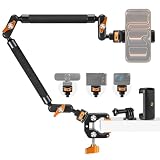
The K&F CONCEPT 22-inch Magic Arm is a flexible super-clamp camera mount for creators who need one arm to move between a desk, shelf, light stand, or round tube. The kit includes both a phone holder and an action-camera adapter, so it starts with a broader set of uses than a camera-only arm.
Three 360-degree ball heads make fine positioning easy, particularly when the clamp cannot sit directly under the intended frame. For a phone shooting food or an action camera recording a small craft area, that flexibility is genuinely useful.
The source lists a 1-kilogram maximum recommendation, a super clamp for flat surfaces up to 50 mm thick, and cylindrical objects from 20 to 60 mm. It has non-slip foam padding, silicone pads, and anti-twist pins, all sensible features for a clamp that will be loaded at an angle.
Still, a magic arm is not a substitute for a two-post platform. The farther a camera is placed from the clamp, the more leverage it creates, so I would reserve the longest reach for lightweight devices.
This arm suits phone, action-camera, and light-accessory work
Use this mount for a phone overhead, a compact action camera, a small LED light, or a microphone positioned beside the flat lay. The rotating clamp blocks make it useful when the only secure anchor is a round leg or shelf tube.
It is also a practical secondary mount beside a larger camera rig. A second angle or an overhead fill light can be positioned without crowding the main camera support.
This arm needs conservative loading at full reach
The 1-kilogram stated limit is the ceiling, not a target for an extended overhead shot. A heavier camera can make the joints harder to hold perfectly still and create more motion after a touch to the desk.
Clamp it directly to a rigid surface and recheck the main tightening knob after composing. This is especially important for stop motion or close product photography, where a small framing shift is obvious.
4. JEBUTU Camera Desk Mount is the simple C-clamp option for small spaces
- Secure C-clamp
- Phone holder with cold shoe
- Aluminum construction
- Compact height adjustment
- Capacity changes by angle
- Clamp has thickness limit
The JEBUTU Camera Desk Mount is a compact desk solution with a C-clamp rather than a weighted base. That is a worthwhile distinction in a cramped workspace, because a clamp keeps the tabletop clear for backgrounds, reflectors, ingredients, or art supplies.
Its two-section stand adjusts from 12 to 22.4 inches, and the 14.5-inch overhead arm carries a 360-degree ball head. The bundle also includes a phone mount with a cold shoe for a small light or microphone, which makes the format useful for short vertical video.
JEBUTU lists a 4.4-pound maximum capacity, but its own details say the phone-mount arm’s usable load varies from 1.1 to 2.2 pounds by angle. I would read that as a reason to keep an overhead phone or compact camera close to the vertical stand.
The C-clamp is made for surfaces 10 to 50 mm thick. A properly tightened clamp is normally steadier than a small round base, yet the desk itself must be stiff enough not to vibrate when you work.
This mount fits phone-first creators at a narrow desk
This is a sensible overhead camera mount for a phone, webcam, light panel, or small camera used at modest reach. The cold shoe is particularly convenient for recipe clips, makeup demonstrations, and live streaming where front fill light matters.
Use the shortest working height that frames the entire subject. A lower position reduces the chance of visible shake and usually makes it easier to manage the phone screen.
This mount has an angle-sensitive load limit
Do not apply the 4.4-pound headline capacity to every overhead arrangement. Load on an extended arm behaves differently than load directly above a vertical pole, and the supplied limit reflects that.
This clamp also cannot fit a desktop thicker than 50 mm. If your table has a deep lip or an apron beneath the edge, measure the clear clamping area rather than its visible thickness.
5. SMALLRIG 22 inch Magic Arm is the phone-focused choice with a wide clamp
- Long reach
- Wide-opening clamp
- Anti-slip details
- Phone holder included
- 250 g recommended capacity
- Heavy phones may slip at full reach
The SMALLRIG 22-inch Magic Arm is designed around a phone, lightweight accessory, or very compact camera rather than a heavy interchangeable-lens setup. It is a good example of why the recommended working load matters more than the most generous figure in a specification list.
SMALLRIG describes a 56 cm arm with double-ball clamps and a 600 g load claim, while the product details list a 250 g maximum weight recommendation. For a safe overhead setup, I would use the lower recommended figure as the planning number.
The crab clamp opens to 63.5 mm and can attach to flat desktops or round tubes. Twelve anti-slip and anti-scratch elements, including silicone pads and rubber rings, help the clamp grip without marking the mounting surface.
The phone holder accepts phones 5.5 to 8.5 cm wide. That range suits many phones, but a large phone in a thick case should be checked carefully before the camera is positioned over the work area.
This arm is best for lightweight phone overhead video
This is a useful choice for overhead reels, stop motion with a phone, video calls, or a compact LED light. Its 22-inch reach can get the camera over a small desk without needing a floor stand.
The independent joint adjustment gives you control over where the clamp sits, which helps if the preferred shooting area is not right next to the desk edge. Keep the final joint as straight and short as the composition allows.
This arm is not the choice for a heavy camera package
The product information specifically warns that heavier phones can slip at extreme arm angles. A heavier camera and lens would increase the same risk, so this should not be the primary support for a DSLR flat lay rig.
If your screen or lens makes the package heavier, move up to a fixed post or crossbar mount. The extra structure is less convenient, but it produces a more dependable top-down frame.
6. NEEWER UA057 is the adaptable 22 inch phone and accessory arm
- Aluminum construction
- Flat and round clamp support
- Anti-twist pins
- Phone holder included
- 500 g maximum
- Not for moving setups
The NEEWER UA057 is another 22-inch articulated arm, but it is a compelling option when you want a supplied phone holder and a clamp that can work on either a desktop or a round support. It lists a 500 g maximum load and three sets of 360-degree dual ball-head adapters.
I see it as a focused phone, webcam, microphone, or compact-light mount. It can create an overhead angle for casual food photography or a drawing demonstration, but its capacity places it below the level needed for a serious camera body and lens.
Its super clamp is rated for flat surfaces up to 2 inches thick and cylindrical supports up to 1.6 inches in diameter. V-grooves, pivot tips, non-slip pads, and anti-twist pins give the clamp useful purchase on different surfaces.
NEEWER notes that it is not recommended for moving or dynamic situations. That makes sense: an articulated arm is strongest when clamped, locked, and left alone rather than repeatedly swung in and out during a shoot.
This arm works well for a light, static overhead composition
Use the UA057 for a phone above a journal, small cutting board, sketchbook, or product tray. It can also hold a microphone or light beside a fixed camera rig, where the lighter device will not demand much from the extended arm.
Set the framing, tighten all three joint groups, then wait briefly to see whether the composition settles. If it drifts after you let go, shorten the reach or lighten the device before recording.
This arm does not replace a full camera stand
A 500 g maximum is restrictive for interchangeable-lens cameras, and motion in the desk can transfer through the arm. Use it for the type of gear it names rather than treating it as a general camera boom.
For hands-on cooking or craft demonstrations, avoid bumping the clamped surface. An independent support table for the mount and a separate work surface can reduce vibration.
7. DImotliyor Overhead Desk Stand is the flexible option for a midweight camera
- Detachable sections
- Multiple screw sizes
- Rotating base
- Padded C-clamp
- Less established review base
- Capacity falls when horizontal
The DImotliyor overhead desk stand steps beyond a typical magic arm with three detachable pole sections. Its design is for people who want more configuration options from a C-clamped mount without committing to a full two-post platform.
The arm has a rotating base, 180-degree adjustment at each rod, and a supplied 360-degree ball head. It also supports 1/4-inch, 3/8-inch, and 5/8-inch screw sizes, which is helpful if your gear includes lights, microphones, or different camera adapters.
The product data gives a 4.5-pound horizontal load capacity and a 6-pound maximum. The horizontal number is the more relevant one for an overhead flat lay, because that is when the arm has the most leverage against the clamp.
The aluminum C-clamp has padding and fits desks up to 2.4 inches thick. Its portability and detachable construction are positives, but every extra section is another joint to lock and inspect before a camera goes over the subject.
This mount suits adjustable midweight camera configurations
This stand is a reasonable match for a lighter camera system, webcam, phone, or LED panel when you need to customize reach. The multi-size thread support can simplify a work area that changes between photo, video, and streaming sessions.
I would assemble only the pole sections needed for the shot. Removing unused length makes the system less likely to flex and leaves more room around the flat lay.
This mount needs attention to horizontal loading
The 4.5-pound horizontal rating is the meaningful limit for a lens pointing straight down. Do not use the 6-pound maximum as permission to hang that much gear on a fully extended side arm.
Confirm the C-clamp is attached to a solid portion of the desktop, not a flimsy extension or hollow edge. A padded clamp protects the desk, but padding cannot make a weak surface rigid.
8. JUSMO LS15 Pro is the high-capacity option for a multi-device studio desk
- Highest stated capacity
- Expandable system
- Anti-deflection locks
- Large desk clamps
- Large multi-part setup
- Three-month warranty
The JUSMO LS15 Pro is the high-capacity choice in this group for a creator who needs a more complete desk-mounted system. Its stated capacity is 22 pounds, and it uses multiple universal pole sections, two C-clamps with tubes, aluminum fixed bases, and a super clamp.
That structure is intended for larger cameras, multiple accessories, stop motion work, painting demonstrations, and streaming setups. It is far more involved than a single clamp arm, but the extra parts give it a better foundation for heavier, more complex rigs.
The poles have corrugated anti-slip surfaces and secondary anti-deflection locking screws. Laser-engraved tick marks can make it easier to return a camera to a familiar position, which is useful when a series needs the same top-down framing each session.
The enlarged C-clamps fit desks up to 90 mm thick, and the system can be expanded with compatible poles or a super clamp. Its three-month stated warranty is short, so inspect the hardware on arrival and keep the tools with the rig.
This system is best for heavier cameras and multi-device work
Choose the LS15 Pro when the flat-lay station includes a heavier camera, larger lens, lights, a microphone, or several devices. Its segmented format is also attractive when the same desk supports overhead crafts, animation, and talking-head accessories.
Build the rig symmetrically and use the shortest pole arrangement that gives the desired frame. A high stated capacity does not remove the need to manage torque from an off-center camera.
This system is a poor match for occasional phone clips
For a quick phone video, this is more hardware than most desks need. Assembly time, storage space, and the multi-part layout are better justified by regular studio work than by an occasional overhead post.
Do a no-camera assembly first, checking that the desk can accept the clamp spacing and that nothing interferes with drawers or cable paths. Then add gear one piece at a time and retighten the locking screws.
A stable overhead mount starts with the right support type
A two-post crossbar rig is the strongest choice for a regular camera-based flat lay workstation because the lens can sit between supports. The NEEWER ST100 follows this pattern, while a segmented dual-clamp system such as the JUSMO is better for a configurable multi-device desk.
A fixed desk pole works for a modest camera or phone when the arm stays short. Magic arms are the portable choice for phones, action cameras, small lights, and microphones, but their long unsupported reach makes them more sensitive to load and desk vibration.
A C-stand can also form an overhead rig, especially in a studio, but it needs careful counterbalancing and a secure footprint. If that is your direction, compare the hardware in our guide to the best C stands for photography studios before placing a camera over a set.
A safe setup checks capacity, leverage, and the desk before the camera goes up
Start with the mount’s stated capacity, then use the overhead or horizontal rating where one is supplied. Include the camera body, lens, quick-release plate, adapter, phone case, and any accessory that hangs from the same support.
Next, keep the camera as close to the vertical support as the composition permits. A mount can carry a certain weight when the load is centered but become much less stable when the same weight is placed at the end of a long arm.
Then assess the desk. Clamp a mount to a rigid, non-wobbly section, avoid a loose pullout surface, and make sure the clamp’s stated thickness range matches the clear edge below the tabletop.
Finally, use a secondary camera safety tether attached to a secure point whenever a camera is above people, props, or valuable work. Forum users repeatedly flag tethering, counterweights, and sandbags as basic precautions, not optional extras for an overhead rig.
A flat-lay overhead rig can be set up in five deliberate steps
Choose a rigid desk or support surface and measure its usable clamping edge, width, and clearance below the top.
Mount the stand with no camera attached, tighten every clamp, and test the support for movement by applying light pressure.
Attach the camera or phone at the shortest practical reach, lock the ball head, and frame the area with live view or a remote-monitoring method.
Add lights and accessories one at a time, keeping heavier items centered or on independent stands rather than on the same extended arm.
Fit a safety tether for a camera, make a short recording, and inspect it for shake or frame drift before arranging the final scene.
This sequence answers how to set up an overhead camera rig for flat lays without assuming that one mount style suits every camera. It also keeps the camera position repeatable, which is often the reason to use a purpose-built top-down camera mount in the first place.
A phone mount and a camera mount need different margins
Phone setups are usually light enough for the K&F CONCEPT, SMALLRIG, or NEEWER magic arms, provided the clamp is secure and the device stays within the listed recommendation. A phone holder should grip the phone without squeezing buttons, and a heavy case can change the balance more than expected.
A mirrorless or DSLR kit needs more margin. I favor the NEEWER ST100 for a dedicated camera desk and the JUSMO LS15 Pro when heavier gear or extra devices are part of the job, because both supply a more substantial support structure.
Remote framing is also worth planning. A flip screen may be hard to see when the camera is high above the table, so use the camera’s supported remote viewing method or position a monitor where it does not pull on the rig.
A DIY rig can work only when it follows the same stability rules
A horizontal center-column tripod can work for small objects, and forum contributors also describe using a strong crossbar between two light stands with super clamps. Those approaches can be useful for occasional work, but they need the same attention to rated hardware, counterweighting, and a safety tether as a purpose-built mount.
Do not improvise an overhead camera mount from a weak shelf, lightweight boom, or unweighted stand. If a DIY route needs lighting support, choose appropriate equipment from our guide to light stands for photographers and keep the camera support separate whenever possible.
A stable result comes from reducing flex, not from adding more loose adapters. For product photography, lens choice affects working height and composition too; our guide to the best lenses for Fujifilm cameras is a useful companion if that is your camera system.
These answers cover common overhead camera mount questions
What is the best overhead camera mount for flat lay photography?
The NEEWER ST100 is the strongest all-around choice in this guide for camera-based flat lays because its two supported columns, steel crossbar, and stated 10-pound capacity provide a stable dedicated workstation. A compact SMALLRIG desk mount is a better fit for lighter gear and smaller desks.
How do I set up an overhead camera rig for flat lays?
Clamp or position the mount on a rigid surface, keep the camera close to the main support, lock every joint, and frame the scene through live view. Add a safety tether for a camera, then record a short test clip to check for shake or drifting before the final shoot.
What tripod is best for overhead flat lay shots?
A heavy tripod with a horizontal center column can work for small, occasional flat lays, but a purpose-built crossbar or desk-mounted rig is generally more repeatable for regular work. Choose a support that keeps the camera centered and within its stated load limit.
How much does a good overhead camera mount cost?
The right choice depends on the camera weight, desk size, required reach, and whether you need to support extra lights or microphones. Instead of choosing by cost alone, compare the stated capacity, clamp fit, support geometry, and the accessories included with the mount.
What are the most stable overhead camera mounts?
Two-post crossbar rigs such as the NEEWER ST100 are typically the most stable format here because the camera sits between supports. For heavier multi-device work, a high-capacity segmented pole system such as the JUSMO LS15 Pro provides more mounting structure than a single articulated arm.
The right flat-lay mount matches your camera weight and your working surface
For a dedicated camera station, I would start with the NEEWER ST100; for a small desk with modest gear, the SMALLRIG Camera Desk Mount offers a compact alternative. The JUSMO LS15 Pro is the choice when capacity and expansion matter more than portability.
The best overhead camera mounts for flat lays in 2026 are not interchangeable. Measure the desk, total the actual gear weight, keep arms short, and treat a safety tether as part of the setup before you start composing.