
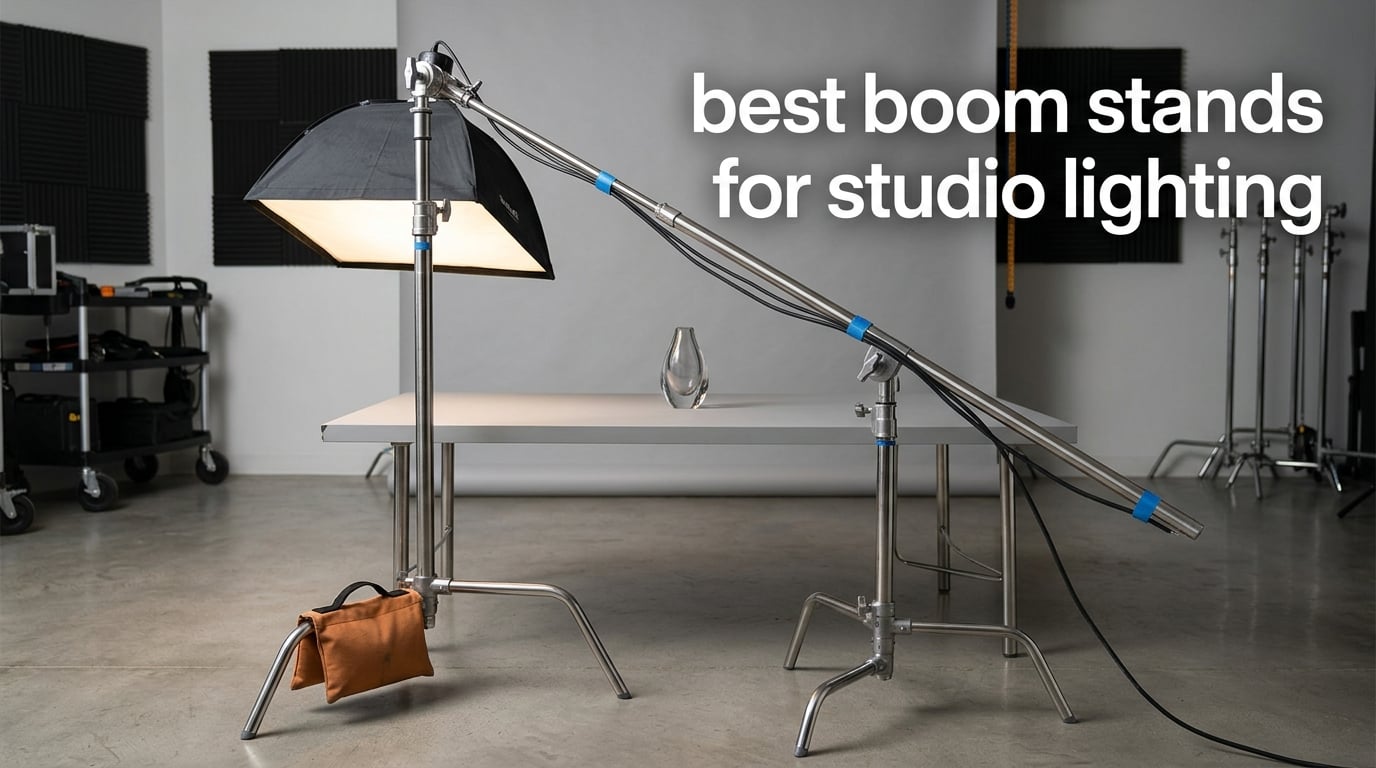
The best boom stands for studio lighting put a light where a normal upright stand cannot: above a product table, just behind a portrait subject, or far enough forward for a clean overhead pool of light. The decision is less about a long arm alone and more about the whole support system: rated load, base, reach, mounting hardware, counterweight, and the room around it.
I approached these 12 options as equipment choices rather than interchangeable sticks of metal. A small LED panel, an umbrella, a softbox, and a monolight create very different leverage at the end of a boom, so the safe pick is the one with capacity and base stability left over after your fixture is mounted.
A boom stand is a lighting support with an offset arm that places a fixture horizontally away from its vertical support. A C-stand is a heavy-duty stand and grip system; paired with a grip head and holding arm, it becomes one of the most secure ways to build an overhead lighting stand.
Before choosing an arm, measure ceiling height, the intended light position, the fixture weight with modifier, and the clear floor area for legs. Readers building a complete support kit can also compare our light stands for photographers and our guide to professional C-stands for photography studios.
Every recommendation below comes from the supplied product specifications and review data. I have not treated a stated center-column capacity as an automatic boom capacity, because the horizontal arm is the part creating the tipping force.
Table of Contents
Top 3 picks are the NEEWER Basics C Stand, SmallRig RA-S280A, and LINCO 4255K.
The NEEWER Basics SC320 Lite is the all-around pick when a full stainless C-stand, 10.5 foot maximum height, and a stated 17.6 pound boom-arm rating match the job. SmallRig’s RA-S280A makes more sense when carrying weight and air cushioning matter, while the compact LINCO 4255K is an add-on arm for light fixtures on an existing tripod-style stand.
These labels are use-case choices, not permission to skip ballast. Check the load limit of the arm itself, use a sandbag or counterweight as the maker directs, and keep people out from beneath an unsupported overhead fixture.


The best boom stands for studio lighting in 2026 cover full C-stands, convertible stands, and add-on arms.
The overview separates complete support systems from arms that require your own stand or grip head. That distinction prevents a common mismatch: an excellent extension arm is not a safe complete overhead setup unless the stand below it is rated, stable, and correctly ballasted.
| Product | Specifications | Action |
|---|---|---|
| NEEWER Basics SC320 Lite |
|
Check Latest Price |
 LOMTAP LPUS026 C Stand LOMTAP LPUS026 C Stand |
|
Check Latest Price |
 SmallRig RA-S280A SmallRig RA-S280A |
|
Check Latest Price |
 soonpho C Stand soonpho C Stand |
|
Check Latest Price |
 K&F CONCEPT C Stand K&F CONCEPT C Stand |
|
Check Latest Price |
 NEEWER 2-in-1 Stand NEEWER 2-in-1 Stand |
|
Check Latest Price |
 soonpho Extension Arm soonpho Extension Arm |
|
Check Latest Price |
 FreeSea Extension Arm FreeSea Extension Arm |
|
Check Latest Price |
| LINCO 4255K |
|
Check Latest Price |
 NEEWER Tripod Boom Arm NEEWER Tripod Boom Arm |
|
Check Latest Price |
 LINCO Zenith AM224 LINCO Zenith AM224 |
|
Check Latest Price |
 Amaran Light Stand Amaran Light Stand |
|
Check Latest Price |
1. NEEWER Basics SC320 Lite is the strongest all-purpose complete C-stand choice.
- Stainless steel build
- 17.6 pound boom rating
- 10.5 foot height
- Foldable turtle base
- Two grip heads
- Weighs 7.64 kg
- No air cushioning
The SC320 Lite combines a stainless-steel C-stand, extension arm, turtle base, and two grip heads in one package. Its published boom-arm capacity is 17.6 pounds, while the center column is listed at 44 pounds; for an offset fixture, I would plan around the lower boom figure.
The 4.7 to 10.5 foot center-column range gives this stand useful vertical room for a hair light or a high overhead modifier. Its holding arm reaches 4.2 feet and tilts, so it can move a light into frame position while keeping the riser outside the shot.
The spring-loaded structure is meant to protect mounted equipment from shock, but it is not air cushioning. Hold the riser while loosening it, especially with a fixture attached; forum users specifically warn that spring-supported budget stands can move abruptly when not controlled.
The right workload is a medium-to-heavy studio light on a short, balanced boom.
This is the pick I would start with for a monolight, softbox, reflector, or product-photography fixture when the complete stand must live in the studio. Stainless construction, rubber-padded feet, and a foldable turtle base favor repeated placement over a delicate travel setup.
The 1/4 inch and 3/8 inch mounting screws make it easier to connect common grip and photo hardware. Still, take the quoted boom rating as a ceiling rather than a target, particularly when a large softbox catches air or when the arm is extended.
The tradeoff is transport weight and hands-on riser control.
At 7.64 kilograms, the SC320 Lite is not the easy carry choice in this group. The weight is useful once planted on a studio floor, but it makes a rolling case or a short carry from vehicle to set more realistic than a casual walk-in setup.
No air-cushion mechanism is listed. Keep one hand on the upper section before releasing a lock, load the fixture only after the base is placed, and add counterweight before moving the boom out from the center column.
2. LOMTAP LPUS026 is a full kit for photographers who need included accessories.
- Sandbag included
- Carrying bag included
- Two grip heads
- 120 degree base
- 10.8 foot height
- 6.6 pound limit
- Weighs 8.55 kg
The LOMTAP LPUS026 arrives as a more complete working kit than many C-stand listings: a water sandbag, carrying bag, two grip heads, and three clips are included. The steel and aluminum construction reaches 10.8 feet, with a 4.2 foot boom arm and a base that opens to 120 degrees.
The published 6.6 pound weight limit puts it in a different task class from the NEEWER Basics stainless C-stand. I would reserve it for modest lights, reflectors, small softboxes, and controlled studio configurations rather than assuming its tall silhouette suits a large modifier.
Its 1/4 inch to 3/8 inch screw tip covers common photo accessories. The detachable foldable base and supplied carrying bag are practical when a complete studio light stand with boom needs to travel as a single kit.
The best use is a ready-to-pack portrait or small product-lighting kit.
The included sandbag eliminates one missing-item surprise, although the bag still needs filling before it does any balancing work. I like the clearly defined package for someone who needs clips for fabric modifiers and does not already own grip heads.
The base design matters in tight rooms because one leg can be directed under the boom load. Give that leg the priority position, lock the riser, and run the arm over the strongest portion of the footprint instead of into open, unsupported space.
The limit is a stated 6.6 pound load, not its 10.8 foot height.
Height and capacity are separate figures. A tall stand with a light boom should be loaded more conservatively near maximum height or maximum reach, since either adjustment increases the consequences of a small shift.
At 8.55 kilograms, this is also a substantial carry. The foldable base helps storage, but it does not turn the kit into a lightweight location stand.
3. SmallRig RA-S280A is the portable complete stand with air-cushioned adjustment.
- Air cushioning
- 94 cm folded length
- 180 degree arm pivot
- Two year warranty
- 11 pound load
- Aluminum build
- Lower capacity than steel C-stands
SmallRig’s RA-S280A is an aluminum boom stand rated for 11 pounds, with a 94 centimeter folded length and a 9.2 foot maximum height. The arm pivots to 180 degrees, and separate tilt, pan, and arm knobs make it easier to set a position without disturbing every adjustment.
Air cushioning is its defining practical feature. When I compare portable boom stand photography options, controlled lowering has real value because it reduces the chance of a riser section dropping toward a mounted light while the stand is being adjusted.
The included stainless-steel 1/4 inch thread adapter and stated two-year manufacturer warranty add useful detail for a mobile kit. Its 6.61 pound item weight is much easier to move than the full stainless C-stands listed here.
The right setting is location work with a modest softbox or LED fixture.
A 94 centimeter folded length makes this a credible choice when the stand must enter a car, closet, or modest home studio. Its air-cushioned riser helps repeated height adjustments for talking-head, portrait, flash, and ring-light work.
For the safest result, keep the arm short whenever the fixture is bulky. An 11 pound stated limit does not account for the wind force of a modifier or the extra torque created by fully extending the boom.
The compromise is aluminum rather than a heavy stainless C-stand base.
Aluminum helps portability but does not offer the same mass as the larger stainless options. Use a properly filled sandbag, keep legs fully opened, and avoid treating a compact tripod-style stand as though it were a heavy grip stand.
The product data does not list a sandbag, so plan one as part of the setup rather than an optional extra. That preparation is more important than a small difference in stated reach.
4. soonpho C Stand is the complete stainless kit with a 360-degree arm.
- Stainless construction
- 360 degree arm
- 17.6 pound boom rating
- Sandbag included
- Carry bag included
- Weighs 7.98 kg
- Less established brand
The soonpho C Stand has a 10.8 foot maximum height, a 360-degree rotating boom arm, and a stated 17.6 pound arm limit alongside a 20 kilogram center-column figure. It also includes a sandbag, carrying bag, two grip heads, and three clips.
Its 100% stainless-steel construction, C-shaped three-leg design, and non-slip rubber pads suit a permanent or semi-permanent studio position. The built-in buffer spring is intended to protect equipment while changing height.
The included hardware is helpful for a photographer setting up a softbox or reflector immediately, but balance still starts with the fixture and arm length. The sandbag has to be filled and positioned on the counterweight side before the boom is moved over a subject or table.
The advantage is flexible light placement from a full C-stand package.
The 360-degree arm rotation gives more placement options around a set than a fixed straight arm. That is useful for placing a rim light behind a portrait subject, moving a reflector above a product table, or shifting a softbox without dragging the entire base.
At 4.92 to 10.8 feet, the riser has enough range for both lower fill work and higher overhead arrangements. Keep the lowest practical height for the shot; it reduces leverage and makes adjustment easier.
The consideration is its nearly 8 kilogram carry weight.
The 7.98 kilogram item weight supports the heavy-duty positioning of the stand but makes it an equipment-case item. If you change locations daily, compare that burden with the 6.61 pound SmallRig instead of selecting purely for capacity.
Community discussions praise soonpho for value, yet brand familiarity is lower than with NEEWER or SmallRig. Inspect locks, threads, grip heads, and the loaded balance before every overhead use, whatever brand is on the stand.
5. K&F CONCEPT C Stand is the 20 kilogram-rated stainless option with adaptable crossbar hardware.
- 20 kg stated capacity
- Stainless steel
- Cushion spring
- Adjustable crossbar
- Sandbag included
- 110 reviews
- No warranty detail
K&F CONCEPT lists this stainless-steel C-stand at 149 to 330 centimeters tall with a stated load capacity up to 20 kilograms. A built-in cushion spring, two grip heads, a sandbag, and a crossbar with two adapters make it a flexible grip-oriented option.
The crossbar and adapter arrangement is the point of difference here. It gives a user ways to adjust both angle and length, while the 1/4 inch and 3/8 inch threaded ends cover ordinary studio accessories.
Its foldable C-shaped base with non-slip pads supports storage and floor protection. The product data gives a 17.42 pound item weight, so this is still a serious stand rather than a light travel accessory.
The capability is a versatile arm configuration for studio modifiers.
If your work changes between a reflector, monolight, and softbox, the adaptable crossbar is useful. I would fit the hardware dry first, then attach the fixture, then add ballast, so there is no need to reconfigure a loaded arm overhead.
The 20 kilogram number is reported as a general capacity, not a separate boom-arm capacity. Treat an extended horizontal setup more cautiously than a centered vertical mount, particularly with a broad modifier.
The unknown is long-term warranty detail and a smaller review sample.
The supplied data lists 110 reviews and does not specify warranty coverage. That does not disqualify the stand, but it means the well-documented parts of the decision are the materials, height range, included components, and stated capacity.
Check that the leg nearest the load is fully deployed and that the grip head is clamped firmly before use. The right adjustment sequence protects both the equipment and the person standing nearby.
6. NEEWER 2-in-1 Stand is the compact convertible choice for moderate fixtures.
- Convertible 2-in-1 design
- 3.8 foot arm
- 180 degree rotation
- Spring cushion
- Dual threads
- Empty sandbag
- Needs ballast for heavy accessories
The NEEWER 2-in-1 converts from a regular stand to a boom setup with screw knobs. It extends from 3.6 to 9.7 feet, while its boom arm reaches from 0.8 to 3.8 feet and rotates through 180 degrees.
At 3.2 kilograms, its black-anodized aluminum build is far more manageable than a stainless C-stand. The built-in spring cushion and 1/4 inch plus 3/8 inch spigot add practical compatibility for a video light, strobe, reflector, softbox, or similar fixture.
The product data says the sandbag arrives empty. That is normal for this category, but it is a safety action item: bring suitable fill before the stand becomes a boom, not after the light is already extended.
The practical role is a flexible stand for a small studio or home setup.
The convertible design saves storage space because one stand can handle ordinary upright lighting and occasional overhead positioning. This is the type of boom arm for studio lighting I would choose when a compact LED, flash, or small modifier needs controlled repositioning rather than a permanent heavy rig.
Use the mid-level spreader, open the legs completely, and point a leg toward the load. The 180-degree rotation helps with angle, but greater reach always asks more from the same base.
The boundary is heavy accessories and unfilled ballast.
The data specifically notes a need for counterweight with heavy accessories. Do not extend a large softbox to the end of the 3.8 foot arm simply because the arm can physically reach that far.
Spring cushioning protects gear from a sudden drop, but it does not replace a hand on the riser during adjustment. That distinction responds directly to the forum concern about spring mechanisms moving unexpectedly.
7. soonpho Extension Boom Arm is the long-reach add-on for an existing C-stand.
- 8.2 foot maximum reach
- Stainless steel
- 90 degree rotation
- Non-slip handle
- Sandbag included
- Stand not included
- Grip head not included
This soonpho item is an extension boom arm, not a complete boom stand. Its all-stainless construction adjusts from 3.6 to 8.2 feet, rotates 90 degrees, and includes a sandbag; the light stand and grip head are not included.
The long 250 centimeter maximum reach is its attraction for product tables or a wide overhead arrangement. The non-slip handle and universal photographic interface are useful touches, but reach is only useful when the base below it is designed to resist the resulting leverage.
At 7.73 pounds, the arm itself has real mass. Add the fixture, modifier, counterweight, and attachment hardware before deciding whether your existing stand is an appropriate partner.
The use case is maximum reach from a proven heavy-duty support.
This arm fits a photographer who already owns a compatible C-stand and grip head and wants more horizontal distance. It can cover a larger product set or place a light forward of the support, where a compact integrated boom would run out of length.
Work progressively: begin with the arm short, balance the counterweight, test lock security, and extend only as far as the composition requires. A long stainless arm should never be swung across a person or left unsupported during adjustment.
The requirement is separately sourced support hardware.
The listing does not include the stand or grip head, so it is not a one-box solution. A low-cost or lightweight tripod stand does not become heavy duty merely because a stainless boom arm is attached to it.
Choose a C-stand or base whose maker permits the intended load and configuration. This is also where our comparison of professional C-stands for photography studios is useful before you commit to an extra-long arm.
8. FreeSea Extension Arm is the compact, low-load arm for lightweight overhead work.
- Compact 3.2 pound weight
- Tool-free knobs
- 90 degree tilt
- 360 degree base
- Sandbag hook
- 4.4 pound limit
- Counterweight is mandatory
The FreeSea extension arm extends from 27.6 to 80.7 inches and has a stated 4.4 pound load capacity at full extension. It uses thickened aluminum tubing, CNC-forged joints, a 90-degree tilt bracket, and a 360-degree rotating base.
It weighs 3.2 pounds and folds compactly, which is attractive for content creation and location work. Three 1/4 inch screw holes offer attachment points for accessories, and the detachable 3/8 inch hook is designed for sandbags.
The item description calls for a counterweight protocol. That is the correct framing: with an arm this long and a full-extension limit of 4.4 pounds, ballast is part of normal use rather than an upgrade.
The best fit is a light LED, microphone-sized accessory, or compact modifier.
This is a strong match for a lightweight camera accessory or LED where portability and tool-free adjustment matter. The 90-degree tilt and 360-degree base permit overhead or angled positioning without requiring a massive piece of grip gear.
Its extendable tail is intended to reduce counterweight demand, but it does not remove the need to balance the setup. Keep the fixture well within the published maximum and make the actual balance check before letting go.
The constraint is its 4.4 pound maximum load at full extension.
Do not confuse its 80.7 inch reach with suitability for a large softbox, heavy flash, or monolight. A lightweight arm is the right design only when the light and modifier are lightweight too.
Use the tool-free knobs as a convenience, not a reason to rush. Verify each locking point after moving the arm, particularly after rotating or tilting it into an overhead position.
9. LINCO 4255K is the simple tripod-clamp arm for light fixtures in small spaces.
- Very lightweight
- Tripod clamp
- Counterweight bag
- 2.5 to 5 foot reach
- Built-in clamp
- Lower capacity
- Basic design
The LINCO Lincostore 4255K is a 1.45 pound overhead boom arm that adjusts from 2.5 to 5 feet. It includes a universal tripod clamp, metal photo-equipment stud, built-in boom clamp, and a durable counterweight bag.
This is deliberately a basic, lightweight design rather than a C-stand replacement. The short-to-medium reach can be just what a cramped desk, small product table, or home content corner needs when the light is light and the supporting stand is stable.
I appreciate that its clamp is built in, since fewer loose parts makes setup less confusing. The same simplicity means you need to judge the complete system yourself: tripod stand, clamp engagement, fixture size, and filled counterweight.
The sweet spot is a compact fixture above a small tabletop setup.
A five foot maximum arm is enough to move a small light away from the vertical stand for overhead product photography or a modest hair light. The lightweight 1.45 pound arm will not add much burden to storage or transport.
Keep the arm as short as possible until the light position is confirmed. Filling the included bag with suitable ballast and placing a tripod leg under the load direction matters more than achieving the final inch of reach.
The limitation is its basic, lower-capacity construction.
No heavy-duty load figure is supplied, and the product data explicitly describes lower weight capacity versus higher-end models. Use it for small equipment, not as an economical shortcut for a large softbox or a heavy overhead studio light.
Check the tripod clamp for a firm fit on your particular stand diameter before mounting gear. An arm is only as trustworthy as the connection between its clamp and the stand.
10. NEEWER Tripod Boom Arm is the accessory arm with included counterweight hardware.
- 5 kg stated load
- Counterweight included
- 180 degree swivel
- Separate locks
- Foam handle
- Stand not included
- Empty sandbag
NEEWER’s tripod boom arm expands from 35 to 61 inches in two sections and carries a stated maximum load of 5 kilograms. It has 180-degree swivel adjustment, separate tilt, pan, and arm lock knobs, and an aluminum-alloy boom with a stainless 1/4 inch threaded screw.
It includes a 1.5 kilogram counterweight and a sandbag, which is unusually helpful for an add-on arm. The sandbag is empty, and the light stand is not included, so the package starts the balancing process but cannot complete it without a suitable stand and fill.
The long locking knob and foam handle are sensible for controlled repositioning. Separate controls are especially useful because they allow a small angle adjustment without loosening every part of the assembly.
The sensible pairing is an existing compatible stand and medium-weight light.
The stated 5 kilogram maximum makes it more capable than ultra-light accessory arms, provided the stand below is equally capable. It can suit an umbrella, flash, reflector, ring light, softbox, or studio light within the maker’s load guidance.
The included counterweight is one part of a balanced system. Match its position and any added sandbag fill to the fixture and arm length; a long arm with a short counterweight tail requires more attention than a short, centered setup.
The missing component is the stand, not an optional detail.
Because a stand is not included, this is not a complete overhead lighting stand. Confirm that your stand accepts the boom hardware and has a stable, wide-enough base before relying on the 5 kilogram arm rating.
Do not fill the sandbag beyond what your stand and boom system can manage. Balance is about opposing torque and base stability, not just adding as much weight as possible.
11. LINCO Zenith AM224 is the extra-long option for fixtures under 2 pounds.
LINCO Lincostore Zenith Photography Boom Arm 83″ / 210cm with Sandbag, AM224 (Not Including Stand)
- 83 inch reach
- Compact 32 inch storage
- 360 degree clamp
- Counterweight bag
- One year warranty
- Stand not included
- Under 2 pound light limit
- Nylon durability concerns
The LINCO Zenith AM224 is a three-section arm that extends to over 83 inches while storing at 32 inches. It has a 360-degree pivot clamp, cylindrical counterweight bag with metal hook, and a zinc stud with a 1/4 inch mounting tip.
Its use boundary is explicit: it is suitable for lighting equipment under 2 pounds. That makes this an extra-reach arm for a very light fixture, not a general-purpose solution for a softbox-equipped studio flash.
The kit works with 5/8 inch or smaller mount light stands, but the stand itself is not included. Its 2.5 pound item weight and compact stored size are attractive if the fixture falls within the stated limit.
The advantage is long reach for a very light compact light.
A light panel or small fixture can be moved a long way from the riser without carrying the weight of a large C-stand. The 360-degree pivot clamp permits useful angle changes for a lightweight hair light or narrow tabletop overhead shot.
The counterweight bag is included, and it should be filled before the fixture is extended. Even a sub-2-pound light gains leverage quickly at an 83 inch arm length.
The restriction is the under-2-pound equipment recommendation.
This limit should determine the purchase. If your light plus mount and modifier exceed 2 pounds, select an arm with a stated capacity that covers the full mounted assembly rather than hoping the nylon-based design will tolerate more.
Some review feedback raises durability concerns with the nylon material. Inspect the clamp and arm sections before each use, and never leave a light suspended overhead unattended.
12. Amaran Light Stand is the 9.2-foot integrated boom with a 5 kilogram rating.
- 5 kg load
- 180 degree rotation
- Sandbag included
- Reversible adapter
- Foldable design
- Assembly required
- Empty sandbag
- Small review sample
The Amaran integrated stand reaches 9.2 feet or 2.8 meters, uses aluminum alloy and iron construction, and lists a 5 kilogram or 11 pound maximum load. Its boom rotates 180 degrees and uses a double-ended reversible 1/4 inch to 3/8 inch screw adapter.
Flip on/off locks and a 117 centimeter folded length make it a practical studio light stand with boom for someone who wants one package rather than separate grip hardware. A sandbag is included, though it arrives empty and assembly is required.
The supplied review count is only 19 with a 4.1 rating, so I would put more weight on the documented specifications and your setup requirements than on a small review sample. The stated capacity is still useful as a clear starting boundary.
The fit is a portable integrated stand for a controlled 5 kilogram setup.
The 180-degree free rotation and reversible screw simplify switching among compatible lights, flashes, umbrellas, ring lights, and softboxes. Its foldable format makes sense where the stand is packed away between shoots.
For a 5 kilogram maximum, count the fixture, mount, modifier, and any accessory on the boom together. The safest use is below the published maximum, with the boom shortened whenever the frame allows.
The consideration is assembly and limited buyer feedback.
Build the stand and inspect each lock before putting it into service. Assembly is not a defect, but it means the first setup should happen without a valuable fixture overhead so you can learn the locking sequence.
Bring fill for the sandbag and follow the same balance rule as every other boom: base leg toward load, weight opposite the fixture, locks checked, and no one beneath an unsupported light.
The buying guide starts with the complete loaded weight, not the light alone.
Add the fixture, battery or power supply if it rides on the arm, adapter, mount, umbrella, softbox, grid, and cable support. Compare that total with the manufacturer’s stated boom rating, not merely with a center-column figure or a vertical stand rating.
Leave headroom rather than operating at the published maximum. A large modifier can act like a sail, a boom loses stiffness as it extends, and a cable tug can change the force on the far end of the arm.
The safest counterweight setup balances torque before the boom goes overhead.
Put the stand on level ground with its legs fully deployed and one leg aimed in the direction of the light. Mount the boom short, attach the fixture, add counterweight on the opposite side, and test the balance while keeping a hand on the system.
Then extend the arm only as much as needed, rechecking balance after every change. A counterweight must oppose the fixture’s leverage; an arbitrary heavy bag dropped on a stand does not automatically correct a long-arm imbalance.
Keep cables loose enough that they do not pull the light sideways, but secure enough that they cannot snag. Never leave an overhead fixture unattended, and keep people out from under the boom while you adjust it.
The correct ceiling measurement includes the stand, arm angle, and modifier depth.
Measure from floor to ceiling, then subtract the height of the light, mount, and modifier beneath the boom. A stand advertised at 10.8 feet may not work in a room with a low ceiling when the riser, grip head, arm, and softbox all need vertical clearance.
For a small home studio, a 9.2 to 9.7 foot integrated stand may be easier to manage than a 10.8 foot C-stand, provided your fixture is within the lower rated capacity. Low ceilings also favor using the boom at a shallower, shorter configuration rather than forcing a vertical riser to its limit.
Test the planned placement with an unloaded arm first. This confirms that the boom clears ceiling fans, doorways, backdrops, and shelves before expensive lighting equipment is added.
A boom stand differs from a C-stand because one describes placement and the other describes support hardware.
A boom stand uses an offset arm to position a light away from the vertical support. A C-stand is a heavy-duty grip stand with a distinctive three-leg base; it can hold a boom arm through a grip head, but it can also support flags, reflectors, and other grip equipment without an arm.
Choose a complete C-stand system for heavier fixtures, extended reach, and repeatable studio placement. Choose a tripod-style boom stand for portability and lighter fixtures, while respecting its lower load capacity and greater need for careful counterweighting.
That is why a standalone arm and a complete C-stand should not be treated as equal purchases. The arm controls reach; the stand, base, and grip head determine whether that reach is safely supported.
The most useful materials trade weight for portability.
Stainless-steel C-stands such as the NEEWER Basics, soonpho, and K&F CONCEPT models bring mass, corrosion resistance, and a studio-oriented feel. They are better suited to heavier equipment but can weigh around 7.64 to 8.55 kilograms as complete products.
Aluminum options such as the SmallRig, NEEWER 2-in-1, FreeSea, and Amaran are easier to transport. Their mobility is valuable, but it makes ballast, short boom extension, and conservative loading even more important.
Grip heads and threaded adapters deserve the same scrutiny as the arm material. Confirm 1/4 inch, 3/8 inch, or 5/8 inch compatibility for your fixture and stand before buying; an adapter mismatch can make an otherwise good setup unusable.
The right boom length is the shortest length that places the light outside the frame.
A 2.5 to 5 foot arm can handle a compact tabletop setup, while a 3.8 to 4.2 foot integrated arm works for many portrait and small-studio angles. Arms reaching 8.2 feet or 83 inches are specialized tools that ask much more of their base and ballast.
For product photography, start with the light just beyond the edge of the table and adjust angle before increasing distance. For portraits, a short boom positioned as a hair light or overhead key can deliver separation without putting the base directly behind the subject.
If you need a normal vertical support rather than offset lighting, a conventional stand may be simpler. Our guide to light stands for photographers helps with that separate decision.
FAQs
What is the difference between a boom stand and a C stand?
A boom stand uses an offset arm to place a light horizontally away from its vertical support. A C-stand is a heavy-duty grip stand that can hold a boom arm through a grip head, but it can also support other gear without an arm.
How much weight can a boom arm support?
Support varies by model and by arm extension. In this guide, stated boom or arm limits range from under 2 pounds for the LINCO Zenith AM224 to 17.6 pounds for the NEEWER Basics and soonpho complete C-stands; always include the fixture, mount, and modifier in the total load.
How do I set up a boom stand safely?
Open the base fully on level ground, point a leg toward the load, mount the fixture with the arm short, add counterweight opposite the fixture, confirm all locks, then extend gradually. Keep people clear of the overhead area and never leave a suspended light unattended.
What size boom arm do I need for studio photography?
Choose the shortest arm that places the light outside the frame. A 2.5 to 5 foot arm often suits small tabletop setups, while a 3.8 to 4.2 foot arm covers many portrait positions; extra-long arms need a substantially more capable support system.
Are lights on tripods any good?
Tripod-style light stands work well with light fixtures, short booms, and correct ballast. They are less suitable than heavy C-stand systems for long reach, large modifiers, or heavy overhead fixtures because the base has less mass and usually a lower rated capacity.
Conclusion
For a complete heavy-duty system, the NEEWER Basics SC320 Lite has the clearest combination of stainless-steel construction, 10.5 foot height, and a stated 17.6 pound boom rating. SmallRig RA-S280A is the more portable air-cushioned alternative, while a compact LINCO or FreeSea arm belongs with genuinely lightweight fixtures and a compatible stand.
The best boom stands for studio lighting in 2026 are not the longest arms by default. Select conservatively, measure the room, build the counterweight setup before extending the light, and choose a support system you can use safely on every shoot.