
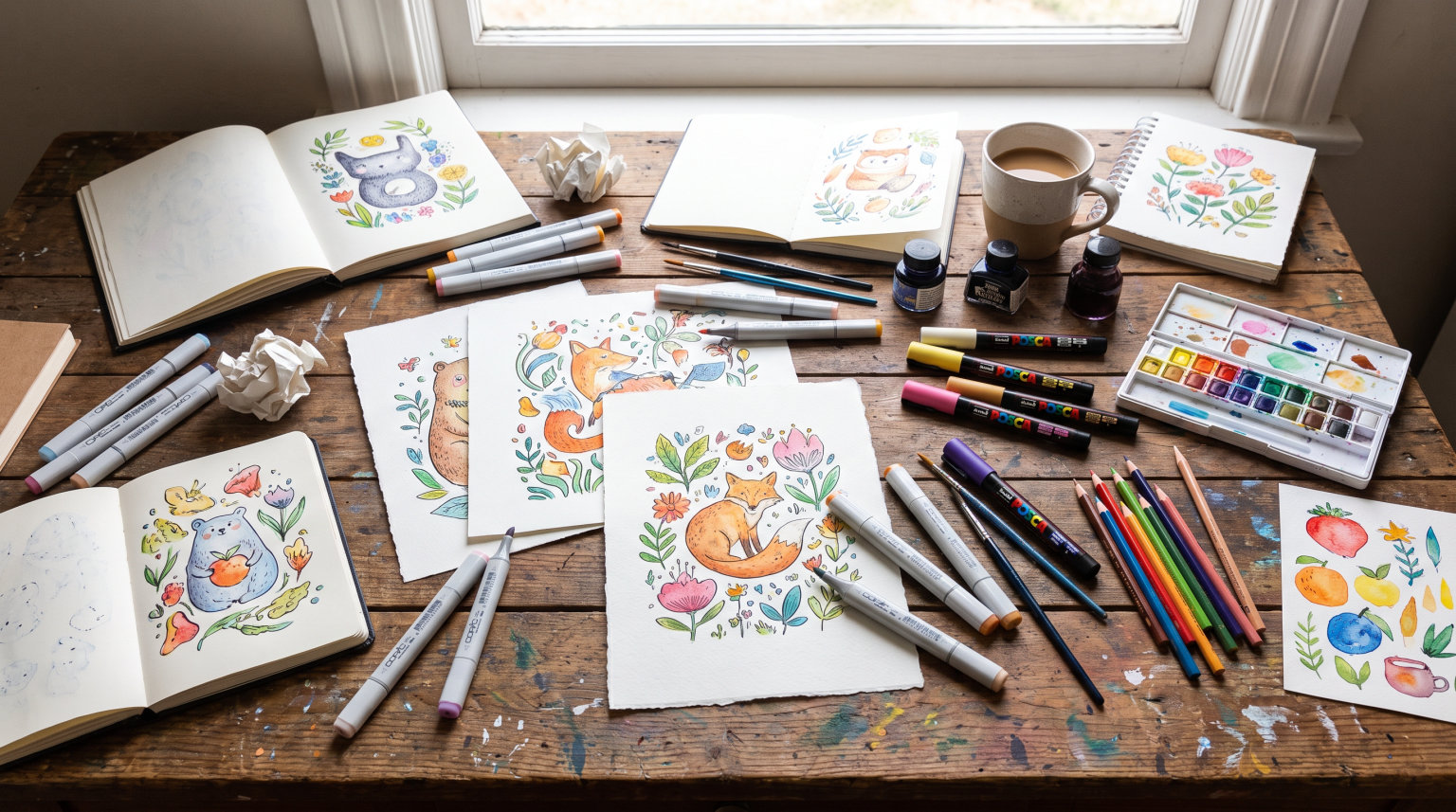
Walk through any contemporary art fair, scroll through any digital portfolio, or strike up a conversation with any emerging artist under thirty, and you’ll encounter the same phenomenon: indie illustration on Instagram has fundamentally altered how art reaches audiences, how careers take shape, and how the very definition of artistic success gets negotiated. What began as a simple photo-sharing app has become the most consequential platform for independent illustrators since the invention of the printed zine, democratizing visibility in ways that would have seemed impossible a generation ago while simultaneously creating a new set of pressures that artists are still learning to navigate.
Indie illustration refers to the work of independent artists who create illustration-based art outside traditional commercial pathways or institutional validation. Unlike commercial illustrators working for established publications or agencies, indie illustrators typically operate solo, selling directly to collectors, building audiences through social media, and often prioritizing artistic authenticity over marketability. Instagram, with its visual-first architecture and discovery mechanisms, became the natural habitat for this community, offering something unprecedented: direct access to audiences without gatekeepers.
The rise of indie illustration on Instagram represents something more than a shift in marketing strategy for artists. It reflects a broader transformation in how cultural value gets determined, how artistic careers get built, and how the relationship between creator and audience has evolved in the digital age. This article explores the phenomenon in depth, examining how it changed the art world, what challenges it presents, and how artists are adapting to an ecosystem that continues to evolve at a pace that can feel overwhelming.
Table of Contents
How Instagram Democratized Art Visibility
Before Instagram, an aspiring illustrator faced a gauntlet of gatekeepers. Gallerists decided who got shows. Art directors controlled who appeared in publications. Agents mediated nearly every meaningful opportunity for emerging artists. The path from creation to audience required navigating institutions that controlled access at every level, and those institutions had clear preferences that often reflected commercial considerations more than artistic merit. For many talented artists, the result was invisibility not because their work lacked value, but because they lacked the connections, resources, or proximity to power that the system required.
Instagram upended this entire structure. For the first time, an illustrator could post work directly to an audience of millions without requiring anyone’s permission. The discovery mechanisms, while imperfect, meant that a piece of art could find its audience through hashtags, exploration pages, and shares without ever passing through traditional gatekeeping institutions. An artist in rural Oklahoma could build a following alongside an artist in London or Tokyo, all competing on the same visual playing field.
This democratization produced tangible results. Artists who might never have found gallery representation discovered collectors willing to purchase their work directly. Illustrators who lacked industry connections built audiences that eventually attracted the attention of brands, publishers, and even galleries that previously would not have considered them. The walrus documented how Instagram “accelerated the speed at which an artist’s career can grow,” allowing artists to gain visibility that previously required years of networking and institutional backing.
The impact extended beyond individual careers. By enabling direct-to-fan relationships, Instagram allowed illustrators to retain more control over their creative output and financial destiny. Rather than ceding significant percentages to galleries or agents, indie illustrators could sell work directly, building sustainable businesses that did not require institutional validation. This shift fundamentally changed the calculus of what it meant to be a working artist, expanding the possibilities while simultaneously introducing new forms of precarity.
Perhaps most significantly, Instagram created what might be called the “long tail” effect for illustration. While traditional art world gatekeepers focused attention on a small number of established artists, Instagram allowed thousands of indie illustrators to build meaningful audiences even without mainstream recognition. A 23-year-old creating distinctive work in their bedroom could amass a following that, while not celebrity-scale, was substantial enough to sustain a creative practice and generate meaningful income. The platforms made the invisible visible in ways that changed individual lives and reshaped the broader art landscape.
Illustration Styles Thriving on Instagram
Understanding which illustration styles succeed on Instagram requires recognizing that the platform rewards certain visual characteristics that may or may not align with broader artistic merit. The algorithm, trained to maximize engagement, tends to favor work that stops scrollers, provokes interaction, and generates saves and shares. This creates specific niches where indie illustrators can find traction, though it also means that purely commercial considerations increasingly influence what gets seen.
Figurative painting and portraiture dominate the platform in ways that would be familiar to any art world observer but are amplified exponentially on Instagram. Artists like Anna Weyant, whose rise The Walrus attributed partly to Instagram visibility, demonstrate how the platform can accelerate careers that have roots in traditional painting skills. The flatness of digital screens actually advantages certain approaches to figurative work, particularly styles that emphasize bold outlines, high contrast, and distinctive color palettes that read well on mobile devices.
Minimalist illustration has also found significant audiences on Instagram. The platform’s visual language, built around clean feeds and curated aesthetics, rewards artists who can create impactful work with limited elements. This style aligns well with Instagram’s emphasis on readability at small sizes and fits neatly into the broader minimalist aesthetic that dominates the platform’s most successful accounts. Artists working in this style often develop instantly recognizable visual signatures that function as branding, making their work shareable and collectible.
Character design represents perhaps the most distinctively Instagram-native illustration category. Whether through surrealist compositions, whimsical creatures, or stylized human figures, character-focused illustrators have found enormous audiences on the platform. This category spans a vast range of approaches, from children’s book styles to adult-oriented surrealism, but shares a common emphasis on memorable figures that can function as cultural currency within the platform’s meme-driven environment. Characters created for Instagram often become standalone properties with their own merchandise lines, reflecting how the platform can incubate intellectual property that extends far beyond the original posts.
Critically, video content has emerged as the dominant format for discovery on Instagram. Timelapse videos showing the creation process, reels featuring finished work with music overlays, and behind-the-scenes content consistently outperform static images in algorithmic terms. This shift has produced what many artists describe as a bifurcation of their practice: the work itself, which may take hours or days to create, and the content about the work, which must be produced at a pace and in formats optimized for platform discovery. Artists who adapt to this reality, creating content that showcases process and personality alongside finished work, find significantly more success than those who rely solely on posting completed pieces.
The Double-Edged Sword: Algorithm Challenges
The same platform that democratized visibility also introduced new forms of gatekeeping, albeit algorithmic rather than institutional. Instagram’s algorithm, which determines what content appears in users’ feeds and exploration pages, has evolved significantly since the platform’s early days. What once rewarded simply posting work now requires specific behaviors, content types, and engagement strategies that can feel like a moving target for artists trying to focus on their creative practice.
Organic reach, the percentage of followers who actually see any given post, has declined dramatically over the platform’s history. Early Instagram offered something approaching natural distribution, where posts reached most followers simply by appearing in their feeds. Today, an indie illustrator might post to thousands of followers and reach only a fraction of them, with the algorithm deciding whose work deserves visibility based on signals that often reward engagement-baiting over artistic merit.
Instagram Algorithm: Then vs Now
| Aspect | Early Instagram (2010-2016) | Current Instagram (2024-2026) |
|---|---|---|
| Organic Reach | 60-80% of followers saw each post | 5-20% of followers see posts organically |
| Content Format | Static images dominated | Reels/video content prioritized heavily |
| Discovery | Hashtags and chronological feed | Algorithmic recommendations and explore page |
| Posting Frequency | 1-2 times daily was aggressive | 3-5 times weekly minimum for visibility |
| Engagement Focus | Likes and comments primary | Saves, shares, and watch time weighted heavily |
Forum discussions on Reddit reveal the frustration this creates for indie illustrators. One artist in the ArtistLounge community described the experience as “feeling invisible despite creating quality work,” noting that their most technically accomplished pieces often received the least engagement while simpler work performed unexpectedly well. The algorithm, these artists argue, often rewards content that is easy to consume and difficult to evaluate critically, creating a systematic bias against work that requires more viewer attention.
The shift toward video content has proven particularly challenging for illustrators whose practice centers on static, time-intensive work. Creating the timelapses and reels that the algorithm favors requires additional skills, equipment, and time that many artists feel pull them away from their actual creative practice. Yet ignoring video content means accepting diminished discovery, creating a catch-22 that has driven many artists to frustration. As one digital artist on the ProCreate subreddit noted, “I didn’t become an illustrator to become a content creator,” yet the platform increasingly demands both.
Perhaps most troubling for indie illustrators is the disconnect between follower counts and meaningful outcomes. Across forum discussions, artists report that follower numbers do not reliably translate to sales, meaningful engagement, or career advancement. An illustrator with 100k followers might struggle to sell work while someone with 10k builds a sustainable practice through highly engaged, loyal supporters. This disconnect challenges the fundamental promise of Instagram as a democratizing force, suggesting that visibility alone does not determine success and that the platform’s metrics may not align with what artists actually need.
Community Dynamics: Connection vs Competition
Instagram promised community alongside visibility, and for many indie illustrators, it delivered. The platform enabled connections between artists separated by geography, facilitated collaborations that would have been impossible in the pre-digital era, and created support networks where artists shared resources, celebrated each other’s successes, and offered encouragement during difficult periods. For these artists, Instagram became something more than a marketing tool: it became a genuine creative community.
Yet forum discussions reveal a more complicated picture of community dynamics on Instagram. Many artists report that the community aspect has deteriorated significantly as the platform grew and as algorithmic pressures intensified. The emphasis on metrics and visibility has transformed relationships that might once have been supportive into something more transactional. Artists describe feeling pressure to engage with others’ work primarily for reciprocal engagement rather than genuine interest, and some report experiences of hostility from other artists who view engagement as competition for limited attention.
The perception of the Instagram art community as unwelcoming or even hostile appears repeatedly in forum discussions. Artists describe situations where posting experimental or unusual work led to follower loss, where supportive comments from other artists were conspicuously absent during difficult periods, and where the pursuit of aesthetic consistency created implicit pressure to conform to dominant visual trends. These experiences suggest that while Instagram enabled connections, it also introduced dynamics that can undermine the community it promised.
Authenticity emerges as a central concern in discussions of community dynamics. Artists consistently report that the platform rewards performative authenticity over genuine expression, creating pressure to construct personas that resonate with audiences even when those personas diverge from their actual creative identities. The “artist on Instagram” becomes a character distinct from the artist themselves, managed and optimized for platform success in ways that can feel exhausting and inauthentic. This tension between who artists are and who they must present as creates cognitive dissonance that many find difficult to resolve.
Despite these challenges, many indie illustrators have built genuine communities on Instagram, finding audiences and collaborators who share their values and interests. These communities often extend beyond Instagram itself, becoming groups that meet in person, collaborate on projects, and support each other’s work outside the platform’s metrics-driven environment. For these artists, Instagram functions as an entry point to relationships that become meaningful independent of the platform, suggesting that community remains possible even within Instagram’s imperfect systems.
Mental Health Considerations for Social Media Artists
The mental health implications of building an artistic practice through social media have emerged as one of the most significant concerns within the indie illustration community. Forum discussions across multiple subreddits consistently highlight psychological challenges that range from everyday frustration to serious mental health crises, reflecting a community that is increasingly aware of the emotional costs of platform-based creative work.
Comparison culture represents perhaps the most pervasive challenge. Instagram’s visual-first design makes it easy to compare your work, your followers, and your engagement to countless other artists at any moment. For many illustrators, this creates a constant background awareness of where they stand relative to peers, an awareness that rarely produces positive outcomes. Artists report that viewing others’ work can induce feelings of inadequacy, that follower milestones that once felt meaningful quickly become baselines for new comparisons, and that the platform cultivates a permanent sense of not being enough.
The phenomenon artists describe as “invisible art” takes particular psychological toll. Many indie illustrators report experiencing significant gap between the quality of their work and the attention it receives, a gap they attribute to algorithm dynamics, market factors, or simple bad luck. This invisibility, when it persists despite quality and effort, can produce despair, questioning of artistic direction, and in extreme cases, abandonment of creative practice altogether. The rational knowledge that Instagram metrics do not reflect artistic merit offers little comfort against the emotional weight of perceived failure.
Burnout from the demands of platform management affects artists across experience levels. The requirement for consistent posting, the additional work of creating video content, the need to engage authentically with comments and messages, and the constant attention to metrics create a workload that can overwhelm creative practice. Many artists describe feeling that they must choose between their mental health and their Instagram presence, unable to maintain the posting frequency the platform rewards without sacrificing their wellbeing. This catch-22 has driven some artists to step back from the platform entirely, accepting diminished visibility as the price of sustainable creative practice.
The attention economy’s effects extend beyond individual artists to broader creative culture. The dopamine dynamics of social media engagement, the intermittent reward schedules of viral posts, and the neurological impacts of constant comparison create conditions that make concentration on deep creative work increasingly difficult. Artists report struggling to enter the flow states that their work requires when their habits have been shaped by platform engagement patterns designed to capture and hold attention. This subtle but significant impact on creative capacity represents a cost that extends far beyond metrics and visible outcomes.
Strategies for Getting Your Illustration Noticed
Despite the challenges, many indie illustrators do succeed on Instagram, building audiences and sustainable practices through strategic approaches that work within the platform’s constraints while maintaining artistic integrity. These strategies, drawn from community discussions and observed best practices, offer a roadmap for artists trying to navigate the platform’s complexities.
Optimizing Your Instagram Profile for Illustration
Your profile serves as your introduction to potential followers, and first impressions matter enormously on a platform where attention is scarce. Ensure your bio clearly communicates what kind of work you create and who your work is for. Use a recognizable image as your profile picture, ideally your face or a consistent brand mark that appears across your content. Include a link to your portfolio or shop, and consider adding relevant keywords to your bio that help discovery without appearing spammy.
Your feed’s visual coherence significantly impacts whether visitors follow you after viewing your profile. Artists who present a cohesive visual identity, whether through consistent color palette, subject matter, or style, tend to convert profile visitors to followers at higher rates than those whose feeds appear random or eclectic. This does not mean you must limit your artistic range, but it does mean considering how your overall grid appears to someone evaluating whether to follow.
Content Strategy for Illustrators
Embrace video content as a complement to your static work rather than a replacement for it. Timelapse videos showing your creative process consistently perform well across the illustration community, offering audiences insight into technique and effort while generating the algorithmic signals that improve discovery. Reels that showcase finished work with brief captions or trending audio can reach audiences far beyond your existing follower base, providing valuable exposure that static posts rarely achieve.
Post with consistency over perfection. The algorithm rewards regular posting, and your audience develops expectations about when you’ll share new work. Finding a sustainable posting rhythm, even if less frequent than algorithmic ideal, produces better long-term results than burning out on unsustainable posting schedules. Many successful illustrators post three to four times weekly, balancing visibility with creative practice sustainability.
Engage authentically with your community rather than pursuing engagement transactions. Genuine responses to comments, thoughtful interaction with other artists’ work, and participation in relevant conversations create relationships that transcend metrics. These relationships often prove more valuable than raw follower counts, producing the word-of-mouth referrals and collaborative opportunities that genuinely build careers.
Building Community Over Followers
Prioritize depth over breadth in your community building efforts. A thousand highly engaged followers who genuinely connect with your work will produce more meaningful outcomes than ten thousand passive followers who scroll past your posts without engaging. Focus on creating content that resonates with specific audiences rather than attempting to appeal to everyone, and build relationships with those who respond positively.
Consider the artists and accounts that represent your ideal community and actively engage with them. Authentic engagement with accounts you genuinely respect creates relationships that can lead to features, collaborations, and mutual support networks. These organic connections often prove more valuable than any growth hacking strategy because they create genuine affinity that converts to sustainable support.
Remember that community extends beyond Instagram. Many artists find that Instagram serves as an entry point to relationships that continue through other channels, including email newsletters, Discord communities, in-person events, and collaborative projects. Building these connections while using Instagram primarily for discovery and initial contact creates more resilient community structures that do not depend entirely on platform health.
Frequently Asked Questions
Which art is trending on Instagram?
Figurative illustration, character design, minimalist styles, and surrealist work currently dominate Instagram. Video content showing artistic process (timelapses, reels) performs exceptionally well, often outperforming static finished pieces by significant margins. Character-focused work that can function as shareable cultural currency performs particularly well in discovery mechanisms.
Is Instagram still good for artists?
Instagram remains valuable for artists but requires strategic approach. While organic reach has declined, the platform still offers unparalleled discovery potential and direct audience access. Success typically requires consistent posting (3-5 times weekly), video content integration, and genuine community engagement over pure follower accumulation. Artists who adapt to the platform’s evolved requirements can still build meaningful audiences and sustainable practices.
How do indie illustrators find an audience on Instagram?
Indie illustrators build audiences through consistent posting of quality work, engaging authentically with the illustration community, utilizing video content to showcase process, and leveraging relevant hashtags strategically. Building genuine relationships with followers often proves more valuable than pursuing follower counts, and many successful illustrators report that community depth matters more than raw audience size.
What are the biggest challenges indie illustrators face on Instagram?
Major challenges include algorithm changes favoring video content over static images, declining organic reach making discovery difficult, the constant pressure to post frequently content, maintaining artistic authenticity while optimizing for engagement, and mental health impacts from comparison culture and perceived invisibility despite quality work. Many artists report that the platform’s metrics do not align with their actual needs for sustainable creative practice.
How can illustrators balance experimentation with consistency on Instagram?
Balancing experimentation with consistency requires recognizing that your feed’s overall coherence matters more than any individual post. Allow yourself to experiment with new styles, techniques, or subject matter, but consider how experimental work fits into your overall visual narrative. Many successful illustrators use highlights or carousel posts to share experimental work while maintaining their primary feed for more consistent content that serves audience expectations.
The Future of Indie Illustration on Instagram
The rise of indie illustration on Instagram represents not a temporary phenomenon but a fundamental shift in how art reaches audiences and how artistic careers take shape. While the platform continues to evolve and its challenges remain significant, the broader transformation it represents appears permanent. Artists now operate in an environment where platform presence is effectively mandatory for those seeking audiences outside traditional institutional pathways, and the skills required to navigate that environment have become core competencies for working illustrators.
The indie illustration community has shown remarkable resilience in adapting to platform changes. When algorithm shifts reduced organic reach, artists developed new strategies. When video content became prioritized, artists learned new skills. This adaptability suggests that while specific platforms may rise and fall, the community that formed around Instagram’s illustration culture will continue finding ways to connect and support each other regardless of where discovery happens next.
What seems clear is that the relationship between indie illustrators and Instagram will continue evolving in ways that neither party can fully predict. The platform needs the creative community’s content more than ever, even as it struggles to integrate that community’s needs into product decisions designed for mass market engagement. Meanwhile, illustrators increasingly recognize the risks of over-dependence on any single platform, developing strategies that use Instagram for discovery while building audience relationships through channels they control more directly.
The rise of indie illustration on Instagram fundamentally changed what it means to be a working artist in the digital age. It democratized visibility, enabled direct-to-fan relationships, and created pathways for artistic careers outside traditional gatekeeping institutions. It also introduced new pressures, accelerated attention economy dynamics, and created mental health challenges that the community is still learning to address. Yet for all its contradictions and challenges, the phenomenon represents something genuinely new in how art and audiences find each other, a transformation that has only begun to unfold.
For indie illustrators navigating this landscape, the path forward involves embracing the platform’s opportunities while maintaining critical awareness of its limitations. Build genuine community rather than chasing metrics. Create work that matters to you and trust that it will find its audience. Recognize that Instagram’s algorithmic preferences are not the same as artistic merit, and that sustainable creative practice requires protecting your mental health and artistic integrity against the platform’s often contradictory demands. The rise of indie illustration represents possibility as much as precarity, and the artists who will shape the next chapter of this phenomenon are those who can hold both truths simultaneously.