
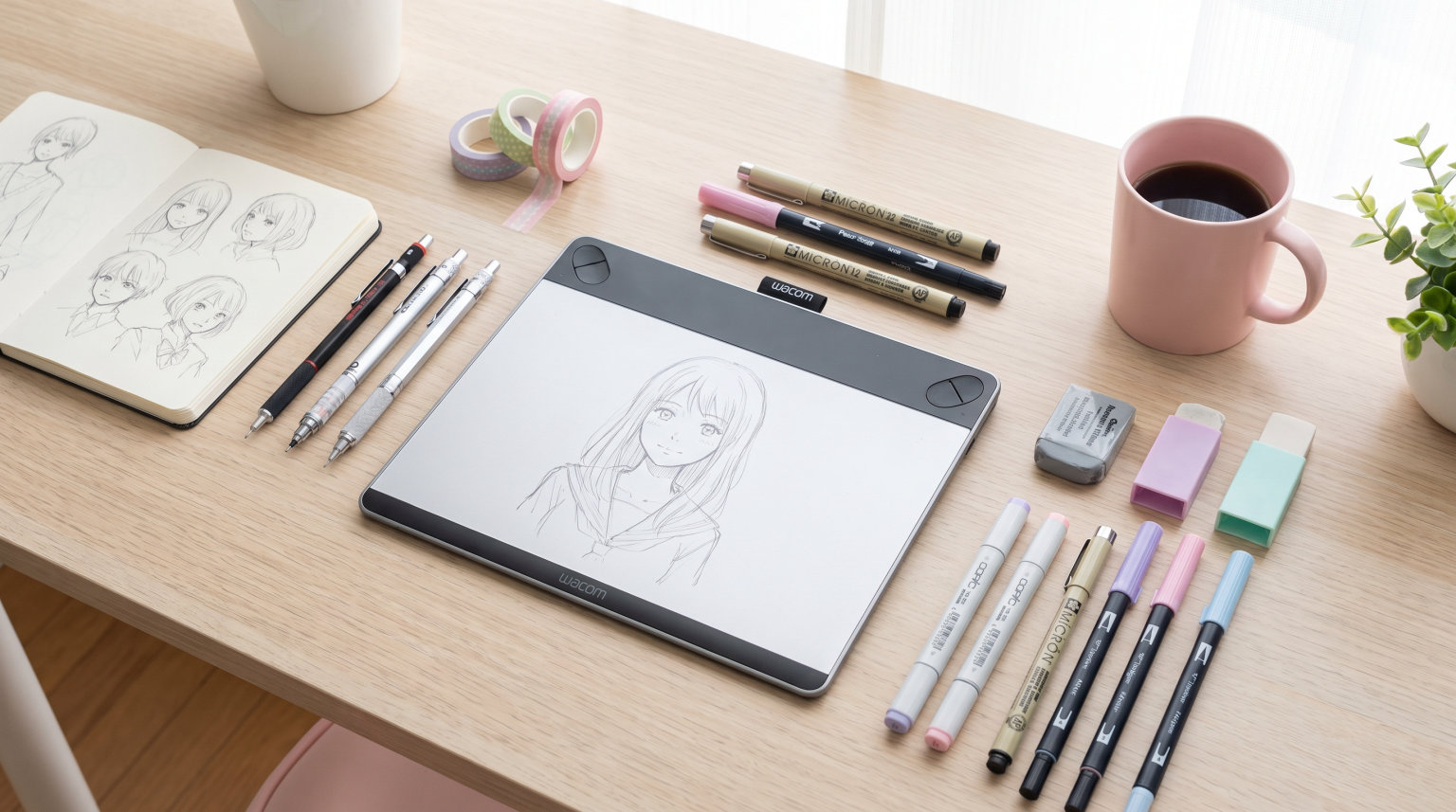
You want to learn how to draw in a manga style, but you have zero experience. Maybe you are 27 or 37 or even older, and you think you missed your chance. Here is what I want you to know right now: manga drawing is one of the most approachable art styles for beginners. The exaggerated features, the simplified forms, the visual shorthand that makes characters readable in seconds. Manga style was designed to be learned, and people like you pick it up every single day.
In this guide, I will walk you through exactly how to start drawing in a manga style, starting from absolute square one. We will cover proportions, facial expressions, eye drawing, hair, body basics, and a practice routine that actually works. No overwhelming theory. No expensive supplies. Just a clear path forward.
Table of Contents
Understanding Manga Proportions and Stylization
Manga characters look different from real people because manga artists use a specific set of proportion rules. These rules simplify reality to make characters more expressive and easier to draw quickly. Once you understand the 70/30 rule, everything else starts making sense.
The 70/30 Rule Explained
The 70/30 rule in manga drawing refers to how much stylization versus realism you apply. About 70% of manga drawing comes from learned artistic conventions, and only 30% comes from observing real human anatomy. This is why manga looks consistent across different artists. Everyone is using the same visual language.
Real human heads fit about seven to eight times into the full body height. In manga, especially for female characters, the head can fit into the body only five or six times. This creates those long, elegant limbs that define anime aesthetics. Male characters often stay closer to seven heads tall, giving them a more grounded, powerful feel.
What Makes Manga Heads Different
Manga heads are larger relative to the body than real human proportions. The eyes take up the middle third of the face. The nose is often just a small dot or line. The mouth is simplified to a single curve or small shape. This exaggeration creates that characteristic manga look where everything reads clearly even in small panels.
When you look at a manga character, your eye goes immediately to the eyes because they are the largest facial feature. This is intentional. Manga artists sacrifice anatomical accuracy in the nose and mouth to put more visual weight on the eyes, which carry the emotion of the entire character.
Essential Basic Drawing Skills You Need First
Before you start drawing manga specifically, you need three foundational skills. I know it is tempting to jump straight into drawing anime eyes and cool poses. Trust me, skipping these basics is exactly what causes that frustrating plateau most beginners hit after a few months.
Line Quality Basics
Your lines need to do three things: show direction, show weight, and show confidence. A wobbly, uncertain line tells the viewer that you do not know where that edge goes. A confident line that varies in thickness tells them exactly what matters in the drawing. Practice drawing continuous curves without lifting your pencil. Draw the same line ten times until it feels natural.
For manga specifically, you need to master the clean outline. Manga uses strong, defined edges more than shading to separate forms. Your outline work needs to be consistent in weight and deliberate in direction. This means drawing each line with intention, not sketching aimlessly until something looks right.
Shape Fundamentals
Every manga character breaks down into basic shapes: circles for heads and joints, ovals for eyes, rectangles and trapezoids for torsos, cylinders for limbs. Before you can assemble a character, you need to be able to draw these shapes confidently. I recommend spending a week just drawing circles, ovals, and basic geometric forms. Make them smooth. Make them consistent. Make them feel automatic.
Once basic shapes feel natural, move to constructing simple objects. A ball, a cube, a cylinder, a cone. Draw them from multiple angles. This builds the spatial reasoning you need when drawing characters from different viewpoints.
Observation Skills
Drawing is seeing. The better you observe real objects, poses, and faces, the better your manga characters will be. This does not mean you need to become a realist. It means you need to train your eye to notice what makes something look the way it does. Why does hair fall a certain way? What creates expression in a real face? How do shoulders actually move when an arm raises?
Start carrying a small sketchbook. When you see an interesting pose, a cool hairstyle, or an expressive face, sketch it quickly. Do not worry about quality. This is training your visual library so your manga characters have that grounded, believable quality.
Manga Facial Expressions Fundamentals
Manga conveys emotion through visual shorthand that readers learn to read instantly. When you see those three horizontal lines on a forehead, you know someone is blushing. When you see the small angled eyebrows and slight frown, you know someone is angry. These expression markers work like a visual vocabulary.
Simplified Expression Indicators
The mouth is rarely drawn with full detail in manga. Instead, it becomes a simple curve or shape that indicates the emotion. A slight upward curve means a small smile or contentment. A downward curve with a drop shadow indicates frustration or pain. A small open mouth with a curve shows surprise. That is it. You can convey most emotions with three to five mouth variations.
Eyebrows do massive work in manga expressions. Raised eyebrows signal surprise. Angled eyebrows going down toward the nose show anger. One raised eyebrow with the other lowered creates a mischievous or skeptical look. Learn these combinations and your characters will read clearly in any panel.
Common Manga Expression Marks
Manga uses specific symbols to indicate emotional states. These are worth memorizing because readers expect them. Blushing shows as three horizontal lines on each cheek, or as pink gradient shapes. Anger shows as small v-shaped marks near the temples or above the eyebrows. Sweat drops indicate nervousness or embarrassment.
Speed lines and action marks convey motion and impact. A burst of lines from a character’s face shows they got hit or shouted. Concentric arcs near the head indicate dizziness. A small cartoon-style vein popping near the temple shows anger. These conventions are visual shortcuts that every manga reader understands instantly.
Practice these expression markers separately before trying to combine them. Draw ten different mouths showing different emotions. Draw ten pairs of eyebrows in different configurations. When you can draw these elements automatically, putting them together into full expressions becomes much easier.
Eye Drawing Techniques for Manga Style
Eyes are the most important feature in manga drawing. They take up about 30% of the face in typical manga proportions, which is three to four times larger than in real human faces. This exaggeration is intentional. Larger eyes read better in small panels, carry more emotional impact, and give manga its characteristic look.
Eye Shape Variations
Manga eyes come in several basic shapes. The classic anime eye is tall and almond-shaped with a large iris that touches both the top and bottom of the eye outline. Shonen-style eyes are more angular and aggressive, often with sharper corners. Shojo eyes are rounder and softer, with extra emphasis on highlights and reflections.
Male characters typically have smaller, more simplified eyes. Female characters have larger eyes with more detailed irises. This difference is consistent across most manga styles and helps readers immediately identify character genders even with minimal other features.
Start by practicing the basic eye shape. Draw a smooth almond outline. Add the iris circle inside. Then add the pupil. Then add highlights. Each element should sit cleanly inside the previous one. Messy overlaps make the eye feel muddy rather than crisp.
Iris and Pupil Details
The iris in manga is often drawn larger than anatomically correct. This exaggeration makes the eye feel more expressive and readable. The iris typically contains a gradient or pattern of lines radiating from the pupil. These lines add detail and interest without overwhelming the eye.
Pupils in manga are usually simple black circles, but they can also have small highlight dots to create that characteristic anime sparkle. Multiple highlights in different positions make the eye look more lively and detailed. A single large highlight creates a more intense, focused look.
What sits inside the iris besides the pupil? That depends on the style you are going for. Some manga uses simple flat colors. Other styles add gradient shading inside the iris. Some add a second color ring around the edge. Study different manga styles to see which iris treatments appeal to you.
Expressive Eye Styles
Beyond basic eye shapes, manga uses specific eye treatments for emotional states. Closed eyes with simple curves show relaxation or contentment. Wide open eyes with small pupils show shock or fear. Narrowed eyes with heavy outlines show determination or suspicion. The same character can feel completely different just from changing their eye expression.
Practice drawing the same face with different eye expressions. Notice how much the mood changes even though the face shape, nose, and mouth stay identical. This is the power of the eyes in manga. They carry the emotional weight of the entire character.
Hair Drawing Basics for Manga Characters
Hair in manga serves two purposes. It frames the face and establishes character personality. Manga hair is never just hair. Every style, color, and cut communicates something about who the character is before you even see them do anything.
Hair Flow and Direction
Hair in manga follows consistent flow patterns. Even messy, spiky hair has a logical direction that the strands follow. Before drawing any hair style, you need to understand where the hair originates on the head and where it flows from there. All the strands follow paths that make visual sense.
Start with the basic hairline shape on the head. Then add the main sections of hair that split and flow in different directions. Finally, add individual strands and spikes to define the style. Working from large shapes to small details keeps your hair from looking like a tangled mess.
Hair should also respond to movement and gravity. Hair blowing in wind flows in one direction. Hair hanging down follows gravity. Hair sitting on shoulders rests against the body. Your hair needs to look like it exists in a real space with real physical forces acting on it.
Volume and Styling
Manga hair has more volume than real hair. Even sleek, straight hair in manga looks thicker and more stylized than real hair. This exaggeration helps hair read clearly in small panels and adds to the overall graphic quality of manga art.
Long hair in manga often flows behind the character to create movement and add visual interest to panels. Short hair gets more dramatic styling with unusual cuts, extreme colors, or exaggerated spikes. Both choices are about personality communication as much as aesthetics.
When adding color to manga hair, manga artists often use simple flat colors or two-tone shading rather than complex realistic gradients. This keeps the graphic quality high and makes the art faster to produce without sacrificing readability.
Common Hair Drawing Mistakes
Beginners tend to draw hair as a solid shape without understanding strand direction. This creates flat, lifeless hair that looks more like a helmet than hair. Another common mistake is drawing hair that does not connect logically to the head. The hairline needs to sit naturally on the skull shape.
Overcomplicating strand details is also a trap. Yes, you need individual strands to define the style, but too many details create visual noise. Pick a few key strand patterns and repeat them rather than trying to draw every single hair individually.
Body Anatomy for Manga Artists
Manga bodies use simplified anatomy that captures the essence of human form without getting bogged down in anatomical accuracy. You do not need to memorize every muscle and bone. You need to understand the major landmarks that create readable manga bodies.
Head-to-Body Ratio
The most important proportion in manga character design is the head-to-body ratio. Standard manga proportions place the head about six to seven heads tall for the full body. Simplified chibi characters drop to two to four heads tall. Realistic manga sits around five to six heads. Heroic or shonen manga often pushes toward seven to eight heads for that powerful, elongated look.
Different ratios create different feels. A five-head body feels youthful and cute. A seven-head body feels mature and heroic. An eight-head body feels superhuman and imposing. Know what ratio you are aiming for before you start drawing.
Simplified Muscle Groups
Manga bodies use simplified muscle shapes rather than anatomically correct musculature. The chest is often just a simple trapezoid or triangle. The abs are simplified to three or four lines. The arms and legs use cylindrical forms with simple joint circles at the elbows and knees.
This simplification works because manga is about readability and expression, not anatomical accuracy. A reader does not need to know which muscle creates a particular pose. They just need to see that the character is strong, or lithe, or soft. Simplified anatomy communicates these qualities faster.
Dynamic Poses
Manga loves dynamic action poses. Characters in motion, fighting, running, jumping. These poses use foreshortening and exaggerated angles to create energy and impact. The body compresses before expanding, limbs twist to show torque, and speed lines add to the sense of movement.
To draw dynamic poses, start with simple action lines showing the major movement direction. Then block in the body using basic shapes. Finally, refine the contours and add detail. Starting too detailed makes it impossible to capture that sense of energy.
Study action manga to see how professional artists handle dynamic poses. Notice how they compress the body before a punch, then extend fully on impact. Notice how they use diagonal lines to create tension. These techniques are learnable once you start looking for them.
Practice Methods and Daily Routines That Work
Here is the truth that nobody tells you when you start drawing manga. There is no secret technique that makes you good overnight. There is only consistent practice over months and years. But the kind of practice matters. Mindless drawing will not improve you the way deliberate practice will.
Building a Daily Drawing Habit
Draw every single day, even if only for fifteen minutes. Consistency matters more than duration. A fifteen-minute daily practice builds more skill than a three-hour session once a week because you are training your hand and eye to work together regularly.
Set a specific time for drawing and protect it. Morning, lunch break, evening before bed. Whatever works for your schedule. The habit needs to become automatic, like brushing your teeth. You do not decide whether to brush your teeth. You just do it. Your drawing practice needs that same automatic quality.
Track your practice somehow. A simple calendar with checkmarks, a habit tracking app, a sketchbook with dates. This tracking serves two purposes. It keeps you accountable, and it shows you your progress over time. Six months of daily practice is visible progress you will not believe when you look back.
The Reference Study Method
Copying manga you admire is one of the fastest ways to learn. You are not tracing. You are studying. Hold the reference up, study a section, then look away and draw it from memory. Compare. Notice what you missed. Try again. This process trains your eye and hand simultaneously.
Choose references that are slightly above your current skill level. Too easy and you learn nothing. Too hard and you get frustrated. You want something that challenges you but does not overwhelm you. This sweet spot is where real learning happens.
When you copy, pay attention to what the artist did. Why this line here? How did they create this effect? What shapes make up this form? Asking these questions turns copying from passive reproduction into active learning.
Progression Tracking
Every month, draw the same character or scene. Same pose, same angle, same level of detail. Keep all these drawings in a folder. Six months from now, you will look at your first attempt and your most recent attempt side by side. The progress will amaze you, even when you feel like you are not improving day to day.
This tracking also helps you identify what still needs work. Maybe your line quality improved but your eyes still look muddy. Maybe your poses got better but your hands still look weird. The gaps you need to focus on become obvious when you can compare your work over time.
Common Mistakes to Avoid When Starting Out
Most beginners make the same mistakes. I made them. Every manga artist you admire made them. Knowing what they are helps you avoid the frustration and wasted time that comes from repeating mistakes that others already learned from.
Skipping Fundamentals
The biggest mistake is jumping straight to drawing complete manga characters before mastering basic shapes and proportions. You want to draw that cool anime girl with the elaborate hair and the intense eyes. So you try it. It looks wrong. You try again. Still wrong. After a hundred failed attempts, you get frustrated and quit.
The problem is not talent. The problem is that you were trying to run before you learned to walk. Basic shapes, line quality, simple forms. These are not boring exercises. They are the foundation everything else builds on. Go back and do the fundamentals work. It will make everything else faster.
Over-Relying on References
References are not cheating. References are essential. But beginners often use references as a replacement for learning rather than a tool for learning. They copy a reference line by line without understanding why those lines go where they do. Then when they try to draw a similar pose from a different reference, they cannot do it.
Use references to learn from, not to copy blindly. After copying a reference, close it and draw the same thing from memory. Use a mirror to flip your reference and see if anything looks off. Study the reference to understand the underlying structure. This active engagement with references builds real skill.
The Comparison Trap
You will see other beginners online who seem to progress impossibly fast. You will compare their work to yours and feel discouraged. Here is what you need to understand. You are only seeing their best work, carefully curated and presented. You are seeing your every hesitation line, your every failed attempt, your every awkward proportion.
Everyone starts at zero. The artists whose work amazes you spent years getting there. Some of them had formal training. Some had natural talent. All of them had years of practice. Your timeline is your own. Compare yourself only to yourself last month, last year. That is the only comparison that matters.
Perfectionism and Starting Over
You finish a drawing. It looks mostly okay but something feels off. You start a new one. Same thing. You start another. Eventually you have a folder of half-finished drawings and nothing complete. This is perfectionism killing your progress.
Every drawing does not need to be your best work. Every drawing is practice. Finish the drawing even if it is not perfect. Learn from what went wrong. Move on to the next one. The only way to improve is to complete things and see what happens. A hundred finished drawings with mistakes teaches you more than a dozen abandoned near-complete pieces.
Learning Resources for Manga Drawing
You do not need expensive courses to learn manga drawing. Some of the best resources are free. The key is choosing resources that match your current skill level and moving to harder resources as you progress.
Free Online Tutorials
YouTube has thousands of manga drawing tutorials. The challenge is finding ones that match your level and teaching style. Some channels assume no prior knowledge. Others jump straight into advanced techniques. Search for “manga drawing for absolute beginners” and try several channels until you find one that clicks with how you learn.
Websites like Animeoutline and DeviantArt groups dedicated to manga art offer structured tutorials. These resources are often created by artists who learned the same way you are trying to learn, which means they often explain concepts in ways that make sense for self-taught artists.
Books for Beginners
Books like “Mastering Manga” by Mark Crilley offer step-by-step progression through manga fundamentals. Books are great because they present information in a structured, sequential way that many online resources lack. You can work through a book from start to finish and know you have covered everything.
Look for books specifically labeled for beginners. Advanced books will overwhelm you and teach bad habits if you do not have the fundamentals yet. Books like “Figure Drawing for All It’s Worth” by Andrew Loomis provide foundational anatomy knowledge that every manga artist benefits from, even if the style is more realistic than manga.
Structured Courses
If you prefer structured learning with accountability, online courses offer curriculum-based progression. Platforms like Skillshare, Domestika, and Udemy have manga drawing courses. Some are excellent. Others are overpriced for what they offer. Read reviews before buying and start with courses that offer a free trial or money-back guarantee.
The advantage of courses is clear progression. You know what you should learn next. You have assignments to complete. You have deadlines to meet. For people who struggle with self-directed learning, this structure can make the difference between finishing and quitting.
Frequently Asked Questions
How to start manga drawing?
Start by learning basic shapes and proportions. Practice drawing simple manga eyes, mouths, and facial expressions. Build a daily drawing habit of 15-30 minutes. Copy manga you admire while studying the techniques. Focus on line quality and understanding how manga simplifies real anatomy. Progress to drawing complete characters once basic elements feel automatic.
What is the 70 30 rule in drawing?
The 70/30 rule in manga drawing means that approximately 70% of manga comes from learned artistic conventions and stylization, while only 30% comes from observing real human anatomy. This ratio explains why manga has consistent visual language across different artists and why it uses specific proportion rules and expression markers that readers learn to interpret instantly.
How do manga artists start?
Manga artists typically start by mastering basic drawing skills like line quality, shape fundamentals, and observation. They then study manga-specific techniques like exaggerated proportions, simplified anatomy, and expression markers. Most practice daily, copying references they admire while building their own style. Professional manga artists often start with smaller projects like doujinshi before working on published manga.
Can anyone learn to draw manga?
Yes, anyone can learn to draw manga. Unlike some skills that require innate talent, manga drawing is learnable because it relies on specific conventions and techniques that follow consistent rules. Whether you are 15 or 45, whether you have never drawn anything or have some basic skills, you can improve with consistent practice. The artists you admire did not start knowing how to draw manga either. They learned through years of dedicated practice.
Your Path Forward
You came here wondering how to start drawing in a manga style. Now you have a clear path. Master basic shapes and line quality. Learn manga proportions and the 70/30 rule. Practice eyes, expressions, hair, and simplified anatomy. Build a daily drawing habit. Use reference study methods. Avoid the common mistakes. Use good resources and track your progress.
Here is the thing about age that forums get wrong. There is no age limit on learning manga drawing. The 27-year-old asking if they are too old, the 40-year-old who always wanted to try, the retiree looking for a new hobby. You are not starting too late. You are starting right now, and that is exactly when you should start.
Manga drawing takes time. Not weeks. Months and years. But every day you practice, you are building skill that compounds. The artists whose work you admire did not get there in a month. They got there through years of consistent practice, just like you can.
Start today. Draw one eye. Then draw another. Tomorrow, draw a mouth. Next week, put them together on a face. A month from now, add hair. A year from now, you will look back at your first attempts and be amazed at how far you came. This is how everyone starts. You just have to start.