
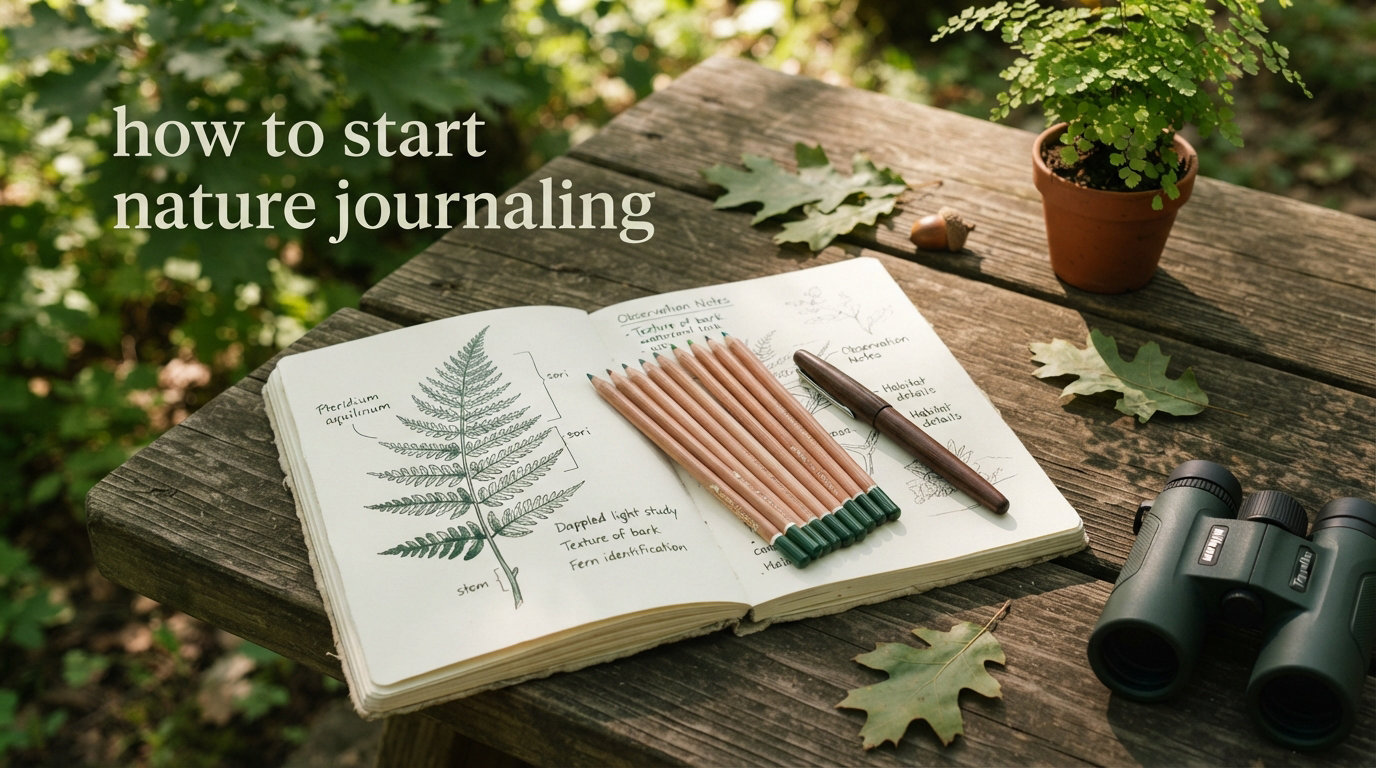
Three years ago I sat on a fallen log in my local park with a cheap spiral notebook and a pencil I found in my car console. I had no plan, no artistic training, and no idea what I was doing. I just started drawing the dandelion growing between two rocks. That single scribbled entry turned into a daily practice that has changed how I see the world around me. If you have been wondering how to start nature journaling, you are in exactly the right place. This guide walks you through everything you need to begin, and I promise you do not need to be an artist to do it.
Nature journaling is simply the practice of recording your observations about the natural world using a combination of words, pictures, and numbers. You write what you see, sketch what catches your eye, and note details like the weather or the time of day. That is it. You can do it in your backyard, at a city park, on a hiking trail, or even from your window. The beauty of a nature journal is that it works wherever you are and whatever your skill level happens to be.
Our team has spent months researching the best approaches, testing techniques from experts like John Muir Laws, and gathering advice from communities of nature journalers on forums like Reddit’s r/naturejournaling. What follows is a complete, practical guide that answers every question a beginner might have. Whether you want to build mindfulness, connect with your kids outdoors, or simply slow down and pay attention, this guide will help you take that first step.
Table of Contents
What Is a Nature Journal?
A nature journal is a personal notebook where you record your observations, drawings, and reflections about the natural world. Unlike a traditional diary that focuses on your thoughts and feelings, a nature journal focuses outward on what you notice around you. You use words, sketches, and sometimes numbers to document plants, animals, weather patterns, landscapes, and anything else in nature that catches your attention.
The practice has deep roots. Explorers like Lewis and Clark kept detailed field journals filled with sketches of plants and animals they encountered. Henry David Thoreau filled notebooks with observations from Walden Pond. Naturalists have relied on field notes for centuries as a way to understand and remember what they saw. Today, nature journaling has grown into a popular hobby for people of all ages who want to pay closer attention to the world around them.
A nature journal is not the same thing as an art portfolio or a science report. Think of it as a workbook. Some entries might be beautiful sketches. Others might be messy scribbles with a few words jotted down. Both are equally valuable. The goal is observation, not perfection. Your journal is a tool for seeing more clearly, thinking more carefully, and remembering what you discovered.
Why Start Nature Journaling? The Benefits Are Backed by Science
The reasons to start nature journaling go far beyond making pretty drawings. Research consistently shows that spending intentional time observing nature reduces stress, lowers cortisol levels, and improves overall mental health. A study published in the Journal of Positive Psychology found that just 30 minutes spent in nature each week can significantly decrease symptoms of anxiety and depression. When you combine that outdoor time with the focused attention of journaling, the benefits multiply.
Here are the key benefits that make nature journaling worth your time:
Reduced stress and anxiety: Sitting quietly and focusing on a leaf, a bird, or a cloud pattern pulls your attention away from racing thoughts. Nature journaler forums on Reddit are filled with people who describe the practice as a “treasured gift” for their mental health. One user called it “a mindfulness exercise for people who do not want to meditate.”
Sharper observation skills: When you know you will be recording what you see, you start looking more carefully. You notice the tiny details you would normally walk right past. Over time, this heightened awareness carries over into everyday life. You become a better listener, a more careful thinker, and a more curious person.
Boosted creativity: The act of drawing and writing about what you see activates both sides of your brain. The left brain handles the analytical parts like counting petals and measuring distances, while the right brain engages with shapes, colors, and spatial relationships. This combination sparks creative thinking in ways that passive observation alone cannot.
Deeper connection to place: When you revisit the same spot week after week and record changes, you develop a relationship with that place that most people never experience. You notice the first buds of spring, the migration of birds through your area, and the slow color shifts of autumn. Your journal becomes a personal record of the seasons as they unfold in your specific corner of the world.
Stronger family bonds: Parents on nature journaling forums consistently report that journaling transforms family outdoor time. Instead of just walking through a park, families stop, look closely, and share discoveries together. Kids who journal develop stronger writing skills, scientific thinking, and a genuine love of the outdoors that can last a lifetime.
What You Need to Start Nature Journaling (Keep It Simple)
If there is one thing I want you to take away from this section, it is this: you already have everything you need. The most common mistake beginners make is buying too many supplies before they even start. Nature journaling requires almost nothing, and starting with simple materials actually removes the pressure that comes with expensive gear.
The absolute essentials (two items):
A notebook and something to write with. That is the complete list. Any notebook works. Lined, unlined, spiral-bound, or hardcover. Any pen or pencil works. A ballpoint pen from your junk drawer is perfectly fine. The Virginia Department of Wildlife Resources puts it simply: all you need is curiosity, a piece of paper, and something to write with.
Nice-to-have supplies if you want to expand later:
Once you have been journaling for a few weeks and know you enjoy it, you might consider upgrading. Here are some optional items that experienced nature journalers often use:
A dedicated sketchbook with heavier paper (90-120 lb weight) that can handle watercolors. Colored pencils for adding quick color to sketches. A small portable watercolor set for field painting. A waterproof pen (like a Micron Pigma) so your ink does not run if the page gets damp. A small ruler for measuring and a field guide for identifying species in your area.
Do not buy any of this before you start. Wait until you have made at least ten journal entries. By then you will know what you actually need based on how you naturally journal. Some people never move beyond pencil and paper, and their journals are beautiful and rich with detail.
How to Start Nature Journaling in 7 Steps
This is the section I wish I had when I started. Follow these seven steps in order, and you will have your first complete nature journal entry by the end of today.
Step 1: Gather your materials. Grab any notebook and any writing tool. Seriously. Do not overthink this. A composition notebook and a standard pencil will serve you well for your first hundred entries. Put them in a bag you can easily grab on your way out the door.
Step 2: Find your sit spot. A sit spot is a specific outdoor location you return to regularly. It could be a bench in a park, a chair on your patio, a spot under a tree at the edge of a field, or even a window overlooking your yard. The key is choosing a place that is convenient enough to visit often. John Muir Laws, one of the most respected voices in nature journaling, emphasizes that your sit spot should feel comfortable and safe. You are more likely to return to a spot that is easy to access.
Step 3: Record your metadata. At the top of every journal entry, write down the date, time, location, and current weather conditions. This takes ten seconds, but it transforms your journal from a random collection of sketches into a scientific record. Months later, you will be able to look back and see patterns. You will notice that the same patch of wildflowers bloomed on nearly the same date two years in a row, or that a particular bird showed up right after the first frost.
Step 4: Use the “I Notice, I Wonder, It Reminds Me Of” framework. This three-part observation prompt is the single most powerful tool for beginners. Naturalist John Muir Laws teaches this framework as the foundation of nature journaling, and it works because it gives your brain a structure when you do not know where to start.
Start with “I notice…” and write down three things you see. Then write “I wonder…” and note any questions that come up. Finish with “It reminds me of…” and make connections to things you already know. This framework forces you to look carefully, think critically, and connect new observations to your existing knowledge. It works whether you are writing full sentences or just jotting down single words.
Step 5: Warm up with “sacrificial pancakes.” This brilliant concept comes from John Muir Laws, and it addresses the biggest fear beginners have: that their drawings will be bad. The idea is simple. Before you start your real journal entry, spend two minutes making quick, messy marks on the page. Doodle, scribble, draw random shapes. These warm-up sketches are your “sacrificial pancakes,” like the first pancake you throw away because the griddle was not hot enough yet. Once you have made a mess on the page, the pressure to be perfect disappears. Your real work can flow more freely because you have already “ruined” the page.
Step 6: Draw what you actually see, not what you think you see. This is the biggest drawing tip I can give you, and it has nothing to do with technique. When most people try to draw a leaf, they draw their idea of a leaf, not the specific leaf in front of them. Slow down. Look at the actual shape. Notice the uneven edges, the way the veins branch, the spot where a bug took a bite. Draw that specific leaf with all its imperfections. Your drawing will be more interesting and more accurate than any idealized version you could invent.
Step 7: Make it small and consistent. You do not need to spend an hour on each entry. Start with ten minutes. A quick sketch and three written observations count as a complete entry. The people who stick with nature journaling long-term are not the ones who create elaborate entries every time. They are the ones who show up consistently, even for just a few minutes. Aim for one or two entries per week to start, and build from there.
What to Record in Your Nature Journal: 25 Ideas
The second biggest challenge beginners face, after the fear of drawing, is not knowing what to write or sketch about. When you sit down with your blank page, your mind might go blank too. Here is a comprehensive list to keep handy. You do not need to include all of these in every entry. Pick one or two each time you go out.
Plants and fungi: Sketch a single leaf and note its shape, edge pattern, and color. Draw a flower and count its petals. Record the stages of a bud opening over several visits. Make a leaf rubbing by placing the leaf under your page and rubbing with the side of your pencil. Document mushrooms or lichen growing on a fallen log. Track how a specific tree changes through the seasons.
Animals and insects: Draw a bird and note its colors, size, and behavior. Record bird songs using your own phonetic spelling (for example, “cheer-up, cheerily, cheerily” for a robin). Sketch an insect you find on a plant and note what the plant is. Watch a squirrel or chipmunk for five minutes and describe its actions step by step. Look for animal tracks in mud or snow and sketch the pattern.
Weather and atmosphere: Describe the cloud formations and what weather they might indicate. Note the temperature and wind direction. Record the quality of light at different times of day. Draw the sunset or sunrise colors. Document the first frost, first snow, or first warm day of spring.
Landscape and place: Draw a quick map of your sit spot showing landmarks. Sketch the same view in different seasons for comparison. Note changes to the landscape after a storm. Record water levels in a stream or pond over time.
Using all five senses: Write down what you hear (bird calls, wind, water, traffic in the distance). Describe what you smell (pine, wet earth, flowers). Touch bark, leaves, and soil and note the textures. If it is safe, taste something identifiable like a wild blackberry. This multi-sensory approach makes your entries richer and pulls you deeper into the present moment.
Quick-reference list of 25 things to record:
1. A single leaf with its exact shape and any damage
2. A bird’s colors, size, and call
3. Cloud shapes and what they tell you about weather
4. The temperature, wind, and general weather
5. A flower with petal count and color notes
6. An insect on a plant with behavior notes
7. Animal tracks or signs (scat, chewed leaves, nests)
8. A tree’s bark pattern up close
9. A soundscape map of what you hear from your sit spot
10. A leaf rubbing with color notes
11. The same view you sketched last time, noting changes
12. A seed, cone, or fruit you find on the ground
13. A mushroom or fungi with texture details
14. Water movement in a stream, puddle, or pond
15. The light quality and shadow directions
16. A landscape sketch with major features labeled
17. Soil or rock colors and textures
18. A behavior sequence (animal or insect doing something)
19. A scent description of the air around you
20. A comparison between two similar plants or leaves
21. Moon phase and its position in the sky
22. Evidence of seasonal change (buds, falling leaves, frost)
23. A quick map of your sit spot with landmarks
24. Something that surprised you and why
25. A question you want to research later
Overcoming Common Struggles When You Start Nature Journaling
Every beginner hits roadblocks. The good news is that every single one of them is solvable. Here are the four most common struggles I hear from new nature journalers, along with practical solutions.
“I cannot draw, so I cannot nature journal.” This is the biggest myth in the entire practice. Nature journaling is not about making art. It is about paying attention. Your sketches are a tool for looking more carefully, not a performance for anyone else. As one Reddit user put it perfectly: “Think of your journal as a workbook, not an art book.” If drawing truly terrifies you, start with just writing. Describe what you see in words. Use the “I notice, I wonder, it reminds me of” framework. Over time, you will likely find yourself wanting to sketch because words alone will not capture what you are observing. But even if you never draw a single thing, your written observations are completely valid nature journaling.
Perfectionism and “journal block.” That paralysis you feel when facing a blank page is real. Artists call it “journal block,” and it stems from the fear that your first mark will not be good enough. The sacrificial pancakes warm-up I described earlier is the antidote. Make a deliberate mess first. Scribble in a corner. Draw a terrible stick figure. Once you have broken the seal, your brain stops treating the page as something precious. Another trick: start on page five instead of page one. The first page carries too much psychological weight. Skip it and come back later when you are more comfortable.
Animals and birds will not stay still. This frustrates every new nature journaler. Here is what experienced sketchers do: draw quick gesture sketches first. Spend 10 to 15 seconds capturing the basic shape and posture. Do not worry about details. If the animal moves, draw the new pose next to the first one. Add written notes about behavior to fill in the details you did not have time to sketch. You can also take a quick photo with your phone and finish your sketch later using the photo as reference. Many experienced nature journalers do exactly this.
I keep forgetting to journal or I cannot find the time. The key to building any habit is to attach it to something you already do. If you walk your dog every morning, bring your journal. If you drink coffee on the porch, keep your journal on the table next to your mug. Do not set ambitious goals like “I will journal for an hour every day.” Start with something so small you cannot say no. Ten minutes, once a week. That is enough to build the foundation. Once the habit is established, it will naturally expand because you will start looking forward to it.
Tips for Making Nature Journaling a Habit That Sticks
Starting is one thing. Keeping it going is another. After talking with dozens of experienced nature journalers and reading through hundreds of forum posts, a few patterns emerge among the people who maintain their practice for years.
Pair it with an existing routine. Habit stacking is the most reliable way to build consistency. Pick something you already do every day or every week, and add journaling to it. Morning coffee on the patio. A weekend hike. A walk to the mailbox. When nature journaling becomes part of something you already do, you stop relying on willpower alone.
Start a nature journal club or find a community. John Muir Laws specifically recommends forming a nature journal club because sharing your observations with others deepens your learning and keeps you accountable. You can start with just one friend. Meet at a park once a month, journal together for 30 minutes, and then share what you found. Online communities like Reddit’s r/naturejournaling are also welcoming places to post entries and get encouragement from fellow journalers.
Revisit the same sit spot across seasons. This is where nature journaling transforms from a hobby into a genuine study of place. When you return to the same tree or the same corner of a park month after month, you build a visual record of change that is incredibly rewarding. You will notice things no one else around you sees because you have been paying sustained attention.
Embrace imperfection as a feature, not a bug. The most valuable entries in my own journal are not the best-drawn ones. They are the ones where I was genuinely curious and engaged. A messy sketch with lots of questions scribbled in the margins is worth more than a polished drawing with no thinking behind it. Remind yourself regularly that nature journaling is about the process, not the product.
Use seasonal themes to stay motivated. Give yourself a focus for each month or season. January might be all about bark and branch patterns. April could focus on buds and blooms. July is for insects and wildflowers. October for leaf colors and seed pods. Having a loose theme keeps your entries feeling fresh and gives you a reason to keep going outside even when the weather is not perfect.
FAQs
What do you need to start a nature journal?
You need just two things: a notebook and something to write with. Any pen, pencil, or marker works, and any notebook from a cheap spiral-bound pad to a dedicated sketchbook is fine. Do not buy expensive supplies before you start. Once you have made at least ten entries, you will know whether you want to upgrade to watercolor supplies or heavier paper.
How do you practice nature journaling?
Find an outdoor spot, record the date, time, location, and weather at the top of your page, then use the ‘I Notice, I Wonder, It Reminds Me Of’ observation framework to guide your entries. Sketch what you see, write descriptions, ask questions, and note connections. Spend at least 10 minutes per session and aim for consistency over perfection.
What to include in a nature journal for beginners?
Include metadata (date, time, location, weather) at the top of every entry. Then record observations through sketches, written descriptions, measurements, questions, and comparisons. Focus on plants, animals, weather, insects, landscapes, and seasonal changes. Use all five senses to make your entries richer.
Can you nature journal without drawing?
Yes, absolutely. Nature journaling is about observation, not art. You can write detailed descriptions of what you see, record data like temperature and species counts, make leaf rubbings, press flowers between pages, or use the ‘I Notice, I Wonder, It Reminds Me Of’ framework with only words. Many experienced nature journalers focus primarily on written observations.
How often should you nature journal?
There is no required frequency. For beginners, aim for one or two entries per week to build the habit without feeling pressured. Even one entry per week is enough to develop your observation skills and build a meaningful record. The most important thing is consistency over volume. A ten-minute weekly session is better than a two-hour session you only do once a month.
Your Nature Journaling Journey Starts Today
You now have everything you need to know about how to start nature journaling. You know what a nature journal is, why the practice is worth your time, what supplies you need (which is almost nothing), and a clear seven-step process for making your first entry today. You have got 25 specific ideas for what to record, strategies for overcoming the most common beginner struggles, and tips for turning this into a habit that lasts.
The only thing left is to actually do it. Grab any notebook and any pen. Step outside. Find a spot that looks interesting. Sit down. Look at something closely for ten minutes, and write or draw what you see. That first entry does not need to be impressive. It just needs to exist. Every nature journaler you admire started with a single page and zero confidence. The difference between them and everyone else is that they started.
Your nature is waiting. Your journal is ready. Go see what you can discover.