
SoHo, the Manhattan neighborhood south of Houston Street, holds one of the most remarkable transformation stories in New York City history. What began as a district of cast-iron factories and textile warehouses became, over the course of just two decades, the undisputed center of the contemporary art world. The history of SoHo as an art neighborhood is a story about how painters, sculptors, and performers turned abandoned industrial buildings into the most influential creative community of the 20th century.
In the 1960s and 1970s, artists began moving into these massive, light-filled loft spaces illegally, drawn by cheap rents and cavernous interiors perfect for making large-scale work. By the 1980s, SoHo was home to the most important galleries on the planet, hosting artists like Andy Warhol, Jean-Michel Basquiat, and Donald Judd. The neighborhood’s rise and eventual gentrification became a template, and a cautionary tale, for arts-led urban development worldwide.
I have spent years researching this story, drawing on oral histories, archival records, and the accounts of artists who lived through it. If you want to understand how a declining manufacturing district became the beating heart of American art, and what remains of that legacy in 2026, this guide walks through every chapter of that transformation. For a broader look at the city’s art scene today, our guide to the best galleries in NYC covers what the city offers across all five boroughs.
Table of Contents
What Does SoHo Mean? The Name and the Neighborhood
SoHo stands for “South of Houston Street,” and the name tells you exactly where the neighborhood sits in Manhattan. Bounded roughly by Houston Street to the north, Canal Street to the south, Lafayette Street to the east, and West Street to the west, SoHo covers about 26 blocks of some of the most distinctive architecture in New York.
The name “SoHo” was coined in the early 1960s by urban planner Chester Rapkin. He was conducting a housing study for the city and needed a convenient label for the area, which at the time had no widely recognized neighborhood name. The coinage echoed London’s Soho district, though the two have no historical connection. Before the 1960s, the area went by several different names depending on who you asked and what era you were in.
In the 18th century, the land was part of a larger area known as Bloomingdale, a rural stretch of farms and estates north of the settled city. By the mid-1800s, as industry took over, locals sometimes called it Hellems Hook or simply “the Valley,” a reference to its low-lying geography near the old Collect Pond. For most of its industrial life, though, the area had no distinct identity at all. It was just the warehouse district south of Houston.
Rapkin’s catchy shorthand stuck fast once artists and writers began using it in the 1960s and 1970s. By the time SoHo became internationally known for art, the name was permanent. Today the Landmarks Preservation Commission formally recognizes the SoHo-Cast Iron Historic District, and the name is recognized worldwide as synonymous with a particular kind of urban artistic transformation.
The Industrial Roots: Cast-Iron Buildings and Factory Floors
Long before any artist set foot in a SoHo loft, the neighborhood was a powerhouse of American manufacturing. The story of SoHo’s built environment begins with Collect Pond, a freshwater lake that once occupied the area near what is now Foley Square. By the early 1800s, the pond had become polluted by nearby industries and tanneries, and the city drained and filled it in 1811. That landfill created new buildable land, and industry rushed in.
Between the 1850s and the 1880s, developers constructed hundreds of cast-iron buildings in the district. Cast-iron architecture was a technological marvel of its time: prefabricated iron facades could be assembled quickly, decorated elaborately, and produced at a fraction of the cost of carved stone. The facades featured Corinthian columns, arched windows, and ornate filigree, giving these functional warehouses an unexpected grandeur. SoHo eventually accumulated the largest concentration of cast-iron architecture in the world, with over 250 cast-iron buildings still standing today.
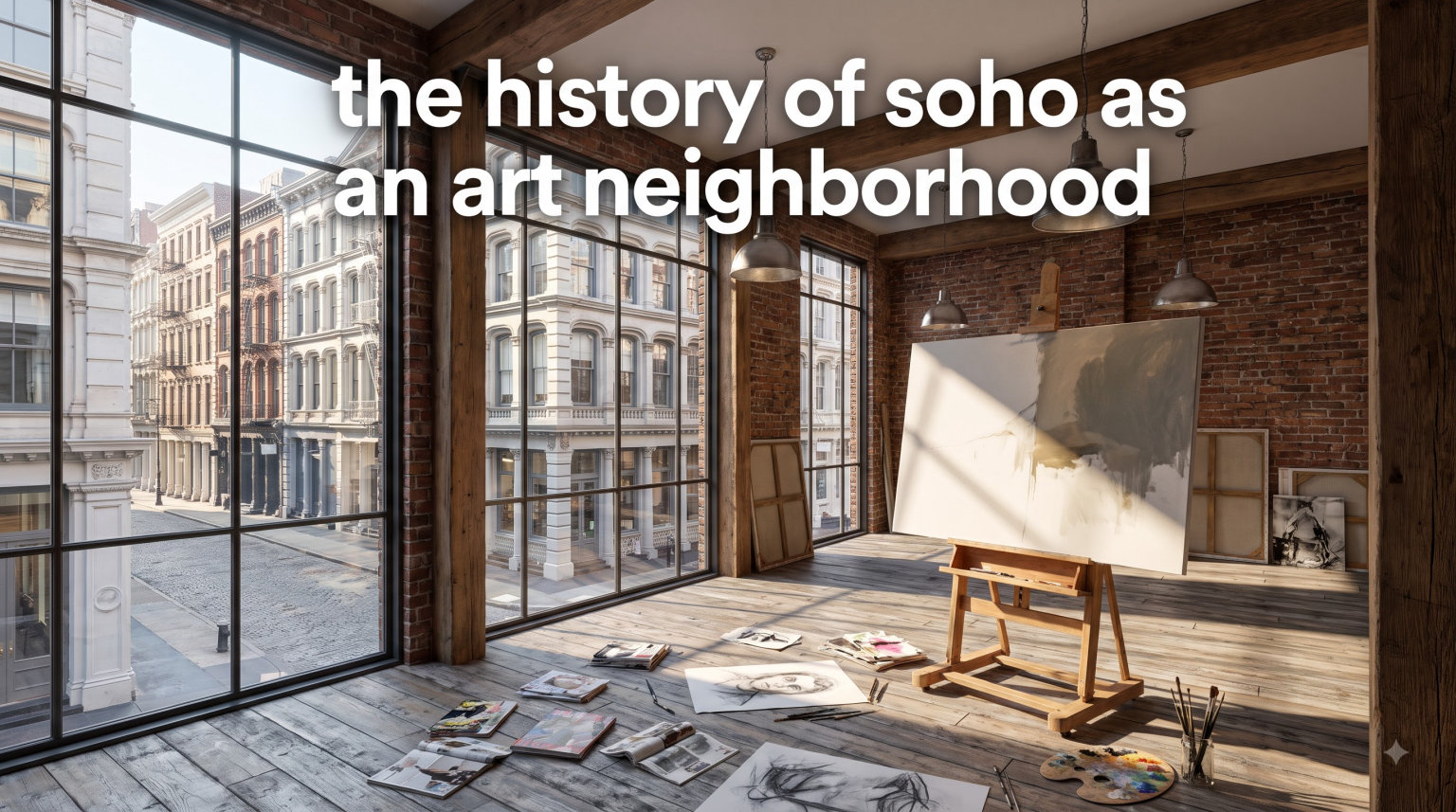
These buildings were designed for manufacturing, and their structural features reflected that purpose. The floors were reinforced to hold heavy machinery. Ceilings stretched 12 to 16 feet high. The windows were enormous, often spanning floor to ceiling, flooding the interiors with natural light that factory workers needed for detailed textile and garment work. Open floor plans allowed for flexible layouts of looms, cutting tables, and assembly lines.
The neighborhood became a hub for the textile and dry goods trade. Merchants, garment manufacturers, and fabric wholesalers filled the buildings along Broadway, Mercer Street, and Prince Street. Freight wagons and later trucks clogged the cobblestone streets. It was busy, noisy, and profitable.
But after World War II, the industrial landscape of New York changed rapidly. Manufacturing moved to the suburbs and overseas. Factories closed, and warehouses emptied. By the late 1950s, large sections of the district sat abandoned. Buildings that had once hummed with productive activity were dark, drafty, and available for practically nothing.
The city’s planning establishment viewed these empty buildings as blight. Robert Moses, the powerful city planner, proposed demolishing large portions of the area to build the Lower Manhattan Expressway, a massive highway that would have cut straight through what is now SoHo. That highway plan, ultimately defeated by community opposition, would have erased the neighborhood entirely. The defeat of the expressway in the late 1960s preserved the buildings that artists would soon claim as their own.
When Artists Discovered SoHo: The 1960s Arrival
The first artists began drifting into the empty factory district in the late 1950s and early 1960s. They came for the same reasons the factories had once been there: the spaces were enormous, and they were cheap. Painters, sculptors, and performers working in the Abstract Expressionist tradition and the emerging avant-garde movements needed room to create large-scale work. They found it in SoHo’s abandoned upper floors.
A typical SoHo loft might run 2,000 to 5,000 square feet, with soaring ceilings and those massive industrial windows that let in incredible natural light. In the early 1960s, artists were paying somewhere between $30 and $75 a month for these spaces. That was a fraction of what even a small apartment cost elsewhere in Manhattan. The catch was that living in these lofts was illegal.
The buildings were zoned for manufacturing, not residential use. There were no residential certificates of occupancy. That meant no legal right to live there, no heat in many buildings, and no basic residential services. Artists who moved in were technically trespassing or violating zoning codes. The city could, and occasionally did, evict them.
To address this precarious situation, artists developed the Artist in Residence, or AIR, system. They posted small signs on their building entrances indicating that artists were living and working inside. These AIR signs were not official city documents. They were a community-created signal, partly a declaration of presence and partly a practical measure. In theory, the signs informed fire departments that people were inside buildings that were officially unoccupied.
The atmosphere of early SoHo was raw and unfinished in the best and worst ways. The streets were largely empty at night. There were few restaurants, no grocery stores, and minimal foot traffic after the remaining factory workers went home. Heat was unreliable. Elevators were freight lifts, if they worked at all. The floors were unfinished wood or concrete, the walls exposed brick and plaster.
But the creative energy was electric. The Fluxus art group, an international network of experimental artists, composers, and designers, was among the early artistic community in the area. George Maciunas, the Lithuanian-American artist who organized Fluxus, established the Fluxhouse Cooperatives in SoHo, purchasing buildings and converting them into artist housing. These cooperatives were among the first organized efforts to create legal artist housing in the district.
Word spread through the art world quickly. If you were a young artist in New York in the mid-1960s and you needed a big space you could actually afford, SoHo was the place. The relationship between street art and gallery art would later evolve in SoHo in fascinating ways, but in the beginning it was simply about survival: finding a place to work when conventional options were too expensive.
The Battle for Loft Living: SoHo Artists Association and Legalization
By the late 1960s, hundreds of artists were living and working in SoHo lofts, but their situation remained legally precarious. The city could raid buildings, issue violations, and force evictions at any time. Artists needed a way to make their presence legitimate, and that required changing New York City’s zoning laws and building codes.
The SoHo Artists Association formed in the late 1960s to tackle exactly this problem. This grassroots organization brought artists together to advocate for their right to live and work in the district. The association met regularly, organized politically, and lobbied city officials. It was, in many ways, the first time the neighborhood’s artists had acted as a unified political force.
Their efforts paid off. In 1971, New York State passed an amendment to the Multiple Dwelling Law, known as Article 7-C or the Loft Law, which created a legal pathway for artists to live in manufacturing-zoned buildings. Under this law, artists who could demonstrate they were certified by the city’s Department of Cultural Affairs as “artists in residence” could legally occupy their lofts, provided the buildings met certain safety standards.
The certification process itself became a defining feature of SoHo life. To qualify for legal residency, an artist had to prove they were a practicing fine artist, reviewed by a panel of their peers. This was not a casual process. The city maintained a list of certified artists, and being on that list was essential for staying in your home. It created an unusual situation where your identity as an artist was not just a personal calling but a legal necessity.
The Loft Law required building owners to bring their properties up to residential code over time, including installing proper heating, plumbing, and fire safety systems. Many landlords resisted, preferring to sell to developers or wait for the neighborhood’s rising property values to make eviction more profitable. The tension between artists, landlords, and the city dragged on for years, with the SoHo Artists Association and later the SoHo Tenants Association fighting continuous legal and political battles.
Chester Rapkin, the same urban planner who had coined the name “SoHo,” played a key role in legitimizing the artist community. His 1962 study for the city documented that artists were already living in the area in significant numbers and argued that their presence was not a problem but an opportunity. His research provided the factual basis for eventual policy changes.
The community that emerged during this struggle was remarkably tight-knit. Artists organized shared resources: playgroups for children, bulk purchasing of building materials, informal security networks. Oral histories from the era describe a neighborhood where everyone knew each other, where you could walk down the street and visit a dozen studios in an afternoon, where collaboration and mutual support were the norm, not the exception.
The Gallery Scene: SoHo as the Center of Contemporary Art in the 1970s and 1980s
Once artists established themselves in SoHo, galleries followed. The transformation happened fast. In 1968, Paula Cooper opened the first gallery in the neighborhood at 96 Prince Street. Her inaugural exhibition featured the work of artists associated with the Minimalist and Conceptual art movements, including Sol LeWitt, Robert Ryman, and Carl Andre. The show was a statement: serious art was happening south of Houston Street, and the art world needed to pay attention.
Other galleries followed quickly. By the mid-1970s, West Broadway had become a gallery corridor. Leo Castelli, one of the most influential art dealers of the 20th century, moved his gallery from the Upper East Side to 420 West Broadway in 1971. Ileana Sonnabend opened her gallery nearby. Holly Solomon established her gallery on West Broadway as well. Within a few years, dozens of galleries lined the main streets of SoHo.
These were not small operations. Castelli had launched the careers of Jasper Johns, Robert Rauschenberg, and Frank Stella. Sonnabend was a bridge between American and European contemporary art. When galleries of this caliber moved to SoHo, collectors, critics, and curators followed. The neighborhood became the place where the art world conducted its business.
The artists who showed in SoHo galleries during this era reads like a who’s who of late 20th century art. Donald Judd occupied an entire cast-iron building at 101 Spring Street as his home and studio, filling it with his signature minimalist sculptures and the work of other artists he admired. Dan Flavin created his fluorescent light installations in SoHo spaces. Bruce Nauman, Eva Hesse, and Robert Smithson all had significant gallery presence in the neighborhood.
Andy Warhol maintained his Factory nearby and was a constant presence in the SoHo scene. Jean-Michel Basquiat, who emerged from the downtown graffiti and Neo-Expressionist movements, showed in SoHo galleries and embodied the neighborhood’s blend of street credibility and high-art ambition. The 1973 exhibition “Graffiti Art ’73” at Artists Space on Wooster Street was one of the first gallery shows to treat street art as a serious artistic practice.
What made SoHo’s gallery scene different from the previous generation’s gallery districts, like the 57th Street corridor or the Upper East Side, was its openness. The spaces were large, raw, and accessible. You could walk into a gallery on a Saturday afternoon and find yourself standing next to a famous artist, a major collector, or a curator from the Museum of Modern Art. There was a democratic energy to it that the more rarefied uptown galleries never quite achieved.
Central to the social life of this community was Restaurant Food, a pioneering eatery opened in 1971 by artists Carol Goodden and Gordon Matta-Clark at 127 Prince Street. Restaurant Food was not just a place to eat. It was an artwork in itself, a social sculpture where the act of preparing and sharing meals was treated as a creative practice. The restaurant became the unofficial clubhouse of the SoHo art world. Artists, critics, and curators gathered there nightly, and the kitchen itself functioned as a kind of performance space.
Matta-Clark, who would become famous for his “building cuts,” large-scale architectural interventions where he literally sliced through buildings, was a fixture in the SoHo scene. His work embodied the neighborhood’s spirit: taking the existing industrial fabric of the city and transforming it into something new and unexpected. Restaurant Food operated in that same spirit until it closed in 1973, but its influence on the intersection of art and food culture lasted for decades.
At its peak, SoHo hosted over 200 galleries, making it the densest concentration of contemporary art galleries in the world. For anyone interested in the galleries throughout NYC and their history, understanding SoHo’s 1970s-80s boom is essential. The neighborhood functioned as an engine of artistic production and distribution, connecting artists to a global network of collectors and institutions.
The Transformation: Gentrification and the End of an Era
The very success of SoHo’s artist community planted the seeds of its undoing. As the neighborhood became famous for art, it attracted attention from outside the creative world. Real estate developers, retailers, and wealthy buyers recognized that the same qualities artists valued, large spaces, distinctive architecture, and cultural cachet, made SoHo incredibly desirable for commercial and residential development.
Rents began climbing in the 1980s and accelerated sharply in the 1990s. Galleries that had signed cheap leases in the 1970s found that their renewals came with dramatically higher costs. Artists who owned their lofts saw property tax assessments soar. Artists who rented faced eviction as landlords realized they could charge far more to professionals, executives, and celebrities than to painters and sculptors.
Commercial development followed the money. Chain stores and luxury boutiques began replacing galleries along West Broadway and Spring Street. Prada opened a flagship store designed by Rem Koolhaas at 575 Broadway in 2001, a $40 million architectural statement that symbolized the neighborhood’s transformation from gritty artistic outpost to luxury shopping destination. The Apple Store, Chanel, and dozens of other high-end retailers followed.
The artist exodus happened gradually, then all at once. By the mid-1990s, many galleries had relocated to Chelsea, where former industrial spaces offered the same kind of large, flexible layouts that SoHo had once provided, but at lower rents. Artists moved to Williamsburg, DUMBO, and later Bushwick in Brooklyn, following the same pattern their predecessors had followed into SoHo decades earlier: find cheap industrial space, move in, build community.
The scholar Aaron Shkuda, in his book “The Lofts of SoHo,” argues that the neighborhood’s trajectory demonstrates the inherent tension in arts-led development. Artists make neglected areas desirable, but that desirability eventually pushes the artists out. SoHo became a case study in how this cycle works, one that urban planners and city officials have studied ever since.
By the 2000s, the transformation was largely complete. SoHo was one of the most expensive neighborhoods in Manhattan. The cast-iron facades were beautifully restored, the cobblestone streets were immaculate, and the lofts were worth millions. But the artists who had made the neighborhood what it was were largely gone.
SoHo Today: What Remains of the Art Neighborhood
SoHo in 2026 is a very different place from the bohemian enclave of the 1970s. The streets are crowded with shoppers, tourists, and fashion photographers. Luxury boutiques line the major commercial strips. Apartments in former artist lofts sell for tens of millions of dollars. The neighborhood’s Instagram appeal has largely replaced its avant-garde edge.
But the art world has not disappeared entirely. Several important institutions remain. The Drawing Center, founded in 1977 at 35 Wooster Street, continues to present exhibitions of drawing in all its forms. Artists Space, one of the first alternative art spaces in the neighborhood, still operates, though it has moved from its original location. The Leslie-Lohman Museum of Art, dedicated to LGBTQ+ art, maintains a presence in the district.
The cast-iron architecture that artists fell in love with is now fiercely protected. The SoHo-Cast Iron Historic District, designated by the Landmarks Preservation Commission in 1973 and expanded in 2010, encompasses approximately 500 buildings. These structures are among the most photographed and admired examples of 19th century commercial architecture anywhere. The landmark designation ensures they will survive, even as the uses inside them continue to change.
A few galleries still operate in SoHo, and some newer spaces have opened, drawn by the neighborhood’s enduring cultural prestige. But the critical mass that once made SoHo the center of the art world has dispersed across the city. Chelsea, the Lower East Side, and neighborhoods in Brooklyn now carry the creative energy that SoHo once generated.
The legacy of SoHo as an art neighborhood extends far beyond Manhattan. The model of artists transforming industrial spaces into creative communities has been replicated in cities around the world, from Berlin’s Kreuzberg to London’s Shoreditch to Los Angeles’s Arts District. Every time a group of artists moves into an abandoned warehouse district and begins building a creative community, they are following the template that SoHo pioneered.
Key Dates in the History of SoHo as an Art Neighborhood
1811: Collect Pond is filled in, creating new land for industrial development south of Houston Street.
1850s-1880s: Cast-iron building boom transforms the area into a manufacturing and textile district.
Early 1960s: Chester Rapkin coins the name “SoHo” (South of Houston) in a city housing study.
Mid-1960s: First wave of artists moves into abandoned factory lofts, living illegally in manufacturing-zoned buildings.
Late 1960s: George Maciunas establishes Fluxhouse Cooperatives to create organized artist housing.
1968: Paula Cooper opens the first gallery in SoHo at 96 Prince Street.
1971: New York passes the Loft Law (Article 7-C of the Multiple Dwelling Law), legalizing artist occupancy in manufacturing buildings.
1971: Restaurant Food opens at 127 Prince Street, becoming the social hub of the art community.
1971: Leo Castelli moves his influential gallery to 420 West Broadway.
1973: The Landmarks Preservation Commission designates the SoHo-Cast Iron Historic District.
1973: “Graffiti Art ’73” at Artists Space becomes one of the first gallery exhibitions of street art.
Late 1970s-1980s: SoHo gallery boom peaks with over 200 galleries operating in the neighborhood.
1980s-1990s: Gentrification accelerates; rents rise sharply; galleries and artists begin leaving.
1990s-2000s: Major galleries relocate to Chelsea; luxury retail replaces galleries along main streets.
2001: Prada opens a flagship store designed by Rem Koolhaas, symbolizing the neighborhood’s commercial transformation.
2026: SoHo remains an upscale shopping and residential district with a few surviving art institutions and protected cast-iron architecture.
FAQs
Is SoHo known for art?
Yes, SoHo is historically one of the most important art neighborhoods in the world. Between the 1970s and 1990s, it was home to over 200 galleries and hosted the work of artists like Andy Warhol, Jean-Michel Basquiat, and Donald Judd. While the gallery scene has largely moved to Chelsea and Brooklyn, SoHo’s identity as an art neighborhood remains a defining part of its cultural legacy.
What is the SoHo neighborhood known for?
SoHo is known for its distinctive cast-iron architecture, its history as an artist and gallery district, and its current status as an upscale shopping and residential neighborhood. It contains the largest concentration of cast-iron buildings in the world and was designated the SoHo-Cast Iron Historic District in 1973. The neighborhood’s cobblestone streets and landmark buildings make it one of the most photographed areas in Manhattan.
What is the story behind SoHo?
SoHo began as an industrial and manufacturing district in the 1800s, filled with cast-iron warehouses and textile factories. After World War II, industry left and the area fell into decline. In the 1960s, artists began moving into the empty factory lofts illegally, attracted by the large spaces, natural light, and cheap rent. The artist community fought for and won legal recognition in 1971 through the Loft Law. The neighborhood then became the center of the contemporary art world in the 1970s and 1980s before gentrification transformed it into a luxury shopping district.
When did SoHo become a thing?
SoHo emerged as a distinct neighborhood in the early-to-mid 1960s when urban planner Chester Rapkin coined the name ‘SoHo’ (South of Houston Street) in a city housing study. The neighborhood gained its artistic identity between 1968 and 1971, when the first galleries opened and the Loft Law legalized artist residency in the district. By the mid-1970s, SoHo was internationally recognized as a major art center.
What was the old name for SoHo New York?
Before it was called SoHo, the area had several names. In the 18th century it was part of Bloomingdale, a rural district of farms and estates. In the 19th century it was sometimes called Hellems Hook or ‘the Valley,’ referring to its low-lying terrain near the former Collect Pond. During its industrial period, it was simply known as the warehouse or factory district south of Houston Street, with no distinct neighborhood name until the 1960s.
Conclusion
The history of SoHo as an art neighborhood is a story about creativity, community, and the complicated relationship between art and real estate. What artists built in SoHo between the 1960s and the 1990s was extraordinary: a self-made creative ecosystem that became the global center of contemporary art, all constructed inside a declining industrial district that the city had largely written off.
The cast-iron buildings remain, beautifully preserved under landmark protection. A handful of galleries and art institutions carry on. But the creative community that gave SoHo its soul has scattered across New York and the world, following the same instinct that brought the first artists to those empty lofts over sixty years ago: find affordable space, fill it with art, and build something together.
Understanding the history of SoHo as an art neighborhood means understanding a fundamental truth about how cities work. Artists transform neglected places into desirable ones, and then the economics of desirability pushes them out. SoHo was the first neighborhood to live this cycle at such scale, and its story continues to shape how cities think about art, development, and community in 2026.