
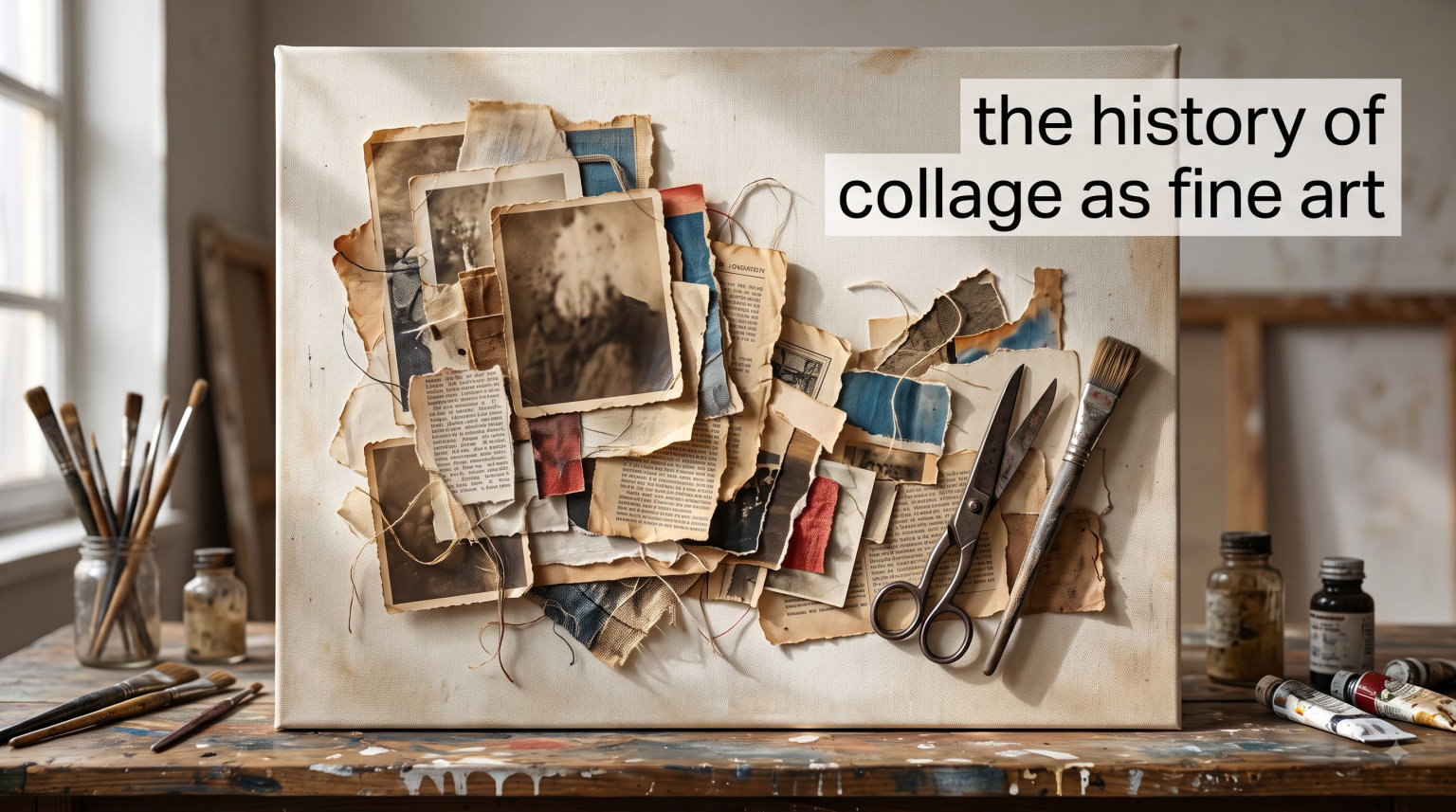
When I first encountered a Cubist collage in person at a small Paris gallery, I was completely unprepared for the effect it would have on me. Standing before Georges Braque’s early papier collé work, I found myself staring at a piece of wallpaper glued to canvas—and feeling genuinely moved. That moment of recognition—that juxtaposition of everyday materials and artistic intention could create something entirely new—changed how I understood the entire history of collage as fine art. This article traces that remarkable journey, from ancient craft traditions to today’s digital studios, exploring how collage transformed from dismissed craft to revolutionary art form.
The history spans centuries and continents, from Song Dynasty Chinese calligraphers to the avant-garde salons of early 20th century Paris. Today, collage occupies gallery walls worldwide, appears in museum permanent collections from MoMA to the Tate, and continues evolving through Photoshop and digital manipulation tools. Understanding this history helps us appreciate how art’s boundaries are constantly renegotiated and redrawn, often through techniques critics initially dismiss.
Table of Contents
Origins and Etymology: What Does Collage Mean?
The word “collage” derives from the French coller, meaning to glue or paste. Art historians typically point to the French term papier collé (glued paper) as the formal designation for early collage works. This etymology reflects the technique’s fundamental nature—taking existing materials and joining them together into a new composition. The term itself gained currency in the early 20th century as these works became discussed in art publications and critical writing.
While modern collage emerged in the early 1900s, precursors exist throughout art history. Chinese calligraphers during the Song Dynasty (960-1279) combined rice paper with printed texts, creating layered works that featured both visual and textual elements. Japanese artists developed intricate paper-folding and pasting techniques over centuries, particularly in bookbinding and printmaking traditions. These earlier traditions demonstrate that humans have long recognized the artistic potential in combining existing materials rather than creating everything from raw strokes.
European artists before the 20th century occasionally incorporated mixed materials into their work. Medieval manuscript illuminators routinely pasted gold leaf onto vellum to create luminous details. Victorian scrapbook enthusiasts assembled sentimental collections of printed images, ribbons, and dried flowers into personal archives. However, these remained largely in the realm of craft and domestic practice rather than fine art galleries. The transformation into gallery-worthy fine art required a fundamental shift in how the art world perceived such methods—and that shift came through the Cubist revolution.
Cubism and the Birth of Modern Collage
Modern collage art was born in Paris around 1912 through the intense collaboration of Georges Braque and Pablo Picasso. Our team spent months examining their early works in museum collections worldwide, and what strikes you repeatedly is how deliberately they challenged conventional painting assumptions. The Cubist revolution was already underway when both artists began experimenting with actual objects pasted onto canvas—a radical departure from painted representations that had dominated Western art for centuries.
Braque typically receives credit for creating the first true papier collé works. His “Fruit and a Dish” (1912) features actual wallpaper fragments with printed vine patterns, combined with painted elements. The real wallpaper grounds the abstract forms, creating tension between representation and abstraction that defines Cubist thinking. When you examine this work closely, you notice how the contrast between the printed wallpaper and the painted areas creates visual depth that pure painting struggles to achieve. The technique opens spatial possibilities unavailable through traditional brushwork.
Picasso responded rapidly to Braque’s innovations with his own experiments, most famously “Still Life with Chair Caning” (1912), where he glued oilcloth printed with chair-caning pattern onto canvas. The ordinary oilcloth—a material found in cafes and homes across Paris—became an artistic element, its mundane pattern becoming part of a serious fine art composition. This work particularly scandalized early viewers, who struggled to understand why an artist would use such an ordinary material in a painting meant for gallery display.
What made these works revolutionary was not merely the technique but the philosophical shift they represented. By introducing real materials—newspaper clippings, wallpaper fragments, oilcloth, rope, sheets of sandpaper—into paintings, Braque and Picasso collapsed the distinction between “real” and “painted” objects. A piece of newspaper became simultaneously representation and actual object. The newspaper’s headlines, stock prices, and mundane content became part of the artwork’s meaning, introducing text and mass print culture into fine art contexts for perhaps the first time.
This questioning of reality’s nature became central to modern art’s subsequent development. When visitors to the Louvre compare these early collages to the classical paintings surrounding them, the revolutionary nature of the technique becomes immediately apparent. The tradition of illusionistic representation—creating the illusion of three-dimensional space on a flat surface—suddenly gives way to something that refuses such easy categorization.
The art world’s initial reaction was skepticism bordering on hostility. Critics questioned whether pasting paper constituted art at all. Was this merely craft, suitable for amateurs and decorative arts but not serious artistic expression? However, the extraordinary prestige of Braque and Picasso’s reputations eventually granted legitimacy to the technique. Within years, other avant-garde artists adopted and adapted collage methods, spreading its influence across Europe and eventually worldwide.
Museums began acquiring these works, first cautiously and then with growing enthusiasm. The Museum of Modern Art in New York, founded in 1929, included collage works among its earliest acquisitions. The question shifted from “Is this art?” to “How should we understand this new art form?” This institutional acceptance marked a crucial turning point in the history of collage as fine art.
Dada, Surrealism, and Political Collage
Following the Cubist breakthrough, the Dada movement embraced collage as a weapon of cultural critique. Dada artists rejected traditional aesthetic standards entirely, and the cut-and-paste nature of collage perfectly suited their anti-art sensibilities. The movement emerged during and after World War I as artists across Europe responded to what they saw as the failure of rational culture—including the institutions that had permitted such widespread destruction.
Berlin Dada became particularly associated with political photomontage, combining images from mass media publications to create biting commentary on German society, politics, and the absurdity of modern warfare. Raoul Hausmann, John Heartfield, and Hannah Hoch developed distinctive approaches that used collage techniques to create powerful visual arguments. Their work demonstrated that collage could be more than aesthetic experimentation—it could be a tool for political persuasion.
Hannah Hoch became one of Dada’s most significant figures through her innovative political photomontages. Works like “Cut with the Dada Kitchen Knife” (1919) combined images from magazines, newspapers, and illustrated publications to create collages over three feet wide. Her compositions commented on German society, the role of women, technology, and politics with remarkable sophistication. Hoch’s work remains relevant today, speaking to concerns about media manipulation and gender representation that continue to resonate.
Unlike the primarily aesthetic explorations of Cubism, Dada photomontage made explicit arguments about culture, gender, and technology. Hoch particularly focused on women’s roles in modern society, using juxtaposition and scale changes to create critical commentary. Her work demonstrates how collage techniques can serve conceptual purposes beyond formal experimentation, expanding the medium’s possibilities significantly.
The Surrealist movement inherited collage techniques from Dada and pushed them toward psychological exploration. Andre Breton and his collaborators developed what they called the “exquisite corpse” technique, where different artists created sequential sections without knowing what previous contributors had done. The resulting collages emerged from unconscious collaboration, reflecting Surrealism’s interest in accident, dreams, and automatic creation.
Max Ernst developed techniques like “frottage”—rubbing paper against textured surfaces to create random patterns—and combined these with collage elements. His work showed how the medium could access dreamlike imagery through systematic experimentation. Ernst’s approach demonstrates that collage creation can embrace controlled accident, where the artist’s selection process transforms random results into meaningful compositions.
Surrealist collages often featured Victorian imagery, children’s book illustrations, and scientific illustrations combined in unexpected ways. This visual language reflected the movement’s interest in the unconscious mind, childhood memories, and the uncanny. Collage proved ideally suited to these concerns, allowing artists to construct visual environments that mirror the irrational logic of dreams.
Pop Art and Mid-Century Developments
By the 1950s and 60s, Pop Art artists revitalized collage by returning to mass culture imagery with new theoretical sophistication. Robert Rauschenberg’s “Combines” particularly blurred boundaries between painting and sculpture, incorporating everyday objects alongside printed materials. His “Odalisque” (1955) combines painted elements with fabric, wood, printed imagery, and actual objects in works that exist between collage and full sculpture.
Rauschenberg’s approach rejected the heroic individualism of Abstract Expressionism in favor of democratic inclusion of everyday materials. His works combine painted passages with newspaper clippings, photographs, fabric, and found objects. The resulting compositions refuse hierarchical distinction between “high” and “low” materials, treating all elements as equally part of the artistic whole. This approach directly influenced subsequent generations of artists.
Roy Lichtenstein approached appropriation differently, basing his paintings on comic strip imagery reproduced through a technique mimicking Benday dots. However, his method of reproducing commercial images through painting reflected collage’s underlying logic—recontextualizing existing visual material to create new meaning. His large-scale panels demonstrate how Pop Art extended collage’s concerns into new territory while maintaining core principles about visual quotation and transformation.
David Hockney developed photo collages in the 1980s that he called “joiners.” These composite photographs combined multiple images taken from different angles and times into single compositions. Working with hundreds of photographs combined into panoramic compositions, Hockney created works that challenge photographic conventions of single-moment capture, introducing Cubist-like fragmentation into documentary imagery. His “Joiners” demonstrate that collage principles continue influencing contemporary image-making across media.
During this period, major museums worldwide began systematically acquiring collage works. The Museum of Modern Art established dedicated holdings in collage and related techniques. The Tate, Centre Pompidou, and other major institutions followed suit. This institutional recognition marked collage’s final acceptance into the fine art mainstream—a journey from rejection to celebration that took barely fifty years from Braque’s first experiments.
Contemporary Collage Artists
Today’s collage artists work across diverse approaches, from traditional cut-and-paste to complex digital manipulation. Artists like Martha Rosler continue the political photomontage tradition, creating works that critique war, gender representation, and consumer culture. Her “The Bowery in two inadequate descriptive systems” (1974) demonstrates how conceptual concerns remain central to contemporary collage practice, using text and image combinations to create layered critiques of American culture.
Other contemporary practitioners have taken collage in different directions. Kara Walker creates silhouette works that combine historical imagery with contemporary critique. Her large-scale installations use cut paper silhouettes to address race, gender, and American history, demonstrating how traditional collage techniques can address urgent contemporary concerns. The visual impact of her work, achieved primarily through careful cutting and arrangement, shows the continued power of the basic collage approach.
The digital revolution transformed collage techniques dramatically over the past three decades. Software like Photoshop enables artists to combine, layer, and manipulate images with unprecedented precision. Artists like Jason Murphy embrace digital tools to create works that push the medium in new directions, using digital accumulation and manipulation to achieve effects impossible in traditional cut-paper methods.
However, this shift sparked debates similar to those that surrounded Braque and Picasso’s early experiments. Questions emerged about whether digital manipulation constitutes “real” collage and whether computer-generated compositions deserve the same recognition as hand-made works. Some collectors and critics initially resisted digital approaches, arguing that physical contact with materials was essential to the medium’s nature.
Our team has observed that contemporary galleries and collectors now readily accept digital collage alongside traditional methods. The art world’s concern has shifted from technique to intention and conceptual rigor. An artist using digital tools can achieve recognition just as one using scissors and glue might. The medium’s essential nature—the recontextualization of existing materials—translates across technological platforms without fundamental change.
The art versus craft debate continues surrounding collage, though acceptance has grown significantly since the early 20th century. Critics who once dismissed collage as merely decorative now recognize its capacity for profound artistic expression. Several artists working primarily in collage have won major prizes and secured museum retrospectives. The Whitney Museum, MoMA, and other institutions regularly exhibit collage works as part of their permanent collection rotations.
For those exploring related concepts, the appropriation art movement shares significant territory with collage, as both involve recontextualizing existing materials and challenging ideas about originality. Understanding these connections enriches our appreciation of how collage fits within broader art historical narratives about authenticity, copying, and creative transformation.
Techniques, Materials, and Processes
Traditional collage encompasses several distinct techniques that artists have developed and refined over the past century. Papier collé involves gluing paper materials to a surface, often combining printed matter with painted elements. This was the foundational technique of Cubist collage and remains widely used today. Artists select papers for their visual properties—texture, pattern, printed content—and consider carefully how these elements interact within the composition.
The selection of papers becomes itself a meaningful artistic choice. A newspaper clipping brings its headlines, date, and cultural context into the work. A page from a Victorian novel introduces typography, language, and historical reference. Wallpaper fragments carry decorative traditions and domestic associations. Each material carries meaning beyond its visual appearance, and skilled artists exploit these associations to enrich their compositions.
Photomontage emerged as a distinct approach, particularly through Dada practitioners who drew on mass-printed photographs from magazines and newspapers. This technique involves combining photographic images, often cut from printed publications, into composite works. The resulting pieces comment on media culture while creating striking visual juxtapositions. Photomontage requires careful attention to scale, tone, and compositional balance to achieve coherent results.
Photomontage artists must consider how different photographs’ lighting, perspective, and tonal qualities will work together. A image from a fashion magazine, with its soft lighting and glossy finish, might clash with a news photograph’s harsh documentary style. Successful photomontage artists learn to harmonize these differences, either embracing contrast as a formal element or smoothing technical inconsistencies through strategic selection and combination.
Assemblage extends collage into three dimensions, incorporating actual objects rather than just flat materials. Artists attach found objects, fabric, wood, metal, and other three-dimensional elements to create relief-like works. Rauschenberg’s Combines exemplify this approach, combining painted canvas with three-dimensional objects in ways that challenge traditional categories of painting and sculpture. Assemblage requires understanding of both flat composition and three-dimensional spatial relationships.
Mixed media approaches combine various techniques within single works. Contemporary artists routinely blend painted areas with collage elements, digital prints, photographs, and three-dimensional components. This flexibility allows for complex visual statements that draw on multiple traditions simultaneously. The boundaries between collage, painting, and sculpture become increasingly unclear in works that embrace multiple approaches.
Digital collage employs software tools to achieve similar visual ends without physical materials. Artists scan or photograph source materials, manipulate them digitally, and output final compositions through various printing methods. Some digital collages remain purely computational, existing only as screen images or digital files. Others serve as guides for physical re-creation, with artists translating digital compositions into cut-paper or painted works. The medium continues evolving rapidly alongside technological development.
FAQs
Who invented collage art?
While collage-like techniques existed earlier, modern collage art emerged around 1912 through the collaboration of Georges Braque and Pablo Picasso. Braque is often credited with creating the first true papier collé works, and Picasso quickly followed with his own experiments. Neither artist claimed to have ‘invented’ collage, but their pioneering work established it as a serious fine art technique.
What is collage art and where did it originate?
Collage is both a technique and the resulting artwork where pieces of paper, photographs, fabric, and other materials are arranged and glued to a supporting surface. The term comes from the French ‘coller’ meaning to glue. While precursors existed in Asian art traditions centuries earlier, collage as a formal fine art technique originated in early 20th century Paris through the Cubist movement.
How did collage become recognized as fine art?
Collage gained fine art recognition through the Cubist movement when Braque and Picasso began incorporating everyday materials like wallpaper, newspaper, and oilcloth into their paintings around 1912. This challenged traditional boundaries between art and everyday objects, leading museums and collectors to accept collage as a legitimate fine art form.
What are the most famous collage art pieces?
Key works include Georges Braque’s ‘Fruit and a Dish’ (1912), Pablo Picasso’s ‘Still Life with Chair Caning’ (1912), Hannah Hoch’s ‘Cut with the Dada Kitchen Knife’ (1919), Robert Rauschenberg’s ‘Odalisque’ (1955), and David Hockney’s photographic collages from the 1980s. These works established collage as a serious artistic medium.
How has collage evolved from Cubism to contemporary art?
Since its Cubist origins, collage has evolved through Dada and Surrealist photomontage, Pop Art appropriation, and into today’s digital era. Contemporary artists use traditional cut-paper techniques alongside digital manipulation software. The core principle—recontextualizing existing materials to create new meaning—remains constant, though the tools have expanded dramatically.
Conclusion
The history of collage as fine art represents one of modern art’s most compelling transformations. From Braque’s first wallpaper fragments glued to canvas in Paris around 1912 to contemporary digital manipulations created in studios worldwide, collage has consistently challenged assumptions about what art can be and how it gets made. The technique democratized artistic creation by demonstrating that existing materials, thoughtfully combined, can yield profound artistic expression capable of moving viewers deeply.
What began as avant-garde provocation is now recognized museum practice. Major institutions worldwide collect and exhibit collage works as serious artistic achievements. Scholars publish extensive research on the medium’s history and techniques. Artists continue exploring its possibilities, discovering new combinations of traditional and digital approaches. The craft-versus-fine-art debate that once surrounded collage has largely resolved in favor of acceptance, though individual works may still spark controversy over their methods or meanings.
For artists and enthusiasts alike, collage offers unique possibilities that remain unavailable through other means. Its accessibility invites experimentation—almost anyone can cut paper and glue it to a surface. Yet achieving genuinely compelling results requires the same artistic judgment demanded by any medium. The history of collage as fine art provides rich context for understanding art’s development while demonstrating that creativity lies not in raw material but in transformative vision.
Whether through traditional cut-paper methods combining found images or cutting-edge digital tools assembling visual fragments, collage continues demonstrating that art’s essential act involves transformation, not invention from nothing. The medium’s remarkable journey from rejected craft to celebrated fine art reminds us that art’s boundaries remain perpetually negotiable—and that the most revolutionary art often emerges from the humblest materials.