
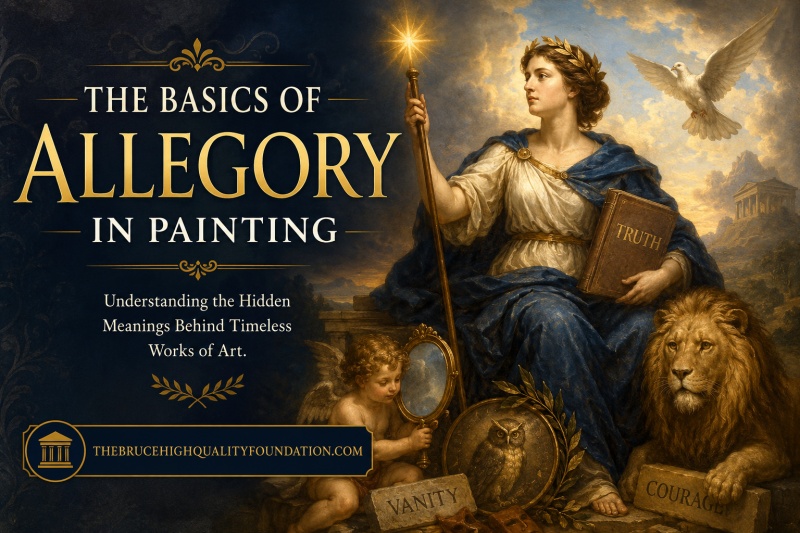
Allegory in painting is when the subject of an artwork, or the various elements within its composition, symbolize a deeper moral or spiritual meaning. A painting of a woman holding scales is not just a portrait. It represents justice. A skull sitting on a table is not merely a still life prop. It speaks to the certainty of death and the fleeting nature of earthly pursuits. Understanding allegory opens a hidden layer of meaning in some of the most celebrated paintings in art history, and this guide will walk you through everything you need to know.
Our team has spent years studying and teaching art history, and we have found that allegory is one of the most rewarding concepts to grasp. Once you learn to read these visual narratives, every museum visit becomes a richer experience. You start seeing the “story within the story” that art historians and Reddit communities alike find so compelling.
Whether you are an art student working through your first survey course, a painter looking to add conceptual depth to your work, or simply someone who wants to appreciate museum collections more fully, this guide covers the basics of allegory in painting from definition to hands-on practice.
Table of Contents
What Is Allegory in Painting?
Allegory in painting refers to a visual strategy where artists use figures, objects, and actions to represent abstract ideas that go far beyond what appears on the canvas surface. The word comes from the Greek allos (meaning “other”) and agoreuein (meaning “to speak publicly”). Together, they literally mean “to speak otherwise,” which captures exactly what allegorical paintings do: they communicate one idea by presenting another.
Think of it as an extended metaphor rendered in paint. A single painting can tell a surface-level story while simultaneously conveying a philosophical argument, a moral lesson, or a political critique. The beauty of allegory lies in how it rewards careful observation. The more you look, the more meaning you uncover.
Allegory differs from simple symbolism because it operates at the level of an entire narrative, not just individual objects. While a symbol might represent one idea (a dove means peace), an allegory weaves multiple symbols together into a coherent story with a moral or philosophical point. We will explore this distinction more deeply later in the article.
The Three Main Features of Allegory
Every allegorical painting shares three core characteristics:
- A surface narrative. The painting depicts a recognizable scene: figures interacting, objects arranged, a landscape unfolding. This surface story needs to make sense on its own. You can appreciate it without knowing the deeper meaning.
- A deeper message. Beneath the surface, the composition carries a second, more abstract meaning. This might be a moral lesson about virtue, a political statement about power, a religious truth about salvation, or a philosophical reflection on mortality.
- Consistent symbolic logic. The symbols within the painting follow an organized system. A figure representing Justice does not randomly hold a guitar in one painting and scales in another. The visual language follows conventions that educated viewers of the time would recognize.
When all three features work together, the painting operates on two tracks simultaneously, and that duality is what makes allegory so powerful as an artistic tool.
The History of Allegory in Art
Allegory has been a driving force in Western painting for centuries, evolving alongside the cultures that produced it. The tradition has roots in classical antiquity, where Greek and Roman artists personified abstract concepts as gods and mythological figures. But it was during the Renaissance that allegory truly flourished as a painting tradition.
Renaissance Allegory
During the Renaissance (roughly the 14th through 16th centuries), painters rediscovered classical texts and embraced the idea that art could teach as well as delight. Artists like Sandro Botticelli created paintings where mythological scenes served as vehicles for Neoplatonic philosophy. His Primavera (around 1482) is not just a gathering of mythological figures in a garden. It is a meditation on love, beauty, and the awakening of nature, layered with references to Renaissance literary culture.
Renaissance allegory often drew on a tradition called impresa, where personal emblems combined images and mottoes to represent an individual’s values or aspirations. Painters wove these emblems into portraits and historical scenes, creating works that communicated on multiple levels to viewers educated enough to decode them.
Baroque Allegory
The Baroque period (17th century) took allegory to new heights of drama and complexity. Artists like Peter Paul Rubens and Nicolas Poussin constructed elaborate allegorical programs that filled entire ceilings and gallery walls. Baroque allegory tended to be more theatrical, with dynamic compositions and intense contrasts of light and shadow that amplified the emotional weight of the moral message.
One particularly rich vein of Baroque allegory was the vanitas still life. These paintings featured skulls, extinguished candles, wilting flowers, overturned goblets, and scattered books. Each object symbolized the transience of earthly pleasures and the inevitability of death. Viewers were meant to reflect on their own mortality and the futility of material pursuits.
Neoclassical to Modern Allegory
Neoclassical painters in the 18th and 19th centuries used allegory for political and civic purposes. Jacques-Louis David’s compositions often personified ideals like liberty, sacrifice, and civic virtue. These paintings were not subtle. They were designed to inspire specific political feelings in a broad audience.
As art moved into the modern era, allegory became less dominant but never disappeared. Surrealists like Salvador Dali used dreamlike imagery as allegory for the unconscious mind. Contemporary artists continue to employ allegorical strategies, sometimes openly and sometimes encoded in personal symbolism. The tradition of using visual narratives to convey deeper truths remains very much alive in 2026.
Key Elements: Symbolism and Personification
Two techniques form the backbone of allegorical painting: symbolism and personification. Understanding how each works is essential for reading allegory in any era of art.
How Personification Works in Allegory
Personification is the practice of representing an abstract concept as a human figure. This is the most recognizable feature of allegorical painting. A woman in flowing robes holding a sword and scales is not a specific person. She is Justice. A winged boy with a bow and arrow is not a child. He is Cupid, representing desire or love.
Artists developed a rich visual vocabulary for these personifications. Each figure had standard attributes, objects consistently associated with them so viewers could identify them at a glance. This visual shorthand allowed painters to communicate complex philosophical ideas to audiences who understood the code. A single figure could represent an entire concept, and a group of figures interacting could represent a philosophical argument or moral narrative.
Personification also allowed artists to paint abstract ideas in a visually compelling way. Rather than writing an essay about the triumph of love over war, a painter could show Venus disarming Mars. The image is immediately engaging, and the deeper meaning unfolds as you study the details.
How Symbols Carry Deeper Meaning
While personification gives abstract ideas a human face, symbolism uses objects, animals, colors, and gestures to layer additional meaning into a composition. In allegorical painting, nearly every element can function as a symbol.
A white lily often signals purity or the Virgin Mary. A black dog might represent loyalty or, in some contexts, temptation. The direction a figure gazes can indicate spiritual aspiration or earthly distraction. Even the time of day depicted in a landscape can carry meaning: dawn suggests hope and renewal, while twilight suggests decline and mortality.
The key to reading these symbols is context. The same object can mean different things in different paintings, depending on the surrounding elements and the artistic tradition the painter is working within. This is why studying the conventions of a particular era helps so much when decoding allegorical works.
Common Symbols in Allegorical Paintings
Over centuries of allegorical painting, certain symbols became standardized. Here is a practical reference guide to some of the most frequently encountered symbols in Western allegorical art:
- Scales represent justice, balance, and judgment. Often held by a female personification of Justice.
- Skull represents mortality, the inevitability of death, and the vanity of earthly pursuits. A staple of vanitas paintings.
- Hourglass represents the passage of time, life’s brevity, and the urgency of moral reflection.
- Dove represents peace, the Holy Spirit, or divine love, depending on the context.
- Laurel wreath represents victory, honor, and poetic or military achievement.
- Mirror represents truth, self-knowledge, or vanity. Context determines whether the meaning is positive or cautionary.
- Serpent represents temptation, sin, and the fall of man, though in some classical contexts it represents wisdom or healing.
- Blindfold when worn by a figure holding scales, it represents impartial justice. In other contexts, it can represent ignorance or lack of awareness.
- Extinguished candle represents the end of life, the fragility of existence, and the passage from light into darkness.
- Books and scrolls represent knowledge, learning, and intellectual pursuits. An overturned or burning book can suggest the limits of worldly knowledge.
Keep in mind that these are conventions, not absolute rules. A skilled allegorical painter might deliberately subvert a standard symbol to create tension or irony. The surrounding composition always provides clues to the intended meaning.
Famous Allegorical Paintings and Their Meanings
Studying specific examples is one of the best ways to understand how allegory operates in practice. Here are five landmark allegorical paintings and how they work.
Sandro Botticelli, Primavera (c. 1482)
At first glance, Primavera shows mythological figures gathered in an orange grove. Venus stands at the center, Cupid hovers above her blindfolded, and the three Graces dance together on the left. Mercury clears clouds on the far left, while Flora scatters flowers and Chloris reaches toward Zephyr on the right. But this is not simply a scene from classical mythology. Scholars interpret the painting as an allegory of the awakening of nature and the transformative power of love. Each figure represents a stage in the cycle of the seasons and the progression of desire from wild passion to civilized love.
Bronzino, Venus, Cupid, Folly and Time (c. 1545)
This Mannerist masterpiece appears to be a celebration of love and beauty, with Venus and Cupid at the center of a crowded composition. Look closer and the painting reveals itself as an allegory about the dangerous consequences of lust. Folly strews rose petals, a screaming child offers a handful of honeycomb hiding a sting, and Father Time pulls back a curtain to expose the scene. Jealousy gnashes teeth in the background. The painting warns viewers that indulging in uncontrolled desire leads to suffering, deception, and regret.
Johannes Vermeer, The Art of Painting (c. 1666)
Vermeer’s The Art of Painting shows an artist at his easel painting a young woman wearing a laurel wreath, holding a trumpet and a book. She represents Clio, the muse of history. The map on the back wall and the chandelier with a double-headed eagle (a Habsburg symbol) add layers of political and cultural meaning. The painting functions as an allegory about the power and dignity of the art of painting itself, asserting that the painter’s craft deserves the same respect as poetry and history.
Artemisia Gentileschi, Allegory of Painting (c. 1638)
Gentileschi’s work is notable because it breaks from the tradition of using idealized personifications. Instead of painting an abstract figure representing Painting, she painted herself in the act of painting. This creates a powerful fusion of allegory and self-portrait. The painting asserts that real women can embody the abstract concept of artistic genius, challenging the conventions of her era. Art historians frequently point to this work as a milestone in both allegorical tradition and the history of women in art.
Pieter Bruegel the Elder, The Triumph of Death (c. 1562)
This nightmarish panorama shows an army of skeletons laying waste to a landscape filled with people from every walk of life. Kings, peasants, soldiers, lovers, and cardinals all fall before the relentless march of death. The painting is an allegory about the universality of mortality and the futility of earthly wealth, status, and pleasure. No one escapes. Every activity depicted, from feasting to gambling to making music, is rendered meaningless in the face of death’s inevitability.
How to Create Your Own Allegorical Painting
One of the most common questions we hear from students and emerging painters is how to actually create an allegorical painting. No competitor guide covers this practical process, so here is a step-by-step approach you can follow.
Step 1: Choose your central idea. Start with one abstract concept you want to explore. Keep it focused. “Love” is too broad. “The conflict between romantic passion and familial duty” gives you something concrete to work with. Write your concept in a single sentence before touching a brush.
Step 2: Develop your cast of personifications. Decide which abstract ideas need to appear as figures. If your theme is the passage of time, you might personify Youth, Maturity, and Old Age. Sketch these figures and give each one distinctive attributes that communicate their identity without labels.
Step 3: Select supporting symbols. Build a symbol list for your painting. Choose objects, animals, colors, and gestures that reinforce your theme. An hourglass, autumn leaves, and a setting sun all support a theme of decline or ending. Make sure your symbols are internally consistent so they do not confuse the viewer.
Step 4: Compose the narrative. Arrange your figures and symbols into a scene that tells a story on the surface level. Even viewers who miss the deeper meaning should find the composition engaging. The interaction between figures should suggest action and drama, not just static posing.
Step 5: Layer the deeper meaning. Step back and ask yourself whether the composition communicates your intended allegorical message. Does the arrangement of figures suggest the right relationship between the ideas you are representing? Do the symbols support the argument? Adjust until the surface story and the deeper meaning work in harmony.
Step 6: Test with viewers. Show the painting to someone who does not know your intended meaning. Ask them what they think it is about. If they pick up on at least some of the allegorical content, your visual language is working. If they see only the surface narrative, consider making your symbols more legible or your figure interactions more suggestive of the deeper theme.
Allegory vs. Symbolism: Understanding the Difference
This is one of the most common sources of confusion we encounter, and it comes up regularly in art history forums. The distinction matters because calling something allegorical when it is merely symbolic (or vice versa) can lead to misinterpreting the work.
Symbolism is the use of a specific image, object, or element to represent a single idea. A dove means peace. A red rose means love. A skull means death. Each symbol operates independently. You can add or remove a symbol from a painting without changing the fundamental narrative structure.
Allegory is an entire narrative structure built from symbols and personifications working together to convey a sustained, coherent message. Every element contributes to a single overarching argument or moral lesson. Removing one piece would weaken or break the whole structure.
A helpful way to think about it: symbolism is a word, and allegory is a sentence. A painting with symbolic elements might use a skull and an hourglass to suggest mortality. An allegorical painting would arrange those symbols within a complete narrative, perhaps showing a figure encountering mortality on a journey and being transformed by the experience. The allegory tells a story with a moral point; the symbolic painting evokes a mood or idea.
Many allegorical paintings contain symbols, but not all paintings with symbols are allegorical. If the symbols do not add up to a sustained narrative with a moral or philosophical argument, you are looking at symbolic painting, not allegory.
FAQs
What is an allegory in painting?
An allegory in painting is a visual strategy where the subject of the artwork and the elements within its composition symbolize a deeper moral, spiritual, or philosophical meaning beyond the surface image. A painting of a woman holding scales and a sword is not just a portrait — it personifies the abstract concept of justice.
What are the three main features of an allegory?
The three main features are: (1) a surface narrative that makes sense on its own, (2) a deeper moral, spiritual, or philosophical message, and (3) consistent symbolic logic where every element follows a recognizable visual language that supports the hidden meaning.
What is an example of an allegory in art?
Bronzino’s Venus, Cupid, Folly and Time (c. 1545) is a classic example. It appears to celebrate love and beauty but is actually an allegory warning about the dangerous consequences of lust. Figures like Folly, Jealousy, and Father Time each carry symbolic meaning that builds the moral argument.
How do you identify allegory in a painting?
Look for personified abstract concepts (human figures representing ideas like Justice, Love, or Death), symbolic objects arranged with clear intent rather than random placement, and an overall narrative that seems to point beyond itself. If the painting tells a story that feels like it has a moral or philosophical lesson, it is likely allegorical.
Can contemporary art use allegory effectively?
Yes. Contemporary artists continue to use allegorical strategies, often to address political, social, or environmental themes. While the specific symbols may differ from classical conventions, the core approach of using visual narratives to convey deeper meanings remains a powerful tool in modern and contemporary painting.
Conclusion
Understanding the basics of allegory in painting transforms how you experience art. What once looked like a simple portrait becomes a meditation on mortality. A mythological scene reveals itself as a philosophical argument. A still life of everyday objects becomes a moral lesson about the brevity of life.
We covered the definition and three core features of allegory, traced its development from the Renaissance through the Baroque and into contemporary practice, explored the key building blocks of personification and symbolism, and examined five famous allegorical paintings in detail. You also now have a practical six-step process for creating your own allegorical work, a topic no other guide in this space addresses.
The next time you stand in front of a painting and sense there is more happening than meets the eye, trust that instinct. Look for the figures that seem to represent ideas rather than individuals. Look for objects that seem too deliberately placed to be decorative. Look for the narrative that points beyond itself. That is allegory at work, and now you know how to read it.