
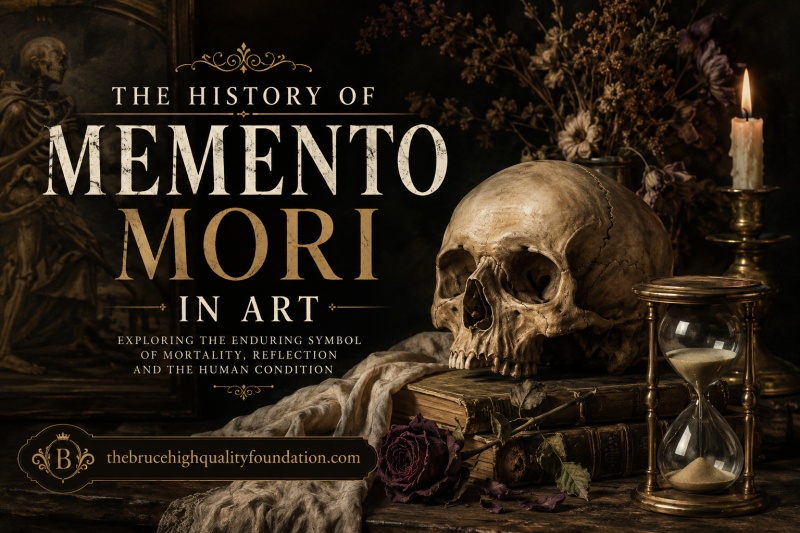
The phrase memento mori carries a weight that transcends centuries. In Latin, it translates simply to “remember you will die.” Yet this modest phrase has inspired countless works of art, shaped philosophical movements, and influenced how entire civilizations have grappled with the certainty of death. The history of memento mori in art spans over two thousand years, weaving through ancient philosophy, medieval devotion, Renaissance portraiture, and contemporary expression.
Artists have always understood that confronting mortality can clarify what matters most. By placing skulls, hourglasses, and other symbols of death before viewers, they invite us to pause, reflect, and reconsider our priorities. This tradition remains remarkably alive today, appearing in everything from museum galleries to tattoo studios.
Table of Contents
What is Memento Mori? Understanding the Concept
Memento mori represents more than a reminder of death. It serves as a philosophical practice encouraging mindful living through awareness of mortality. The concept asks us to hold death in mind during life, not to dwell on it morbidly, but to use that awareness as a lens for evaluating what truly deserves our attention and energy.
Visual memento mori takes many forms. A skull positioned prominently in a portrait watches over the subject. An hourglass measures sand flowing toward oblivion. An extinguished candle represents the snuffing out of life. These symbols speak a universal language, recognizable across cultures and centuries, carrying the same essential message: this life is temporary, and that temporariness gives it meaning.
The term itself derives from ancient Roman practice, where victorious generals would have a slave ride beside them in triumph processions, whispering “memento mori” — remember you will die. The slave’s presence served as a humbling reminder that glory was fleeting, that even the mightiest conqueror faced the same end as everyone else. This powerful imagery and the philosophy behind it would eventually become central to Western art.
Ancient Philosophical Origins: The Stoic Foundation
The philosophical roots of memento mori extend deep into classical antiquity. Stoic philosophers such as Seneca, Epictetus, and Marcus Aurelius regularly meditated on death as a tool for living well. They understood that accepting mortality stripped away trivial concerns and revealed what genuinely mattered.
Socrates, whom Plato called the wisest man in Athens, famously told his students that philosophy begins with the awareness of death. “The unexamined life is not worth living,” he declared, and his approach to death at his trial demonstrated his convictions. Rather than flee execution, he spent his final hours discussing the immortality of the soul, showing his students that dying could be as noble as living philosophically.
Seneca wrote extensively about death as a constant companion. “Let us set our affairs in order as if we were going to die tomorrow,” he advised, “and then, if we are lucky enough to live longer, let us correct our course.” This practice of imagining death daily, of holding it before us like a mirror, became the philosophical foundation that would later become visual art.
The Romans formalized this practice into ceremony. During victory parades, when generals like Pompey and Caesar celebrated their triumphs, enslaved people stood behind them in chariots, their grim task to whisper reminders of mortality. The general might be decked in purple and gold, surrounded by laurel wreaths and adoring crowds, but his body servant would murmur constantly: “You are mortal. Your glory will fade. You will die.” This practice directly influenced how medieval and Renaissance artists would later incorporate death imagery into portraiture, suggesting that true power lies not in temporal success but in preparing for the inevitable.
The Medieval Period: Death, Devotion, and the Church
During the medieval period, memento mori became inseparable from Christian theology. The Church transformed death from a philosophical concept into a spiritual imperative. Believers were reminded constantly of judgment, salvation, and the soul’s eternal fate. Art served as a primary vehicle for these teachings, appearing in churches, manuscripts, and funerary monuments across Europe.
The Black Death of the 14th century intensified death awareness in ways that reshaped art. The plague killed an estimated one-third of Europe’s population, leaving survivors haunted by mortality. Artists responded by creating increasingly explicit death imagery. The Danse Macabre — the Dance of Death — emerged as a powerful visual theme during this period, depicting skeletal figures leading people from every social class in a ghostly procession toward eternity. Death showed no favoritism; emperors and peasants, popes and servants all danced together in these stark visual warnings.
The earliest recorded Danse Macabre appeared as a mural on the charnel house of the Cemetery of Holy Innocents in Paris, dating to around 1425. The imagery spread rapidly across Europe, appearing in churches, monasteries, and public spaces. Artists like Michael Wolgemut created elaborate woodcut series depicting death’s dominion over humanity. These works served dual purposes: they reminded viewers of their mortality while also challenging the illusions of worldly status.
Alongside the Danse Macabre, the Ars Moriendi — the “art of dying” — became a recognized literary and artistic genre. These guides, designed to help Christians face death properly, included detailed instructions and illustrations for the dying and their families. They depicted proper deathbed scenes, the presence of angels and demons, and the prayers and rituals that could ensure a blessed passage. Art accompanying these texts showed death not as an ending but as a transition, a doorway to eternal life for those who prepared properly.
Monastic communities embraced memento mori as a daily spiritual discipline. The Rule of Saint Benedict, established in the 6th century, included meditation on death as part of regular monastic practice. Cloistered artists created illuminated manuscripts featuring skulls and skeletons as reminders of mortality, their elegant decorations belying their grim subjects. These works suggest that contemplating death was not defeatist but transformative, a pathway to spiritual freedom.
Renaissance to Baroque: Memento Mori in Portraiture
The Renaissance brought new energy to memento mori imagery, transforming it from church-centered religious art into a powerful element of secular portraiture. Wealthy patrons, particularly in Italy and Northern Europe, began commissioning works that placed death symbols alongside their likenesses, creating a haunting tension between worldly achievement and eternal consequences.
Albrecht Dürer created some of the most influential memento mori images of this period. His 1512 engraving “St. Jerome in His Study” depicts the saint working calmly with a lion beside him, a skull resting on his desk. The skull represents human vanity and the transience of earthly knowledge — all the scholar’s learning will ultimately return to dust. Dürer’s 1513 “Melancholia I” includes a skeletal figure lurking in shadows, symbolizing the creative torment that accompanies artistic genius when confronted with mortality’s certainty.
Hans Holbein the Younger produced woodcut series that became definitive images of memento mori. His “Dance of Death” series, created around 1538, depicted allegorical scenes where death surprised people in everyday situations. A rich man counting his gold finds a skeleton beside him; a mother holding her baby looks up to see death with a tiny shroud. These images achieved remarkable popularity, copied and distributed across Europe, their psychological realism unprecedented.
Dutch masters embraced memento mori in portrait painting with particular intensity. The 17th century saw Dutch citizens — merchants, scholars, civic leaders — requesting portraits that included subtle death reminders. A skull on a table, a watch with hands stopped at the hour of death, a flower beginning to wilt: these elements appeared alongside confident subjects in their finery, suggesting that even the most successful lives ended the same way as everyone else’s.
Frans Hals painted portraits that balanced celebration of life with acknowledgment of its brevity. His “Laughing Cavalier” (1624) depicts a young man in magnificent attire, but art historians note that the painting contains memento mori symbols hidden in plain sight: the ruffled collar resembles a shroud, and musical instruments in the background suggest the fleeting nature of pleasure. These interpretations suggest that even joyful celebration could carry mortality’s shadow.
The Vanitas Tradition: Still Life and Mortality
The vanitas tradition represents a distinct branch of memento mori art, developing particularly in 17th century Dutch and Flemish painting. Vanitas comes from the Latin for “emptiness” or “vanity,” drawing from the biblical Book of Ecclesiastes: “Vanity of vanities, all is vanity.” These still life paintings depicted arrangements of objects symbolizing earthly transience and the uselessness of worldly pursuits.
A typical vanitas painting might show a skull beside an hourglass, a book, a candle, and a bowl of rotting fruit. Each element carries specific meaning. The skull obviously represents death. The hourglass measures time running out. The candle, especially if extinguished, represents life being snuffed. Books signify earthly knowledge that will not follow us beyond death. The wilting or rotting elements show that beauty and abundance inevitably decay.
These paintings appeared during a period when Protestant and Catholic theology emphasized personal salvation and the uncertainty of eternal fate. In the Dutch Republic especially, mercantile success created anxieties about whether wealth and comfort were spiritually appropriate. Vanitas paintings served as visual sermons, reminding viewers that accumulating goods meant nothing if the soul faced damnation.
Maria van Oosterwijck (1630-1693) represents an important voice often underrepresented in memento mori discussions. This Dutch artist specialized in flower paintings with rich symbolic content, earning recognition as one of the most celebrated women artists of her era. Her works feature wilting flowers, insects, and careful attention to decay — vanitas themes executed with technical mastery. She created paintings for royal patrons across Europe, proving that women could excel in this prestigious genre.
The vanitas tradition extended beyond flowers and still life to include allegorical scenes depicting human folly. Bubbles, soap bubbles especially, became common symbols — they were beautiful, iridescent, and profoundly fragile, bursting after only moments of existence. Paintings showing children blowing bubbles combined innocence with mortality, suggesting that life itself was as precarious and temporary as those floating spheres.
Danse Macabre: The Dance of Death
The Danse Macabre — French for “Dance of Death” — represents one of the most enduring visual traditions within memento mori art. This genre depicts death not as a silent ending but as an active presence, often shown as a skeleton that interrupts human activities and draws everyone into an involuntary dance toward the grave.
The tradition likely emerged from the charnel houses of medieval Paris, where bones of thousands of plague victims accumulated. The Cemetery of Holy Innocents created wall paintings showing death arriving for people from all stations of life, perhaps intended to console plague survivors by suggesting that death equalized all social distinctions. Whether or not this origin story is accurate, the imagery resonated powerfully across Europe.
What makes the Danse Macabre distinctive is its democratic critique. A skeleton or shrouded corpse seizes the pope and drags him into the dance. A skeleton grabs an emperor by his crown. A peasant woman finds death pulling her hand. The message is clear: no matter your station, no matter your achievements, death claims everyone equally. This egalitarian dimension must have seemed either comforting or terrifying, depending on one’s position in society.
Hans Holbein’s woodcut series remains the most famous interpretation of this tradition. Holbein’s skill at creating psychologically resonant images transformed the Danse Macabre from mere moral warning into profound meditation on human nature. His skeletal figures appear sometimes playful, sometimes menacing, but always unmistakably certain of their victory. The series achieved such popularity that “Holbein’s Dance of Death” became a phrase in English, referenced in literature and conversation for centuries.
Beyond woodcuts, the Danse Macabre appeared in carved stone in church cloisters, in painted frescoes on cemetery walls, and eventually in printed books that brought the imagery to broader audiences. The tradition influenced later artists including Vincent van Gogh, who created his own death-themed compositions, and continues to appear in contemporary art and graphic design.
Global Traditions: Beyond Western Art
While memento mori is most commonly discussed in Western art contexts, traditions of remembering death appear across cultures worldwide. Examining these traditions broadens understanding of how humanity shares mortality’s universal challenge while expressing it through diverse artistic languages.
Mexico’s Día de los Muertos — Day of the Dead — offers perhaps the most vibrant counterpoint to somber Western memento mori imagery. Rather than fearing death, Mexican traditions celebrate deceased loved ones returning for annual visits. Altars (ofrendas) display photographs, favorite foods, and marigolds to welcome spirits back from the afterlife. Skull imagery (calaveras) appears everywhere, but in playful forms like decorated sugar skulls and costumed revelers who dance in cemeteries. This tradition suggests that remembering the dead need not be mournful; it can be joyful reunion.
Tibetan Buddhist traditions include the Chitipati, a dancing pair of skeletons or skulls representing the dance of death in Buddhist practice. These figures appear in thangka paintings and temple decorations, serving as reminders of impermanence while also symbolizing the potential for enlightenment even amid death’s reality. Tibetan Buddhism’s concept of reincarnation frames death differently than Western traditions — each death offers opportunity for advancement on the path to liberation, making mortality a positive rather than negative transition.
Japanese artistic traditions explore mortality through cherry blossoms celebrated precisely because they bloom briefly before falling, through autumn leaves admired in their dying, and through the impermanence celebrated in tea ceremony aesthetics. These approaches suggest that contemplating mortality can lead not to despair but to deeper appreciation of beauty and presence.
African traditions include diverse death practices reflected in art, from the Yoruba concepts of ancestors continuing presence among the living to Ghanaian fantasy coffins shaped as airplanes, fish, or other meaningful forms. These creative expressions of death attitudes demonstrate that humanity’s relationship with mortality is infinitely varied, not limited to European skull iconography.
Modern and Contemporary Interpretations
Artists continue exploring memento mori themes into the present day, adapting ancient symbols for contemporary contexts while sometimes inventing entirely new visual languages for death’s presence.
Vincent van Gogh’s “Skull with Burning Cigarette” (1886) exemplifies the 19th century’s complicated relationship with mortality. Van Gogh painted this work during his stay at the asylum in Saint-Rémy, using a skull from the anatomy class he attended. The addition of a burning cigarette suggests both self-destruction and a certain defiant pleasure — life consuming itself, perhaps. The pale, sickly color palette evokes decay while the smoking figure implies continued living despite awareness of death.
Picasso’s later works frequently engage with memento mori, especially his still life paintings featuring skulls and bones. His 1950s paintings show memento mori themes in contexts of political violence and existential anxiety, transforming personal mortality meditation into commentary on collective human experience. The skulls in Picasso’s work often appear fragmented, reflecting the artist’s Cubist investigations into how we perceive reality.
Contemporary artists have pushed memento mori in unexpected directions. Damien Hirst’s installations featuring preserved animals in formaldehyde — sharks, cows, sheep — prompt viewers to confront mortality in visceral ways. The clinical preservation suggests an attempt to defeat death, but the subjects are undeniably dead, their frozen forms reminding us that preservation cannot restore life.
Skull imagery has achieved near-ubiquity in contemporary visual culture, appearing everywhere from fashion runways to tattoo studios. The symbolic density that medieval artists built into skull imagery has been simplified but not lost — when someone wears a skull pendant or displays skull art, they participate in a visual tradition spanning thousands of years. The persistence suggests that human need for mortality reminders remains strong, whether expressed through religious devotion, philosophical reflection, or aesthetic choice.
Frequently Asked Questions
What is the history of memento mori art?
The history of memento mori in art spans from ancient Stoic philosophy through medieval religious art, Renaissance portraiture, and into contemporary expression. Ancient philosophers like Socrates and Seneca practiced daily meditation on death, a tradition that became visual art in Roman triumphal practices where slaves whispered reminders to victorious generals. Medieval artists developed death imagery in church contexts, particularly during the Black Death when the Danse Macabre emerged. Renaissance painters like Dürer and Holbein created definitive memento mori works, while 17th century Dutch masters developed the vanitas still life tradition. Artists continue exploring these themes today.
What did Socrates say about memento mori?
Socrates taught that philosophy begins with contemplating death. He famously argued that the unexamined life is not worth living, suggesting that understanding our mortality is essential to living well. Rather than fearing death, Socrates viewed it as a transition worth approaching with calmness and inquiry, famously discussing the immortality of the soul during his final hours before execution rather than accepting escape from his sentence.
Did slaves whisper memento mori to Roman generals?
Yes, this was a documented Roman practice during triumphal processions. When generals like Pompey and Caesar celebrated victories, a slave would ride behind them in their chariot, whispering memento mori (remember you will die) as a humbling reminder that glory was temporary and even the mightiest conqueror faced the same end as everyone else. This tradition influenced how later Western art would incorporate death imagery into celebrations of worldly achievement.
Does memento mori go against Christianity?
No, memento mori has strong connections to Christian theology and practice. Medieval Christians understood death as transition to eternal life, and memento mori imagery served to prepare souls for judgment and salvation. The Church encouraged contemplation of death as spiritual discipline, leading to extensive death imagery in church art, tombs, and devotional materials. Ars Moriendi texts specifically helped Christians prepare for holy deaths. Memento mori and Christian practice evolved together, each reinforcing the other’s emphasis on eternal consequences of earthly choices.
What is the difference between memento mori and vanitas?
Memento mori is the broader concept of remembering death, applicable across all periods and media. Vanitas specifically refers to 17th century Dutch and Flemish still life paintings that depict objects symbolizing earthly transience and the emptiness of worldly pursuits. While all vanitas paintings contain memento mori themes, not all memento mori art is vanitas. A medieval church skull or Renaissance portrait with death symbols would be memento mori but not vanitas. Vanitas comes from the biblical phrase vanity of vanities, all is vanity from Ecclesiastes.
Why was memento mori important in Renaissance portraiture?
Renaissance patrons wanted their portraits to remind viewers of salvation and mortality, encouraging spiritual preparation over earthly achievement. Wealthy citizens commissioned works showing themselves with death symbols as a theological statement about priorities. These portraits served dual purposes: celebrating the subject’s worldly success while simultaneously questioning whether that success mattered in light of inevitable death and judgment. The tension between celebration and warning created powerful, complex images that continue moving viewers centuries later.
The Enduring Power of Memento Mori
The history of memento mori in art reveals something fundamental about human nature. Across cultures and centuries, we have returned repeatedly to death’s imagery not because we are morbid but because we understand instinctively that awareness of mortality enriches life. The Stoic slave whispering to triumphant generals, the medieval monk praying over skeletal illuminations, the Dutch merchant contemplating a vanitas still life, the contemporary artist installing preserved animals — all participate in the same ancient project: using death’s reminder to clarify what matters.
When we encounter memento mori imagery today, we join a conversation spanning millennia. The skull that watches from a museum painting, the hourglass sand flowing endlessly, the candle extinguished in its prime — these symbols speak because they tell truth. We will die. Everything we build, everything we accumulate, every triumph we achieve will eventually fade. This knowledge can depress us or it can liberate us, depending on how we receive it.
Artists understood that memento mori could serve as medicine rather than poison. Seneca advised his students to think about death daily, not to despair but to prioritize correctly. By holding mortality before us, we escape the illusion that we have unlimited time to become who we want to be, to repair relationships that need repair, to pursue work that matters. The reminder becomes invitation to live fully now, while now is all we have.
As you leave this exploration of memento mori’s artistic history, perhaps consider what symbols of your own mortality you might embrace. The tradition offers no single correct interpretation, only the invitation to pause before the mirror death holds up and ask what we see, what we value, and what we might change while time remains.