
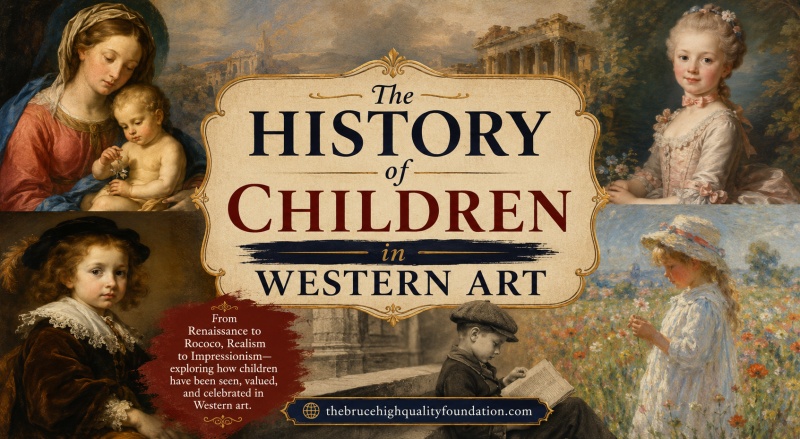
When I first encountered medieval paintings of the Christ child, I found myself puzzled. These babies looked nothing like the cherubic infants we see in modern nursery decorations. They had adult faces, solemn expressions, and bodies that seemed somehow wrong for their age. That initial confusion sparked a deeper curiosity about how and why the depiction of children in Western art transformed so dramatically over the centuries. The history of children in western art is not simply a story of improving technique. It is a reflection of evolving religious beliefs, shifting philosophical ideas about childhood itself, and the gradual recognition that children are fundamentally different from adults.
Western art spanning from the early medieval period through contemporary times shows a remarkable evolution in how artists represented children. Initially, children served primarily as religious symbols. Over time, they became subjects worthy of artistic attention in their own right. By the modern era, children stood at the center of movements celebrating innocence and advocating for their rights. Understanding this transformation helps us grasp not just art history, but the broader cultural story of how Western societies came to view childhood as a distinct and precious phase of human life.
This comprehensive exploration traces how children moved from being theological symbols to individual personalities in Western art. We will examine each major period, understanding why depictions changed and what those shifts reveal about the societies that produced them. From the rigid iconography of medieval altarpieces to the fragmented figures of Picasso’s cubist explorations, the representation of children in Western art tells a compelling story about changing values, beliefs, and aspirations.
Table of Contents
The Medieval Period: Children as Religious Symbols
In medieval art, which dominated roughly from the 5th to the 15th century, children appeared almost exclusively in religious contexts. The most common depiction was the Virgin Mary holding the infant Christ, a motif known as the Madonna and Child. These images were not intended to show realistic babies. Instead, they conveyed theological truths about the divine nature of Christ and the sacred role of Mary in salvation history. Every visual choice served a spiritual purpose, from the gold backgrounds symbolizing the heavenly realm to the simplified poses communicating eternal truths.
Artists working in this period had specific reasons for depicting Christ as they did. The small, sometimes seemingly aged infant in medieval paintings communicated that this was no ordinary child. The Christ child carried the weight of divinity, and his physical presentation reflected spiritual rather than physical reality. His sometimes small scale within compositions also symbolized his subordinate relationship to God the Father. This intentional stylization meant that medieval babies often appeared with adult-like facial features, small bodies, and an unusual solemnity that strikes modern viewers as peculiar.
Consider the famous ” Maestà” paintings from this period, such as those by Duccio di Buoninsegna. In these works, the infant Christ appears almost as a small wise adult, gazing out with knowing eyes rather than displaying the curious abandon of actual babies. This choice was deliberate and meaningful to medieval viewers who understood that the Christ child represented divinity incarnate. The visual language communicated theological sophistication that casual observation might miss.
The iconography extended beyond the Christ child to other religious figures. Angels in medieval art frequently appeared as child-like beings, their youthfulness suggesting purity and divine messenger status. However, these were not portraits of actual children. They were symbolic representations of spiritual qualities. The concept of childhood as we understand it today simply did not exist in medieval thought. Children were considered small adults, and art reflected this philosophical reality. Children participated in adult work, wore adult clothing scaled down, and were expected to behave as adults from an early age.
Class distinctions appeared even in religious imagery. Wealthy patrons commissioning works often had their own children depicted as angels or saints in private devotional pieces. These commissioned works served both religious and social functions, Displaying the patron’s piety while also affirming their elevated status in society. The poor and working-class children of the period rarely appeared in surviving artworks from this era, as religious commissions were primarily the domain of the wealthy and the Church. This selective representation tells us much about who mattered in medieval visual culture.
The Renaissance Transformation: Naturalism Meets Humanism
The Renaissance, beginning in Italy around the 14th century and spreading throughout Europe over the following centuries, fundamentally altered how artists portrayed children. This transformation emerged from broader cultural shifts emphasizing human potential, scientific observation, and the study of classical antiquity. Artists began prioritizing realistic representation of the human form, including accurate depictions of children’s anatomies. This shift represented nothing less than a revolution in how Western art approached its youngest subjects.
Leonardo da Vinci exemplified this new approach. His sketches of children showing actual proportions and movements demonstrated a commitment to observation that medieval artists had not pursued. His anatomical studies included careful observations of how children’s bodies differed from adults, documenting the larger heads, shorter limbs, and different proportions that characterize the young. The famous angel in his “Madonna of the Carnation” displays a child with realistic anatomy, soft facial features, and the awkward physicality that characterizes actual infants. This represented a dramatic departure from the symbolic figures of earlier centuries.
Sandro Botticelli’s “Madonna and Child with Two Angels” shows similar developments. The infants here display genuine childhood characteristics rather than adult-like features miniaturized. The rounded forms, curious expressions, and physical vulnerability all reflect careful observation of real children. Artists began understanding that children’s bodies differed significantly from adult bodies in proportion, movement, and expression. This recognition revolutionized how children could be represented in art.
The Renaissance also introduced the concept of the developmental sequence of childhood into artistic representation. Children were no longer simply small adults rendered smaller. Artists began showing age-appropriate characteristics for different life stages. A toddler differed meaningfully from a five-year-old, and both differed from a teenager. This recognition of distinct developmental stages represented a profound shift in how Western culture understood childhood itself. Paintings began to show children at play, learning, and developing rather than simply posed in static religious compositions.
Portraiture of actual children also emerged during this period, though it remained relatively rare. Royal and aristocratic families began commissioning images of their children as separate subjects rather than simply inserting them into religious compositions. These portraits served multiple purposes, including documenting lineage, Displaying family wealth, and celebrating the continuation of dynastic lines. The famous portrait of “Federico da Montefeltro and his son” demonstrates how Renaissance artists approached the challenge of depicting children with both dignity and realistic representation.
Raphael’s Madonnas further developed the representation of childhood. In works like “Madonna del Prato” (Meadow Madonna), the infant Christ appears as a chubby, rosy-cheeked baby with genuine infant characteristics. Raphael’s careful study of children’s anatomy and behavior resulted in images that communicate both theological meaning and authentic childhood. These paintings showed that religious subjects could be rendered with naturalistic observation without losing their spiritual significance.
The Baroque and Rococo Periods: Children Enter Everyday Scenes
The 17th and 18th centuries brought children out of exclusively religious contexts and into the broader world of genre painting and domestic scenes. The Baroque period, with its dramatic lighting and emotional intensity, found children both in religious compositions and in scenes of everyday life. Artists began exploring the psychological dimensions of childhood, showing children as individual personalities rather than symbolic types. This expansion of subject matter reflected changing attitudes about what deserved artistic attention.
The Dutch Golden Age produced particularly rich examples of this shift. Jan Steen’s “The Music Lesson” and similar works show children in domestic settings, engaged in activities that reflect their developing personalities. These paintings acknowledged children as beings with their own interests, pleasures, and character traits. The emotional warmth in these domestic scenes suggests artists recognized the unique qualities of childhood as a life stage. Dutch genre painting celebrated everyday life, and children were integral to that celebration.
Pieter de Hooch and Gerard ter Borch created interior scenes showing children in middle-class homes, learning manners, music, and the skills they would need as adults. These paintings reveal how children of different classes were prepared for their future roles. The carefully rendered domestic spaces communicate the relative comfort of bourgeois family life, while the children’s clothing and activities indicate their anticipated social positions.
Peter Paul Rubens frequently depicted children in mythological and allegorical contexts, but his “Children with Garland” and similar works show the influence of the growing interest in childhood as a subject. These cherubic figures, while still idealized, demonstrate more naturalistic observation of actual children’s forms and movements than medieval precedents had shown. The playful energy and physical characteristics reflect real childhood rather than purely symbolic representation. Rubens understood how children’s bodies moved and occupied space in ways that differed fundamentally from adults.
The Rococo period, emerging in the early 18th century, continued and intensified the romanticization of childhood. Artists like Antoine Watteau and Jean-Honore Fragonard created works celebrating youthful beauty and innocent play. These paintings often featured children in pastoral settings, engaged in graceful activities that reflected aristocratic ideals. While idealized, these works acknowledged that childhood possessed qualities worth celebrating and preserving. The aristocratic children in these paintings often appear in scenes of effortless elegance that suggest a world of privilege and leisure.
During these periods, the depiction of class differences became more pronounced in secular art. Wealthy children appeared in refined settings with appropriate accessories, tutors, and refined clothing. In contrast, paintings depicting peasant or street children often highlighted their poverty, lack of supervision, and premature exposure to adult labor. Artists like Jean-Baptistegreuze created moralistic images showing the consequences of parental neglect or childhood vice. These class-based differences in representation reflected broader societal attitudes about childhood’s meaning and purpose across social strata.
The 19th Century: Childhood Becomes Sacred
The 19th century witnessed a fundamental transformation in how Western culture conceptualized childhood, and art reflected and amplified this shift. The Romantic movement celebrated childhood as a state of innocence and purity, distinct from the corruption and artificiality of adult society. This philosophical stance created an explosion of imagery centered on children’s natural state, their connection to emotion and imagination, and their vulnerability in a changing world. The concept of childhood as a lost paradise gained tremendous cultural force.
William Blake’s poetry and illustrations, including “Songs of Innocence and Experience,” epitomized this romanticized view. His images of children playing in natural settings represented childhood as a paradise lost, a state of grace that industrialization and modernity were rapidly destroying. Blake contrasted innocent childhood with the corruption of adult experience, creating a powerful visual vocabulary that influenced generations of artists. The chimney sweeps and street children he depicted carried both sorrow and spiritual significance.
The Pre-Raphaelites continued this romantic tradition, creating highly detailed images of childhood innocence. Artists like John Everett Millais and William Holman Hunt painted children with meticulous detail, suggesting that careful observation could reveal spiritual truths. These paintings often featured children in medieval or allegorical contexts, combining historical revivalism with romanticized notions of childhood purity.
The rise of photography during this century created new possibilities and pressures for artists. Photographic portraits of children became increasingly common among middle-class families, reducing the traditional market for painted portraits. This technological shift pushed painters either toward greater artistic interpretation or toward documenting childhood with photographic realism. Artists like John Singer Sargent navigated this landscape by combining technical precision with artistic sensitivity. Sargent’s portraits of children, such as “Princesse de Polignac,” capture childhood’s fleeting qualities with remarkable insight.
Social reformers used imagery of children to advocate for children’s rights and protections. The work of artists depicting child labor in factories and mines helped build public support for legislation limiting children’s work hours and improving their conditions. These images presented children as innocent victims of industrial capitalism, requiring society’s protection. Artists like Robert Koehler created paintings like “The Socialist” showing children in political contexts, emphasizing the stakes of social reform for the youngest members of society.
Portrait painters continued developing approaches that captured childhood’s fleeting qualities. Artists learned to represent the energy, spontaneity, and emotional transparency that characterized children at different ages. The best of these portraits succeed in preserving something of the child’s essential nature rather than simply documenting their appearance. James Whistler and other artists created memorable images that feel fresh and alive despite their age. This attention to psychological authenticity marked a maturation of how artists approached their youngest subjects.
The Modern and Contemporary Era: Breaking Traditions
The 20th century shattered many established conventions for depicting children in Western art. Modernist movements from Impressionism through Abstract Expressionism rejected traditional representational approaches entirely. Children appeared in modernist works not as realistic figures but as formal elements, emotional triggers, or conceptual explorations. This radical departure from centuries of tradition reflected broader societal changes in how Western cultures understood both art and childhood.
Impressionist artists like Monet and Renoir had already begun capturing children in scenes of modern life, emphasizing the fleeting quality of perception and the immediacy of experience. Their children playing in gardens, at the beach, or in domestic settings show the influence of photography and the desire to capture moments of modern life. These works presented childhood as something to be experienced rather than idealized.
Picasso’s variations on the theme of children, including his series on the children of his friends and his “Weeping Woman” studies, show how modernist artists used children to explore complex emotional and formal concerns. The distorted, fragmented figures in works like “Girl before a Mirror” suggest that childhood itself had become unstable as a concept, something that modernity had fundamentally altered. These works asked viewers to reconsider what childhood meant in a world that had experienced world wars, industrialization, and cultural upheaval.
Other modernist artists took different approaches. Henri Matisse created joyful, colorful images of children, emphasizing the pleasures of bodily existence and visual sensation. His “The Joy of Life” and similar works celebrate childhood as a state of natural harmony with the world. Yet even these seemingly optimistic images carry the weight of artistic experimentation and cultural transformation.
Contemporary artists have continued challenging assumptions about how children should appear in art. Some deliberately subvert traditional imagery, showing children in contexts that contradict romanticized expectations. Others explore cultural diversity in how different societies understand and represent childhood. Still others examine the sexualization of children in advertising and media, questioning what it means to depict children in contemporary visual culture. Artists like Barbara Kruger and Cindy Sherman interrogate how images of children function in mass media and consumer culture.
Photography and digital media have transformed possibilities for representing children. Family photography, social media, and digital archives allow unprecedented documentation of children’s lives. Yet this proliferation of images has also raised ethical questions about consent, privacy, and the commodification of children’s images. Contemporary artists engage with these concerns, creating works that interrogate the very nature of representing children in visual culture. Artists like Sophie Calle have explored how surveillance and documentation affect children’s sense of self and privacy.
The global perspective has also expanded representations of childhood in Western art. Artists increasingly consider how non-Western traditions depict children, and how migration and multiculturalism have changed Western societies themselves. This broader cultural context has created space for more diverse representations of childhood, acknowledging that children from different backgrounds experience their youth in fundamentally different ways. The history of children in western art continues to evolve as artists incorporate these new perspectives and concerns.
Conclusion: From Symbols to Individuals
The history of children in western art traces a remarkable journey from stylized religious symbols to individuals with distinct personalities and inner lives. Each transformation reflected broader changes in how Western societies understood childhood itself. Medieval artists saw children primarily as theological symbols, while Renaissance painters began recognizing children’s physical distinctiveness from adults.
Baroque and Rococo artists brought children into everyday scenes, acknowledging their presence in domestic life. The 19th century romanticized childhood as a state of innocence worth preserving. Modern and contemporary artists have questioned and fractured traditional representations, using children to explore formal innovations and cultural anxieties.
Today we benefit from this centuries-long artistic conversation about childhood. When we visit museums and encounter paintings of children across different periods, we can read them as more than aesthetic objects. Each image reveals something about how people at that moment understood what it meant to be young, what children represented in society’s broader fabric, and what adults believed they owed to the youngest members of their communities.
This evolution in depiction paralleled real changes in how Western societies treated children. The art tells us that our ancestors gradually came to see children not as incomplete adults but as beings with their own needs, rights, and potential. That recognition represents one of the most significant shifts in human cultural history, and the art that documents it helps us understand how far we have come and what challenges remain.