
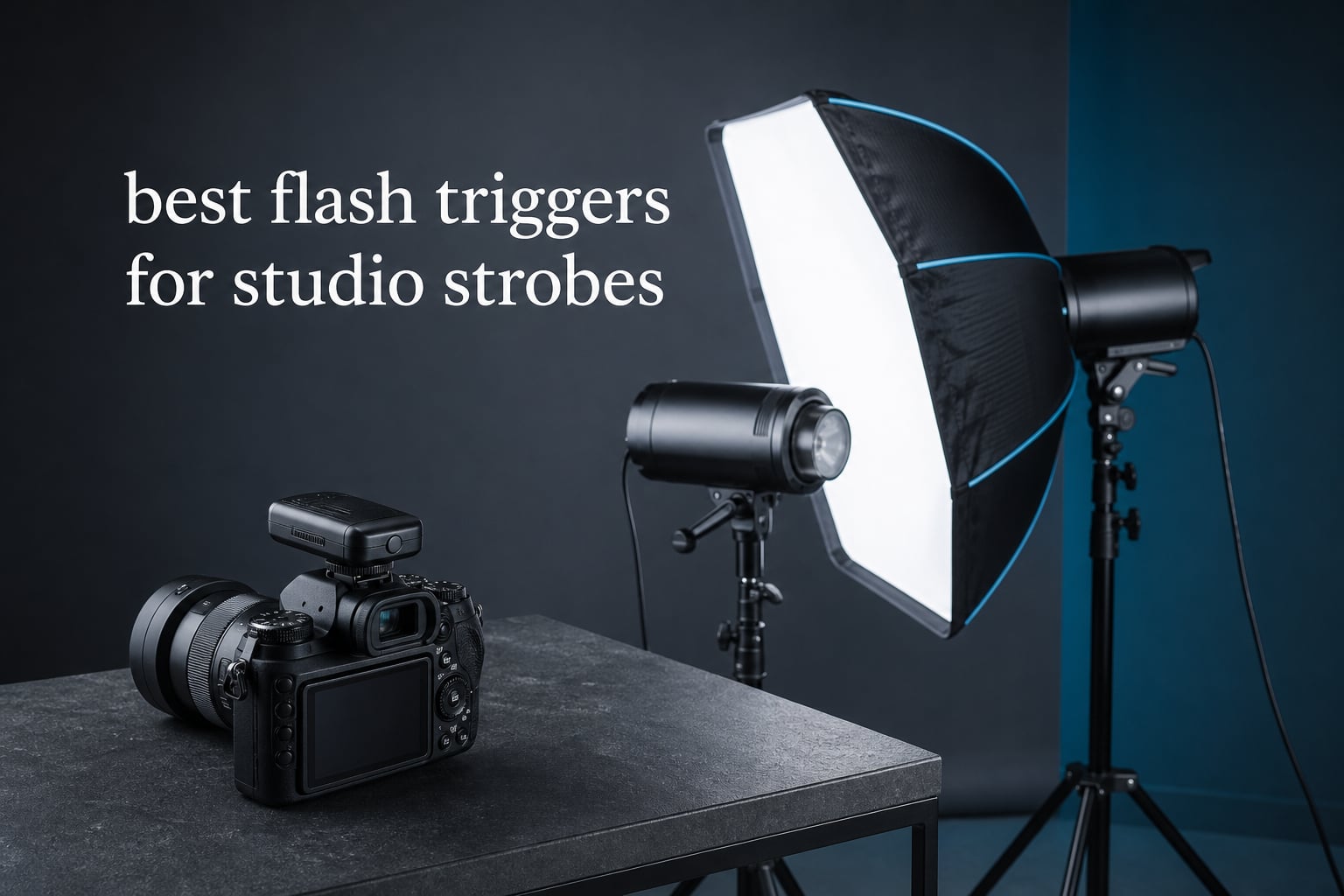
A flash trigger is a wireless device that sends a radio signal from the camera hot shoe to a compatible studio strobe or receiver, firing the light when you press the shutter. That simple connection is what lets us move lights off camera for portrait lighting, product photography, and location work without relying on an optical slave.
The best flash triggers for studio strobes are not interchangeable accessories. I start with the camera mount and the flash ecosystem, then check whether the job needs remote power changes, TTL metering, high-speed sync, or only a dependable manual fire signal.
This guide covers eight verified options, from feature-rich 2.4 GHz systems to basic 433 MHz transmitter-and-receiver kits for monolights and older lights with sync jacks. It also explains the terms that create the most confusion: a channel avoids radio traffic, a group controls selected lights together, and an ID adds another layer of separation within a shared channel.
If you are building a lighting kit from scratch, our guide to the best photography flashes for beginners is a useful companion. A trigger also needs a stable place for each light, so pair this research with our roundup of the best light stands for photographers.
Table of Contents
The top 3 flash triggers cover Canon, Sony, and basic multi-light studios
Our editor’s choice is the Canon-specific Godox X3C for its compact OLED touch interface, USB-C rechargeable battery, TTL-to-manual conversion, and 1/8000-second HSS support. Sony photographers who manage large multi-light setups should look first at the X3 Pro S, while the CT-16 kit is the straightforward pick when three receivers and basic PC-sync triggering matter more than automatic exposure.
These flash triggers for studio strobes in 2026 make compatibility easy to compare
The chart below contains every reviewed model. “TTL” means through-the-lens automatic flash metering; “HSS” is high-speed sync for shutter speeds above normal flash sync when the camera-and-flash combination supports it. A basic single-contact trigger can fire a compatible light but does not carry the extra data needed for TTL or HSS.
| Product | Specifications | Action |
|---|---|---|
 Godox X3C Godox X3C |
|
Check Latest Price |
 Godox X3 Pro S Godox X3 Pro S |
|
Check Latest Price |
 Godox XProII-C Godox XProII-C |
|
Check Latest Price |
 NEEWER QZ-S NEEWER QZ-S |
|
Check Latest Price |
 NEEWER QPRO-C NEEWER QPRO-C |
|
Check Latest Price |
 Godox CT-16 kit Godox CT-16 kit |
|
Check Latest Price |
 Godox RT-16 set Godox RT-16 set |
|
Check Latest Price |
 AODELAN E7G AODELAN E7G |
|
Check Latest Price |
1. Godox X3C is the compact Canon choice for touch-based X-system control
- 1.6 inch OLED touchscreen
- TTL to manual TCM
- 1/8000 sec HSS
- USB-C recharge
- channel scanning
- Canon-specific mount
- not water resistant
- some reliability complaints
The Godox X3C is the one I would narrow down first for a Canon photographer already using Godox X-system lights. It puts TTL Auto, Manual, Multi flash, front-curtain sync, rear-curtain sync, and HSS in a very small hot-shoe transmitter, with a 1.6-inch high-contrast OLED touchscreen rather than a long row of buttons.
The 850 mAh lithium battery is built in and recharges over USB-C in two hours according to the supplied specifications. That matters during a full studio day because I would rather top up a trigger with a cable than stop to find AA batteries.
Its TCM function is especially useful when I want TTL to establish a starting exposure and then need repeatable manual output for a series. The trigger can also scan for a spare channel, a practical response to radio interference in shared studios.
The X3C gives Canon shooters fast exposure-to-manual workflow
For portraits, I would use TTL for the first frame, convert that result with TCM, and then make small manual changes by group. It is a faster path to consistent output than leaving automatic metering to react to every change in a bright shirt or reflective product.
The screen lock is another small but welcome detail when the transmitter sits against a camera strap or is handled while moving between sets. Side buttons remain available for adjustment when gloves make touchscreen use less pleasant.
The X3C fits Godox X-system lights rather than every studio strobe
Canon compatibility is explicit, so it is not a universal replacement for a Sony, Nikon, or Fujifilm version. Confirm that the strobe has Godox X-system radio built in or that an appropriate receiver is part of the lighting plan before ordering.
Customer feedback is strong at 4.7 from 769 reviews, with 87 percent five-star ratings in the supplied review data. Still, four percent are one-star reviews, so I would charge it before important sessions and carry a wired sync option for paid work.
2. Godox X3 Pro S is the advanced Sony controller for large lighting sets
- 16 group control
- 8 saved presets
- Bluetooth app control
- PC sync port
- USB-C fast charging
- Sony-specific mount
- not water resistant
- AF assist absent on listed Sony bodies
The Godox X3 Pro S is a serious control surface for Sony shooters using several lights. Its 2.4-inch touchscreen can display four lighting groups at once, while the transmitter can control up to 16 groups and save eight group presets for repeatable sets.
I like that the feature list goes beyond firing a flash: Bluetooth links it to the Godox Flash App, a PC sync port broadens connection options, and the unit offers Creative Shutter Control for single shots, time-lapse, and long-exposure sequences. HSS Delay provides granular sync-delay adjustment for photographers who need to tune a high-speed-sync result.
The built-in lithium battery has a stated standby time of up to a month and reaches full charge via USB-C in two hours. A battery indicator and a pre-session charge routine remain sensible, because standby time is not the same as continuous shooting time.
The X3 Pro S makes multi-group Sony lighting quicker to repeat
Sixteen groups are more than a small two-light portrait setup needs, but they make sense for a studio with background lights, key and fill lights, a rim light, and separate product accents. Saving eight preset arrangements can cut down on re-entering familiar power relationships between shoots.
The app connection may be useful when a light is mounted high or placed behind a set wall. I would still learn the physical controls first, since direct camera-side adjustment is the faster fallback when a phone is busy or unavailable.
The X3 Pro S requires careful Sony body and system checks
This version mounts to Sony Alpha cameras, and the supplied list specifically names many A7, A9, A1, and A6xxx bodies. The listing also says its AF assist beam does not work on the A7R, A6400, A6700, A6000, or RX10, so do not buy it expecting that aid on those cameras.
The 4.7 rating comes from 276 reviews, with 84 percent five-star feedback. It is a strong Sony-focused choice, not a way to add TTL data communication to unrelated radio brands.
3. Godox XProII-C is the Canon choice for physical controls and memory slots
- Large LCD
- 16 groups and 32 channels
- 5 memory slots
- Bluetooth app
- lever hotshoe lock
- Canon-specific
- receiver needed for Canon flashes
- not water resistant
The Godox XProII-C gives Canon users a large LCD and a more traditional control layout than the X3C. It supports TTL and HSS up to 1/8000 second, controls 16 groups across 32 channels, and adds channel scanning plus an ID system to help separate your radio traffic from nearby photographers.
Five user memory slots make this model appealing if I rotate between a headshot setup, a white-background product setup, and a darker portrait configuration. The quick-release lever lock is also a practical upgrade over a loose hot shoe fit, particularly on a camera that moves around a busy studio.
Bluetooth support works with the Godox Flash App, while USB-C provides firmware-update capability through Godox V3 utility. Firmware updates are worth checking before a new camera body or light enters the kit, not after an incompatibility appears at a session.
The XProII-C keeps several Canon lighting recipes within reach
The large display can show a lot of group information without menu hopping. For a photographer who changes flash power manually between setups, direct group selection and saved settings may feel more efficient than a compact touch-first transmitter.
TCM converts a TTL exposure into a manual power starting point, which suits a studio sequence where consistency matters. Individual modeling-lamp control is also helpful when checking placement without changing the output of every light.
The XProII-C needs an X-system route to control the intended light
It controls Godox wireless X-system flashes directly. Canon original flashes require the separately specified X1R-C receiver, and a legacy studio strobe needs a compatible receiver or wired sync connection rather than an assumption that the hot shoe alone will communicate.
This trigger holds a 4.6 rating from 172 reviews. Its published Canon support list is broad, including 1D, 5D, 6D, 7D, 80D and M-series bodies, but I would always compare the exact camera model with the current compatibility listing.
4. NEEWER QZ-S is the Sony touchscreen alternative with stated 328-foot range
- Dimmable OLED touchscreen
- 1000 mAh battery
- 5 groups and 32 channels
- Godox-compatible listed flashes
- HSS
- Latest firmware needed for listed Godox units
- not water resistant
- Sony-specific
The NEEWER QZ-S is a Sony-specific radio flash trigger with a dimmable OLED touchscreen, TTL exposure compensation of plus or minus three EV, manual output control from 1/256 to full power, and HSS to 1/8000 second. Its supplied specification lists five groups, 32 channels, IDs from 01 to 99, channel scanning, and a 328-foot wireless range.
I would treat that range as a useful outdoor ceiling, not a promise for every room. Walls, metal, crowded Wi-Fi environments, body position, and a receiver tucked behind a modifier can reduce any radio system’s working distance; forum reports commonly put real use far below headline claims in difficult conditions.
The QZ-S uses a 1000 mAh lithium battery, displays its battery level, and lists a two-and-a-half-hour full charge. It also includes S1 and S2 optical slave modes, which can be useful for an optical-triggering fallback where radio is not needed.
The QZ-S brings Sony photographers current touchscreen controls
The camera list is extensive, covering Sony A9 III through older Alpha bodies and ZV models. A large supported list does not remove the need to check one’s exact body, especially after camera firmware changes.
For studio use, the combination of group control, an OLED screen, manual power settings, and real-time battery status is the practical draw. It can keep a five-light arrangement organized without moving to a much larger transmitter.
The QZ-S depends on the right NEEWER or updated Godox flash connection
NEEWER lists its Q flashes as native partners and also lists Godox IT32 V1, V100, AD200 Pro II, and AD100 Pro II compatibility when the latest firmware is installed. “Compatible” here should be read precisely: update both devices and test TTL, HSS, and group changes before relying on them.
The QZ-S has a 4.6 rating from 63 reviews, with 86 percent five-star feedback. Its smaller review base makes it sensible to value its documented fit and feature list over broad claims about every Godox light.
5. NEEWER QPRO-C is the Canon control-first option for five visible groups
- Five groups shown at once
- metal hotshoe
- HSS and TTL
- focus assist
- firmware updates
- Not for Canon RP or R50
- AA batteries
- receiver required for non-Q lights
The NEEWER QPRO-C is designed around seeing and changing five flash groups quickly. Its large high-definition LCD has a slanted shape for better viewing from behind the camera, and an enlarged single-group view is available with a double press of the group button.
It supports TTL automatic flash, flash exposure compensation, manual mode, stroboscopic flash, and HSS to 1/8000 second. Five group buttons, four function buttons, and a scroll wheel provide nine customizable controls, a layout I would favor when adjusting lights by feel rather than working through a touchscreen.
The built-in 2.4 GHz Q system uses five groups, 32 channels, and IDs from 01 to 99. A metal hot shoe gives the camera mount a sturdier foundation, and the focus-assist light can help when the room is too dim for the camera to acquire focus.
The QPRO-C keeps five NEEWER groups readable from the camera position
Five groups are a logical maximum for a typical studio: key, fill, background, rim, and accent. Modeling-lamp and zoom controls by group give a photographer another way to refine the set without walking to each compatible flash.
The slanted LCD is not merely decorative when a camera is held below eye level or mounted on a tripod. Clear readout is a workflow feature when small power changes have to be repeated accurately.
The QPRO-C has two compatibility limits Canon owners should check first
The supplied data explicitly excludes Canon RP and R50 cameras, even though many other Canon EOS R bodies and DSLRs are listed. It also says that a NEEWER QR receiver and 2.5 mm sync cord are sold separately for non-Q-system flashes.
This is a 4.5-rated unit from 296 reviews, and its review data notes six percent one-star ratings. I would verify the camera body, flash family, and whether single-contact mode needs to be disabled for TTL or HSS before putting it into regular work.
6. Godox CT-16 is the basic multi-receiver kit for mixed DSLR studio gear
- Three included receivers
- 16 channels
- PC sync
- Canon Nikon Pentax support
- simple controls
- 1/200 sec maximum sync
- not water resistant
- cords may be needed
The Godox CT-16 kit takes a very different approach from the touchscreen units above: it supplies one transmitter and three receivers on a 433 MHz radio system. That makes it relevant for a studio with several manual monolights, especially when each light needs its own receiver rather than built-in proprietary radio.
It has 16 channels, a PC sync option, and a maximum sync speed specified as 1/200 second. The compatible-device list includes Canon, Nikon, and Pentax DSLR equipment alongside studio strobe flashes and many older speedlights.
This is the sort of kit I would consider for simple manual triggering, not for remote TTL metering, HSS, app control, or a visual dashboard of group power. The purpose is to fire compatible lights together with a basic radio signal.
The CT-16 places receivers where basic studio lights need them
Three receivers in one kit can suit a key light, fill light, and background light right away. Use the same channel on the transmitter and every receiver, then attach each receiver through the appropriate sync connection for that light.
Because the interface is simple, it can be easier for a beginner to troubleshoot. First test one transmitter-to-one receiver connection, then add the remaining lights one at a time and confirm that each fires at the chosen shutter speed.
The CT-16 favors legacy flexibility over advanced flash data
Do not confuse 16 channels with 16 independently controlled groups. A channel is a radio lane; this kit primarily gives you a way to avoid interference, while power changes still happen at the strobe itself.
The kit is rated 4.4 from 69 reviews. Some studio setups may need extra PC sync cords, so check the strobe’s connector type before committing to this route.
7. Godox RT-16 is the simple monolight set with 3.5 mm and 6.35 mm sync support
- Monolight-focused design
- 3.5 mm and 6.35 mm jacks
- 16 channels
- Canon Nikon Fujifilm support
- simple set
- No Sony MI hotshoe support
- 1/200 sec sync
- limited review base
The Godox RT-16 is a stripped-back transmitter-and-receiver set specifically described for monolight studio strobes. It works at 433 MHz, offers 16 selectable channels, lists a working distance up to 30 meters, and synchronizes at 1/200 second.
The practical benefit is its support for both 3.5 mm and 6.35 mm sync jacks. Many older or budget studio heads have one of those physical ports, and a wired receiver connection is often the missing piece that turns a non-radio strobe into a wireless-triggered light.
I would choose this type of wireless trigger for strobe work when the need is basic camera-to-light firing across brands, not automatic exposure or advanced remote changes. It is listed for Canon, Nikon, Fujifilm, Olympus, and Pentax cameras.
The RT-16 connects simply to studio heads with common sync sockets
Before buying, inspect the exact port on every light and match the correct cable or adapter to it. The receiver does not make an incompatible flash protocol compatible; it only closes the sync circuit so a connected strobe fires.
Thirty meters can be plenty for a home studio, small rental space, or controlled portrait location. Keep the receiver antenna area unobstructed where possible and verify the connection after placing a light inside a metal-backed modifier or behind a wall.
The RT-16 has camera and performance limits that matter for modern bodies
The supplied listing says it does not work with Sony MI hot-shoe cameras and names several excluded Canon bodies: 1500D, 3000D, and 200D Mark II. Confirm the specific hot shoe before treating a “universal” trigger as universal.
Its 4.3 rating is based on 13 reviews, so this is a lightly reviewed basic option. Its feature list supports a manual-studio use case; it does not claim the TTL and HSS benefits of dedicated camera-brand radio systems.
8. AODELAN E7G is the simple Godox and Flashpoint compatible manual radio option
- Godox X and Flashpoint R2 support
- 32 channels and 5 groups
- USB-C or AAA power
- transmit receive switching
- stated 650 ft range
- No TTL or HSS
- single-contact hot shoe
- not for Sony MI hot shoes
The AODELAN E7G is aimed at photographers who use Godox 2.4 GHz X-system or Flashpoint R2 radio equipment but only need a single-contact manual trigger. It lists 32 channels, five groups, 99 selectable IDs, transmit/receive switching, and a maximum stated working range of 200 meters or 650 feet.
The important trade-off is explicit: TTL and HSS are not supported. That does not make the E7G a poor match for a manual studio; it means the trigger is for firing and manual group organization, not camera-to-flash exposure data.
It can run from AAA batteries or USB-C power, a welcome choice for photographers who prefer disposable batteries as an emergency backup. Its stated 72-hour battery life should be treated as a planning reference rather than a reason to skip a charged spare or extra cells.
The E7G connects manual Godox and Flashpoint radio workflows
Five groups let me separate a key light from a background or accent light at the trigger level, while 32 channels and 99 IDs offer ways to reduce conflicts with other nearby users. Match group, channel, and ID settings consistently on every compatible device.
Transmit/receive switching adds flexibility for a basic radio unit. Still, first confirm the exact light belongs to the Godox X or Flashpoint R2 system rather than assuming that a similar-looking 2.4 GHz radio device speaks the same protocol.
The E7G works best when manual exposure is the plan from frame one
Single-contact communication is often a good fit for product photography, fixed portraits, and legacy setups where the flash output is set manually. It is not the right tool if your workflow depends on TTL, HSS, or camera-brand-specific hot-shoe communication.
The E7G is rated 4.2 from 30 reviews, and it is not compatible with Sony MI hot-shoe cameras. That makes exact camera compatibility the first check, followed by a full test at your typical shutter speed before a real shoot.
The right trigger starts with camera and strobe compatibility, not feature count
Start by writing down the exact camera body, the exact light model, and every connector on the strobe. A camera-specific Godox or NEEWER transmitter can pass TTL and HSS data only when it is paired with compatible radio lights or receivers; a basic receiver kit can often fire many older strobes through PC, 3.5 mm, or 6.35 mm sync, but it cannot create advanced data features.
This compatibility-first habit answers the common question, “Can I use any flash trigger with my strobes?” No: the transmitter must fit and communicate correctly with the camera, while the receiver or built-in radio must match the strobe. Cross-brand setups frequently need a receiver, a cable, manual flash mode, or a separate ecosystem for each light family.
TTL gives a starting exposure while manual power gives repeatability
TTL, or through-the-lens metering, has the camera measure a pre-flash and choose an output level. It is useful for changing distances, event work, or the first frame of a new portrait setup, though reflective subjects and large bright backgrounds can make its choices vary.
Manual flash power is the steadier studio method once the composition is fixed. Set the key, fill, background, and accent outputs deliberately, take a frame, and adjust one group at a time; many Godox transmitters add TCM so a TTL result can become a manual starting value.
HSS solves bright-light shutter limits but is not a default requirement
Most cameras have a normal flash sync speed around 1/160 to 1/250 second, but check the manual for the exact body. At faster shutter speeds, the shutter curtains create a moving slit, so ordinary flash output will leave a dark band unless the compatible camera, trigger, and flash are all using high-speed sync.
Use HSS when you need a wide aperture outdoors or want to tame daylight with a fast shutter speed. For a stationary indoor studio shoot at or below normal sync speed, standard manual sync is simpler and generally asks less of the trigger and flash.
Channels, groups, and IDs solve different radio-control problems
A channel is the radio path shared by the transmitter and compatible receivers. Change it when another nearby photographer’s equipment causes interference, then set every part of your own system to the new channel.
A group is a set of lights you want to control together, such as every background light or both rim lights. An ID is an extra matching code available on some systems; it helps separate your kit from another kit using the same channel in a crowded studio.
Real shooting range is lower than a clean open-field claim
Manufacturer range is usually measured in conditions that favor the radio. In forums, photographers report roughly 130 to 135 feet as a more realistic result for some systems despite claims above 1,000 feet, and interference, obstacles, antenna orientation, and receiver placement all matter.
I set up the camera, trigger, and every light at the greatest distance I expect to use, then shoot repeated frames before the client arrives. If reliability matters more than convenience, keep a compatible sync cable in the bag and avoid burying the receiver under metal or dense equipment.
A basic setup checklist prevents most first-session trigger failures
First, charge or replace batteries, mount the transmitter securely, and select one channel and ID across every component. Second, connect each receiver with the correct sync cable, set the strobe to a suitable manual or radio mode, and test every light individually before testing them together.
Third, start at the camera’s normal flash sync speed and turn off any HSS setting until basic firing is confirmed. Then assign groups, set manual output, take a test exposure, and update firmware only after reading the manufacturer’s compatibility notes.
For creators who do not need the short flash duration and light-shaping control of a strobe, our guide to the best ring lights for content creators covers a continuous-light alternative. A ring light does not replace a studio flash trigger, but it can simplify a desk-based video or beauty-light setup.
FAQs
What is the best Godox flash trigger?
The Godox X3C is the best choice in this list for Canon photographers who want a compact OLED touchscreen, TTL, 1/8000-second HSS, TCM conversion, and USB-C charging. Sony photographers should choose the Godox X3 Pro S version for its Sony mount, 16 groups, Bluetooth app control, and PC sync port.
What shutter speed for studio flash?
Use your camera’s normal flash sync speed first, which is commonly around 1/160 to 1/250 second but varies by body. Use HSS only when the camera, trigger, and compatible flash all support it and you need a faster shutter speed; otherwise, speeds above sync can create a dark shutter-curtain band.
Is Neewer better than Godox?
Neither brand is better for every setup. Godox is the clearer match when you already own Godox X-system lights and want choices such as the X3C, X3 Pro S, or XProII-C. NEEWER Q triggers suit compatible NEEWER Q lights, and the QZ-S lists support for selected updated Godox flashes, but you should verify the exact camera, flash, firmware, TTL, and HSS functions.
What are the best flash settings for indoor event photography?
Start in manual exposure near your camera’s normal sync speed, use a moderate ISO that suits the room, and set the flash or strobe power after a test frame. TTL can help when distances change quickly; for fixed rooms, manual flash power produces more consistent results. Do not use HSS indoors unless a faster shutter speed is genuinely needed.
The best choice is the trigger that matches your camera and lighting system
For Canon users with Godox lights, the X3C is our top all-around pick, while the X3 Pro S brings deeper group and app control to compatible Sony setups. Pick the CT-16 or RT-16 when manual monolights and physical sync sockets are the priority, and select the AODELAN E7G only when manual Godox or Flashpoint radio operation is enough.
These flash triggers for studio strobes in 2026 all solve a different connection problem. Check the exact camera mount, strobe radio system, receiver cable, normal sync speed, and needed features before you buy, then test the complete chain before your next shoot.