
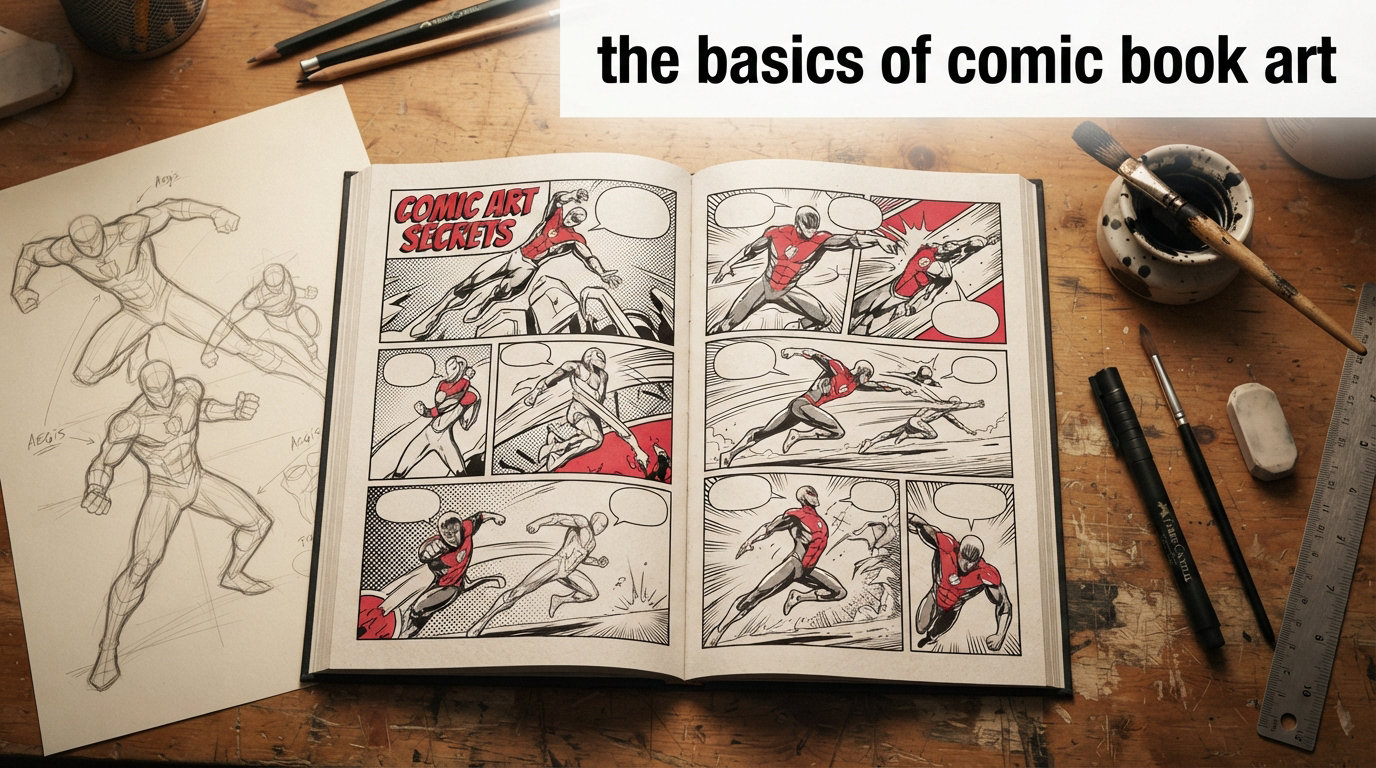
If you have ever wanted to create your own comics but felt overwhelmed by where to start, you are in the right place. Understanding the basics of comic book art comes down to mastering a handful of core skills and learning how to arrange images and words together to tell a story. In this guide, I will walk you through the fundamental elements, the essential drawing skills, and the step-by-step process that professional comic artists use to go from a blank page to a finished comic.
Comic book art is not just about drawing well. It is about visual storytelling. That means thinking about how readers move through a page, how dialogue fits into the artwork, and how a sequence of images creates meaning. Whether you want to draw superheroes, slice-of-life stories, or experimental graphic novels, the fundamentals remain the same.
I have spent years studying comic art techniques, talking to working professionals, and testing different workflows. What follows is everything I wish I had known when I first picked up a pencil to draw comics. Let us break it all down.
Table of Contents
What Is Comic Book Art?
Comic book art is a form of sequential visual storytelling that combines images and text in arranged panels to convey a narrative. Unlike a single illustration, comic art relies on the relationship between multiple images placed in sequence. The reader moves from panel to panel, filling in the gaps between images with their imagination. That act of reading between the panels is what makes comics unique as an art form.
The term “sequential art” was popularized by legendary cartoonist Will Eisner, and it captures the essence of what comic creators do. Each panel shows a moment in time, and the arrangement of those moments creates the story. The artist controls pacing through panel size, layout, and the amount of visual information in each frame.
Comic book art sits at the intersection of several disciplines: drawing, writing, design, and pacing. You do not need to master all of them before you start making comics. But understanding how they work together will make every page you create stronger.
The 5 Core Elements of Comic Art
Every comic, from a three-panel newspaper strip to a 200-page graphic novel, is built from the same five core elements. Understanding these basics of comic book art gives you a framework for approaching any project. Let me walk through each one.
Element 1: The Idea
Every comic starts with an idea. It might be a character you want to explore, a situation that feels compelling, or a theme you want to examine visually. The idea does not need to be fully formed. Many great comics started as a rough concept that evolved during the creative process.
I recommend keeping a sketchbook or note file where you jot down ideas as they come to you. Professional comic artists collect reference images, character notes, and story fragments over months or even years before starting a project. The stronger your initial idea, the easier the rest of the process becomes.
Element 2: The Script
The script is the written blueprint for your comic. It describes what happens in each page and panel, including dialogue, action, and sometimes camera angles. Some creators write full scripts with detailed panel descriptions. Others use a looser outline and discover the details while drawing.
What matters most is having a plan before you start drawing. Professional comic artist Palle Schmidt, who runs Comics for Beginners, points out that having a finished script before you start drawing increases your chance of actually finishing the comic by a massive margin. I have found this to be true in my own work. Even a rough outline keeps you moving forward instead of staring at a blank page wondering what happens next.
Element 3: Panels and Page Layout
Panels are the framed boxes that contain individual images on a comic page. The layout of those panels determines how the reader experiences the story. A grid of equal-sized panels creates a steady, rhythmic pace. A large panel breaking across the page creates a dramatic moment. An unusual arrangement can create tension, confusion, or surprise.
Gutters are the spaces between panels. They might seem like empty space, but they do important narrative work. The reader imagines what happens in the gutter, connecting one panel to the next. A wide gutter suggests a longer passage of time. A thin gutter suggests quick, continuous action. As the artist, you control this invisible storytelling tool.
Splash pages are full-page or near-full-page images used for dramatic effect. They typically appear at the beginning of a story or at a major turning point. Used sparingly, they deliver a powerful visual punch.
Element 4: The Art
The art is the visual content inside each panel: the characters, environments, objects, and actions. Comic art ranges from highly realistic to wildly stylized. There is no single “correct” style. What matters is clarity and consistency. The reader needs to understand what is happening in each panel and recognize characters from page to page.
Comic art typically goes through several stages. First comes the rough sketch or pencils, where you establish the basic shapes and composition. Then comes inking, where you finalize the linework with clean, confident strokes. Finally, coloring and shading add atmosphere and depth. Not every comic uses all three stages. Black-and-white comics can be just as effective as full-color ones.
Element 5: Lettering
Lettering includes all the text elements in a comic: speech balloons, thought bubbles, caption boxes, and sound effects. Good lettering is invisible to the reader. It guides the eye naturally through the dialogue without pulling attention away from the art. Bad lettering, on the other hand, can ruin an otherwise well-drawn page.
Speech balloons should be placed so the reader encounters them in the correct reading order. The tail of the balloon should point clearly to the speaking character. Sound effects, like “BAM” or “WHOOOSH,” are drawn directly into the artwork and can add energy and movement to a scene. Many beginners overlook lettering, but it is one of the five pillars of comic art for good reason.
The 8 Fundamental Skills Every Comic Artist Needs
While the five elements describe what goes into a comic, the following eight skills describe what you need to practice as an artist. No competitor in this space combines both frameworks, so I want to give you the complete picture. Think of these as the muscles you build through regular exercise.
1. Construction
Construction is the ability to build complex forms from simple shapes. Before you draw a human figure, you block it out as a collection of spheres, cylinders, and boxes. This gives your drawings structure and makes them feel three-dimensional, even in a stylized art style.
I practice construction by setting a timer for two minutes and drawing characters starting from basic shapes. It trains your brain to see the underlying geometry in everything you draw. Every professional comic artist I have studied uses some form of construction, whether they talk about it or not.
2. Perspective
Perspective is the system for creating the illusion of depth on a flat page. One-point perspective works for hallways and roads. Two-point perspective handles most interior and exterior scenes. Three-point perspective adds dramatic angles, looking up at buildings or down from rooftops.
You do not need to master complex perspective grids to draw comics. But you do need to understand how objects recede into the distance and how eye level affects the viewer’s relationship to the scene. Practicing simple boxes in one- and two-point perspective builds a foundation that carries into every panel you draw.
3. Anatomy
Anatomy knowledge helps you draw convincing human figures. You do not need a medical degree, but you should understand the major muscle groups, how joints move, and how the body’s proportions relate to itself. This applies whether you draw realistic characters or exaggerated cartoon figures.
Life drawing classes are one of the best ways to study anatomy. Drawing from a live model teaches you to capture weight, balance, and gesture in ways that reference photos alone cannot. If in-person classes are not available, timed gesture drawing websites like Line of Action or Croquis Cafe provide similar practice.
4. Gesture Drawing
Gesture drawing captures the movement and energy of a figure in a short amount of time, usually 30 seconds to two minutes. It is not about details. It is about the flow, the line of action, and the overall feeling of the pose.
In comic art, gesture is what makes characters feel alive. A well-drawn gesture communicates emotion, intention, and physical effort. Without strong gesture, even anatomically correct figures look stiff and lifeless. I spend the first ten minutes of every drawing session doing quick gesture sketches. It warms up my hand and my eye.
5. Color and Light
Understanding how light interacts with form is essential for creating convincing artwork. Light reveals shape, texture, and depth. Shadows ground objects in their environment. Color temperature creates mood and atmosphere.
For comic artists, color theory means knowing which colors complement each other, how to create focal points with color contrast, and how limited color palettes can unify a page. Even if you work in black and white, understanding value, which is the lightness or darkness of a tone, is critical. A page with strong values reads clearly. A page with muddy values confuses the eye.
6. Composition
Composition is the arrangement of visual elements within a panel or page. Good composition guides the reader’s eye where you want it to go. Professionals on forums like r/comicbookart consistently name composition as the single most important skill for comic artists.
Key composition concepts include the rule of thirds, where you place important elements at the intersections of a three-by-three grid. Leading lines direct the eye toward a focal point. Negative space gives the eye room to rest. Framing uses elements within the scene to create a natural border around the subject. Every panel in a comic is a composition problem waiting to be solved.
7. Visual Design
Design in comics covers character design, costume design, prop design, and environment design. A well-designed character is recognizable from their silhouette alone. Think about Batman’s pointed ears or Spider-Man’s web pattern. These designs communicate the character’s personality and role before a single word of dialogue is spoken.
Good design also means variety. If every character in your comic has the same body type, face shape, and hairstyle, readers will struggle to tell them apart. Pushing designs to be distinct from each other makes your comic easier to read and more visually interesting.
8. Tools and Materials
Traditional comic artists work with pencils, inking pens, brushes, and paper. Common tools include mechanical pencils for sketching, Micron pens or dip pens for inking, and Bristol board for the final artwork. Each tool produces a different quality of line, and finding the right combination is a personal journey.
Digital comic artists use drawing tablets and software like Clip Studio Paint, Procreate, or Photoshop. Clip Studio Paint is popular among comic artists because it includes built-in tools for panel borders, speech balloons, and page management. The choice between traditional and digital comes down to personal preference. Both approaches produce professional results.
The Comic Creation Process: From Idea to Finished Page
Understanding the basics of comic book art also means knowing the workflow professionals follow. Here is the step-by-step process that takes you from concept to completed comic page.
Step 1: Write the script. Decide what happens on each page and in each panel. Include dialogue and any important visual notes. Even a rough outline is better than winging it.
Step 2: Create thumbnails. These are tiny, rough sketches of each page. Thumbnails let you plan the panel layout, figure out the reading flow, and spot problems before you invest hours in detailed drawing. Most artists draw thumbnails at about one-quarter the size of the finished page.
Step 3: Draw rough pencils. Using your thumbnail as a guide, sketch the full-size page. Focus on getting the composition, character poses, and perspective right. Details come later.
Step 4: Add lettering. Many professionals letter the page before finalizing the art. This ensures the speech balloons fit naturally within the composition rather than being crammed in as an afterthought.
Step 5: Tighten the pencils. Refine your rough sketch into clean, detailed linework. This is where you add facial expressions, texture, and fine details.
Step 6: Ink the page. Trace over your pencils with ink to create crisp, final lines. Erase the pencil marks underneath. Inking is where many artists feel the drawing truly comes to life.
Step 7: Scan and clean up. If you work traditionally, scan the inked page at high resolution. Adjust levels and clean up any smudges or stray marks in your software of choice.
Step 8: Add color (optional). Flat colors go down first, followed by shading and highlights. Many colorists use a separate layer for flat colors and another for rendering to keep the process organized.
Step 9: Final assembly. Combine the lettering, art, and colors into the final page format. Export at the correct resolution for print (300 DPI) or digital display (72 DPI).
Getting Started: How to Practice Comic Art Fundamentals
One of the biggest pain points beginners share on forums is feeling overwhelmed by the sheer number of skills to learn. My advice is to stop trying to learn everything at once. Focus on one or two fundamentals at a time, and build from there.
Here is a simple weekly practice schedule I recommend for beginners. Spend 20 minutes a day on gesture drawing. Spend one session a week on perspective exercises. Draw simple boxes in one-point and two-point perspective until it feels natural. Spend another session on construction, building characters from basic shapes. Then set aside time each week to work on an actual comic page, even a short one.
The most common mistakes I see beginners make include skipping thumbnails and jumping straight to final art. This almost always leads to composition problems and frustration. Another frequent mistake is neglecting lettering until the page is finished, which forces speech balloons into awkward positions.
Drawing from imagination is another challenge that comes up constantly in community discussions. The truth is, even professional artists use reference photos. There is no shame in looking at reference for poses, backgrounds, clothing, or objects. Building a personal reference library is one of the most practical things you can do for your comic art practice.
When it comes to choosing between traditional and digital tools, try both before committing. Start with whatever you already have access to. A pencil and printer paper is enough to practice construction, gesture, and composition. If you want to go digital, a basic drawing tablet and Clip Studio Paint or Procreate will cover everything you need. The tools matter less than the consistent practice.
Frequently Asked Questions About Comic Book Art
What are the basic elements of comic book art?
The five basic elements of comic book art are the idea, the script, panels and page layout, the artwork itself, and lettering. Every comic combines these five components to create sequential visual storytelling. Without any one of these elements, the comic would be incomplete or difficult for readers to follow.
What are the principles of comic art?
The core principles of comic art include construction (building forms from simple shapes), perspective (creating depth), anatomy (understanding the human figure), gesture (capturing movement and energy), color and light (creating mood and dimension), composition (arranging visual elements), and design (creating recognizable characters and environments). These principles work together to create clear, compelling visual narratives.
What is the 180 rule in comics?
The 180-degree rule in comics means keeping characters on the same side of the panel across consecutive panels to maintain spatial consistency. If Character A is on the left and Character B is on the right in one panel, they should remain in those positions in the following panels. Crossing the 180-degree line confuses the reader about who is where in the scene.
What skills do comic book artists need?
Comic book artists need skills in construction, perspective, anatomy, gesture drawing, color theory, composition, character design, and familiarity with comic creation tools. They also need storytelling ability, patience for the iterative process of thumbnails through finished art, and lettering skills. Most artists develop these skills over years of consistent practice rather than learning them all at once.
How to start making comics as a beginner?
Start by writing a short script for a one-page comic. Create thumbnail sketches to plan your panel layout. Draw rough pencils based on those thumbnails, then ink the page and add lettering. Begin with a simple story and short format to build confidence. Practice gesture drawing and construction regularly, and study comics you admire to understand how professional artists handle panel layout and storytelling.
Do comic artists get paid well?
Comic artist income varies widely based on experience, publisher, and whether the artist works freelance or full-time. Entry-level comic artists may earn modest rates per page, while established artists at major publishers can earn significantly more. Many comic artists supplement their income with commissions, Patreon supporters, convention sales, and teaching. Building a career in comics typically takes years of consistent work and networking.
Start Your Comic Art Journey Today
Learning the basics of comic book art is not about memorizing rules. It is about building a set of skills that let you tell the stories you want to tell. The five core elements, idea, script, panels, art, and lettering, give you a framework for constructing any comic. The eight fundamental skills, construction, perspective, anatomy, gesture, color and light, composition, design, and materials, give you the tools to make each page stronger.
No comic artist starts out great. Every professional was once a beginner staring at a blank page. The difference is that they kept practicing, kept making comics, and kept learning from each page they finished. Start small. A single-page comic is a complete comic. Finish it, learn from it, and then make the next one better.
Pick up a pencil, sketch out a few thumbnails, and start telling your story. The only way to learn comic art is by doing it. Your first comic is waiting for you to create it.