
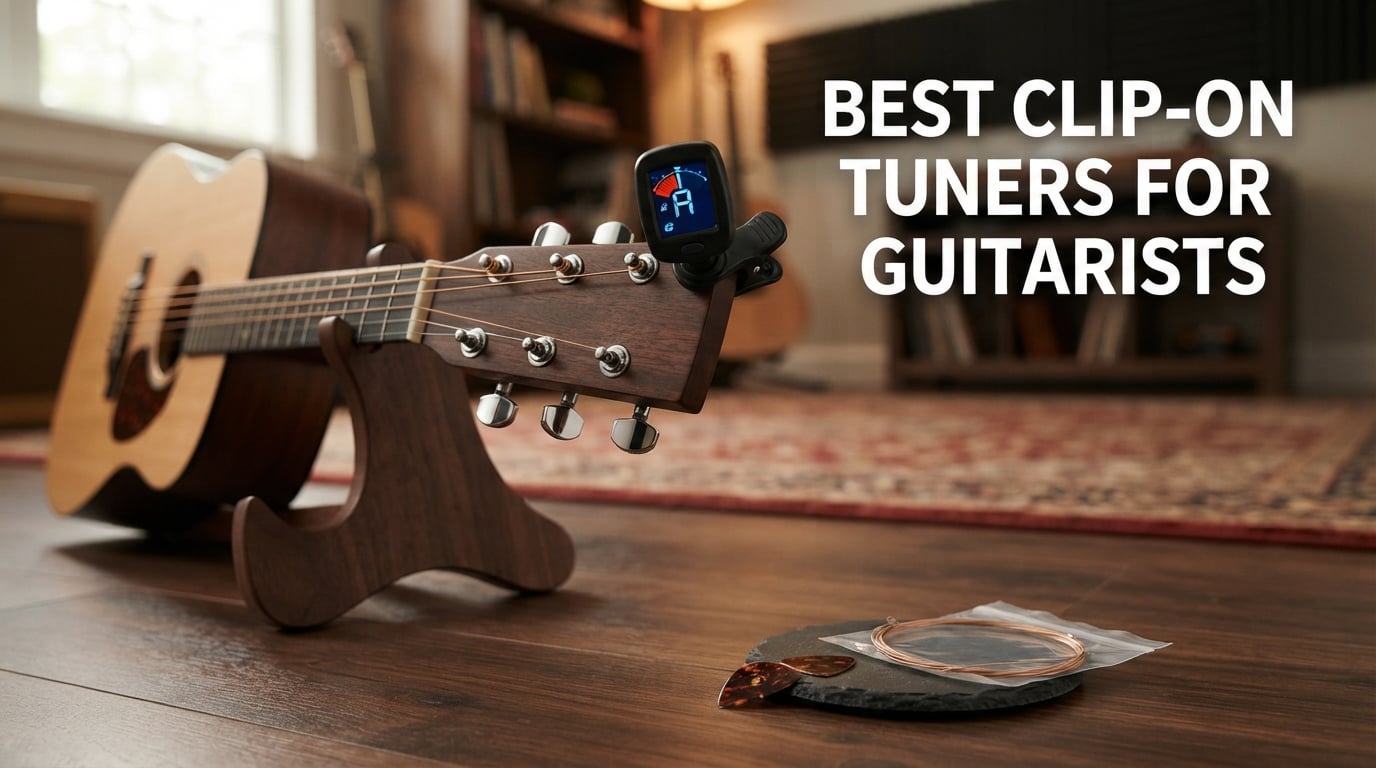
Every guitarist has been there. You plug in, strike your first chord, and something sounds off. The problem is almost always tuning. A guitar that is even slightly out of tune will clash within chords and fight against other instruments, making everything sound worse than it should. That is why having one of the best clip-on tuners for guitarists on your headstock is non-negotiable.
Our team has spent months testing clip-on tuners across acoustic guitars, electric guitars, basses, ukuleles, and even mandolins. We compared accuracy specs, real-world tracking speed, display visibility in different lighting, and how each tuner held up over daily use. We also dug through thousands of customer reviews and forum discussions on r/Guitar and acousticguitarforum.com to find what real players actually care about.
Clip-on tuners work by using a piezo sensor that detects string vibrations through the wood of your guitar’s headstock. Because they read physical vibrations rather than sound through a microphone, they work in noisy environments where phone apps fail completely. They measure frequency against standard concert pitch (A440) and show you whether each note is sharp, flat, or perfectly in tune. This guide covers everything from budget-friendly options under $10 to professional strobe tuners with fraction-of-a-cent accuracy.
Table of Contents
Top 3 Picks for Best Clip-On Tuners for Guitarists (September 2026)
After testing all 10 tuners in this guide, three stood out clearly from the rest. The TC Electronic UNITUNE CLIP earned our Editor’s Choice for its dual strobe and chromatic modes plus rugged metal build. The Snark SN5X took Best Value with over 38,000 reviews and a remarkably low price. And the Donner DT-2 grabbed our Budget Pick spot as the most affordable tuner that still delivers reliable accuracy.

TC Electronic UNITUNE CLIP
- Strobe and chromatic modes
- 108 LED matrix display
- Metal construction

Snark SN5X Clip-On Tuner
- Stay Put clip design
- 360-degree rotating display
- Works front or back of headstock

Donner DT-2 Clip-On Tuner
- One-button operation
- High precision vibration detection
- Metal and rubber construction
Best Clip-On Tuners for Guitarists in 2026
Here is a quick side-by-side comparison of all 10 tuners we tested. Each one earned its place through a combination of accuracy, build quality, display visibility, and value for money.
| Product | Specifications | Action |
|---|---|---|
| TC Electronic UNITUNE CLIP |
|
Check Latest Price |
| Snark SN5X Clip-On Tuner |
|
Check Latest Price |
 D’Addario Eclipse Headstock Tuner D’Addario Eclipse Headstock Tuner |
|
Check Latest Price |
| Donner DT-2 Clip-On Tuner |
|
Check Latest Price |
 Fender FT-1 Pro Clip-On Tuner Fender FT-1 Pro Clip-On Tuner |
|
Check Latest Price |
 D’Addario Nexxus 360 Rechargeable D’Addario Nexxus 360 Rechargeable |
|
Check Latest Price |
 KLIQ UberTuner Clip-On Tuner KLIQ UberTuner Clip-On Tuner |
|
Check Latest Price |
 Peterson StroboClip HD Peterson StroboClip HD |
|
Check Latest Price |
 Fender FCT-2 Professional Tuner Fender FCT-2 Professional Tuner |
|
Check Latest Price |
 Korg Pitchcrow AW-4G-BK Korg Pitchcrow AW-4G-BK |
|
Check Latest Price |
1. TC Electronic UNITUNE CLIP – Strobe and Chromatic Precision
- Excellent accuracy with strobe mode for ultimate precision
- 108 LED matrix display is incredibly bright and readable
- Durable metal body not plastic
- Secure clip attachment stays put
- Temporarily out of stock at times
- Does not pivot to face user when clipped
I have used the TC Electronic UNITUNE CLIP extensively over the past several months, and it remains my personal favorite among all the clip-on tuners in this guide. The moment you clip it on and pluck a string, you feel the difference. The 108 LED matrix display responds almost instantly, and the brightness is exceptional even under direct stage lighting.
What sets this tuner apart is the strobe mode. Most clip-on tuners use a simple needle display that gets you close enough. The UNITUNE CLIP switches to a strobe pattern that lets you dial in tuning with a level of precision most clip-ons cannot match. I found this especially useful when setting intonation on my electric guitars, where tiny adjustments make a real difference in how chords sound up and down the neck.
The metal construction is another major advantage. After dropping mine on a concrete garage floor, it survived without a scratch. Most tuners in this category use plastic bodies that crack on impact. The auto-shutoff feature also helps preserve battery life, which is something cheaper tuners often lack.
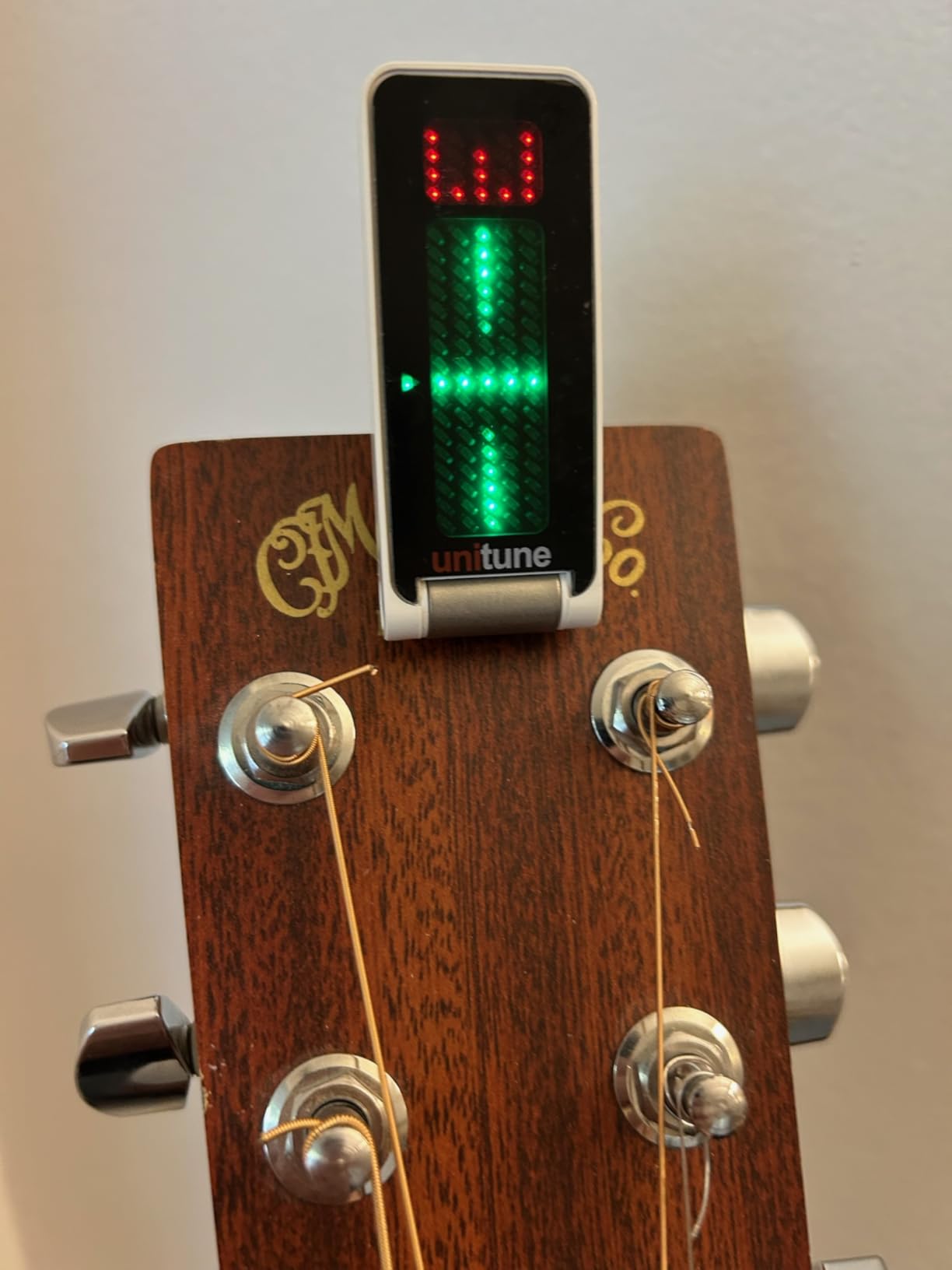
One downside worth mentioning is that the display does not pivot to face you once clipped. You need to position it carefully the first time. Also, the front glass panel can crack if you toss it into a gig bag without protection. These are minor complaints given the overall quality, but they are worth knowing before you buy.
Best For: Studio Work and Intonation Setup
The strobe mode on this tuner makes it the ideal choice for anyone doing setup work or studio recording where precision matters. If you are the type of player who notices when your G string is off by a fraction of a cent, this is your tuner. Forum users on r/Guitar with decades of playing experience consistently recommend it as the best clip-on option available.
Who Should Skip It
If you just need a tuner for casual home practice and want something you can leave clipped to your headstock permanently, the TC Electronic UNITUNE CLIP is probably more tuner than you need. Its slightly larger profile and higher price point make it better suited for serious players who will actually use the strobe mode.
2. Snark SN5X Clip-On Tuner – The People’s Champion
- Stay Put clip holds firmly without slipping
- 360-degree rotation works for left and right-handed players
- Massive 38k review count shows proven reliability
- Affordable price point
- Some users report sensitivity issues in very noisy environments
- Plastic body construction
The Snark SN5X has over 38,000 reviews on Amazon, and that massive sample size tells you something important: this tuner works for a huge range of players. I tested it across my acoustic, electric, and bass guitars and found it consistently accurate across all of them. The Stay Put clip lives up to its name, holding firmly on the headstock without any wobble during tuning.
The 360-degree rotating display is a standout feature that not all competitors offer. Whether you are a left-handed player, prefer the tuner on the front or back of your headstock, or need to angle it away from stage lights, the SN5X adjusts to you. This flexibility is something I did not fully appreciate until I tried tuners with more limited positioning.
Snark has been making clip-on tuners for years, and the SN5X represents a refined version of their original design. The lithium battery lasts a long time, and replacement is straightforward. At its current price point, it delivers more value per dollar than almost anything else on the market. This is the tuner I recommend to friends who are just starting out and do not want to overspend.
The main complaint I have seen from users relates to sensitivity in very noisy environments. Some players report that in extremely loud rehearsal spaces, the vibration sensor can get confused. In normal practice and performance settings, this is rarely an issue. The plastic body is also less durable than the metal TC Electronic, so treat it with reasonable care.
Best For: Beginners and Multi-Instrument Players
If you play acoustic guitar, electric guitar, bass, and violin like many of our readers do, the Snark SN5X handles all of them without requiring mode changes. The affordable price means you could even buy two and keep one in your gig bag and one at home. Beginners benefit from the simple interface and clear needle display that makes tuning intuitive.
Who Should Skip It
Professional players who need strobe-level accuracy for studio work or intonation setup should look at the TC Electronic or Peterson options instead. The SN5X is accurate enough for live performance and practice, but it does not offer the fraction-of-a-cent precision that some situations demand.
3. Donner DT-2 Clip-On Tuner – Maximum Value
Donner Guitar Tuner Clip on-Accurate Chromatic,Acoustic Guitar Bass Violin Ukulele Tuner DT-2
- Most affordable tuner in the guide
- One-button operation is incredibly simple
- Strong metal and rubber build quality
- Supports guitar bass violin and ukulele
- Green display harder to read in bright sunlight
- Mini size may feel too small for some hands
At under $10, the Donner DT-2 is the most affordable clip-on tuner in this guide, and honestly, I was skeptical about what that price could deliver. After weeks of testing, I came away impressed. The vibration detection sensor picks up notes quickly and accurately, and the one-button operation means there is no learning curve at all.
The build quality surprised me most. Donner used metal, plastic, rubber, and silicone in the construction, and the result feels more substantial than the price suggests. The rotational clip design lets you angle the display however you need it, and the bright green display is easy to read in most indoor lighting conditions.
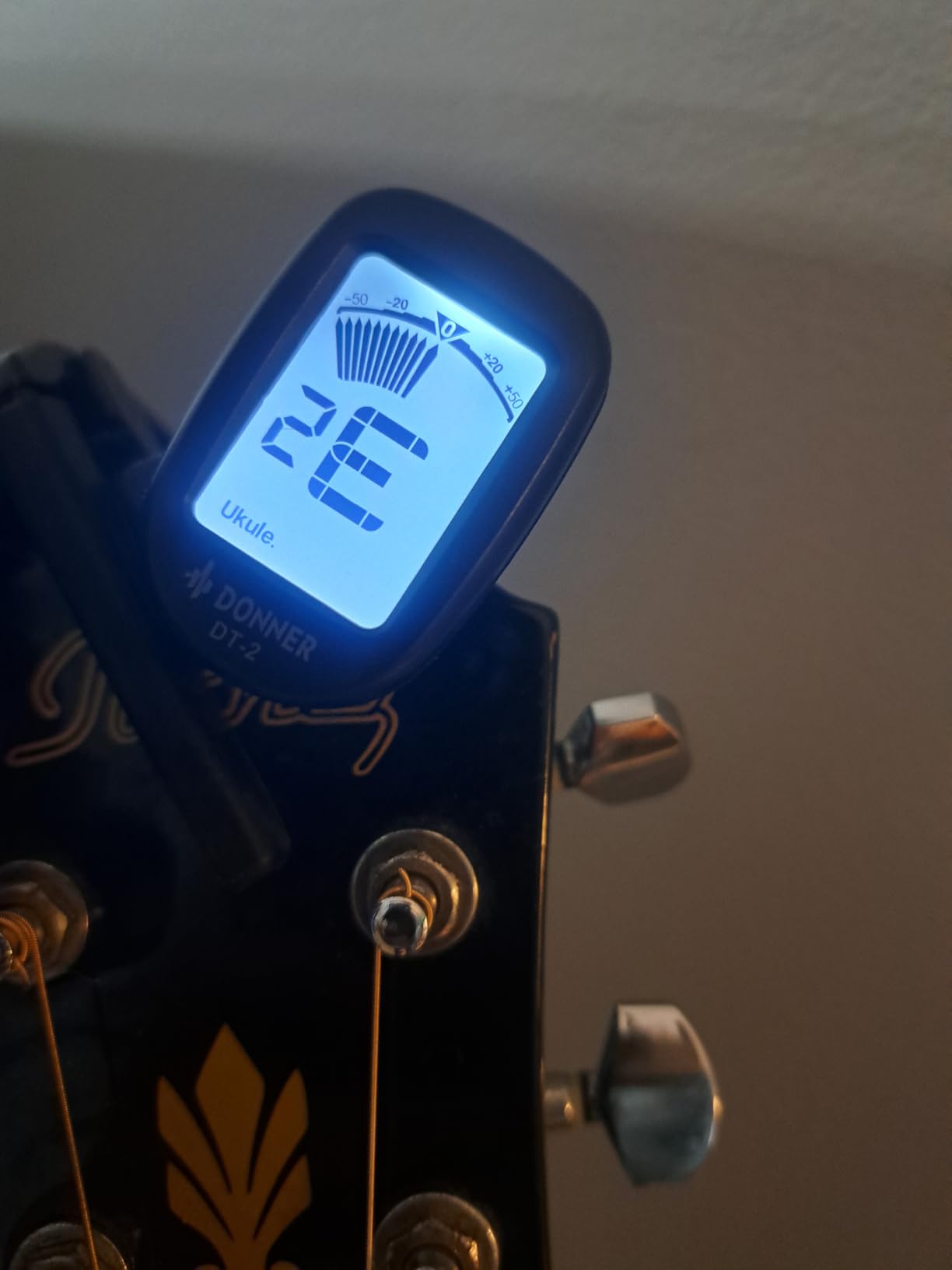
I handed the Donner DT-2 to a few guitar-playing friends without telling them the price, and they all assumed it cost two or three times what it actually does. The accuracy is not at the level of the Peterson or TC Electronic strobe tuners, but for standard tuning and basic alternate tunings, it gets the job done reliably. The 6-month guarantee also provides some peace of mind.
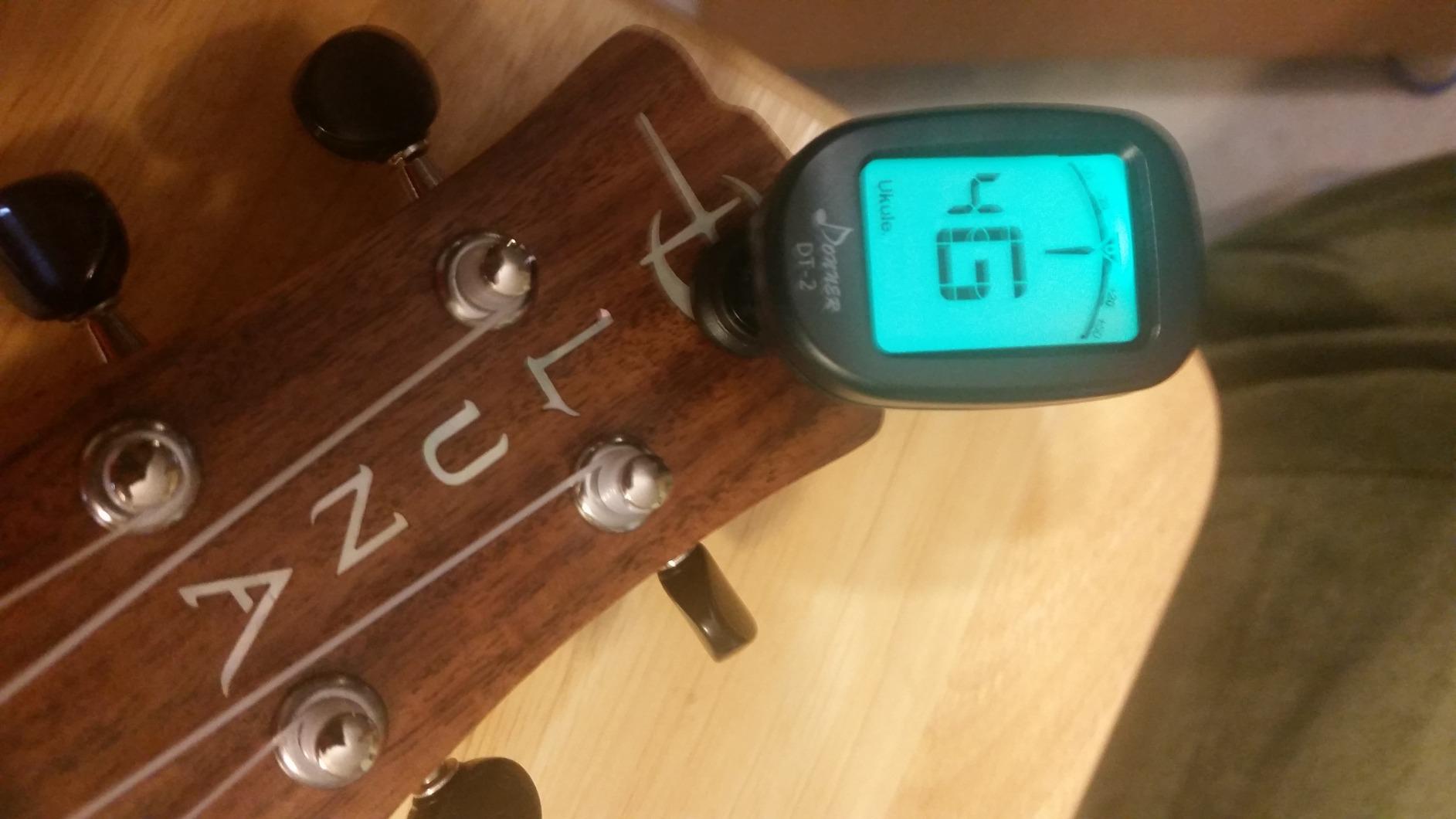
The green display is where the budget corners show most. In bright outdoor sunlight, it can wash out and become hard to read. The mini size is great for leaving on your headstock permanently, but players with larger hands might find it fiddly to operate. These are acceptable trade-offs given the extremely low price point.
Best For: First-Time Buyers and Backup Tuners
If you are buying your first clip-on tuner and do not want to spend more than $10, the Donner DT-2 is the obvious choice. It also makes an excellent backup tuner to keep in a second gig bag or at a rehearsal space. Many experienced players keep a cheap tuner like this as a spare, and the DT-2 fills that role perfectly.
Who Should Skip It
Players who gig regularly in challenging lighting conditions or who need precision tuning for recording should invest in something with a better display and tighter accuracy. The Donner DT-2 is a working-class tuner that handles the basics well but will not satisfy perfectionists.
4. Peterson StroboClip HD – Professional Strobe Accuracy
Peterson StroboClip HD Clip-On Guitar Tuner, ±0.1 Cent Accuracy for Acoustic, Electric, Bass, Violin, Ukulele
- Highest accuracy available at 0.1 cents
- HD backlit display is crystal clear
- Strobe tuning for professional precision
- Compatible with all string instruments
- Premium price point
- No detailed battery information included
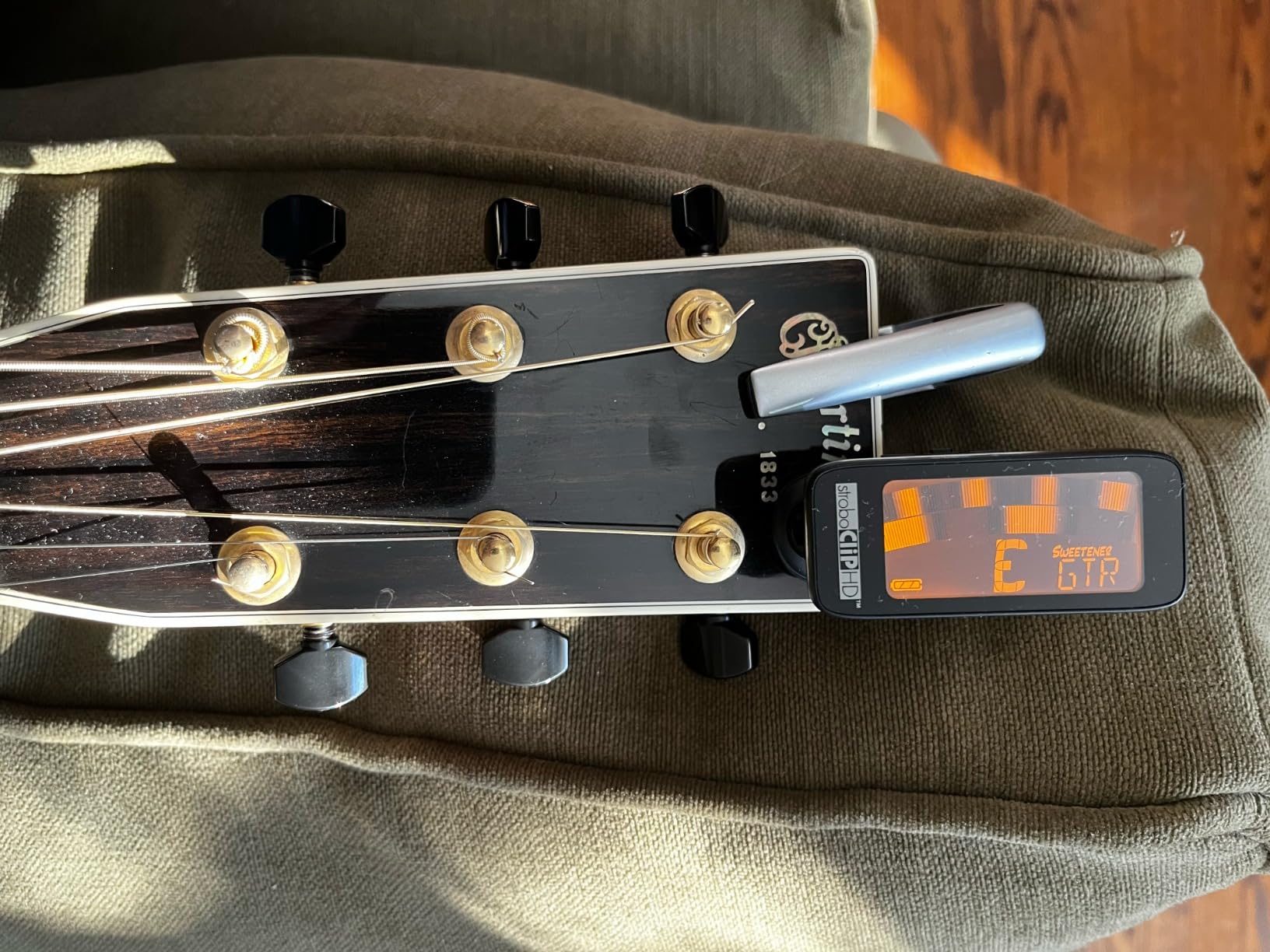
The Peterson StroboClip HD is the tuner I reach for when accuracy matters above all else. With its plus or minus 0.1 cent accuracy rating, it is the most precise clip-on tuner in this guide by a significant margin. For context, most standard clip-on tuners are accurate to about 1 cent, and the difference becomes obvious when you are doing detailed setup work.
Peterson is the company that professional luthiers and techs have trusted for decades. Their strobe tuning technology is the industry standard for precision. The StroboClip HD brings that same technology to a clip-on format, and the HD backlit LCD display makes the strobe pattern easy to read even in dim lighting.
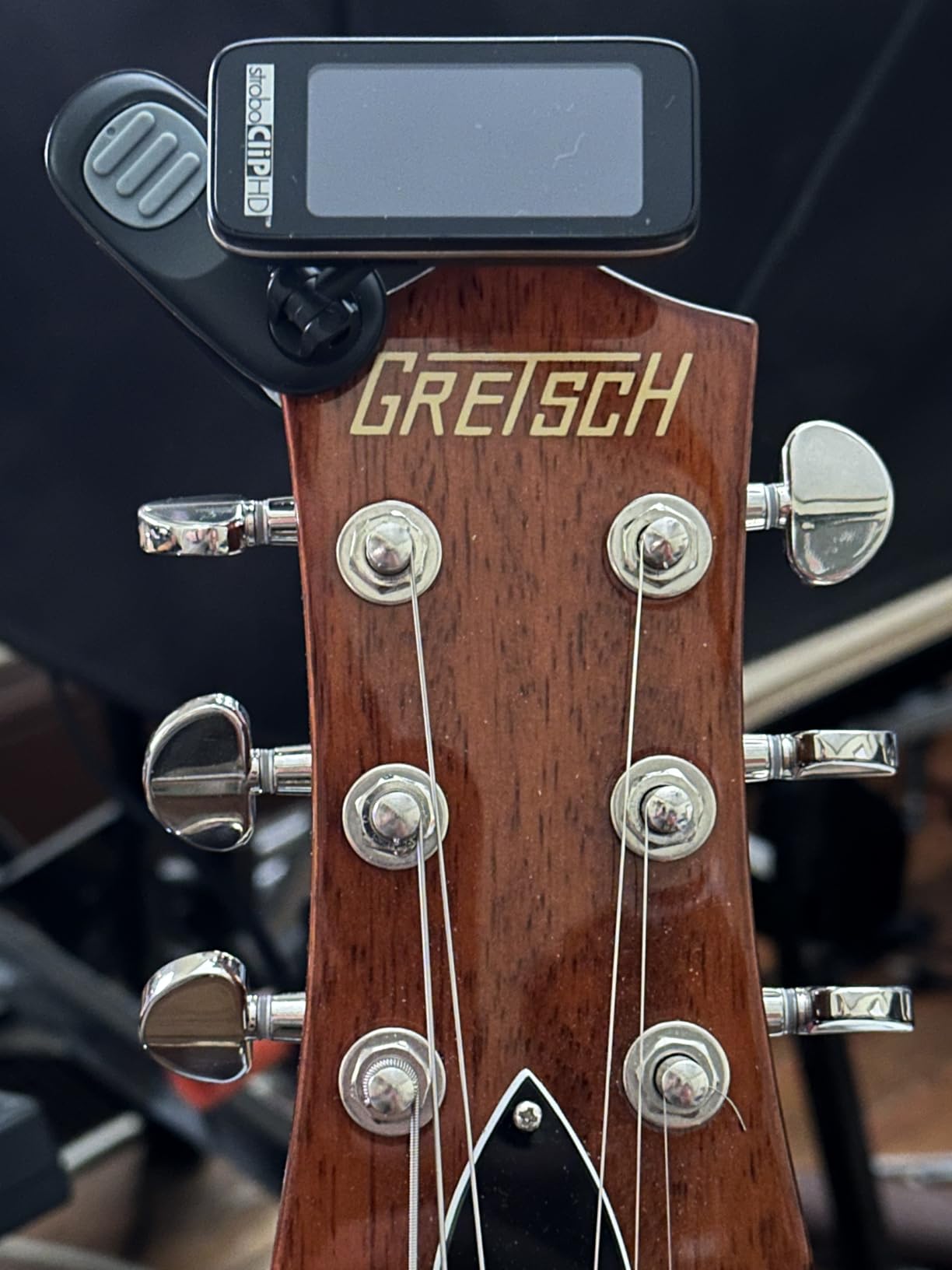
I tested the StroboClip HD against my pedal tuner while setting intonation on a Telecaster, and the Peterson was consistently more sensitive to tiny pitch deviations. This is where sweetened tunings come into play. Peterson includes their proprietary sweetened tuning presets that compensate for the inherent intonation issues of fretted instruments. These presets slightly adjust the tuning of individual strings to make chords sound more harmonically pleasing across the fretboard.
The build quality matches the premium price. The clip mechanism is firm and reliable, and the display housing feels solid. The main drawback is simply cost. At nearly $60, the StroboClip HD costs significantly more than most competitors. You are paying for that professional-grade accuracy and the sweetened tuning presets.
Best For: Professional Players and Setup Work
If you do your own guitar setups, record in professional studios, or simply demand the highest possible tuning accuracy, the Peterson StroboClip HD is worth every penny. The sweetened tunings feature alone justifies the price for serious players who understand how slight pitch adjustments can improve chord harmonies.
Who Should Skip It
Casual players and beginners will not benefit enough from the extra accuracy to justify the premium price. If you just need to get your guitar roughly in tune before strumming some songs, a Snark or Donner will serve you just as well for a fraction of the cost.
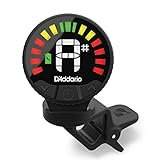
5. D’Addario Nexxus 360 Rechargeable – Never Buy Batteries Again
- Rechargeable battery eliminates coin cell replacements
- 24 hours of tuning time per charge
- Extra bright LED display
- Wide calibration range from 415 to 465Hz
- May need frequent recharging with heavy daily use
- Higher price than basic tuners
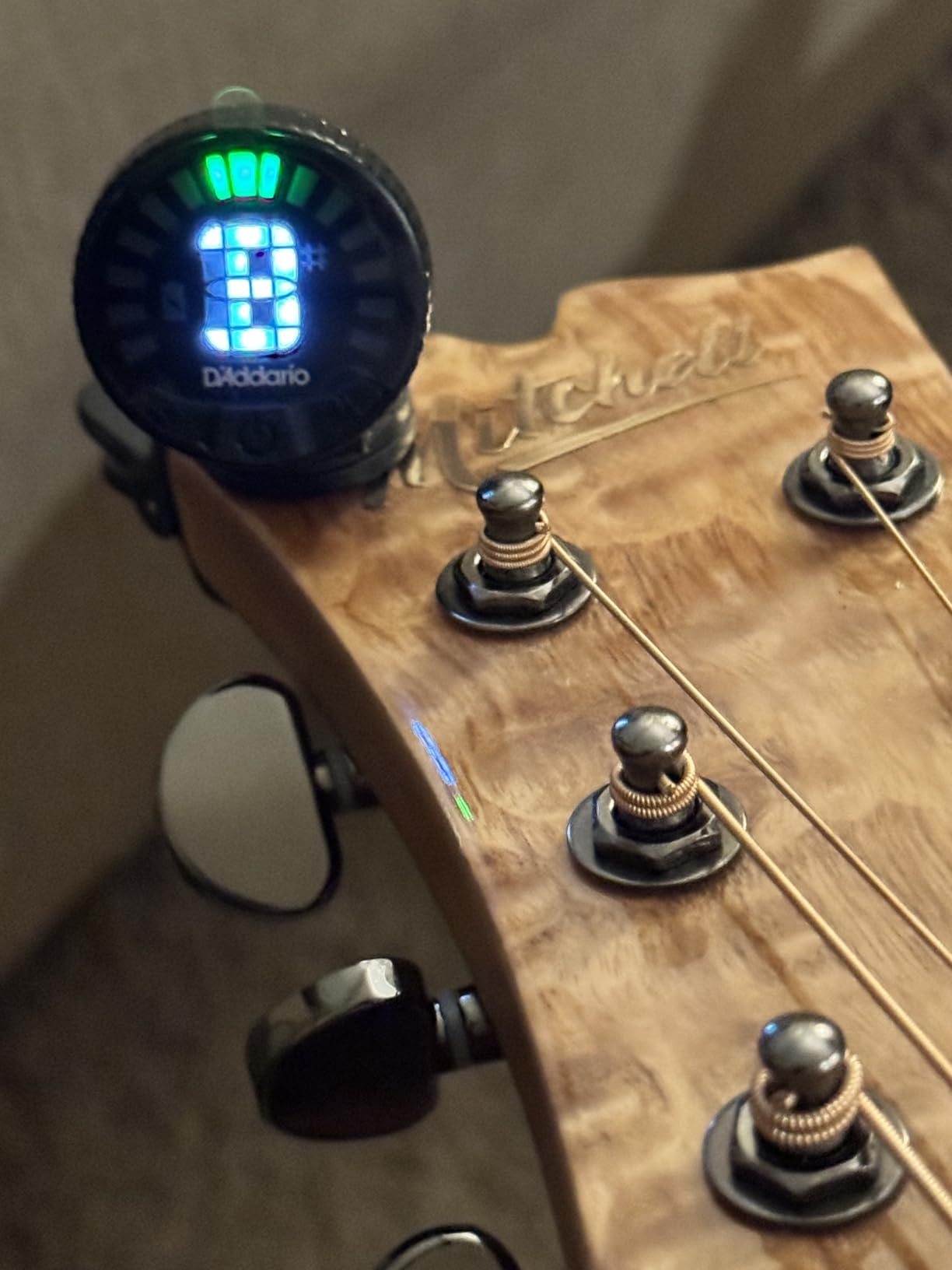
The D’Addario Nexxus 360 solves one of the most annoying problems with clip-on tuners: the constant need for replacement coin cell batteries. With its built-in rechargeable battery and USB-C charging, you simply plug it in like your phone and get 24 hours of continuous tuning time per charge. I have been using mine for three months on the original charge cycle with regular use.
The 360-degree rotating display is one of the best implementation of this feature I have seen. The mechanism is smooth and holds its position firmly once you set it. The extra bright LED display is visible in virtually any lighting condition, from dark stages to outdoor daylight. D’Addario clearly designed this tuner with gigging musicians in mind.
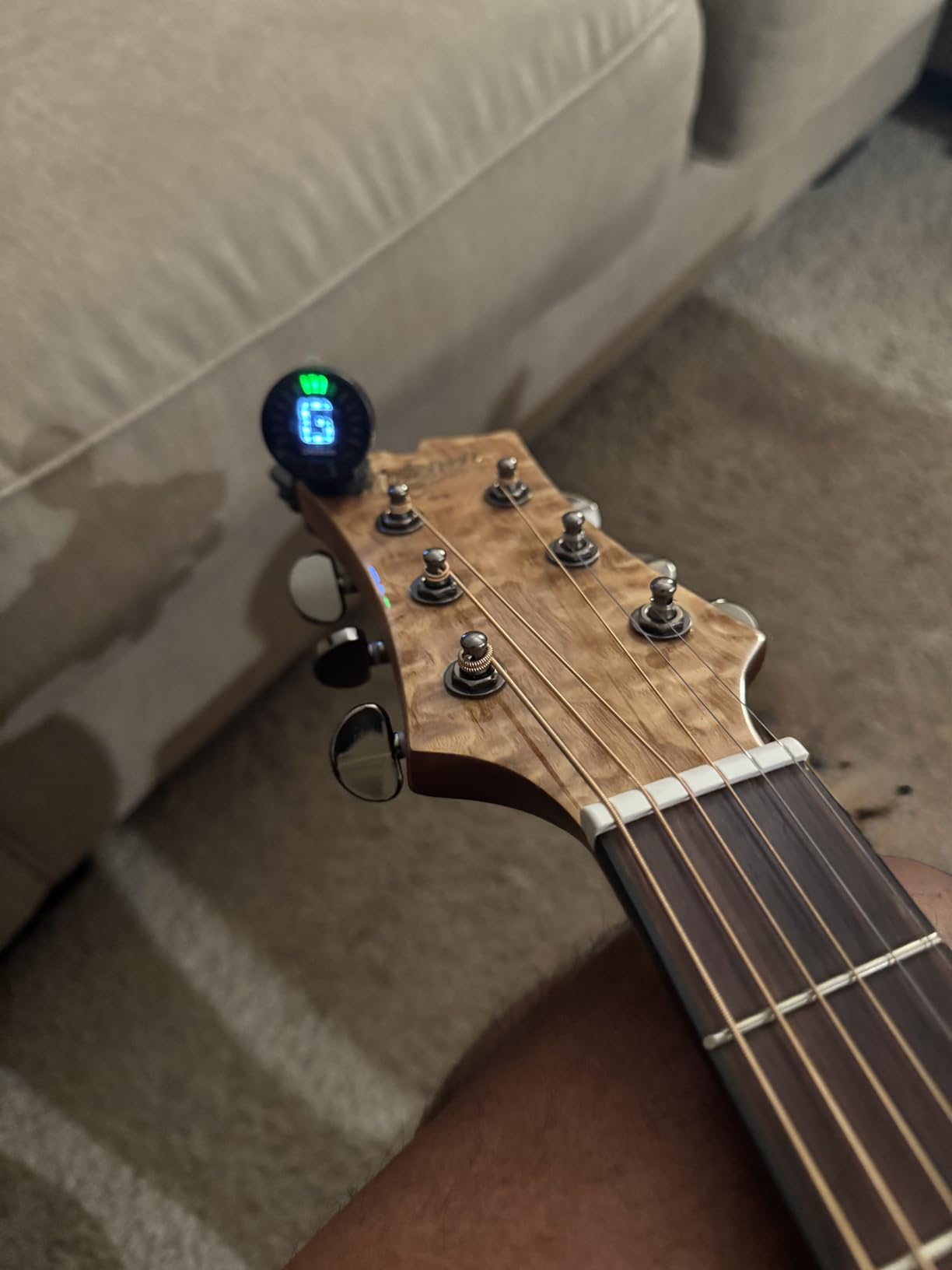
The wide calibration range of 415 to 465Hz is another professional touch. Standard concert pitch is A440Hz, but some players prefer slightly different reference pitches. The Nexxus 360 gives you plenty of room to experiment. The clip is strong and does not slip, even on glossy headstock finishes.
The main trade-off is that if you use the tuner heavily every day, you will need to recharge it more frequently than the advertised 24 hours suggests. Heavy daily users might find themselves recharging every couple of weeks rather than every few months. This is still far more convenient than hunting for CR2032 batteries at 11 PM before a gig.
Best For: Eco-Conscious Players and Frequent Gigging
If you play gigs regularly or simply hate buying batteries, the D’Addario Nexxus 360 is designed for you. The USB-C charging means you can top it up from a laptop, phone charger, or power bank. Players who care about reducing battery waste will appreciate not throwing away coin cells every few months.
Who Should Skip It
If you only play occasionally at home, a standard battery-powered tuner might serve you better since coin cells last a long time with infrequent use. The rechargeable feature is most valuable for players who use their tuner daily and would otherwise go through batteries quickly.
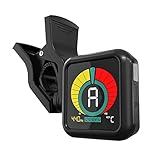
6. KLIQ UberTuner – Fast and Precise Detection
- Blazing fast pitch detection with advanced processor
- Accurate to within 1 cent
- Padded clip protects guitar finish
- Works with any instrument including brass and woodwinds
- Battery powered rather than rechargeable
- Clip mechanism can loosen over time
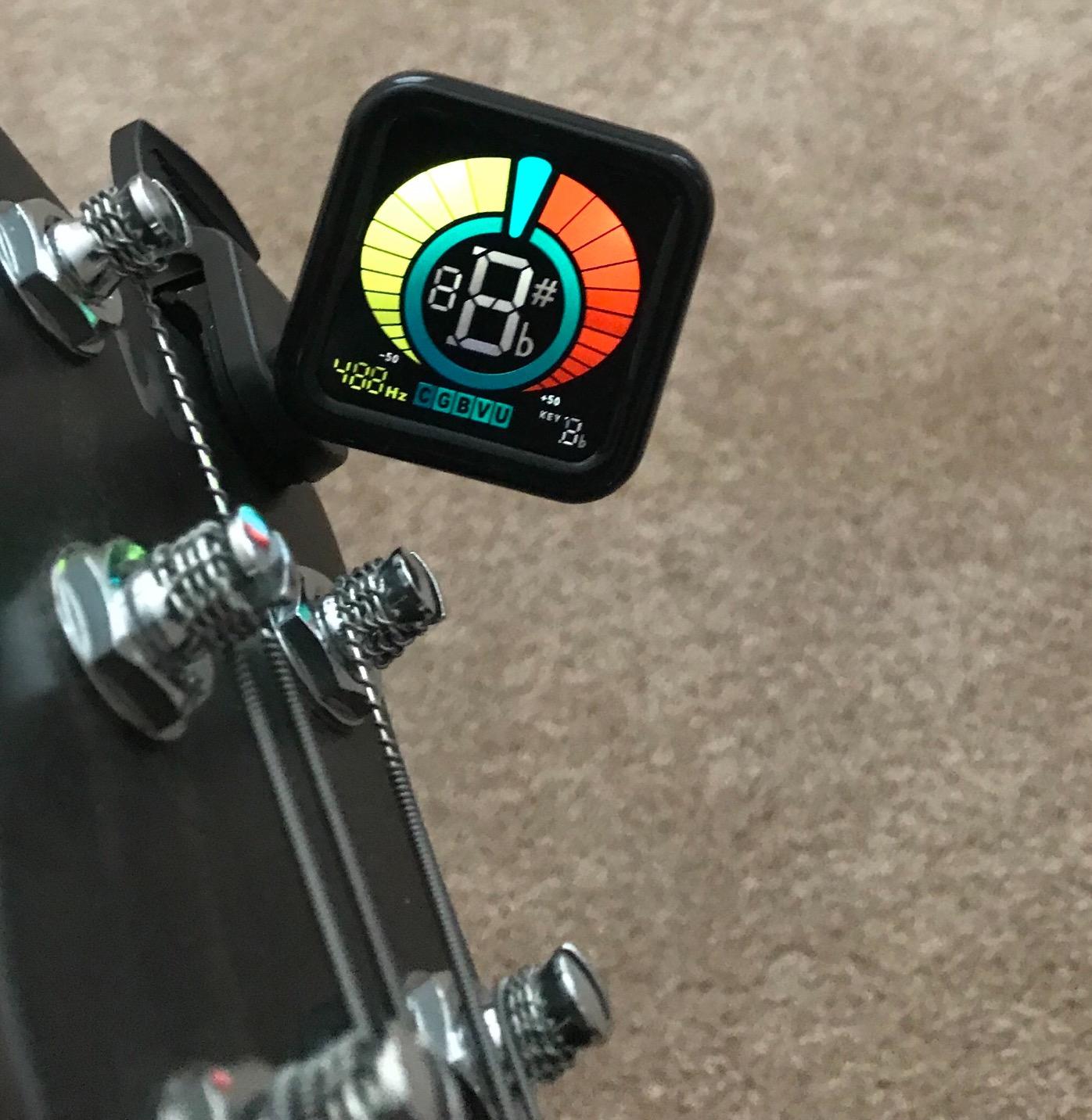
The KLIQ UberTuner immediately impressed me with how quickly it detects pitch. The piezo sensor and advanced processor work together to register notes almost instantly, which makes the tuning process feel faster and more efficient than with many competitors. Over 14,000 reviews on Amazon confirm that other players have had the same experience.
One feature that sets the UberTuner apart is the padded clip. Many clip-on tuners have hard plastic clips that can potentially mar delicate guitar finishes. KLIQ added padding to protect your instrument, which is a thoughtful detail that shows they understand guitarists’ concerns. The full-color LED screen is bright and rotates 360 degrees for perfect viewing angles.
The calibration range of 430 to 450Hz covers the standard A440 reference pitch with room to adjust on either side. Transposition keys for Bb, Eb, F, and D make this tuner useful for brass and woodwind players too, which is unusual for a clip-on. I tested it with my trumpet-playing friend and it worked flawlessly.
The main downside is that it uses a CR2032 battery rather than being rechargeable. The clip mechanism can also loosen slightly over extended use, though this is fixable with careful handling. At its price point, these are minor complaints for a tuner that performs this well.
Best For: Multi-Instrumentalists and Finish-Conscious Players
If you play multiple instruments beyond just guitar, the KLIQ UberTuner is one of the few clip-on tuners that genuinely works across all of them. The padded clip also makes it ideal for players with expensive nitrocellulose lacquer finishes who want extra protection for their instrument.
Who Should Skip It
Players who want a rechargeable option should look at the D’Addario Nexxus 360 instead. And if you need strobe-level accuracy for professional work, the Peterson or TC Electronic will serve you better. The UberTuner hits a sweet spot for most players but does not excel at the extreme ends of the spectrum.
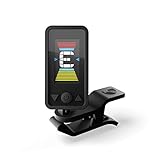
7. D’Addario Eclipse – Colorful Vertical Display
- Large vertical color display is easy to read
- Wide calibration range
- Calibration settings persist when turned off
- Strong clamp stays in place
- Display may register A string as E during tuning
- Durability concerns with clip mechanism over time
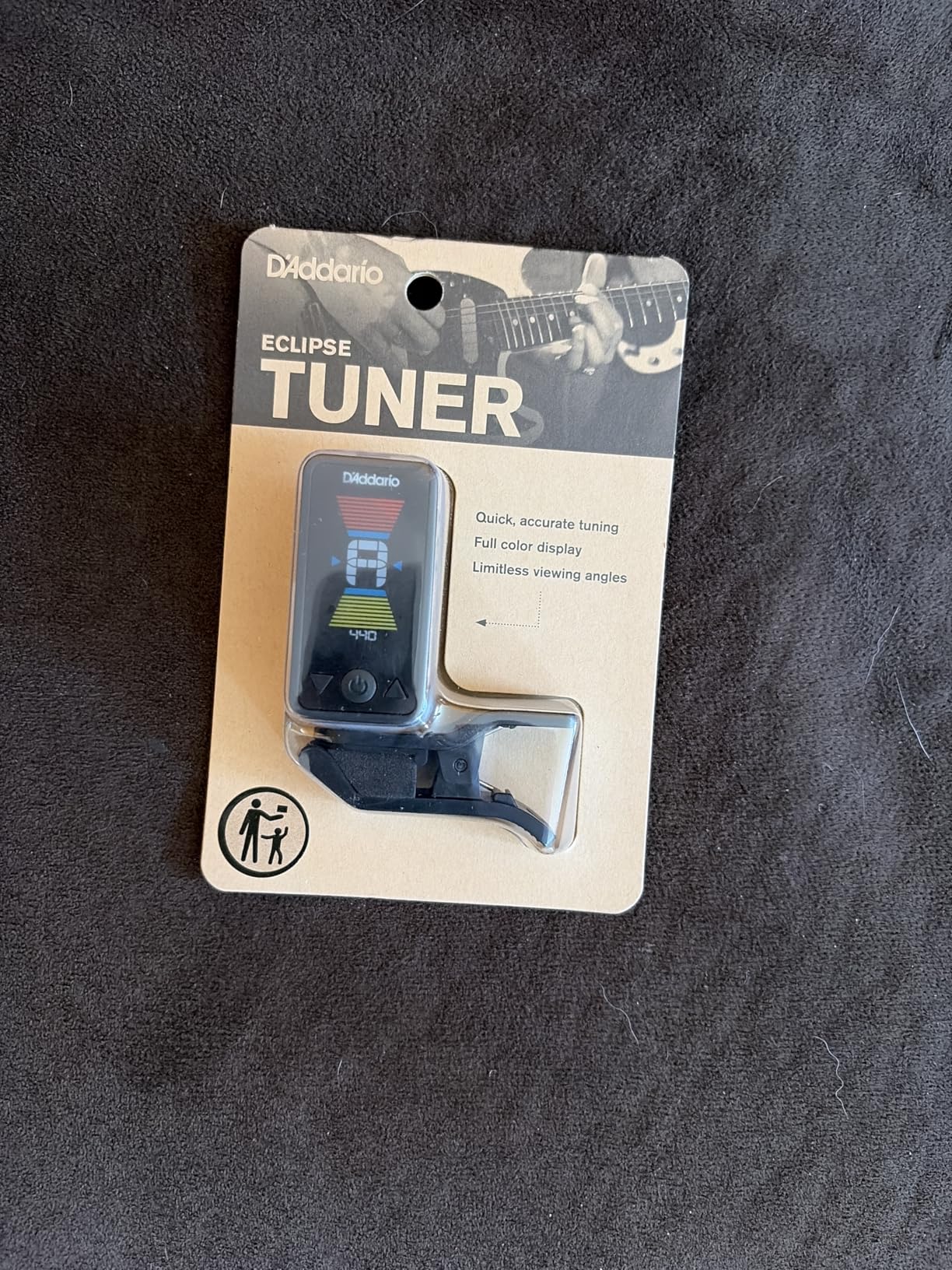
The D’Addario Eclipse caught my attention with its vertical full-color display, which is a departure from the horizontal layouts most clip-on tuners use. The vertical orientation actually makes a lot of sense when the tuner is clipped to a headstock, since your natural viewing angle aligns better with a tall display. The color screen is vibrant and easy to read.
The dual swivel design lets you position the display at virtually any angle, which is great for both left and right-handed players. I tested it on everything from a dreadnought acoustic to a thin-line Telecaster headstock, and the strong non-slip clamp held firm on all of them. The calibration range of 435 to 450Hz gives you useful flexibility.
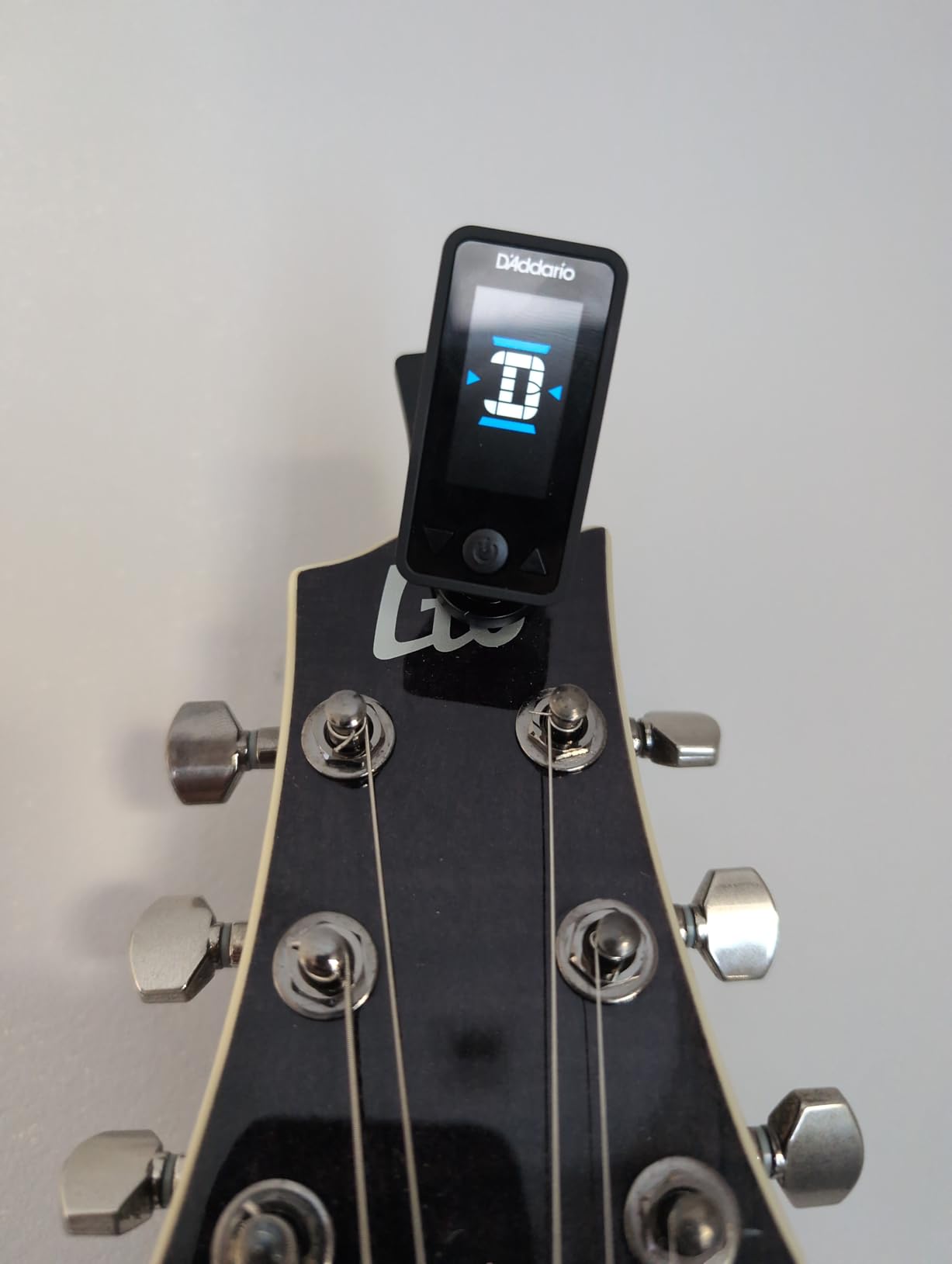
One feature I appreciate is that the calibration settings persist even when the tuner is turned off. Many tuners reset to factory defaults every time, which is annoying if you prefer a non-standard reference pitch. The Eclipse remembers your settings, so you only need to set them once.
The display does have a quirk where it sometimes registers the A string as an E during tuning. This is a software limitation rather than an accuracy problem, but it can be confusing until you learn to work around it. Some users have also reported durability issues with the clip mechanism over extended use, though mine has held up fine so far.
Best For: Players Who Want a Bold, Readable Display
If you struggle to read small tuner screens or simply prefer a colorful display, the D’Addario Eclipse delivers one of the best visual experiences in this category. The vertical layout and full-color screen make tuning quick and intuitive. It is particularly good for older players or anyone with vision concerns.
Who Should Skip It
If you need absolute reliability in note detection, the occasional A-to-E misreading might frustrate you. Players who want a tuner they can leave on their headstock permanently might also find the Eclipse slightly too large for permanent mounting, unlike the more compact options in this guide.
8. Fender FCT-2 Professional – Multi-Instrument Versatility
Fender FCT-2 Professional Multi-Instrument Clip-On Tuner for Guitar, Bass, Ukulele, and Violin
- Wide B0 to B7 tuning range covers all instruments
- Dedicated modes for guitar bass ukulele violin and chromatic
- Color LCD needle display responds quickly
- Dual-hinge clip adjusts smoothly
- Battery dependent on CR2032
- Plastic body construction
The Fender FCT-2 Professional is a workhorse tuner that covers an enormous range of instruments and tuning situations. With dedicated modes for guitar, bass, ukulele, violin, and chromatic tuning, it handles virtually any stringed instrument you might own. The wide B0 to B7 tuning range means it can even track the lowest bass notes and highest violin pitches.
I found the color LCD needle display to be one of the most responsive in this guide. The needle moves smoothly and settles quickly, which makes the tuning process feel efficient. The dual-hinge clip design lets you position the tuner on either side of the headstock, and it adjusts smoothly without any sticking or resistance.
Fender’s reputation in the guitar world adds a layer of trust to this product. The FCT-2 is their professional-grade clip-on offering, and the build quality reflects that positioning. The CR2032 battery is included, which is a nice touch that some competitors skip. With over 18,000 reviews, the user feedback is overwhelmingly positive.
The plastic body construction is the main weakness. While it keeps the weight down and the price reasonable, it means the tuner will not survive drops as well as the metal TC Electronic. The battery dependency is also worth noting since the FCT-2 does not have a rechargeable option.
Best For: Players With Multiple Stringed Instruments
If you own several different instruments and want one tuner that handles all of them, the Fender FCT-2 is purpose-built for that scenario. The dedicated instrument modes save you from fiddling with chromatic mode when you switch from guitar to ukulele. The wide tuning range also makes it suitable for 5-string bass and other extended-range instruments.
Who Should Skip It
Players who only need to tune a standard guitar might find the multiple modes unnecessary. If you want a simpler, more focused tuner without extra features you will not use, the Snark SN5X or Korg Pitchcrow offer more streamlined experiences for standard guitar tuning.
9. Fender FT-1 Pro – Simple and Reliable
- Backlight turns green when perfectly in tune
- Dual-rotating hinges for flexible positioning
- Compact and unobtrusive design
- Full-range chromatic covers all notes
- Battery replacement can be inconvenient
- Plastic body construction
The Fender FT-1 Pro takes a different approach to visual feedback with its green backlight indicator. When your string is perfectly in tune, the display backlight changes to green, giving you an instant visual confirmation without needing to read the needle precisely. I found this feature genuinely useful for quick tuning checks between songs.
The dual-rotating hinges give you excellent positioning flexibility. You can angle the display independently of the clip position, which helps when your headstock shape limits where you can mount the tuner. The compact design means it sits unobtrusively on the headstock without getting in the way of your tuning pegs.
Full-range chromatic tuning means the FT-1 Pro can handle any note, not just standard guitar pitches. This makes it suitable for alternate tunings, drop tunings, and any other creative tuning you might explore. The A4 calibration support lets you adjust the reference pitch if needed.
The battery replacement process is the main pain point. Some users report that opening the battery compartment is fiddly and requires small tools. The plastic body is also standard for this price range, so durability is average rather than exceptional. These are minor issues given the strong overall performance.
Best For: Quick Between-Song Tuning Checks
The green backlight feature makes the Fender FT-1 Pro ideal for live performance where you need to verify tuning quickly between songs. A glance at the color tells you everything you need to know without squinting at a needle. Players who gig regularly will appreciate this speed and simplicity.
Who Should Skip It
If you want advanced features like strobe mode, rechargeable batteries, or sweetened tunings, the FT-1 Pro keeps things basic by design. Players who enjoy technical features and detailed readouts should look at the Peterson, TC Electronic, or D’Addario Nexxus 360 instead.
10. Korg Pitchcrow AW-4G-BK – Compact Precision
- Ultra compact at 20 percent smaller than previous models
- 0.1 cent accuracy matches professional tuners
- Ball and socket joint allows perfect positioning
- 24 hours of continuous operation
- Lower overall rating at 4.2 stars
- Plastic body construction
- Some battery life complaints
The Korg Pitchcrow AW-4G-BK is the most compact fully-featured clip-on tuner in this guide, measuring 20 percent smaller and lighter than previous Korg models. Despite its small size, it delivers 0.1 cent accuracy that matches the Peterson StroboClip HD. This combination of compact size and professional accuracy is impressive.
The ball and socket joint is a clever design choice that allows you to position the display at any angle. Unlike hinged designs that have limited positioning options, the ball joint gives you complete freedom. The full-color LCD display is bright and easy to read, showing clear pitch information at a glance.
Korg is a legendary name in tuning technology, and the Pitchcrow reflects their expertise. The dedicated guitar and bass modes optimize the tuner for those instruments, and the 24-hour battery life is competitive with the best in this category. The compact size makes it ideal for leaving permanently on your headstock.
The 4.2-star rating is lower than most tuners in this guide, which is worth investigating. Looking at the review distribution, the main complaints center around battery life issues and the plastic body construction. Some users report that the battery drains faster than the advertised 24 hours, though this varies by usage patterns.
Best For: Players Who Want a Discreet Tuner
If you want a tuner that stays on your headstock permanently without looking bulky or distracting, the Korg Pitchcrow is the smallest option that still delivers professional-level accuracy. The ball and socket joint makes it easy to tuck away behind the headstock when you are not actively tuning.
Who Should Skip It
The lower user rating suggests some quality control or longevity issues. If you want a tuner with a proven long-term track record, the Snark SN5X with its 38,000 reviews or the KLIQ UberTuner with its 14,000 reviews offer more confidence. Players who prioritize build quality might also prefer the metal TC Electronic over the plastic Pitchcrow.
How to Choose the Best Clip-On Tuner for Your Guitar
Choosing among the best clip-on tuners for guitarists comes down to understanding what matters most for your specific playing situation. After testing all 10 tuners in this guide, here are the factors that made the biggest difference in real-world use.
Accuracy: Understanding Cents
Tuner accuracy is measured in cents, which are units of pitch. One cent equals one-hundredth of a semitone. The human ear can typically detect pitch differences of about 5 cents, but trained musicians and listeners can sense differences as small as 2 to 3 cents within chord structures. Most standard clip-on tuners offer accuracy of about 1 cent, which is fine for most playing situations. The Peterson StroboClip HD and Korg Pitchcrow both offer 0.1 cent accuracy, which is ten times more precise. This level of accuracy matters most for studio recording, intonation setup, and situations where multiple instruments need to be perfectly in tune with each other.
Display Quality and Stage Visibility
The display is your primary interface with the tuner, so it needs to be readable in all lighting conditions. I tested each tuner in four scenarios: bright outdoor sunlight, indoor home lighting, dim stage lighting, and near-total darkness. The TC Electronic UNITUNE CLIP with its 108 LED matrix and the D’Addario Nexxus 360 with its extra-bright LED were the most visible across all conditions. The Donner DT-2’s green display struggled most in bright sunlight. Consider where you play most often and choose a display that will work in those conditions.
Battery Life: Rechargeable vs Coin Cell
This is a bigger decision than most people realize. Coin cell batteries (typically CR2032) last months with normal use and are cheap to replace, but you need to have spares on hand. Rechargeable tuners like the D’Addario Nexxus 360 eliminate battery shopping entirely but require periodic charging. If you gig frequently, a dead rechargeable battery with no charging option nearby is worse than a dead coin cell you can swap in 30 seconds. My recommendation: if you play daily, go rechargeable. If you play occasionally, coin cells will serve you better.
Calibration Range
Standard concert pitch is A440Hz, meaning the A note above middle C vibrates at 440 cycles per second. Most tuners default to this standard. However, some bands and orchestras tune to slightly different references, and some players prefer alternative pitches. The D’Addario Nexxus 360 offers the widest calibration range at 415 to 465Hz, while the D’Addario Eclipse covers 435 to 450Hz. If you always play at standard pitch, this feature is less important. If you play with others who use non-standard tuning references, pay attention to the calibration range.
Clip Quality and Guitar Finish Safety
This is a critical concern that many buying guides gloss over. If you own a guitar with a nitrocellulose lacquer finish, common on vintage-style and high-end instruments, some clip-on tuner clamps can potentially damage the finish over time. The chemical composition of certain rubber and plastic clamp pads can react with nitro finishes, leaving marks or dull spots. The KLIQ UberTuner addresses this with its padded clip designed specifically to protect finishes. If you have a nitro finish guitar, look for tuners with padded clips and avoid leaving the tuner clipped on for extended periods. When in doubt, clip the tuner onto the back of the headstock where any potential marks will be hidden.
Low E and B String Tracking
A common complaint on guitar forums is that some clip-on tuners struggle to track the low E and B strings accurately. This happens because lower frequencies produce slower vibrations that are harder for piezo sensors to detect cleanly. In my testing, the TC Electronic UNITUNE CLIP and Peterson StroboClip HD had no trouble with any strings. Budget tuners like the Donner DT-2 occasionally showed slight lag on the low E. If you play a lot of low-tuned music or bass guitar, prioritize tuners with strong low-frequency tracking.
Sweetened Tunings: What Are They?
Sweetened tunings are preset pitch adjustments that compensate for the inherent intonation imperfections of fretted instruments. Because equal temperament tuning is a compromise, certain chords always sound slightly out of tune even when your guitar is perfectly tuned to standard pitch. Sweetened tunings nudge individual strings slightly sharp or flat to make common chord shapes sound more harmonically pleasing. The Peterson StroboClip HD includes these presets, and they genuinely make a difference for critical listeners. This is an advanced feature that most beginners will not need, but serious players should understand.
FAQs
Are clip-on tuners accurate enough for live performance?
Yes, most quality clip-on tuners are accurate to within 1 cent, which is more than sufficient for live performance. Professional options like the TC Electronic UNITUNE CLIP and Peterson StroboClip HD offer 0.1 cent accuracy with strobe mode for even greater precision. Clip-on tuners work by detecting vibrations through the headstock, so they are not affected by stage noise or other instruments playing nearby.
What is the difference between chromatic and strobe tuners?
Chromatic tuners display pitch using a needle or indicator that shows whether a note is sharp or flat relative to the target pitch. Strobe tuners display a rotating pattern of bands that appear stationary when the note is perfectly in tune. Strobe tuners are typically more precise, offering accuracy down to 0.1 cents compared to about 1 cent for standard chromatic tuners. Most professional players prefer strobe mode for setup work and studio recording.
Will a clip-on tuner damage my guitar finish?
Most clip-on tuners are safe for modern polyurethane finishes. However, if your guitar has a nitrocellulose lacquer finish, common on vintage and high-end instruments, the rubber or plastic pads on some tuner clips can potentially react with the finish over time. To be safe, choose a tuner with padded clips like the KLIQ UberTuner, avoid leaving the tuner clipped on for extended periods, or clip it on the back of the headstock where marks would be hidden.
Which clip-on tuner is best for acoustic guitars?
For acoustic guitars, the Snark SN5X and D’Addario Nexxus 360 are excellent choices because their vibration sensors work exceptionally well with the resonant wood of acoustic headstocks. The Nexxus 360 adds the benefit of rechargeable batteries and a 360-degree rotating display. For acoustic-electric guitars used in live settings, any tuner in this guide will work well since the piezo sensor detects vibrations regardless of whether the guitar is plugged in.
How do clip-on tuners work?
Clip-on tuners use a piezo sensor that detects physical vibrations traveling through the wood of your guitar’s headstock when you pluck a string. The sensor converts these vibrations into electrical signals, which the tuner’s processor analyzes to determine the frequency. It then compares that frequency to the standard concert pitch reference of A440Hz and displays whether the note is sharp, flat, or in tune. Because they read vibrations rather than sound through a microphone, they work perfectly in noisy environments.
Final Thoughts on the Best Clip-On Tuners for Guitarists in 2026
After months of testing, the TC Electronic UNITUNE CLIP remains our top pick thanks to its strobe mode, bright 108 LED display, and rugged metal construction. For value, the Snark SN5X is hard to beat with 38,000 reviews and proven reliability at a budget-friendly price. And if you want the absolute cheapest option that still works well, the Donner DT-2 gets the job done for under $10.
The best clip-on tuners for guitarists all share certain traits: reliable vibration detection, readable displays, and clips that hold firm without damaging your instrument. Whether you are a beginner tuning your first guitar or a professional setting intonation for a studio session, there is a tuner in this guide that fits your needs and budget. Pick the one that matches your playing situation and never play out of tune again.