
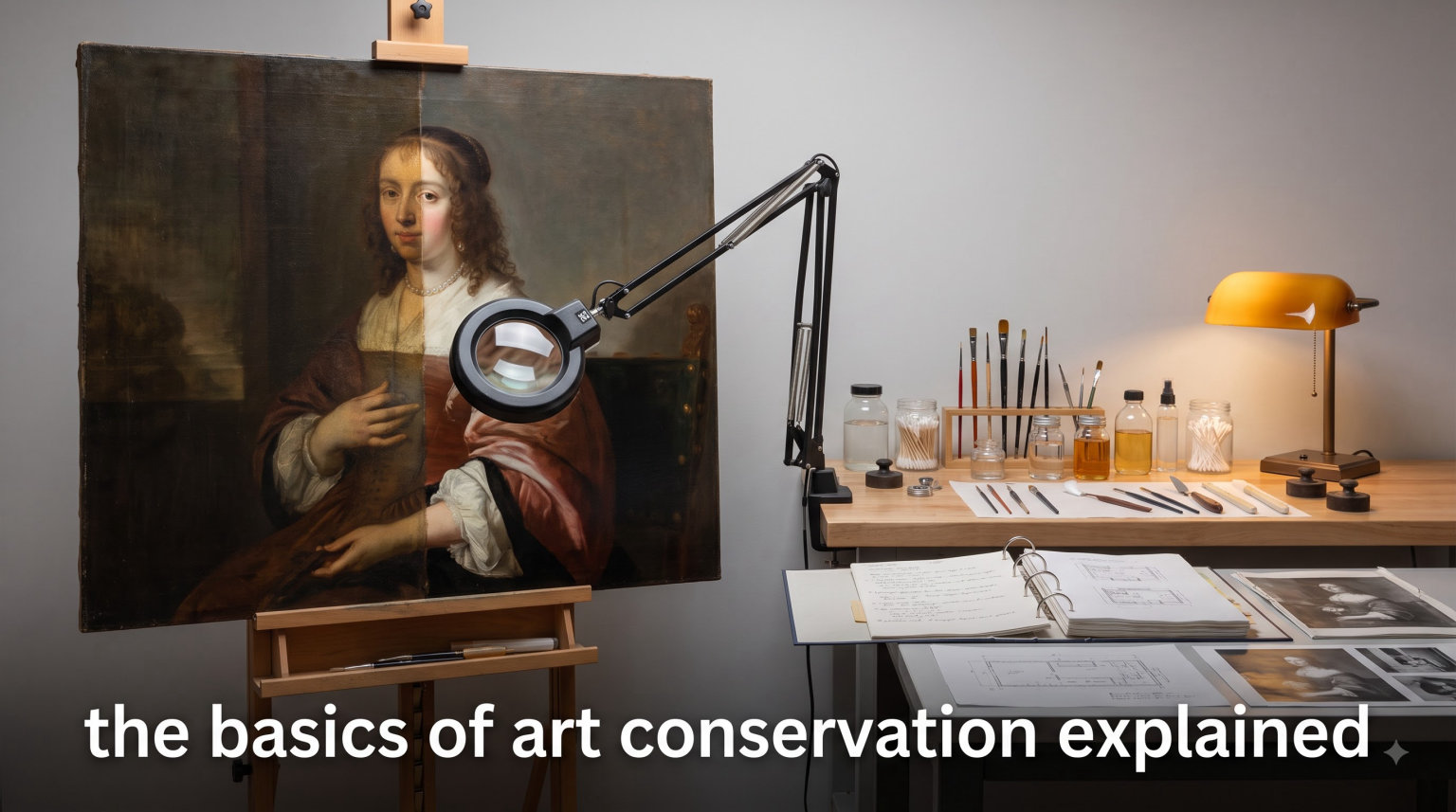
Walk into any major museum and you will see centuries-old paintings that still glow with color, sculptures that hold every detail the artist intended, and textiles that look nearly as vibrant as the day they were woven. None of that happens by accident. Behind every well-preserved work of art is a team of trained professionals working to slow down the relentless march of time. That work, at its core, is what we call art conservation.
If you have ever wondered how a 500-year-old canvas survives, or why some objects in a collection look pristine while others fade into obscurity, the answer always comes back to the same discipline. Understanding the basics of art conservation explained means understanding how science, history, and hands-on skill come together to protect cultural heritage for future generations. It also means understanding the choices that museums, galleries, and private collectors make every day, from the curatorial decision-making process down to the climate controls in a storage room.
In this guide, our team breaks down what art conservation actually involves, how it differs from restoration, what tools and techniques professionals use, and why the field is more relevant now than ever. Whether you are a student considering a career in conservation, a collector looking to protect your investments, or simply someone who loves art and wants to understand the invisible labor behind it, this article covers the essentials.
Table of Contents
What Is Art Conservation?
Art conservation is the professional practice of preserving art and objects of cultural heritage through examination, documentation, treatment, and prevention. The goal is not to make old things look new again. Instead, conservators work to stabilize an object’s condition, slow or stop ongoing deterioration, and protect it from future damage, all while respecting the original materials and the artist’s intent.
This field sits at the intersection of art history, chemistry, materials science, and hands-on craftsmanship. A conservator might spend one day analyzing the pigment composition of a Renaissance painting under a microscope and the next day building a custom storage mount for a fragile textile. The breadth of knowledge required is what makes this profession both demanding and deeply rewarding.
The American Institute for Conservation (AIC), the primary professional body in the United States, defines conservation as “the profession devoted to the preservation of cultural property for the future.” That definition is intentionally broad because conservation covers an enormous range of objects: paintings, sculptures, photographs, textiles, ceramics, furniture, manuscripts, digital media, and even entire buildings and archaeological sites.
At its most fundamental level, art conservation rests on four pillars:
Examination: Investigating the structure, materials, and condition of an object to understand what it is made of and what is happening to it.
Documentation: Creating detailed written, photographic, and scientific records of the object’s condition before, during, and after any treatment.
Treatment: Performing hands-on interventions to stabilize, repair, or protect the object using reversible methods whenever possible.
Prevention: Implementing environmental controls, handling protocols, and storage standards to prevent damage from occurring in the first place.
These four pillars guide every decision a conservator makes, and they apply whether the object is a Ming dynasty vase or a contemporary digital installation.
Art Conservation vs Restoration: Key Differences
People often use the terms “conservation” and “restoration” interchangeably, but they refer to distinctly different approaches. Understanding the difference is one of the most common questions people have when they first learn about this field, and for good reason. The distinction matters because it shapes every treatment decision a professional makes.
Restoration focuses on returning an object to a known or assumed earlier state. The emphasis is on appearance. A restorer might repaint damaged areas of a canvas, rebuild missing portions of a sculpture, or refinish a piece of antique furniture so that it looks as close to “original” as possible. Restoration has a long history, and many historical treatments were purely restorative, often with little regard for the original materials.
Conservation takes a broader and more cautious approach. The emphasis is on preservation, stabilization, and prevention rather than visual perfection. A conservator prioritizes the physical and chemical integrity of the original materials. Treatments are designed to be reversible whenever possible, meaning they can be undone by future conservators without damaging the object. Documentation is rigorous, and every intervention is recorded in detail.
Here is a side-by-side comparison of the two approaches:
Primary goal: Restoration aims to restore appearance; conservation aims to preserve integrity and prevent further loss.
Ethics: Conservation follows strict ethical guidelines established by professional organizations like AIC. Restoration has fewer formal ethical constraints.
Reversibility: Conservation treatments are designed to be reversible or retreatable. Restoration may use permanent methods.
Documentation: Conservation requires thorough documentation of all conditions and treatments. Restoration may or may not document the process.
Original materials: Conservation prioritizes preserving original materials above all else. Restoration may replace or cover original materials to achieve a desired look.
Long-term approach: Conservation considers the object’s future needs and the needs of future researchers. Restoration focuses primarily on the present appearance.
In practice, most modern professionals operate within the conservation framework, even when they perform treatments that have a visual component. The field has moved decisively toward conservation over the past several decades, driven by a growing understanding of how aggressive past restorations sometimes caused more harm than good.
That said, the two approaches are not always in opposition. A conservator might perform a treatment that improves an object’s appearance, but they do so within an ethical framework that prioritizes reversibility, documentation, and the long-term health of the object. The best practitioners combine technical skill with a deep respect for the history and materiality of the work.
The Art Conservation Process Explained
Every conservation project follows a structured process, whether it involves a single painting or an entire collection. The process is methodical by design. Rushing or skipping steps can lead to irreversible mistakes. Here is how a typical conservation project unfolds, broken down into its four key phases.
Step 1: Examination and Condition Assessment
Before a conservator touches any object, they need to understand it thoroughly. Examination is the foundation of every conservation project. It involves studying the object visually, scientifically, and historically to determine what it is made of, how it was constructed, and what condition it is in right now.
Visual examination under normal and raking light reveals surface cracks, discoloration, flaking paint, and other visible issues. But the real insights often come from scientific analysis. Conservators use ultraviolet fluorescence to detect previous repairs, infrared imaging to see underdrawings beneath paint layers, X-radiography to examine structural elements, and pigment analysis to identify specific materials.
The condition assessment that results from this examination becomes the baseline for all future work. It records every scratch, stain, area of loss, and structural weakness. This document serves as both a diagnostic tool and a legal record, protecting the conservator, the institution, and the object itself.
Step 2: Documentation
If examination is the diagnosis, documentation is the medical record. Conservation professionals document everything, and for good reason. Future conservators, researchers, and curators need to know exactly what was done, when, and why. Without thorough documentation, the history of an object becomes unreliable.
Documentation typically includes written condition reports, high-resolution photographs from multiple angles, scientific analysis results, and diagrams or maps showing the location of damage. During treatment, the conservator continues to photograph and write notes at every significant stage.
Modern documentation increasingly includes digital tools. Photogrammetry creates three-dimensional models of objects. Multispectral imaging captures data beyond what the human eye can see. Digital databases allow institutions to track the condition of entire collections over time, making it easier to spot trends and prioritize treatments.
Step 3: Treatment
Treatment is what most people picture when they think of conservation: the hands-on work of repairing and stabilizing an object. But treatment in the conservation sense is far more measured and deliberate than most people assume.
Before any treatment begins, the conservator develops a detailed treatment plan that outlines the proposed interventions, the materials to be used, and the expected outcomes. This plan is often reviewed by curators, scientists, and other stakeholders before work proceeds.
Common treatments include surface cleaning to remove dirt and grime, consolidation to reattach flaking paint, structural repairs to stabilize canvas or wood supports, and inpainting to visually reintegrate areas of loss. The materials used for inpainting are chosen specifically because they can be removed later without affecting the original paint layers.
Every treatment follows the principle of minimal intervention. The conservator does only what is necessary to stabilize the object and prevent further damage. This restrained approach reflects the understanding that future conservators will have access to better materials and techniques, and the less original material disturbed now, the better.
Step 4: Preventive Conservation
Preventive conservation is arguably the most important phase, and it is certainly the one that affects the largest number of objects. Rather than treating damage after it occurs, preventive conservation focuses on creating conditions that prevent damage from happening in the first place.
This phase covers a wide range of activities: controlling temperature and humidity in storage and display spaces, filtering air to remove pollutants, limiting light exposure on sensitive materials, implementing integrated pest management programs, establishing proper handling and transport protocols, and designing appropriate storage solutions.
Institutions that invest in preventive conservation save enormous resources over time. Treating a single deteriorated painting can cost thousands of dollars and hundreds of hours of labor. Maintaining proper environmental controls for an entire collection is far more cost-effective and protects a much larger number of objects.
The 10 Agents of Deterioration
Understanding what causes art to deteriorate is central to understanding conservation. Conservation professionals recognize 10 primary agents of deterioration, a framework developed by the Canadian Conservation Institute and now used worldwide. These agents represent the full spectrum of threats to cultural heritage.
Here are the 10 agents, ranked roughly by how commonly conservators encounter them:
Physical forces: Impact, vibration, abrasion, and gravity. A painting dropped during transport, a sculpture cracked by vibration from nearby construction, or a textile sagging under its own weight.
Theft and vandalism: Deliberate removal or damage. Security systems, controlled access, and proper documentation help mitigate this threat.
Fire: Extreme heat and smoke damage. Fire suppression systems, proper storage of flammable materials, and emergency response plans are essential.
Water: Floods, leaks, condensation, and high humidity. Water causes mold, warping, corrosion, and dissolution of water-soluble materials.
Pests: Insects, rodents, and mold organisms that feed on organic materials. Integrated pest management programs monitor and control infestations.
Pollutants: Gases, particulates, and aerosols that cause chemical degradation. Indoor air quality management and proper housing materials are critical defenses.
Light and ultraviolet radiation: Fading, yellowing, and chemical breakdown of pigments and substrates. UV-filtering glazing and controlled lighting schedules are standard preventive measures.
Incorrect temperature: Extreme heat accelerates chemical reactions and biological growth. Extreme cold can cause brittleness and condensation when temperatures fluctuate.
Incorrect relative humidity: High humidity promotes mold growth and corrosion. Low humidity causes desiccation and cracking. Rapid fluctuations cause mechanical stress as materials expand and contract.
Dissociation: The loss of meaning, context, or association. This includes losing provenance records, separating parts of a set, or forgetting the cultural significance of an object.
Most objects face multiple agents simultaneously. A painting stored in a damp basement, for example, might battle high humidity, mold, pests, and dissociation all at once. Effective preventive conservation addresses these agents in combination rather than in isolation.
Tools and Techniques Used by Conservators
The tools of art conservation range from centuries-old hand tools to cutting-edge scientific instruments. A conservator’s toolkit reflects the dual nature of the profession: part artisan, part scientist. Understanding these tools helps explain how conservation actually works in practice.
Traditional Conservation Techniques
Many of the hand skills used in conservation have been refined over centuries. Conservators use fine brushes, scalpels, cotton swabs, and specialized solvents to clean surfaces and remove discolored varnish layers. They apply adhesives with surgical precision to reattach flaking paint or consolidate crumbling stone. They use warm to cold set lining techniques to reinforce weakened canvas supports.
These traditional techniques require extensive training and a steady hand, but they remain the backbone of most treatment work. The best technology in the world cannot replace the tactile sensitivity and judgment that comes from years of hands-on practice.
Scientific and Imaging Tools
Modern conservation relies heavily on scientific analysis. Stereomicroscopes allow conservators to examine surfaces at high magnification, revealing details invisible to the naked eye. Ultraviolet fluorescence lamps highlight previous repairs and areas of retouching because different materials fluoresce in distinct colors under UV light.
Infrared reflectography can reveal underdrawings and compositional changes beneath the visible paint layers of a painting. X-radiography shows the internal structure of objects, including the weave of a canvas, the construction of a wooden panel, or the armature inside a sculpture. Colorimeters and spectrophotometers measure color with scientific precision, allowing conservators to track fading or color shifts over time.
Digital and Diagnostic Technologies
The digital revolution has transformed conservation practice. Multispectral imaging captures data across the electromagnetic spectrum, revealing pigments, alterations, and damage patterns that are invisible under normal lighting conditions. Photogrammetry software constructs detailed three-dimensional models from dozens or hundreds of photographs, creating precise records of an object’s form.
X-ray fluorescence (XRF) analyzers identify the elemental composition of pigments and metals without touching the object. Gas chromatography-mass spectrometry (GC-MS) identifies organic materials like resins, oils, and binding media. These analytical tools give conservators unprecedented insight into the materials they are treating, leading to more informed and effective treatments.
Modern Challenges in Art Conservation
The field of art conservation is not static. As art itself evolves, so must the methods used to preserve it. Contemporary conservation faces challenges that would have been unimaginable even a few decades ago, and addressing these challenges requires new thinking, new materials, and new approaches.
Contemporary Art and Unconventional Materials
Modern and contemporary artists frequently use materials that were never designed to last. Plastic, food, biological matter, electronics, and found objects all present unique preservation challenges. A sculpture made from wax, chocolate, or soap might be intended to change over time as part of the artist’s concept, creating a philosophical tension between the impulse to preserve and the artist’s intent.
Conservators working with contemporary art must navigate these questions carefully. Sometimes the best conservation choice is to allow controlled change, or to document the work thoroughly and create a plan for eventual refabrication rather than attempting to arrest natural decay. These decisions require close collaboration with living artists whenever possible.
Digital Art Preservation
Digital art presents an entirely new category of conservation challenges. Software-based installations, interactive works, video art, and virtual reality experiences depend on hardware, operating systems, and file formats that become obsolete at an accelerating pace. A work created on a specific version of custom software in 2005 may be completely unviewable by 2026 if no preservation strategy was in place.
Digital preservation strategies include emulation (creating virtual environments that mimic obsolete hardware and software), migration (converting files to current formats), and documentation of the work’s behavior and appearance for potential recreation. This area of conservation is still developing, and standards continue to evolve as the field matures.
Sustainability in Conservation Practice
The environmental cost of museum operations, particularly climate control, has come under increasing scrutiny. Traditional environmental standards for museum storage specify narrow ranges for temperature and humidity that require energy-intensive HVAC systems running around the clock. As institutions face pressure to reduce their carbon footprints, conservators are reassessing whether those strict parameters are always necessary.
Research into the tolerance of different materials to broader environmental fluctuations is ongoing. Some institutions are adopting more flexible guidelines that still protect collections while significantly reducing energy consumption. This conversation intersects with the broader preservation of different art forms and the evolving standards of the art world.
Sustainability also extends to the materials conservators use. Many traditional solvents and chemicals are being replaced with greener alternatives, and waste management protocols are becoming more rigorous. The field is gradually embracing practices that protect both cultural heritage and the environment.
Careers in Art Conservation
For people drawn to the intersection of art and science, conservation can be an exceptionally fulfilling career. It is also a field with specific requirements and realities that anyone considering it should understand before committing to the long educational pathway it demands.
Education and Training Requirements
Most professional conservation positions require a master’s degree from a recognized conservation program. In the United States, there are only a handful of accredited graduate programs, including those at New York University, the University of Delaware, Buffalo State College, and UCLA. Acceptance rates at these programs are highly competitive, often admitting fewer than 10 students per year.
Admission typically requires a strong foundation in both studio art and chemistry, along with hundreds of hours of documented conservation experience, usually gained through internships or volunteer positions at museums and conservation labs. This combination of art and science prerequisites means that aspiring conservators often need to plan their undergraduate coursework carefully.
Salary and Job Market
According to the Bureau of Labor Statistics, the median annual salary for museum conservators in the United States is approximately $52,500. Salaries range from around $35,000 for entry-level positions to over $80,000 for senior conservators at major institutions. The field is small, with an estimated 14,400 museum conservators nationwide, which means competition for open positions can be intense.
Despite the competitive job market and relatively modest salaries, conservation consistently ranks as a highly satisfying career among those who practice it. Many conservators describe it as a calling rather than just a job. The combination of intellectual challenge, hands-on craftsmanship, and meaningful contribution to cultural preservation creates a level of professional fulfillment that is difficult to find elsewhere.
Professional Development and Credentials
The American Institute for Conservation offers a peer-reviewed credential called Professional Associate (PA) and a higher designation called Fellow. These credentials signal a commitment to professional standards and ongoing education. Many employers prefer or require these credentials for senior positions.
Continuing education is essential in conservation. New materials, techniques, and technologies emerge regularly, and conservators must stay current to provide the best possible care for the objects entrusted to them. Professional conferences, workshops, and publications provide the primary channels for this ongoing learning.
FAQs
What is art conservation?
Art conservation is the professional practice of preserving art and cultural heritage through examination, documentation, treatment, and prevention. Conservators work to stabilize objects, slow deterioration, and protect them from future damage while respecting original materials and the artist’s intent.
What is the difference between conservation and restoration?
Conservation focuses on preserving an object’s original materials and preventing further deterioration, using reversible treatments and thorough documentation. Restoration aims to return an object to a previous appearance, which may involve replacing or covering original materials. Modern professionals generally follow conservation principles.
Why is art conservation important?
Art conservation protects cultural heritage for future generations, preserves historical artifacts that tell the story of human civilization, maintains the integrity of museum collections, supports academic research, and keeps art accessible to the public.
How much do art conservators make in the US?
The median annual salary for museum conservators in the United States is approximately $52,500. Entry-level positions start around $35,000, while senior conservators at major institutions can earn over $80,000 per year.
Is it hard to become an art conservator?
Yes, becoming an art conservator is challenging. Most positions require a master’s degree from one of a small number of accredited programs, which have competitive admission rates. You also need hundreds of hours of hands-on internship experience and a strong background in both art and chemistry.
Are conservators in demand?
The demand for conservators is steady but the field is small, with approximately 14,400 museum conservators in the US. Competition for positions can be intense, especially at prestigious institutions. However, retiring professionals and growing collections continue to create openings.
What degree does an art conservator need?
Most professional conservation positions require a master’s degree from a recognized conservation graduate program. In the US, accredited programs include those at NYU, University of Delaware, Buffalo State College, and UCLA. A strong undergraduate foundation in studio art and chemistry is also expected.
What are the 10 agents of deterioration?
The 10 agents of deterioration are: physical forces, theft and vandalism, fire, water, pests, pollutants, light and ultraviolet radiation, incorrect temperature, incorrect relative humidity, and dissociation. This framework helps conservators identify and address the full range of threats to cultural heritage.
Wrapping Up: Why the Basics of Art Conservation Explained Matters
Art conservation is one of those fields that most people never think about until something goes wrong, until a flood damages a local museum, a famous painting is vandalized, or a collector discovers that a prized acquisition is deteriorating. But the professionals who practice this discipline work quietly every day to ensure that the objects and images we treasure survive long after we are gone.
The basics of art conservation explained in this guide cover the core concepts: what conservation is and how it differs from restoration, the four-phase process that guides every project, the 10 agents of deterioration that threaten cultural heritage, the tools and techniques professionals use, the modern challenges the field faces, and what it takes to build a career in this demanding but deeply rewarding profession.
If you are interested in learning more about how museums operate, including the decisions that shape what gets preserved and what gets displayed, our guide to how museums choose what to show provides additional context. Conservation is just one piece of a much larger system that keeps art alive, accessible, and meaningful for generations to come.