
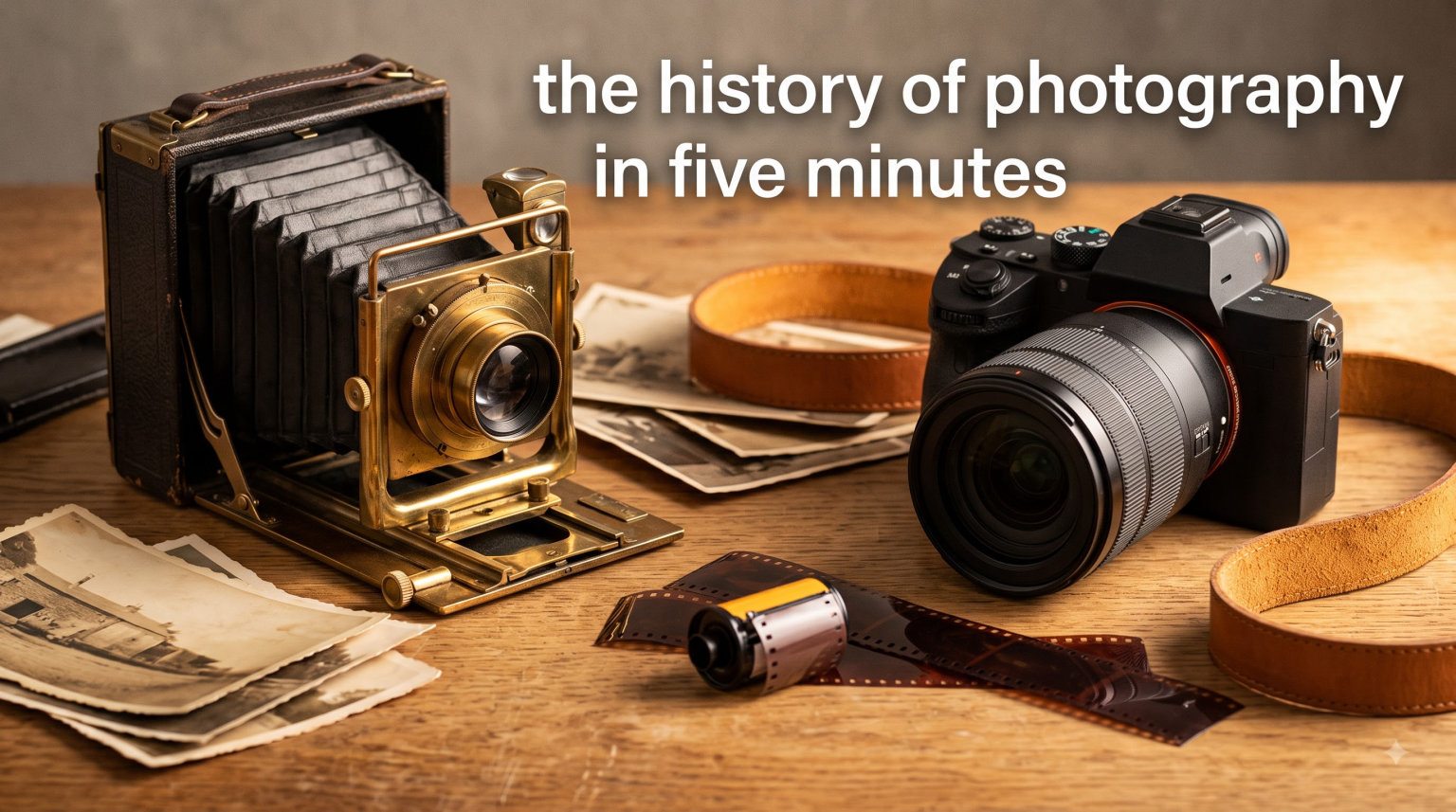
Every time you snap a photo with your phone, you are holding roughly 2,400 years of human ingenuity in your hand. The history of photography stretches from ancient philosophers staring at inverted images on cave walls to silicon sensors that capture billions of pixels per second. Photography itself takes its name from two Greek words: photos, meaning light, and graphein, meaning to draw. In other words, drawing with light. That simple idea has reshaped how we document wars, celebrate birthdays, share meals, and see the surface of distant planets.
Our team has spent weeks digging through archives, academic sources, and historical records to put together this rapid-fire timeline. Whether you are a student working on a project, a photographer curious about your craft, or someone who just wants to understand how we got from shadowy projections to computational smartphone cameras, this guide covers it all. Let me walk you through the history of photography in five minutes.
Table of Contents
The History of Photography in Five Minutes: A Complete Timeline
Think of this as a speed run through the most significant milestones in photographic history. From the first written descriptions of light projection in ancient China to the multi-lens computational cameras in your pocket, each breakthrough built directly on the one before it. I have organized everything chronologically so the chain of inventions is easy to follow.
One thing I noticed while researching: most timelines skip the cultural significance and just list dates. I wanted to do something different here. Alongside the technical milestones, I will point out why each invention mattered to ordinary people at the time, because that context is what makes the story compelling.
The Camera Obscura: Where It All Began
The story starts around 400 BCE with a Chinese philosopher named Mo Ti, also known as Mozi. He noticed that light passing through a pinhole into a darkened room projected an inverted image of the outside world on the opposite wall. Aristotle independently described a similar phenomenon a century later. This principle is called the camera obscura, Latin for “dark room.”
In the 10th and 11th centuries, the Arab scholar Ibn al-Haytham, known in Europe as Alhazen, built the first actual camera obscura device and wrote extensively about how it worked. His Book of Optics laid the groundwork for understanding light, refraction, and image formation. For hundreds of years after that, artists and astronomers used camera obscuras as tools, carrying portable versions into the field to trace landscapes and solar eclipses.
Here is the key insight: every camera ever made, from Niepce’s wooden boxes to your iPhone, operates on this same fundamental principle. Light enters through a small opening, and an image forms on a surface inside. The only thing that changed over centuries was what that surface was made of, and how quickly it could record the image.
The First Permanent Photograph: Niepce and Heliography
For all the centuries that camera obscuras projected images, nobody could figure out how to make those images permanent. Several experimenters tried. In the late 1790s, an English potter named Thomas Wedgwood coated paper with silver nitrate and successfully captured shadow images of leaves and insect wings. The problem? He had no way to fix the images. They faded to black when exposed to more light. It was heartbreaking progress.
The breakthrough came around 1826 or 1827, when a French inventor named Nicéphore Niepce produced the first permanent photograph. He called his process heliography, meaning “sun drawing.” Niepce coated a pewter plate with bitumen of Judea, a naturally occurring asphalt that hardens when exposed to light. After an exposure of roughly eight hours, he washed the plate with lavender oil, which dissolved the unexposed bitumen and left behind a permanent image.
That photograph, titled View from the Window at Le Gras, shows the rooftop and courtyard visible from Niepce’s upstairs window at his estate in Saint-Loup-de-Varennes, France. It is blurry, ghostly, and almost impossible to make out without enhancement. But it is the earliest surviving photograph ever made, and it currently resides in the Harry Ransom Center at the University of Texas at Austin.
Eight hours for a single image. I think about that every time I burst-shoot fifty frames in two seconds with my phone. The patience required for early photography is staggering.
The Daguerreotype: Photography Goes Public
Niepce knew his heliography process was too slow and impractical for widespread use. In 1829, he formed a partnership with a fellow Frenchman, Louis-Jacques-Mande Daguerre, a theatrical designer and showman who had been experimenting with his own light-sensitive processes. Niepce died in 1833, but Daguerre kept working, and by 1839 he had developed something far superior.
Daguerre announced his invention, the daguerreotype, to the French Academy of Sciences on August 19, 1839. The French government purchased the patent and released it as a gift “free to the world.” The process involved polishing a silver-coated copper plate, sensitizing it with iodine vapor to form silver iodide, exposing it in a camera for several minutes, and then developing the latent image with mercury vapor. The result was a startlingly detailed, one-of-a-kind image on a polished metal plate.
Daguerreotype portrait studios exploded across Europe and the United States within months. For the first time in human history, ordinary people could have a precise visual record of what they looked like. It was a sensation. The French newspaper La Gazette de France wrote that the daguerreotype “throws all theories of art into confusion.”
The big limitation was that each daguerreotype was unique. There was no negative, so there was no way to make copies. If you wanted a second portrait, you sat for a second exposure. This is where the next major invention entered the picture.
The Calotype: Birth of the Negative-Positive Process
While Daguerre was perfecting his metal-plate process in France, an English scientist named William Henry Fox Talbot was pursuing a different path. Talbot had been frustrated by his inability to sketch landscapes using a camera obscura during a trip to Lake Como in Italy in 1833. His solution was to find a way to make the camera obscura’s image record itself permanently.
By 1835, Talbot had created what he called photogenic drawings by placing objects on paper soaked in silver chloride and exposing them to sunlight. But like Wedgwood before him, he initially struggled to fix the images. By 1841, Talbot had refined his approach into the calotype process, which he patented that year. The calotype used paper coated with silver iodide to create a paper negative. That negative could then be used to make unlimited positive prints by contact printing.
This was a turning point. The daguerreotype produced sharper images, but the calotype produced reproducible images. Every photograph printed in every newspaper, book, and magazine since then descends from Talbot’s negative-positive principle. The ability to make multiple copies from a single original is what turned photography from a curiosity into a mass communication tool.
During this same period, a woman named Anna Atkins produced what many historians consider the first book illustrated with photographic images. Her Photographs of British Algae, published between 1843 and 1853, used the cyanotype process (a blueprint technique) to document seaweed specimens. Atkins is one of the earliest known female photographers, and her work sits at the intersection of photography and scientific documentation.
The Kodak Revolution: Photography for Everyone
For the first fifty years of photography’s existence, making a photograph required chemicals, glass plates, darkrooms, and serious technical skill. Then George Eastman changed everything. In 1888, Eastman introduced the Kodak No. 1 camera, pre-loaded with a 100-exposure roll of flexible film. His slogan told you everything you needed to know: “You press the button, we do the rest.”
Here is how it worked. You bought the camera, took your hundred photos, and mailed the entire camera back to Kodak’s factory in Rochester, New York. Kodak developed the film, printed the photos, reloaded the camera with fresh film, and mailed everything back to you. No darkroom. No chemistry knowledge. No glass plates. The barrier to entry dropped from “trained professional” to “anyone with a finger.”
In 1900, Kodak released the Brownie camera, which sold for one dollar. One dollar. That is roughly thirty-five dollars in 2026 money. Photography shifted from a professional craft to a consumer hobby almost overnight. Families started documenting everyday life: picnics, children playing, vacations, pets. The snapshot was born, and with it came an entirely new way of seeing the world.
I find it fascinating that Eastman essentially invented the same business model we now call “razor and blades”: sell the camera cheaply, make the real money on the consumable film and developing services. That model persisted for over a century until digital photography finally disrupted it.
Color Photography: From Autochrome to Kodachrome
Black-and-white photography dominated for decades, but the dream of capturing color was always there. The first color photograph was actually produced in 1861 by the Scottish physicist James Clerk Maxwell. He photographed a tartan ribbon three times through red, green, and blue filters, then projected the three images together to recreate full color. It was a proof of concept, not a practical process.
The first commercially viable color process arrived in 1907, when the French Lumiere brothers introduced Autochrome. Autochrome plates were coated with microscopic grains of dyed potato starch that acted as color filters. The results were soft, painterly, and genuinely beautiful. Autochrome made color photography accessible to serious amateurs and professionals, though it remained expensive and somewhat cumbersome.
The real game-changer for color was Kodachrome, invented by Leopold Godowsky Jr. and Leopold Mannes and introduced by Kodak in 1935. Kodachrome produced vivid, stable colors that resisted fading for decades. It became the standard for magazines, National Geographic spreads, family slide shows, and professional work. If you have ever seen a photograph from the mid-20th century with impossibly rich, warm colors, it was probably shot on Kodachrome.
By the 1960s, color film had become cheap enough and simple enough that it surpassed black-and-white as the default choice for consumer photography. The era of black-and-white family snapshots was largely over.
The Digital Revolution: From Sensors to Smartphones
The seeds of digital photography were planted in 1969 at Bell Labs, where Willard Boyle and George Smith invented the charge-coupled device, or CCD. A CCD is an electronic sensor that converts light into electrical charges, essentially replacing chemical film with a silicon chip. It was originally developed for computer memory, but its imaging potential was immediately obvious.
In 1975, a young engineer named Steven Sasson built the first digital camera at Kodak. It weighed eight pounds, recorded images onto a cassette tape, and captured a resolution of 0.01 megapixels (that is 100 by 100 pixels). The first image Sasson captured took 23 seconds to record. Kodak management reportedly told him, “That’s cute, but don’t tell anyone about it.” The irony of a film company inventing the technology that would eventually destroy its own business is hard to ignore.
The CMOS sensor, patented in 1995, was the next leap. CMOS chips were cheaper, used less power, and could be manufactured on standard semiconductor production lines. This is what made small, affordable digital cameras possible. By the late 1990s, consumer digital cameras from Sony, Canon, and Nikon were hitting store shelves with resolutions of one to three megapixels.
Then came the camera phone. The Kyocera VP-210 Visual Phone, released in Japan in 1999, was the first mobile phone with a built-in camera. Sharp’s J-SH04 followed in 2000. These early camera phones had terrible resolution by any standard, but they planted the idea that a phone could also be a camera.
Apple’s iPhone, launched in 2007, was not the first smartphone with a camera, but it was the first one that made mobile photography feel natural and fun. Instagram launched in 2010, and within two years it had over 100 million users sharing photos daily. Photography had become a form of social communication, not just documentation.
In 2026, modern smartphones use computational photography to achieve results that would have required professional equipment just ten years ago. Multi-frame processing, artificial intelligence-driven scene detection, portrait mode depth effects, and night mode algorithms all work together to produce images from a tiny sensor that can rival dedicated cameras. The camera obscura principle is still there, light passing through a small opening. But what happens after the light hits the sensor has changed beyond anything Niepce, Daguerre, or Talbot could have imagined.
Photography’s Cultural Impact: How It Changed the World
The history of photography is not just a story of technical invention. It is the story of how humanity learned to freeze time. Before photography, the only way to record what something looked like was to draw or paint it. Both required skill, interpretation, and time. Photography offered something radically different: a mechanical record of reality, produced in minutes instead of weeks.
That capability reshaped everything. Portrait painting declined almost immediately after the daguerreotype appeared. Photojournalism brought distant wars and distant suffering into living rooms for the first time. Matthew Brady’s photographs of the American Civil War, the harrowing images from Vietnam, and the photo of the Earth rising over the moon’s horizon, taken by Apollo 8 astronaut William Anders in 1968, all changed how people understood the world.
Photography also democratized art. You did not need years of training to make a meaningful image. A Kodak Brownie in 1900 or an iPhone in 2026 gives anyone the power to create something visually compelling. That accessibility has only deepened with time. Billions of photographs are now uploaded to the internet every single day. We live in an image-saturated world, and this history is how we got here.
The arc from Ibn al-Haytham’s dark room to your smartphone’s multi-lens camera system is long, but it is remarkably continuous. Every generation built on the discoveries of the one before, each solving the biggest problem of the previous era: making images permanent, making them reproducible, making them affordable, making them instant, and making them shareable. The next chapter is being written right now with artificial intelligence and generative imaging, but the foundation remains the same. Photography is still, at its core, drawing with light.
FAQs
Who invented photography and why?
Nicéphore Niépce is credited with inventing photography in 1826/27 when he created the first permanent photograph using his heliography process. He was motivated by a desire to capture images from camera obscura without needing to trace them by hand. His partnership with Louis Daguerre later helped bring photography to the public.
What was the first picture ever taken?
The first permanent photograph was View from the Window at Le Gras, taken by Nicéphore Niépce around 1826 or 1827. It required an exposure time of approximately 8 hours and shows the rooftop and courtyard visible from an upstairs window at his estate in Saint-Loup-de-Varennes, France.
What was the first color photograph?
The first color photograph was taken by Scottish physicist James Clerk Maxwell in 1861. He photographed a tartan ribbon three times through red, green, and blue filters, then projected the three images together to recreate a full-color reproduction using the three-color separation method.
When was the first photograph taken?
The first permanent photograph was taken in either 1826 or 1827 by Nicéphore Niépce at his estate in Le Gras, France. Earlier experiments by Thomas Wedgwood in the 1790s captured shadow images on silver nitrate-treated paper, but those images could not be made permanent and faded quickly.
How did photography evolve from camera obscura to digital?
Photography evolved through several key stages: the camera obscura principle (400 BCE), heliography and the first permanent image (1826), daguerreotype (1839), negative-positive calotype (1841), roll film and Kodak cameras (1888), color processes like Autochrome and Kodachrome (1907-1935), electronic CCD sensors (1969), the first digital camera (1975), CMOS sensors (1995), camera phones (1999), and modern computational smartphone photography.
Conclusion
The history of photography is a story about human persistence. From Mo Ti’s ancient observations of light through a pinhole to Niepce’s grueling eight-hour exposures, from Daguerre’s polished metal plates to Talbot’s paper negatives, from Eastman’s roll film to Sasson’s cassette-tape digital camera, every single breakthrough required someone to look at the current state of things and ask, “How can I make this better?” That chain of questions and answers spans nearly two and a half millennia, and it is still going.
What strikes me most after putting this timeline together is how consistent the core idea has been. A camera obscura in 400 BCE and a smartphone camera in 2026 both do the same thing: they capture light and turn it into an image. The materials have changed from bitumen to silver to silicon to algorithms, but the principle remains identical. Photography has always been about drawing with light, and as long as humans are curious about the world around them, it always will be.