
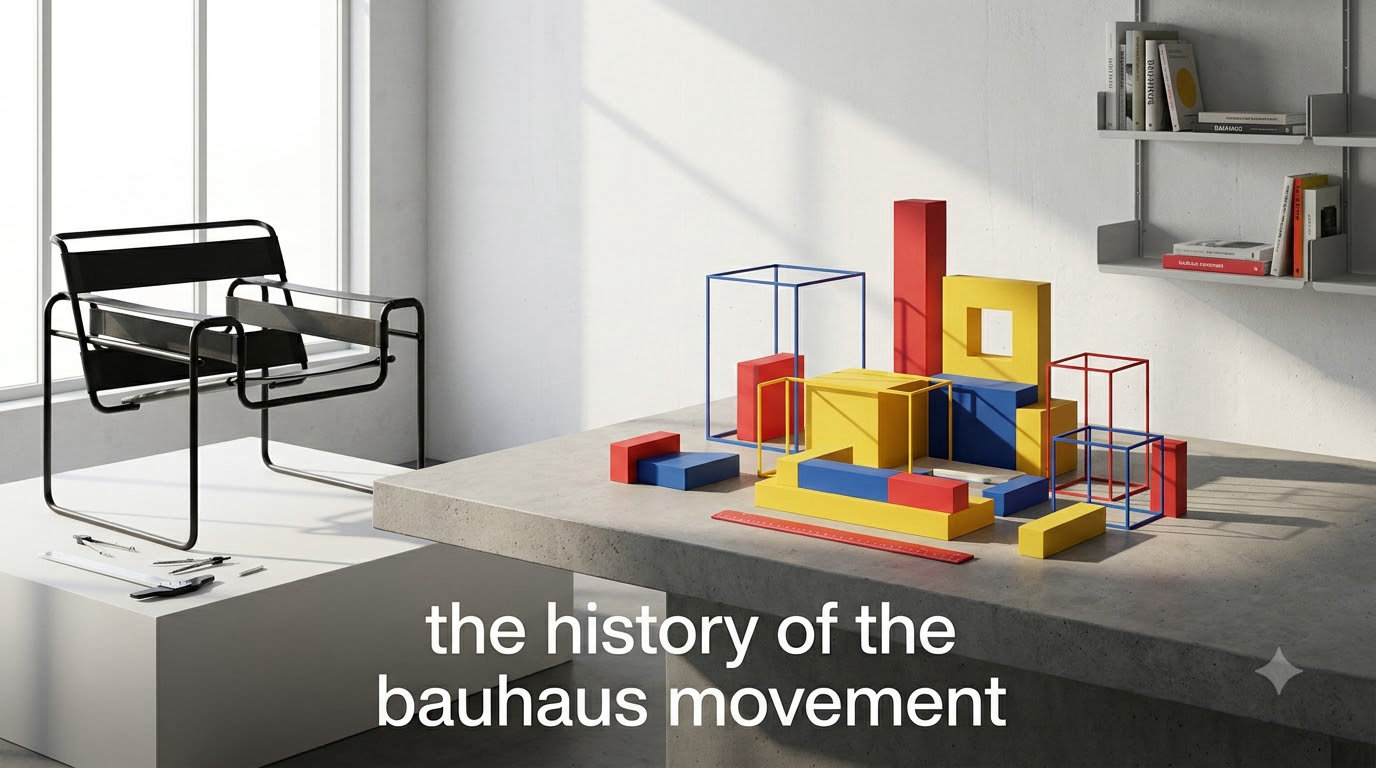
The Bauhaus was a German art school founded in 1919 by architect Walter Gropius in the city of Weimar. It existed for just 14 years, yet its influence on architecture, furniture design, graphic design, typography, and industrial design remains visible in nearly every manufactured object and building you interact with today. Understanding the history of the Bauhaus movement means understanding where modern design was born.
The school operated through three German cities, weathered political hostility, and survived long enough to seed a global design philosophy. From the tubular steel chairs in modern offices to the sans-serif fonts on your phone screen, Bauhaus ideas shaped the visual world we live in. This guide walks through the full arc of the Bauhaus story, from its idealistic founding to its forced closure and its extraordinary afterlife in exile.
I have spent years studying design history, and the Bauhaus remains one of the most fascinating stories in art and education. What makes it remarkable is not just what was created inside its walls, but how a small school with fewer than 200 students at any given time managed to rewrite the rules of design for the entire world. The story involves political intrigue, ideological battles, creative breakthroughs, and a diaspora that spread one school’s philosophy to every continent.
Our team has researched this topic extensively using primary sources, museum archives, and academic texts. What follows is the most complete account of the Bauhaus you will find online, covering not just the well-known events but also the contributions of women, the political pressures, and the exile experience that turned a regional art school into a global movement.
Table of Contents
What Was the Bauhaus Movement?
The Bauhaus was both a physical school and a radical design philosophy that emerged from the wreckage of World War I. The name itself is a compound of two German words: Bau (building or construction) and Haus (house). Gropius deliberately coined this name to signal that the school would focus on building, craft, and the integration of all arts under one roof. The word also subtly inverted Hausbau (house-building), suggesting a new way of thinking about construction and design.
The foundational concept was Gesamtkunstwerk, a German term meaning “total work of art.” Gropius envisioned a world where painting, sculpture, architecture, craft, and industrial design were not separate disciplines practiced in isolation but parts of a single, integrated creative practice. He laid this out in the founding manifesto published in April 1919, which called for a return to craft guilds and the unification of art and labor under the banner of architecture.
In that manifesto, Gropius wrote: “Together let us desire, conceive, and create the new structure of the future, which will embrace architecture and sculpture and painting in one unity and which will one day rise toward heaven from the hands of a million workers like the crystal symbol of a new faith.” The rhetoric was idealistic, even mystical. But the practical outcome was a school that fundamentally changed how people think about functional objects and the relationship between beauty and utility.
A common misconception, especially in online forums, is treating Bauhaus as just an aesthetic style characterized by geometric shapes and primary colors. In reality, the Bauhaus was a school with a specific educational philosophy and process. The “Bauhaus style” emerged from that process, but the school itself was never about prescribing a look. It was about teaching students to think systematically about design problems and to find the most functional, honest solution to each challenge.
The distinction matters because it explains why the Bauhaus had such a broad influence. If it had simply been a style, it would have gone out of fashion like Art Deco or Memphis Design. But because it was a methodology, a way of approaching design problems, its principles could be applied to any medium, any era, and any culture. That is why Bauhaus thinking still shapes digital product design, architecture, and industrial manufacturing today.
The History of the Bauhaus Movement: A Timeline of Three Cities
The Bauhaus story divides naturally into three phases, each tied to a different German city. Each city brought different political pressures, different resources, and a different character to the school. Understanding this timeline is essential to understanding why the Bauhaus evolved the way it did and why it ultimately met the fate it did.
Weimar Phase (1919-1925): The Founding
The Bauhaus opened its doors on April 1, 1919, in Weimar, Germany. Gropius convinced the local government to merge two existing institutions, the Weimar Academy of Fine Art and the Weimar School of Arts and Crafts, into a single new school. The timing was significant. Germany had just lost World War I, the Kaiser had abdicated, and the new Weimar Republic was struggling to establish itself amid economic collapse, hyperinflation, and political violence from both the far left and the far right.
Weimar itself was a loaded location. It was the city of Goethe and Schiller, the heart of German classical culture. Placing a radical new art school there was a deliberate statement about building a new Germany from the ruins of the old. The early years in Weimar were marked by tension between the school’s utopian ambitions and a hostile local population that saw the Bauhaus as a den of foreign degeneracy and moral corruption.
Students and faculty lived communally, experimented with radical social practices, and produced work that baffled the traditional townspeople. The atmosphere inside the school was electric and experimental. Johannes Itten, the first instructor of the preliminary course, encouraged students to adopt vegetarian diets, practice meditation, and explore Persian mysticism alongside their formal studies. This spiritual, almost cult-like atmosphere alienated some while inspiring others.
Despite the external pressure and internal eccentricities, the Weimar period established the core Bauhaus educational model: the preliminary course followed by specialized workshop training. Instructors like Johannes Itten, Lyonel Feininger, Gerhard Marcks, and Adolf Meyer helped shape the curriculum during these formative years. By 1923, the school held its first public exhibition, showcasing student and faculty work to an international audience and attracting attention from designers and architects worldwide.
Political pressure intensified in 1924 when right-wing parties won local elections in Thuringia. Funding was slashed, and the Bauhaus faculty voted to dissolve the school effective April 1, 1925, rather than submit to political control. The Weimar period was over, but the foundation had been laid for what would become the school’s most productive years.
Dessau Phase (1925-1932): The Golden Age
The city of Dessau, an industrial center east of Weimar, invited the Bauhaus to relocate and funded the construction of a purpose-built campus. Gropius designed the new Bauhaus building himself, and it remains one of the most important structures in modern architecture. Completed in 1926, the building featured a glass curtain wall, an asymmetrical pinwheel floor plan, and separate wings for workshops, dormitories, and administration connected by a bridge housing administrative offices.
The building itself was a manifesto in concrete, steel, and glass. The massive glass wall of the workshop wing, which allowed passersby to see directly into the working studios, symbolized the Bauhaus commitment to transparency and the integration of art with public life. The flat roof, which infuriated local traditionalists who demanded pitched roofs with tiles, became a defining feature of modernist architecture worldwide.
The Dessau years are widely considered the school’s most productive period. The workshop system matured, and products began reaching the market through licensing agreements with manufacturers. The Bauhaus wallpaper, designed in the wall-painting workshop, became a genuine commercial success and provided the school with a reliable revenue stream for the first time. Furniture, lighting fixtures, and textiles produced in Dessau workshops were sold to the public and reviewed in design magazines across Europe.
This period also saw the school gain its official title as a “Hochschule für Gestaltung” (Institute of Design), granting it university status. The faculty expanded to include some of the most important artists of the era, and the work became more focused on industrial production and standardization. The Dessau years produced many of the iconic objects people associate with Bauhaus design today, from Marcel Breuer’s tubular steel chairs to Marianne Brandt’s metal tea infusers to Herbert Bayer’s experimental typefaces.
Berlin Phase (1932-1933): The Final Chapter
In 1932, the Nazi party won control of the Dessau city council and voted to close the Bauhaus. The school had already been under sustained political attack for years, with local newspapers accusing it of producing “degenerate art” and harboring communists. Mies van der Rohe, who had taken over as director in 1930, attempted to keep the school alive by moving it to Berlin as a private institution.
In Berlin, the Bauhaus operated in an abandoned telephone factory in the Steglitz neighborhood. The setup was makeshift compared to the Dessau campus, with no dedicated workshops and far fewer resources. Enrollment dropped as students left for safer institutions or fled the country entirely. The political situation deteriorated rapidly after Adolf Hitler became Chancellor in January 1933, and the writing was on the wall for any institution associated with modernist culture.
The Gestapo raided the school in April 1933, sealing the buildings and demanding the removal of “Marxist” instructors. Mies van der Rohe and other faculty members were briefly detained for questioning. The Nazi authorities offered to allow the school to reopen if it dismissed certain teachers and submitted its curriculum to government oversight.
Mies van der Rohe convened the faculty. After intense deliberation, they concluded that operating under Nazi conditions would destroy everything the Bauhaus stood for. On July 20, 1933, the faculty voted to dissolve the Bauhaus rather than accept political control. Mies reportedly said simply: “We are closing. That is that.” The school that had revolutionized design education was gone. But its ideas were about to spread across the globe.
The Three Directors Who Shaped the Bauhaus
Each of the Bauhaus’s three directors brought a distinct vision that shaped the school’s direction during their tenure. The transitions between directors marked real philosophical shifts, not just administrative changes. Understanding these three personalities is key to understanding why the Bauhaus evolved as it did.
Walter Gropius (1919-1928): The Visionary Founder
Walter Gropius founded the Bauhaus with the ambition of reunifying art and craft. A veteran of World War I who had served on the Western Front, Gropius brought both idealism and practical architectural experience to the role. Before the war, he had been a partner in the firm that designed the Fagus Factory in Alfeld, a pioneering modernist building with glass curtain walls that anticipated the Bauhaus aesthetic by nearly a decade.
His early vision for the school emphasized handcraft, spiritual renewal through creative work, and the medieval guild model. The original manifesto featured a woodcut by Lyonel Feininger of a cathedral radiating light, symbolizing the unity of all arts under architecture. Over time, however, Gropius shifted the school’s focus toward industry and mass production. By the mid-1920s, he was advocating for designs that could be manufactured at scale, arguing that the artist should work with industry rather than against it.
This evolution from craft to industry defined the school’s maturation and sparked internal debates that shaped its trajectory. Gropius resigned in 1928, at the height of the Dessau period, to return to private practice. He handed the directorship to Hannes Meyer, believing the school was stable enough to survive a leadership transition. That confidence was partly justified, but the political storms ahead would prove far more severe than anyone anticipated.
Hannes Meyer (1928-1930): Social Functionalism
Hannes Meyer brought a starkly different philosophy to the Bauhaus. Where Gropius spoke of beauty, spiritual unity, and Gesamtkunstwerk, Meyer emphasized social responsibility, scientific method, and practical utility. His famous declaration was: “The people’s needs instead of the need for luxury.” He pushed the school toward affordable housing, standardized building components, and designs aimed at working-class consumers.
Meyer expanded the architecture program, which had been surprisingly thin under Gropius despite architecture being the stated ultimate goal of the school. He secured real commissions for housing projects and brought a more rigorous, empirical approach to the workshops. Under Meyer, students produced designs for modular housing, prefabricated building components, and affordable consumer goods with an explicit social mission.
However, his openly leftist politics made the school an even bigger target for conservative and Nazi opponents. Meyer joined the communist party and allowed political meetings on campus, giving ammunition to those who wanted the school shut down. Gropius and the Dessau city government forced Meyer out in 1930, replacing him with Mies van der Rohe in an attempt to depoliticize the institution. It was too late. The political momentum against the Bauhaus had become unstoppable.
Ludwig Mies van der Rohe (1930-1933): Architectural Refinement
Mies van der Rohe, already one of the most celebrated modernist architects in Europe, took over a school under siege. His approach was more disciplined and architecturally focused than either of his predecessors. He reduced the curriculum, tightened admissions, and emphasized individual mastery over collective experimentation. Where the early Bauhaus had embraced communal creativity, Mies prioritized personal excellence.
Under Mies, the Bauhaus became more of an architecture school than a comprehensive design institution. The workshop system continued, but with less emphasis on collective production and more on individual design development. He fought tenaciously to keep the school open through the move to Berlin and the escalating Nazi attacks, negotiating with authorities and reorganizing the institution as a private school.
When the end came in July 1933, Mies made the difficult decision to close the school rather than compromise its independence. His own later career in the United States, designing icons like the Seagram Building in New York and the Farnsworth House in Plano, Illinois, would carry Bauhaus principles into the American architectural mainstream and define the look of the modern corporate skyline.
Inside the Bauhaus Curriculum and Teaching Method
The Bauhaus educational model was genuinely innovative and remains influential in design schools worldwide. At its core was a two-phase system: a required preliminary course followed by specialization in a specific workshop. This structure, which seems obvious now, was radical in an era when art education meant copying classical sculptures and painting from live models.
The Preliminary Course (Vorkurs)
Every student entering the Bauhaus had to complete the preliminary course, typically lasting one semester. Originally taught by Johannes Itten, and later by László Moholy-Nagy and Josef Albers, the course was designed to strip away academic habits and teach students to see form, color, and material with fresh eyes. It was, in effect, a crash course in unlearning everything traditional art education had taught them.
Students experimented with texture, contrast, rhythm, and color theory. They drew, built three-dimensional models, and analyzed the properties of different materials like wood, metal, paper, and wire. The goal was not to produce finished work but to develop a fundamental visual and material vocabulary that would serve them in any discipline they later pursued.
Itten’s version of the course had a somewhat mystical character. He encouraged breathing exercises, dietary restrictions, and the study of Mazdaznan, a Zoroastrian-inspired philosophy. When Gropius decided the school needed to move toward a more industrial, technology-oriented approach, Itten’s mysticism became a liability, and he was replaced by Moholy-Nagy in 1923. Albers then took over the material studies portion, bringing his systematic approach to paper folding, glass assembly, and structural experimentation.
The Workshop System and Dual Masters
After completing the preliminary course, students entered one of the school’s workshops. Each workshop had two types of instructors: a Master of Form (a fine artist responsible for aesthetic and theoretical guidance) and a Master of Craft (a skilled tradesperson who taught technical skills). This dual-master system embodied the Bauhaus philosophy of merging art and craft, ensuring that students developed both creative vision and practical competence.
The major workshops included:
Metalworking Workshop: Produced lighting fixtures, tea sets, and household objects in silver, brass, and later chrome-plated steel. Marianne Brandt’s geometric tea infusers and ashtrays from this workshop became iconic examples of Bauhaus industrial design and are still reproduced today.
Cabinetmaking Workshop: Created furniture that redefined how people think about seating, tables, and storage. Marcel Breuer’s Wassily Chair, made from tubular steel inspired by his Adler bicycle frame, revolutionized furniture design by proving that industrial materials could produce elegant, comfortable, and affordable chairs.
Weaving Workshop: Became the primary space for women students and produced some of the school’s most innovative work. Under Gunta Stölzl and later Anni Albers, the workshop developed textiles that combined handcraft technique with industrial patterns, synthetic fibers, and bold abstract compositions.
Typography and Advertising Workshop: Developed new approaches to graphic communication, emphasizing clarity, readability, and the integration of photography with text. Herbert Bayer’s universal typeface eliminated capital letters entirely, arguing that uppercase and lowercase versions of the same letter were redundant.
Mural Painting Workshop: Explored color theory at architectural scale, producing wall paintings for Bauhaus buildings and exhibitions. Under Hinnerk Scheper, the workshop developed systematic approaches to color for interior spaces.
Pottery Workshop: Operated in Dornburg, a town near Weimar, producing functional ceramics that explored the relationship between form and function in everyday vessels.
Notable Bauhaus Artists and Instructors
The Bauhaus attracted some of the most important artists and designers of the 20th century. Many were already established figures when Gropius recruited them, and their time at the Bauhaus shaped the rest of their careers. The faculty roster reads like a who’s who of modern art, and their collective influence on design education is immeasurable.
Wassily Kandinsky joined the Bauhaus in 1922 and taught the course on color theory and abstract form until the school closed. One of the pioneers of abstract painting, Kandinsky brought rigorous analytical thinking to the study of color relationships, geometric forms, and the emotional effects of visual composition. His classes required students to analyze the “inner sound” of colors and shapes, connecting visual perception to emotional and even musical experience. His theoretical writings from the Bauhaus period, including “Point and Line to Plane,” remain foundational texts in abstract art education.
Paul Klee taught alongside Kandinsky and brought his own distinctive approach to visual thinking. His classes explored the relationship between nature, structure, and artistic creation through exercises in linear expression, tonal values, and color theory. Klee’s lecture notes, later published as “Pedagogical Sketchbook” and other volumes, remain important texts in art education. His own paintings blended abstraction with playful, childlike imagery in ways that influenced generations of artists and designers.
Josef Albers started as a student at the Bauhaus in 1920 and became an instructor by 1923, eventually directing the preliminary course. He brought a systematic, almost scientific approach to material experimentation. Students in Albers’s class folded paper into complex structures, stacked cardboard to test load-bearing principles, and manipulated sheet metal to understand malleability and structural properties. His later work with color interaction, documented in his 1963 book “Interaction of Color,” became foundational to color theory education worldwide and influenced generations of painters, designers, and architects.
László Moholy-Nagy replaced Itten in 1923 and brought a fascination with technology, photography, light, and new media that reshaped the school’s direction. He experimented with photograms (cameraless photographs made by placing objects directly on light-sensitive paper), kinetic sculpture, transparent materials, and light-space modulators. His belief that technology was the new medium of artistic expression pushed the Bauhaus toward genuine engagement with industrial processes rather than nostalgic retreat into handcraft.
Marcel Breuer was a student who became a master, eventually heading the cabinetmaking workshop. His tubular steel furniture designs, inspired by the construction of his Adler bicycle frame, demonstrated how industrial materials could be used to create lightweight, mass-producible, and visually striking furniture. The Wassily Chair (named after Kandinsky, who admired it) and the Cesca Chair remain in production nearly a century later, selling alongside contemporary designs without looking dated.
Herbert Bayer studied and then taught at the Bauhaus, making major contributions to typography and graphic design. His universal alphabet, which eliminated capital letters, embodied the Bauhaus principle of functional efficiency applied to written language. After emigrating to the United States, he became a major figure in American graphic design and advertising.
Women at the Bauhaus: Contributions and Challenges
The Bauhaus admitted women from its founding in 1919, which was unusual for the era and was one of the school’s genuinely progressive features. Gropius’s manifesto made no gender distinctions, and many women applied with genuine hope of receiving equal training in architecture, painting, and industrial design. The reality, however, was more complicated and more revealing of the social limitations that persisted even within this forward-thinking institution.
Despite the egalitarian rhetoric, women were frequently steered into the weaving workshop rather than being allowed to study architecture, metalwork, or cabinetmaking. Administrators, including Gropius himself, argued that weaving was more “natural” for women and that the heavier workshops were unsuitable for female students. This restriction frustrated many talented students who wanted to work in other media. But it also, paradoxically, produced some of the Bauhaus’s most extraordinary work, because the weaving workshop became a space of intense creative innovation led by women who transformed a “feminine” craft into a cutting-edge design laboratory.
Gunta Stölzl began as a student in 1919 and rose to become the first and only female master at the Bauhaus, leading the weaving workshop from 1927 to 1931. She transformed the workshop from a traditional craft-based studio into a space for experimental textile design, integrating synthetic fibers, industrial production methods, and bold abstract color compositions. Her tapestries and textiles are now recognized as some of the most important work produced at the school, and her influence on textile design is still felt in the fashion and interior design industries.
Anni Albers studied under Stölzl and became one of the most important textile artists of the 20th century. After emigrating to the United States with her husband Josef Albers, she taught at Black Mountain College and later at Yale University. Her writings on textile design, particularly “On Weaving” (1965), remain influential texts. Her work demonstrated conclusively that weaving could be a fine art medium on par with painting or sculpture, challenging the hierarchy that had relegated fiber arts to “craft” rather than “art.”
Marianne Brandt broke into the metalworking workshop, which was rare for a woman. She designed tea infusers, ashtrays, and lighting fixtures that became signature Bauhaus products. Her compact, geometric metal objects in silver and brass are now among the most collected Bauhaus artifacts in the world. After leaving the Bauhaus, she struggled to find work as a designer in a field dominated by men, a reminder that even the Bauhaus could not fully overcome the structural barriers facing women in industry.
Alma Siedhoff-Buscher designed children’s toys and furniture, producing work that was both functional and playful. Her small ship building blocks and cut-out dollhouse furniture remain in production and are celebrated for their design intelligence. She showed that designing for children was a serious creative challenge worthy of the same rigor applied to adult products.
Margaretha Reichardt worked in the weaving workshop and developed innovative textiles that were used in Bauhaus buildings. She later established her own independent weaving studio, carrying Bauhaus textile principles into postwar German craft production.
Why Was the Bauhaus Controversial?
The Bauhaus faced opposition from the moment it opened, and the controversy only escalated over its 14-year existence. Understanding why requires looking at the political and cultural climate of Weimar-era Germany, a period of intense instability and ideological conflict where every cultural institution became a battleground.
In the immediate aftermath of World War I, Germany was a defeated nation grappling with hyperinflation so extreme that workers were paid twice daily and rushed to spend their wages before they became worthless. Political assassinations, attempted coups (including the Beer Hall Putsch by the nascent Nazi party in 1923), and deep social divisions created an atmosphere of perpetual crisis. Many conservatives blamed modernism, internationalism, and cultural experimentation for Germany’s problems.
The Bauhaus, with its international faculty that included Russian, Swiss, Hungarian, and American members alongside Germans, its experimental social practices, and its explicit rejection of traditional German design aesthetics, became a natural target for conservative outrage. Local newspapers in Weimar ran sustained campaigns against the school, accusing it of wasting taxpayer money on degenerate art and corrupting the morals of young people.
Politicians demanded audits and budget cuts. Students and faculty were harassed in the streets of Weimar. The hostility was not just aesthetic but fundamentally political. Conservatives saw the Bauhaus as a hotbed of Bolshevism, a charge that was partly true. Some students and faculty were genuinely committed to socialist or communist politics, and the communal living arrangements, shared kitchens, and collective decision-making processes did resemble aspects of socialist organization.
Hannes Meyer’s directorship made the political dimension explicit. He openly declared his socialist convictions, joined the communist party, and oriented the school’s work toward affordable housing and working-class consumer goods. This gave conservative opponents the ammunition they needed to portray the entire institution as a Marxist project, even though many faculty members were politically moderate or apolitical.
The controversy escalated dramatically when the Nazis entered the picture. The Nazi ideology celebrated traditional German folk art, neoclassical architecture, and figurative painting depicting heroic Aryan subjects. Anything modernist, abstract, or experimental was branded “entartete Kunst” (degenerate art) or “un-German.” The Bauhaus, with its flat roofs, glass walls, and geometric abstractions, represented everything the Nazis despised about modern culture. This ideological hostility, backed by state power, is ultimately what destroyed the school.
The Closure of the Bauhaus in 1933
The final act of the Bauhaus story was swift and brutal. Adolf Hitler became Chancellor of Germany on January 30, 1933. Within months, the new regime moved systematically against institutions it considered ideologically suspect, and the Bauhaus was high on the list.
In April 1933, the Gestapo raided the Berlin Bauhaus, sealing the buildings and demanding that the school dismiss its “Marxist” instructors. Mies van der Rohe and other faculty members were briefly detained for questioning. The Nazi authorities offered to allow the school to reopen if it dismissed certain teachers, removed politically suspect students, and submitted its curriculum to direct government oversight.
Mies van der Rohe convened the faculty to discuss the terms. After intense deliberation, they concluded that operating under Nazi conditions would destroy everything the Bauhaus stood for. Accepting government control over staffing and curriculum would reduce the school to a propaganda instrument. On July 20, 1933, the faculty voted unanimously to dissolve the Bauhaus.
The closure was not just an administrative event. It was part of a broader Nazi campaign against modernist culture that included the infamous Degenerate Art Exhibition of 1937 (which displayed works by Kandinsky, Klee, and other Bauhaus artists alongside pieces ridiculed as evidence of cultural decay), the dismissal of Jewish and politically dissident professors from universities, the burning of books, and the suppression of avant-garde music, literature, and theater. The Bauhaus was one victim among many in a systematic assault on cultural freedom.
The personal toll on faculty and students was severe. Many lost their livelihoods overnight. Jewish members faced not just professional ruin but physical danger. Several former Bauhaus members who remained in Europe perished in the Holocaust. Those who could flee did so, beginning one of the most significant cultural migrations in modern history.
The Bauhaus Diaspora and Exile
The closing of the Bauhaus in Berlin did not kill its ideas. Instead, the Nazi regime’s persecution scattered Bauhaus faculty and alumni across the globe, where they planted the school’s philosophy in new soil. This diaspora turned a German design school into a worldwide movement and is one of the great ironies of cultural history: the Nazis’ attempt to destroy modernism actually ensured its global triumph.
Walter Gropius emigrated to Britain in 1934 and then to the United States in 1937. He joined the Harvard Graduate School of Design as professor and later chair of the architecture department, where he trained a generation of American architects who would design the postwar corporate landscape. The Harvard GSD became one of the most important centers of modernist architecture in the world. Gropius also partnered with Marcel Breuer in a private architectural practice that produced significant modernist buildings in the United States.
László Moholy-Nagy moved to Chicago in 1937 at the invitation of the Association of Arts and Industries and founded the New Bauhaus, later renamed the School of Design and eventually the Institute of Design. The school carried forward the Bauhaus workshop model, the preliminary course, and the emphasis on experimentation with new materials and technologies. Moholy-Nagy died of leukemia in 1946 at just 51, but the Institute of Design survived, eventually becoming part of the Illinois Institute of Technology, where it continues to operate today.
Josef Albers and his wife Anni Albers emigrated to the United States in 1933, the same year the Bauhaus closed. Josef was invited to teach at Black Mountain College in North Carolina, an experimental liberal arts school that became a crucible for American avant-garde art in the 1940s and 1950s. Students at Black Mountain included Robert Rauschenberg, Cy Twombly, and John Cage, all of whom were influenced by Albers’s systematic approach to color and form. He later taught at Yale University, where his color theory curriculum influenced generations of American artists and designers.
Marcel Breuer and Ludwig Mies van der Rohe both settled in the United States, where their architectural practices flourished and produced some of the defining buildings of postwar American modernism. Mies designed the campus of the Illinois Institute of Technology, the Seagram Building on Park Avenue in New York (widely considered the finest modernist office tower ever built), and the Farnsworth House, a glass-and-steel weekend retreat outside Chicago. Breuer designed the Whitney Museum of American Art on Madison Avenue (now the Met Breuer), the UNESCO headquarters in Paris, and numerous residential and commercial buildings.
The result of this emigration was the rapid internationalization of Bauhaus ideas. What had been a German school with a few hundred students became a global design language that shaped the built environment of the 20th century. The International Style in architecture, the spread of modern design education in universities worldwide, and the development of industrial design as a recognized profession all owe a direct debt to the Bauhaus diaspora.
The Bauhaus Legacy: Influence on Modern Design
More than nine decades after the Bauhaus closed, its ideas remain embedded in daily life. The school’s legacy shows up in places you might expect, like modern architecture and furniture, and in places you might not, like smartphone interfaces, corporate branding, and the design thinking methodologies used by technology companies.
In architecture, the Bauhaus directly influenced the International Style that dominated corporate and institutional building from the 1940s through the 1970s. Glass-and-steel office towers, open floor plans, curtain wall construction, and the idea that buildings should express their structure and function rather than hiding behind decorative facades all trace directly back to Bauhaus teaching. Every major city skyline in the world bears the imprint of Bauhaus thinking.
In furniture and product design, the principle of designing for mass production rather than for individual craft became standard industry practice. The idea that everyday objects should be well-designed, functional, and affordable, rather than decorative and exclusive, is a Bauhaus inheritance that most people now take for granted. Every flat-pack furniture store, every ergonomic office chair, and every well-designed kitchen tool owes something to the philosophy that beautiful design should be accessible to everyone, not just the wealthy.
In graphic design and typography, the Bauhaus insistence on clarity, legibility, and functional communication shaped modern visual culture in ways that are nearly impossible to overstate. Sans-serif typefaces (like the one you are likely reading right now), asymmetrical page layouts, and the integration of photography with text are all Bauhaus principles that remain standard practice in editorial design, advertising, corporate identity, and digital media.
Perhaps most surprisingly, the Bauhaus emphasis on systematic design processes and user-centered thinking connects directly to contemporary UI and UX design. As forum discussions among designers have noted, modern Android, iOS, and web design is heavily inspired by Bauhaus principles: clean geometric forms, functional layouts, and the elimination of unnecessary ornamentation. The philosophy of stripping design down to its essential elements, which the Bauhaus taught in its workshops in the 1920s, is now the default approach in digital product design worldwide.
The Bauhaus-Archiv in Berlin, the Bauhaus Dessau Foundation, and the Bauhaus-Universität Weimar all continue to preserve and promote the school’s legacy. The Bauhaus buildings in Dessau and Weimar were designated a UNESCO World Heritage Site in 1996, recognizing their significance not just to German culture but to the cultural heritage of humanity. The centenary of the Bauhaus in 2019 triggered a worldwide wave of exhibitions, publications, and renewed interest in the school’s ideas, proving that the Bauhaus remains as relevant in the 21st century as it was in the 20th.
FAQs
What is the history of the Bauhaus movement?
The Bauhaus was a German art school founded in 1919 by architect Walter Gropius in Weimar, Germany. It operated through three phases in three cities: Weimar (1919-1925), Dessau (1925-1932), and Berlin (1932-1933). The school merged fine arts with craft and industrial design, introducing a revolutionary educational model based on a preliminary course followed by hands-on workshop training. After the Nazis forced its closure in July 1933, Bauhaus faculty emigrated to the United States and elsewhere, spreading modernist design principles worldwide and shaping architecture, furniture, graphic design, and industrial design for the rest of the 20th century.
Was Le Corbusier in Bauhaus?
No, Le Corbusier was never a student or instructor at the Bauhaus. He was a Swiss-French architect working independently in Paris during the Bauhaus years. However, Le Corbusier and the Bauhaus shared many of the same modernist principles, including functionalism, open floor plans, and the use of industrial materials like reinforced concrete and steel. Le Corbusier’s work was known and discussed at the Bauhaus, and he and Walter Gropius moved in the same modernist architectural circles throughout the 1920s and 1930s.
Is the Bauhaus school still open?
The original Bauhaus school closed on July 20, 1933, under pressure from the Nazi regime. However, several successor institutions carry on its legacy. The Bauhaus Building in Dessau is now a UNESCO World Heritage Site that hosts exhibitions, educational programs, and artist residencies. The Bauhaus-Universität Weimar continues to offer design education under the Bauhaus name. In the United States, the Institute of Design at the Illinois Institute of Technology, founded by László Moholy-Nagy as the New Bauhaus in 1937, continues to operate as a graduate design school.
Why was Bauhaus controversial?
The Bauhaus was controversial for both cultural and political reasons. In conservative Weimar-era Germany, the school’s embrace of modernist, abstract art was seen as a rejection of traditional German culture and values. Its international faculty, which included Russian, Swiss, and Hungarian members, was accused of being un-German. The school’s communal living arrangements and experimental social practices scandalized conservative communities. Politically, some Bauhaus members held leftist or socialist views, which led to accusations of Bolshevism, particularly during the directorship of Hannes Meyer (1928-1930). After the Nazis rose to power, the school was condemned as a producer of degenerate art and targeted for closure.
Why was Bauhaus shut down?
The Bauhaus was shut down because the Nazi regime viewed it as ideologically opposed to their vision of German culture. The Nazis promoted traditional folk art, classical architecture, and figurative painting, while condemning modernist, abstract, and experimental work as degenerate. After Adolf Hitler became Chancellor in January 1933, the Gestapo raided the Berlin Bauhaus in April 1933, sealing the buildings and demanding the dismissal of Marxist instructors. Director Ludwig Mies van der Rohe and the faculty voted to dissolve the school on July 20, 1933, rather than accept Nazi political control over its curriculum, staffing, and artistic direction.
Conclusion
The history of the Bauhaus movement is a story about what a small group of determined people can accomplish under enormous pressure. In just 14 years, through three cities and under constant political attack, the Bauhaus produced a body of work and a design philosophy that reshaped the built environment of the entire world. That alone would be remarkable. But the story does not end with the school’s closure.
From the founding in Weimar in 1919 through the golden years in Dessau to the courageous decision to close rather than submit in Berlin in 1933, the Bauhaus demonstrated that design is never separate from politics, culture, or human values. The exile and diaspora that followed the closure turned a German school into a global movement, and its principles continue to shape architecture, furniture, graphic design, and digital interfaces today. The history of the Bauhaus movement teaches us that good design is not about style but about thinking clearly about human needs.
If you want to experience the Bauhaus legacy firsthand, you can visit the restored Bauhaus buildings in Dessau (now a UNESCO World Heritage Site), explore museum collections at the Met, the Getty, and the Bauhaus-Archiv in Berlin, or simply look around you. The clean lines, functional forms, and systematic design thinking you see in everyday objects are part of the inheritance the Bauhaus left to the world nearly a century ago.