
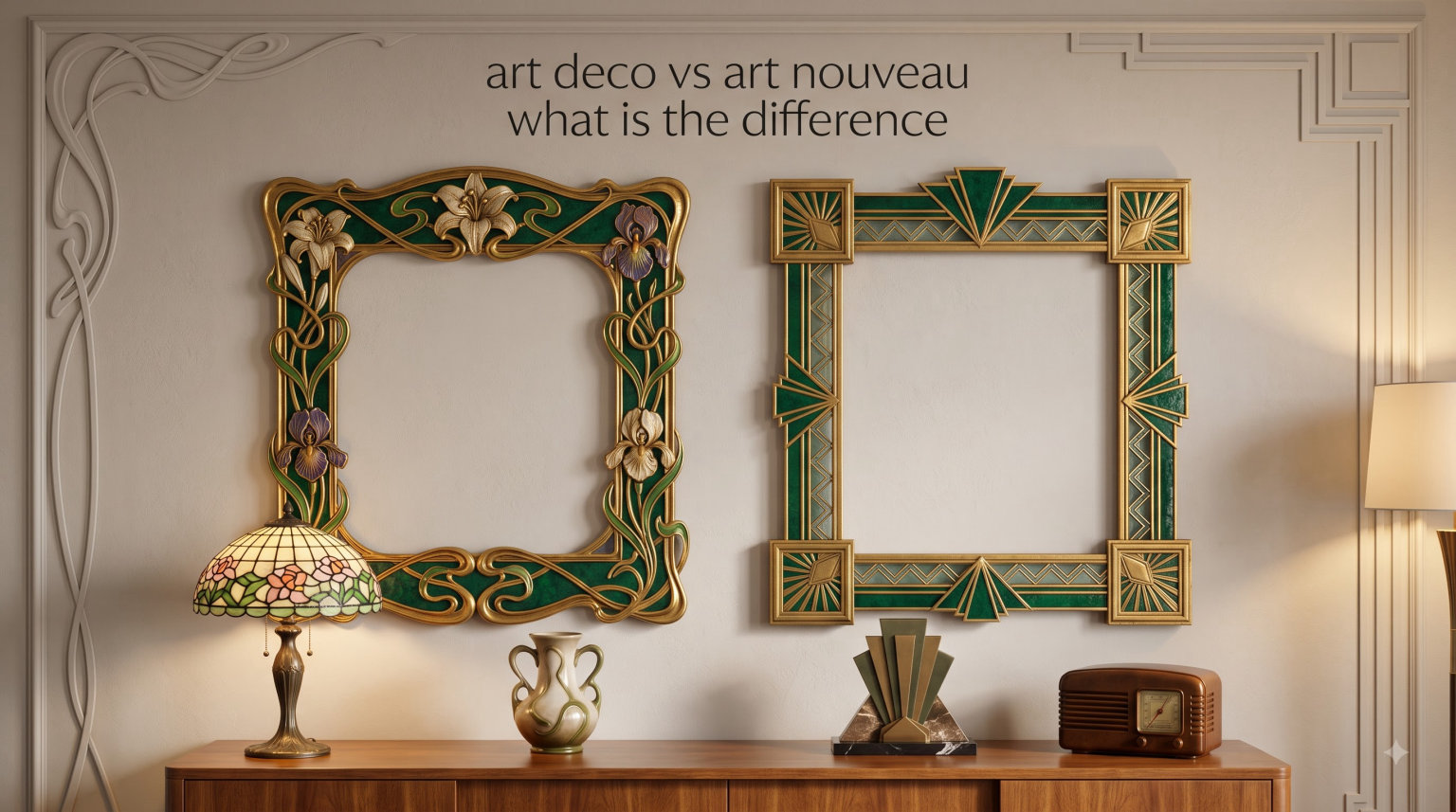
Art Nouveau and Art Deco are two of the most influential decorative art movements of the last century, and although they are often confused, the difference is straightforward: Art Nouveau features organic, flowing curves inspired by nature, while Art Deco uses sharp geometric angles inspired by machines and modernity. Once you know what to look for, telling them apart becomes second nature.
I have spent years studying design history, visiting Art Deco buildings from Miami to Mumbai, and examining Art Nouveau pieces in museums across Europe. This guide distills everything I have learned into a clear, practical comparison so you can confidently identify and appreciate both styles.
Whether you are decorating your home, shopping for antiques, or studying art history, understanding the art deco vs art nouveau difference will change how you see the buildings, furniture, and art around you. Let me walk you through everything you need to know.
Table of Contents
What Is Art Nouveau?
Art Nouveau is an international art movement that flourished from roughly 1890 to 1910. It was a reaction against the rigid historical revival styles of the 19th century and the mass-produced goods of the early Industrial Revolution. The name means “new art” in French, and at the time, it genuinely felt like something the world had never seen.
The movement swept across Europe and North America under different names: Jugendstil in Germany, Secession in Austria, Modernisme in Catalonia, and Stile Liberty in Italy. Despite the regional labels, the visual language was remarkably consistent. Artists everywhere drew from the same well of natural forms.
Origins and the Industrial Revolution
Art Nouveau was born from a contradiction. As factories churned out identical goods, artists and designers pushed back by celebrating handcraft and individuality. They wanted to bring beauty back into everyday objects, from door handles and streetlamps to posters and tableware.
The movement got its biggest stage at the 1900 Exposition Universelle in Paris, where millions of visitors encountered pavilions dripping with organic ornament. It was the style’s peak moment of public visibility and influence.
Key figures like William Morris and the Arts and Crafts movement laid the philosophical groundwork, but Art Nouveau took those ideas in a more decorative, less morally rigid direction. It was less about rejecting machines entirely and more about proving that industrial-age design could still be beautiful.
Visual Hallmarks of Art Nouveau
The single most recognizable feature of Art Nouveau is the whiplash curve. These are long, sinuous lines that sweep, taper, and curl like vines, tendrils, or waves. They appear in everything from ironwork and furniture to typography and glass.
Beyond curves, you will notice a deep love of natural imagery: flowers, insects, peacock feathers, dragonfly wings, orchids, and sinuous plant stems. Stylized female figures with flowing hair are everywhere in Art Nouveau posters and decorative objects.
The compositions tend to be asymmetric and organic. Nothing sits in a rigid grid. Colors are soft and muted, think sage greens, dusty roses, muted golds, earthy browns, and pale lavenders. The overall effect is romantic, dreamy, and slightly otherworldly.
What Is Art Deco?
Art Deco emerged in the 1920s and dominated design through the 1930s. Where Art Nouveau looked to nature, Art Deco looked to the future. It celebrated the machine age, speed, technology, and the optimism of the post-World War I era. The style made its formal debut at the 1925 Exposition Internationale des Arts Decoratifs et Industriels Modernes in Paris, the event that eventually gave the movement its name.
Art Deco was not just a European phenomenon. It became a truly global style, leaving its mark on skyscrapers in New York, cinemas in London, hotels in Shanghai, and apartment buildings in Mumbai. It was the visual language of the Jazz Age, the Roaring Twenties, and the golden age of ocean travel.
The Machine Age and Modernity
The trauma of World War I shattered the romantic worldview that had fueled Art Nouveau. In its place came a hunger for progress, speed, and modernity. Designers looked to airplanes, automobiles, ocean liners, and skyscrapers for inspiration.
The discovery of King Tutankhamun’s tomb in 1922 also triggered a wave of Egyptomania that fed into Art Deco’s visual vocabulary. You can spot Egyptian-inspired motifs like zigzag patterns, lotus shapes, and stepped forms in many Deco buildings and objects.
Unlike Art Nouveau’s emphasis on handcraft, Art Deco embraced new industrial materials and production methods. Chrome, plate glass, Bakelite, stainless steel, and aluminum became the materials of choice. The style celebrated the idea that mass production and great design were not enemies.
Visual Hallmarks of Art Deco
Art Deco is built on geometry. Sunburst patterns, zigzag motifs, chevrons, stepped forms, and fan shapes are its signature elements. Where Art Nouveau curves, Art Deco angles. The lines are clean, sharp, and deliberate.
Symmetry is important in Art Deco. Designs are often perfectly balanced, with repeating elements that create a sense of order and rhythm. This is the opposite of Art Nouveau’s free-flowing asymmetry.
The color palette is bold and high-contrast: black and gold, chrome and deep red, silver and navy blue. Metallic finishes are everywhere. The overall mood is glamorous, confident, and forward-looking. One Reddit user I came across described the difference perfectly: Art Nouveau looks like it was “made by elves” while Art Deco looks like it was “made by dwarves.” That playful analogy captures the organic-versus-geometric split better than any textbook.
Art Deco vs Art Nouveau: Key Differences Explained
This is where the art deco vs art nouveau difference becomes crystal clear. I am going to break down each major point of comparison so you can see how the two styles diverge across every dimension of design.
Lines and Shapes
This is the most reliable way to tell the styles apart. Art Nouveau relies on curved, sinuous lines that flow like water or growing vines. You will see arcs, spirals, and organic shapes that resist any hint of a straight edge. Art Deco, by contrast, builds on straight lines, sharp angles, and geometric precision. Triangles, trapezoids, and zigzags replace the soft swoops of the earlier style.
If you run your finger along a design and it follows a smooth, continuous curve, you are almost certainly looking at Art Nouveau. If your finger traces sharp corners and repeated angles, it is Art Deco.
Color Palettes
Art Nouveau colors are soft, muted, and drawn from the natural world. Think sage green, olive, dusty rose, mustard yellow, peacock blue, and muted gold. The effect is subtle and harmonious, like walking through a garden at golden hour.
Art Deco colors are bold, contrasting, and theatrical. Black paired with gold or silver is a classic combination. Deep jewel tones like emerald green, sapphire blue, and ruby red appear frequently. Metallic surfaces and high-gloss finishes amplify the drama.
Materials and Craftsmanship
Art Nouveau designers favored natural materials and traditional techniques. Wrought iron, stained glass, carved wood, ceramic tiles, and hand-painted surfaces are common. The emphasis was on craftsmanship and the visible hand of the maker.
Art Deco designers embraced modern, industrial materials. Chrome-plated steel, plate glass, lacquered wood, Bakelite, and polished aluminum define the style. These materials allowed for sleek surfaces and machine-perfect precision that would have been impossible a generation earlier.
Inspiration and Philosophy
Art Nouveau was inspired by nature, mythology, and the idea that beauty should infuse everyday life. Its philosophy was essentially romantic. Designers believed that surrounding people with organic beauty could improve their lives and elevate their spirits.
Art Deco was inspired by technology, speed, and the promise of the modern age. Its philosophy was optimistic and forward-looking. Designers believed that embracing industrial progress and geometric precision could create a bold new visual language for a new era.
This philosophical split is the root of every visual difference between the two styles. One looked backward to nature. The other looked forward to machines.
Famous Artists and Iconic Examples
Knowing the key artists and buildings associated with each movement makes it much easier to anchor your understanding. These are the names and places that defined each style.
In the Art Nouveau corner, the biggest names include Alphonse Mucha, whose posters of elegant women with flowing hair became the face of the movement. Gustav Klimt brought Art Nouveau sensibilities into fine art with his gold-leaf paintings like “The Kiss.” Rene Lalique created extraordinary jewelry and glass pieces that turned natural forms into wearable sculpture. Victor Horta and Antonio Gaudi pushed Art Nouveau into architecture, with Horta’s townhouses in Brussels and Gaudi’s Sagrada Familia in Barcelona standing as some of the most extraordinary buildings ever constructed.
On the Art Deco side, Jacques-Emile Ruhlmann created some of the most luxurious furniture of the era, combining rare materials with geometric precision. Jean Dunand produced striking lacquered panels and vases. A.M. Cassandre designed iconic travel posters that distilled the Deco aesthetic into graphic design. Raymond Hood and William van Alen shaped the American skyline with buildings like the Chrysler Building and Rockefeller Center.
As for Tiffany, this is where things get interesting. Louis Comfort Tiffany’s work spans both styles. His early stained glass and lamps from the 1890s and 1900s are firmly Art Nouveau, with their organic forms and nature-inspired motifs. But by the 1920s, Tiffany Studios had shifted toward more geometric, Art Deco-inspired designs. So the answer to whether Tiffany is Art Nouveau or Art Deco depends entirely on when the specific piece was made.
How to Tell Art Deco from Art Nouveau at a Glance
Based on what I have seen in antique shops, museums, and online forums, most people can learn to distinguish these styles in under a minute. Here is a quick-reference checklist I use whenever I encounter a piece I need to identify.
First, look at the lines. Curves mean Nouveau. Angles mean Deco. This single test works about 80 percent of the time.
Second, check the symmetry. If the design is balanced and mirrored, it is likely Art Deco. If it feels organic and free-flowing, it is probably Art Nouveau.
Third, examine the materials. Chrome, glass, and lacquer point to Deco. Wrought iron, stained glass, and carved wood point to Nouveau.
Fourth, consider the subject matter. Plants, flowers, insects, and women with flowing hair are Art Nouveau favorites. Sunbursts, chevrons, stepped pyramids, and stylized geometric animals are Art Deco hallmarks.
Fifth, think about the date. Anything from before 1910 is almost certainly Art Nouveau or a predecessor. Anything from the 1920s or 1930s is almost certainly Art Deco. Pieces from the 1910s transition period can be tricky and may show elements of both styles.
One common challenge people mention in forums is dealing with transitional pieces made between roughly 1910 and 1920. During this period, designers were experimenting with new directions. You might see geometric patterns combined with organic curves, and that is normal. When in doubt, let the dominant visual language guide your classification.
Can You Mix Art Deco and Art Nouveau in Modern Spaces?
This is one of the most common questions I see in design forums, and the short answer is yes, but with intention. The two styles have very different energies, so mixing them requires a light hand.
The safest approach is to pick one style as your dominant theme and use the other as an accent. For example, you might design a living room around Art Deco geometry, with a sleek chrome console and a sunburst mirror, then add a single Art Nouveau stained-glass lamp as an organic counterpoint. The contrast between the two styles becomes a deliberate design feature rather than a confused accident.
Color is your bridge. Both styles work with deep greens and golds, so anchoring a mixed scheme around shared colors helps unify the space. Avoid placing a highly ornate Art Nouveau piece directly next to a sharp-lined Art Deco piece without a visual buffer. A neutral wall, a solid-color rug, or some breathing room between them lets each piece shine on its own terms.
The key principle is contrast, not conflict. When mixed thoughtfully, the organic softness of Art Nouveau can actually highlight the geometric boldness of Art Deco, and vice versa. Think of it like pairing a silk scarf with a leather jacket. The combination works because the contrast is the point.
FAQs
How to tell the difference between Art Nouveau and Art Deco?
The fastest way is to look at the lines. Art Nouveau uses curved, flowing, organic lines inspired by nature, while Art Deco uses straight, sharp, geometric lines inspired by machines. If it curves like a vine, it is Nouveau. If it angles like a skyscraper, it is Deco.
Which came first: Art Nouveau or Art Deco?
Art Nouveau came first, flourishing from roughly 1890 to 1910. Art Deco emerged in the 1920s and dominated through the 1930s. There is roughly a decade of overlap and transition between the two styles.
Is Tiffany Art Nouveau or Art Deco?
Louis Comfort Tiffany produced work in both styles. His early stained glass and lamps from the 1890s through the 1900s are Art Nouveau, featuring organic, nature-inspired forms. By the 1920s, Tiffany Studios adopted Art Deco geometric elements. The classification depends on when the specific piece was created.
Can Art Deco and Art Nouveau be mixed in interior design?
Yes, but it works best when one style dominates and the other serves as an accent. Shared colors like deep greens and golds help unify the two looks. The contrast between organic Nouveau curves and geometric Deco angles can create a striking, intentional design when handled carefully.
What are the most famous Art Nouveau buildings?
The most iconic Art Nouveau buildings include Antoni Gaudi’s Sagrada Familia and Casa Batllo in Barcelona, Victor Horta’s Hotel Tassel and townhouses in Brussels, and the Hotel Metrople Palace in Monte Carlo. The entrances to the Paris Metro designed by Hector Guimard are also classic Art Nouveau landmarks.
Why did Art Nouveau end and Art Deco begin?
Art Nouveau declined because its labor-intensive handcraft approach was expensive and could not keep up with modern industrial production. World War I also shattered the romantic, optimistic worldview that had sustained the movement. Art Deco emerged as a style that embraced industrial materials and celebrated the modern age rather than resisting it.
Conclusion
Understanding the art deco vs art nouveau difference comes down to one core distinction: nature versus machine. Art Nouveau, born in the 1890s, wraps the world in organic curves, soft colors, and handcrafted beauty drawn from the natural world. Art Deco, rising in the 1920s, cuts through with geometric angles, bold metallics, and an unapologetic celebration of industrial progress.
The easiest test I can offer is this: look at the lines. Curves mean Nouveau. Angles mean Deco. From there, the materials, colors, and subject matter all fall into place. Whether you are browsing an antique shop, touring a historic building, or planning a room redesign, that single observation will serve you well.
Both styles left an extraordinary legacy that still shapes architecture, furniture, jewelry, and graphic design in 2026. They may be opposites in their visual language, but together they tell the story of how design evolved from the romantic idealism of the 19th century to the bold optimism of the 20th. Neither style is better than the other. They simply reflect two very different eras with two very different ideas about what beautiful design should look like.