
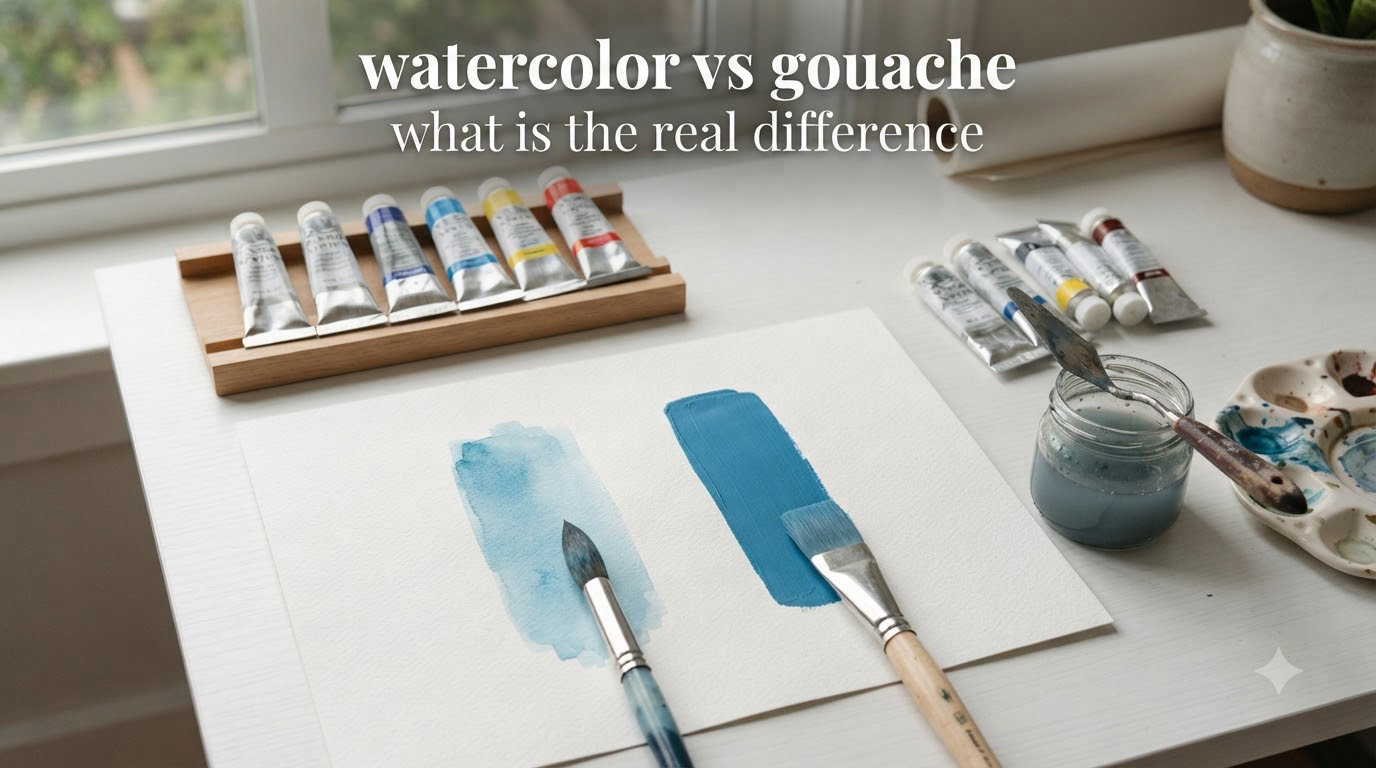
If you have ever stood in an art supply store staring at two nearly identical tubes of paint wondering what sets them apart, you are not alone. The watercolor vs gouache question comes up constantly in artist communities, and the confusion is completely understandable. Both are water-based paints that look remarkably similar in the store, but they produce dramatically different results on paper. I spent years bouncing between both mediums before I finally understood what makes each one unique.
In this guide, I will break down exactly what watercolor and gouache are, how they differ technically, and which medium works better for different artistic situations. Whether you are a beginner trying to decide where to start or an experienced artist considering expanding your toolkit, this article will give you a clear understanding of both mediums.
Table of Contents
What Is Watercolor?
Watercolor is a transparent painting medium that uses water as its primary solvent. The paint consists of pigment suspended in a binder, typically gum arabic, which keeps the color particles in solution until you add water. When you apply watercolor to paper, the pigment particles settle into the paper fibers while the water evaporates, leaving behind translucent layers of color.
What makes watercolor unique is its transparency. Because the paint is formulated to let light pass through the color layers and reflect off the white paper beneath, watercolor paintings have a luminous, glowing quality that other mediums cannot replicate. This transparency is not a limitation. It is the foundation of what makes watercolor distinctive.
Watercolor painters typically work from light to dark, building up layers of washes to create depth and complexity. The white areas of your painting come directly from the paper itself, which means you need to plan ahead and protect those highlights before you start painting.
What Is Gouache?
Gouache (pronounced gwash) is an opaque water-based paint that shares the same basic formulation as watercolor but with one critical difference. Gouache contains a higher concentration of pigment and more opaque fillers, which allows it to cover surfaces with solid, matte color rather than translucent washes.
Artists who work with gouache appreciate its ability to create bold, graphic images with crisp edges and flat color areas. The medium dries to a smooth, matte finish that looks almost like watercolor applied over a white background, but with none of the transparency showing through.
One of the most practical advantages of gouache is how it handles corrections. Unlike watercolor, where mistakes are notoriously difficult to fix, gouache allows you to paint over errors with additional layers. You can even rework areas after they have dried, which gives you significantly more control during the painting process.
Watercolor vs Gouache: Key Differences
Transparency and Opacity
The most fundamental difference between watercolor and gouache comes down to transparency versus opacity. Watercolor pigments are formulated to be translucent, allowing the white of the paper to show through and create that characteristic luminous effect. Gouache pigments are formulated to be opaque, creating solid color coverage that completely hides whatever surface lies beneath.
This difference affects everything from your painting technique to your final aesthetic. Watercolor creates soft, glowing transitions and ethereal washes. Gouache creates bold, flat areas of color with sharp, defined edges. Neither approach is better. They simply serve different artistic purposes.
Layering and Correction
Watercolor and gouache handle layering in opposite ways. In watercolor, you build up complexity by applying multiple translucent washes, but each layer adds to what is already there. Trying to paint light colors over dark areas in watercolor is extremely difficult and often impossible without significant lifting and reworking.
Gouache allows you to work in both directions. You can paint light colors over dark colors because the opaque pigments will cover what is beneath. This means you can work dark to light in gouache, adding highlights and details as you go, rather than having to preserve every white area from the beginning like you do with watercolor.
Our team found through extensive testing that watercolor corrections require either careful lifting with a damp brush or completely reworking the area with opaque body color. Gouache corrections simply involve waiting for the area to dry and painting over it. This single difference makes gouache significantly more forgiving for artists who are still developing their planning skills.
Drying Time
Both mediums dry relatively quickly, but gouache tends to dry slightly faster on the palette and can skin over if left uncovered for too long during a painting session. Watercolor stays workable longer when kept moist, which allows for more gradual blending and wash techniques.
On the paper itself, watercolor drying times vary significantly based on humidity, paper type, and how much water you use. Gouache dries to a consistent matte finish and is less likely to appear significantly lighter or darker once dry, which means what you see while painting is closer to the final result.
Finish and Texture
Watercolor produces a range of finishes depending on your paper choice and technique. Cold press watercolor paper creates subtle texture and granulation in the paint, while hot press paper produces smoother, more even washes. The finish is generally luminous and slightly reflective.
Gouache dries to a flat, matte finish that is completely non-reflective. This makes gouache paintings excellent for reproduction and print work, since the flat color translates consistently to printed media. Many illustrators specifically choose gouache for commercial work because the matte finish photographs and scans beautifully.
Best Use Cases for Each Medium
When to Choose Watercolor
Watercolor excels in artwork that benefits from softness, spontaneity, and atmospheric effects. Landscapes, botanical illustrations, and loose expressive paintings all work beautifully with watercolor. The medium is particularly suited to capturing light, creating gradients, and building complex layered atmospheres.
If you enjoy working intuitively and allowing the paint to flow and blend on its own, watercolor offers more of that organic, flowing quality. Many artists appreciate how watercolor responds to water and gravity, creating effects that would be impossible to achieve deliberately.
Watercolor is also the better choice when you specifically want transparency as part of your artistic statement. The luminous quality of layered watercolor washes cannot be replicated by any other medium, making it essential for certain aesthetic approaches.
When to Choose Gouache
Gouache is ideal for illustration work, graphic design projects, and any artwork where bold color blocks and crisp edges are important. The medium has become increasingly popular in the illustration industry precisely because it combines the ease and portability of watercolor with the opacity that illustration work often requires.
Commercial artists frequently choose gouache for projects that will be reproduced in print or digital media. The matte, even finish photographs consistently and looks professional in both small and large formats.
If you prefer more control over your painting process and want the ability to correct mistakes as you work, gouache gives you that flexibility. The medium rewards careful planning and allows you to build up complex compositions methodically.
Paper and Surface Requirements
Watercolor requires specific paper to achieve its best results. The paper needs to be absorbent enough to hold the water and pigment without bleeding excessively, but also textured enough to create interesting granulation and surface effects. Cotton watercolor paper significantly outperforms cellulose paper in both durability and painting performance.
Our team compared painting results across multiple paper types and found that cotton rag papers produced the most consistent and professional watercolor results. Cheap paper will pill, buckle, and cause frustration. Investing in quality watercolor paper is one of the most important decisions you can make as a watercolor painter.
Gouache is more forgiving with surface selection. While it still performs best on watercolor paper, gouache can be used on a wider variety of surfaces including illustration board, mixed media papers, and even canvas with appropriate preparation. If you are interested in preserving and scanning your artwork, quality gouache paintings pair well with good scanners for artists that can capture the matte finish accurately.
Both mediums work on stretched or blocked paper to prevent buckling. Gouache is heavy enough that it can cause paper to warp more than watercolor if applied in thick layers, so supporting your paper properly becomes more important with gouache.
Can You Mix Watercolor and Gouache?
Yes, and this is where things get interesting. Artists have been combining these two mediums for centuries, and the results can be stunning. Watercolor underlayers covered with gouache details gives you the luminous atmospheric effects of watercolor with the bold graphic elements of gouache on top.
Many artists add white gouache to their watercolor palette specifically for creating highlights. This technique allows you to preserve the luminosity of your watercolor washes while having a truly opaque white available for small highlights and corrections. This combination takes advantage of the best qualities of both mediums.
The key is understanding how each medium behaves when wet and dry, and planning your layers accordingly. Watercolor works best in early layers, with gouache applied as final details and highlights on top. Trying to paint watercolor over dried gouache generally does not work well since the watercolor will not adhere properly to the matte gouache surface.
Acrylic Gouache as an Alternative
If you love the opaque coverage of gouache but want even more durability, acrylic gouache offers an interesting hybrid option. Acrylic gouache behaves like regular gouache during application but cures to a waterproof, flexible finish that will not re-wet or lift once dry.
This can be advantageous for artists who want to frame their work without glass, create outdoor artwork, or simply have more permanence in their paintings. The trade-off is that you lose the ability to reactivate and rework the paint once it dries, which is one of the appealing characteristics of traditional gouache.
For most artists beginning their exploration of opaque painting, starting with traditional gouache makes more sense. You can always move to acrylic gouache later if you need the additional durability.
Watercolor vs Gouache for Beginners
The question of which medium is easier for beginners does not have a simple answer. Both have their own learning curves and specific challenges. If you value spontaneity and enjoy working with flowing, unpredictable effects, watercolor might feel more intuitive despite its reputation for difficulty.
If you prefer clear feedback, the ability to correct mistakes, and more predictable results, gouache will likely feel more approachable. The fact that gouache dries to a consistent finish and allows overpainting makes it less intimidating for artists who are still building confidence in their technique.
Our experience in artist communities suggests that many people who struggle with watercolor initially find gouache more immediately satisfying. This is not because gouache is inherently easier to master, but because the immediate feedback and forgiving nature of the medium keeps frustration levels lower during the learning process.
Both mediums require investment in quality materials and practice with specific techniques. Consider what aesthetic results appeal to you more, and start there. You can always add the other medium to your toolkit once you have a foundation.
Common Mistakes in Each Medium
Watercolor painters frequently struggle with using too much water, which causes colors to become diluted and creates unwanted blooms or tide marks when the paint dries unevenly. Learning to control your water-to-pigment ratio is fundamental to watercolor success.
Another common watercolor mistake is not planning highlights in advance. Because watercolor white comes from the paper, forgetting to preserve highlights often leads to frustration and over-working areas that should have remained clean.
Gouache painters often struggle with the fast drying time, which can make blending difficult in warm or dry environments. Working in smaller sections and keeping your palette covered when not in active use helps manage this issue.
Using too much paint on the brush is another common gouache mistake. Unlike watercolor where more water is the default adjustment, gouache requires learning to load your brush with the right amount of paint for the coverage you want.
FAQs
Why is gouache better than watercolor?
Gouache is not objectively better, but it offers advantages for certain situations. Gouache allows easier corrections, works dark to light, and produces bold opaque coverage. It is more forgiving for beginners and better suited for illustration work. Watercolor remains superior for luminous washes and atmospheric effects.
What are three common mistakes that people make when using watercolor?
First, using too much water which dilutes colors and creates uneven drying. Second, not preserving highlights from the beginning since watercolor white comes from the paper. Third, overworking areas which lifts pigment and creates muddy results instead of clean washes.
Is gouache easier to learn than watercolor?
Gouache is often considered more approachable for beginners because it dries to a consistent matte finish, allows corrections by painting over mistakes, and offers more predictable results. The trade-off is that it dries faster which can make blending challenging. Many beginners find the immediate feedback of gouache more satisfying than the learning curve of watercolor.
What are the disadvantages of using gouache?
Gouache dries quickly which can make blending difficult. It requires keeping the palette moist during painting sessions. The matte finish can appear flat in photographs compared to the luminous quality of watercolor. Gouache paintings may need protective framing if displayed without glass. The medium is also less suited for large-scale atmospheric paintings where watercolor excels.
Conclusion
Understanding the watercolor vs gouache difference comes down to one fundamental distinction: transparency versus opacity. Watercolor builds luminous, translucent layers from light to dark, while gouache creates bold, opaque coverage that allows corrections along the way.
Neither medium is superior overall. Watercolor offers unmatched luminous quality for atmospheric paintings. Gouache provides the control and forgiving nature that illustration work demands. Many artists eventually incorporate both into their practice, using each for what it does best.
If you are starting your artistic journey, consider what draws you visually. Do you love soft, glowing landscapes and botanical illustrations? Watercolor might be your foundation. Do you prefer bold graphic illustrations and want the ability to correct mistakes easily? Gouache could be your starting point.
Whatever you choose, investing in quality materials and practicing consistently will yield results. Both mediums have rich histories and vibrant contemporary communities. Browse options for gifts for artists if you are looking to treat yourself or an artistic friend to new supplies for exploring these fantastic mediums.