
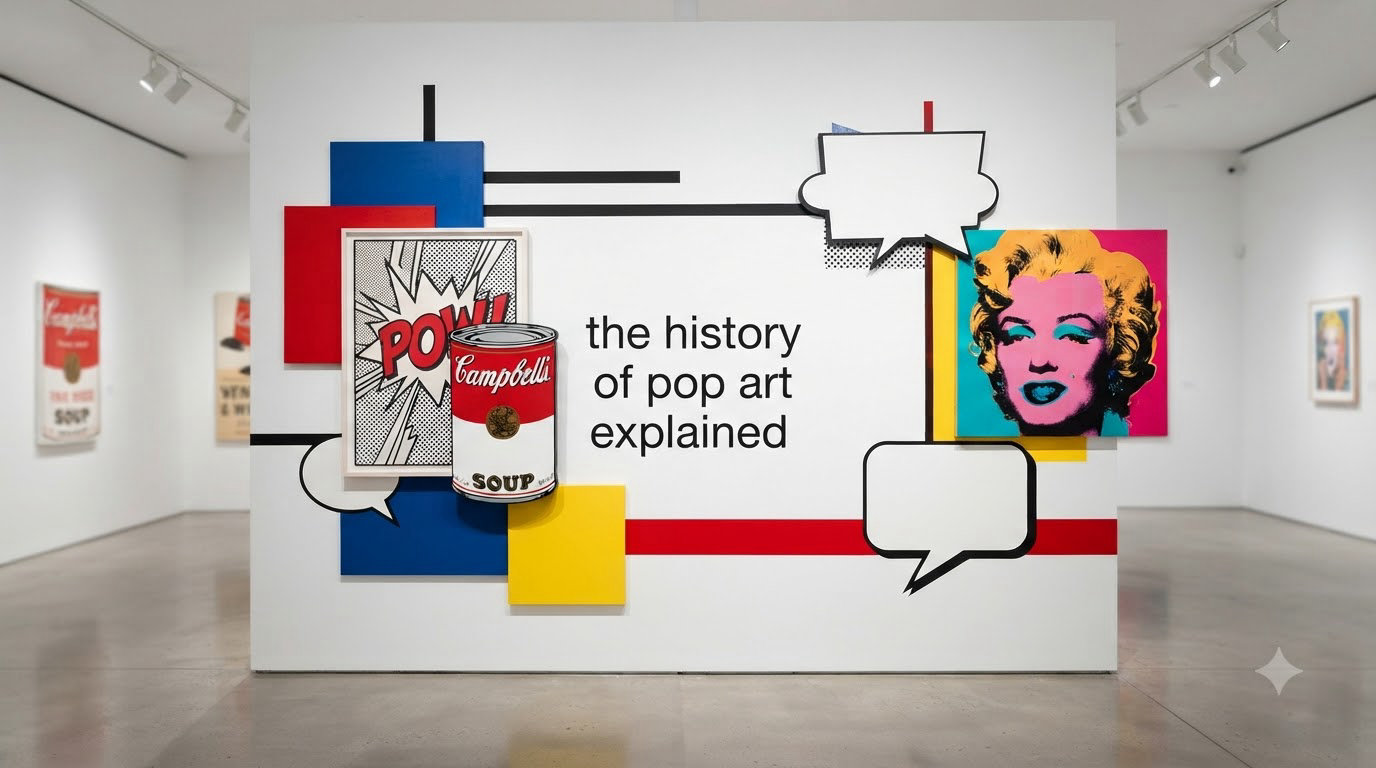
Pop Art is an art movement that emerged in the 1950s in Britain and flourished in the 1960s in America and Britain, drawing inspiration from sources in popular and commercial culture such as advertising, comic books, and mass media imagery. This movement fundamentally challenged what art could be by taking images from everyday life, advertising, and mass culture and presenting them as serious art objects.
If you have ever wondered how soup cans and comic strips became fine art, this guide to the history of Pop Art will walk you through every major development. What makes this movement so fascinating is how it flipped the art world upside down during the Cold War era.
Table of Contents
Origins: How Pop Art Started in 1950s Britain
Pop Art began in Britain during the mid-1950s, long before it caught fire in America. The movement traces back to the Independent Group, a collective of artists, architects, and writers formed in London in 1952. Among them were Eduardo Paolozzi, Richard Hamilton, and architecture critic Reyner Banham.
These artists were fascinated by America’s post-war cultural output. Eduardo Paolozzi created one of the foundational works of Pop Art with his 1947 collage series “Bunk.” These photomontage works combined images from American mass media: pin-up girls, car parts, coffee ads, and technological diagrams.
Paolozzi called these “Bunk” after the American slang for empty talk, deliberately highlighting the superficiality of commercial imagery. His approach of reassembling mass-produced images into new compositions would become a core Pop Art technique.
Richard Hamilton created what many consider the first true Pop Art painting in 1956. His work “Just what is it that makes today’s homes so different, so appealing?” used collaged images from American magazines and advertisements. The piece depicted a muscleman, a bikini woman, a television set, a vacuum cleaner, and a piece of roast beef.
It was a deliberate statement about consumer culture infiltrating the British home. The British context matters enormously for understanding why Pop Art emerged. Post-war Britain was still dealing with rationing, economic struggle, and the gradual arrival of American cultural exports through films, music, and advertising.
Key Pop Art Artists and Their Most Famous Works
Andy Warhol: The Icon of American Pop Art
When discussing the history of Pop Art, Andy Warhol remains the most recognizable name, and for good reason. Warhol took the movement’s core ideas further than anyone else, transforming his studio into what he called a “factory” and mass-producing images with systematic precision.
Warhol’s Campbell’s Soup Cans, first exhibited in 1962, remains perhaps the most famous Pop Art work ever created. The piece presented thirty-two canvases, each depicting a different variety of Campbell’s soup. The bland, commercial imagery combined with the gallery setting forced viewers to question what they were looking at.
His Marilyn Diptych from 1962 demonstrates his approach to celebrity and death. The piece features fifty silkscreened images of Marilyn Monroe, half in color and half in black and white. The repetition creates a sense of both overexposure and vulnerability, examining how mass media creates and destroys icons.
Roy Lichtenstein: Comics Become Canvas
Roy Lichtenstein took a different approach by directly reproducing comic book panels and printing techniques. His work “Whaam!” from 1963 became one of the defining images of the movement, depicting a pilot firing a rocket at a biplane while a friend looks on in horror.
Lichtenstein carefully recreated the Ben-Day dots used in comic book printing, deliberately copying the commercial technique while expanding it to gallery scale. The irony of Lichtenstein’s work was profound. Comic books were considered lowbrow entertainment, unworthy of serious artistic attention.
By reproducing them exactly but at massive scale, Lichtenstein forced the art world to reconsider what qualified as subject matter for fine art. His brushstroke paintings, which appeared in 1964, took this further by recreating brushstroke patterns from comic book caption boxes.
Other Notable Pop Art Artists
James Rosenquist came to Pop Art after working as a billboard painter for commercial advertisements. His enormous canvases translated the language of outdoor advertising into fine art. His 1965 work “F-111” stretched 86 feet long, combining images of an F-111 fighter jet, a crash-test dummy, a pie, and a fireball.
Claes Oldenburg brought Pop Art into three dimensions with his soft sculptures of everyday objects. His “Floor Cake” from 1962 resembled a giant slice of birthday cake lying on the gallery floor. His giant sculptures of mundane kitchen objects transformed ordinary items into monumental works.
Ed Ruscha, often overlooked in favor of Warhol and Lichtenstein, made significant contributions through his paintings and conceptual approaches. His 1966 work combined photographs of gas stations with hand-painted text, creating a distinctly American vocabulary of landscape and commerce. Ruscha’s influence on conceptual art proved that Pop Art’s questioning of art’s boundaries would extend far beyond the 1960s.
American Pop Art vs British Pop Art: Key Differences
Understanding the distinction between American Pop Art and British Pop Art requires recognizing two fundamentally different relationships to consumer culture. British artists like Hamilton and Paolozzi observed American culture from a distance, analyzing its imagery with academic precision.
American artists lived inside consumer culture and absorbed it daily, making their work more visceral and celebratory. British Pop Art emerged from an intellectual tradition that included literary sources and theoretical frameworks. The movement engaged with Marxist critiques of capitalism and questions about authenticity in mechanical reproduction.
The post-war economic boom created unprecedented consumer abundance in America, and American artists responded with both enthusiasm and skepticism. The Cold War loomed large over everything, and Pop Art’s relationship to American power was complicated.
Some critics during the 1960s accused Pop Artists of creating a kind of propaganda, though the artists themselves generally rejected this interpretation. Abstract Expressionism emphasized individual emotional expression and viewed commercial imagery as beneath serious art. Pop Artists deliberately challenged this hierarchy by embracing mass culture imagery.
Pop Art Techniques and Materials
The techniques Pop Artists employed were as important as their subjects. Screen printing, also called silkscreen or serigraphy, became the movement’s signature method. Warhol adopted it from commercial printing and transformed it into a fine art technique that allowed him to repeat images rapidly while maintaining subtle variations.
Ben-Day dots originated as a commercial printing technique used in magazines and comic books. Lichtenstein’s deliberate reproduction of these dots on canvas raised questions about mechanical reproduction and artistic authorship that remain relevant today.
Collage and photomontage techniques, inherited from the Dadaists, allowed artists to combine imagery from disparate sources. This technique suited Pop Art’s project of recontextualizing everyday images within fine art settings. Pop Artists also embraced the aesthetic of mechanical reproduction itself.
Rather than hiding the signs of mass production, they emphasized them. The flat colors, hard edges, and recognizable imagery from commercial art became badges of Pop Art authenticity. Artists who would later practice appropriation art explained as a technique found their foundation in these early Pop Art experiments.
FAQs
Why was Pop Art created
Pop Art was created as a response to the dominance of Abstract Expressionism and the rise of consumer culture in post-war America and Britain. Artists sought to challenge the boundaries between high art and popular culture by using imagery from advertising, comic books, and everyday objects. The movement also reflected broader social questions about celebrity, commerce, and the role of art in a capitalist society during the Cold War era.
What is Pop Art
Pop Art is an art movement that emerged in the 1950s in Britain and flourished in the 1960s in America and Britain. It draws inspiration from popular and commercial culture such as advertising, comic books, and mass media imagery. The movement challenged traditional art by using recognizable imagery from everyday life and mass culture, often employing techniques like screen printing and collage to question the boundaries between high art and popular culture.
When did Pop Art end
Pop Art peaked during the 1960s but gradually dissolved into other movements by the early 1970s. However, its influence on contemporary art, design, and visual culture remains strong. The movement’s strategies of appropriation and engagement with mass culture became foundational for subsequent art movements including Conceptual Art, Neo-Expressionism, and contemporary appropriation art.
Who are the key Pop Art artists
The key Pop Art artists include Andy Warhol, Roy Lichtenstein, James Rosenquist, and Claes Oldenburg from America, and Eduardo Paolozzi and Richard Hamilton from Britain. Other significant artists include Ed Ruscha, Jasper Johns, and women artists like Pauline Boty and Martha Rosler who brought important critical perspectives to the movement.
What are the characteristics of Pop Art
Pop Art is characterized by bold colors, recognizable imagery from everyday life and mass culture, irony and satire, use of commercial techniques like screen printing and Ben-Day dots, engagement with celebrity and consumer imagery, and questioning of the boundaries between high art and popular culture. The movement often employed repetition, appropriation, and mechanical reproduction aesthetics.
International Spread and Pop Art’s Legacy
Pop Art did not remain confined to America and Britain. In Germany, artists like Gerhard Richter and Sigmar Polme developed Capitalist Realism as a German variant, examining the arrival of American consumer culture in post-war Germany.
French artists created Nouveau Realisme, which shared Pop Art’s interest in everyday objects and mass production. Yves Klein, Arman, and Christo engaged with industrial materials and consumer goods, though their approaches varied considerably from American Pop.
The women artists of Pop Art have only recently received the recognition they deserve. Pauline Boty, working in Britain during the early 1960s, created paintings and collages that examined female sexuality and celebrity culture with critical intelligence. Martha Rosler’s work brought feminist critique to Pop Art’s celebration of consumer culture.
Los Angeles developed its own vibrant Pop scene during the 1960s, with artists like Ed Ruscha, Mel Ramos, and William Wiley creating work that responded to California’s specific cultural landscape. LA Pop engaged with surfing culture, car culture, and the entertainment industry in ways distinct from New York Pop Art.
Pop Art’s influence extends far beyond the 1960s. Contemporary artists continue to draw on its strategies of appropriation and engagement with mass culture. This movement established that art could take any subject matter and that the artist’s interpretation mattered more than the source material’s social status.
Pop Art marked the transition from Modern to Contemporary Art by questioning the assumptions that had governed art since the Renaissance. Where Modern Art sought authentic expression and spiritual transcendence, Contemporary Art engages critically with culture, commerce, and the constructed nature of meaning.
Understanding the history of Pop Art helps you see how we arrived at today’s art world, where appropriation is standard practice and the boundaries between high and low culture have largely dissolved. Art movements that emerged after Pop Art would build directly on these foundations.