
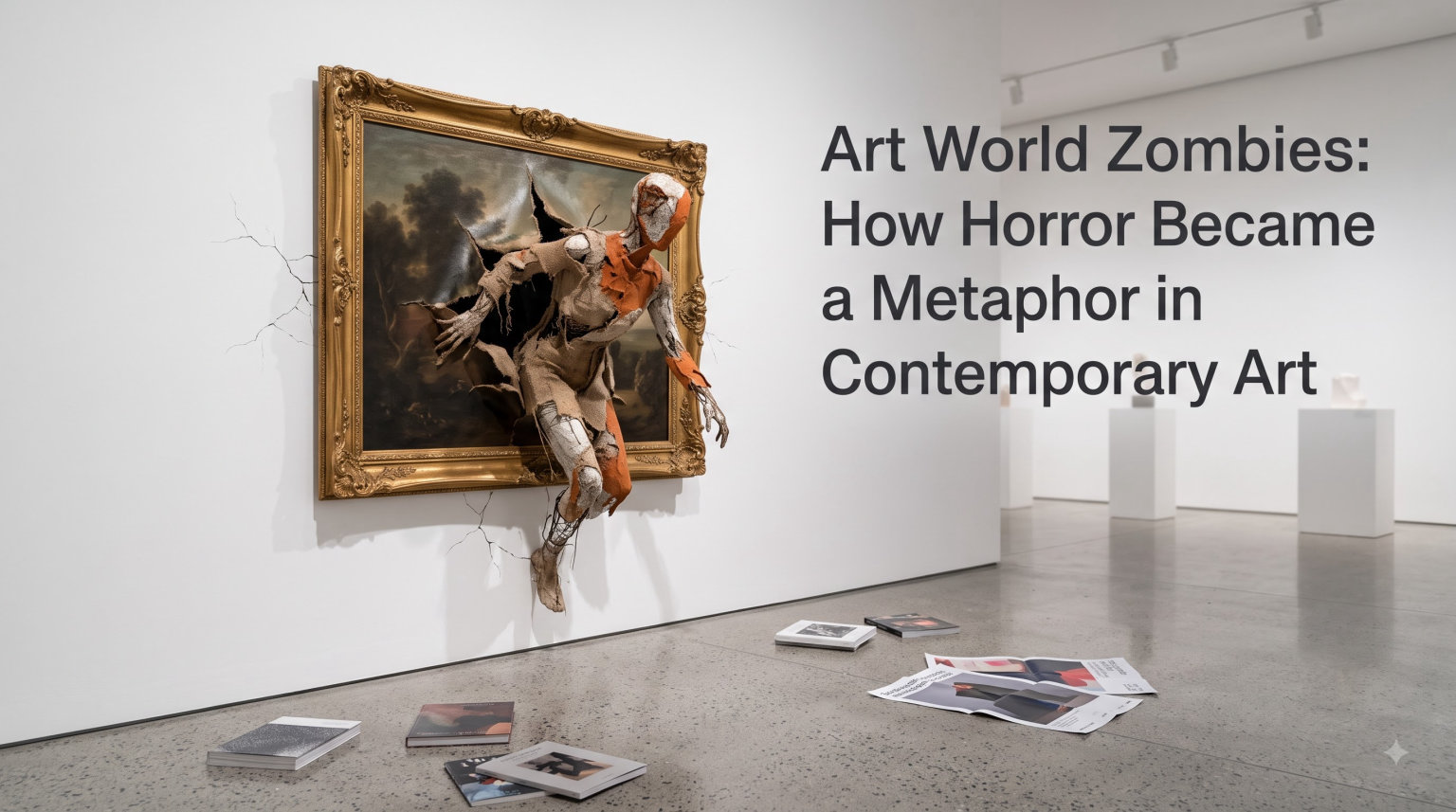
Zombie horror has shuffled from cinema screens into gallery walls, transforming from cheap thrills into sophisticated cultural commentary in 2026. The undead have become one of the most powerful metaphors artists use to examine modern anxieties. From mindless consumerism to labor exploitation, the zombie serves as a mirror reflecting what ails contemporary society.
When I first encountered a zombie-themed installation at a major museum, I expected schlocky horror tropes. Instead, I found a meditation on precarious labor and environmental collapse. This revelation sent me down a rabbit hole of contemporary art that uses undead imagery for serious critique. What I discovered was a rich tradition spanning decades, connecting Haitian folklore to abstract painting.
In this guide, I will walk you through how zombie horror became a metaphor in contemporary art. We will explore the historical evolution from voodoo legends to Romero films. You will learn about Zombie Formalism, the controversial art movement that borrowed the monster’s name. I will introduce you to contemporary artists using zombie imagery for everything from capitalism critique to chronic illness representation.
Table of Contents
From Folklore to Fine Art: The Zombie’s Evolution
The zombie did not start as a brain-hungry corpse in American movies. Its origins trace back to Haitian Vodou traditions, where zombies represented something far more terrifying than death. A zombie was a person stripped of free will, forced into endless labor under a sorcerer’s control. This original metaphor spoke directly to the horrors of slavery and colonial oppression in the Caribbean.
The 1932 film “White Zombie” introduced Western audiences to this concept, though it sanitized the racial and labor politics. Bela Lugosi played a plantation owner using zombies as mindless workers in his sugar mill. Even in this early, problematic form, the zombie represented exploited labor. The film unintentionally preserved the monster’s connection to forced work and dehumanization.
George Romero changed everything in 1968 with “Night of the Living Dead.” His ghouls were not spellbound slaves but flesh-eating reanimated corpses. More importantly, Romero embedded social commentary within the horror. The film’s bleak ending and racial tensions mirrored real American anxieties. Romero’s subsequent films, particularly “Dawn of the Dead” (1978), explicitly linked zombies to consumer culture.
The shopping mall setting in “Dawn of the Dead” was no accident. The dead wandered through consumer temples, drawn by instinct to places they once frequented. This interpretation gave artists a powerful new metaphor. The zombie became a stand-in for mindless consumption and alienated existence. Contemporary artists seized upon this rich symbolic potential throughout the August 2026 era.
Theoretical Frameworks: Why Zombies Resonate
Artists and theorists have developed sophisticated frameworks for understanding zombie horror metaphor in contemporary art. These concepts help explain why the undead refuse to die as a cultural symbol. The zombie adapts because it speaks to fundamental conditions of modern life. Three major theoretical lenses dominate art world discussions.
Marxist Critique and Immaterial Labor
Karl Marx’s concept of alienation finds its perfect visual metaphor in the zombie. Workers stripped of creative agency, performing repetitive tasks, become effectively undead. Contemporary theorists have updated this for the digital age with the idea of immaterial labor. We produce value through affect, attention, and social connection rather than physical goods.
The zombie represents workers who have lost even the limited autonomy of industrial labor. In the experience economy, we must perform enthusiasm and authenticity on demand. Artists channel this anxiety through undead imagery, showing bodies persistently moving without living purpose. The horror lies not in death but in death-in-life, endless persistence without meaning.
Hauntology and the Specter
Jacques Derrida introduced “hauntology” in “Specters of Marx,” describing how past violence continues haunting the present. Zombies literalize this concept. They are the return of the repressed, unresolved historical trauma walking among us. Contemporary artists use this framework to address colonialism, slavery, and systemic violence that society tries to bury.
The spectral presence of the zombie reminds viewers that nothing truly stays dead. Historical exploitation continues shaping present conditions. This theoretical approach gives zombie art its political edge. It refuses to let audiences forget past atrocities while demanding engagement with ongoing inequality.
Abjection and Body Horror
Julia Kristeva’s theory of abjection describes our revulsion at boundary violations between self and other. The zombie embodies abjection perfectly. Decaying flesh, exposed viscera, and the blurring of human and corpse trigger visceral disgust. Contemporary artists deploy this affective response strategically.
By confronting viewers with abject bodies, artists force recognition of our own vulnerability. The zombie’s decaying form reminds us that civilization is a thin veneer. This framework connects zombie art to body horror traditions and disability studies. Chronic illness, in particular, finds expression through zombie metaphor, as we will explore later.
What Is Zombie Formalism? Understanding the Movement
Zombie Formalism refers to a specific trend in abstract painting that emerged in the early 2010s, not art depicting actual zombies. The term was coined pejoratively by critic Walter Robinson to describe a wave of young painters creating slick, process-based abstractions. These works borrowed techniques from Abstract Expressionism but felt lifeless, mechanical, and driven by market forces rather than authentic expression.
The movement’s name proved unfortunately perfect. Like cinematic zombies, these paintings seemed to persist without living purpose. They moved through the art market, consuming attention and capital, without genuine artistic vitality. Robinson’s critique targeted what he saw as empty repetition of historical styles for speculative investment purposes.
Is Zombie Formalism a Derogatory Term?
The term is indeed derogatory, though some artists have reclaimed it. Robinson intended to critique market speculation and derivative painting practices. However, the label stuck to specific artists regardless of their actual practice quality. Lucien Smith and Oscar Murillo became most associated with the term, though their careers have evolved considerably since.
Some defenders argue the term unfairly dismisses an entire generation of painters. Others contend it accurately described a bubble where wealthy collectors flipped paintings for quick profit. The controversy itself reveals tensions in the art market. When financial speculation drives aesthetic trends, the resulting work may feel hollow, even undead.
Characteristics of Zombie Formalist Painting
Zombie Formalist works typically share several characteristics. They employ process-based techniques like poured paint, staining, or mechanical application. The surfaces are often slick and attractive, designed for Instagram reproduction and luxury interiors. Scale tends toward the large and impressive, suitable for trophy display in speculative collectors’ homes.
The works reference art history without transforming their sources. You might see echoes of Pollock’s pours or Rothko’s color fields, but without the original emotional intensity. This calculated pastiche, combined with market timing, created the zombie effect. The paintings persisted, moved, and consumed resources while seeming strangely lifeless.
The Art Market Context
Zombie Formalism flourished in a specific economic moment. Low interest rates and new wealth from emerging markets flooded the art world with capital. Young painters became investment vehicles, with prices rising purely on speculation rather than critical consensus. When the market corrected, many of these careers stalled, confirming the zombie metaphor’s accuracy.
The phenomenon revealed uncomfortable truths about how neoliberal economics infects aesthetic production. Art made primarily for accumulation feels different from art made from necessity. Zombie Formalism made this condition visible, even if unintentionally. The movement serves as a case study in how capital can reanimate historical forms while killing their spirit.
Contemporary Artists Using Zombie Horror Metaphor
Beyond Zombie Formalism, many contemporary artists engage directly with zombie imagery and themes. These practitioners use the undead for diverse critiques ranging from consumer culture to racial violence. The following artists represent significant approaches to zombie horror metaphor in contemporary art practices.
Installation and Video Art
The Aspen Art Museum’s exhibition on supernatural themes showcased how contemporary artists deploy zombie aesthetics. Artists in this exhibition used horror tropes to address real social conditions. Video installations showed zombie-like figures in corporate settings, literalizing the “corporate zombie” metaphor. The effect was simultaneously funny and deeply unsettling.
Performance artists have also embraced zombie imagery. Some create durational works where performers move in slow, undead patterns for hours. These pieces force audiences to confront the passage of time and the physical limits of bodies. The performers become living zombies, embodying persistence without progress.
Painting and Zombie Figuration
Several contemporary painters create figurative works featuring zombie subjects. These are not the cartoonish zombies of pop culture but somber meditations on mortality. Artists like Nicola Samori create works that appear to decay before your eyes. His technique involves partially destroying realistic portraits, creating a sense of living decomposition.
Other painters explore zombie metaphor through color and surface rather than direct figuration. Works that seem to rot or mold on the canvas suggest the fragility of aesthetic categories. These paintings challenge the traditional boundaries between beautiful and abject, finished and unfinished, art and garbage.
Digital and New Media Zombie Art
An emerging field involves digital zombies and undead avatars. New media artists create generative zombies that proliferate across screens. These digital undead comment on online existence, where our data persists after our attention moves elsewhere. Social media profiles of deceased users become a new form of digital haunting.
Some artists use artificial intelligence to create zombie-like imagery. Machine learning trained on horror films generates endless variations of undead faces. The results are both familiar and uncanny, like zombies themselves. This technological approach updates the zombie metaphor for algorithmic culture.
Disability and Chronic Illness Perspectives
An important development involves disabled and chronically ill artists reclaiming zombie metaphor. These practitioners describe their relationship to the metaphor from lived experience. The zombie’s persistence despite decay mirrors the experience of managing illness. The undead refusal to die becomes empowering rather than horrifying.
Some artists create “plant zombie” series combining botanical and undead imagery. These works suggest that life persists even in compromised forms. The metaphor shifts from something imposed by healthy artists to something claimed by those with direct experience. This represents the most significant evolution in zombie horror metaphor contemporary art in recent years.
Zombie Metaphor Interpretations Across Themes
Contemporary artists deploy zombie imagery to address several interconnected themes. Each interpretation adapts the core metaphor to specific cultural anxieties. The flexibility of the zombie explains its persistence across decades and mediums.
Consumerism and the Undead Shopper
Romero’s shopping mall zombies remain the touchstone for consumer critique. Contemporary artists extend this metaphor to address online consumerism and digital advertising. Zombies clicking endlessly through shopping sites appear in video works. The insatiable appetite of the undead perfectly represents algorithmic recommendation engines.
Installation artists create environments resembling abandoned big-box stores populated by zombie mannequins. These works mourn the death of retail while critiquing its environmental costs. The zombie consumer haunts the ruins of consumerism, still seeking satisfaction that no longer exists.
Labor Exploitation and the Working Dead
Returning to the zombie’s origins, many artists use undead imagery to address labor conditions. The “working dead” metaphor describes employees expected to sacrifice health and boundaries for employers. Zombie figures in business attire appear in sculpture and photography. These works resonate with viewers experiencing burnout and precarity.
The gig economy particularly invites zombie comparison. Workers performing tasks without benefits, community, or security resemble the undead in their isolation. Artists document this condition through both literal zombie imagery and more subtle formal approaches. The exhaustion of overwork becomes visible in the decaying form.
Environmental Horror and Climate Zombies
Emerging climate art uses zombie metaphor for environmental destruction. The undead represent resources extracted beyond sustainability, persisting in toxic forms. Zombie forests, zombie oceans, and zombie cities appear in contemporary works. These pieces suggest that nature itself has become undead under human exploitation.
Some artists create works from actual toxic materials, making the zombie metaphor literal. Sculptures that off-gas chemicals or paintings using hazardous pigments embody the undead environment. Viewers confront art that is itself potentially harmful, mirroring our relationship with a damaged planet.
Chronic Illness and the Persisting Body
As mentioned earlier, disabled artists increasingly claim zombie metaphor for chronic illness representation. The zombie’s persistence despite visible decay describes living with ongoing health conditions. Unlike tragic narratives of illness, zombie metaphor suggests power and endurance. The undead keep moving despite everything.
These works often contrast with earlier abled artists using disability metaphorically. When disabled artists control the zombie image, the representation gains nuance and authenticity. The metaphor shifts from horror at the disabled body to recognition of disabled resilience.
Cross-Disciplinary Connections: Film, Literature, and Visual Art
Zombie horror metaphor contemporary art does not exist in isolation. It draws heavily from film, literature, and popular culture while influencing those fields in return. Understanding these cross-disciplinary connections enriches appreciation of zombie art.
Film Influence on Fine Art Practice
George Romero’s influence on visual artists cannot be overstated. His zombies established the visual vocabulary that artists still reference. The shambling gait, rotting flesh, and mob mentality all derive from his films. Contemporary artists cite Romero alongside art historical masters as influence.
International zombie cinema also shapes contemporary art. Japanese zombie films with different aesthetic traditions influence Asian contemporary artists. French zombie films emphasizing atmosphere over gore inform European installation practices. The global zombie conversation enriches fine art approaches.
Gothic and Folk Horror Aesthetics
Zombie art connects to broader gothic and folk horror revivals in contemporary culture. Artists working with undead themes often engage supernatural and occult imagery more broadly. Vampires, ghosts, and witches appear alongside zombies in exhibitions and individual practices. This atmosphere of supernatural dread addresses secular anxieties without religious frameworks.
Folk horror specifically influences zombie art through its attention to rural landscapes and ancient practices. The zombie as revenant connects to European traditions of the unquiet dead. Artists exploring folk horror often include zombie-like figures in pastoral settings. This juxtaposition of decay and nature creates particularly haunting effects.
Literary Connections
Literary zombie fiction informs visual art practice. Novels like “Zone One” by Colson Whitehead and “The Last Days of American Capitalism” by other authors provide conceptual frameworks. Artists read these texts and create visual responses. The relationship between word and image strengthens both forms.
Poetry about zombies also influences visual artists. The zombie’s liminal state between life and death attracts poetic meditation. Artists translate these poetic investigations into visual form. The resulting works occupy the space between narrative and pure abstraction.
FAQs: Understanding Zombie Horror in Contemporary Art
What is zombie formalism in art?
Zombie Formalism is a term coined by critic Walter Robinson to describe a trend in early 2010s abstract painting characterized by slick, process-based works that reference Abstract Expressionism without genuine emotional investment. The term suggests these paintings persist and move through the art market like undead creatures, driven by speculation rather than authentic artistic purpose.
What is the metaphor for zombies?
In contemporary art, zombies metaphorically represent mindless persistence without purpose. They symbolize consumerism, labor exploitation, alienation under capitalism, historical trauma that refuses to stay buried, and chronic illness experiences. The zombie’s endless, hungry movement mirrors modern conditions of work and consumption that continue without satisfaction or endpoint.
Is Zombie Formalism a derogatory term?
Yes, Zombie Formalism was originally intended as a derogatory critique of market-driven abstract painting. Walter Robinson coined it to criticize works he saw as mechanically reproducing historical styles for speculative investment. However, some associated artists have reclaimed the term, and it has become a useful descriptor for understanding relationships between art markets and aesthetic production.
What do zombies symbolize in literature?
In literature, zombies symbolize mass culture conformity, infectious contagion (both literal and ideological), breakdown of social order, and humanity reduced to pure appetite. They represent fears of losing individuality and agency. Contemporary literary zombie narratives often focus on survival ethics and rebuilding community after collapse, using the undead as catalyst for examining human nature under extreme conditions.
What is the meaning of zombie art?
Zombie art refers to contemporary artworks that use undead imagery and themes to explore cultural anxieties. The meaning varies by context but generally addresses persistence without purpose, whether in consumerism, labor, historical trauma, or illness. Zombie art can critique capitalism, represent disabled experience, address environmental destruction, or examine the art market itself. The meaning depends on the specific artist’s intentions and theoretical framework.
Which contemporary artists are known for zombie themes?
Contemporary artists working with zombie themes include Lucien Smith and Oscar Murillo (associated with Zombie Formalism), Nicola Samori (figurative painting with decay), and various installation and performance artists who have shown at venues like the Aspen Art Museum’s supernatural-themed exhibitions. Additionally, disabled and chronically ill artists are increasingly creating work that reclaims zombie metaphor from lived experience.
How did George Romero influence contemporary art?
George Romero fundamentally shaped contemporary art’s approach to zombie horror metaphor through his films, particularly Night of the Living Dead (1968) and Dawn of the Dead (1978). Romero established zombies as vehicles for social commentary, specifically consumerism critique. Contemporary artists reference his visual vocabulary and thematic approach, treating his films as important texts alongside traditional art history.
Conclusion: Why Zombie Horror Metaphor Persists in Contemporary Art
Zombie horror metaphor in contemporary art refuses to die because the conditions it critiques persist and evolve. As long as we experience alienated labor, mindless consumption, and systemic violence, the zombie will remain relevant. The metaphor adapts because it speaks to fundamental aspects of modern existence.
In 2026, we see zombie art expanding beyond traditional Western frameworks. Disabled artists reclaim the metaphor for chronic illness. Climate artists use undead imagery for environmental critique. Digital artists create algorithmic zombies for our technological moment. This expansion proves the metaphor’s flexibility and power.
The zombie began as a symbol of colonial violence and slavery in Haitian folklore. It evolved through Romero’s consumer critique into a multipurpose cultural tool. Today, it serves artists addressing everything from art market speculation to disability experience. The undead have become, paradoxically, one of the most alive metaphors in contemporary art practice.
Whether you encounter Zombie Formalist paintings, installation works at major museums, or digital art online, the zombie continues its hungry walk through culture. Understanding this metaphor enriches appreciation of contemporary art’s engagement with horror aesthetics. The living dead help us confront what is truly frightening about being alive in the twenty-first century.