
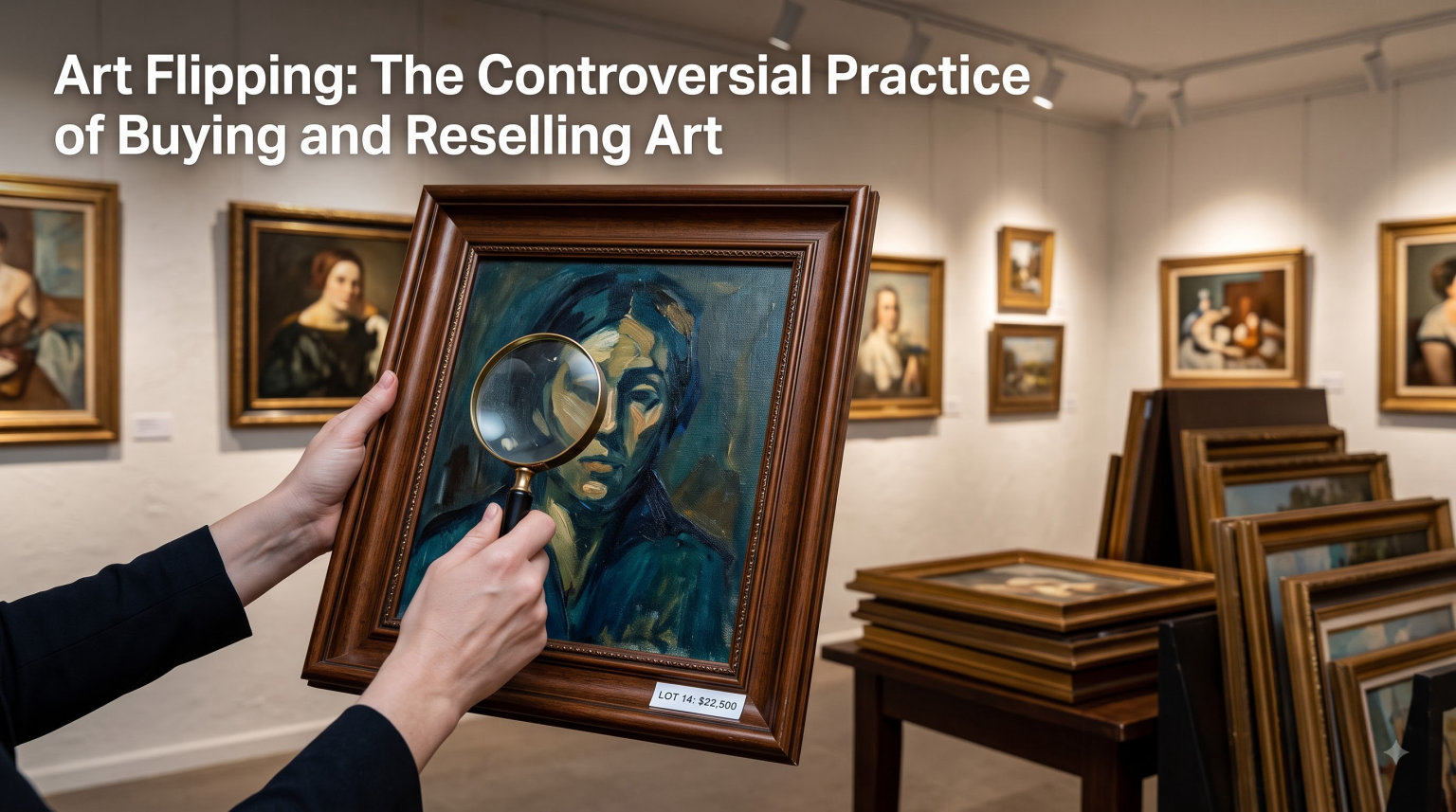
Art flipping is the practice of buying artwork and quickly reselling it for profit, typically targeting under-priced pieces by emerging artists and selling them within 5 to 10 years. In the art world, this practice carries a reputation that makes even seasoned collectors uncomfortable. Understanding what art flipping is, why it sparks such heated debate, and how it impacts everyone from emerging painters to established galleries is essential for anyone navigating the contemporary art market in 2026.
This article explores the mechanics of buying and reselling art, examines the controversy that surrounds it, and offers a balanced view of both sides of this contentious practice. Whether you are a collector, an artist, or simply curious about how the art market works, you will find actionable insights here.
Table of Contents
What Is Art Flipping?
Art flipping refers to the swift purchase and resale of artwork to generate quick profit, usually by acquiring pieces below their perceived market value and selling them as prices appreciate. Unlike traditional collecting, which often involves long-term holding and aesthetic appreciation, flipping treats art as a financial instrument designed for rapid turnover.
The practice operates primarily between two distinct market layers. The primary market encompasses first-time sales directly from artists or through galleries representing them. The secondary market involves all subsequent resales, typically conducted through auction houses, private dealers, or online platforms. Flippers exploit the gap between these markets, buying at primary market prices and selling at inflated secondary market values.
Timing defines whether a sale constitutes flipping. Industry consensus suggests that reselling within 5 to 10 years of purchase crosses into flipping territory, while holding periods exceeding a decade generally qualify as normal collecting behavior. This distinction matters because it separates investment-minded speculators from genuine art patrons.
How Art Flipping Works
The typical flipping workflow follows a predictable pattern. First, the flipper identifies undervalued works, often from emerging artists showing early career momentum. Next, they purchase pieces at gallery prices or below during studio visits. Then they monitor the artist’s market trajectory through auction results and critical coverage. Finally, they consign works to auction houses or sell privately when prices peak, capturing the spread between purchase and sale prices.
Success requires market knowledge, timing, and often, relationships with gallery insiders who tip off collectors about rising stars. The most successful flippers develop an eye for talent before the broader market catches on, allowing them to buy early and sell into rising demand.
Why Art Flipping Is So Controversial
In art circles, “flipping” functions as a dirty word. Art adviser Lisa Schiff did not mince words when she called it “disgusting,” reflecting a widespread sentiment among industry professionals. The controversy stems from multiple ethical, practical, and economic concerns that affect everyone in the art ecosystem.
At its core, the opposition centers on the perception that flippers exploit artists’ creative labor without contributing to their development. Artists receive no compensation from secondary market sales in most jurisdictions, meaning they watch others profit from their work while receiving nothing themselves. This dynamic feels particularly egregious when young artists sell work for modest sums, only to see those same pieces resold for multiples within months.
Gallery relationships also suffer when collectors flip. Galleries invest years developing artists, funding exhibitions, building critical discourse, and cultivating collectors. When buyers treat these relationships as arbitrage opportunities, galleries lose the ability to control market positioning and price development. Many galleries now maintain blacklists of known flippers, refusing to sell to collectors with flipping reputations.
Market distortion represents another major concern. Rapid flipping can create artificial price bubbles that collapse suddenly, damaging artists’ long-term career prospects. When prices spike too quickly, subsequent works fail to sell at comparable levels, leaving collectors underwater and galleries unable to move inventory.
| Pros of Art Flipping | Cons of Art Flipping |
|---|---|
| Provides liquidity to art market | Exploits artists without compensation |
| Validates emerging artist market potential | Damages artist career trajectories |
| Offers investment returns for collectors | Destroys gallery-collector relationships |
| Creates price discovery mechanisms | Generates artificial price bubbles |
| Funds further collecting activity | Undermines long-term market stability |
How Art Flipping Affects Artists
The impact of art flipping varies dramatically depending on where an artist sits in their career trajectory. Emerging artists face disproportionate risks from speculative trading, while established artists often weather flipping activity with minimal disruption.
Impact on Emerging Artists
For young artists just building their market, flipping poses existential career threats. When early works sell for $5,000 and resell for $50,000 within two years, the artist receives none of that appreciation. Worse, the inflated secondary price becomes their new market floor, making subsequent sales difficult when demand normalizes.
Consider the psychological toll. An emerging artist watches their work trading at prices they could never command directly, while collectors who bought low profit enormously. This dynamic breeds resentment and can sour the artist’s relationship with the market itself.
Perhaps most damaging is the career collapse that follows when flipping activity stops. Artists whose markets were driven by speculative buyers often experience catastrophic price corrections when flippers move on to newer targets. Gallery representation may be lost, collectors abandon ship, and the artist struggles to rebuild at sustainable price levels.
Impact on Established Artists
Established artists with mature markets and strong gallery representation typically absorb flipping without significant harm. Their markets have depth from genuine collectors, institutions, and museums rather than speculative capital. When flipping occurs in these markets, it represents a smaller percentage of overall activity.
Established artists also benefit from resale royalty laws in applicable jurisdictions, receiving a percentage of secondary market sales. This compensation, while modest, at least acknowledges their ongoing stake in the work’s value. Emerging artists rarely benefit from these protections, as their markets operate below the thresholds where royalty collection becomes practical.
| Emerging Artists | Established Artists |
|---|---|
| Market driven by speculative buyers | Market supported by genuine collectors |
| No resale royalty protection | May benefit from resale royalty laws |
| Career vulnerable to price collapse | Market can absorb price volatility |
| Psychological impact of seeing work flipped | Flipping represents normal market activity |
| Gallery relationships easily damaged | Gallery representation provides market stability |
Notable Cases: When Art Flipping Made Headlines
Real-world examples illustrate both the profit potential and devastating consequences of art flipping. These case studies reveal how quickly fortunes can change in the speculative art market.
The Lucien Smith Story
Lucien Smith became the poster child for art flipping gone wrong. In 2013, his painting “Two Sides of the Same Coin” sold at Phillips for $94,500, a remarkable price for an artist then just 24 years old. The work had originally sold from the OHWOW gallery for a fraction of that amount months earlier. This 400% return exemplified the profit potential that attracted speculators to Smith’s market.
But the flipper’s paradise proved temporary. As speculators flooded Smith’s market with inventory, prices collapsed. Secondary market works stopped selling at premiums, and Smith’s primary market prices adjusted downward. The artist’s reputation suffered from being labeled a “flipper’s darling,” making serious collectors wary. His market took years to stabilize after the speculative bubble burst.
Anselm Reyle’s Market Collapse
German artist Anselm Reyle experienced an even more dramatic boom-and-bust cycle. His neon-colored found-object sculptures attracted intense flipping activity in the mid-2000s, with works trading hands multiple times annually at ever-increasing prices. At the market peak, his works sold for hundreds of thousands of dollars.
When the flipping stopped, Reyle’s market cratered. Auction results fell 90% from their peaks, with some works failing to sell entirely. The artist faced the difficult task of rebuilding his career after speculators moved on, a cautionary tale about markets built on momentum rather than connoisseurship.
Amoako Boafo and the New Generation
More recently, Ghanaian painter Amoako Boafo’s vibrant portraits attracted intense flipping interest. After his 2019 debut with Roberts Projects in Los Angeles, secondary market prices surged rapidly. Works purchased for $20,000 reportedly resold for $200,000 within months, generating substantial returns for early collectors.
Boafo’s case differs from earlier examples because his gallery and the artist himself have been more proactive about controlling supply and managing the market. This illustrates how emerging strategies might help artists and galleries protect themselves against destructive flipping activity.
Dan Colen’s Rollercoaster
American artist Dan Colen experienced similar dynamics. His “Candle” paintings and other works attracted aggressive speculation in the early 2010s, with prices rising rapidly as collectors bet on his continued ascent. When critical reception cooled and flipping activity declined, Colen’s market corrected substantially, demonstrating the risks of momentum-driven collecting.
The Investment Case: Why Collectors Flip Art
Despite the controversy, art flipping persists because it can generate substantial financial returns. Understanding why collectors engage in this practice requires examining the profit potential and market dynamics that make art attractive as an alternative investment.
Contemporary art has historically delivered strong returns. The Artprice100 index, tracking blue-chip artists, has outperformed the S&P 500 in certain periods. For emerging artists, the upside can be even more dramatic. A collector who purchased Jean-Michel Basquiat’s work in the early 1980s for $1,000 could have sold for millions decades later. While Basquiat represents an extreme example, similar dynamics operate at smaller scales throughout the art market.
Platforms like Masterworks have democratized art investment by offering fractional shares of blue-chip works, making the asset class accessible to smaller investors. This trend reflects broader interest in art as a portfolio diversifier uncorrelated with traditional equity markets.
However, the risks are substantial. Not every artist becomes Basquiat. For every success story, dozens of artists experience market collapses that destroy collector capital. Research from ArtTactic suggests that a majority of flipped works actually lose money when accounting for buyer’s premiums, seller’s commissions, insurance, storage, and other carrying costs.
Forum discussions among experienced art flippers reveal the reality behind the profit stories. One Reddit user noted, “You generally only do well financially with art when you know what you’re doing.” Another emphasized that “it definitely takes a bit of an eye that you develop over time.” The most successful flippers treat it as a skilled profession requiring deep market knowledge, not a casual hobby for quick returns.
Resale Royalty Laws: Do Artists Get Paid?
The question of artist compensation from secondary sales sits at the heart of the flipping debate. In most countries, artists receive nothing when their work resells for profit. This contrasts sharply with music, literature, and other creative fields where royalties provide ongoing income.
The European Union has led efforts to address this imbalance through the Artist’s Resale Right (ARR), implemented in 2006. This directive requires sellers to pay artists a percentage of resale prices when works sell through auction houses or professional galleries above certain thresholds. The royalty ranges from 4% to 0.25% depending on sale price, with caps limiting maximum payments.
The United States notably lacks federal resale royalty legislation. The California Resale Royalties Act, passed in 1976, was the only state-level protection until courts struck down key provisions. Efforts to pass the American Royalties Too (ART) Act have stalled repeatedly in Congress, leaving American artists without legal protection.
Implementation challenges plague even countries with resale royalty laws. Collection agencies must track thousands of transactions across multiple jurisdictions, and smaller sales often fall below reporting thresholds. Emerging artists, who most need protection from flipping, frequently benefit least because their works sell below minimum royalty thresholds.
| Country/Region | Resale Royalty Status | Royalty Rate | Threshold |
|---|---|---|---|
| European Union | Mandatory | 4% – 0.25% | €1,000 – €3,000 |
| United Kingdom | Mandatory | 4% – 0.25% | €1,000 |
| France | Mandatory | Up to 4% | €1,000 |
| United States | No federal law | N/A | N/A |
| California | Limited (court restricted) | 5% | $1,000 |
| Australia | Mandatory | 5% | $1,000 AUD |
| Canada | No federal law | N/A | N/A |
How to Ethically Resell Art
For collectors who need or want to sell works from their collection, ethical approaches exist that minimize harm to artists and galleries while respecting market dynamics. These guidelines help navigate the complex territory between legitimate collecting and exploitative flipping.
Transparency forms the foundation of ethical reselling. Sellers should document provenance accurately, disclose any condition issues, and represent the work’s history honestly. This protects both the seller’s reputation and the buyer’s investment.
Maintaining gallery relationships requires communication. If you purchased work through a gallery and plan to resell, contacting them first often yields the best results. Galleries may have waiting lists for sought-after artists and can facilitate private sales that benefit all parties. This approach also preserves your standing for future purchases.
Timing matters ethically as much as financially. Holding periods exceeding 10 years generally distinguish legitimate collecting from flipping. Even if market conditions suggest earlier sale, the artist benefits from seeing their work held by committed collectors rather than treated as liquid assets.
Supporting artist compensation, where possible, demonstrates good faith. Some collectors voluntarily share proceeds with artists even absent legal requirements. Others structure sales to benefit artist-endowed foundations or donate portions to arts organizations. While not universal practice, these gestures acknowledge the creative labor underlying the work’s value.
Finally, buying from reputable sources reduces downstream ethical complications. Works with clear provenance, solid exhibition history, and legitimate gallery representation present fewer problems than works from questionable sources. The savings from buying dubious works rarely justify the risks.
Frequently Asked Questions
Can you buy art and resell it?
Yes, you can legally buy art and resell it. Art ownership includes the right to sell, trade, or transfer works. However, ethical considerations apply, particularly regarding timing and artist compensation. Reselling quickly for profit (flipping) is controversial in the art world, while long-term collecting followed by eventual resale is generally accepted practice.
Why is flipping art so controversial?
Art flipping is controversial because it treats creative work purely as financial instruments, often without compensating the artist. It can damage emerging artists’ careers by creating unsustainable price bubbles that collapse when speculators move on. Galleries also oppose flipping because it undermines their ability to develop artists’ markets carefully and can destroy relationships with serious collectors.
What is the 70 30 rule in art?
The 70-30 rule in art refers to gallery commission splits, where galleries typically retain 30% of sales proceeds while artists receive 70%. This applies to primary market sales. Some variations exist, with more established artists negotiating better terms while emerging artists might accept 60-40 or 50-50 splits until their markets develop.
What is the 80 20 rule in art?
The 80-20 rule in art collecting suggests that 80% of your collection’s value will likely come from 20% of the works you acquire. This principle, borrowed from economics, encourages collectors to focus on acquiring fewer, higher-quality pieces rather than amassing large quantities of mediocre work. It also applies to art market dynamics, where 20% of artists typically generate 80% of market value.
Is thrift flipping unethical?
Thrift flipping (buying secondhand goods from thrift stores and reselling for profit) raises different ethical questions than art flipping. Most thrift items are donated mass-produced goods, not unique creative works. The main concerns involve accessibility for low-income shoppers and whether resellers exploit pricing inefficiencies that thrift stores use to fund charitable missions. Unlike art flipping, thrift flipping does not involve compensating original creators.
Conclusion
Art flipping represents one of the most contentious practices in the contemporary art market. Buying and reselling art for quick profit generates significant returns for successful practitioners while potentially devastating the emerging artists whose work fuels the speculation. The controversy reflects deeper tensions between art as cultural expression and art as financial asset.
The examples of Lucien Smith, Anselm Reyle, and others demonstrate both the profit potential and catastrophic risks involved. Markets driven by speculation rather than connoisseurship prove fragile, collapsing when momentum shifts. Artists, galleries, and even collectors suffer when flipping distorts natural market development.
Yet completely eliminating secondary market activity would also harm the art ecosystem. Resales provide liquidity, validate market interest, and enable collectors to evolve their collections. The challenge lies in distinguishing legitimate collecting from exploitative flipping, and creating structures that compensate artists for their ongoing contribution to work values.
For collectors in 2026, the path forward requires balancing financial interests with ethical responsibilities. Long holding periods, transparent dealings, gallery relationship maintenance, and support for resale royalty legislation all contribute to a healthier art market. The question is not whether art can be resold, but how it can be resold responsibly.