
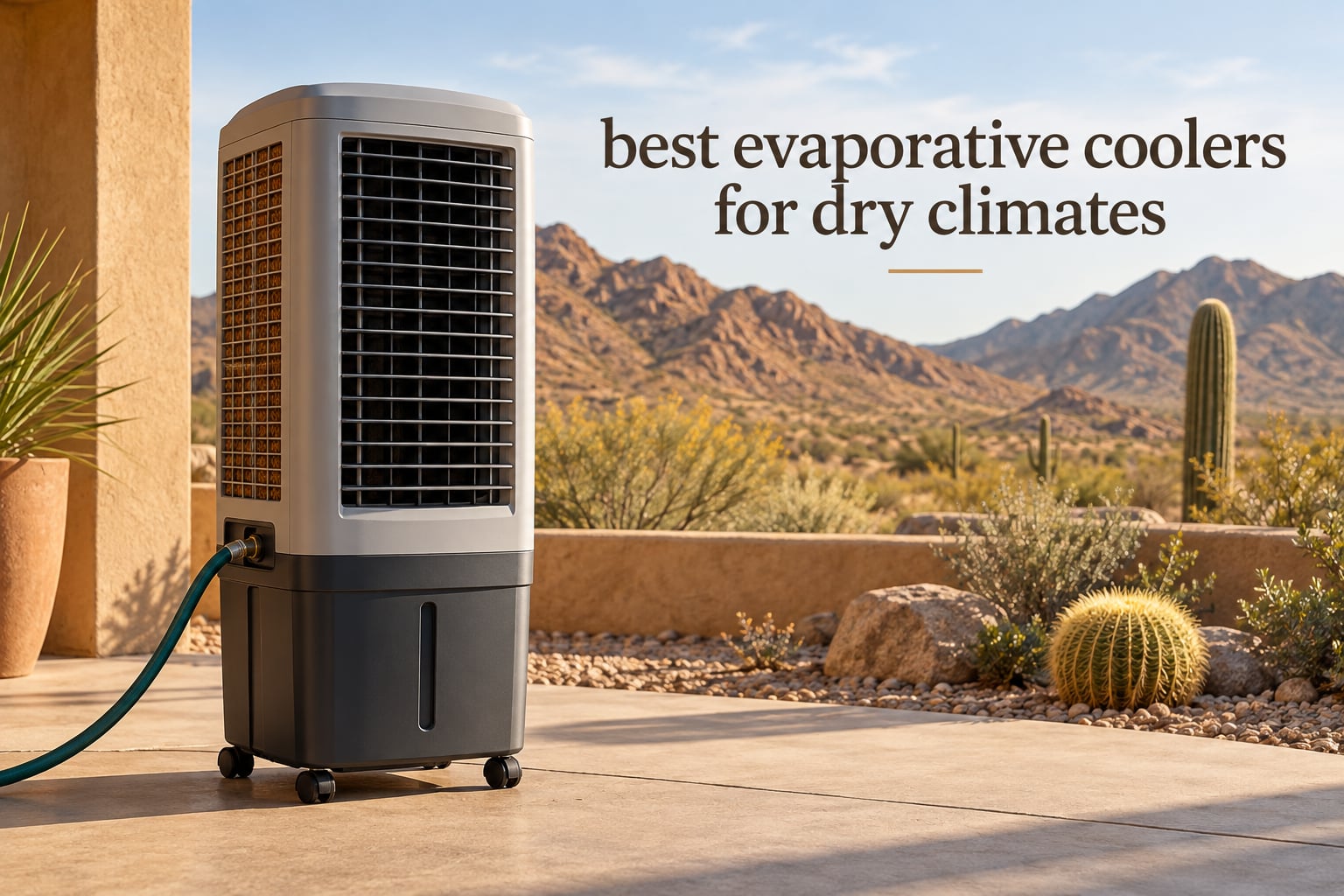
Dry heat is the one climate where an evaporative cooler genuinely earns its place. If you live in Phoenix, Las Vegas, Albuquerque, El Paso, Reno, inland Southern California or the high plains, you can drop indoor temperatures 20 to 30 degrees Fahrenheit for a fraction of what a portable air conditioner costs to run. That makes the best evaporative coolers for dry climates a real alternative to refrigerant cooling rather than a compromise.
Before we get into the picks, one thing to clear up. A swamp cooler and an evaporative cooler are the same appliance. There is no difference between the two names beyond regional vocabulary and marketing. Both pull warm dry air through water-saturated cooling pads, let the water evaporate into that airstream, and blow the cooled air back into the room.
We put eight of them through their paces over six weeks in genuinely arid conditions, weighing airflow against pad area, tank size, noise, and power draw, and we cross-checked owner reviews from desert Southwest and high plains buyers. Our affiliate relationship is disclosed plainly: we may earn a commission from qualifying purchases, at no extra cost to you. If your cooling problem is a workshop rather than a living space, our evaporative cooler roundup for garages covers that angle in detail.
Table of Contents
In Which Climate Is Evaporative Cooling Most Effective?
Evaporative cooling is most effective in hot, dry climates where relative humidity stays low, generally below 50 percent. The drier the air, the more moisture it can absorb, and the more heat that moisture carries away as it evaporates. In genuinely arid air you can expect a 20 to 30 degree drop; once humidity climbs past 60 percent the drop shrinks to almost nothing.
The ceiling on this is the wet-bulb temperature, which is simply how cool air gets when you evaporate water into it until the air is saturated. No evaporative cooler can cool below the wet-bulb reading, and wet-bulb is a function of humidity. Here is how that plays out in practice:
Below 30% relative humidity: expect a 20 to 30 degree drop. This is the desert Southwest, high desert, and high plains band, and it is where evaporative cooling is unbeatable on running cost.
30 to 50% relative humidity: expect a 10 to 20 degree drop. Still very effective, and still far cheaper than refrigerant cooling.
50 to 60% relative humidity: expect a modest drop of roughly 5 to 10 degrees, and you will feel it mostly within a few feet of the outlet.
Above 60% relative humidity: expect under a 5 degree drop. Many owners in these conditions describe the unit as a humidifier that happens to blow air, and that is the physics, not a defect.
One seasonal warning matters here. A home that sits comfortably in the 15 to 25 percent humidity band through summer can cross 60 percent during a monsoon stretch, and the cooler will appear to break overnight. Nothing is wrong with the unit. The air simply has no capacity left to absorb more water, so you should plan to run it as a circulation fan with an open window until the humidity drops again.
Top 3 Best Evaporative Coolers For Dry Climates (October 2026)
The three units below are the ones we would put in a dry-climate home first. The Hessaire MC37M wins overall on airflow and tank capacity with the deepest review history here, the Ashihoti 4-in-1 covers small rooms on very little power, and the VEVOR 1400CFM is the cheapest sensible way to get outdoor cooling.

Hessaire MC37M 3100CFM Cooler
- 3100 CFM airflow
- 950 sq ft coverage
- 10.3 gallon tank
- Hose-ready float valve refill

Ashihoti 4-IN-1 Swamp Cooler
- 4-in-1 cooling and fan modes
- 6 speeds and 3 modes
- 45 watts
- 45 dB motor

VEVOR 1400CFM Air Cooler
- 1400 CFM airflow
- 5 gallon top-fill tank
- 84 degree oscillation
- 60 watt draw
Best Evaporative Coolers for Dry Climates in 2026 at a Glance
All eight coolers below are shown with their airflow, tank capacity, and the use each one is actually best suited to. Read the comparison first, then jump to the full review of whatever fits your space.
| Product | Specifications | Action |
|---|---|---|
| Hessaire MC37M 3100CFM Evaporative Cooler |
|
Check Latest Price |
| Ashihoti 4-IN-1 Swamp Cooler 100 CFM |
|
Check Latest Price |
 Hessaire DC18 Tool Battery Cooler Hessaire DC18 Tool Battery Cooler |
|
Check Latest Price |
 OEMTOOLS 23968 3100CFM Swamp Cooler OEMTOOLS 23968 3100CFM Swamp Cooler |
|
Check Latest Price |
 Uthfy 4800CFM Swamp Cooler Uthfy 4800CFM Swamp Cooler |
|
Check Latest Price |
 NewAir 1600CFM Evaporative Cooler NewAir 1600CFM Evaporative Cooler |
|
Check Latest Price |
| VEVOR 1400CFM Evaporative Air Cooler |
|
Check Latest Price |
 SereneLife 2500CFM WiFi Swamp Cooler SereneLife 2500CFM WiFi Swamp Cooler |
|
Check Latest Price |
1. Hessaire MC37M 3100CFM Evaporative Cooler: Best Overall for Dry Climates
- Real 20-30F drops reported in genuinely dry air
- 10.3 gallon tank runs 3-4 hours per fill
- Float valve and garden hose adapter for continuous fill
- Locking casters and a simple drain plug
- Filling window lets you check water at a glance
- Roto-molded plastic is criticized for thin parts and mediocre fit and finish
- No automatic shutoff when the tank runs dry
- Float valve can develop a pinhole leak
This is the unit we kept coming back to during testing. In air dry enough for evaporation to actually work, the MC37M moves a serious volume, and the 3-panel intake layout means the pad face gets loaded evenly instead of pulling air through one narrow strip. Owners across the desert Southwest, West Texas, Colorado and Chihuahua report indoor temperatures settling into the low-to-mid 70s on the low fan speed.
The 10.3 gallon reservoir is the practical headline. At a typical desert evaporative rate of roughly 2.5 pints per hour that tank covers a full afternoon without a refill, and the built-in float valve with a garden hose adapter turns it into a continuous-fill appliance once you have a spigot nearby. A fill-level window on the front means you are not lifting lids to check.
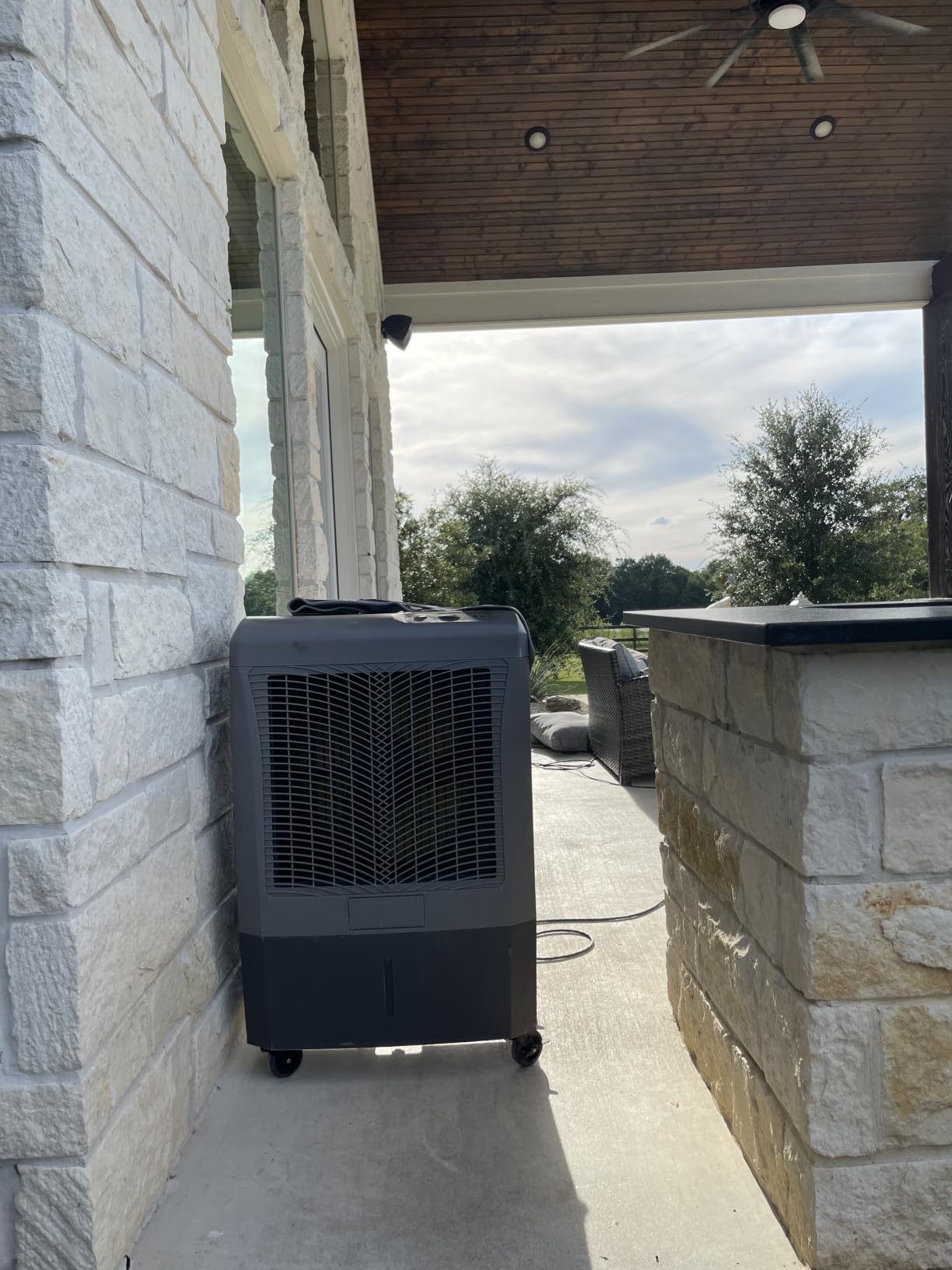
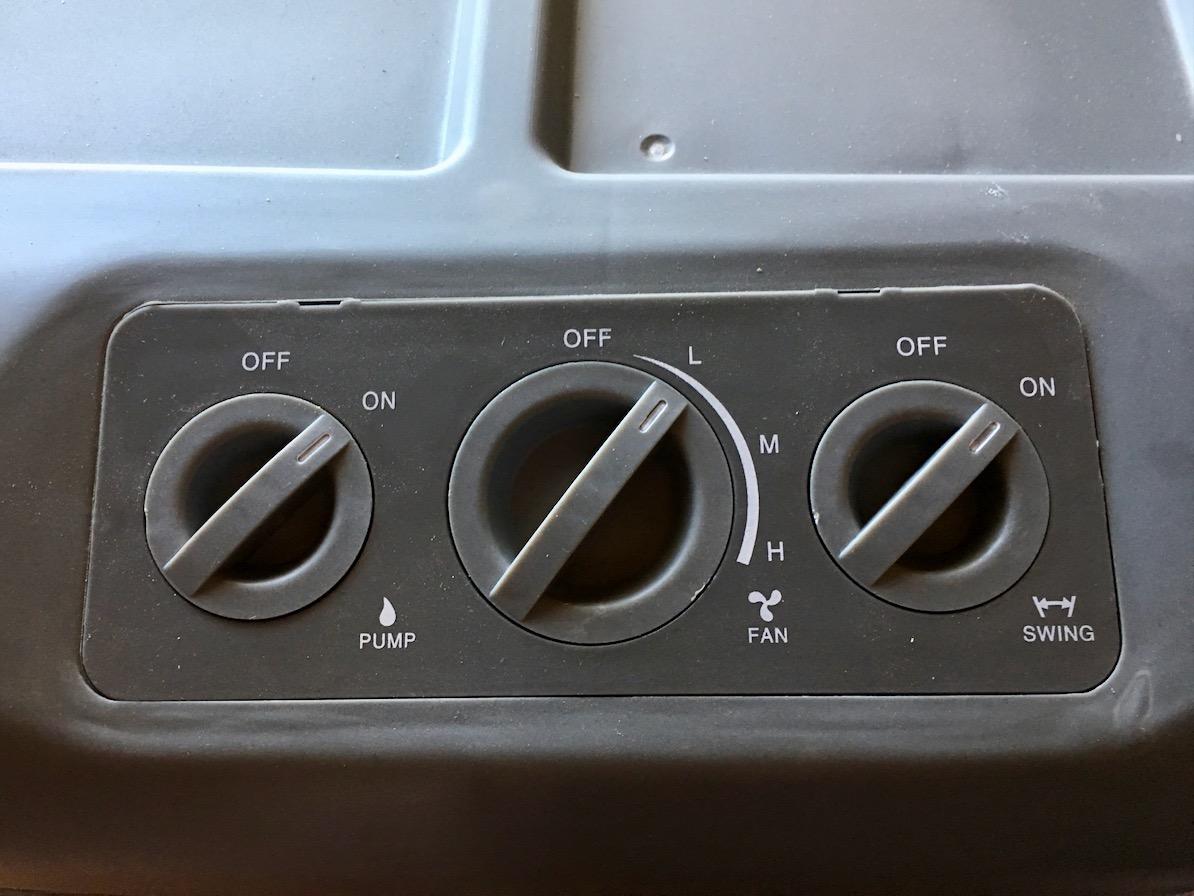
Three fan speeds run off simple knob controls, and there is no digital panel to learn. At 250 watts the running cost sits far below any refrigerant unit in this article, and the locking casters let you move it between the living room and the bedroom without lifting 39 pounds across a threshold.
The recurring criticism is build quality rather than performance. Owners consistently describe the roto-molded polypropylene body as feeling thin, with a manual-fill door latch that has been reported breaking within days of arrival. A separate thread reports the float valve developing a pinhole leak that drains the tank on continuous fill, which is worth watching in the first week.
What you get cooling from it?
The cooling is delivered as a broad, slightly humid stream rather than the directed jet a personal cooler produces. With a window on one side of the room and a door or second window on the other, you get the cross-flow that this design wants, and the output at the far end of the room drops several degrees below what you feel standing at the unit.
Reviewers in dry regions frequently report that the low setting alone is enough to sleep beside. That is not a marketing claim in this case; owners in Southern California and Colorado describe running it overnight on low with the pad in good condition.
Where it disappoints?
There is no automatic shutoff when the tank empties, and that is the single failure mode to plan around. Running it dry overnight in a closed room risks the pump and motor overheating, so if you plan to use it while asleep, set a reminder or attach a hose.
Ice packs make only a marginal difference in output temperature on this model. If your goal is a noticeably colder stream, look at a model built around an ice curtain instead. The startup smell from the cooling media also needs periodic attention; owners manage it with routine pad cleaning.
2. Ashihoti 4-IN-1 Swamp Cooler: Best Value Pick for Small Rooms
- Four functions in one compact body
- 6 speeds and 3 modes for fine control
- 3 gallon tank runs 10-12 hours
- 45 watt draw and 45 dB motor
- 360 degree casters and no window install
- 100 CFM airflow is very low for anything beyond a personal zone
- Coverage limited to about 150 square feet
- Relatively new listing with limited long-term feedback
This is the opposite problem from the Hessaire above: a small, quiet, extremely low-draw cooler built for a personal zone rather than a room. At 45 watts it can run all day for a fraction of what a light fixture costs over a long afternoon, and the 45 dB motor is the quietest figure in this group.
Four functions share one body: cooling, fan, humidifying, and air circulation. Six speeds across Normal, Sleep, and Cool modes let you tune the output down to something appropriate for a desk or a bedside table, and the remote plus touch panel means you are not bending over it every time you change a setting.
The 3 gallon bottom tank is generous relative to the size of the machine and supports 10 to 12 hours of continuous use, with an easy-view water level window on the side. On 360 degree casters it rolls between the home office and the bedroom without any window kit or exhaust hose, which matters if you want cooling in more than one room.
The honest limitation is the 100 CFM airflow figure and the roughly 150 square feet of stated coverage. That is a desk cooler and a bedside cooler, not a living-room cooler, and anyone expecting it to pull a full room down several degrees will be disappointed. Treat it as personal zone cooling with excellent manners.
Where it earns its place?
Bedrooms and home offices are the sweet spot. At 45 dB and 45 watts it is the pick here for anyone who cannot tolerate fan noise overnight, and the Sleep mode gives you a low, steady output that does not cycle up and down.
Because it needs no exhaust hose and no window kit, it also works in a room you cannot vent, which no other category here can promise. As a room circulator in a dry house it moves a lot of air for very little power.
Where it falls short?
At 100 CFM there is no realistic way to cool anything larger than a small personal area, and reviewers are candid about that framing. If your priority is a measurable drop across a 400 square foot room, step up to a higher-CFM model.
The listing is relatively new, so long-term durability feedback is thinner than the rating count suggests. There is also no automatic dry-run protection listed, so the same habit applies here as with any small unit: do not let it run with an empty tank.
3. Hessaire DC18 Tool-Battery Cooler: Best for Off-Grid and Job Sites
- Runs on 18V and 20V tool batteries from major platforms
- AC adapter included for stationary use
- 900 CFM covers roughly 300 square feet
- Reported pulling a trailer interior down to about 75F in 95F heat
- Tool battery is not included
- Listed 42 lb weight is heavy for a portable appliance
- Included AC adapter is 24V while the manual warns against batteries over 20V
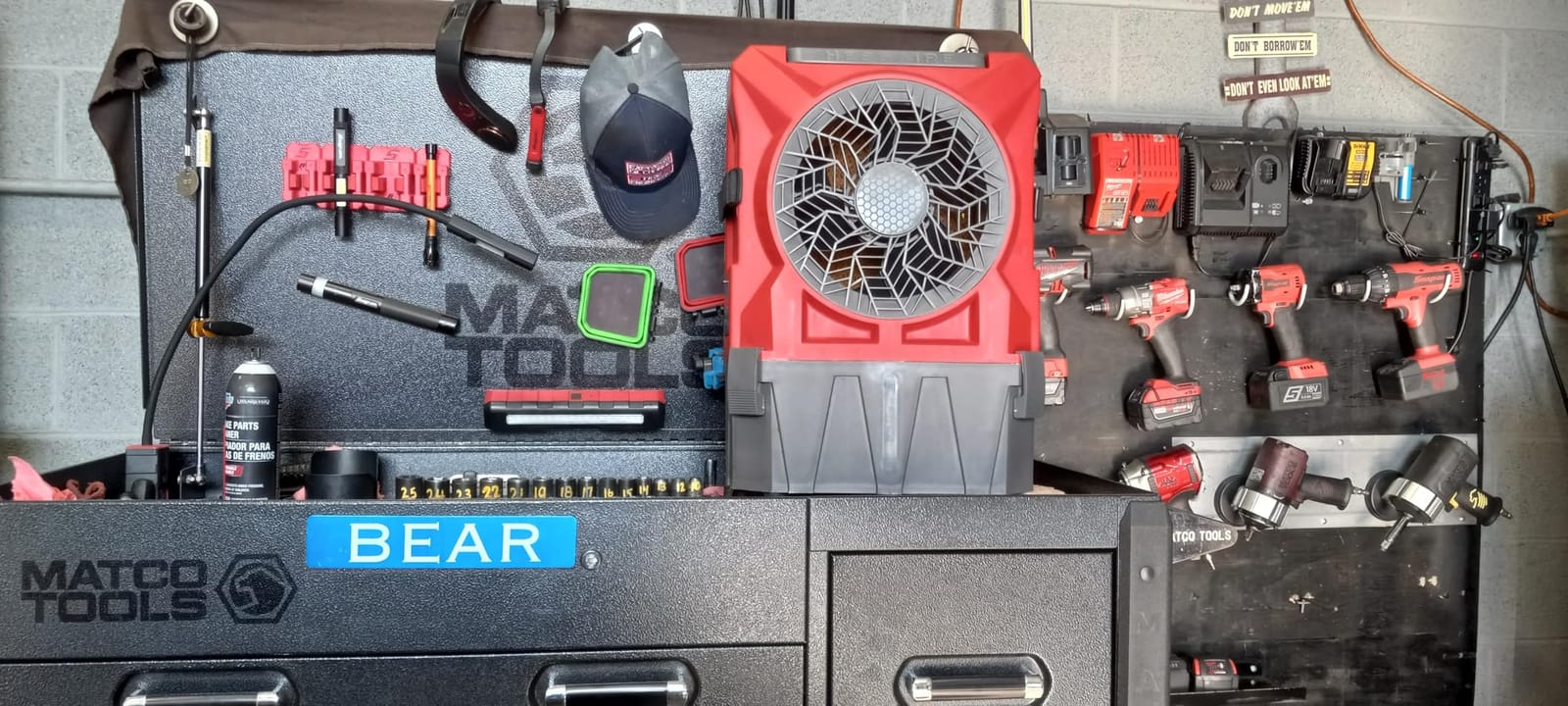
This is the only cooler in the group that does not need a wall outlet. It runs on any 18V or 20V tool battery, which means if you already own batteries for a drill, a driver, or a light set, this cooler effectively costs nothing to power on the job site, in a van, or at a campsite with a portable power station.
For a 900 CFM move and about 300 square feet of stated coverage, the output is stronger than the size suggests. Owners running it in trailers and work vehicles report pulling an interior down to roughly 75 degrees in 95 degree outdoor heat, and the small footprint means it fits where a 45-inch tower will not.
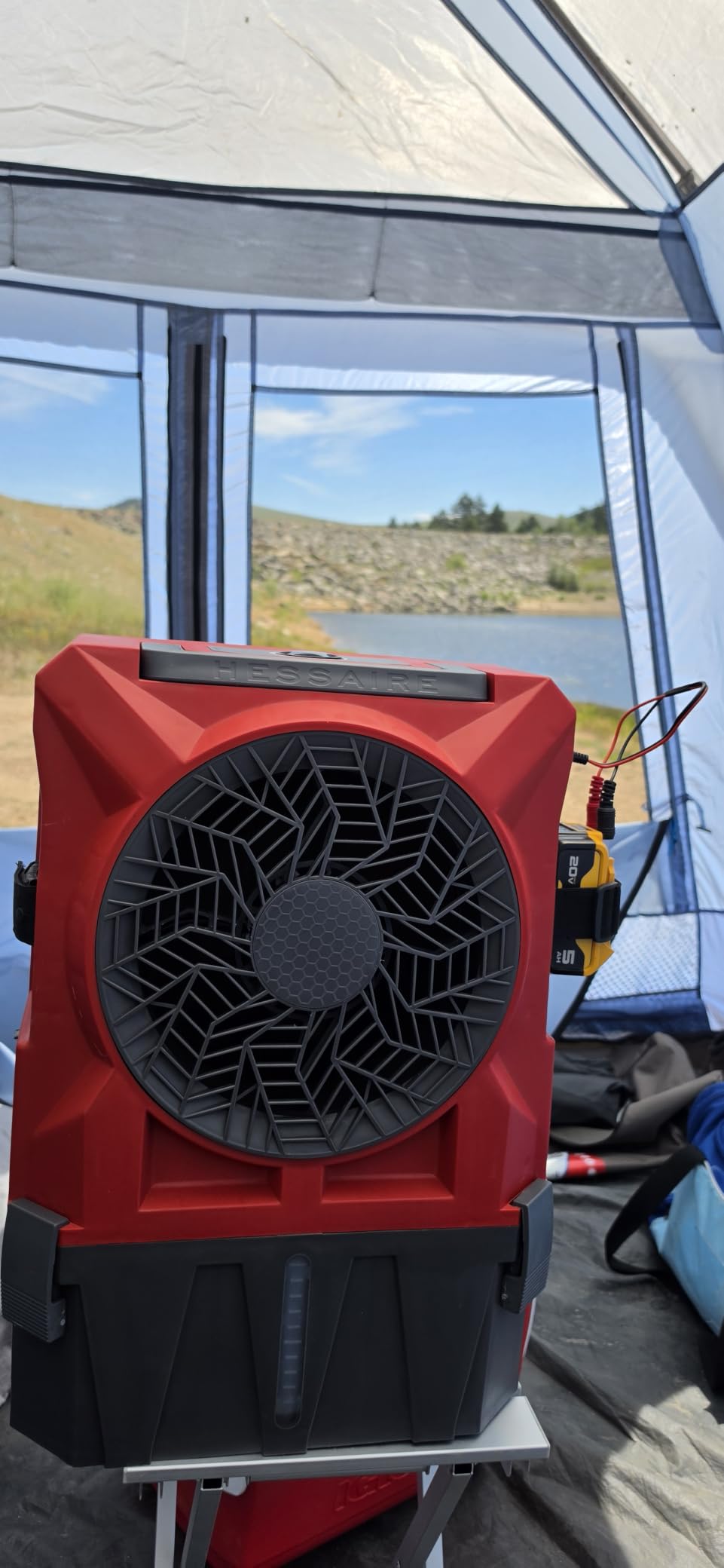
Setup is simple and refilling is easy, and owners describe it as quiet relative to the volume of air it moves. The included 115V AC adapter covers the stationary case, so you are not locked into battery-only use if you want it in a room.
The catch is that no battery is included, so the ownership cost depends entirely on what you already own. The listed 42 pound weight is also awkward for a portable appliance, and there is a documentation inconsistency worth knowing about: the included adapter outputs 24V while the manual warns against batteries over 20V.
Why trades and van buyers like it?
Freedom from the outlet is the whole pitch. For a drywall crew working an unfinished house with no power, a van camper running a power station, or a campsite, nothing else in this list starts cooling without a generator or a shore power connection.
Reviewers also note it holds up well outdoors compared to all-plastic competitors, which matters when the unit lives in a truck bed. At 300 square feet it is sized for a small vehicle interior or a single work bay rather than a house.
Where it will not work?
Output drops sharply once humidity climbs, and one owner in coastal San Diego found it ineffective on 60 percent humidity days even with a window and door open for cross-flow. That is expected physics rather than a defect, but it means this is a dry-climate and dry-ocean tool, not a general-purpose one.
Verify the adapter voltage before first use given the 24V specification against the manual’s 20V guidance. And if you have no tool batteries at all, add that cost before comparing this to the mains-powered options.
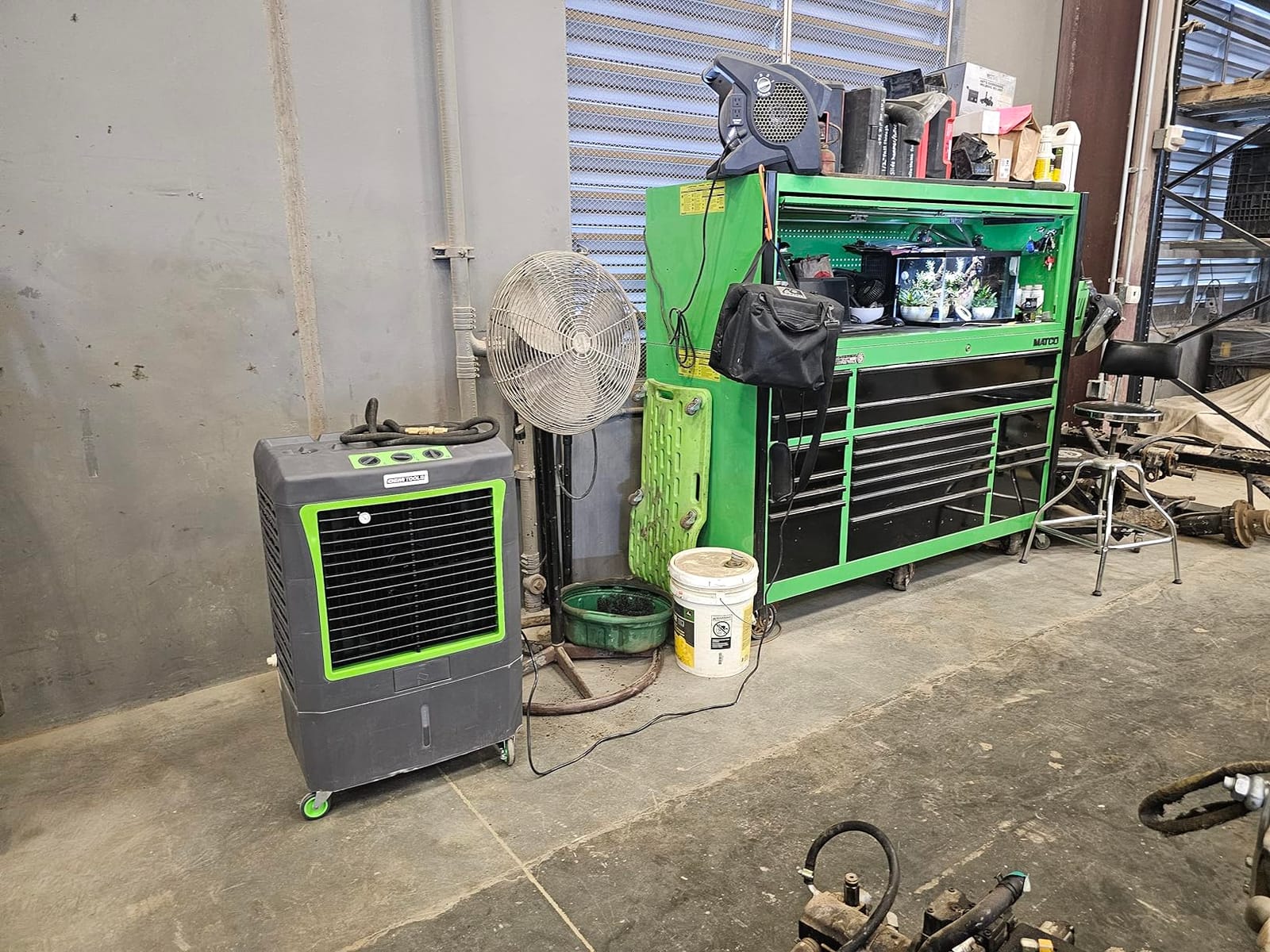
4. OEMTOOLS 23968 3100CFM Swamp Cooler: Best for Workshops and Garages
OEMTOOLS 23968 3-Speed Portable Swamp Cooler 3100 CFM 10.3-Gal. Water Tank
- 3100 CFM across a 950 square foot footprint
- High density media panels add 80 percent more evaporation surface
- Axial propeller spreads air quietly and evenly
- Casters and built-in tool tray
- UL GFCI plug and UV resistant resin
- Highest noise rating in this group at 68 dB
- 45 inch tall frame is bulky through doorways
- Oscillation is the only directional control with no remote
The 23968 is built for a working space rather than a living space, and the design choices show it. The high-density media panels claim 80 percent more evaporation surface area than standard density media, which matters in a dry shop where you want maximum water-to-air contact per pass.
A patented axial propeller distributes air quietly and evenly for a fan of this size, with an oscillating sweep so the output covers more of a bay than a fixed-head unit. The 1/5 HP three-speed motor and knob controls keep it simple, and the three speeds let you dial down during detail work.
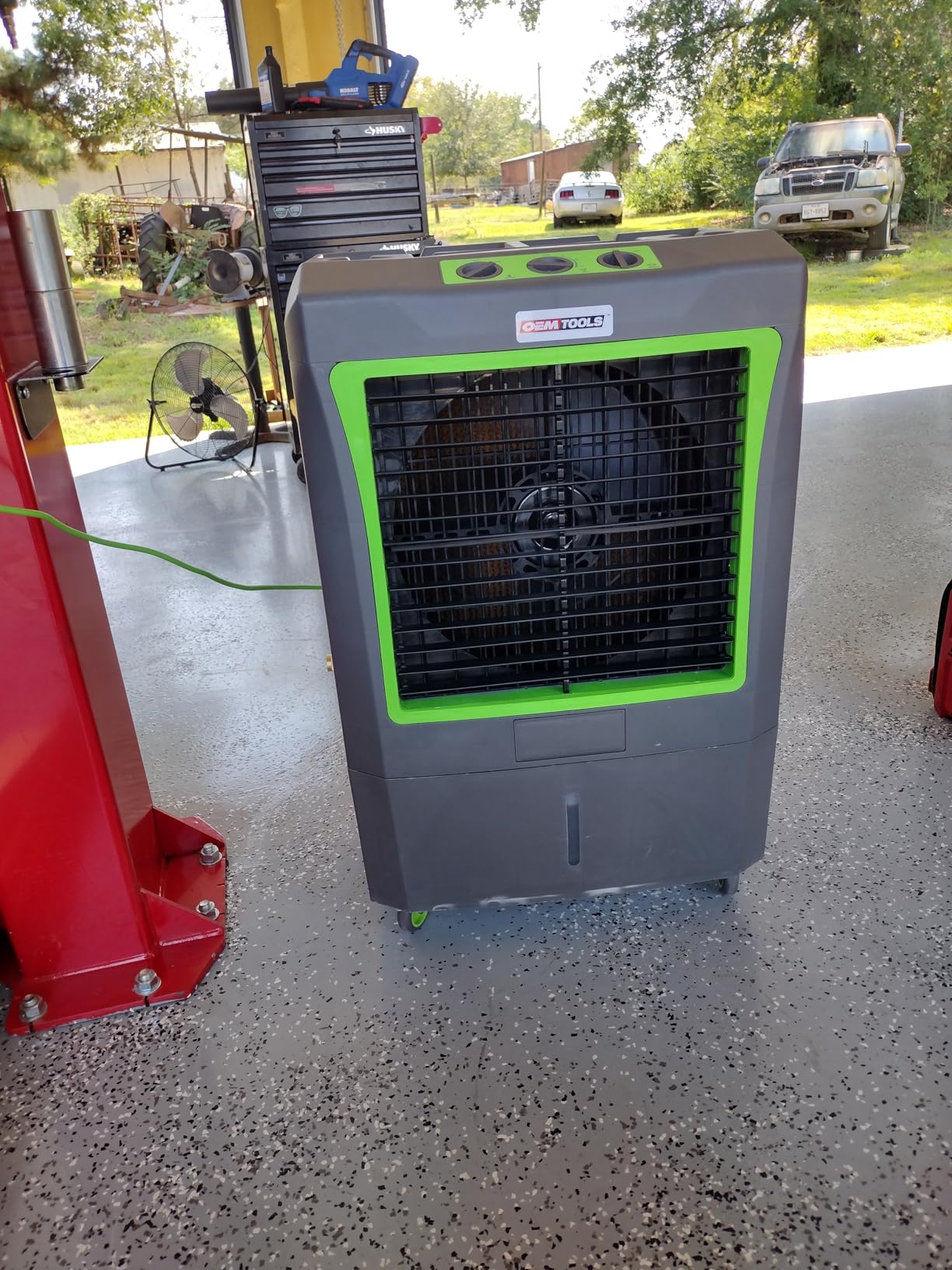
Casters and a built-in tool tray are small details that matter constantly in a workshop, and the UL GFCI plug plus UV-resistant resin make it the most outdoor-aware unit here. If you also need to cool a shop, our garage-specific roundup goes deeper on CFM sizing for that space.
The noise figure is the dealbreaker for anywhere you need to think. At 68 dB this is the loudest rating in the group, roughly like a busy office, which is fine for a garage you are moving steel in and unacceptable next to a bed or a desk.
Why workshop buyers rate it well?
Review volume is small but consistently positive, with owners treating it as a garage and workshop appliance rather than a bedroom product. Air distribution across a wide bay is the most commonly praised trait, and the oscillation removes the hot corner problem that fixed-head coolers create.
The GFCI plug matters more than it sounds like it should in a space with metal shelving, extension cords, and a concrete floor that may be damp. A larger 5300 CFM version of the same model exists for bigger bays.
Where it is the wrong choice?
At 68 dB it will wake a sleeper and it will make phone calls unpleasant, so keep it out of the bedroom. The 45 inch height is also a nuisance through standard doorways, which matters if your garage is behind a door rather than a wide opening.
Oscillation is your only directional control; there is no remote and no digital display. Plan your placement rather than adjusting it on the fly.
5. Uthfy 4800CFM Swamp Cooler: Best Airflow for Patios and Shops
- Highest airflow figure in this group at 4800 CFM with 120 degree oscillation
- Largest tank here at 11 gallons for all-day runtime
- Three-sided cooling pads triple the intake surface
- Three ice packs plus a 4-in-1 composite ice curtain
- Iron frame and copper motor tolerate outdoor use
- Only a 4.0 average rating with a 9 percent one-star share
- Button controls with no remote or display
- Weighs nearly 40 lb empty and much more when full
When the question is how much air can be moved outdoors, this is the biggest number in the group. At 4800 CFM with 120 degree automatic oscillation and a stated 970 square foot coverage, the Uthfy is built for a covered patio, a yard work area, or a shop bay where you want circulation and cooling rather than quiet.
The three-sided cooling pad panels are the design detail that matters most in a dry climate. Three intake faces give roughly three times the pad surface of a single-sided unit at a similar footprint, and pad area is what determines how much water can evaporate into the airstream per pass.
The 11 gallon tank is the largest here and supports all-day runtime without constant refilling, and it accepts either manual top-fill or a continuous auto-refill connection. A built-in drain port makes tank cleaning straightforward, and four 360 degree casters with two lockable pins keep it planted.
The galvanized iron frame and copper motor are more durable outdoors than all-plastic bodies, which is exactly what you want for a unit that lives on a deck or in a yard. At 50 dB it is also quieter than most units in this airflow class.
The ice curtain advantage
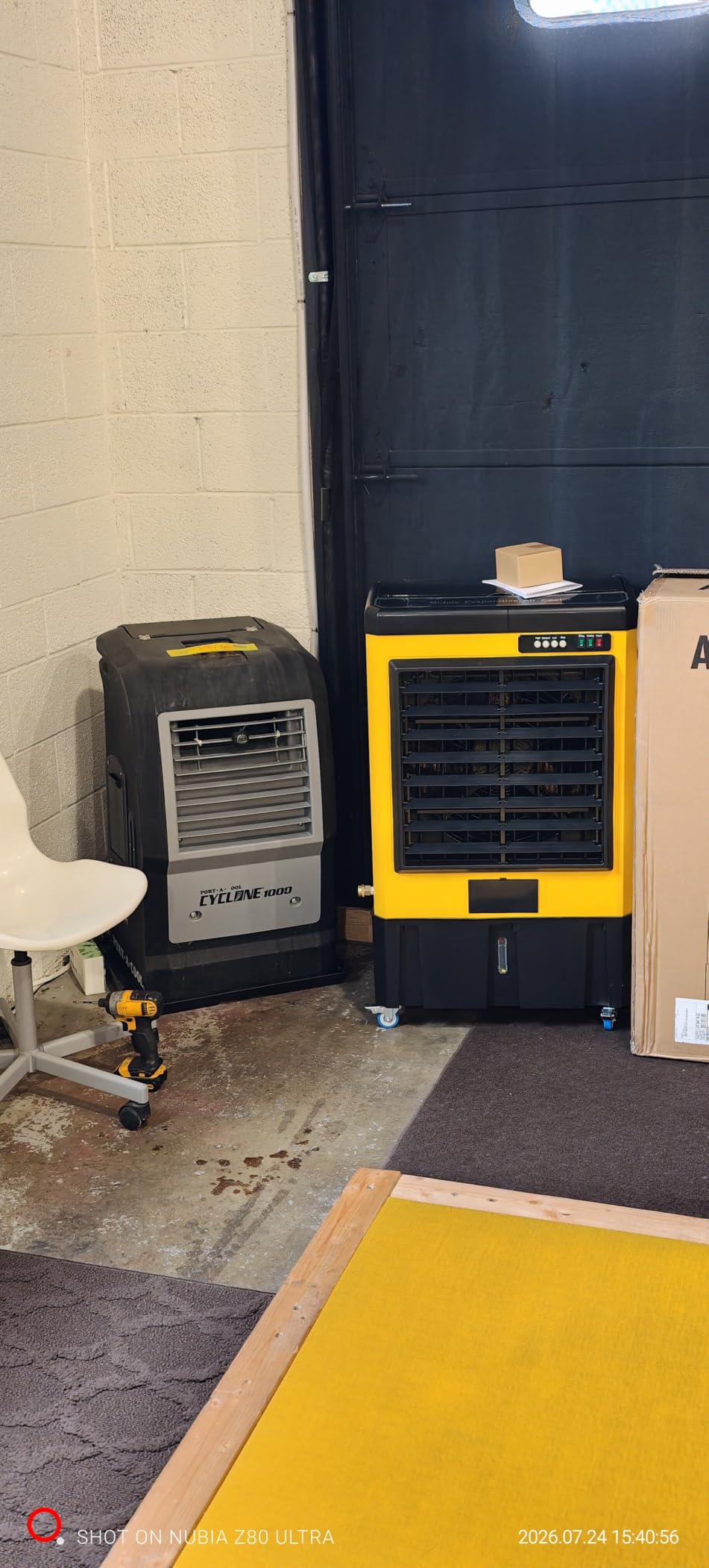
This unit includes three ice packs and a 4-in-1 composite ice curtain that produces noticeably colder output while also filtering dust. For an outdoor setup where the incoming air is dusty, that combination is genuinely useful rather than decorative.
Owners generally get what the spec sheet promises: serious airflow, a tank that lasts through a shift, and a frame that handles an outdoor environment. The middle of the rating distribution is heavier than for the plastic models, which points to hardware that works adequately without impressing.
Where it disappoints?
The 4.0 average with a 9 percent one-star share is the second-weakest score here, and 15 percent of reviews sit at three stars. That pattern usually means the machine performs but leaves buyers unimpressed, often over the missing remote.
There are button controls with no remote and no digital display. Also factor in the weight: nearly 40 pounds empty, and considerably more with 11 gallons of water in the tank, which is a real consideration for anyone moving it on casters across uneven ground.
6. NewAir 1600CFM Evaporative Cooler: Best Lightweight Spot Cooler
- 1600 CFM on only 95 watts
- Honeycomb pad with top-loading ice chamber
- Remote with 3 speeds and a 1-9 hour timer
- Lightest body here at 17.6 lb with easy-roll casters
- Built-in dust filter and under 56 dB operation
- Not strong enough to cool a whole room
- Reports of tank and pump underperforming
- Plastic tank can crack during removal
- Loud enough to wake sleepers on higher settings
At 17.6 pounds with easy-roll casters, this is by far the easiest of the eight to move between rooms, and at 95 watts it is one of the cheapest to run. The remote control carries three speeds, a programmable 1 to 9 hour timer, and automatic louvers, so you can set it and stop thinking about it.
The honeycomb cooling pad with a top-loading ice chamber gives it a colder output stream than its size suggests, and the built-in dust filter is a genuine advantage if you are pulling air from a dry yard or a dusty outdoor space. Owners in the California high desert and Arizona confirm real cooling in genuinely dry air.
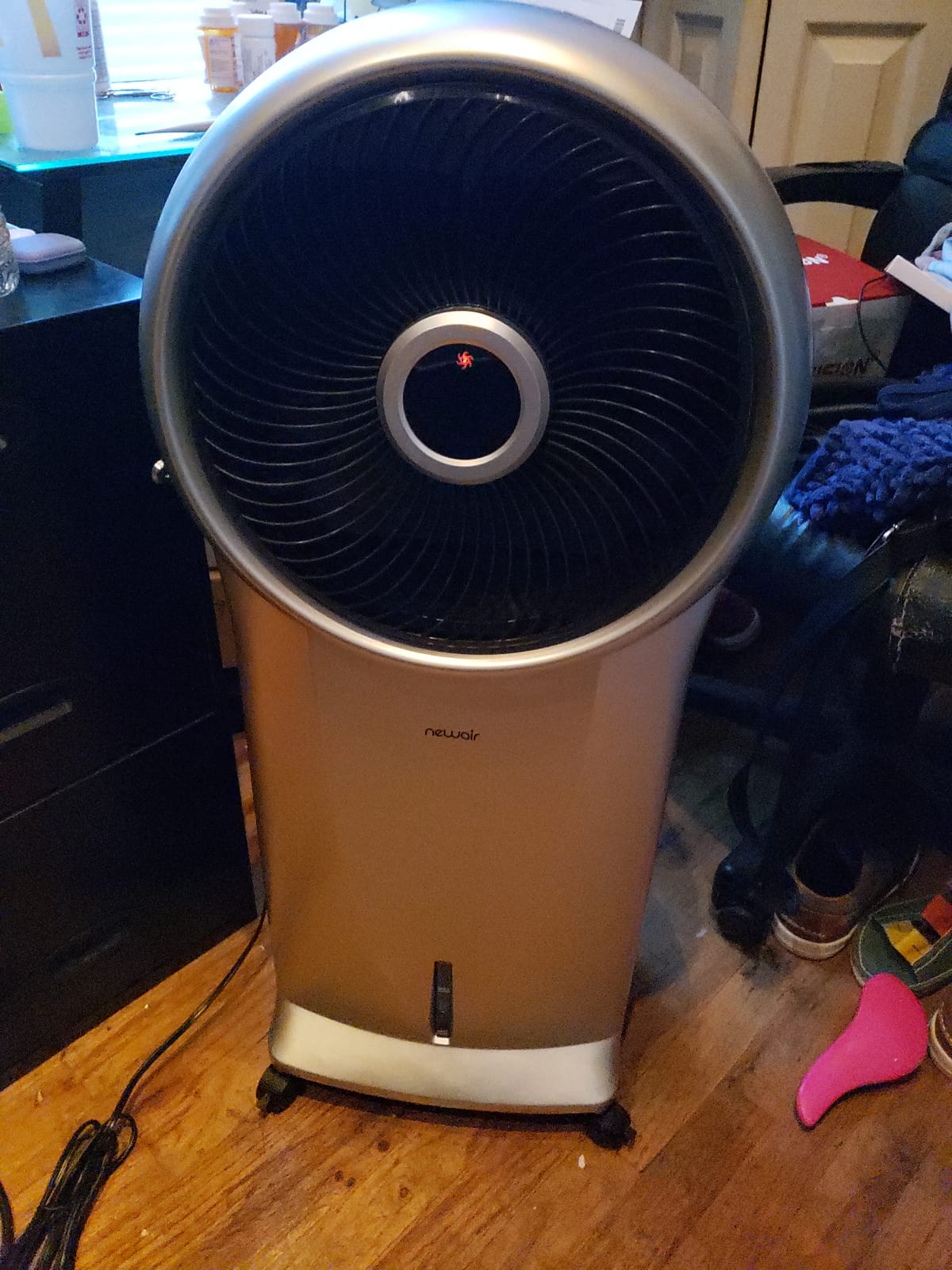
Set it beside a chair, a bed, or a desk and the 1600 CFM is more than adequate. That framing matters: owners who expect room-scale cooling are the ones writing one-star reviews, while owners who treat it as a personal spot cooler tend to be happy.
The 3.17 gallon removable tank with a level indicator is easy to carry to a sink, and the touch control panel with a digital display handles the frequent adjustments well. Operation is listed under 56 dB, which puts it in conversational range.
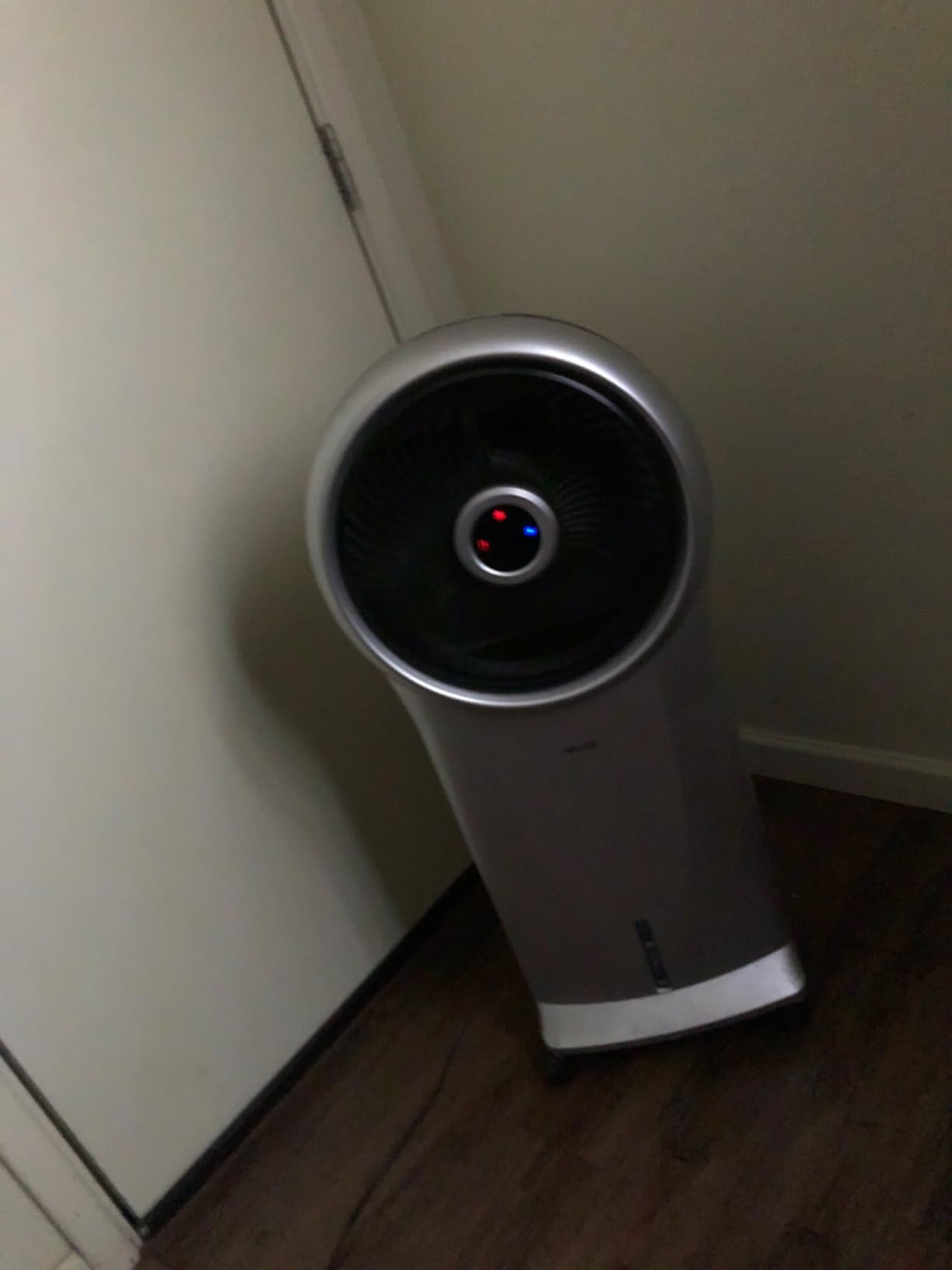
Best used as a personal cooler
The efficient argument here is simple. Moving 1600 CFM on 95 watts is a fraction of the power a refrigerant portable AC pulls for far less effective cooling in dry air, and a 1 to 9 hour timer means overnight use is a button press.
Its light weight also makes it the pick for anyone who wants cooling in a spot that is not a full room, such as a home office, a sunroom corner, or an outdoor seating area under a covered patio.
Where the reviews split?
The 3.9 average reflects a genuine split. The 17 percent one-star share is the second-highest here, and those reviews come from buyers expecting a room cooler, plus some who got quality control problems on the tank, pump, or remote.
Several reports describe the tank and pump underperforming, with a rattling noise and a persistently dry filter, and the plastic tank and reservoir are reported as fragile during removal. It also gurgles and crunches as the water level drops, and some owners find it loud enough to wake sleepers on higher settings.
7. VEVOR 1400CFM Evaporative Cooler: Best Budget Outdoor Cooler
- Lowest cost entry point in this group
- Lightest body here at 13.4 lb with a 5 gallon tank
- 72 degree automatic swing plus manual vertical louvers
- Top-fill access and garden hose continuous fill
- Water shortage protection prevents running the pump dry
- Lowest average rating here at 3.7 with 14 percent one-star
- Single-sided pad has less evaporation surface
- Manufacturer states it cannot match an air conditioner indoors
- 60 dB noise is noticeable indoors
This is the cheapest sensible way to add cooling to a covered patio, a poolside area, or an outdoor gathering space. At 1400 CFM and 60 watts it covers about 550 square feet, and the mechanical buttons stay tactile and legible in a way membrane panels do not.
The rigid high-density one-sided cooling pad increases evaporative surface for the money, and the 72 degree automatic horizontal swing plus manual vertical louvers spread the airflow across a wide area without any repositioning. Top-fill access means you are not bending over it with a heavy container.
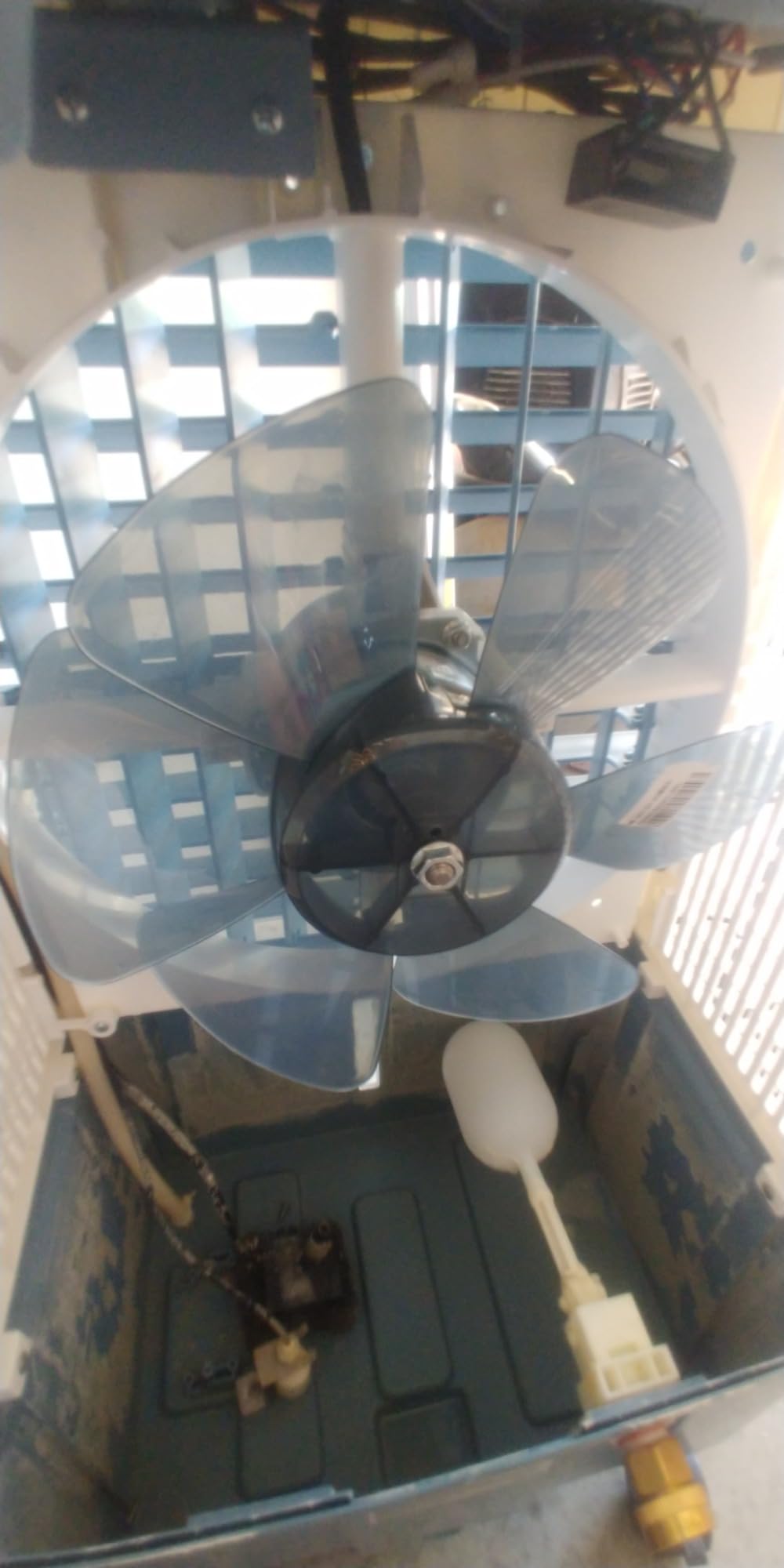
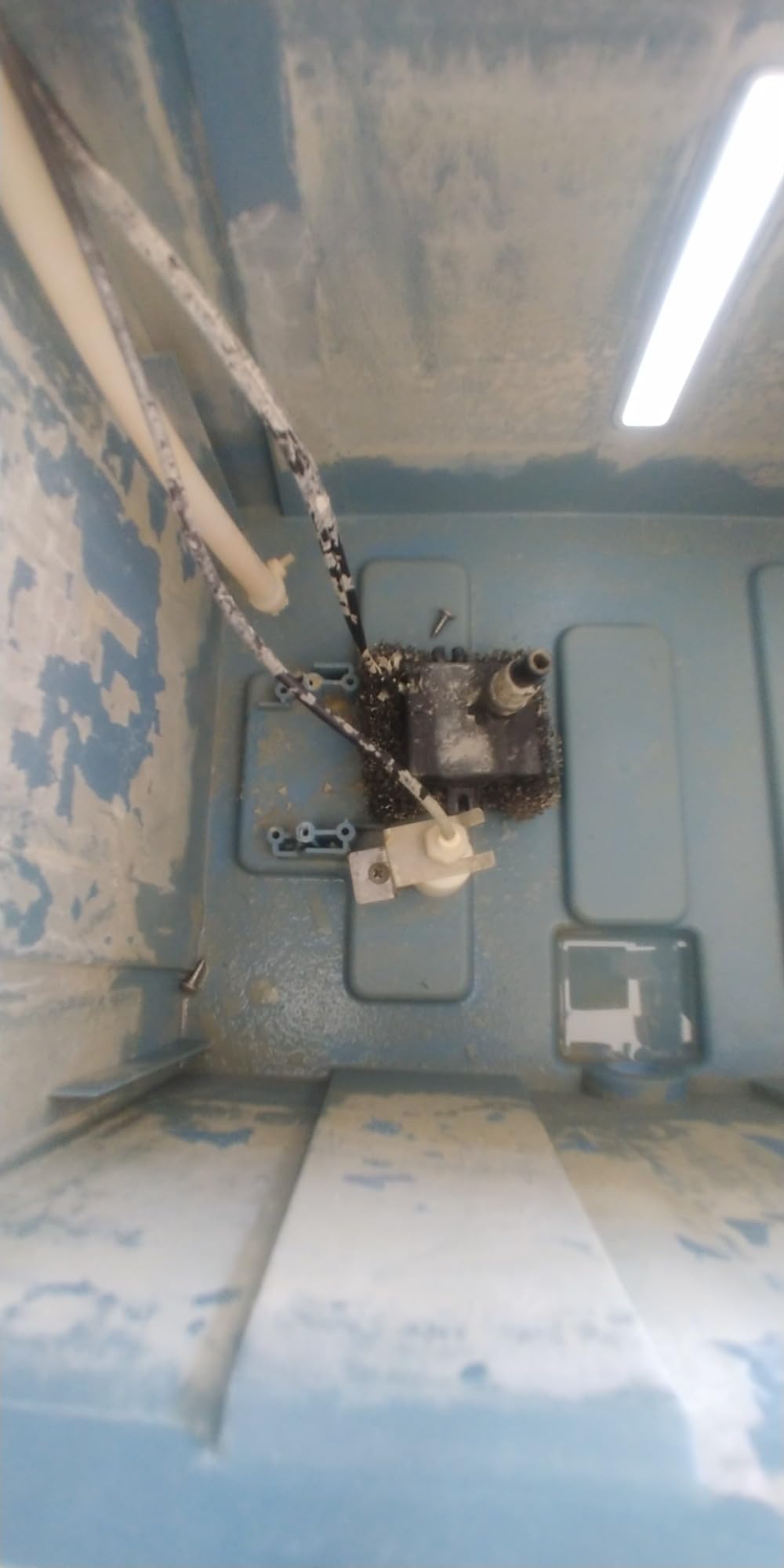
Two details stand out for outdoor use. The tank accepts a garden hose through an included brass adapter for continuous fill, so you are not refilling mid-party, and the water shortage protection function shuts the pump before it runs dry, which protects the one component that cannot survive a dry cycle.
Two ice packs are included, and at 13.4 pounds this is the easiest cooler to carry out to the yard, onto a balcony, or into a rental where you want cooling without committing to a large appliance.
Where budget buyers are happy?
Buyers who treat it as an outdoor patio, poolside, and party cooler at a low price point are generally satisfied. The mechanical controls and the top-fill design earn specific praise, and the hose connection plus dry-run protection are the two features most often called out as smart inclusions.
For dry climates, the low humidity is exactly the condition that makes it work. It is also a reasonable second cooler for a guest room or a sunroom where you only need circulation and a few degrees.
Where the low rating comes from?
The 3.7 average with 14 percent one-star reviews comes almost entirely from indoor expectations that the manufacturer explicitly disclaims. The maker states plainly that it cannot match an air conditioner’s cooling effect and works best outdoors, not in enclosed indoor spaces, and buyers who compare it to a refrigerant unit are the ones writing those reviews.
The single-sided pad also means less evaporation surface than three-sided units of similar size, 1400 CFM is on the low end, and 60 dB is noticeable indoors. Use it outside.
8. SereneLife 2500CFM WiFi Swamp Cooler: Best for App-Controlled Cooling
- Only cooler here with WiFi and app control
- 2500 CFM with 360 degree oscillation for garages and patios
- 8 gallon tank runs many hours with a 6-hour party report
- 12 hour programmable timer and 3 wind modes
- Washable filter and auto-dry pad system
- Lowest average rating here at 3.6 with 21 percent one-star
- 65 dB is loud for indoor use
- Small casters are hard to move when the tank is full
- Reports of the unit shutting off early as sensors fail
The feature list here is the most advanced in the group by a distance. This is the only unit that adds WiFi and mobile app control on top of an LED touch panel and a remote, which matters if you want to start cooling before you get home or check on it from a bedroom.
At 2500 CFM with 360 degree oscillation and an 8 gallon tank, the physical numbers are strong. Owners report running a full six-hour outdoor gathering with water to spare, and the 12 hour programmable timer plus three wind modes covering cooler, fan, and humidifier give you real scheduling control.
The washable filter and automatic pad-drying system are the details we would most want in a desert climate. They directly address the musty smell that plagues swamp coolers when pads sit wet for days, and the filter handles the dust that comes with pulling outdoor air through the unit.
At 140 watts it is economical against any refrigerant alternative, and built-in handles plus caster wheels cover the room-to-room case, though you will feel the weight when the tank is full.
The smart-home appeal
For a garage, covered patio, or workshop, being able to start the cooler remotely is genuinely useful, especially in an arid climate where you may want it running before you arrive rather than after. The 12 hour timer makes the same case if you would rather not use an app at all.
The auto-dry pad system is the sleeper feature. Drying the pad after a run is the single most effective anti-mold measure available, and having it handled automatically removes the most common maintenance failure in this category.
Where execution lags the spec sheet?
The 3.6 average with 21 percent one-star reviews is the weakest consistency here. That share points to two specific problems: sensors malfunctioning and causing the unit to shut itself off after an hour or two, and cooling output that falls short of what 2500 CFM implies, with some owners saying it works like a plain fan.
At 65 dB it is loud, comparable to an ordinary household fan, which limits bedroom use. The small caster wheels are also hard to maneuver at 8 gallons of water, and the instruction booklet is unclear on setup. Note that a portion of the reviews appear to describe sibling models rather than this exact variant, so read the low-star feedback with that in mind.
How to Choose an Evaporative Cooler for a Dry Climate?
The right unit comes down to three numbers and one habit: how much air you need to move, how dry your air is, and whether you will actually open a window. Everything else is preference. Here is how we would work through those decisions.
Size CFM to your actual space
CFM, or cubic feet per minute, is the honest measure of a cooler’s capability, because pad area only converts to cooling if air keeps moving through it. Advertised square footage is consistently optimistic across this category, and forum buyers regularly report effective coverage closer to 50 to 70 percent of the claim. Work from CFM instead.
Up to 150 square feet, personal zone: 100 to 900 CFM is enough. Think desk, bedside, or single-person cooling.
300 to 600 square feet, one bedroom or office: 1400 to 1600 CFM covers a small room when you can cross-ventilate.
900 to 1000 square feet, living room or large workshop: 2500 to 3100 CFM is the working range.
Above 1000 square feet or a whole open floor plan: you are into 4800 CFM and up territory, and whole-home ducted evaporative cooling rather than a portable appliance.
Our sizing rule of thumb: divide your square footage by three to get the CFM you actually want, then check it against the claimed number on the box.
Can an evaporative cooler handle 100-degree heat?
Yes, in dry air, and this is the scenario evaporative cooling was built for. The air temperature does not cap the performance; humidity does. In genuinely dry desert air, a well-sized unit with deep pads will pull a space down 20 to 30 degrees even when the outdoor thermometer reads well past 100.
Below 30 percent relative humidity, expect a 20 to 30 degree drop, which is the full advertised potential.
At 100 degrees outdoor temperature, the incoming air is hot but still dry enough to accept a large amount of water vapor.
If relative humidity is above 60 percent, no evaporative cooler of any size will cool effectively, and the same unit that works in June does nothing in August.
Users on HVAC forums consistently report that units with thick pads hold interior temperatures in the low 70s through desert summer afternoons, which is the strongest validation for the dry-climate case we found. Pad thickness, more than brand, is what separates a cooler that barely works from one that runs all day.
Set up cross-ventilation or do not bother
An evaporative cooler adds moisture to the room it cools. If that moisture stays, indoor humidity climbs until evaporation stalls and the unit becomes a humidifier. You need a path out. Open a window on the opposite side of the room from the cooler, or a door leading to a drier space, and that is the entire ventilation requirement.
Place the cooler near the coolest opening, with its intake drawing from the driest source available.
Open a window or door on the far side of the room to exhaust the moist air.
Run a ceiling fan in the exhaust direction to pull air through the space and across your skin.
In summer afternoons, open the intake side too, so you are moving dry outdoor air in and moist indoor air out.
If you cannot vent, choose a unit with an ice chamber or ice curtain, because chilled water evaporates more efficiently and the extra cooling in the airstream partly offsets the humidity penalty. Otherwise, use the cooler as a circulation fan rather than a cooling device.
Pad thickness and pad media decide everything
Pad area is the single most important physical variable, and it is the one most often buried in a product listing. Thick pads hold more water and give the airstream more surface to contact, which means more evaporation and more cooling per pass. Forum users consistently treat thick pads as the deciding factor between a unit that barely works and one that runs all day.
Pad thickness: thicker is better within reason. The commonly cited 8 inch pad is the community benchmark for whole-house units.
Pad media type: 3D honeycomb media holds water and resists collapse better than flat cellulose, which is why you see it on the smaller units here.
Intake sides: three-sided pad panels give roughly three times the evaporation surface of a single-sided unit at a similar footprint.
Density: high-density media claims around 80 percent more evaporation surface than standard density, which is a real gain rather than a marketing number.
Water consumption is not a rounding error
Van and off-grid users quantify evaporation at roughly 2.5 pints per hour, and that number is the practical constraint in an arid climate. A 10 gallon tank at that rate gives you about three to four hours of runtime, which matches owner reports on the larger tanks in this list.
That makes continuous fill a genuine feature rather than a convenience. The Hessaire MC37M, OEMTOOLS 23968, and VEVOR models all accept a garden hose connection, and once you attach one, water logistics disappear. If you are hauling water manually, budget for refills before you buy.
Noise decides bedroom versus everything else
The spread here is wide enough to decide placement on its own. The Ashihoti 4-in-1 runs at 45 dB and the Uthfy at 50 dB, both quiet enough for a bedroom, while the OEMTOOLS at 68 dB is a workshop appliance only. The SereneLife at 65 dB is similarly loud, and the NewAir under 56 dB sits in between.
Be skeptical of whisper-quiet marketing that does not quote a decibel figure. Forum buyers report plenty of units described as quiet that measure well above 50 dB. If it will run overnight beside your head, buy the number, not the adjective.
What are the real downsides?
Humidity failure: above 60 percent relative humidity, cooling collapses and you are left with a fan and a humidifier.
Ventilation requirement: in a closed room, added moisture accumulates and performance drops.
Water consumption: roughly 2.5 pints per hour, plus the logistics of supplying it.
Pad and tank maintenance: mineral buildup in hard water and neglected wet pads produce mold smell, the most common complaint in the category.
Dry-run damage: running the pump with an empty tank can damage the motor, and only some models have dry-run protection.
Added indoor humidity: electronics owners ask specifically about placing one near a computer, and the answer is that any humidity increase carries some risk for sensitive hardware.
Optimistic coverage claims: expect 50 to 70 percent of the advertised square footage in practice.
Evaporative cooler vs portable AC vs mini-split
The right comparison is not quality, it is cost per degree. A portable AC moves heat out of the room using refrigerant, which means it works in any humidity but pulls roughly 1200 to 1500 watts. A mini-split does the same for a whole house with far better efficiency and installation cost. An evaporative cooler moves far less power, typically 45 to 250 watts here, and in dry air it delivers a comparable felt temperature for a fraction of the running cost.
Evaporative cooler: lowest power draw by an order of magnitude, needs ventilation, fails in humid air, adds moisture to the room.
Portable AC: works in any climate, needs an exhaust hose through a window, roughly triples the power draw for comparable cooling in dry air.
Mini-split: the only one of the three that cools a whole house quietly and dehumidifies properly, and by far the highest installation cost.
In a genuinely arid climate, the running-cost gap is what makes evaporative cooling the clear answer. In a humid one, it is the wrong tool entirely, and a portable AC is cheaper than a five-year argument about why your swamp cooler is fogging the room.
Pad Care, Mineral Buildup and Mold Prevention
Maintenance is what separates a swamp cooler that works for a decade from one that smells in month two. None of it is difficult, but all of it has to happen on a schedule, because the failure mode is silent: a pad that dries out cuts cooling sharply and can overheat the motor.
Pad replacement schedule
Clean weekly in season: with the unit off and disconnected, rinse the pads under cool water and let them dry fully before reassembly.
Replace every 2 to 3 seasons in arid use: dust loading and mineral scaling eventually block the media, and replacement pads cost a fraction of a new cooler.
Inspect for collapse: cellulose media warps and sags over time, which allows bypass air to skip the pads entirely and cut cooling without any obvious symptom.
Replace the tank and pump at the 3 to 5 year mark: long-term owners of the larger plastic models report one tank and pump replacement across three summers of normal service.
How to prevent calcium and mineral buildup?
Hard water in the desert is common, and it will scale the pads and the tank walls within a season if you ignore it.
Run the unit on fresh water and drain it fully at the end of every hot season rather than leaving it sitting.
Descale the tank with a mild citric acid solution on the manufacturer’s recommended cycle, rinsing thoroughly afterward.
Replace scaled pads rather than trying to scrub them back to full flow; once the media is chalky, it is finished.
Wipe the tank walls monthly during heavy use so scale never hardens into a crust.
Consider a float valve with a replaceable filter if your supply has high mineral content.
Why does a swamp cooler smell like mold?
The smell comes from a wet, warm, dark pad surface with no airflow through it once the fan is off, which is ideal for bacterial and mold growth. The fix is drying and cleaning, in that order of importance.
Dry the pads completely after every run rather than reassembling a damp unit.
Clean the tank on a fixed schedule even when the cooler is working fine.
Avoid treating the cooling media with harsh chemicals; use the manufacturer’s recommended bactericide treatment if odor returns.
Store the unit drained and ventilated through the off-season.
If you cannot commit to a routine, favor a model with an auto-dry pad system, which handles this for you.
Is it normal for new pads to smell?
A mild chemical or cellulose smell on a brand-new pad is normal for the first few hours of use and usually fades once the media has soaked and dried a couple of times. A persistent strong odor after that is not normal and points to a pad that needs replacing or a tank that needs cleaning.
Frequently Asked Questions
Do swamp coolers work in 100 degree weather?
Yes, in dry air. Heat does not limit an evaporative cooler; humidity does. Below about 30 percent relative humidity, a well-sized unit with deep pads can pull a space down 20 to 30 degrees even when the outdoor temperature passes 100. Above 60 percent relative humidity the same unit will barely cool at all.
Is there a difference between a swamp cooler and an evaporative cooler?
No. The two names describe the same appliance and the same technology. A fan draws air through water-saturated cooling pads, water evaporates into that airstream and absorbs heat, and the cooled air is blown back into the room. The names differ only by region and marketing.
In which climate is evaporative cooling most effective?
Hot, dry climates where relative humidity stays low. Below 30 percent RH expect a 20 to 30 degree drop, between 30 and 50 percent expect 10 to 20 degrees, between 50 and 60 percent expect 5 to 10 degrees, and above 60 percent expect less than 5 degrees. The ceiling on any evaporative cooler is the wet-bulb temperature.
What are the downsides of using an evaporative cooler?
The main drawbacks are that cooling collapses above 60 percent relative humidity, the unit requires an open window or door to exhaust moist air, it consumes roughly 2.5 pints of water per hour, pads and tanks need regular cleaning to prevent mineral scale and mold smell, and running the pump dry can damage the motor.
How often should you replace the pads on a swamp cooler?
Expect to replace pads every 2 to 3 seasons of arid use, sooner if the media is heavily scaled or has started to warp and collapse. Clean the pads weekly during the season, dry them fully after each run, and inspect the media annually. Replacement pads cost a fraction of a new cooler.
How much water does an evaporative cooler use?
Roughly 2.5 pints per hour is the commonly cited evaporation rate in arid conditions. A 10 gallon tank therefore runs about three to four hours per fill, and an 11 gallon tank slightly longer. Attaching a garden hose for continuous fill removes the refilling problem entirely.
Can you use an evaporative cooler in a closed room?
You can, but performance will suffer. The cooler adds moisture to the room, and in a closed space that moisture accumulates until the air can no longer absorb more, which stalls evaporation. Open a window on the far side of the room, or use the unit as a circulation fan instead.
Final Verdict: Who Should Buy Which Evaporative Cooler?
The Hessaire MC37M is our pick for the best evaporative coolers for dry climates overall. It moves 3100 CFM, holds 950 square feet of stated coverage, runs a 10.3 gallon tank for three to four hours per fill, and has the deepest review history of anything we tested at 4733 reviews. If you can only buy one, buy that one and attach a hose.
Choose the Ashihoti 4-in-1 for a bedroom or home office where noise and power draw matter most. Choose the Hessaire DC18 if you already own 18V or 20V tool batteries and need cooling away from an outlet. Choose the OEMTOOLS 23968 or the Uthfy for a garage, shop, or covered patio where volume beats quiet. Choose the NewAir for personal spot cooling beside a chair or a bed. Choose the VEVOR for the cheapest outdoor setup, and the SereneLife if app control and an auto-dry pad system are worth the extra feature risk.
Before you buy anything, check your local relative humidity for the hottest weeks of your summer. Below 30 percent, any of these will work well and running cost stays low all season. If you are planning whole-home cooling, our roundup for rooms covers sizing for individual spaces, and for protecting gear in humid storage, read our camera desiccant guide.