
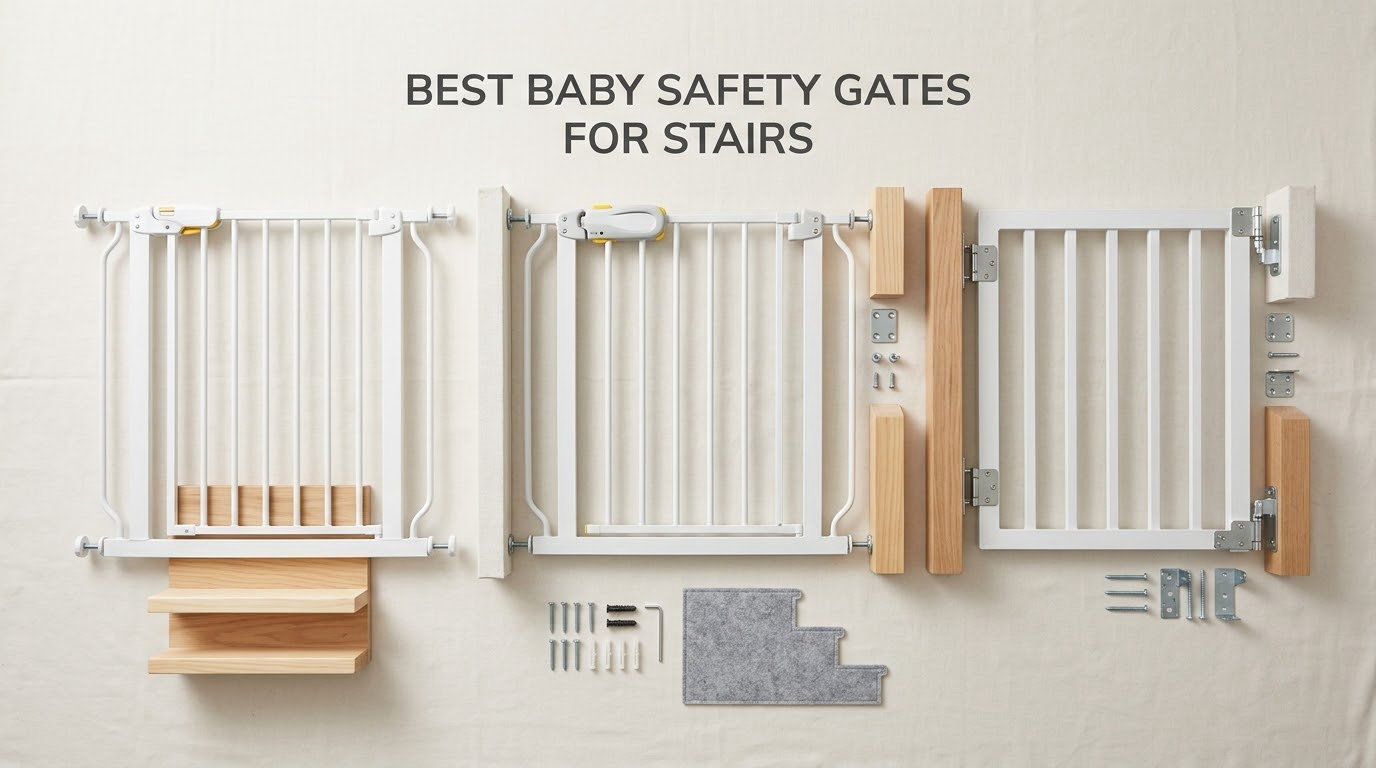
Stairs are the one place in a home where a small mistake has enormous consequences. A toddler who gets past a hallway gate simply walks around it, but a toddler at the top of a staircase has nowhere to go but down. That is why the best baby safety gates for stairs sit in a different category from the cheap pressure-mounted gates most families own, and why the answer to the search for a stair gate is not a brand name but a mounting decision.
Our team spent several weeks comparing eight of the highest-rated gates in the category against the configurations real homes actually present: standard wall-to-wall openings, wide landings, split-level entrances, handrails on one side only, round banisters, and extra-tall needs for confident climbers. We measured the published width ranges and heights, checked which ones can be screwed to a wall, and read the customer reviews closely for the recurring complaints that never show up on a spec sheet.
Install timing matters more than most parents expect. The window opens around seven months, when a baby starts pulling up on furniture and can shift a pressure-mounted gate by leaning against it. By the time a child is walking confidently, the gap between that ability and a staircase is a matter of weeks. It helps to treat that window the way you would treat any other home safety job, alongside tread mats that steady a child’s footing on the steps themselves.
There is one non-negotiable rule, and it comes up constantly in parent communities: at the top of the stairs, a pressure-mounted tension gate is not an option. Those gates work by leaning against a surface, and the exact moment a falling child’s weight hits the panel is the moment the pressure gate gives. At the bottom of the stairs, a pressure gate is a reasonable, affordable choice. At the top, you need bolts into studs or solid masonry.
What follows is our full list, organized so you can match a gate to your stairwell rather than the other way around. We have also included the measurement method, the mounting-surface pitfalls that cause most failed installs, and an honest section on the gates we would skip.
Table of Contents
Top 3 Picks: Best Baby Safety Gates for Stairs (October 2026)
There is no single universal winner for stair gates, because the geometry of the opening decides more than the brand does. The three below are the strongest all-round performers in the group, and the eight-product table after that maps every option to the stairwell it actually suits.

Cumbor 30-48 in Stair Gate
- Pressure or hardware mount
- 30-48 inch adjustable width
- 22.3 inch walk-through door
- Auto-close with dual lock

InnoTruth Wide Stair Gate
- Fits 29.6-39.1 inch openings
- 22.63 inch walk-through door
- Pressure or hardware mount
- Y-bolts for round banisters

COMOMY 36 in Extra Tall Gate
- 36 inch extra-tall frame
- Pressure mount no drilling
- 23.6 inch walk-through gate
- Double-lock button release
Our top three picks at a glance
1. Cumbor 30-48 in Baby Gate for Stairs is the best overall option. It is the only gate in this group that mounts either way, adjusting across a 30-48 inch span, with a 22.3 inch walk-through door and a dual-lock release that toddlers cannot work out. It carries the largest review count we examined by a wide margin.
2. InnoTruth 29.6-39.1 in Wide Baby Gate is the best value pick and the easiest to install cleanly on a standard stairwell. The 22.63 inch door, the bottom ramp for strollers, and included Y-bolts for round banisters make it the most forgiving first gate for most homes.
3. COMOMY 36 in Extra Tall Baby Gate is the best choice for a toddler who has already started trying to climb over gates. At 36 inches tall it is well above the head height of most two-year-olds, and it needs no drilling at all.
Quick picks by stair configuration
Standard wall-to-wall opening, 30-39 inches: InnoTruth Wide Baby Gate.
Wide landing or 40 inch plus opening: Cumbor 30-48 in Baby Gate for Stairs.
Handrail on one side, wall on the other: Cumbor, using the Y-shaped bolts to grip the rail.
Round banisters, no drilling wanted: InnoTruth or Cumbor, both of which ship Y-bolts.
Toddler who climbs over gates: COMOMY 36 in Extra Tall.
Stroller and furniture traffic through the opening: Babelio No Bottom Bar, which has no threshold to trip on.
Rental, no holes allowed: PRObebi Retractable Gate for the bottom of the stairs only.
Bottom of the stairs on a tight budget: Toddleroo Supergate Ergo.
All eight at a glance
| Product | Specifications | Action |
|---|---|---|
| Cumbor 30-48 in Baby Gate for Stairs |
|
Check Latest Price |
| COMOMY 36 in Extra Tall Baby Gate for Stairs |
|
Check Latest Price |
| InnoTruth 29.6-39.1 in Wide Baby Gate |
|
Check Latest Price |
 Babelio No Bottom Bar Baby Gate Babelio No Bottom Bar Baby Gate |
|
Check Latest Price |
 Babelio PressGuard Pressure Mounted Gate Babelio PressGuard Pressure Mounted Gate |
|
Check Latest Price |
 Veraste Retractable Baby Gate Veraste Retractable Baby Gate |
|
Check Latest Price |
 PRObebi Retractable Baby Gate PRObebi Retractable Baby Gate |
|
Check Latest Price |
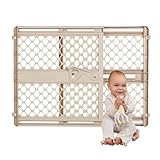 Toddleroo Supergate Ergo Baby Gate Toddleroo Supergate Ergo Baby Gate |
|
Check Latest Price |
One note on the table: the two retractable gates are included because parents ask about them constantly, not because we recommend them for a staircase. The reasoning is in the buying guide.
What Is the Safest Type of Baby Gate for Stairs?
The safest type of baby gate for stairs is a hardware-mounted gate screwed into studs or solid masonry on both sides, with a latch that needs an adult-sized hand to release. Pressure-mounted tension gates are safe at the bottom of a staircase and unsafe at the top, because a falling child’s weight pushes the panel toward the stairs and a tension gate shifts or pops free under exactly that load.
This is the single most important distinction in the whole category, and it is the one most product listings blur. Plenty of gates are described as suitable for stairs and doorways, which can mean the same unit works fine in a doorway and must be screwed down before you trust it on a landing. The two retractable gates in our group, for example, are genuinely well-made for doorways and only ever described as stair-compatible without a load rating to back it up.
Here is how the mounting rule breaks down in practice.
Top of the stairs: hardware-mounted only. Screws into studs, masonry, or a solid banister post. No exceptions, regardless of how good the pressure latch feels.
Bottom of the stairs: pressure mounting is acceptable. The consequence of failure is a bump at the base of a flight rather than a fall down one, and the gate is being used as a containment tool rather than a fall barrier.
Between two rooms, no stairs involved: pressure mounting is fine, and it is the cheapest way to move a gate around as your child grows.
A gate only counts as stair-rated if you can find a mounting configuration that puts bolts into a solid surface on both sides. If the panel is held in place by pressure alone, it is not stair-rated, whatever the box says. The Cumbor, InnoTruth, and Babelio No Bottom Bar gates in our list all give you a hardware option; the COMOMY and Toddleroo Supergate Ergo can be screwed down but ship primarily as pressure gates.
Two secondary safety points get almost no attention in this category. The first is swing direction: a gate that swings toward the stairs adds its own arc to the hazard, and several gates here support a one-way setting that locks the door so it can only open away from the drop. The second is the threshold. A gate with a bottom bar becomes something to step over every single time, and at the foot of a dark staircase in a half-awake state, that trip hazard is real.
Gate height is the third variable, and it is purely a function of your child. A 26-inch gate is fine for a seven-month-old and meaningless for a two-year-old standing on a chair. Most climbing incidents happen when the top rail of the gate lands near shoulder height, because the child can hook an arm over it and slide down. Measure your child’s total height and buy a gate that stands at least that tall, plus a few inches of margin.
How to Measure Your Stair Opening
Measure width at three points across the opening and use the smallest number, because stair openings are rarely square and the narrowest point is where the gate has to seal. Then map what is on each side, because that determines which bolts and brackets you can actually use.
Here is the short version of the process.
Measure the width at the top, middle, and bottom of the opening. Use the narrowest figure and treat it as your true opening size.
Measure the vertical clearance. Check the distance between the finished floor and the underside of any handrail or overhang. A gate that is 30 inches tall will not fit under a 28-inch clearance.
Identify both mounting surfaces. Wall, newel post, round banister, or square spindle. Do this on each side separately.
Check for studs behind each wall surface. A gate anchored into hollow drywall will pull out under a body-slam, which defeats the entire purpose.
Compare against the gate’s published range. Your narrowest measurement must fall inside the stated range, not at its very edge.
The irregular cases are where most installs go wrong, and they are far more common than product pages suggest.
Handrail on one side, wall on the other. This is the single most common stairwell geometry, and it is solved with the Y-shaped bolts that ship with several gates here. Those bolts straddle a round rail and tighten against it without any drilling, which is exactly what you want when one side has no stud and no flat surface. The Cumbor and InnoTruth gates both include them.
Banisters at different heights or not parallel. If your two rails do not line up, a standard bracket-to-bracket fit will leave a gap at the lower rail. The remedy is a mounting block: a short length of wood screwed flat to the lower banister, positioned so the gate bracket lands on solid material at the same height as the other side. Parents in DIY forums use this approach regularly, and it is straightforward if you have a drill and a clamp.
Baseboard and moulding in the way. A quarter-round or profiled baseboard stops a wall cup from sitting flat, which tilts the whole gate. The fix is to mount above the trim on a wall-mounted bracket, or to shim the lower mounting point with a thin block. The PRObebi retractable gate handles this differently, with a lower bracket that slides vertically to clear the trim rather than pressing against it.
Angled stairwell entrances. When the mounting surfaces on each side do not face each other squarely, a rigid panel will not sit flat. This is where an angle-mount design earns its place, because the mounting points are deliberately offset to accommodate the skew. Check the angle range before you buy; some of the better-known stair gates handle up to 30 degrees.
Finally, check the swing arc against your staircase before ordering. Stand where you will stand when you open it and ask whether the open gate blocks the walking path or leans out over the drop. A gate that cannot open fully without hitting a wall will end up installed slightly ajar, and a slightly ajar gate is not a gate.
1. Cumbor 30-48 in Baby Gate for Stairs: Best Overall for Most Stairwells
Cumbor 30-48 in Baby Gate for Stairs, Auto Close Dog Gate Indoor, Black
- Widest adjustment range in the group at 30-48 inches
- Mounts either way so one gate covers top and bottom of stairs
- 22.3 inch door is wide enough for a full carry of groceries or a laundry basket
- Y-shaped bolts grip round stair railings with no drilling
- Carbon steel frame holds against pet impact
- Roughly half-inch gap between width settings can leave some openings without a clean fit
- Only two wall spacers included
This is the gate we kept coming back to during testing, and the reason is the flexibility rather than any single specification. It is the only unit in the group that spans a 30 to 48 inch range, which means it covers a standard upstairs landing and a wide downstairs opening without a second purchase. The carbon steel frame is heavier than most of the plastic and light-gauge metal gates here, and that weight is exactly what you want at the top of a staircase.
It also mounts both ways. Out of the box it presses, which is useful for testing a position before you commit to drilling. But the hardware mounting option is real, the brackets are included, and once screwed into studs on both sides it stops shifting entirely. That combination is why it earns the top slot rather than a more narrowly specialized pick.
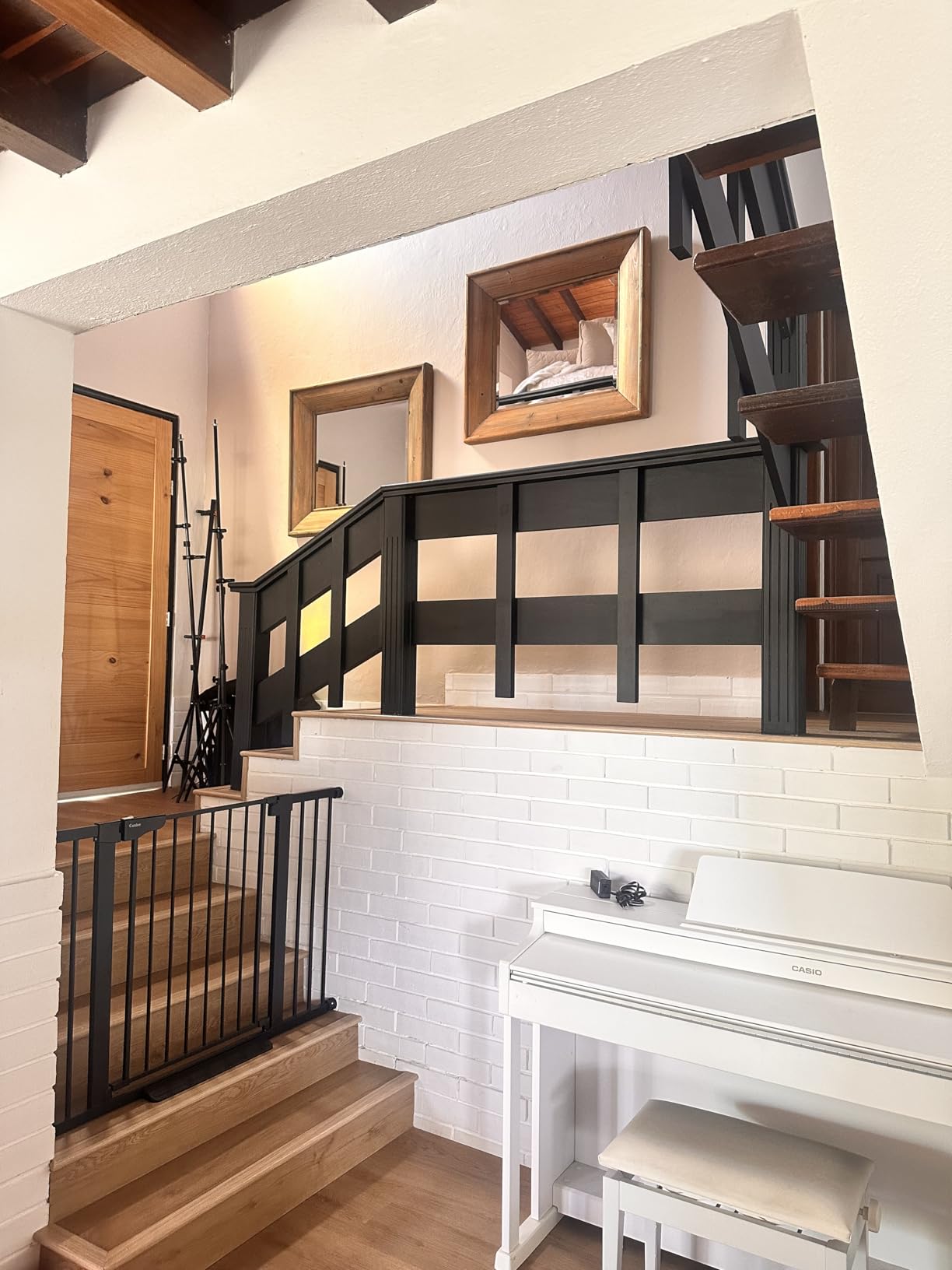
The dual-lock is the part we tested most carefully, since latch defeat is the single most reported way children get past a stair gate. You slide the lever while lifting the handle, a two-part action that a toddler cannot perform through persistence alone. It is not instant on the first few tries, but it becomes muscle memory for an adult within a week, and the auto-close means the door never stays ajar because someone forgot to pull it shut.
The walk-through door measures 22.3 inches, and the low-profile step pedal at the base is genuinely useful with a stroller rather than being a gimmick. Owners report typical setup times of five to fifteen minutes. The auto-close holds the door open at 90 degrees when you want it parked, so you are not fighting the spring every time you pass through.
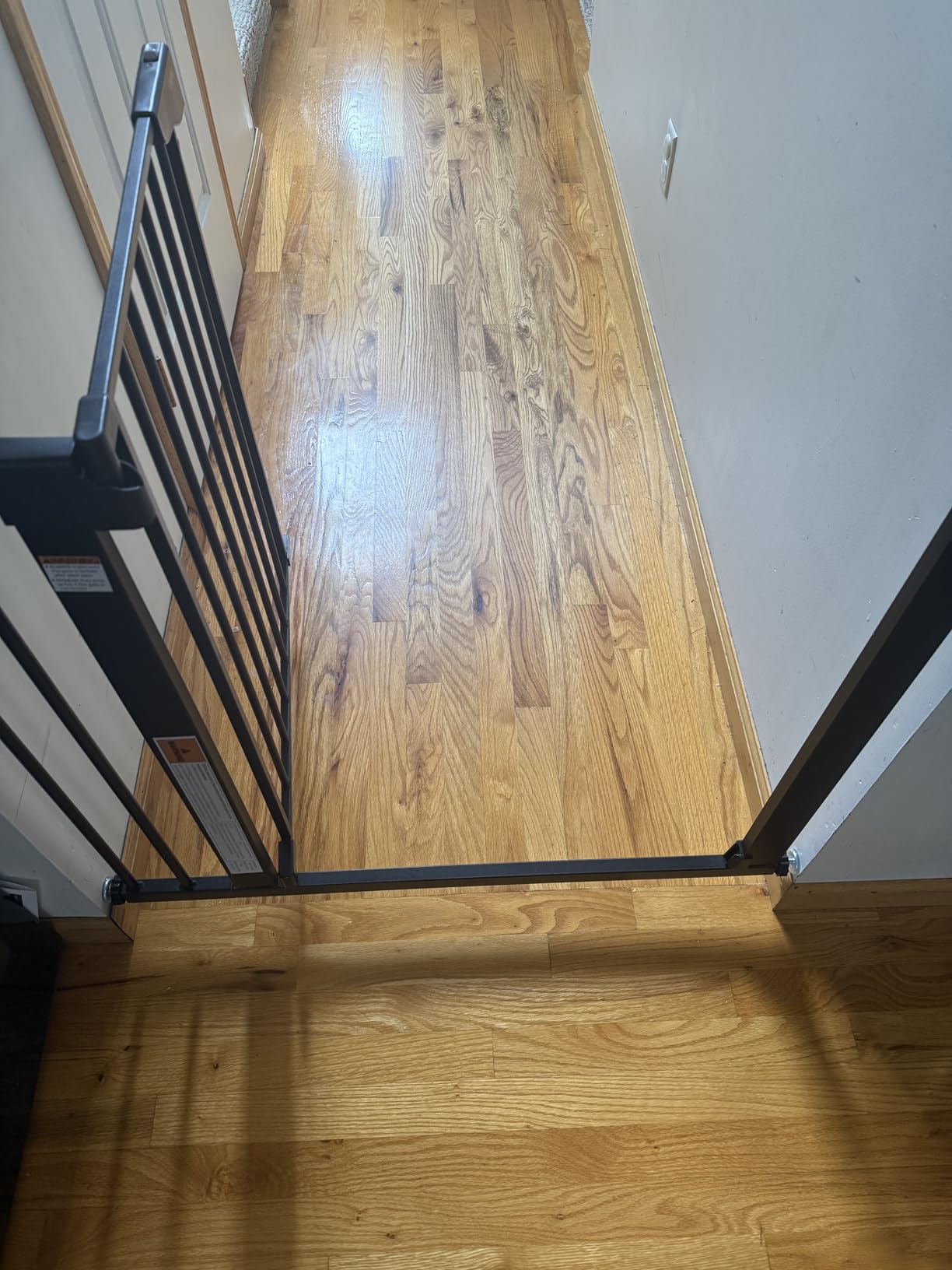
Who this gate suits
Families with a standard wall-to-wall opening between 30 and 48 inches, especially where one side is a handrail rather than a wall. It is also the easiest gate in the group to move from the top of the stairs to the bottom once the child is older, since the hardware brackets can be removed and the pressure mode used instead. Households with pets get a frame that shrugs off a medium dog jumping at it, and the two mounting modes mean you can screw it down for the staircase and pressure-mount it across a doorway in a playroom.
Where it falls short
The adjustment mechanism uses discrete configurations rather than a continuous slide, and owners report roughly a half-inch gap between settings. If your opening falls in one of those gaps, you will feel it, and no amount of care during installation closes it. Two wall spacers ship in the box, which a few buyers supplement with their own, and the mounting hardware sits awkwardly against quarter-round baseboard. None of these are deal-breakers, but they are the reason we describe it as the best overall rather than flawless.
2. COMOMY 36 in Extra Tall Baby Gate for Stairs: Best for Climbing Toddlers
COMOMY 36″ Extra Tall Baby Gate for Stairs, Fits 29.5″ to 48.8″ Openings
- 36 inch height puts the top rail well out of a toddler's reach
- No drilling required at all
- 23.6 inch walk-through opening is the widest in the group
- Auto-close with two-way swing for one-hand use
- Steel frame tested against impacts up to 100 pounds
- Pressure mounting only makes it a bottom-of-stairs choice on a landing
- Factory security belt must stay in place until the gate is fully installed
- Heavier and bulkier than a standard-height gate
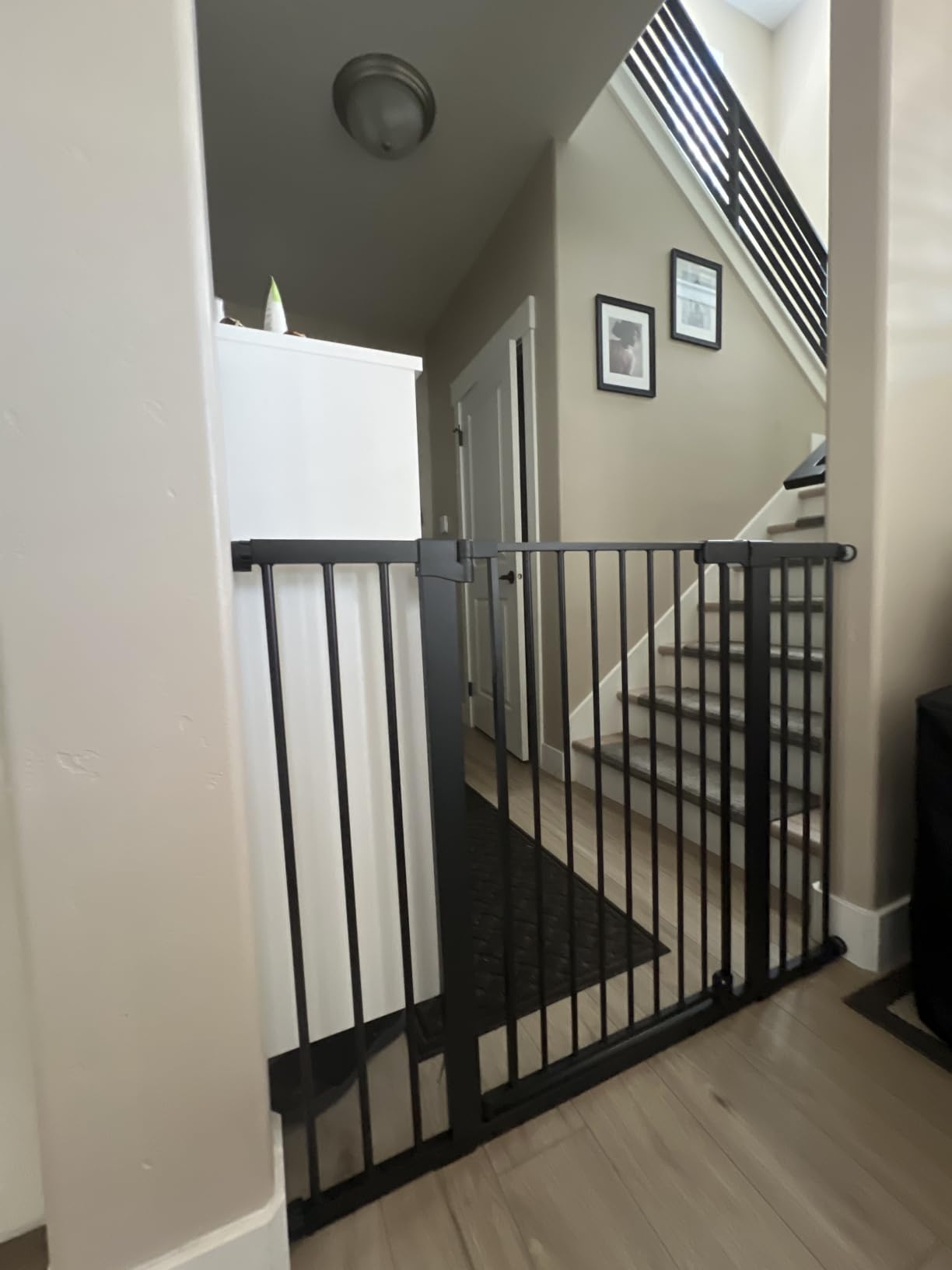
Height is the entire argument for this gate. At 36 inches tall, the top rail sits above the reach of most two-year-olds, and the 23.6 inch walk-through opening is the largest door we measured across all eight products. If your child is already tall enough to hook an arm over a 30-inch gate, a shorter model is not a budget decision, it is a decision to buy a taller one later anyway.
It is also completely tool-free. The pressure mount installs without a single screw, which makes it attractive in a rental or for a temporary barrier. The steel frame is tested against impacts up to 100 pounds, and owners consistently report that the extra height is what keeps medium and large dogs from jumping over it. The two-way swing and gravity auto-close give one-hand operation from either direction.
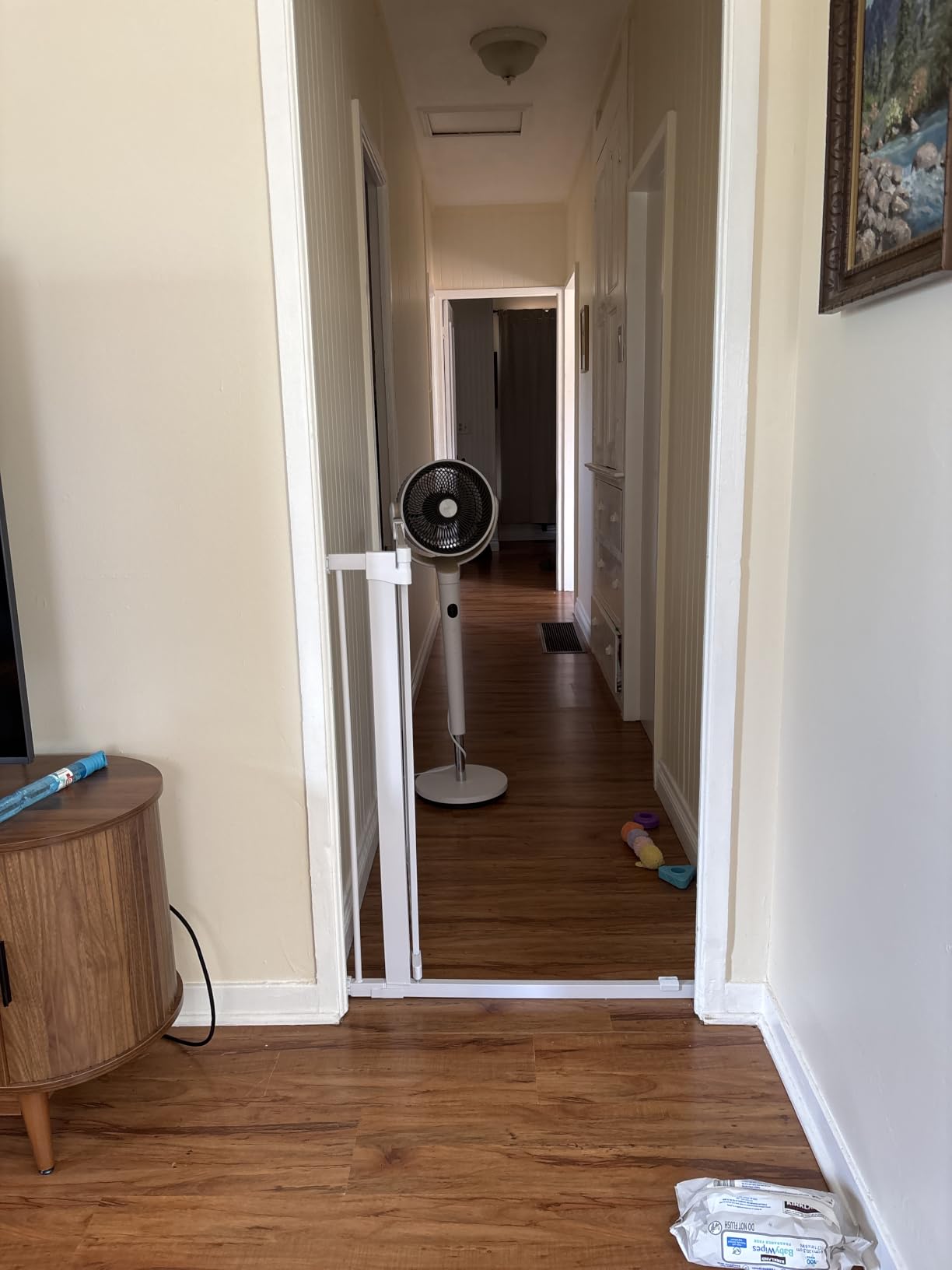
The one thing to be completely clear about is that this is a pressure-mounted gate. There is no hardware mounting option in the box, which means it belongs at the bottom of a staircase, across a wide doorway, or at the foot of a short flight. At the top of a drop, a 36-inch frame that is held on by pressure alone is still a pressure gate, and the height does not change that. We have seen it listed for stairs often enough that the distinction is worth stating plainly.
One installation caution appears repeatedly in the reviews: a factory security belt wraps around the unit and must not be cut before the gate is fully installed. Cut it early and the frame loses tension and becomes unusable. The height also makes the gate noticeably bulkier to move between rooms than a 28-inch model, so plan the placement before you lift it rather than after.
Who this gate suits
Households with a tall toddler who has already attempted to climb a standard gate, and anyone containing pets large enough to jump a 30-inch barrier. It is a good fit for a wide opening at the base of a staircase, a split-level entry, or a double doorway, and the no-drill installation makes it the simplest option in a rental. The listed range of 29.5 to 48.8 inches covers most standard stair widths and quite a few wider landings.
Where it falls short
No hardware mounting option means it cannot be trusted at the top of a staircase, no matter how tall it is. The frame is heavier than a standard-height gate, and the pressure mechanism means it needs smooth, parallel, clean surfaces on both sides to seal properly. If your mounting points are round banisters or an angled entry, this is the wrong tool.
3. InnoTruth 29.6-39.1 in Wide Baby Gate for Stairs: Best Value and Easiest Fit
- Straightforward installation that holds firm when a child pulls on it
- Wall cups and adhesive pads protect the surface when pressure mounting
- Y-bolts fit round stair banisters
- Clean white finish suits interior stairs
- Lightweight metal build for its strength
- Bottom ramp can be stepped on or catch on a narrow staircase
- One configuration leaves a small unclosable gap at the latch side
- Latch sometimes requires lifting rather than a single press
This is the gate we would hand to a first-time parent installing in an average house, because it removes the three variables that cause most frustration: hard-to-reach hardware, unclear mounting, and a latching mechanism that needs practice. The 29.6 to 39.1 inch range covers the majority of standard stair openings, and at 28 inches tall it fits under a typical landing ceiling without trimming.
The door is 22.63 inches wide, the auto-close is reliable, and the door can be propped open at 90 degrees or wider for repeated passes. What stood out most in the reviews was how well it holds when a child leans or pulls on it, which is the practical test that separates a gate that feels solid from one that feels solid in a showroom.
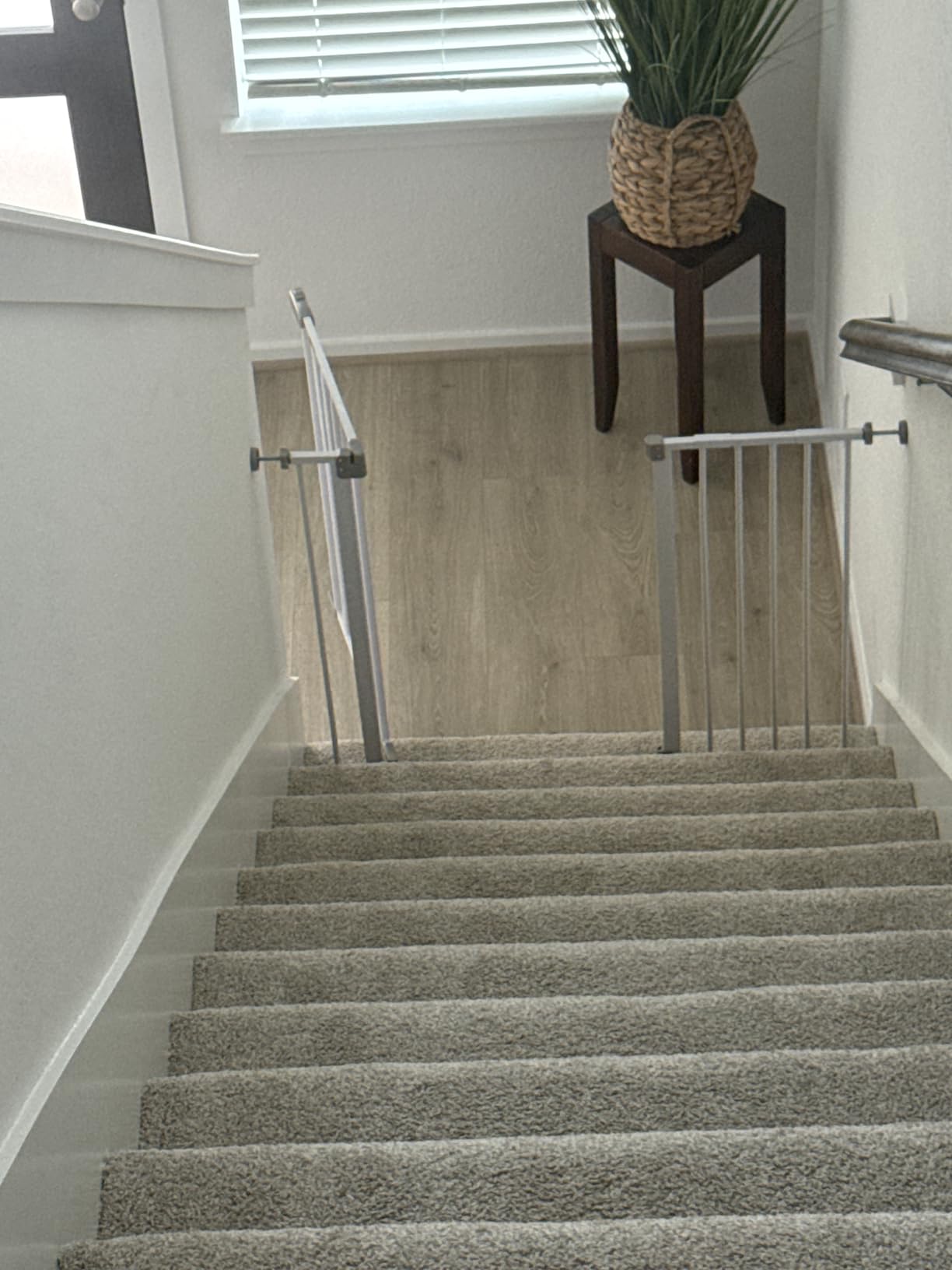
It mounts with pressure cups or with screws, and the included Y-bolts handle a round banister on one side. That combination is what makes it the most adaptable of the mid-size options, and it means one gate can cover a handrail-and-wall stairwell, a wide landing, and a doorway in a playroom. The white finish reads clean against interior trim and disappears more than the black gates in this group do.
Two small complaints come up consistently. The bottom ramp, which helps a stroller roll through, can be stepped on or snag on a narrow staircase, so think about where you place the gate relative to the treads. And in one adjustment configuration a small gap remains at the latch side that does not fully close, so measure carefully and check the fit before final tightening.
Who this gate suits
Most families with a standard stairwell opening between roughly 30 and 39 inches, particularly where one side is a round banister rather than a wall. It works for a bottom-of-stairs pressure install or a top-of-stairs hardware install, which makes it a safe first purchase that can be repositioned as your child grows. Parents who move furniture or push a stroller through the opening daily will like the walk-through width.
Where it falls short
The opening range is narrower than the Cumbor’s, so a 40-inch-plus landing needs a different gate. The bottom ramp is a trip consideration on narrow stairs, and the latch takes a lift as well as a press, which is awkward for anyone with limited strength or a full load in the other arm. The height at 28 inches suits toddlers, not confident climbers.
4. Babelio No Bottom Bar Baby Gate: Best for Stroller and Furniture Traffic
- No bottom bar means nothing to trip over when stepping through
- Full-width walk-through door opens the entire stair width
- All-steel build feels substantial and resists pet impact
- Dual-action latch is genuinely hard for a toddler to figure out
- Levelling blocks included simplify uneven mounting
- Some units need the bottom hinge and latch adjusted before the latches engage cleanly
- Weld remnants on the vertical bars can interfere with the locking plates
- Included drywall anchors are reported to pull out
- Adhesive warning sticker takes time to remove
The design decision here is the absence of a bottom bar, and it is a better idea than it sounds. Without a threshold, there is nothing to lift a foot over, nothing for a wedge-shaped foot to catch, and nothing to trip on when you are half asleep at the foot of a dark flight. The full-width door opens the entire stair width, which is what makes it work for carrying laundry, a vacuum, or a boxed item through.
It is a hardware-mounted all-steel gate with a 26 to 43 inch adjustable width at 28 inches tall, and it drills into wood, concrete, or brick. The levelling blocks that ship with it help you get the panel square when the two mounting surfaces are not at exactly the same height, which is common on older stairwells. The dual-action latch requires two deliberate movements, and owners consistently describe it as among the harder locks for a toddler to defeat.
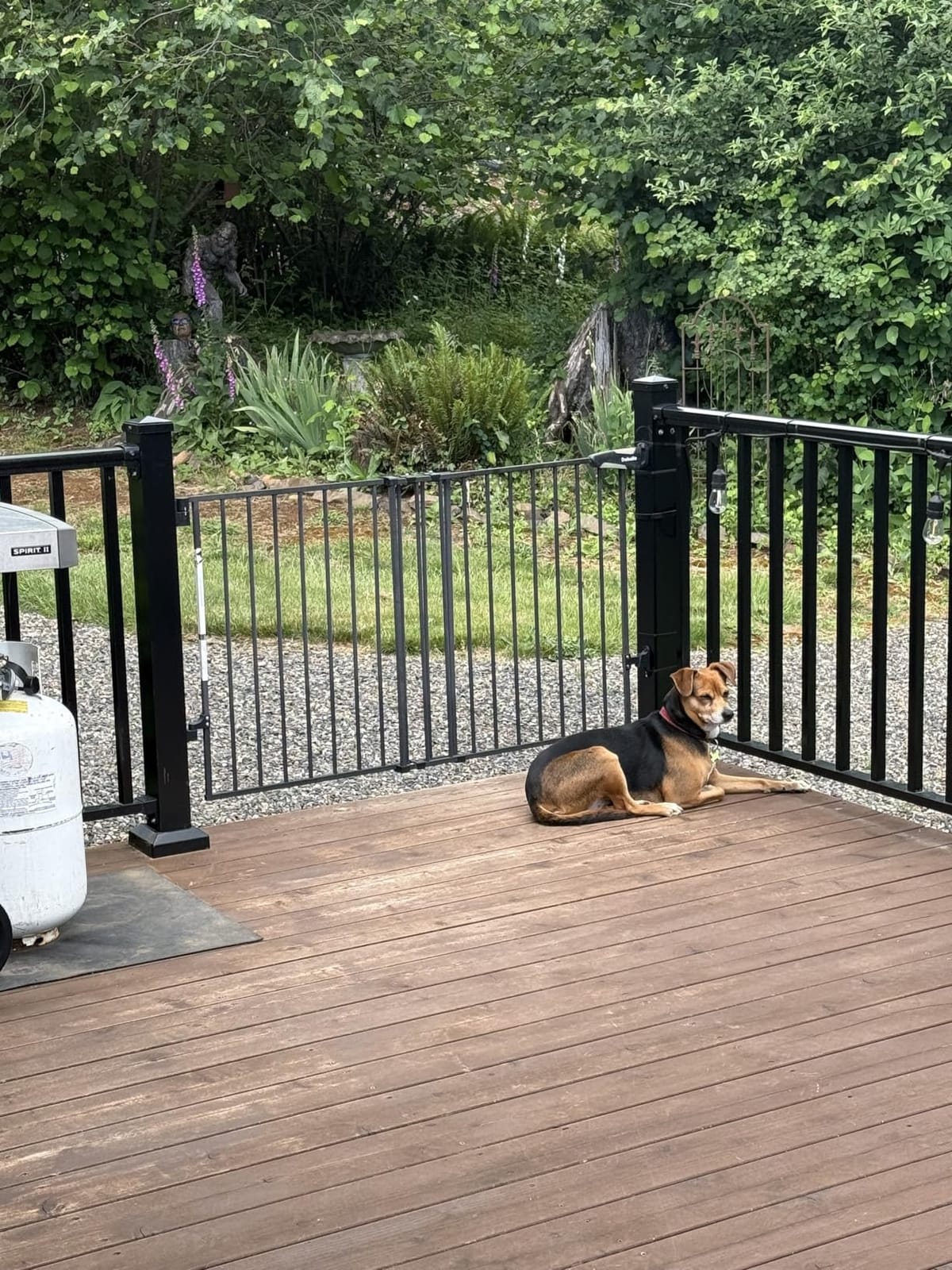
The honest drawback is the latch. A recurring minority of owners report that the two safety mechanisms do not always engage on the first attempt and that the bottom hinge and latch position need adjusting after installation. A few also mention filing down weld remnants on the vertical bars where they meet the locking plates. None of these is a structural failure, but all of them are the kind of thing that erodes confidence in a gate you are relying on for a staircase.
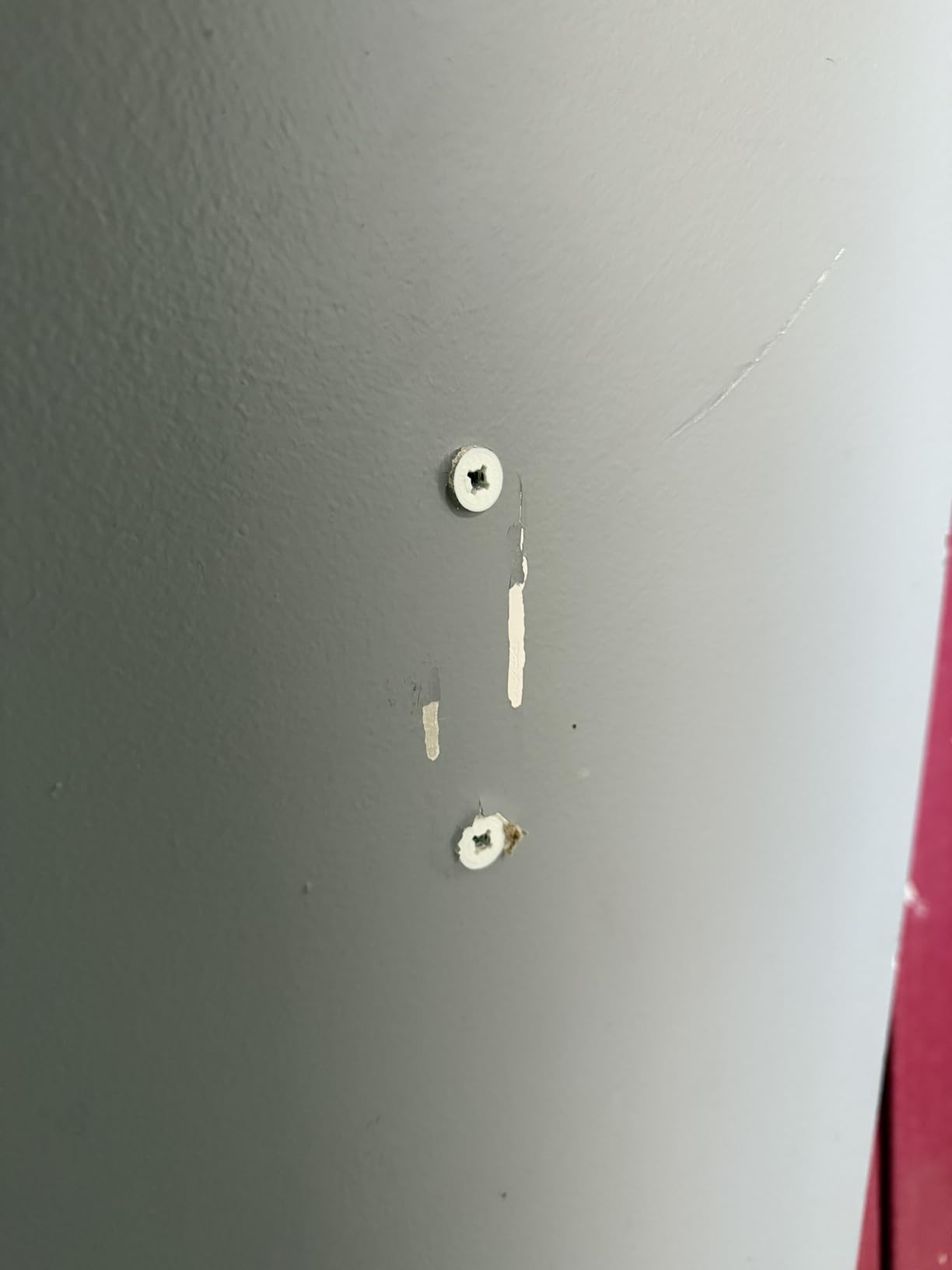
On installation, skip the included drywall anchors if you can. They are reported to pull out under sustained leaning, and a gate at the top of a staircase needs to be anchored into studs or masonry. Locate the studs before you drill rather than relying on the gate to hold itself to hollow wall. The adhesive warning sticker is applied directly and takes some effort to remove cleanly.
Who this gate suits
Families who move a stroller, a vacuum, or furniture through the stair opening regularly and want a completely flat threshold. It is a strong choice at the top of a staircase where a solid mounting surface exists on both sides and the surrounding trim allows a bottom bar to be inconvenient. The 26 to 43 inch range is the widest of the hardware-only options here, and the steel frame handles a dog leaning on it without complaint.
Where it falls short
It requires drilling, so it is not a rental option. The latching consistency is the weakest point in the group, and the 4.2 rating reflects that rather than any safety complaint. At 28 inches it is no taller than a standard gate, so a climbing toddler will need a taller model instead. Expect a little fussy adjustment work on the first install.
5. Babelio PressGuard Pressure Mounted Baby Gate: Best Lock for a Determined Child
Babelio 26-40″ Pressure Mounted Baby Gate for Stairs, PressGuard Dog Gate
- Auto-close is more consistent than on most competing pressure gates
- Triple-lock takes both buttons held while lifting
- Wall cups spread pressure and avoid marking walls
- Force-tested to roughly twice the ASTM F1004 minimum
- Width adapters included for a snug fit
- Small gap between frame and latch closes only as the tension bolts are adjusted
- Tension bolts occasionally arrive with damaged threads
- Bar spacing is wide enough for a small cat to squeeze through
- Opening takes a lift as well as a press
The triple-lock is the reason to look at this gate. You have to hold both the upper and lower buttons while lifting the handle, which turns opening it into a three-step sequence rather than one. Owners with repeat experience describe the auto-close as the most reliable they have used, and the 260 N horizontal force test is roughly twice the 30 lbf ASTM F1004 minimum for push-out resistance.
It fits openings from 26 to 40 inches wide at heights of 30 inches and up, with other sizes available up to 57 inches. It pressure mounts by default, but it also accepts screw hardware mounting for top-of-stairs use, which puts it in a different category from the pure tension gates. The wide wall cups spread the mounting pressure and avoid leaving marks on the surface.
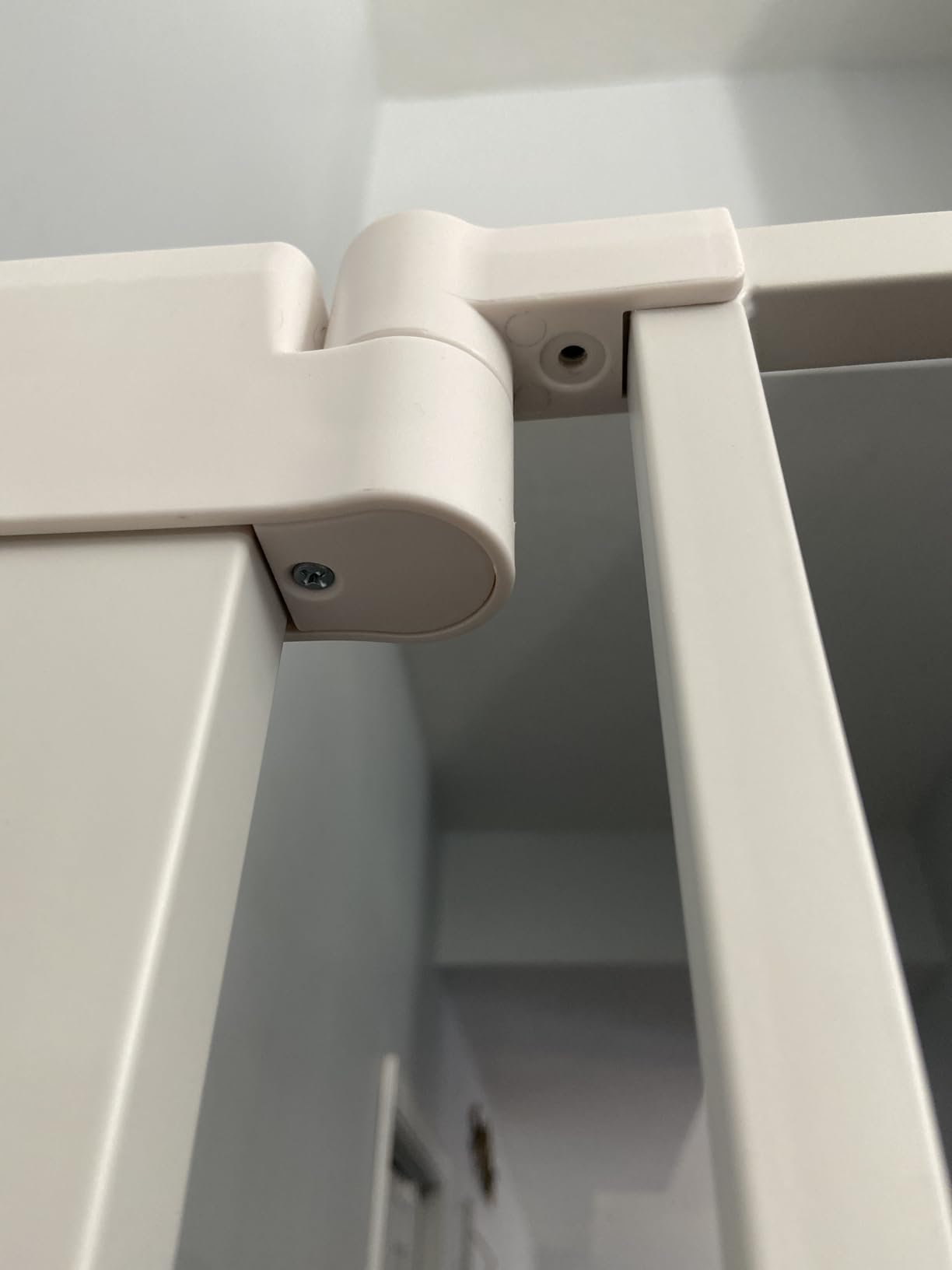
Two practical notes. There is a small gap between the frame and the latch straight out of the packaging, which closes as you tighten the tension bolts, so do not judge the fit until the gate is fully adjusted. And a few buyers have received tension bolts with damaged threads, which turns a fifteen-minute install into an afternoon; check the hardware before you start. The bar spacing is wide enough that a small cat can squeeze through, which matters if you have both a toddler and a small pet.
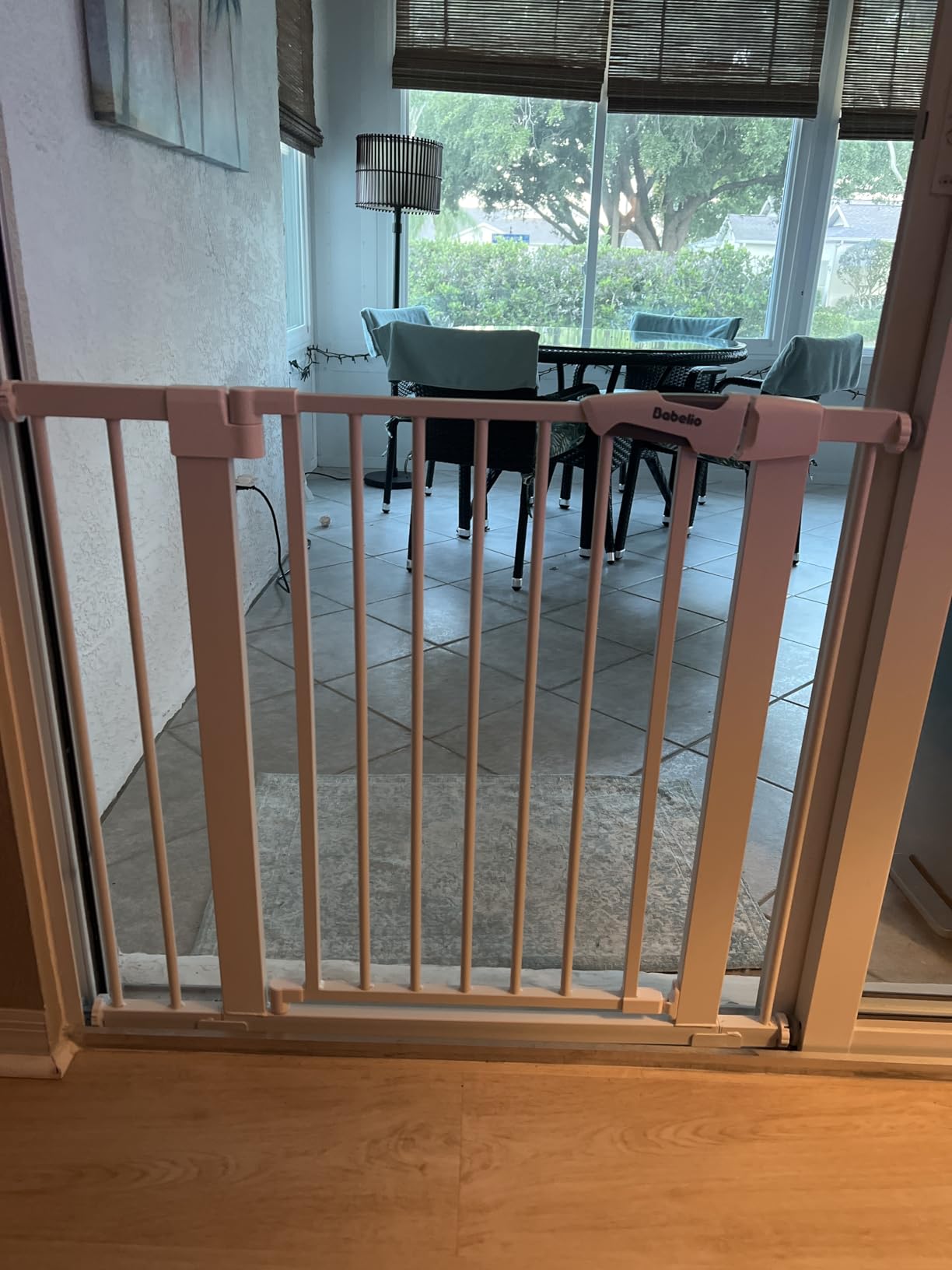
The lift-plus-press opening motion is also worth flagging for anyone with limited strength in one hand. It is secure precisely because it is two-handed in feel, and that same security is the reason it can be awkward while carrying a child on your hip. If one-hand operation while loaded is your top priority, the Cumbor’s single-lever dual lock is a better match.
Who this gate suits
Parents of older toddlers who defeat simple latches, since the triple action is meaningfully harder to work out than a single press. It is a reasonable pick for the bottom of a staircase where the force rating adds margin, or for the top if you commit to the screw mounting option and mount into studs. Households with a small dog will like the auto-close, and the wall cups are kind to painted walls.
Where it falls short
It is a pressure gate first, so it must be screwed down before it belongs at the top of any staircase. The 40 inch maximum width leaves wide landings to other options, and the frame arrives with a latch gap that needs adjustment. Small pets can get through the bar spacing, and the lift-plus-press action is not one-hand friendly under load.
6. Veraste Retractable Baby Gate: Best Space-Saving Option Away From the Drop
- Rolls completely away when not in use
- No bottom rail means no trip hazard
- One-hand operation while carrying a child or groceries
- Works indoors and out
- Soff mesh is gentle on hands and paws
- Not a stair-rated load barrier at the top of a drop
- Mesh sags or loses tension over time
- Mesh gaps will not stop small pets or a determined climber
- Awkward to align near a stair nosing
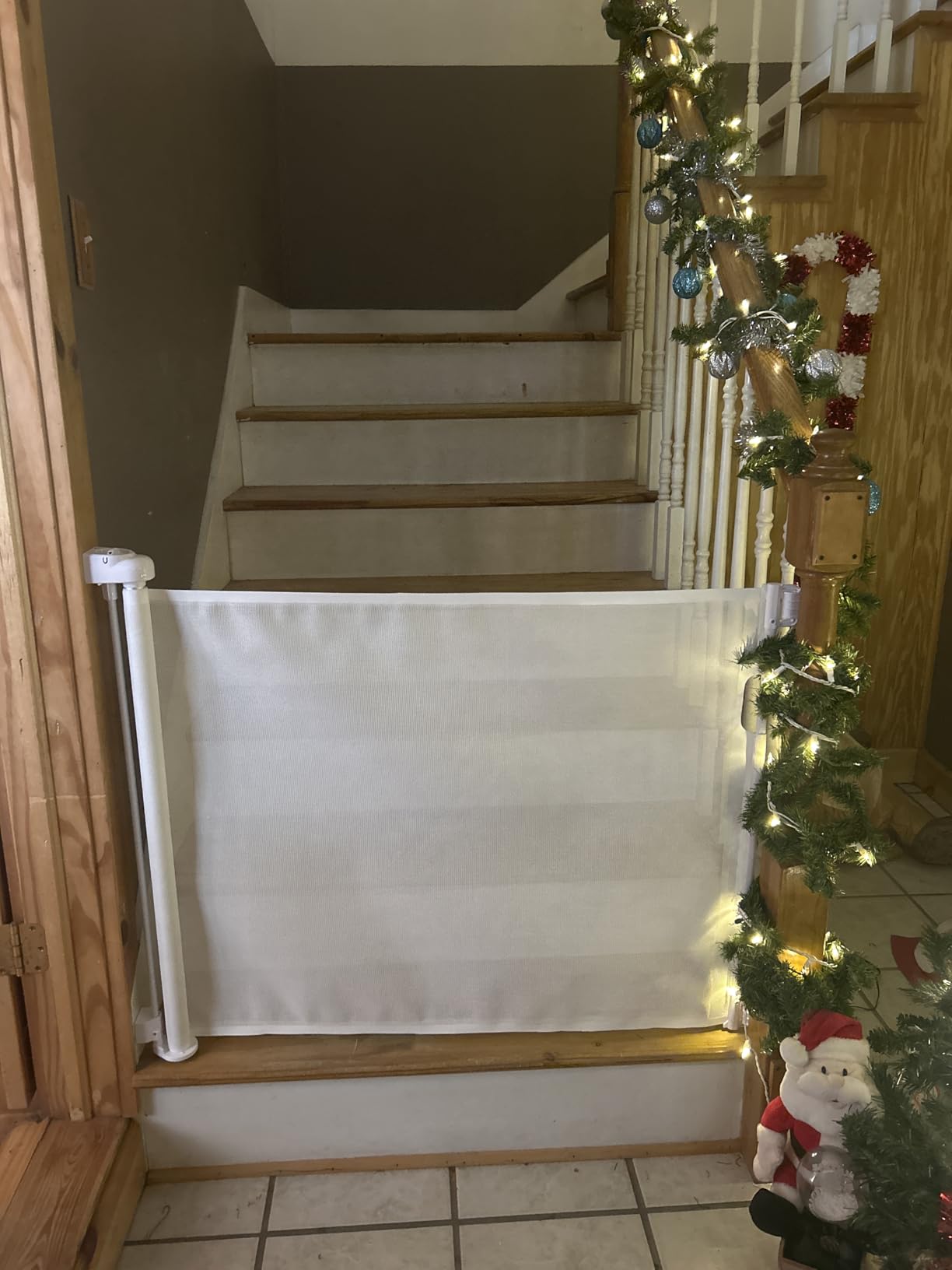
This is a good gate for a doorway or a landing where appearance matters and the drop is not immediately beneath it. The mesh rolls fully into the housing when nobody is passing through, so it does not sit across the opening as a visual and physical obstacle, and there is no bottom rail to step over. The one-hand top knob is genuinely easy to operate with a full load in the other arm.
It extends up to 55 inches wide and stands 33.6 inches tall, which covers a wide doorway and many stair openings at the base of a flight. Installation is light on tools, and owners appreciate that it suits indoor and outdoor use. The soft mesh is comfortable for small hands that pat it while waiting.
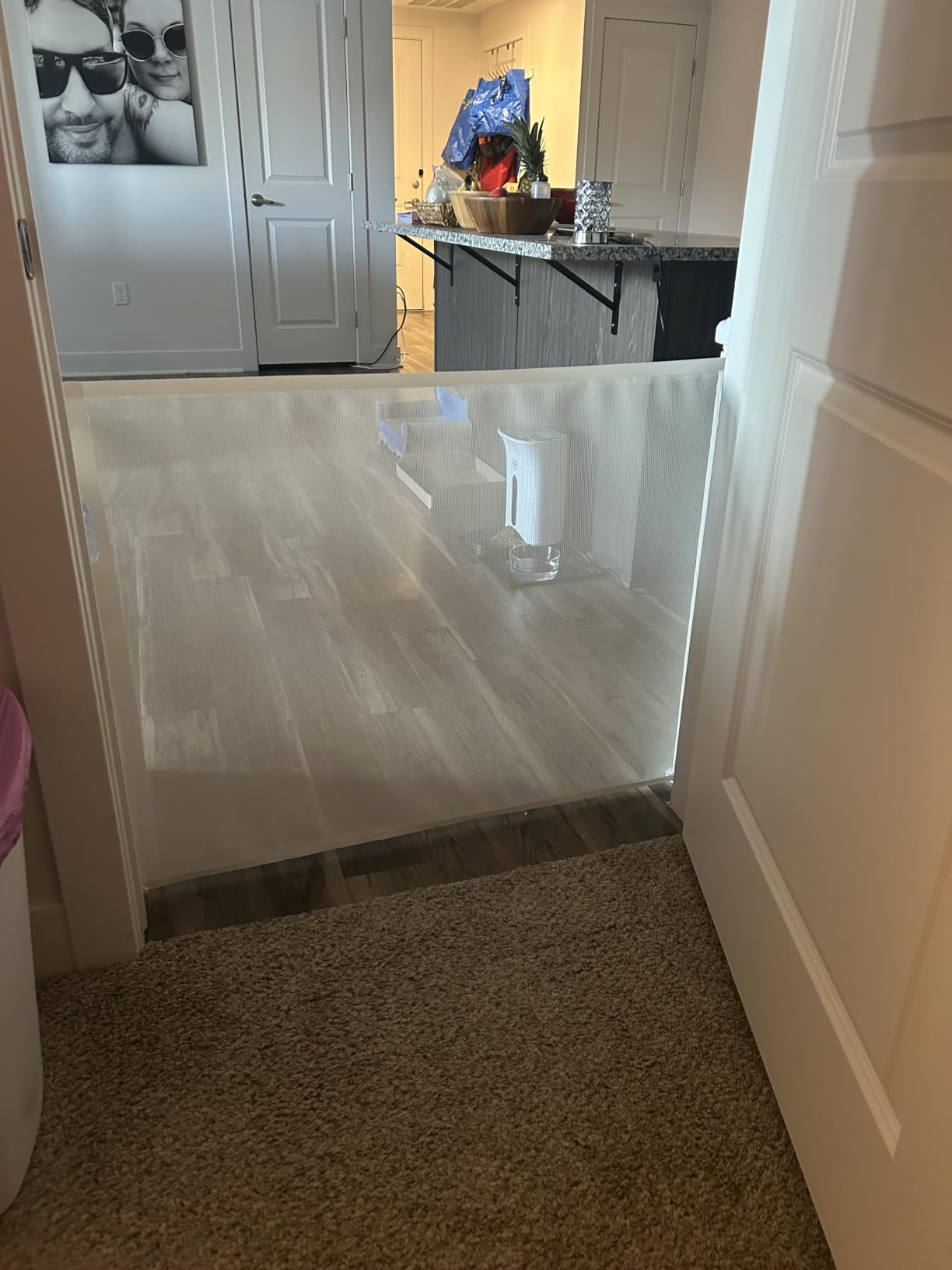
Here is the caveat that matters more than anything else in this section: do not put this at the top of a staircase. There is no stated load rating for the mesh, no rigid frame to take a body-slam, and no published force testing comparable to the 260 N figure on the Babelio PressGuard. A retractable gate is a convenience barrier. It is exactly what many people want in a wide opening where a swing gate would be in the way, and it is the wrong tool for a fall.
Over time the mesh loses tension, and the latch has to be locked every time to keep it taut, which is a small daily habit that people forget. The mesh gaps will not stop a small pet or a determined climber either. Reviewers consistently rate it as well suited to children and medium pets rather than small animals, and note that aligning the housing near a stair nosing is fussy.
Who this gate suits
Homes where a permanent gate would be visually or practically unwelcome, such as an open-plan living area, a wide doorway between rooms, or a landing with no immediate drop. It works for keeping a toddler in a play area or a pet in a room, and the roll-away design is ideal for renters who need the opening clear most of the day. The 33.6 inch height also helps with a climbing toddler compared to a 26-inch plastic gate.
Where it falls short
It is not a stair-rated fall barrier, and the mesh loses tension over time. Small pets pass through the mesh, a determined climber can push at it, and the housing needs careful alignment near a stair nosing. Treat it as a convenience gate, and use a screwed-in metal gate anywhere there is a drop.
7. PRObebi Retractable Baby Gate: Best Retractable Option for Homes with Baseboards
PRObebi Retractable Baby Gates for Stairs & Doorways, Dog Gate 0-54″ W × 34″ H, Black
- Retracts flat against the wall for a clean look
- Adjustable lower bracket clears baseboard trim without scratching it
- Two-step double lock is harder to defeat than a single push
- 54 inch span covers most openings in one unit
- See-through mesh lets you watch a child on the other side
- Mesh tension depends on the latch staying locked
- Retractable frames are less rigid than fixed metal gates
- Mesh openings will not block small pets
- Requires anchoring at one side so it is not a no-drill install
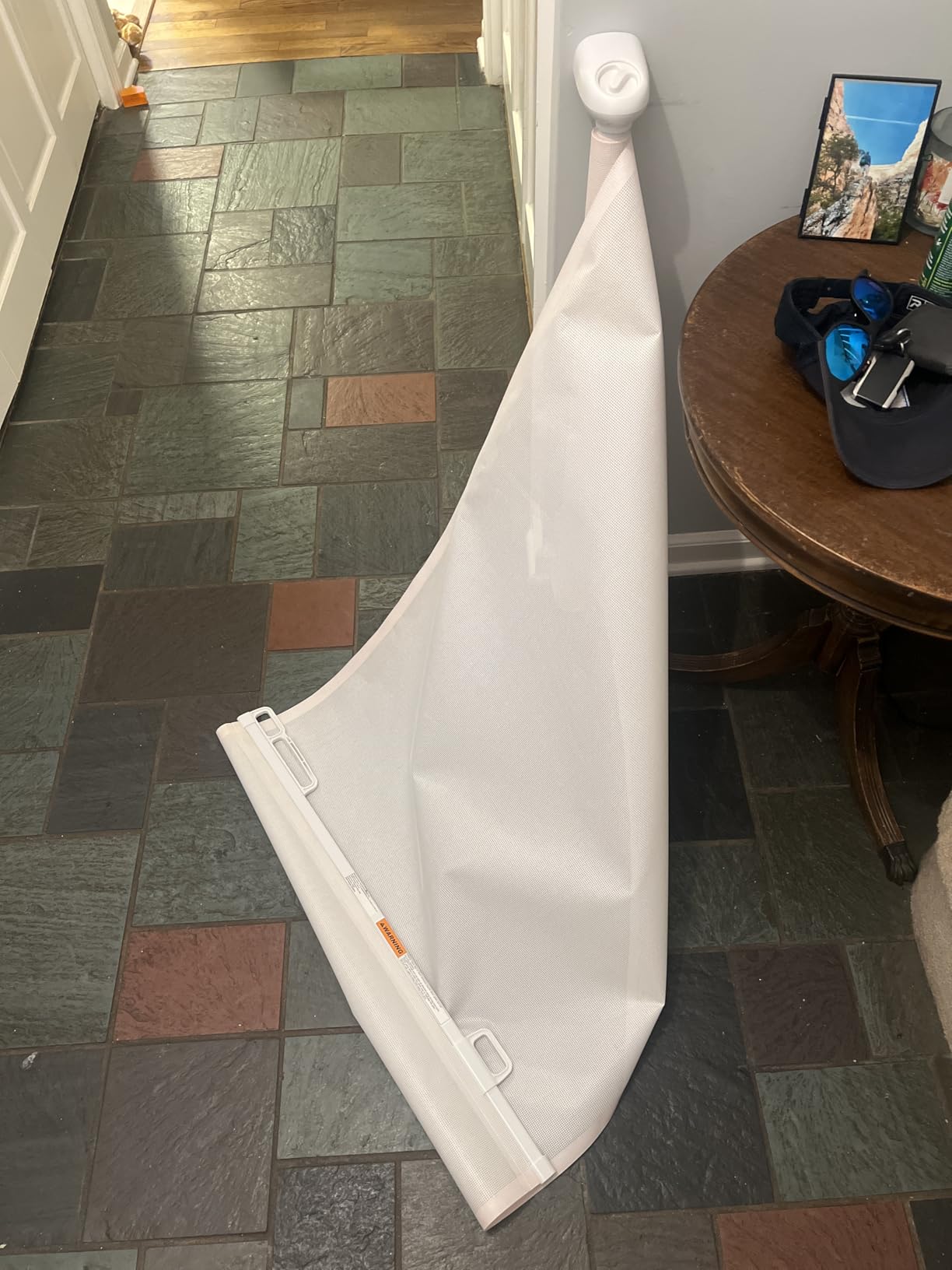
The defining feature is the lower bracket, which slides up and down on the frame so you can align the mounting point above profiled baseboard rather than pressing against it. That single design decision solves the trim problem that forces people to improvise with shims on other gates, and it is the reason this one is worth considering over a comparable retractable model.
It spans 0 to 54 inches wide at 34 inches tall, with 72 inch and 110 inch versions also produced, so one unit can cover a wide opening that would need two fixed gates. The two-step double lock requires pressing down and rotating, which is more involved for a child than a single-push latch. Seeing through the mesh to the other side is a practical advantage when you want to know what is happening in the room beyond.
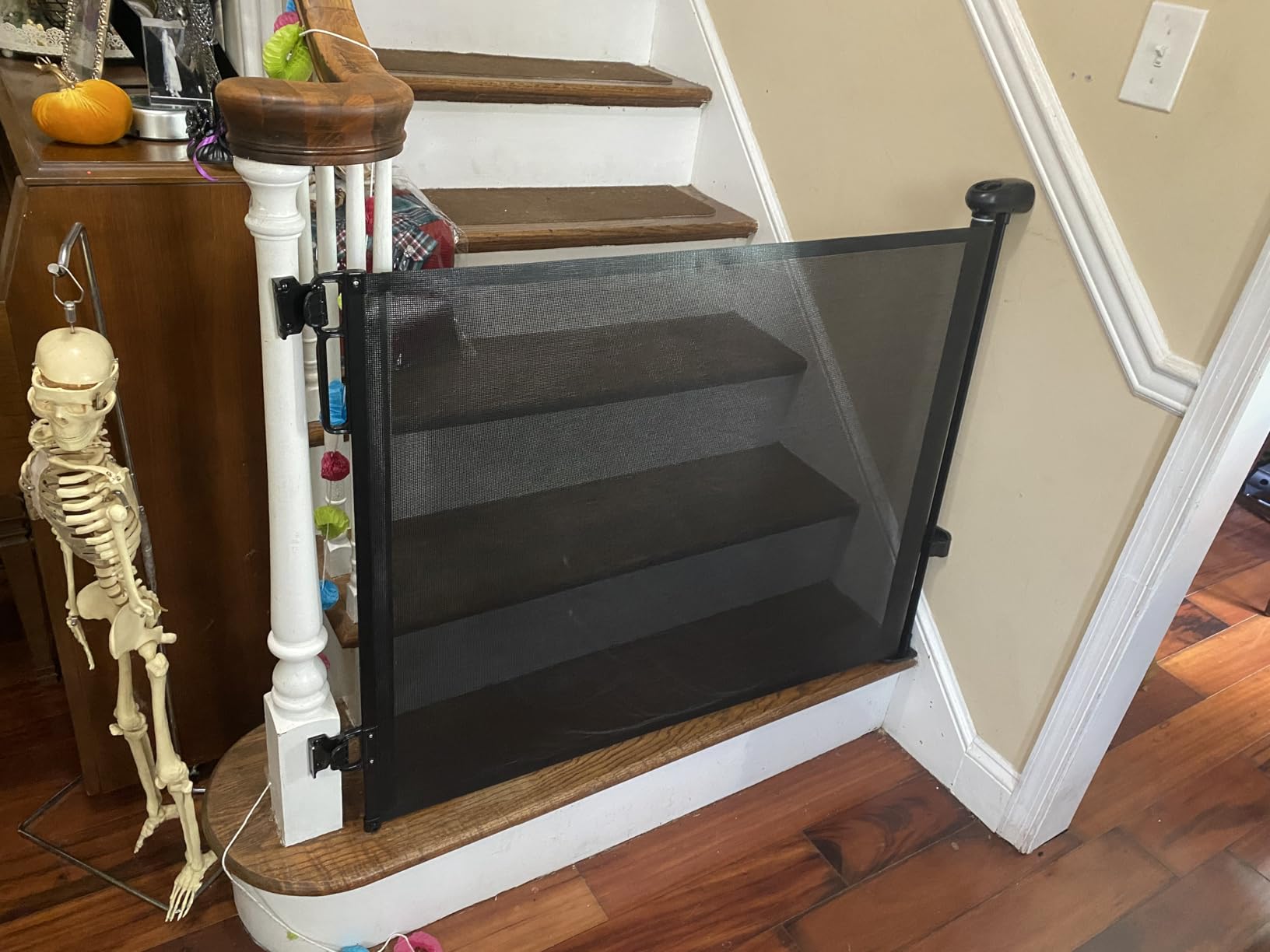
Same core caveat as the previous retractable option: the frame is less rigid than a fixed metal gate, there is no stated load rating for a fall, and the mesh loses tension with use unless the latch is always locked. That is a real limitation rather than a defect, and it is why we rate this one below the hardware-mounted options for any staircase. The 34 inch height is a genuine plus over most plastic gates, but height alone does not make a soft barrier a fall barrier.
Note also that it is not a fully no-drill installation. One side is anchored, so you will be putting at least one screw into a wall, and you need a solid surface there. Mesh openings will not block a small pet pushing through, which matters in homes with a cat or a small dog. The included hardware, anchors, and screws are complete, which removes one common reason installs stall.
Who this gate suits
Renters and homeowners with profiled baseboard trim who want to avoid shimming or marking the wood. The 54 inch span covers a wide doorway, a wide opening between rooms, or the bottom of a staircase where a gate has to double as a room divider. Families who want a visual check through to the other side will like the see-through mesh, and the taller 34 inch frame helps with an early climber.
Where it falls short
It is not a stair-rated fall barrier, and the mesh loosens over time. One side still needs anchoring, so it is not a genuinely no-drill option. Small pets pass through, and the retractable frame is flexier under load than a bolted steel panel. For the top of a staircase, choose a hardware-mounted metal gate instead.
8. Toddleroo by North States Supergate Ergo: Best Budget Pick for the Bottom of the Stairs
- Light and compact enough to move between openings yourself
- Pressure mount leaves no holes when a semi-permanent barrier is not needed
- Holds steady when a child leans on it once the hooks are engaged
- Neutral sand finish blends into most interiors
- JPMA certified from a long-established brand
- 26 inch height is low next to most metal stair gates
- Plastic wall connectors are less durable than metal under heavy leaning
- Instructions are confusing for first-time installers
- Hardware ships between the panels making it awkward to retrieve
This is the least expensive way to put a real barrier at the bottom of a staircase, and it is the only JPMA-certified option in our group. It adjusts from 26 to 42 inches wide and pressure mounts without a single hole, so you can move it between a doorway, a playroom, and the base of a flight as your child’s movement changes. It is light enough to lift and reposition single-handed.
The ergonomic easy-press handle opens with one hand and locks securely, and the frame is designed so the vertical elements are difficult for a child to climb. Owners often note that it feels more durable than the wooden gates it replaced, and the sand or ivory finish is neutral enough to disappear into interior trim.
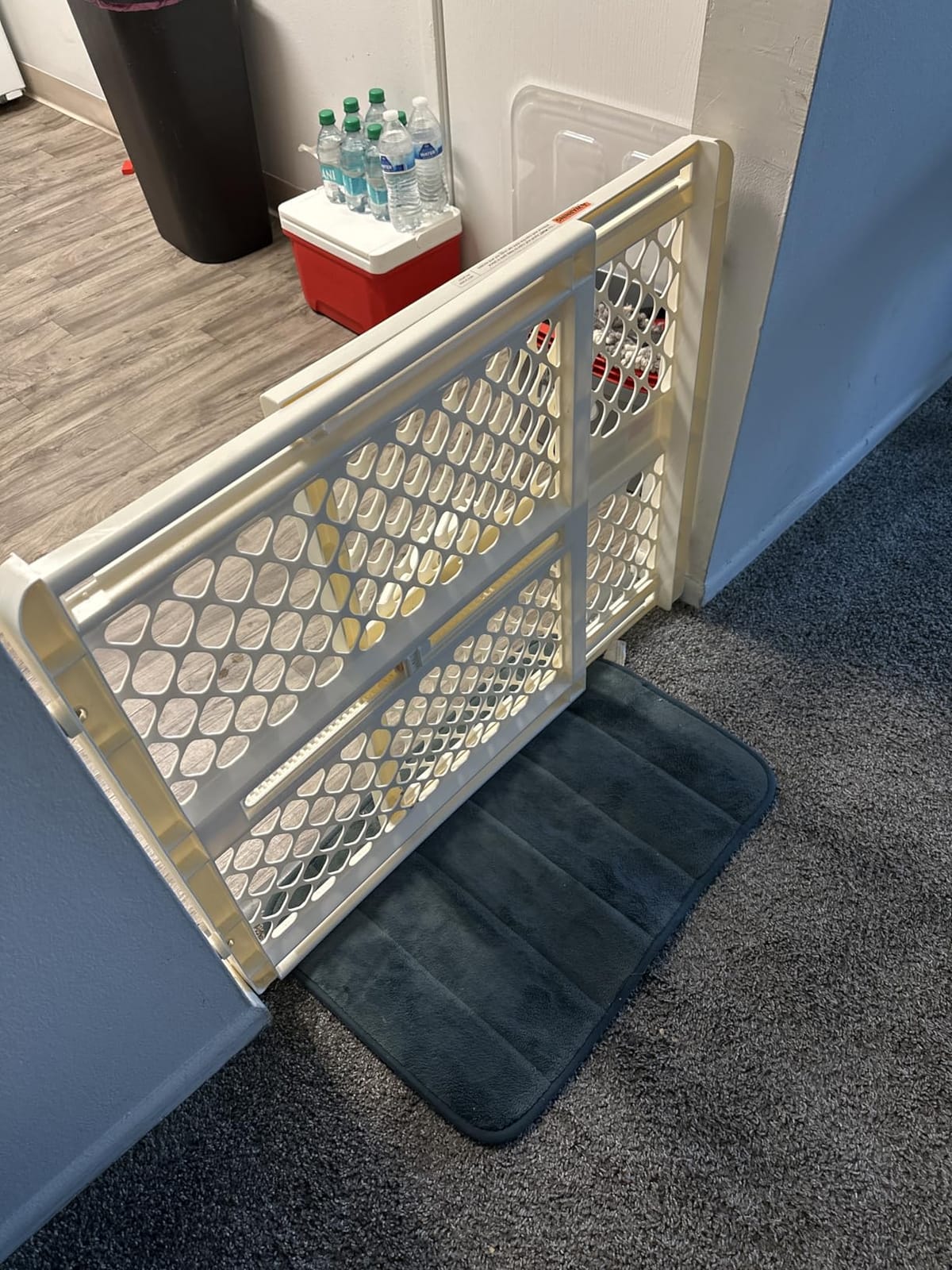
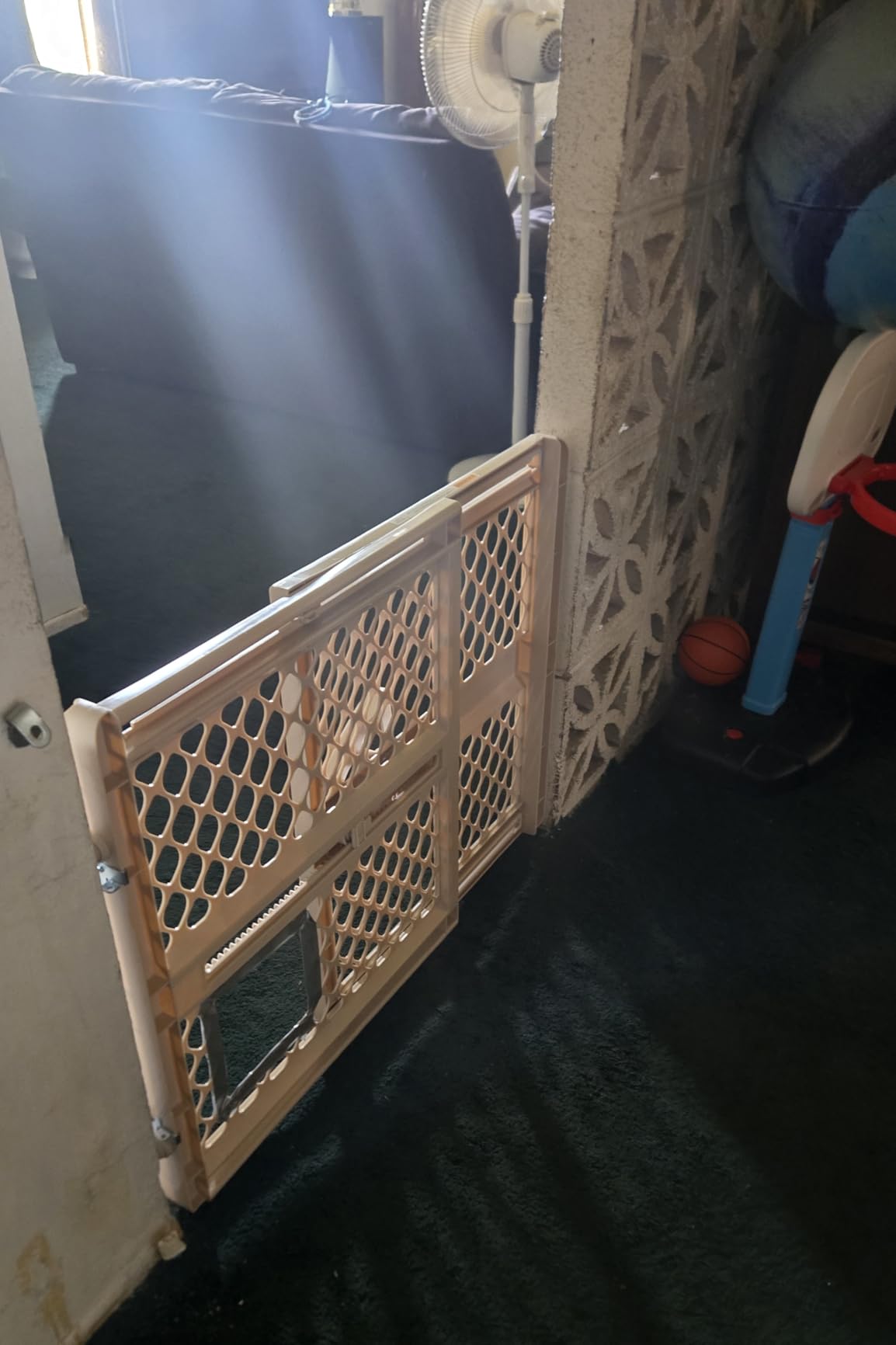
It does accept hardware mounting for stairway use, and that is a meaningful detail: the manual specifies hardware mounting as required for stairs. Where the surface allows it, screw it down. What holds it back is the 26 inch height, which is the shortest frame in the group. For a baby at seven months that is entirely adequate. For a toddler approaching two years old, the top rail sits at a height a determined child can start working at, and the plastic wall connectors are the first part likely to give under sustained leaning.
The packaging is also worth a word. The mounting hardware sits between the two gate panels, which is genuinely awkward to retrieve before you have the thing open in front of you, and the instructions are not well organized for a first-time installer. Neither is a safety problem. Both cost you ten minutes on a Saturday morning.
Who this gate suits
Families on a tight budget who need a reliable barrier at the bottom of a staircase, in a doorway, or across a playroom opening, and who want to move it as their child grows. Parents who want a certified product from an established manufacturer will like the JPMA certification and the made-in-USA manufacturing. It is also a sensible second gate for a playroom once a heavier metal unit is dedicated to the staircase.
Where it falls short
At 26 inches tall it is the shortest option here, and that is the deal-breaker for a climbing toddler. The plastic wall connectors are less durable than metal when a child leans or repeatedly pushes. It must be screwed down for stairs, and the instructions and packaging are the least welcoming in the group.
Baby Gate Buying Guide for Stairs
Buy for your stairwell, not for the badge on the box. The five factors below decide whether a gate fits your home safely, in roughly the order they matter.
Mounting type comes first
At the top of the stairs, hardware mounting is the only acceptable answer. Look for a gate that includes wall brackets, screws, and instructions that reference anchoring into studs or masonry, and confirm you have a solid surface on both sides. A gate that only lists pressure mounting is a bottom-of-stairs or doorway product, no matter what else it claims.
Pressure mounting is fine at the foot of a flight and across interior doorways, and it is the cheapest way to relocate a gate as your child grows. The failure mode is the reason for the top-of-stairs rule: a tension gate depends on friction, and a child falling onto the panel pushes outward with a force that friction alone will not reliably resist.
Opening width decides the model
Measure at the narrowest point, as covered above, then check that number against the published range rather than the maximum. All eight gates here list their ranges, and they are not interchangeable: the 26 to 40 inch options will not cover a 42 inch landing, and the 30 to 48 inch option covers more openings than anything else in the group. If your opening falls outside every range, an extension panel is the answer, not a gate forced past its stop. Sizing the whole route matters too, from the landing carpet to the tread surface underfoot, since a gate that fits perfectly still leaves a slip risk on the steps themselves.
Gate height should outpace your child’s height
A 26-inch gate works for a crawler and fails for a two-year-old. The useful rule is to compare the top rail of the gate against the top of your child’s head when they stand flat, and to have several inches of margin beyond that. The 36-inch option in this group is the one to buy if your child is already tall or already tries to climb. Once a child is taller than the gate, the gate has become furniture, and it is time to move on.
Swing direction and thresholds are safety details
Check whether the door can be set to swing only away from the stairs. A one-way swing removes the risk of a gate opening out over the drop or blocking the path. Also look at the bottom edge: a bar at the base is something to step over every time you pass through, and a no-bottom-bar design removes that entirely. Auto-close matters too, because a gate left ajar is a gate that is not there.
Certification is a baseline, not a feature
Look for JPMA certification or testing to the ASTM F1004 standard, which sets minimum horizontal push-out force. One gate in this group is JPMA certified, and the Babelio PressGuard is documented as tested to 260 N, roughly twice the ASTM minimum. Certification does not replace correct installation, but a gate with no stated testing at all is a poor choice for a staircase.
What about rentals and no-drill options?
At the top of the stairs there is no genuinely safe no-drill option, and any source telling you otherwise is putting your child at risk. At the bottom of the stairs, a pressure-mounted gate, a retractable gate, or a banister-to-banister fabric barrier are all reasonable compromises, with the limitation that none will stop a determined toddler or a medium dog for long. In a rental, the practical route is a pressure gate at the base of the flight, a doorway gate moved as your child grows, and a talk with your landlord about a hardware-mounted top-of-stairs gate, which is a small drilling job.
Gates we would skip and why
We deliberately left out several gate types that rank in this category. Generic pressure-mounted tension gates marketed for stairs with no hardware option and no stated force testing fail the top-of-stairs rule by definition, and auto-close pressure gates with weak aggregate ratings tend to have latch and frame complaints that show up in the one-star reviews. Retractable gates without any load rating, which is most of them, belong in doorways rather than on a landing. We also left out tall plastic play-yard panels marketed for stair use, which are containment for a play space and not a fall barrier.
Beyond the gate itself, there are a few installation mistakes that turn a good gate into a decoration. Mounting into hollow drywall instead of studs is the most serious, because the bracket pulls out under exactly the load the gate is meant to resist. Capping the top hinge with wall moulding prevents the panel from seating flush, which is a problem one parent solved with a wood block. Installing so the gate swings toward the stairs, and leaving the panel unable to open fully because it hits a wall, both leave you with a compromised barrier.
One thing worth saying plainly: a gate is not the whole job. Parents on child development forums consistently describe letting a toddler practise walking up and down stairs with an adult directly behind, which builds the skill rather than only blocking it. The gate buys you the months before that skill is ready, and the two approaches work together rather than against each other.
Frequently Asked Questions
What is the safest type of baby gate for use on stairs?
A hardware-mounted gate screwed into studs or solid masonry on both sides is the safest type for stairs, with a latch that requires an adult-sized hand to release. Pressure-mounted tension gates are acceptable at the bottom of a staircase but unsafe at the top, because a falling child’s weight pushes the panel outward and a friction-held gate can shift or pop free under that load.
What is the best safety gate for babies on stairs?
The best gate depends on your stairwell rather than on any single brand. Choose a hardware-mounted metal gate screwed into studs for the top of the stairs, match the gate’s published width range to your narrowest measurement, and pick a height that stands taller than your child’s head. A dual-lock gate with a wide walk-through door is the most practical all-round configuration.
What is the most secure baby gate for a staircase?
An all-metal gate anchored into studs or masonry on both mounting sides is the most secure, with a latch that needs a deliberate two-part action rather than a single press. Set the door to swing only away from the stairs if the gate supports a one-way setting, and treat a pressure-mounted gate of any height as unsuitable for the top of a drop.
Is it better to put a baby gate at the top or bottom of stairs?
Top of the stairs first, because a fall from the top causes far more severe injuries than a tumble at the base. Gating the top requires a hardware-mounted gate screwed into studs, while the bottom of the stairs can use a pressure-mounted gate, since the consequence of failure is far less serious and the barrier is doing a containment job rather than a fall-barrier job.
Is there a baby gate that doesn’t require drilling for stairs?
There is no genuinely safe no-drill option for the top of the stairs. Pressure-mounted gates and banister-to-banister fabric barriers are the compromises, and both can be shifted or pushed by a determined toddler or a medium pet. At the bottom of a staircase a pressure gate is a reasonable no-drill choice, and retractable gates work for doorways where the visual obstruction matters more than the barrier.
What can you use instead of a baby gate for stairs?
The alternatives are banister-to-banister fabric gates that roll up out of the way, retractable mesh gates for wide doorways, and a door-mounted slide gate for a doorway rather than a landing. Each has a real limit: fabric and mesh gates lack a rigid frame and a load rating, so none of them is a substitute for a screwed-in metal gate at the top of a staircase.
Before you settle on a gate, it is worth reading up on the rest of your stairwell, from stair tread mats that keep footing steady to a canister vacuum made for stairs, since a gate only helps if the surrounding surfaces are not part of the problem.
Our Single Best Pick for Stairs
The Cumbor 30-48 in Baby Gate for Stairs is the one we would put at the top of most stairwells. It spans the widest range of openings in the group, mounts either by pressure or by bolts into studs, opens to a 22.3 inch walk-through door, and carries the highest review count we examined alongside a dual lock that toddlers cannot operate. For a bottom-of-stairs barrier on a tighter budget, the InnoTruth wide gate is the better value, and for a toddler who climbs, the COMOMY extra-tall frame is the right height.
Measure your opening at the narrowest point before you order anything, and screw the top-of-stairs gate into studs rather than drywall. Those two steps prevent almost every failure we saw.