

A picture frame reveals every small mistake at its corners. The best framing miter saws for picture frames make repeatable 45-degree cuts, hold molding securely, and give you a visible reference at the cutline; those three things matter far more here than brute cutting capacity.
For most home framers, I would start with a corded sliding compound miter saw, then fit it with a sharp fine-tooth blade made for clean wood cuts. A compact 10-inch saw is plenty for narrow to medium frame stock, while a 12-inch model gives more room for wide moulding, deep profiles, and occasional trim work.
We reviewed the actual listing data for eight available saws: blade size, bevel arrangement, guide system, stated capacities, included blades, ratings, and review counts. I have kept the focus on the practical question a framer faces: can this saw help produce four matching pieces that close without a bright gap at the corner?
A miter saw is the usual powered saw for this job because its rotating base sets left and right miter angles directly. A table saw with a dependable sled can also make excellent frame parts, but a miter saw is generally the faster choice for repeated, supported crosscuts in molding.
The published reviews also point to an important limit: no saw should be treated as accurate simply because it is new. Users repeatedly flag calibration and blade quality as the difference between a near-perfect picture frame miter cut and a frustrating gap, so plan to check the fence, detent, and blade before cutting your finished stock.
Table of Contents
The top 3 picks for picture-frame miter cuts are these models in 2026
The VEVOR 12-inch combines a 60-tooth blade, LED alignment, a sliding system, and dual bevel action, making it the most rounded option in this group. Hoteche offers a straightforward 10-inch sliding layout with a laser guide, while MarvTool makes sense for a lighter saw where portability and simple frame work come first.


Hoteche 10-Inch Sliding Compound Miter Saw
- Laser guide
- 15-amp motor
- Sliding capacity
- Extension bar
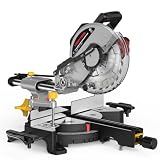
MarvTool 10-Inch Sliding Compound Miter Saw
- 25.6-pound weight
- 5000 RPM
- Extension table
- Vise clamp
The cards above are a starting point, not a substitute for checking a saw’s squareness with scrap molding. For a frame maker, a guide line is helpful, but a correctly adjusted fence and a fresh blade have the final say.
The best framing miter saws for picture frames in 2026 are compared below
This overview covers every model in the supplied product list. Read the individual notes after it because dual bevel, sliding travel, weight, included blade tooth count, and guide type affect picture-framing work in different ways.
| Product | Specifications | Action |
|---|---|---|
| VEVOR 12-Inch Sliding Compound Miter Saw |
|
Check Latest Price |
| Hoteche 10-Inch Sliding Compound Miter Saw |
|
Check Latest Price |
 DOVAMAN 12-Inch Dual-Bevel Miter Saw DOVAMAN 12-Inch Dual-Bevel Miter Saw |
|
Check Latest Price |
| MarvTool 10-Inch Sliding Compound Miter Saw |
|
Check Latest Price |
 WEN MM1213T 12-Inch Dual-Bevel Miter Saw WEN MM1213T 12-Inch Dual-Bevel Miter Saw |
|
Check Latest Price |
 DOVAMAN Updated 10-Inch Sliding Miter Saw DOVAMAN Updated 10-Inch Sliding Miter Saw |
|
Check Latest Price |
 WEN MM1215 12-Inch Dual-Bevel Miter Saw WEN MM1215 12-Inch Dual-Bevel Miter Saw |
|
Check Latest Price |
 VEVOR 10-Inch Sliding Compound Miter Saw VEVOR 10-Inch Sliding Compound Miter Saw |
|
Check Latest Price |
Ratings in the cards reflect the supplied listing data rather than a claim that every unit will arrive calibrated. That distinction is especially important when the work is four decorative parts whose errors accumulate at every corner.
1. VEVOR 12-Inch Sliding Compound Miter Saw is the most complete framing choice
- 60-tooth blade included
- LED alignment
- Dual bevel action
- 5000 RPM motor
- Only 40 listed reviews
- 46.43-pound saw
This VEVOR is the strongest all-around entry because its listed configuration already suits fine framing better than the coarse blades that often ship with jobsite saws. The 12-inch, 60-tooth blade, LED precision alignment system, and stated 5,000 RPM give you a solid foundation for clean crosscuts in wood molding.
The sliding axial system matters when a frame project includes wide profiles or when the same saw will cut shelves, trim, or wider boards. Its 0-to-45-degree bevel capability in both directions is more flexibility than a simple square frame requires, but it is useful for profiles that call for bevel work or for other woodworking tasks.
The supplied data lists a 4.6 rating from 40 reviews, with 74 percent rated five stars. That is a positive early signal, although the comparatively small review base means I would inspect the factory settings carefully before trusting a detent on final material.
At 46.43 pounds, this is not the saw I would choose to lift off a shelf before every small project. Give it a stable bench, add auxiliary support for long molding, and its larger platform becomes much more appealing for repeatable work.
The LED cutline is useful for confirming a picture-frame mark
An LED alignment system can show where the blade will land without relying on a laser that may need its own adjustment. I would still lower the unplugged blade onto a penciled test mark first, because the kerf edge—not the center of a bright line—is what determines the finished length.
For a four-sided frame, cut a scrap at 45 degrees, flip the matching scrap into the mating position, and close the two faces together. If the joint has a gap on either the inside or outside edge, correct the saw before cutting the actual molding.
The 12-inch format is best when frame profiles are wide
A 12-inch blade gives more reach than most basic picture frames demand, so this model makes the most sense if your molding is broad or your workshop also handles trim and laminated stock. The included 60-tooth blade is a better starting point for wood molding than the 36- or 40-tooth blades elsewhere in this list.
Thin delicate stock can still chip if it is unsupported. Back up the exit edge with sacrificial wood, hold the molding flat against the fence, and let the blade reach speed before feeding it down slowly.
2. Hoteche 10-Inch Sliding Compound Miter Saw is a practical compact option
- Laser guide
- 15-amp motor
- Sliding design
- Accessory kit
- Single bevel only
- 40-tooth blade included
The Hoteche uses a 10-inch blade and a 15-amp, 4,500 RPM motor in a 34.9-pound sliding package. That combination is sensible for someone whose main work is picture frames, narrow trim, and small woodworking rather than oversized construction materials.
Its listed 340 mm by 70 mm capacity at zero degrees shows why the slide is valuable: a 10-inch saw can still span much wider stock than a fixed-head tool. For ordinary frame molding, the real gain is not capacity but being able to position a long piece comfortably across the fence.
The 4.5 rating comes from 138 reviews, with 76 percent of them recorded as five-star ratings in the supplied summary. It includes an extension bar, dust bag, wrenches, and replacement carbon brushes, which is a helpful collection for setting up a first dedicated cutting station.
Its limitation is clear: this is single bevel, with bevel cutting up to 45 degrees left. That does not prevent standard 45-degree miter cuts for flat picture-frame stock, since those are made by rotating the base, but it makes multi-angle profile work less convenient.
The laser guide is best treated as a positioning aid
A laser can speed up lining up a pencil mark, particularly when you are trimming a paired piece to final length. Do not use it as the calibration reference; check the actual blade path with an unplugged saw and save a labeled test offcut once the fence is true.
The stock blade is listed at 40 teeth. For painted or hardwood frame molding, I would consider a finer crosscut blade compatible with the saw after following the manufacturer’s fitment and safety directions.
The single-bevel head suits straightforward frame corners
Picture-frame corners normally need the saw table set at 45 degrees left or right, not a bevel tilt. That makes the single-bevel design a reasonable tradeoff if your work stays with flat molding and you want a less complicated head to set up.
Mark each board from the inside edge of the frame, then cut one end and sneak up on the second end with test fits. This approach makes the visible inner opening consistent even if the molding’s outside profile varies.
3. DOVAMAN 12-Inch Dual-Bevel Miter Saw is made for wide material and preset angles
- Dual bevel
- 9 positive stops
- Laser guide
- Large stated capacity
- 53.9-pound weight
- 40-tooth blade included
DOVAMAN’s 12-inch model brings a stated 4.2 by 13-inch maximum cutting capacity, a 15-amp pure-copper motor, dual bevel action from zero to 45 degrees, and nine preset base angles. It is a capable size for a maker who occasionally works on wide shadow-box frames or projects beyond framing.
The nine positive stops are welcome because repeatability starts with finding the same setting each time. Still, positive stops are mechanical reference points, not proof of an exact 45-degree cut, so a machinist square, a reliable 45-degree reference, and two test pieces remain part of the process.
This saw holds a 4.4 rating across 204 supplied reviews. Its 68 percent five-star share and the larger review total offer more feedback than some other entries, but the provided information also identifies it as the heaviest saw here at 53.9 pounds.
The supplied blade is a 40-tooth TCT blade. It can make functional cuts, yet picture frames with stain-ready faces often benefit from stepping up to a finer compatible crosscut blade rather than expecting a general-purpose included blade to leave the final finish.
The large capacity helps when moulding gets wider
Wide or tall molding can make a compact saw feel cramped against its fence. The stated 13-inch width capacity gives this DOVAMAN room for those broader profiles, while the slide lets you keep the workpiece supported instead of trying to reposition it midway through a cut.
For small narrow molding, build a zero-clearance sacrificial fence or backer only if it does not interfere with the saw’s guard, travel, or instructions. Proper workholding keeps short pieces from shifting and reduces splintering where the blade exits.
The ambidextrous controls suit shared workbenches
The product listing describes an ambidextrous trigger switch, a useful detail in a shared studio or for left-handed users. Comfort is not just a convenience: a stable grip and a clear view of the mark make it easier to lower the head in a controlled, unhurried motion.
Because this saw is heavy, consider it a bench-based tool rather than a portable framing kit. A level surface and material supports on both sides will do more for matching miters than moving a large saw around between cuts.
4. MarvTool 10-Inch Sliding Compound Miter Saw is the lightest full-size option
- Light 25.6-pound build
- 5000 RPM
- Extension table
- Vise clamp
- Single bevel only
- 36-tooth blade included
The MarvTool is the lightest listed saw at 25.6 pounds, so it stands out when the tool must come out for a weekend project and then go back into storage. It has a 10-inch blade, 15-amp motor, stated 5,000 RPM speed, extension table, transparent guard, and vise clamp.
That low weight does not automatically mean less useful for frames. In fact, a compact miter saw for picture frame making can be easier to place on a rigid temporary bench, provided the bench itself is stable and the molding has support at both ends.
The listing data reports a 4.4 rating based on 149 reviews, with 70 percent five-star ratings. The saw is intended for wood, plastic, and soft metal, but picture-frame work calls for a clean wood-focused blade and slow, controlled cuts rather than an all-purpose approach.
The included blade has 36 teeth, the coarsest stated blade in this group. I would regard it as a blade to evaluate on scrap rather than the default choice for delicate veneer, narrow hardwood molding, or a visible stained frame edge.
The extension table helps keep long molding level
Long pieces sagging off the side of a saw can rotate a miter just enough to spoil the face alignment. The included extension table provides some support, and additional level stands or blocks can keep the molding at the same height as the saw bed.
Use the vise clamp only where it can secure the stock without bruising the finished face. For fragile profiles, protective scrap between the clamp and molding is often a better choice than squeezing the decorative edge directly.
The 10-inch blade is enough for common frame profiles
A 10-inch saw is not a lesser picture-frame saw simply because it has less reach than a 12-inch machine. Most frame stock is modest in width, and the smaller blade can be a good fit when the priority is controlled crosscuts rather than large construction capacity.
This single-bevel saw should be chosen for standard mitered corners, not for a workflow that requires frequent bevel changes. Take a moment to lock the miter setting at 45 degrees, and verify it with paired offcuts before running your full set of parts.
5. WEN MM1213T 12-Inch Dual-Bevel Miter Saw has broad cutting capacity
WEN 15-Amp 12-Inch Dual-Bevel Sliding Compound Miter Saw with Laser (MM1213T)
- 13-inch stated width
- 48-tooth blade
- Dual bevel
- Miter lock
- Longer listed shipping window
- 1500-watt motor
The WEN MM1213T lists capacity for boards up to 13 inches wide and 4.1 inches thick, a dual-bevel head, and a 48-tooth carbide-tipped blade. Those details make it a credible choice for someone who wants picture framing capability without giving up the option to cut much wider stock.
The onboard laser, five positive miter stops, and a lock for angles between the stops give the operator several ways to set up a cut. For frame work, the ability to lock an angle after a careful calibration can be more useful than having a large list of preset positions.
Its supplied rating is 4.4 from 149 reviews, and the listing reports 69 percent five-star ratings. The data lists 1,500 watts, lower than several 15-amp entries, though a picture-frame cut places much less demand on a motor than thick construction lumber.
The included 48-tooth blade occupies a middle ground: finer than the 36- and 40-tooth options but not as fine as the 60- or 80-tooth blades in this roundup. Test it in the species and profile you plan to frame before deciding whether an upgrade is necessary.
The miter lock supports precise custom-angle work
Not every frame is a rectangle. When a project calls for hexagonal, octagonal, or custom geometry, a miter lock at an angle between the detents is useful after you establish the angle with a trustworthy gauge.
Cut every matching side from the same stop setting without moving it, and label pieces in cut order. Re-setting a nonstandard angle between each cut introduces opportunities for small differences that become obvious when the joints meet.
The 12-inch platform is better for mixed workshop work
Choose this WEN when picture frames share the shop with wide trim, shelves, or other stock that needs a larger crosscut. If picture frames are the only job, the extra capacity may be unused, but it does give you freedom to move into wider molding styles.
Keep the work area clear of offcuts and dust before checking each mitred pair. Fine dust under a piece changes how it sits against the table and fence, which can create a mismatch even when the angle setting is correct.
6. DOVAMAN Updated 10-Inch Sliding Miter Saw offers adjustable speed and extra blades
- Dual speed
- three included blades
- 9 positive stops
- Laser guide
- Single bevel design
- 60-tooth blade is not the only included blade
This DOVAMAN 10-inch model is notable for a two-speed specification of 5,000 or 3,200 RPM, nine positive stops, a laser guide, and three included TCT blades. The supplied listing describes two 40-tooth blades and one 48-tooth blade, plus a 15-amp pure-copper motor.
Multiple blades can be useful for a workshop that cuts wood, plastic, and soft metal, but a framing workflow should stay simple. Pick the blade appropriate to the molding, check it is clean and sharp, and reserve it for fine crosscuts instead of dulling it on materials outside your frame work.
This model has the highest supplied review count in the roundup at 698, with a 4.3 rating. A larger pool of feedback is useful context, although a rating alone never tells you whether the individual saw on your bench is precisely calibrated.
The stated cutting range reaches up to 4 by 13 inches with a sliding rail and extendable side tables. That is ample room for many frame profiles while preserving the easier-to-handle 10-inch blade format.
The two speeds give different material options
The adjustable-speed feature is unusual in this list and can be relevant if the same saw handles more than wood. For picture-frame molding, follow the saw and blade guidance, prioritize a clean blade, and avoid forcing the cut; speed control cannot compensate for a blade that tears fibers.
Make the final trim pass slowly with the molding held firmly against the fence. A smooth downward feed and a brief pause after the blade clears the material can leave a cleaner exit edge than rushing the head back up.
The supplied blades need a framing-specific check
A 48-tooth blade is the finest of the three supplied options and is the first one I would test for ordinary wood molding. For highly visible hardwood, painted edges, or thin veneer, compare its result with a compatible dedicated fine-finish blade before committing to all four rails.
Do not mix results from different blade conditions within a single frame. A slightly rougher edge on one matching side can affect glue contact and make the finished corner look uneven under finish or paint.
7. WEN MM1215 12-Inch Dual-Bevel Miter Saw is the accuracy-led large-capacity choice
WEN MM1215 15-Amp 12-Inch Dual Bevel Sliding Compound Miter Saw with LED Cutline
- 80-tooth blade included
- LED cutline
- 9 miter stops
- Flush-wall operation
- 4.2 supplied rating
- 53.5-pound weight
The WEN MM1215 is compelling for fine picture-frame work because the listing includes an 80-tooth carbide-tipped blade and an onboard LED cutline guide. It also has a 15-amp motor, bevel and miter travel to 45 degrees in either direction, and nine miter stops.
An 80-tooth blade is the finest stated included blade among these eight saws. Tooth count is not the only measure of cut quality, but a finer tooth pattern is typically better aligned with clean crosscuts in molding than a coarse framing-oriented blade.
The supplied figures show a 4.2 rating from 204 reviews. This is not the highest rating in the roundup, yet its stated feature set addresses two frame-maker priorities directly: seeing the blade path and starting with a fine-tooth blade.
The unique dual-rail slide system is listed as working flush against a wall. That is a meaningful workshop convenience if bench depth is limited, since traditional rails can need clearance behind the saw and consume space in a small framing area.
The 80-tooth blade is a strong start for finished molding
An 80-tooth blade gives you a strong starting point for clean cuts in wood molding, especially compared with the coarser blades included with several other models. Still, make sample cuts in the exact stock, because resin buildup, blade runout, and unsupported fibers can affect the result.
Keep a dedicated blade for clean frame stock if possible. Cutting rough construction lumber first can contaminate or dull the edge that you expect to leave a glue-ready, finish-ready miter.
The compact rear clearance helps a small shop layout
Flush-wall operation allows this large-capacity saw to live closer to the wall, leaving more bench space in front for measuring and assembling frames. It does not make the saw small—the supplied weight is 24.25 kilograms—but it reduces one common setup constraint.
Before mounting any saw permanently, cycle the head through its full miter, bevel, and slide travel with no stock installed. That check confirms the actual clearance your bench, wall, and material supports need.
8. VEVOR 10-Inch Sliding Compound Miter Saw is a dual-bevel compact alternative
- 60-tooth blade
- LED guide
- Dual bevel
- 39.7-pound weight
- 4.2 supplied rating
- 73 supplied reviews
The 10-inch VEVOR compresses several of the 12-inch VEVOR’s framing-friendly traits into a smaller model: a 60-tooth blade, LED guide system, 5,000 RPM speed, axial sliding action, and dual bevel capability from zero to 45 degrees in both directions.
That mix makes it a better fit than many basic 10-inch saws when you want compactness without surrendering double-bevel flexibility. At 39.7 pounds, it sits between the light MarvTool and the large 12-inch machines, which may suit a movable but not constantly carried setup.
The supplied data records a 4.2 rating from 73 reviews, with 72 percent five-star ratings. The review base is smaller than the older DOVAMAN 10-inch entry, so I would make an extra point of checking the manual, fence, and 45-degree detent during setup.
Its aluminum base is described as lighter than cast iron and designed for heat dissipation. Base material is less important to frame quality than a rigid, square fence and a stable mounting surface, but a manageable saw is easier to position correctly on a firm workbench.
The 60-tooth blade makes this 10-inch saw framing-ready
A 60-tooth blade is a useful inclusion for a saw meant to cut wood molding, giving this model an advantage over entries supplied with 36- or 40-tooth blades. Test for a clean surface on both the entry and exit side of your actual molding before calling it final-cut ready.
If there is tear-out, support the exit side with a sacrificial backer and confirm the blade is sharp, clean, and correctly installed. These fixes often matter more than changing the motor speed or adding pressure to the handle.
The dual bevel helps beyond square frame construction
Standard frame corners rely on the miter rotation, so dual bevel is not mandatory for a rectangular picture frame. It earns its place if you will also cut trim, angled profiles, or compound work and want to avoid flipping material or resetting the saw repeatedly.
Use the same face orientation for every frame part, especially with profiled molding. A simple pencil mark indicating the show face and inside edge prevents the common error of producing four accurate cuts on the wrong ends of otherwise good stock.
The right picture-frame saw starts with accuracy, not maximum capacity
A framing saw for woodworking should lock at 45 degrees, support the molding flat against a straight fence, and accept a fine-tooth blade. Sliding travel, a laser, or an LED guide can help, but none can correct a fence that is slightly out of square or a blade that flexes and tears the wood.
For a first saw dedicated mostly to frames, a 10-inch sliding compound miter saw is usually sufficient. Pick a 12-inch dual bevel sliding miter saw when you expect to cut wide molding, larger wood stock, or trim alongside frames.
A 10-inch blade is enough for most picture-frame molding
A 10-inch saw takes up less room and handles standard frame profiles well. The VEVOR 10-inch, Hoteche, MarvTool, and DOVAMAN 10-inch models all have sliding action, which gives them more practical width capacity than a fixed non-sliding saw.
A 12-inch saw is better when a wide molding profile, deep box frame, or non-framing project needs extra reach. It is not inherently more accurate, and a smaller saw that has been calibrated well will beat a larger saw that has not.
A fine-tooth blade matters more than a high motor number
Motors in this group range from 1,500 watts to stated 3,000-watt bevel power, and their listed speeds run from 3,800 to 5,000 RPM. Those figures matter for cutting wider or denser stock, but narrow frame molding rarely challenges a corded saw’s available power.
For finished surfaces, prioritize a compatible fine crosscut blade. The WEN MM1215 includes an 80-tooth blade, the two VEVOR models include 60-tooth blades, WEN MM1213T includes 48 teeth, and several models include 36- or 40-tooth blades that may call for more careful testing or replacement.
A dual-bevel head is helpful but not required for 45-degree frame corners
A miter cut is made by swinging the blade left or right across the base. A bevel cut comes from tilting the blade, and a compound cut combines both movements; standard flat frame corners normally use miter cuts only.
That is why single-bevel models such as Hoteche and MarvTool can still make excellent square frames. Dual bevel becomes more appealing for non-flat profiles and varied shop work, where it saves time and reduces the need to turn the molding around.
A laser or LED guide helps, but calibration creates matching corners
LED and laser cutline indicators are useful for placing a mark and making a controlled trim cut. The LED-equipped VEVOR models and WEN MM1215 avoid relying solely on a laser, while the Hoteche, DOVAMAN 12-inch, WEN MM1213T, and DOVAMAN 10-inch list laser guides.
Forum discussions repeatedly point to calibration as the real issue. Check the blade at zero degrees against a reliable square, verify the fence, test each 45-degree detent with paired offcuts, and adjust according to the manufacturer’s manual before cutting good molding.
Perfect picture-frame miters come from this seven-step routine
Choose straight, acclimated molding and mark the show face plus the inside edge on every piece.
Install a clean, compatible fine-tooth crosscut blade and inspect that the blade is fully seated and undamaged.
With the saw unplugged, check the blade-to-fence relationship at zero degrees and correct it following the maker’s adjustment instructions if it is off.
Set the 45-degree miter detent, cut two scrap pieces from the same molding, and hold them together as a corner against a straight reference.
Correct any inside or outside gap before moving to finished stock; a small angular error becomes visible at all four joints.
Cut matching opposite rails together when their length and profile allow, using tape to keep them aligned and keeping hands safely clear of the blade path.
Dry-fit all four parts on a flat surface, then make only tiny corrective trims after identifying which joint actually needs attention.
Cutting paired pieces together is a community-tested way to make opposite sides match, but it does not replace safe workholding. Keep the pieces fully supported, follow the saw’s safety instructions, and never place hands near the blade or clamp an arrangement the saw manufacturer does not allow.
Indoor work also calls for dust management. Every saw here lists a dust bag or dust port in its provided details except where the details are limited, but a bag will not capture everything; protect the room, clean the fence and table often, and connect compatible extraction where the tool instructions permit.
The best saw for cutting picture frames is a calibrated miter saw with a fine blade
Use a miter saw for routine frame corners because it holds the molding at a set angle and makes repeated crosscuts quickly. A table saw and a well-made sled can be excellent for frame parts, especially in a furniture-focused shop, but the miter saw is usually easier for a beginner to set up for molding length and repeated 45-degree cuts.
Do not confuse a large cutting capacity with better joint quality. The best miter saw for picture frames is the one you can mount solidly, calibrate accurately, keep clean, and feed slowly with the appropriate blade.
These common picture-framing questions have direct answers
What mitre saw is best for picture framing?
A calibrated sliding compound miter saw with a fine-tooth crosscut blade is best for most picture framing. A 10-inch model handles common molding sizes, while a 12-inch saw adds capacity for wide profiles. Prioritize a true 45-degree detent, a straight fence, solid work support, and a clean blade over raw motor power.
What saw is best for cutting picture frames?
A miter saw is the usual best powered saw for cutting picture-frame molding because its base swings to repeatable left and right 45-degree angles. A table saw with a dependable miter sled can also make accurate frame components, but a miter saw is generally simpler for repeated supported crosscuts in molding.
How to get perfect miters for picture frames?
Start by calibrating the saw with test cuts, then use a sharp fine-tooth blade and hold the molding firmly against the fence. Cut paired opposite rails together when safe and appropriate, dry-fit all four pieces, and correct only after finding the joint causing the gap. A small detent error compounds across a four-corner frame.
What saw is used to cut picture frames?
Picture frames are commonly cut with a compound miter saw set at 45 degrees for each corner. A manual miter box works for occasional small projects, and professional production framers may use specialized double-miter machines, but a calibrated power miter saw is the flexible choice for most home shops.
The VEVOR 12-inch is our first choice for versatile picture-frame work
The best framing miter saws for picture frames are not chosen by blade diameter alone. The VEVOR 12-inch is our leading all-purpose pick because it pairs a 60-tooth blade and LED alignment with a sliding, dual-bevel design; the WEN MM1215 is especially appealing when an included 80-tooth blade and flush-wall rails matter.
Choose a 10-inch model when your projects use ordinary molding and workshop space is limited, then spend the setup time on calibration and a test corner. In 2026, that careful routine is still the most reliable route to tight, professional-looking frame joints.