
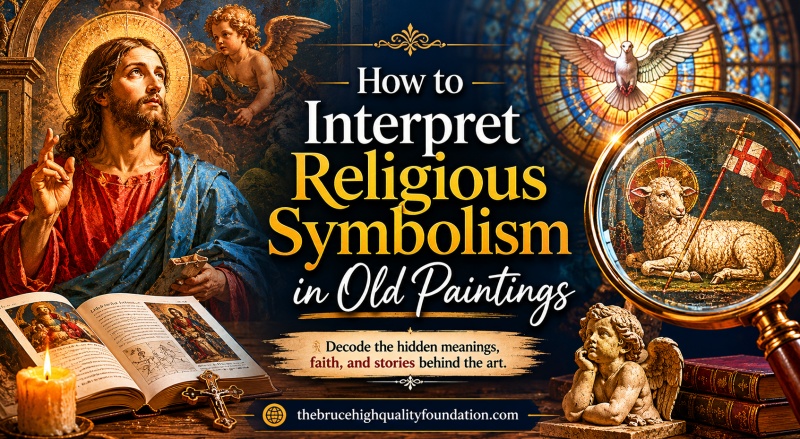
When I first stood in front of a medieval altarpiece, I felt completely lost. Every figure seemed to merge into the next, and I could not tell if I was looking at a scene of triumph or tragedy. That confusion is exactly what this guide is for. If you want to learn how to interpret religious symbolism in old paintings, you are about to discover a visual language that medieval and Renaissance artists used to communicate theological truths to people who could not read.
Religious symbolism in old paintings is not just decorative. Every object, color, gesture, and pose carried meaning that contemporary viewers recognized instantly. A lamb meant Christ. A dove represented the Holy Spirit. Blue garments marked Mary as different from mortals. By understanding this symbolic vocabulary, you transform passive observation into active reading.
In this guide, I will walk you through the key symbols, color meanings, figure identifications, and practical tips. You will learn how to decode religious paintings step by step, and you will discover why the 70/30 rule matters for anyone serious about art interpretation.
Table of Contents
The Cross: Christianity’s Most Powerful Symbol
The cross appears in nearly every Christian painting, but not all crosses mean the same thing. A Latin cross, with its longer vertical beam, dominates crucifixion scenes and reminds viewers of Jesus sacrifice. A Greek cross, with four equal arms, represents resurrection and glory rather than suffering.
In crucifixion paintings, artists added specific details to convey theological messages. A lamb or sheep at the foot of the cross often represents the sacrificial Lamb of God. A skull beneath Calvary scenes connects to Golgotha, the place of the skull, and hints at mortality and redemption.
The cross also appears as a victory symbol. In resurrections and ascensions, Christ stands triumphant over his cross, not weighted down by it. Artists balanced these different representations to serve the narrative needs of each scene.
The Lamb: When Artists Painted Christ as a Lamb
Perhaps no symbol surprises beginners more than the lamb. In paintings dating from the fifth century through the Renaissance, artists depicted Christ as a lamb, not as a bearded man on a throne. This was not a mistake or simplification. The lamb represented the Agnus Dei, the Lamb of God who takes away the sins of the world.
You will find the lamb in several contexts. In the Crucifixion, a small lamb often appears at the base of the cross. In the Resurrection, angels announce Christ’s victory to worshippers represented as lambs. The Garden of Eden even features a lamb in early Christian depictions, foretelling Christ’s sacrifice before his birth.
Artists chose the lamb because it conveyed specific qualities that a human figure could not. Lambs symbolize innocence, gentleness, and willing sacrifice. When viewers in the Middle Ages saw a lamb, they understood these layers of meaning instantly.
The Lily: Mary’s Symbol of Purity
The lily entered Christian art through the Annunciation story, where the angel Gabriel told Mary she would bear God’s son. In countless paintings of this scene, Mary holds a lily, or lilies fill the surrounding space, signaling her Immaculate Conception and virginity.
Artists used lilies to mark Mary throughout religious painting. In paintings of the Madonna and Child, lilies appear in the background, rest on Mary’s lap, or frame the holy family. The white lily specifically represented purity and chastity, making it the perfect symbol for Mary.
You can distinguish lilies from other flowers by their shape. They typically show three petals, referring to the Trinity. Sometimes artists painted lilies growing from a vase, creating a visual connection between Mary’s purity and the flower that symbolized it.
The Dove: Visualizing the Holy Spirit
When artists needed to show the Holy Spirit, they painted a white dove. This convention came directly from the biblical account of Jesus’s baptism, where the Holy Spirit descended like a dove. Once that image became standard, painters used it whenever they wanted to represent divine presence, inspiration, or blessing.
You will see doves in several contexts. During the Baptism of Christ, a dove hovers above Jesus’s head, visible only to viewers within the painting. In Pentecost scenes, a dove brings fire to the apostles. Annunciation paintings sometimes feature a dove near Mary, preparing viewers for the miraculous conception.
The dove’s color matters. White doves represent purity and divine origin. If you see a white dove in a religious painting, you are looking at the Holy Spirit, regardless of what else appears in the scene.
What Are the Five Main Symbols of Christianity
While Christian art uses hundreds of symbols, five appear so frequently that every interpreter should know them. These symbols work together to tell the core story of Christian faith.
The first is the cross, which represents Christ’s sacrifice and redemption. The second is the fish, an ancient symbol predating Christianity that early believers adopted to identify themselves. The third is Alpha and Omega, the first and last letters of the Greek alphabet that God uses in Revelation to declare “I am the Alpha and Omega.” The fourth is the Crown of Thorns, worn by Christ during his crucifixion as a symbol of suffering and mockery. The fifth is the Sacred Heart, representing Christ’s love for humanity, often depicted as a flaming heart surrounded by thorns.
These five symbols appear together in some paintings and separately in others. When you learn to recognize them quickly, you can understand the theological message of a painting even before you examine its composition or narrative details.
Color Symbolism: What Blue, Red, Gold, White, and Yellow Mean
Color carried enormous meaning in medieval and Renaissance painting. Artists did not choose colors randomly. Every hue served a symbolic purpose that educated viewers understood immediately.
Blue: Divinity and Heavenly Origin
Blue represented divinity, heavenly grace, and spiritual authority. When artists painted Mary wearing blue robes, they were not making a fashion choice. They were telling viewers that Mary stood apart from ordinary mortals, connected to the divine realm.
Medieval artists often used ultramamarine, an expensive pigment made from lapis lazuli, for Mary’s blue garments. This choice carried both symbolic and economic weight. The deep, unfading blue communicated Mary’s status, while its cost reminded viewers that only wealthy patrons could afford such devotion.
Christ occasionally wears blue in paintings, though red appears more frequently for his garments. When you see Christ in blue, he typically appears in scenes emphasizing his divine nature rather than his human suffering.
Red: Blood, Passion, and Martyrdom
Red symbolized several things in religious painting. Most obviously, it represented blood, whether from Christ’s crucifixion, a martyr’s execution, or wounds suffered by saints. Red also conveyed passion, both in the romantic sense and in the sense of intense emotional commitment.
Martyrs in religious paintings almost always wear or carry red. Saint Sebastian, martyred by arrows, appears in red robes or against a red background. Saint Catherine of Alexandria holds her wheel of torture, often surrounded by red light. The color signals that this figure suffered or died for faith.
Red also represents love. In paintings of the Holy Family, Mary sometimes wears red under her blue outer garment. This combination signals her role as mother and her divine calling simultaneously.
Gold: Glory and the Divine
Gold represented divinity, glory, and eternal life. Artists covered halos in gold leaf, creating a luminous effect that marked saints and holy figures. The shimmering gold reminded viewers that these figures existed in a different realm, touched by divine light.
Artists also used gold backgrounds in medieval paintings, particularly in altarpieces. This technique eliminated distracting scenery and focused attention entirely on the sacred figures. The gold background created a sense of timeless, heavenly space.
When gold appears on clothing, it usually indicates royalty or high status. Magi and important saints sometimes wear gold-trimmed robes, signaling their elevated position in heaven’s hierarchy.
White: Purity and Resurrection
White represented purity, innocence, and resurrection. Angels wear white to signify their nature as pure servants of God. Christ sometimes wears white in transfiguration scenes, his garments becoming dazzlingly white to reveal his divine glory.
White also marks the resurrection. In paintings of Easter morning, angels sit on Christ’s empty tomb, often dressed in white robes. The color signals the victory over death and the promise of eternal life for believers.
White sometimes appears in negative contexts. Heretics or betrayers might appear in white to suggest their false purity or corruption. Context helps interpreters distinguish between positive and negative uses of white.
Yellow: Betrayal, but Not Always
Yellow carries complicated symbolism. Most famously, Judas Iscariot appears in yellow in many paintings of the Last Supper. This association links yellow to betrayal, cowardice, and moral failure. Artists chose yellow for Judas to make his treachery visually obvious.
However, yellow was not inherently negative. Gold, which is yellow-orange, represented divinity and glory. Yellow also symbolized sunlight, warmth, and natural goodness. Renaissance artists understood that context determined whether yellow carried positive or negative meaning.
When examining yellow in religious paintings, consider the figure wearing it and the scene’s narrative. A wealthy patron in yellow indicates prosperity and status. A betrayer in yellow signals moral corruption. The same color carries opposite meanings based on context.
Deciphering Christ, Mary, and the Apostles
Identifying the main figures in religious paintings requires practice. Artists used specific conventions to distinguish between divine figures, angels, saints, and ordinary mortals. Learning these conventions transforms your ability to understand old paintings.
Identifying Christ in Paintings
Christ appears in several characteristic ways. In the center of compositions, he wears robes that blend red and purple, symbols of royalty and suffering. His beard is typically shorter and neater than God the Father’s wild, white beard. Christ’s halo usually contains a cross inside the circle.
Christ also appears as a child held by Mary. In these Nativity and Adoration scenes, the adult Christ holds a globe, symbolizing his rule over the world. Sometimes he blesses the viewer with one hand while holding the globe with the other.
When distinguishing Christ from God the Father, look for the beard and the surrounding context. God the Father often appears in triadic compositions, sometimes with a triangular halo. Christ frequently appears with angels, disciples, or Mary.
Understanding Mary (Madonna) Depictions
Mary appears more frequently than any other figure in Christian art. Artists developed consistent conventions for depicting her, making her recognizable across different periods and styles.
Mary’s blue garments are the most reliable identifier. While other figures occasionally wear blue, Mary wears it almost universally, a tradition established in Byzantine iconography and continued through Renaissance painting. She typically holds a lily or the infant Christ.
Her halo contains twelve stars, referring to the woman clothed with the sun in Revelation. She stands on a crescent moon in many Immaculate Conception depictions. These astronomical symbols elevate her status above ordinary saints.
Byzantine and Renaissance artists painted Mary differently. Byzantine Madonnas appear stiff, frontal, and hieratic. Renaissance Madonnas show more naturalistic poses, softer expressions, and settings that suggest domestic space. Both traditions mark Mary as holy, but they use different aesthetic languages.
Recognizing the Apostles
The twelve apostles appear throughout the New Testament narrative, but identifying them individually requires learning their martyrdom symbols. Each apostle died for his faith, and artists depicted them with the instruments of their deaths.
Saint Peter carries keys to heaven, referring to Jesus giving him the keys to the kingdom. He was martyred by crucifixion, typically shown upside down. Saint Paul holds a sword, the instrument of his beheading. He was a Roman citizen and could not be crucified.
Saint Andrew appears with an X-shaped cross, the cross on which he was crucified. Saint Thomas holds a builder’s square, referencing his role in constructing churches. Saint Bartholomew often carries a knife, the instrument of his flaying.
When you see an apostle with a specific object, you can identify them by matching the object to their martyrdom tradition. This system of identification allowed medieval viewers to distinguish between figures who otherwise looked similar.
The 70/30 Rule in Art Interpretation
One question appears repeatedly in art history discussions: what is the 70/30 rule in art? This principle offers a useful framework for understanding religious paintings.
The 70/30 rule suggests that about seventy percent of symbols in any painting follow established iconographic traditions. Artists learned these conventions from their teachers and apprentices, passing them down through generations. When you see a cross, a lamb, or a dove, you are looking at symbols that carried the same meaning for centuries.
The remaining thirty percent represents artist-specific choices. An artist might modify a traditional symbol, add unexpected elements, or create new combinations. These choices reveal artistic creativity and innovation, but they build upon the traditional foundation.
Understanding this balance helps interpreters appreciate both the conventional and the innovative. When a painting surprises you with an unusual detail, it likely falls in the thirty percent. The artist was working within a tradition while adding personal expression.
Practical Tips for Decoding Religious Paintings
Theoretical knowledge only takes you so far. Practical application matters more. Here is a step-by-step framework for approaching any religious painting.
First, identify the central figure and scene. Look for crucifixion, resurrection, annunciation, or nativity compositions. The central figure’s identity narrows your interpretive scope immediately.
Second, read the placement hierarchy. Artists arranged figures from most important to least important, with the most significant figures at the center or highest position. Size also indicated importance, with larger figures representing higher status.
Third, examine gestures and objects. Blessing hands, pointing fingers, and holding specific objects all carry meaning. A figure with hands raised in prayer differs from one with hands open in welcome. The object a figure holds identifies their martyrdom symbol.
Fourth, consider the historical context. A Byzantine altarpiece communicates differently than a Northern Renaissance painting. Byzantine art emphasizes theological truth over naturalism. Renaissance art balances doctrine with observation of the physical world.
Fifth, look for memento mori elements. These reminders of death appear in paintings to encourage viewers to contemplate their mortality. Skulls, rotting fruit, hourglasses, and extinguished candles all fall into this category.
The Memento Mori Tradition: Art as a Reminder of Death
Memento mori, the Latin phrase meaning “remember your death,” appears throughout religious art. Artists embedded reminders of mortality into paintings to encourage spiritual contemplation and moral reflection.
Skulls appear most frequently in portraits and religious scenes. A skull at the foot of a crucifix reminds viewers that death comes for everyone, even Christ. In Renaissance portraits, skulls sometimes rest on tables near the sitter, suggesting that wealth and beauty are temporary.
Rotted fruit and wilting flowers carry similar messages. These objects decay, reminding viewers that earthly pleasures fade. Candles being extinguished suggest that life can end suddenly. Artists who included these elements wanted viewers to think about their spiritual condition.
This tradition emerged from medieval monastic practices. Monks contemplated death as part of their spiritual discipline. When this practice influenced art, it created images that helped ordinary viewers engage with mortality in productive ways.
FAQ: Common Questions About Religious Symbolism in Art
What is the 70/30 rule in art?
What are the five main symbols of Christianity?
How to understand symbolism in art?
What is an example of religious symbolism in art?
How do you identify apostles in religious paintings?
Conclusion
Learning how to interpret religious symbolism in old paintings takes practice, but you now have a framework that works. You understand the key symbols: the cross, the lamb, the lily, and the dove. You know what colors meant to medieval and Renaissance artists. You can identify Christ, Mary, and the apostles by their characteristic features.
The next time you visit a museum or church with old paintings, try these techniques. Start with the central figure. Read the placement hierarchy. Examine gestures and objects. Look for memento mori elements that invite contemplation. You will find that religious paintings reveal their meanings when you learn to read them.
This visual language that artists developed over centuries remains accessible today. With patience and attention, anyone can learn to interpret religious symbolism in old paintings. The symbols that once guided illiterate congregations now speak to anyone willing to listen.