
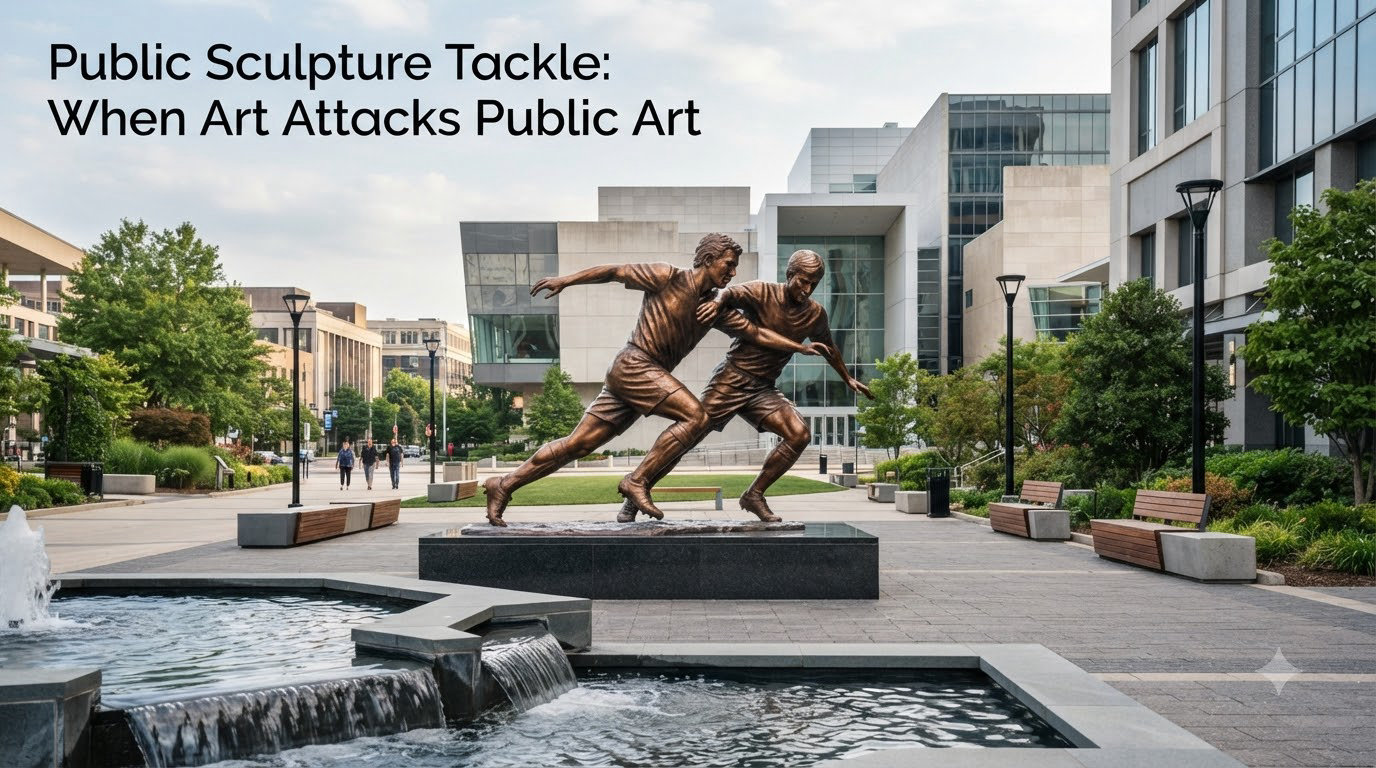
Public art was never meant to be polite. When a sculpture appears in a shared plaza, park, or federal building, it carries an implicit challenge. It demands attention. It interrupts the ordinary flow of daily life. Sometimes, the public interrupts back.
The phrase “when art attacks public art” captures a fascinating phenomenon in cultural history. It describes moments when sculptures, monuments, and installations become flashpoints for civic debate, community outrage, and even physical confrontation. These are not just aesthetic disagreements. They are battles over who owns public space, whose stories deserve commemoration, and how taxpayer money should be spent.
Our team has studied these controversies for years, from the massive steel curves that blocked federal workers in Manhattan to the inflatable structures that sparked international incidents. What we have learned is that confrontational art installations often reveal more about a community’s values than any survey or town hall meeting ever could. The sculptures that generate the strongest backlash are often the ones that succeed most profoundly as art, even when they fail as public relations.
Table of Contents
What Is the “Art Attack” Phenomenon
The term “art attack” operates on two levels. Literally, it describes vandalism, defacement, and destruction of public monuments. Figuratively, it captures how certain artworks seem to assault public sensibilities, challenging comfort, beauty, and consensus.
In 2026, both forms of attack are accelerating. Social media amplifies every controversy, turning local disputes into global conversations within hours. A sculpture that might have generated only local grumbles in 1990 now faces coordinated international campaigns for its removal. The speed of backlash has fundamentally changed how artists and cities approach public commissions.
The Calgary Herald captured this duality perfectly in a 2014 headline: “When art attacks: City pulls sculpture after visitor’s jacket singed by reflected rays.” The piece referenced a reflective sculpture that concentrated sunlight so intensely it melted car parts and burned clothing. Here, art literally attacked. But most controversies are more subtle, involving aesthetic clashes, political disagreements, or debates about representation and history.
The Tilted Arc Case: Public Art’s Most Famous Battle
No single work exemplifies public sculpture controversy better than Richard Serra’s Tilted Arc. Commissioned in 1979 and installed in 1981, this 120-foot-long, 12-foot-high curved wall of Cor-Ten steel bisected New York City’s Federal Plaza. Serra designed it specifically for that location. He believed site-specific art could not be moved without destroying its meaning.
The backlash was immediate and fierce. Federal workers complained that the arc blocked their paths, created security concerns, and served as a gathering place for pigeons and litter. A petition demanding its removal gathered thousands of signatures. The General Services Administration, which had commissioned the piece for $175,000, found itself caught between artistic integrity and public outcry.
The subsequent hearings became a referendum on the nature of public art itself. Serra argued that removing the sculpture would violate his First Amendment rights and destroy his artistic vision. Critics countered that public art must serve the public, not challenge them. After eight years of litigation and debate, the government removed Tilted Arc in 1989, cutting it into three pieces and storing it in a warehouse.
The case established precedents that still shape public art commissioning today. It raised questions that remain unresolved: Who decides what art the public must endure? Does site-specificity give artists veto power over removal? Can taxpayers demand the destruction of something they paid for and now despise? The arc may be gone, but its shadow still falls across every controversial public sculpture installed since.
Six Sculptures That Shook Public Spaces
While Tilted Arc dominates discussions of public sculpture controversy, it is far from the only example. Across more than a century of public art commissioning, certain works have consistently generated the kind of confrontational energy that defines the “when art attacks public art” phenomenon.
Auguste Rodin’s Monument to Balzac (1897)
Rodin’s tribute to the French novelist predates modern public art debates by decades, yet it established patterns that persist today. The Societe des Gens de Lettres commissioned the piece to honor Balzac, but rejected the finished work as obscene and abstract. Critics called it “a lump of plaster” and “an ignoble sack.” The society refused to accept it.
Rodin kept the sculpture at his home until his death. It was not cast in bronze and installed in Paris until 1939, forty-two years after its completion. The Monument to Balzac demonstrates how initial rejection can eventually transform into recognition, but also how the gap between artistic vision and public taste can span generations.
Gutzon Borglum’s Mount Rushmore (1927-1941)
Today, Mount Rushmore is an American icon. But during its creation, it generated intense controversy. Environmentalists opposed the desecration of the Black Hills. Native American activists protested the carving of white men’s faces into land sacred to the Lakota Sioux. The project also required massive federal funding during the Great Depression, raising questions about priorities that echo in contemporary debates about taxpayer funded art.
Chief Henry Standing Bear of the Lakota had originally envisioned a memorial to Crazy Horse, intended to balance the presidential monument. The fact that the Crazy Horse Memorial remains unfinished after seventy years while Mount Rushmore draws millions of visitors annually illustrates how public art controversies often reflect deeper historical power imbalances.
David Cerny’s Pink Tank and Entropa
Czech artist David Cerny has built his career on confrontational art installations. In 1991, he painted a Soviet tank monument in Prague bright pink as a protest against military occupation. The act earned him arrest and international attention. More recently, his Entropa installation for the European Council presidency in 2009 satirized every EU member state with crude stereotypes, causing diplomatic incidents and demands for removal.
Cerny’s work operates intentionally as provocation. He courts controversy, believing that art should disrupt rather than decorate. His pieces raise difficult questions: Is there a difference between challenging art and mere shock value? When an artist seeks confrontation, do communities have an obligation to accommodate them?
Jeff Koons’ Bouquet of Tulips (2016)
Koons proposed his giant hand holding flowers as a tribute to the victims of the 2015 Paris terrorist attacks. The gift seemed generous: an estimated $4 million sculpture donated to the city. But Parisians reacted with derision. Critics called it “pornographic,” “wicked,” and “grotesque.” The placement near the Petit Palais and Champs-Elysees proved contentious, with preservationists arguing it would damage historic sightlines.
The controversy highlighted how even well-intentioned public art can fail when it appears imposed rather than invited. Koons’s hyper-commercial aesthetic clashed with Parisian sensibilities. The piece also raised questions about foreign artists creating memorials for local tragedies. After years of delay and redesigns, a modified version was finally installed in 2019, but the debate illustrated the gap between donor intentions and community reception.
Anish Kapoor’s Cloud Gate and Descension
Not all controversies are negative. Anish Kapoor’s Cloud Gate in Chicago generated significant debate during its development. The original design was larger and more complex than the final bean-shaped sculpture. Engineers worried about construction feasibility. Budget concerns mounted. Some critics dismissed it as a tourist trap rather than serious art.
Yet Cloud Gate succeeded where so many public sculptures fail. It became beloved by Chicagoans and visitors alike. By contrast, Kapoor’s Descension in Brooklyn Bridge Park, a constantly spinning whirlpool of black water, generated more mixed reactions. Some found it mesmerizing. Others questioned its maintenance costs and ecological impact. Both pieces demonstrate how the same artist can produce works that attack public sensibilities in different ways, with different results.
Paul McCarthy’s Tree (2014)
Installed in Paris’s Place Vendome, McCarthy’s inflatable sculpture was unmistakably phallic. The artist claimed it was a Christmas tree. Parisians disagreed. Within two days, vandals cut the sculpture’s support straps, causing it to deflate. McCarthy was punched in the face while trying to defend his work. The piece was removed permanently.
The Tree controversy compressed years of typical public art debate into forty-eight hours. Questions of taste, taxpayer funding, vandalism, and artistic freedom all collided in a single weekend. The speed of the destruction and the physical assault on the artist represented the most literal interpretation possible of “when art attacks public art” and the public attacking back.
Why Public Art Sparks Backlash: The Psychology of Controversy
Understanding individual controversies is useful. Understanding why public sculpture controversy happens repeatedly is essential. Our analysis reveals three fundamental tensions that make confrontational art installations nearly inevitable.
Taxpayer Funding and Democratic Expectations
Most public art is funded by public money. Even privately donated pieces often require public space, permits, and maintenance support. This creates an expectation that art should please the majority, or at least not offend significant minorities. But art that pleases everyone is rarely art that challenges anyone.
The “percent for art” programs common in many cities require that 1% of construction budgets for public buildings be spent on art. This mechanism has created thousands of sculptures, murals, and installations. It has also generated thousands of complaints about waste, ugliness, and misplaced priorities. When taxpayers see a sculpture they hate outside a courthouse or city hall, they see their own money turned against their sensibilities.
Site-Specificity vs Public Comfort
Site-specific art controversy arises when artists create works designed for exact locations, using those locations’ specific histories, sightlines, and social dynamics. Richard Serra argued that Tilted Arc could not exist anywhere but Federal Plaza. The public argued that Federal Plaza belonged to workers, not to Serra’s artistic vision.
This tension is unresolvable. Artists believe site-specificity gives them moral rights over their work’s placement. Communities believe public space gives them veto power over their environment. Every site-specific installation becomes a negotiation between these competing claims, with controversy as the default outcome.
Changing Values and Historical Reckoning
Sculptures commemorate. They honor people, events, and ideas. But values change. A monument that celebrated colonial expansion in 1910 may read as celebration of genocide in 2026. Confederate statues across the American South demonstrate this dynamic most starkly, but similar reckonings are happening globally.
These controversies are not really about aesthetics. They are about whose stories public spaces should tell. Communities that once accepted certain narratives now reject them. The art has not changed. The public has. This creates a different kind of “art attack” than a new installation generating immediate backlash. It is history itself becoming confrontational.
When Art Literally Attacks: Vandalism and Iconoclasm
Sometimes the “attack” in “when art attacks public art” is literal. Protesters destroy art for many reasons that extend beyond simple dislike of aesthetics. Understanding these motivations helps explain why certain sculptures become targets while others, equally controversial, remain untouched.
Political iconoclasm targets symbols of power or oppression. The destruction of Saddam Hussein statues in Iraq, the defacement of Confederate monuments in the United States, and the recent removal of colonial statues across Europe all follow this pattern. The art is not being attacked for what it looks like. It is being attacked for what it represents.
Religious iconoclasm targets art deemed idolatrous or blasphemous. Throughout history, from Byzantine iconoclasm to Taliban destruction of Buddhist statues to recent attacks on contemporary art depicting religious figures, this motivation remains potent. The 2015 attack on Chris Ofili’s The Holy Virgin Mary, which incorporated elephant dung, exemplifies how artistic choices can trigger religious vandalism.
Aesthetic vandalism is rarer but still occurs. Some attackers destroy art simply because they consider it ugly or a waste of resources. The Margaret Thatcher statue in London, which was decapitated by a protester with a cricket bat within months of installation, mixed political and aesthetic motivations. The attacker claimed Thatcher did not deserve a statue, but also that the sculpture was poorly executed.
Art that challenges public spaces physically can provoke protective vandalism. When sculptures appear dangerous, unstable, or poorly designed, community members sometimes destroy them preventively. This was a factor in the Tree’s rapid deflation and has affected numerous interactive installations that seemed hazardous to children or animals.
Recent Controversies: 2026–2026
The landscape of controversial public art continues evolving. In 2026, several high-profile cases demonstrate that these debates are not historical curiosities but ongoing civic concerns.
The St. Helena sculpture controversy emerged in 2024 when a proposed memorial for the island’s colonial history generated fierce debate between descendants of slaves and descendants of colonizers. The planned sculpture, intended to acknowledge the island’s role in the transatlantic slave trade, became a proxy for larger questions about how small communities should address traumatic histories.
In Melbourne, Australia, a proposed kangaroo sculpture generated international ridicule in late 2025 when cost overruns turned a modest public art project into a multi-million dollar expenditure for a piece critics called “a堆积 of metal scrap.” The controversy forced a review of the city’s entire public art commissioning process.
The UK has seen continued debate over its “obnoxious sculptures,” as The Guardian characterized them in 2024 coverage. From Prince Philip’s faceless statue to the ongoing controversy surrounding the Fourth Plinth in Trafalgar Square, Britain remains a hotbed of public sculpture debate. Each new commission generates petitions, social media campaigns, and occasionally physical confrontation.
Frequently Asked Questions
Why was Tilted Arc so controversial?
Tilted Arc was controversial because it blocked pedestrian pathways through Manhattan’s Federal Plaza, disrupted daily routines for federal workers, and was perceived as ugly and alienating. The 120-foot steel wall created what many considered an obstacle rather than an aesthetic enhancement. The subsequent legal battle raised fundamental questions about whether public art must please the public who paid for it.
Why do protesters destroy art?
Protesters destroy art for political, religious, and aesthetic reasons. Political iconoclasm targets symbols of oppression or controversial historical figures. Religious vandalism responds to art deemed blasphemous or idolatrous. Some destruction stems from aesthetic rejection or safety concerns. The motivations often reflect deeper social conflicts rather than simple dislike of the artwork itself.
What makes public art controversial?
Public art becomes controversial when it challenges community values, uses taxpayer funding without sufficient public input, occupies space in ways that disrupt daily life, or commemorates figures or events that generate political disagreement. The combination of public money, shared space, and artistic vision creates inherent tension that often produces conflict.
Can controversial public art be successful?
Yes. Many of history’s most beloved public sculptures generated intense controversy when first installed. Rodin’s Balzac, Eiffel’s Tower, and even Chicago’s beloved Cloud Gate faced significant opposition. Controversy can indicate that art is doing its job by challenging assumptions and sparking dialogue, though not all controversial art eventually wins public acceptance.
What happens to removed public sculptures?
Removed sculptures face various fates. Some are relocated to less prominent locations where controversy fades. Others enter storage indefinitely, like Tilted Arc. A few are destroyed entirely. Occasionally, rejected works find new audiences decades later, as Rodin’s Balzac did. The fate depends on ownership, artistic rights, available space, and whether anyone advocates for preservation.
The Enduring Value of Confrontational Art
Public sculpture controversy is not a bug in the system. It is a feature. When art attacks public art, and when the public attacks back, communities engage in vital conversations about their values, their history, and their shared spaces. The sculptures that generate the strongest reactions are often the ones that matter most.
Our review of decades of confrontational art installations suggests a simple truth: art that never generates controversy is art that has stopped trying. The question is not whether public sculptures should challenge us. They will. The question is whether we will meet that challenge with curiosity, dialogue, and the recognition that shared space requires shared negotiation.
In 2026, as cities commission new works and communities reconsider old ones, the “when art attacks public art” phenomenon will continue. Every controversy is an opportunity. Every defaced monument is a lesson. Every removed sculpture is a story about who we were and who we are becoming. The art endures, even when it disappears. The conversation continues.