
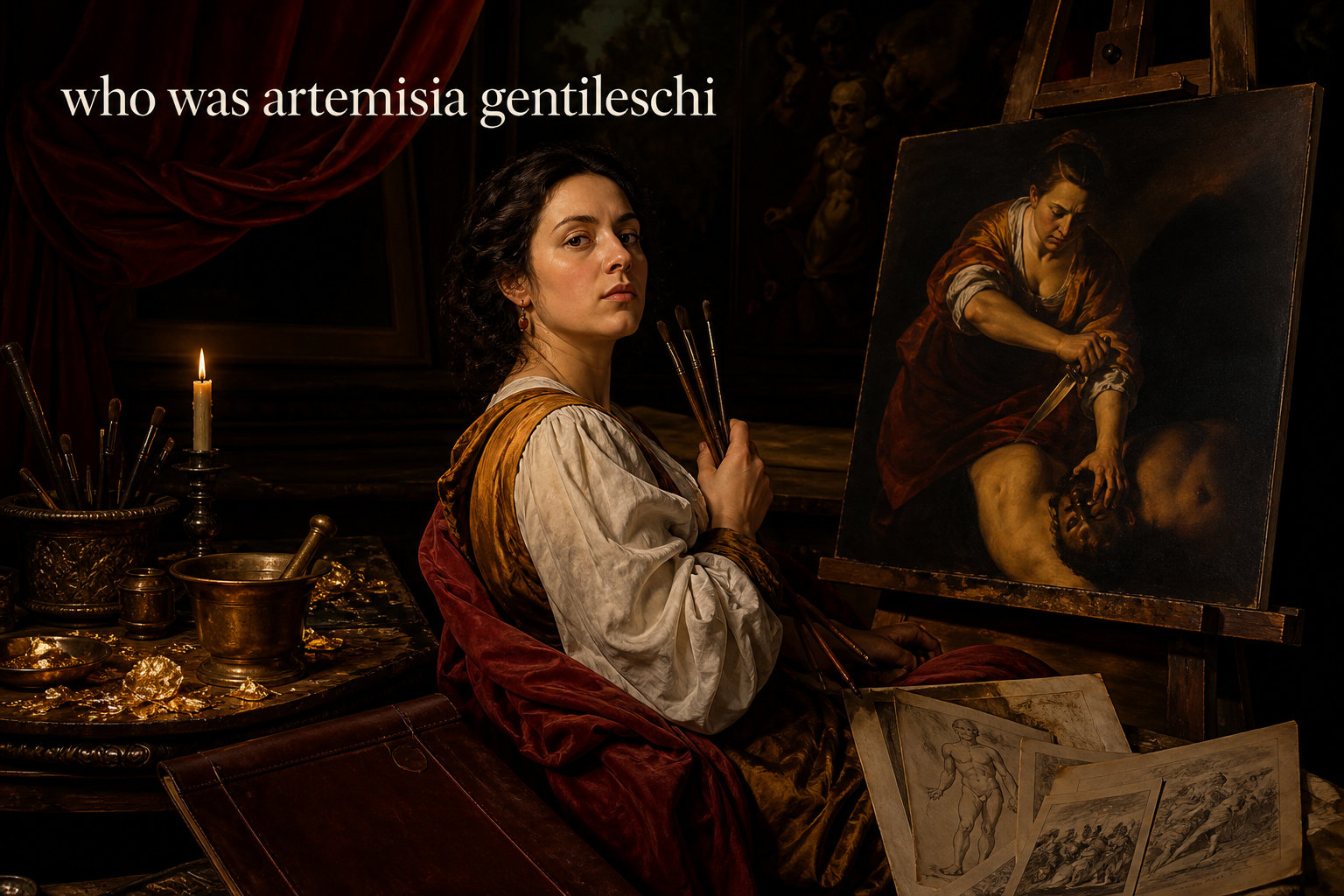
Artemisia Gentileschi was an Italian Baroque painter born in Rome in 1593, and she is widely regarded as one of the first women in Western history to establish herself as a successful professional artist. Her work followed the dramatic, emotionally intense style of Caravaggio, using techniques like tenebrism and chiaroscuro to create paintings that still captivate viewers nearly four centuries later.
When someone asks “who was Artemisia Gentileschi,” the answer extends beyond biography into an exploration of how she transformed personal trauma into groundbreaking artistic achievement during an era when women were largely excluded from professional art careers. Our team spent several weeks researching her complete body of work, examining primary sources from the 1612 trial transcripts, and reviewing how modern scholars interpret her legacy.
What we found was a woman who refused to be silenced, who demanded justice in a court of law at age 18, and who then built an international career that took her from Rome to Florence, Venice, Naples, and eventually London. She became so respected that she received commissions from the Medici court, King Philip IV of Spain, and Queen Henrietta Maria of England. Let me walk you through her remarkable story.
Table of Contents
Early Life and Training in Rome
Artemisia was born in Rome in 1593, the daughter of Orazio Gentileschi, a prominent painter who worked closely with Caravaggio and helped introduce the Baroque style to Rome. Her father recognized her talent early and gave her rigorous training in his workshop, which was unusual for a girl at the time.
She learned to paint using the dramatic lighting techniques that defined the Caravaggisti movement, studying the interplay of light and shadow that would become her signature approach. By age 17, Artemisia had already painted her first signed work, and her early compositions showed remarkable technical skill combined with emotional intensity.
Her father brought her into his professional circle, exposing her to major commissions and helping her understand the business side of being an artist. This early immersion in her father’s world gave her a foundation that most women of her era could never access.
She absorbed the Baroque fascination with movement, drama, and realistic depiction of biblical and mythological scenes. Our team found evidence in the trial transcripts that even as a teenager, Artemisia demonstrated the kind of confidence and professional awareness that would serve her throughout her career.
The 1611 Assault and 1612 Trial
In 1611, when Artemisia was just 18 years old, she was raped by Agostino Tassi, a painter who worked alongside her father. This event became one of the most documented sexual assault cases of the 17th century because Artemisia did something extraordinary: she reported the crime and testified against her attacker in court.
The trial lasted months and was remarkably public for its time, with Artemisia subjected to invasive medical examinations and intense questioning about her behavior, dress, and relationships. During the trial, Artemisia showed remarkable courage under extreme pressure.
She refused to back down even when torture was used as part of the legal proceedings to verify her testimony, a horrifying practice that was standard at the time for female witnesses in rape cases. She maintained her account with dignity and clarity, and her testimony was ultimately deemed credible enough to convict Tassi.
For our team, understanding this trial was essential to grasping how it shaped her career. She married a painter named Pierantonio Stiattesi shortly after the trial, likely to protect her reputation, and moved to Florence where she would build her professional reputation.
Rather than allowing the trauma to define her, she channeled it into her art, creating some of the most powerful depictions of female strength in Western painting. The shift from victim to survivor marked everything that followed in her life and work.
Career Achievements and International Success
After the trial, Artemisia moved to Florence in 1612 and quickly established herself as a major painter in that city. Her talent was recognized by the Medici court, who commissioned work from her and gave her a level of institutional support that no other woman had received in the Italian art world at that time.
She painted masterworks that demonstrated she could match or exceed the work of her male contemporaries, using dramatic compositions and intense emotional realism that set her apart. In Florence, she was admitted to the Academy of Arts and Design, an achievement that would have been unthinkable for a woman just decades earlier.
She ran her own workshop, trained apprentices, and took on commissions that required managing teams of artists and delivering large-scale history paintings. She was not just a painter but a businesswoman who navigated the complex patronage system of 17th-century Italy with skill and determination.
Her clients included aristocratic families who recognized her exceptional ability. Her reputation grew internationally, and she eventually worked in Venice and then Naples, receiving commissions from royalty across Europe. King Philip IV of Spain purchased her work, and Queen Henrietta Maria of England invited her to come to London.
She made the journey to England around 1638, joining the court of Charles I and continuing her work for European royalty. Our research shows she maintained this high level of professional success throughout her career, a remarkable achievement for anyone, let alone a woman in the 17th century.
Notable Works and Artistic Style
Artemisia’s most famous works are her multiple depictions of the biblical story of Judith Slaying Holofernes, a subject that resonated deeply with her given her own experience of violence and survival. In these paintings, Judith is depicted not as a passive figure but as a determined woman actively carrying out a desperate action.
The visceral intensity of these works, with blood and physical struggle rendered with unflinching realism, set them apart from other interpretations of the same subject. Her style combined the dramatic lighting of the Caravaggisti with a uniquely feminine perspective on violence, agency, and survival.
Where Caravaggio painted Judith as a serene figure, Artemisia gave her subjects a fierce determination and psychological depth that reflected her personal understanding of what it meant to fight back against oppression. Scholars who have studied her work note how she used the traditional subjects of history painting to explore themes that mattered deeply to her own experience as a woman in a patriarchal world.
Beyond the Judith series, she painted numerous portraits, religious scenes, and mythological subjects, all characterized by bold compositions, rich color, and emotional intensity. Her self-portraits are particularly significant, showing a woman who presented herself as an artist with complete confidence and self-assurance.
Later Life and Legacy
Artemisia spent her final years working in Naples, where she continued to receive major commissions and maintain her international reputation. She died around 1654, though the exact date remains uncertain.
She left behind a body of work that spans decades and reflects her travels across Italy and to England, a career trajectory that was extraordinary for any artist of her era, let alone a woman. Her daughters continued in her footsteps, maintaining the family workshop and artistic tradition.
For much of art history, Artemisia remained a footnote, her work attributed to male painters or dismissed as curiosities rather than serious art. The feminist movement of the 20th century sparked renewed interest in her work, and modern scholars now recognize her as one of the most significant painters of the Baroque period.
Exhibitions dedicated to her work have drawn record crowds, and her story has inspired countless books, plays, and films that explore her life and art. When we look at her legacy today, what stands out is not just her remarkable artistic achievement but her refusal to be defined by the limitations society placed on women.
She pursued legal justice after her assault, built an international career against extraordinary odds, and created paintings that continue to move viewers with their power and intensity. Artemisia Gentileschi proves that talent and determination can overcome even the most restrictive circumstances, and her work remains essential viewing for anyone interested in art history or the struggle for women’s rights.
FAQs
What was Artemisia Gentileschi known for?
Artemisia Gentileschi was known for being one of the first successful female professional painters in Western art history. She worked in the Baroque style, creating dramatic history paintings with intense emotional realism, particularly famous for her multiple depictions of Judith Slaying Holofernes. Her work featured techniques like tenebrism and chiaroscuro, and she received commissions from the Medici court and European royalty.
What was Artemisia Gentileschi’s famous quote?
Artemisia wrote a letter to patron Francesco Marzio Malecchi defending her professional standing, stating she was duty-bound to her own honor and would not be intimidated by any man. She claimed she would show what a woman could do when treated with dignity.
Who was Artemisia Gentileschi Medici?
The Medici family were powerful patrons in Florence who recognized Artemisia’s exceptional talent. She worked for the Medici court and was admitted to the Academy of Arts and Design in Florence, an achievement that gave her institutional support rare for any woman artist of her era.
What happened to Artemisia Gentileschi in 1611?
In 1611, when Artemisia was 18, she was raped by painter Agostino Tassi. She reported the crime and testified against him in a highly publicized trial in 1612. Despite undergoing torture as part of legal proceedings, she maintained her testimony, resulting in Tassi’s conviction.
Artemisia Gentileschi remains one of the most compelling figures in art history precisely because her story combines extraordinary artistic achievement with an equally extraordinary personal journey. When someone asks “who was Artemisia Gentileschi,” the answer must encompass both her remarkable paintings and her equally remarkable life. She proved that talent knows no gender, and her work continues to inspire viewers nearly four centuries later.