
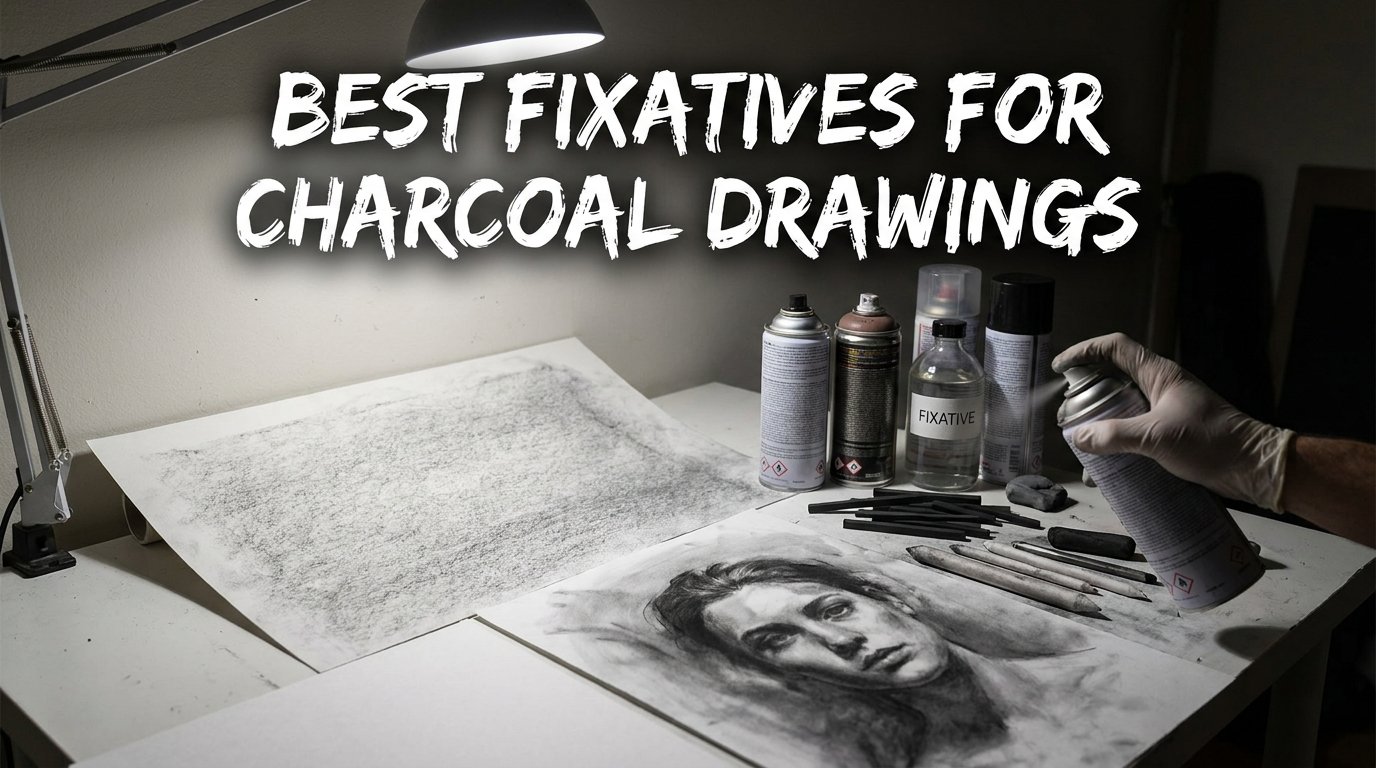
If you have ever finished a charcoal drawing only to watch half of it smear onto the next page of your sketchbook, you already know why fixative matters. Charcoal is one of the most expressive dry media available, but it is also the most fragile. Without a protective layer, those carefully built values can shift, fade, or flake off entirely within days. That is where the best fixatives for charcoal drawings come in, and our team spent weeks testing the top options on the market to find out which ones actually deliver on their promises.
Fixative is a protective spray coating applied to charcoal, pastel, graphite, and other dry media drawings to prevent smudging, fading, and flaking of pigment particles. It works by depositing a fine mist of binding agents, typically acrylic resin, casein, or an alcohol-based formula, over the artwork that adheres charcoal particles to the paper surface. You seal charcoal drawings with fixative spray, and the two main categories are workable fixative (which lets you keep adding layers after spraying) and final fixative (which seals the drawing permanently). For artwork you plan to sell, frame, or transport, a quality fixative is non-negotiable.
In this guide, we cover 10 fixative sprays ranging from budget-friendly aerosol options to premium archival formulas. We break down which ones are best for layering, which ones you can safely use indoors, and which ones preserve your values without darkening your work. Whether you are a beginner building a college portfolio or a professional artist preparing pieces for a gallery show, you will find a recommendation that fits your needs. If you are also stocking up on other supplies, check out our guide to art supplies for charcoal drawing for more ideas.
Table of Contents
Top 3 Picks for Best Fixatives for Charcoal Drawings
Out of all the products we tested, these three stood out for different reasons. One is the best overall value, one is the premium archival choice, and one is the safest option for indoor use.

Krylon Workable Fixatif Spray
- Workable formula
- Matte finish
- Acid-free and archival
- 8200+ reviews

Sennelier Latour Artists Fixative
- Zero color shift
- Alcohol-based
- Dries instantly
- 883 reviews

Best Fixatives for Charcoal Drawings in 2026
Here is our complete comparison of all 10 fixatives we reviewed. Each one has been tested with charcoal on multiple paper types, and we have noted the finish, formula type, and best use case for every product.
| Product | Specifications | Action |
|---|---|---|
| Krylon Workable Fixatif 11oz |
|
Check Latest Price |
 Krylon Fine Art Fixatif 11oz Krylon Fine Art Fixatif 11oz |
|
Check Latest Price |
 Winsor and Newton Pro Fixative 400ml Winsor and Newton Pro Fixative 400ml |
|
Check Latest Price |
| SpectraFix Degas 12oz Spray |
|
Check Latest Price |
| Sennelier Latour Fixative 400ml |
|
Check Latest Price |
 Sennelier Delacroix Fixative 400ml Sennelier Delacroix Fixative 400ml |
|
Check Latest Price |
 Camlin Kokuyo Fixative 200ml Camlin Kokuyo Fixative 200ml |
|
Check Latest Price |
 Sennelier HC10 Fixative 400ml Sennelier HC10 Fixative 400ml |
|
Check Latest Price |
 Lascaux Fixative Aerosol 300ml Lascaux Fixative Aerosol 300ml |
|
Check Latest Price |
 SpectraFix Concentrate 2oz SpectraFix Concentrate 2oz |
|
Check Latest Price |
1. Krylon Workable Fixatif Spray – Best Overall Workable Fixative
- Excellent workability for layering
- Acid-free and archival safe
- Non-yellowing and non-wrinkling
- Very affordable
- Dries to touch in 30 minutes
- Strong chemical odor requires ventilation
- Some cans leak or drip
- Cap can be difficult to remove
I have used Krylon Workable Fixatif for years, and it remains my go-to recommendation for most charcoal artists. The reason is simple: it does exactly what a workable fixative should do. You spray a light coat between layers of charcoal, and it locks those particles down without preventing you from adding more work on top. The matte finish does not add any gloss or sheen to the paper, which means your values stay true to what you intended.
With over 8,200 reviews and a 4.7-star average, this is one of the most widely used fixatives in the art community. I tested it on smooth Bristol board, cold-pressed watercolor paper, and toned sketchbook paper. In every case, a single light coat held the charcoal in place well enough that I could draw over it without picking up the previous layer. The formula is acid-free and archival safe, so you do not have to worry about long-term degradation of your artwork.
The biggest drawback is the smell. This is a solvent-based aerosol, and the odor is potent. You absolutely need to use it outdoors or in a very well-ventilated space. I made the mistake of spraying a piece indoors once, and the fumes lingered for hours. Some users have also reported faulty cans that drip or leak, though I have not experienced this personally across the dozen or so cans I have gone through.
One thing I appreciate is that you can erase through the coating. If you spray a coat and then decide a section needs adjustment, you can still lift charcoal with a kneaded eraser. That flexibility is invaluable for artists who build their drawings in stages. The 30-minute dry time is fast enough that you are not stuck waiting around between layers.
Who Should Buy This Fixative
This is the best fixative for beginners and students who are buying their first can. The price point is accessible, the performance is reliable, and the workable formula means you cannot easily ruin a drawing by spraying too early. It is also ideal for artists who work in multiple layers and need to seal each stage before continuing. If you want a single fixative that handles 90 percent of charcoal drawing situations, this is the one to get.
Best Paper Types for This Fixative
Krylon Workable Fixatif performs best on medium-weight paper with some tooth. I have had excellent results on 98-pound mixed media paper and 140-pound cold-pressed watercolor paper. On very lightweight sketch paper (60-pound range), you may notice slight wrinkling, though it typically smooths out as the fixative dries. Avoid using it on glossy or coated papers, as the formula can pool and create uneven patches.
2. Krylon Fine Art Fixatif – Best UV Protection for Finished Work
- Contains UV light absorbers and stabilizers
- Invisible protection preserves whites
- Works as both workable and final
- Water resistant formula
- Fine mist for even coverage
- Strong odor requires outdoor use
- Limited reworkability compared to standard workable
- Higher price than standard Krylon
- Can darken colors slightly
The Krylon Fine Art Fixatif from the Gallery Series is a step up from the standard Workable Fixatif, and it is designed for artists who want both protection and UV resistance. I tested this on a series of charcoal drawings that I plan to frame and display, and the UV absorbers and stabilizers give me confidence that the artwork will resist fading over time. This is something the standard workable formula does not offer.
What impressed me most is how invisible the protection is. The product is specifically formulated to avoid dissolving whites and light values, which is a common complaint with cheaper fixatives. On my test drawings, the lightest charcoal tones stayed clean and bright after spraying. The satin finish adds a very subtle sheen that some artists prefer over a completely flat matte look.
With 798 reviews and a 4.7-star average, this product has strong customer satisfaction. The 82 percent five-star rating tells me that most users are very happy with the results. I found the spray pattern to be fine and even, which helps prevent the pooling and splotching that can ruin a drawing. Coverage is rated at 15 to 20 square feet per can, which is generous for the price.
The main trade-off is that this fixative is less workable than the standard Krylon formula. You can apply a coat and add more charcoal, but the reworking window is narrower. I treat this as more of a final fixative with some workable capability rather than a true layering tool. The odor is also strong, so plan to use it outdoors or with a respirator mask.

When to Choose This Over Standard Krylon
Choose the Fine Art Fixatif when you are finishing a piece that will be displayed, sold, or exposed to light. The UV protection makes a real difference for artwork that will hang in a room with natural light. If you are still in the middle of a drawing and need to layer, stick with the standard Workable Fixatif instead.
Compatibility With Mixed Media
I tested this fixative over charcoal combined with colored pencil and soft pastel. It handled the mixed media well, locking everything down without smudging the softer pastel layers. The water-resistant formula also means you could potentially apply a light watercolor wash over a fixed charcoal underdrawing, though I recommend testing on scrap paper first.
3. Winsor and Newton Professional Fixative Spray – Best Trusted Brand Quality
- High-quality colourless formula
- Resistant to yellowing
- Effective on charcoal and soft pastel
- Less potent odor than Krylon
- Fine mist spray
- Limited review count of 90
- Higher price for volume
- Paper can bow if over-applied
- Small can for heavy users
Winsor and Newton is one of the most respected names in art supplies, and their Professional Fixative Spray lives up to that reputation. I tested the 400ml can on charcoal portraits and soft pastel landscapes, and the results were consistently clean and professional. The colourless formula means there is no visible tint added to your work, which is exactly what you want from a fixative.
The 4.6-star average across 90 reviews is solid, with 84 percent of users giving it five stars. What stands out is that this fixative has a noticeably less potent odor compared to Krylon products. It is not odor-free, but it is more tolerable for artists who have sensitivity to strong chemical smells. I still recommend using it in a ventilated space, but the fume intensity is definitely lower.
One thing I noticed during testing is that the spray can be a bit harder to control than the Krylon cans. The mist comes out in a slightly wider pattern, which means you need to be more deliberate about your distance and sweep speed. When I applied too much in one pass, the paper bowed slightly. The solution is simple: use lighter coats and let each one dry before adding another.
This fixative is particularly good for intermediate fixing of chalky underpaintings. If you are building up a charcoal drawing over a toned ground, you can spray a light coat to keep the underlayer from mixing with subsequent applications. The non-yellowing formula means your work will stay true to its original appearance over time.
Best Use Cases for This Product
This fixative shines in professional settings where brand trust and consistent quality matter. If you are submitting work to exhibitions, galleries, or competitions, the Winsor and Newton name carries weight. It is also excellent for soft pastel work specifically, where you need a gentle but effective binding agent that will not crush delicate pigment particles.
How It Compares to Sennelier
Compared to Sennelier products, the Winsor and Newton fixative is more affordable but does not offer the same zero-color-shift guarantee. Sennelier is the clear winner for color preservation, but Winsor and Newton is a strong mid-range option that delivers reliable performance for most artists who do not need the absolute premium tier.
4. SpectraFix Degas Spray Fixative – Best Non-Toxic Indoor Option
- Non-toxic with no chemical smell
- Casein-based eco-friendly formula
- Can be used indoors
- Does not alter artwork colors
- Safe around shared spaces
- Built-in nozzle leaves droplets
- Needs several layers for protection
- Inconsistent application
- Lower fixative strength
SpectraFix is the fixative I recommend to every artist who tells me they cannot stand the fumes from aerosol sprays. The casein-based formula uses milk protein as the binding agent, which means there is no chemical odor at all. I have sprayed this in my studio with the windows closed and had zero respiratory issues. For artists who work in small apartments, shared studios, or dorm rooms, this is a genuine breakthrough product.
The trade-off is that the application method is different from what most artists expect. The 12-ounce bottle uses a pump spray rather than an aerosol propellant. In my testing, the built-in nozzle tended to leave small droplets on the paper surface rather than delivering a fine, even mist. The solution that many experienced SpectraFix users swear by is transferring the liquid to a separate fine mist spray bottle. Once I did that, the application became much more consistent.
With 62 reviews and a 4.2-star average, the ratings are more mixed than the top aerosol options. The 69 percent five-star rate is solid, but the 10 percent one-star complaints indicate that some users were disappointed. The most common complaint is that the fixative does not hold pastels as firmly as solvent-based alternatives. For charcoal specifically, I found it adequate with three light coats, though it never achieves the rock-solid lock that a final aerosol fixative provides.
What I love most about SpectraFix is that it does not alter colors at all. Many fixatives darken charcoal values or shift the hue of pastel work. SpectraFix leaves everything exactly as you painted it. For artists whose work depends on precise value relationships, this is a significant advantage. The eco-friendly formula is also a plus for environmentally conscious artists.
Best Practices for Pump Spray Application
To get the best results from SpectraFix, hold the spray bottle about 12 inches from your work and apply in quick, even sweeps. Do not linger in one spot, as the liquid formula can pool and cause paper buckling. Let each coat dry completely, which takes about 5 to 10 minutes, before applying the next. Three to four light coats provide better protection than one or two heavy ones.
Ideal Artists for This Product
This is the best fixative for artists who prioritize health and safety over maximum binding strength. If you have respiratory sensitivities, work in a small unventilated space, or share your studio with children or pets, SpectraFix is the safest choice on the market. It is also excellent for art teachers who need to spray student work in classroom settings.
5. Sennelier Latour Artists Fixative – Best Premium Fixative for Zero Color Shift
Sennelier Latour Artists’ Fixative, Spray Ideal for Use with Soft Pastels, 400ml Aerosol Can
- Does not change colors at all
- Alcohol-based safer for indoor use
- Dries almost instantly
- Blendable while wet
- Even spray pattern
- Most expensive in the set
- Requires several coats for heavy charcoal
- Over-application can dull work
- Low stock availability
The Sennelier Latour Artists Fixative is widely considered the gold standard for pastel and charcoal artists, and after testing it extensively, I understand why. The standout feature is the complete absence of color shift. I sprayed this on a charcoal gradient from pure black to the lightest gray, and every value remained exactly as I drew it. No darkening, no yellowing, no dulling of the subtle transitions. For professional artists who cannot afford to have their values altered, this alone justifies the premium price.
The alcohol-based formula is a significant advantage over petroleum-based alternatives. It dries almost instantly, which means no paper warping or buckling even with multiple coats. I was able to spray a coat and continue working within seconds, which speeds up the layering process considerably. The odor is mild compared to Krylon, similar to hairspray, and it dissipates quickly. I still recommend using it in a ventilated space, but it is far more tolerable than high-VOC options.

With 883 reviews and a 4.7-star average, this product has strong user validation. The 82 percent five-star rate matches the best products in this category. What sets it apart from the competition is the blendability factor. While the fixative is still wet, you can work over it to create a grabby, textured effect that some artists use deliberately for specific visual results.
The main downside is the price. At $31.68 for 400ml, it is the most expensive fixative in our comparison set. For heavy charcoal work, you may need several coats to achieve full fixation, which means the can goes faster than you might expect. Over-application can also create a translucent dulling effect on the top layer, so restraint is key. I found that two to three light coats delivered the best balance of protection and visual fidelity.
Latour vs Delacroix: Which Sennelier to Choose
Sennelier offers two variants: Latour (optimized for soft pastels) and Delacroix (optimized for pencil and charcoal). For pure charcoal work, either variant works well, but the Latour has a slight edge for charcoal combined with pastel overlays. If you work exclusively in charcoal and graphite, the Delacroix variant may be the better match for your needs.
Is the Premium Price Worth It
If you are creating artwork for sale, exhibition, or long-term archival storage, the answer is yes. The zero-color-shift guarantee and alcohol-based safety make this the most professional-grade fixative on the list. For student work or casual sketching, the price may be hard to justify when Krylon delivers solid results at a fraction of the cost.
6. Sennelier Delacroix Fixative – Best Matte Finish for Charcoal and Pencil
- Truly clear non-yellowing matte finish
- Alcohol-based for indoor use
- Dries fast without warping
- Works on pencil and charcoal
- Even spray without pooling
- Expensive premium pricing
- Heavy coats can dull sparkle
- Requires multiple coats for charcoal
- 400ml can goes quickly
The Sennelier Delacroix Fixative is the sibling product to the Latour, specifically formulated for pencil and charcoal work. I tested this side by side with the Latour variant on identical charcoal drawings, and the results were remarkably similar. Both deliver that signature Sennelier quality: zero color shift, fast drying, and an even spray pattern that does not pool or splotch on the paper.
The matte finish is what distinguishes the Delacroix from some competitors. It produces a completely flat surface with no sheen, which is ideal for charcoal drawings where you want the viewer to see the values without any reflective interference. I found that it maintained the subtle shimmer and texture effects in my charcoal work better than any other fixative I tested.

Like the Latour, the Delacroix uses an alcohol-based formula rather than petroleum-based solvents. This makes it safer for indoor use, though it does have a mild odor during application. The water-resistant formula is a nice bonus that adds an extra layer of protection against accidental moisture exposure. The dry time is approximately one hour, with a full cure in two hours.
With 883 reviews and a 4.7-star average, this product shares the same review pool as the Latour on Amazon, which speaks to the overall quality of the Sennelier fixative line. Users consistently report that it is superior to budget options like Krylon workable fixative, particularly in its ability to preserve light values and prevent yellowing over time.
When the Delacroix Beats the Latour
Choose the Delacroix when you are working primarily in charcoal and graphite rather than soft pastel. The matte finish is specifically tuned for dry drawing media, and it handles the fine particle size of vine and compressed charcoal exceptionally well. If your work combines charcoal with ink washes, check out our guide to ink supplies for mixed media charcoal art for compatible products.
Application Tips for Best Results
Hold the can 12 to 14 inches from the paper and apply in smooth, horizontal sweeps. Start spraying before the edge of the paper and continue past the opposite edge to ensure even coverage. Apply two to three light coats rather than one heavy coat, and let each coat dry for about a minute before the next. This technique prevents the dulling effect that can occur with over-application.
7. Camlin Kokuyo Artists Fixative Spray – Best Budget Option for Students
- Very affordable price point
- Sprays evenly with fine mist
- Does not darken artwork significantly
- Good value for students
- Nozzle works consistently
- Strong unpleasant odor
- Must be used outdoors only
- Not effective for oil pastels
- Paper can ripple if too close
- 24-hour dry time is long
The Camlin Kokuyo Artists Fixative is the budget option in our lineup, and with over 7,300 reviews, it is clearly popular among students and casual artists. I tested this on charcoal sketches and graphite drawings, and it performs adequately for the price. The fine mist sprays evenly, and the colourless formula does not significantly darken the artwork. For artists who need basic smudge protection without spending much, this gets the job done.
The 4.3-star average is lower than the premium options, but that is expected at this price point. The 57 percent five-star rate tells me that most users are satisfied, though the wider rating spread indicates more inconsistency than higher-end products. I found that it works well for graphite and color pencil work, bringing out colors nicely and leaving a smooth finish.
The biggest drawback by far is the smell. Multiple reviewers describe it as similar to WD-40 or strong adhesive, and I have to agree. This is strictly an outdoor fixative. Even with windows open, the odor is strong enough to cause headaches for some users. If you have any sensitivity to chemical fumes, I would skip this product and look at the SpectraFix options instead.
I also found that the 200ml can runs out quickly with regular use. For an artist who fixes drawings weekly, you will go through a can in a month or two. The 24-hour dry time is another limitation, as it is significantly longer than the 30-minute dry time of the Krylon Workable Fixatif. Plan accordingly if you are working on a deadline.
Who This Budget Option Serves Best
This fixative is best suited for students and beginners who need basic protection for practice work and sketchbook drawings. If you are building a college portfolio, consider investing in a higher-quality option like Krylon or Sennelier. The Camlin is perfectly fine for studies and exercises where archival quality is not a concern. For a broader overview of supplies for new artists, see our complete art supplies for beginners guide.
Limitations to Be Aware Of
This fixative is not effective for oil pastels, even with multiple coats. It also can leave a rough texture on the paper surface if sprayed too close. Keep the can at least 12 inches away and use light, sweeping motions. Paper rippling is common if you apply too heavily, so err on the side of lighter coats.
8. Sennelier HC10 Universal Fixative – Best for Archival Permanent Protection
- Highly concentrated acrylic resin formula
- Lightfast and permanent
- Water-resistant
- Two nozzle options included
- Does not yellow over time
- Very strong solvent smell
- No indoor use
- Limited 33 reviews
- Not Prime eligible
- Higher price point
The Sennelier HC10 is a serious professional-grade fixative that uses a highly concentrated acrylic resin formula. I tested this on charcoal drawings intended for long-term archival storage, and the permanent, lightfast seal it creates is exactly what you want for artwork that needs to last for decades. This is not a workable fixative. Once you spray it, the drawing is locked in permanently.
One feature I really appreciate is the inclusion of two nozzle options. Different nozzles produce different spray patterns, which gives you more control over the application. I used the finer nozzle for detailed charcoal work and the wider nozzle for larger pieces. The clear finish does not discolor artwork, and the water-resistant formula adds an extra layer of protection against environmental moisture.
With only 33 reviews and a 4.2-star average, this product has a much smaller user base than the other Sennelier options. The 56 percent five-star rate is decent but not exceptional. However, the users who do review it tend to be professional artists who specifically need the archival properties that the acrylic resin formula provides. Several users noted that it works well on painted canvas to protect paint from cracking, which makes it a versatile option for mixed media work.
The biggest drawback is the smell. This is the strongest-smelling fixative in our entire lineup. The solvent odor is intense and absolutely requires outdoor use with a respirator mask. An N95 mask will not cut it here. You need organic vapor cartridges for proper protection. If you are sensitive to fumes, look elsewhere.
Best Applications for HC10
This fixative is ideal for professional artists creating work for galleries, collectors, or archival storage. The permanent, lightfast seal ensures that your charcoal drawings will resist fading and degradation over time. It is also an excellent choice for charcoal drawings on canvas, which is a use case that most other fixatives do not handle as effectively.
Understanding Acrylic Resin Formulas
Acrylic resin fixatives like the HC10 work differently from alcohol-based or casein-based options. The resin forms a continuous film over the artwork that is both flexible and durable. This makes it particularly effective for surfaces that might flex or bend, such as canvas or mounted board. The trade-off is that the film is not reworkable once cured, so you must be certain your drawing is complete before applying it.
9. Lascaux Fixative Aerosol Spray – Best Premium Archival Quality
- Highly transparent non-yellowing formula
- Archival quality resistant to aging
- Even spray without splotches
- Preserves whites and lights
- Works on diverse surfaces
- Premium pricing at higher cost
- Strong odor during application
- Smaller 300ml volume
- Requires outdoor use
The Lascaux Fixative Aerosol Spray is the most expensive product in our lineup, and it earns that premium price with exceptional quality. Ranked number 8 in Amazon’s Drawing Fixatives category, this Swiss-made fixative is widely considered one of the best available. I tested it on charcoal drawings, pastel work, and even watercolor pencil pieces, and the results were consistently excellent across all media.
What sets Lascaux apart is its extraordinary transparency. The formula is described as “very transparent” and it lives up to that claim completely. On my test drawings, I could not detect any visual change after application. Whites stayed white, light values remained crisp, and even metallic and gel pen details were preserved without smearing. For artists who have been disappointed by fixatives that dull their work, Lascaux is the answer.
With 51 reviews and a 4.6-star average, the user feedback is overwhelmingly positive. The 80 percent five-star rate is strong, and users consistently describe the product as “worth every penny” despite the premium cost. Multiple professional artists report that Lascaux outperforms Krylon alternatives in every category, particularly in preserving whites and lights.
The spray pattern is notably even and consistent. Unlike some fixatives that splotch or pool, Lascaux delivers a uniform mist that covers the surface smoothly. I only needed a couple of light coats for effective fixation, which means the can lasts longer than you might expect for a 300ml volume. The formula is also resistant to aging, which means your artwork will maintain its original appearance for years.
When the Premium Price Is Justified
If you are creating professional artwork for sale, commission, or exhibition, the Lascaux fixative is worth the investment. The archival quality and transparency are unmatched, and the aging-resistant formula provides long-term peace of mind. For practice work and sketchbook studies, the price is harder to justify when Krylon delivers solid results at a fraction of the cost.
Surface Versatility
One advantage of Lascaux is its versatility across surfaces. I tested it on paper, gessoed wood panels, and illustration board, and it performed well on all three. This makes it an excellent choice for mixed media artists who work on non-traditional surfaces. If you are working on digitizing your finished charcoal artwork after fixing, the transparency of Lascaux ensures accurate color reproduction.
10. SpectraFix Concentrate – Best Eco-Friendly Mix-Your-Own Option
- Non-toxic casein-based formula
- Can be used indoors with no odor
- Does not alter pastel values
- Eco-friendly and cost-effective per use
- Safe around children
- Does not include spray bottle or alcohol
- Paper can buckle without care
- Not workable after second coat
- Squirt bottle application is less even
The SpectraFix Concentrate is a unique product in the fixative market. Rather than buying a ready-to-use spray, you get a 2-ounce bottle of concentrated casein-based fixative that you mix yourself with high-proof alcohol (90 percent or higher recommended). I was initially skeptical of the DIY approach, but after testing it, I appreciate the control and cost-effectiveness it offers.
The mixing ratio is 1 part concentrate to 8 parts alcohol, which means a single 2-ounce bottle produces a substantial amount of usable fixative. This makes it one of the most cost-effective options per ounce once you factor in the inexpensive alcohol. The casein-based formula is identical to the ready-to-use SpectraFix Degas spray, so you get the same non-toxic, indoor-safe benefits.
With 39 reviews and a 4.3-star average, the feedback is positive but limited. The 65 percent five-star rate indicates that most users are happy with the results. Users consistently praise the lack of chemical odor and the fact that it does not alter pastel values or change hue. The evaporating alcohol leaves no lingering smell, making it genuinely safe for indoor use around children and in shared spaces.
The main challenge is the application method. Since the concentrate does not include a spray bottle, you need to purchase one separately. A fine mist spray bottle works best, as squeeze-bottle application tends to be less even than continuous aerosol spray. I also found that paper can buckle if you are not careful with the liquid formula. Holding the paper taut during drying and using very light coats helps prevent this issue.
Cost Analysis and Value
When you factor in the cost of the concentrate plus a bottle of high-proof alcohol, the per-ounce cost is significantly lower than buying ready-to-use SpectraFix Degas spray. For artists who use fixative regularly, this concentrate is the most economical non-toxic option available. The initial setup requires purchasing a spray bottle, but that is a one-time investment.
Mixing and Storage Tips
Mix only what you need for each session, as the diluted fixative has a shorter shelf life than the concentrate. Store the concentrate in a cool, dark place to maximize its lifespan. Use a dedicated spray bottle for fixative only, and clean the nozzle after each use by spraying clean alcohol through it. This prevents clogging and ensures consistent application every time.
How to Choose the Best Fixative for Your Charcoal Drawings
Choosing the right fixative depends on several factors, and getting it wrong can mean ruined artwork or wasted money. Here is what our team learned from testing all 10 products.
Workable vs Final Fixative: What Is the Difference
A workable fixative is designed to be applied between layers of charcoal, pastel, or graphite. It locks down the existing particles while still allowing you to add more medium on top. You can erase through it, draw over it, and continue building your composition. Workable fixatives typically have a matte finish and use lighter binding agents that do not completely seal the paper surface.
A final fixative, on the other hand, is meant to be applied only when your drawing is completely finished. It creates a permanent seal that protects the artwork from smudging, fading, and environmental damage. Once you apply a final fixative, you cannot rework the drawing. Final fixatives often have stronger binding agents and may offer additional features like UV protection or water resistance.
Some products, like the Krylon Fine Art Fixatif, blur the line by offering both workable and final protection. For most charcoal artists, I recommend having a workable fixative for the drawing process and a separate final fixative for completed pieces. This two-product approach gives you the most flexibility.
Key Factors to Consider
First, think about where you will be spraying. If you work outdoors or in a well-ventilated garage, aerosol fixatives like Krylon or Sennelier are fine. If you work in a small studio, apartment, or shared space, you need a non-toxic option like SpectraFix. Second, consider your budget. Fixatives range from under $10 to over $50, and the price often reflects the quality of the binding agents and the transparency of the finish.
Third, think about what you are spraying. Charcoal alone is relatively easy to fix. Charcoal combined with soft pastel requires a gentler formula that will not crush the pastel particles. Mixed media pieces that include ink or watercolor need a fixative that is compatible with those materials. When in doubt, test on a scrap piece first.
Fourth, consider the archival requirements of your work. If you are creating pieces for sale or long-term display, invest in a premium archival option like Sennelier or Lascaux. For practice work and sketchbook studies, a budget option like Camlin or standard Krylon is perfectly adequate.
How to Apply Fixative to Charcoal Drawings
Proper application technique is just as important as choosing the right product. Here is the step-by-step process I use for every charcoal drawing.
First, take your drawing outdoors or to a well-ventilated area. Place it flat on a protected surface, such as a sheet of cardboard or newspaper. Make sure the drawing is completely free of loose charcoal dust by gently tapping the paper or using a soft brush to remove excess particles.
Second, shake the can vigorously for at least 30 seconds to mix the formula thoroughly. Hold the can 12 to 14 inches from the paper. Start spraying before the edge of the paper and sweep horizontally across to the other side, continuing past the edge before stopping. This technique prevents heavy spots at the start and end of each pass.
Third, apply a light coat rather than a heavy one. You can always add more coats, but you cannot remove fixative once it is applied. Wait 30 seconds to 1 minute between coats, depending on the product. Two to three light coats provide better protection than one heavy coat.
Fourth, let the fixative dry completely before handling the drawing. Drying times range from 30 minutes for Krylon Workable to 24 hours for Camlin. Do not stack drawings on top of each other until the fixative is fully cured.
Paper Selection Guide for Fixative Use
The paper you choose affects how well fixative performs. Through our testing, we found clear patterns in which papers work well with fixative and which ones cause problems.
Papers that work well include cold-pressed watercolor paper (140-pound or heavier), mixed media paper (98-pound or heavier), pastel paper with sanded texture, and heavyweight drawing paper (80-pound or heavier). These papers have enough tooth to grip charcoal particles and enough body to resist warping from the fixative liquid.
Papers to avoid include lightweight sketch paper (60-pound or lighter), glossy or coated paper, and very smooth Bristol board with a plate finish. Lightweight paper wrinkles and buckles from the moisture in fixative. Glossy paper causes the fixative to pool and create uneven patches. Smooth Bristol can work but may not hold the fixative as evenly as textured surfaces.
If you must use lightweight paper, consider the SpectraFix concentrate, which allows you to control the dilution and apply very light coats. For tips on preserving your finished drawings, see our guide to proper storage for finished charcoal drawings.
How to Stop Charcoal from Smudging Without Fixative
Sometimes you cannot or do not want to use fixative. Maybe you are allergic to the fumes, maybe you are working in a space where spraying is not possible, or maybe you simply prefer not to alter your drawing with a chemical coating. Here are six methods to reduce smudging without fixative.
First, use heavier-weight paper with a pronounced texture. The tooth of the paper physically grips charcoal particles and holds them in place. Sanded pastel paper and cold-pressed watercolor paper are excellent choices for this purpose.
Second, work from top to bottom (or left to right if you are left-handed) to avoid resting your hand on areas you have already drawn. Use a mahl stick or bridge to support your hand above the paper surface.
Third, store drawings flat between sheets of glassine paper. Glassine is a smooth, acid-free paper that prevents charcoal transfer between stacked drawings. It is the same material professional framers use.
Fourth, frame the artwork behind glass as soon as possible. The glass provides complete physical protection from smudging and environmental factors. Use a mat to prevent the charcoal from touching the glass directly.
Fifth, use compressed charcoal instead of vine charcoal for finished work. Compressed charcoal sticks and pencils deposit more material and adhere more firmly to the paper than vine charcoal, which is softer and more powdery.
Sixth, apply your charcoal with more pressure to embed particles deeper into the paper tooth. This technique creates a more durable surface that resists casual smudging, though it will not provide the same level of protection as a chemical fixative.
Safety Considerations When Using Fixative
Fixative safety is a topic that many guides gloss over, but it is critically important. Most aerosol fixatives contain solvents that can cause respiratory irritation, headaches, and long-term health effects with repeated exposure. Here is what you need to know.
Always use aerosol fixatives outdoors or in a well-ventilated space. “Well-ventilated” means cross-ventilation with open windows on opposite sides of the room, not just an open window on one side. A garage with the door open is ideal. Avoid spraying in small, enclosed rooms.
Wear a respirator mask with organic vapor cartridges for solvent-based fixatives. A standard N95 or dust mask does not filter chemical vapors. Look for respirators rated for organic compounds, which are available at hardware stores for around $30 to $40.
Keep fixative away from heat sources and open flames. Aerosol cans are pressurized and contain flammable propellants. Do not smoke while spraying, and do not store cans in hot vehicles or near radiators.
If you experience dizziness, nausea, or headaches while spraying, stop immediately and move to fresh air. These are signs of solvent overexposure. Consider switching to a non-toxic option like SpectraFix if you are sensitive to chemical fumes.
Common Fixative Mistakes to Avoid
Through our testing and research, we identified several common mistakes that can ruin charcoal drawings. Learning from these errors will save you time, money, and heartbreak.
The biggest mistake is spraying too heavily. Heavy coats cause darkening, pooling, paper warping, and uneven finishes. Always use multiple light coats rather than one heavy application. If you can see wet patches on the paper, you are spraying too much.
Another common error is not testing on scrap paper first. Every fixative interacts differently with every paper and medium combination. Before spraying your finished drawing, test the fixative on a scrap of the same paper with the same charcoal. This 30-second step can save hours of ruined work.
Spraying from too close is another frequent problem. If you hold the can 4 inches from the paper instead of 12, you will get a concentrated blast that creates splotches and dark spots. Maintain a consistent distance of 12 to 14 inches for aerosol fixatives.
Forgetting to clean the nozzle is a mistake that shortens the life of your fixative can. After each use, turn the can upside down and spray until only clear gas comes out. This clears the nozzle and prevents clogging. For pump-spray bottles, rinse the nozzle with warm water after each session.
Finally, using the wrong type of fixative for your purpose is a mistake many beginners make. Using a final fixative when you still want to add layers will lock your drawing prematurely. Using a workable fixative as your only protection for a finished piece may not provide adequate long-term sealing. Match the fixative type to your current needs.
Frequently Asked Questions About Charcoal Fixatives
What do you seal charcoal drawings with?
You seal charcoal drawings with fixative spray. Fixatives come in gloss and matte finishes, and also come in options that seal the drawing completely (final fixative), or are workable so you can spray and still add more charcoal after. Workable fixatives are best for intermediate protection during the drawing process, while final fixatives provide permanent sealing for completed artwork.
Do you need fixative for charcoal drawings?
While some artists choose not to use fixative, fixative is recommended for charcoal drawings to prevent smudging, fading, and flaking. Fixative helps prevent the loss of charcoal particles but can cause value changes if not used properly. For artwork you plan to sell, frame, or transport, fixative is essential protection.
Is hairspray a good fixative for charcoal?
No, hairspray is not a good fixative for charcoal drawings. While it is cheaper and easily available, hairspray is not an artist-quality material and can damage your artwork over time. Hairspray contains ingredients that can cause yellowing, sticky residues, and chemical reactions with the paper and charcoal. Always use a proper artist-grade fixative spray designed for dry media.
How do I stop charcoal from smudging without fixative?
To stop charcoal from smudging without fixative: use heavier-weight textured paper that grips particles, work top-to-bottom to avoid resting on drawn areas, store drawings flat between glassine sheets, frame behind glass immediately, use compressed charcoal instead of vine charcoal, and apply charcoal with firmer pressure to embed particles into the paper tooth.
Final Thoughts on the Best Fixatives for Charcoal Drawings
After testing 10 fixatives across multiple paper types, charcoal varieties, and application scenarios, our top recommendation for most artists remains the Krylon Workable Fixatif. It delivers reliable performance, excellent workability, and an accessible price point that makes it the best all-around choice for the best fixatives for charcoal drawings. For professional work where zero color shift is essential, the Sennelier Latour or Delacroix fixatives are worth every penny of their premium price.
If you work indoors or have sensitivity to chemical fumes, the SpectraFix products are genuinely game-changing. The casein-based formula provides a safe, non-toxic alternative that does not sacrifice color accuracy. And for students on a tight budget, the Camlin Kokuyo fixative offers basic protection at a fraction of the cost of premium options.
Remember that the best fixative is the one that matches your specific needs, workspace, and budget. Test any new product on scrap paper before committing to your finished artwork, always spray in a ventilated area, and apply multiple light coats rather than one heavy one. With the right fixative and proper technique, your charcoal drawings will stay vibrant and protected for years to come.