
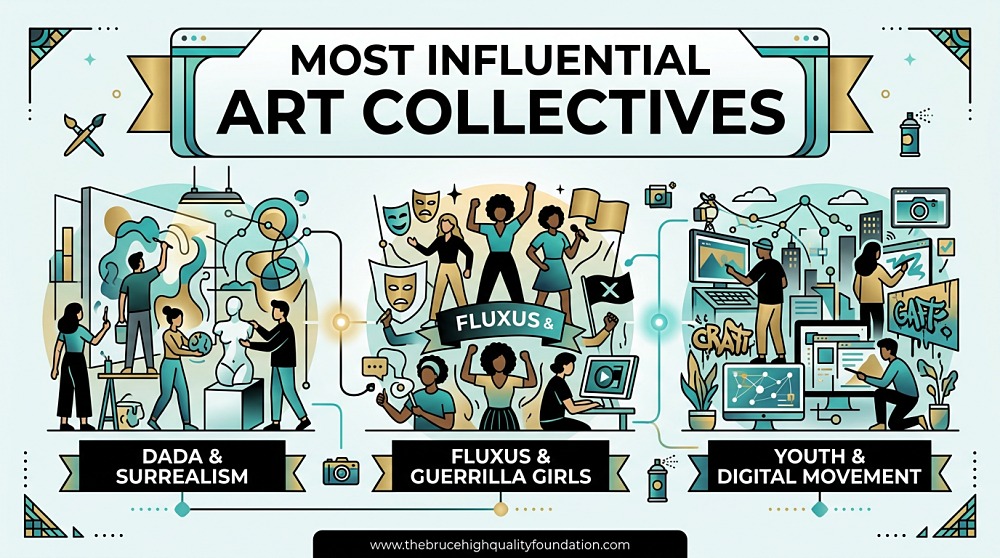
The way we think about art has shifted dramatically since the year 2000. The most influential art collectives of the 21st century have rewritten the rules about who gets to make art, how it gets made, and what it can actually accomplish in the world. These groups prove that creative power multiplies when artists stop competing and start collaborating.
I spent months researching this topic, digging through exhibition archives, reading interviews, and tracking which collectives have genuinely changed how we experience culture. The 25 groups on this list have won major awards, sparked movements, and challenged institutions that seemed untouchable. They represent the most influential art collectives 21st century culture has produced.
Some operate under shared pseudonyms. Others have become household names. A few have disbanded but left legacies that continue shaping contemporary practice. What connects them all is a refusal to accept art as a solitary pursuit reserved for market-approved geniuses.
Table of Contents
What Is An Art Collective?
An art collective is a group of artists who choose to work together under a shared identity. Unlike traditional art practice built around individual authorship and signature style, collectives embrace collaborative methodologies that distribute creative credit across multiple contributors. They often share studio space, split costs, and make decisions through consensus rather than singular vision.
The concept of collective authorship has roots in early 20th-century movements like Dada and Surrealism, but 21st-century collectives have expanded the model into new territories. Contemporary groups use anonymity strategically, create works that cannot be sold as commodities, and frequently position their practice outside the gallery system entirely. Artist collective meaning has evolved to include activist organizing, community development, and institutional reform.
Many collectives on this list maintain group identities that transcend any individual member. When someone leaves or joins, the collective continues. This creates longevity and stability that individual artists rarely achieve. It also allows for evolving perspectives without the pressure of personal branding.
What Makes An Art Collective Influential in the 21st Century?
I evaluated dozens of groups to determine which deserve recognition as the most influential art collectives 21st century practice has established. Several criteria separated the truly impactful from the merely interesting.
Institutional recognition matters. Collectives that have exhibited at the Venice Biennale, won the Turner Prize, or earned major museum retrospectives have demonstrated staying power and critical validation. Assemble winning the Turner Prize in 2015 marked a watershed moment for collective practice gaining mainstream acceptance.
Cultural impact beyond the art world carries significant weight. The most influential groups have affected policy discussions, shifted public conversations, or created lasting physical change in communities. Their work extends past gallery walls into real social and political transformation.
Longevity and consistency separate flash-in-the-pan projects from genuine movements. Groups that have maintained active practice for ten years or more prove that collective structures can sustain creative output over time. This matters because many assume collectives are inherently unstable.
Finally, innovation in collaborative methodology counts. Groups that have developed new ways of working together, new models for decision-making, or new relationships between artists and communities earn their place through contribution to practice itself.
The 25 Most Influential Art Collectives of the 21st Century
1. The Bruce High Quality Foundation
Founded in 2001 by a group of anonymous artists emerging from the Whitney Independent Study Program, The Bruce High Quality Foundation took its name from a fictional character who supposedly died on September 11, 2001. Their work combines institutional critique with absurdist humor, often inserting themselves into museum contexts without permission.
Their most famous intervention involved setting up an unauthorized gift shop inside the Metropolitan Museum of Art selling Bruce-branded merchandise. They have also operated a blue-chip gallery, an art school, and a funeral service for dead art. Their 2009 project “We Like America and America Likes Us” critiqued the art market while participating in it.
The collective has shown at the Whitney Biennial and major European institutions. Their longevity and refusal to reveal individual identities make them a model for anonymous collective practice in 2026.
2. Superflex
Formed in Copenhagen in 1993 by Jakob Fenger, Rasmus Nielsen, and Bjørnstjerne Christiansen, Superflex emerged from Denmark’s experimental music scene to become one of the most internationally recognized collectives. Their practice spans video, installation, sculpture, and what they call “tools” for social and economic change.
Their 1997 project “Supergas” developed biogas systems for developing world communities, treating alternative energy as art. They have created a bank for curating debt, proposed copyright-free beer, and flooded a MoMA gallery with tropical plants. Each project questions economic systems through practical intervention.
Superflex represented Denmark at the Venice Biennale and has major works in the collections of MoMA, Tate Modern, and Centre Pompidou. Their ability to move between gallery contexts and real-world applications demonstrates the flexibility of collective practice.
3. Claire Fontaine
Established in Paris in 2004 by James Thornhill and Fulvia Carnevale, Claire Fontaine named itself after a popular French brand of school notebooks. The collective adopted the readymade artist persona, treating themselves as a manufactured product rather than organic creative entity. This conceptual framework allows them to make work without claiming personal authorship.
Their practice includes neon text works, modified found objects, and interventions in public space. Pieces like “Foreigners Everywhere” and “Ready-Made Artist” directly address labor conditions, migration politics, and the commodification of creativity. They have described their practice as “the human strike” against enforced productivity.
Claire Fontaine has exhibited at the Venice Biennale, Documenta, and major museums worldwide. Their rigorous conceptual framework and refusal of personal branding have influenced a generation of younger collectives thinking about anonymity and alienation.
4. RAQS Media Collective
Based in New Delhi since 1992, RAQS Media Collective operates at the intersection of contemporary art, historical research, philosophical speculation, and political intervention. Founded by Jeebesh Bagchi, Monica Narula, and Shuddhabrata Sengupta, the group emerged from documentary filmmaking to develop a practice they call “kinetic contemplation.”
Their work spans installation, sculpture, online projects, and what they term “new media.” They have curated major exhibitions including the Yokohama Triennale and have been key figures in developing discourse around South Asian contemporary practice. Their research-based methodology produces dense, layered works that reward sustained engagement.
RAQS has shown at Documenta, the Venice Biennale, and institutions across Asia, Europe, and the Americas. Their ability to bridge critical theory and accessible public engagement makes them central to understanding global collective practice.
5. Assume Vivid Astro Focus
Begun in 2001 by Brazilian artists Eli Sudbrack and Christophe Hamaide-Pierson, Assume Vivid Astro Focus creates immersive environments that overwhelm viewers with psychedelic patterns, neon colors, and pop culture references. Their installations transform galleries into total sensory experiences that resist the contemplative distance traditional art demands.
The collective has collaborated with musicians including Caetano Veloso and recorded albums themselves. Their visual language draws from rave culture, advertising, and children’s television, creating maximalist spaces that comment on contemporary information overload. They have transformed spaces from the Mori Art Museum in Tokyo to private homes in Rio de Janeiro.
Their practice demonstrates how collectives can create spectacle while maintaining critical edge. By refusing minimalist restraint and embracing sensory excess, they question what constitutes serious contemporary art.
6. Elmgreen & Dragset
Michael Elmgreen from Denmark and Ingar Dragset from Norway have collaborated since 1995, creating sculptural installations that subvert familiar architectural and social spaces. Based in Berlin, the duo has become one of the most commercially successful collectives while maintaining rigorous conceptual foundations.
Their most famous work, “Prada Marfa,” placed a sealed Prada store in the Texas desert as a commentary on luxury branding and isolation. They have transformed galleries into public swimming pools, airplane crash sites, and gay saunas. Each installation creates narrative spaces that question how we inhabit and interpret built environments.
They represented Denmark and Norway jointly at the Venice Biennale and have major installations worldwide. Their success proves that collective practice can operate at the highest levels of the commercial art world without sacrificing conceptual integrity.
7. Guerrilla Girls
Founded in 1985 in response to MoMA’s “An International Survey of Recent Painting and Sculpture” that included only 13 women among 169 artists, Guerrilla Girls pioneered anonymous feminist art activism. Members wear gorilla masks in public and take names of dead women artists, maintaining anonymity to keep focus on issues rather than personalities.
Their poster campaigns, billboard interventions, and public appearances have exposed sexism and racism in the art world for over three decades. Famous slogans like “Do women have to be naked to get into the Met. Museum?” and statistics about gallery representation have become part of art world vocabulary. Their work predates the 21st century but their continued activity and influence qualify them for this list.
The collective has published books, created performances, and inspired countless younger feminist groups. Their model of anonymous activism and data-driven critique remains relevant and influential in 2026.
8. Assemble
Formed in London in 2010, Assemble is a collective of architects, designers, and artists who work across disciplines to create public and social projects. Their practice blurs boundaries between art, architecture, and community organizing. In 2015, they became the first non-artist collective to win the Turner Prize.
Their Granby Four Streets project in Liverpool involved working with residents to transform derelict housing into community-owned assets. They have built temporary cinemas, adventure playgrounds, and public furniture using affordable materials and collaborative construction methods. Their work prioritizes process and community benefit over aesthetic objects.
Assemble’s Turner Prize win signaled institutional acceptance of socially engaged practice. They demonstrate how collective structures enable sustained engagement with communities that individual artists cannot maintain.
9. DIS
Launched in 2010 by Lauren Boyle, Solomon Chase, Marco Roso, and David Toro, DIS emerged from New York’s downtown fashion and art scenes to become the defining voice of post-internet art. Their work interrogates digital culture, consumer aesthetics, and the collapsing distinctions between commerce and creativity.
They founded DIS Magazine in 2010, an online publication that treated fashion and advertising as art forms worthy of critical attention. Their 2016 exhibition at the New Museum, “Birds of a Feather,” examined human relationships with animals through an Instagram-ready aesthetic. They have curated the Berlin Biennale and created projects for the Venice Biennale.
DIS has influenced how artists engage with digital platforms and commercial imagery. Their collective structure allows for rapid production across media that would overwhelm individual practitioners.
10. The Yes Men
Jacques Servin and Igor Vamos have worked together since the late 1990s as The Yes Men, performing “identity correction” by impersonating corporate and government representatives at conferences and in media appearances. Their interventions expose the absurdity and cruelty of institutional logic through sustained performance.
They have posed as Dow Chemical representatives announcing reparations for the Bhopal disaster, created a fake New York Post edition announcing the end of the Iraq War, and launched a counterfeit Shell Arctic drilling campaign. Each intervention generates media coverage that exposes real institutional failures through fictional pronouncements.
The Yes Men have influenced activist practice worldwide and shown at major museums including the Whitney and the Hayward Gallery. Their work demonstrates how collective action can leverage media systems against themselves.
11. Critical Art Ensemble
Founded in 1987 by Steve Kurtz, Hope Kurtz, and others, Critical Art Ensemble pioneered tactical media art and biotechnology critique. Based in New York and later dispersed across the United States, the collective developed participatory performances and video installations addressing issues from genetic engineering to the militarization of public space.
Their “Genetic Theater” performances involved audience members in experiments exploring biotechnology’s social implications. The 2004 FBI raid on Steve Kurtz’s home following his wife’s death, triggered by their biotech art materials, became a cause célèbre about art and surveillance. The case was eventually dismissed but highlighted risks collective activists face.
CAE has published influential books on tactical media and electronic civil disobedience. Their theoretical writing has shaped discourse around art, activism, and technology throughout the 21st century.
12. Forced Entertainment
Formed in Sheffield, England in 1984, Forced Entertainment is a collective of six artists creating experimental theater and performance works. Under the artistic direction of Tim Etchells, they have developed a distinctive aesthetic of durational performance, fragmented narrative, and direct audience address that has influenced theater worldwide.
Their 24-hour performance “Quizoola” involves performers answering trivial questions without stopping. “And on the Thousandth Night” lasted 24 hours with performers telling stories in a competitive loop. These endurance works test the limits of performer and audience attention while commenting on information culture.
The collective has toured internationally for over three decades, maintaining the same core membership. Their longevity and consistency make them a model for sustained collaborative performance practice.
13. Dread Scott
While Dread Scott often works as an individual artist, his collaborative projects with participants in large-scale social practice works function as temporary collectives. His 2019 project “Slave Rebellion Reenactment” involved hundreds of participants recreating the largest rebellion of enslaved people in American history across Louisiana countryside.
Scott’s work consistently addresses racial justice, historical memory, and systemic oppression. Previous works include “Money to Burn,” where he burned a dollar bill on Wall Street, and “I Am Not a Man,” referencing the 1968 Memphis sanitation workers strike. His projects require collective participation to achieve scale and impact.
The collective aspect of Scott’s practice shows how individual artists can mobilize temporary communities around specific political aims. His work demonstrates the power of collaborative action in social practice art.
14. Forensic Architecture
Established in 2010 at Goldsmiths, University of London by Eyal Weizman, Forensic Architecture operates as a research agency using architectural methods to investigate state violence and human rights violations. The collective includes architects, artists, software developers, journalists, and lawyers who work together on spatial investigations.
They have documented drone strikes in Pakistan, the Grenfell Tower fire, and Syrian prison architecture using models, video analysis, and 3D mapping. Their work has been used as evidence in international courts and United Nations investigations. In 2018, they were nominated for the Turner Prize.
Forensic Architecture represents the most rigorous integration of collective research and political accountability in contemporary art. Their work has established new methodologies that are being adopted by journalists and human rights organizations worldwide.
15. Otabenga Jones & Associates
Founded in 2002 in Houston, Texas, Otabenga Jones & Associates is a collective of educators and artists named after Ota Benga, the Congolese man exhibited in the Bronx Zoo in 1906. Members include Robert Pruitt, Dawolu Jabari Anderson, Jamal Cyrus, and Kenya Evans. Their practice combines black history research, educational interventions, and institutional critique.
The collective has created alternative curricula for schools, transformed galleries into radical libraries, and produced works addressing erased histories of black culture. Their “Otabenga Jones School” model brings black studies into art contexts. They have shown at the Studio Museum in Harlem and the Whitney Biennial.
Their pedagogical approach demonstrates how collectives can function as educational institutions outside traditional academic structures. Their work addresses representation while creating alternative spaces for learning.
16. Temporary Services
Begun in Chicago in 1998 by Marc Fischer, Brett Bloom, and Salem Collo-Julin, Temporary Services creates public art, publishes books and zines, and operates as a collaborative entity without fixed membership. They have described themselves as a “group activity” rather than a traditional collective, allowing for fluid participation.
Their “Half Letter Press” publishing imprint produces affordable books on art and activism. They have created temporary monuments, public signage interventions, and exhibitions addressing labor, housing, and collective practice. Their work consistently emphasizes accessibility and participation over exclusivity.
Temporary Services has influenced DIY publishing and public art practice for over two decades. Their flexible structure provides a model for collectives that resist fixed membership while maintaining consistent output.
17. W.A.G.E. (Working Artists and the Greater Economy)
Founded in 2008 by artist A.L. Steiner and curator A.K. Burns, W.A.G.E. is a collective focused on establishing sustainable economic relationships between artists and institutions. Their name explicitly states their goal: fair payment for artistic labor in an economy that expects free cultural production.
They have developed certification programs for institutions that pay artists fairly, created fee calculators based on institutional budgets, and organized protests against museums that rely on unpaid artist labor. Their advocacy has contributed to policy changes at major institutions including the Whitney Museum and Creative Time.
W.A.G.E. demonstrates how collectives can function as labor organizations within the art world. Their work has made economic exploitation in cultural institutions visible and created tools for artists to demand fair treatment.
18. 16 Beaver Group
Formed in 2000 in New York’s Financial District, 16 Beaver Group occupied a downtown office building to create an alternative space for political discourse and cultural production. Named after their Beaver Street address, the collective organized lectures, screenings, and discussions addressing contemporary politics and philosophy.
The space became a hub for activists, academics, and artists during the post-9/11 period and the 2008 financial crisis. They hosted speakers including Antonio Negri, Saskia Sassen, and numerous Occupy organizers. Their programming connected European philosophical traditions with American activist practice.
16 Beaver represents the potential for physical spaces to anchor collective practice and political community. Their model influenced numerous alternative art spaces that followed.
19. World Famous
Operating from Los Angeles since 1999, World Famous is a collective of artists creating billboard and advertising interventions that subvert commercial media. Their work hijacks the visual language of advertising to deliver political messages in public space.
They have installed billboards addressing immigration, racial justice, and economic inequality in locations normally reserved for commercial messaging. Their “Spectacular” series mimicked the visual style of corporate advertising while delivering anti-capitalist content. The collective maintains anonymity to focus attention on messages rather than personalities.
World Famous demonstrates how collectives can intervene in commercial visual culture without institutional permission. Their unauthorized installations have appeared in major cities across the United States.
20. Gran Fury
Active from 1988 to 1995 as the propaganda wing of ACT UP (AIDS Coalition to Unleash Power), Gran Fury created graphic interventions that brought AIDS crisis visibility to public space. While primarily active in the late 20th century, their influence extends powerfully into 21st-century collective practice.
Their “Silence=Death” poster, Kissing Doesn’t Kill billboard campaign, and fake New York Times front pages established models for activist art that major collectives still use. Their graphic design language, borrowed from advertising and appropriated for political ends, influenced subsequent collectives including Guerrilla Girls and World Famous.
Many contemporary collectives cite Gran Fury as a primary influence. Their work proved that graphic design could save lives and that collective anonymity could amplify political messaging.
21. Group Material
Founded in 1979 by Doug Ashford, Julie Ault, and others, Group Material pioneered the exhibition as public forum. Their “Democracy” and “AIDS” exhibitions in the 1980s and 1990s brought political content into gallery contexts through collaborative curation and community involvement. Their influence extends into 21st-century socially engaged practice.
They developed exhibition formats that rejected the white cube in favor of dense, information-rich installations resembling public libraries or community centers. Their methodology treated exhibitions as ongoing conversations rather than static displays. Current collectives including Temporary Services and Assemble draw directly from their models.
Group Material’s archival approach to exhibition-making and commitment to democratic participation established foundations for contemporary collective practice. Their influence persists through the artists they inspired and the formats they invented.
22. Suzanne Lacy
Though primarily known as an individual artist, Suzanne Lacy’s collaborative projects function as temporary collectives bringing together diverse participants around social issues. She coined the term “New Genre Public Art” to describe her socially engaged, participatory practice that emerged in the 1970s and continues into 2026.
Her “Crystal Quilt” brought together 430 older women in Minneapolis to challenge ageism. “Between the Door and the Street” involved domestic workers and employers in conversations about labor. These projects require hundreds of participants functioning as temporary collectives around specific issues.
Lacy’s writing and teaching at California College of the Arts and Otis College of Art and Design have shaped generations of social practice artists. Her influence on collective methodologies extends through the artists she has mentored and the discourse she established.
23. Rick Lowe
Initiated in 1993 in Houston’s Third Ward, Project Row Houses is a community development initiative founded by artist Rick Lowe that functions as a collective endeavor involving artists, architects, and neighborhood residents. The project transformed 22 shotgun houses into a cultural center addressing gentrification, housing, and community preservation.
Lowe developed “social sculpture” as a practice involving residents in planning and programming decisions. The collective model includes resident artists, community elders, and youth in ongoing cultural production. The project has expanded to include affordable housing development and small business incubation.
Project Row Houses demonstrates how collective practice can create lasting physical and social change in communities. The model has been replicated in other cities and influenced national discourse about art and development.
24. Tania Bruguera
While primarily an individual artist, Tania Bruguera’s initiatives “Immigrant Movement International” and “Arte Util” function as collective platforms for political art. Since founding these projects in the early 2010s, she has created structures for artists to collaborate on social issues.
Immigrant Movement International, launched in 2011 in Queens, New York, brought together artists and immigrants to address policy and community needs. “Arte Util” catalogs and promotes art that functions as a tool for social change, creating a network of artists working collectively on political projects.
Bruguera has been detained multiple times by Cuban authorities for her performances, and her recent work involves collective organizing around free expression. Her initiatives create frameworks for artists to work together on issues that transcend individual careers.
25. LaToya Ruby Frazier
Primarily working as a photographer and educator, LaToya Ruby Frazier’s collaborative projects with communities in Braddock, Pennsylvania and Flint, Michigan function as collective documentation of industrial decline. Her work with family members and community residents creates shared narratives of environmental racism and economic abandonment.
Her “Flint is Family” project documented the water crisis through the lives of three women, collaborating with them to tell stories that traditional journalism missed. “And from the Coaltips of Central Appalachia to the Flint Hills of Kansas We Fight to Save the Black Farmer” addressed environmental justice through collaborative documentary practice.
Frazier’s work demonstrates how individual artists can create collective methodologies by collaborating with subjects as co-authors rather than objects of documentation. Her approach has influenced documentary practice and social engagement in photography.
Frequently Asked Questions
What is the purpose of an art collective?
Art collectives exist to share resources, distribute creative labor, amplify political messaging through anonymity, and enable projects too large or complex for individual artists. They challenge the myth of solitary genius and create space for collaborative decision-making in creative practice.
Who are the most influential artists of the 21st century?
While many individual artists have gained recognition, the 21st century has seen collective practice gain unprecedented visibility. Groups like Superflex, Assemble, Forensic Architecture, and Guerrilla Girls have won major awards and influenced cultural discourse as much as any individual artist.
What art movement are we currently in?
Contemporary art in 2026 is characterized by social practice, institutional critique, post-internet aesthetics, and collective authorship. Rather than unified movements, we see networked practices where artists collaborate across disciplines and geographies to address political and social issues.
How do art collectives make money?
Art collectives generate income through gallery sales, public commissions, grants, teaching positions, and alternative economies like publishing or design work. Some maintain commercial viability while others reject market participation entirely, surviving on institutional support or member day jobs.
Why do artists remain anonymous in collectives?
Anonymity allows artists to avoid personality-driven marketing, protect themselves from political retaliation, emphasize ideas over individual identity, and create work that transcends any single artist’s career. It also enables membership changes without disrupting collective identity.
The Future of Collective Art Practice
The 25 most influential art collectives 21st century culture has produced share certain traits that suggest where collaborative practice is heading. They prioritize process over product, community over market, and systemic change over individual recognition. Their work proves that collective authorship is not a limitation but a source of creative possibility.
As climate crisis, inequality, and political instability intensify, collective practice offers models for solidarity and shared survival. The groups on this list demonstrate that artists can organize, advocate, and create change together rather than competing for limited resources and attention. Their influence extends beyond art into activism, education, and community development.
The future of art belongs to those who can work together across differences and disciplines. These collectives have shown the way, building practices that outlast individual careers and create lasting cultural impact. In 2026 and beyond, the most influential art collectives of the 21st century will continue shaping how we understand creativity, collaboration, and the role of culture in social transformation.