
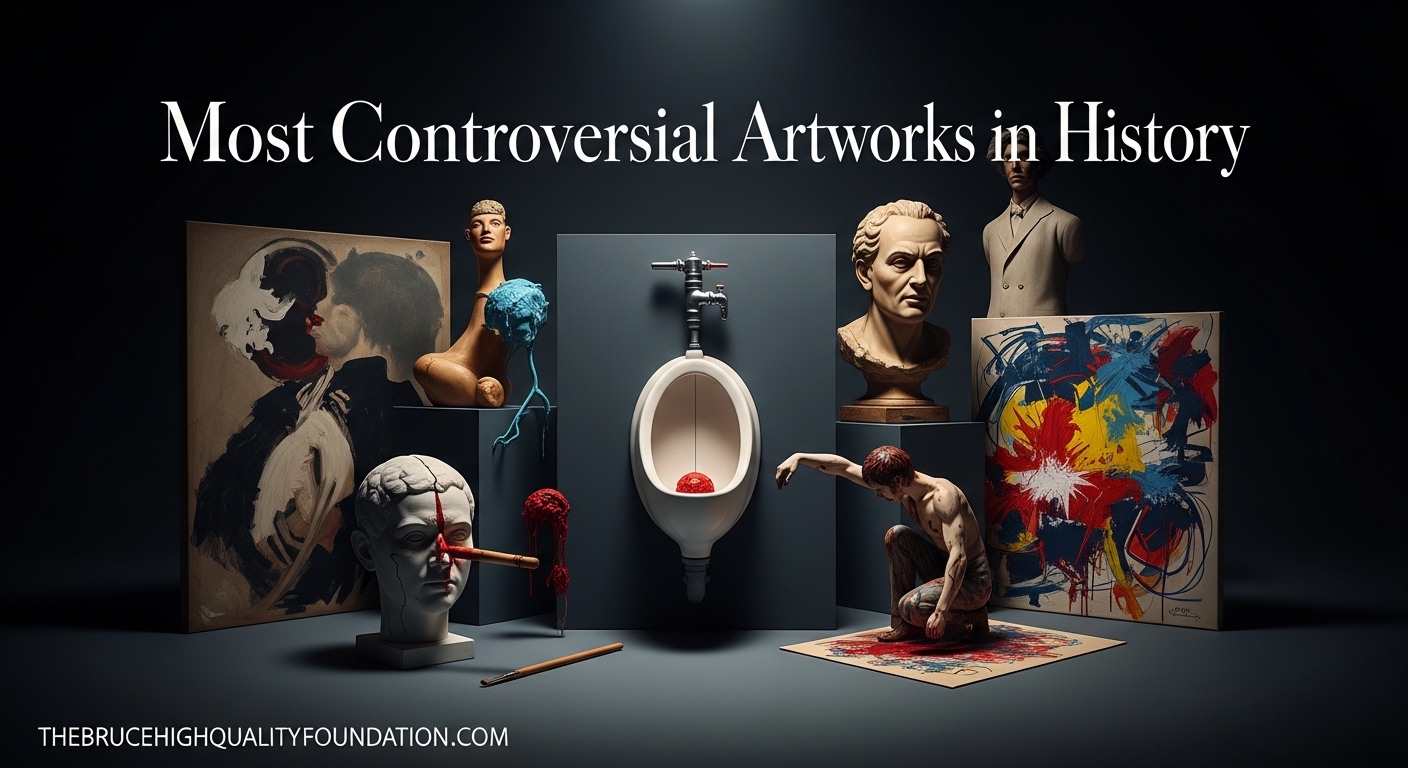
Some artworks divide opinion. Others spark protests, legal battles, and public outrage. The most controversial artworks in history did not merely sit quietly on gallery walls. They forced society to confront uncomfortable questions about taste, morality, religion, and the very definition of art itself.
In this comprehensive guide, we explore the pieces that shook the art world and beyond. These works challenged conventions, tested boundaries, and demonstrated that art could be as provocative as any speech or protest. Whether you are an art enthusiast, a student, or simply curious about why certain creations cause such firestorms, this article provides the context and analysis you need.
We will journey from 19th-century paintings that shocked Victorian sensibilities to 21st-century installations that continue to divide opinion. Each piece tells a story about the time and culture that produced it. Together, they form a chronicle of how art has constantly evolved through controversy and conflict.
Table of Contents
What Makes Art Controversial?
Art becomes controversial when it confronts viewers with ideas, images, or materials that challenge deeply held beliefs or sensibilities. The controversy typically arises from one or more factors: religious offense, sexual content, political critique, unusual or provocative materials, or questions about whether the work even qualifies as art.
The reception of controversial art often depends heavily on context. A work shown in a formal museum gallery carries different weight than the same piece displayed elsewhere. Cultural moment matters enormously. Works that seem tame today once provoked riots. Understanding why requires examining specific cases in their historical context.
Our team has analyzed decades of art controversies to bring you this guide. We studied how institutions responded, how the public reacted, and how these works are viewed today. The goal is not to tell you what to think about these pieces but to understand why they provoked such strong responses.
19th Century: The Birth of Modern Controversies
The 19th century saw art begin to challenge academic traditions in earnest. As artists moved away from idealized representations toward modern life, they encountered resistance from institutions and public alike.
Manet’s Olympia (1863): Challenging the Nude Tradition
When Edouard Manet exhibited Olympia at the 1865 Paris Salon, viewers were horrified. The painting depicted a nude woman lying on a bed, directly meeting the viewer’s gaze. This was not the idealized goddess of academic painting. This was a real woman, possibly a prostitute, staring back at the audience with confidence.
The controversy was immediate and intense. Critics called the work vulgar, ugly, and scandalous. Some described it as a “nightmare” of the female form. The public reportedly pelted the painting with stones and vegetables during its exhibition. Yet beneath the outrage lay something revolutionary: a painting that refused to pretend women’s bodies existed only for male pleasure.
Today, Olympia hangs in the Musee d’Orsay in Paris, recognized as a foundational work of modern art. It demonstrated that direct confrontation could be an artistic strategy, and that art about contemporary reality, not idealized history, was worthy of serious consideration.
Whistler’s Peacock Room (1877): Aesthetic Provocation
James McNeill Whistler created the Peacock Room for Frederick Richards Leyland as a decorative ensemble that blurred the line between art and interior design. The room featured intricate gold leaf work and painted peacocks in vibrant blue and gold. It was beautiful, expensive, and deeply controversial for its radical approach to space and decoration.
The project caused a rift between Whistler and Leyland, who had commissioned the work. Whistler painted over portions of the original ceramics Leyland had collected, treating the entire room as his canvas. The conflict over creative control and the boundaries of artistic license made headlines in London’s art circles.
The Peacock Room now resides in the Freer Gallery of Art in Washington, D.C. It stands as an early example of total design, influencing how we think about immersive artistic environments today.
Early 20th Century: Dadaism and the Readymade Revolution
The early 20th century brought movements that fundamentally questioned what art could be. Dadaism emerged from the chaos of World War I as an explicit rejection of rational culture. Its artists used absurdity, provocation, and found objects to challenge every assumption about artistic creation.
Marcel Duchamp’s Fountain (1917): The Urinal That Changed Art
Marcel Duchamp submitted a mass-produced urinal to the Society of Independent Artists exhibition in 1917, signing it “R. Mutt.” The work was rejected, but the controversy it sparked transformed art forever. Here was a question posed directly: Can anything be art if an artist declares it so?
The argument centered on whether the selection and context determined artistic value. Duchamp argued that the choice of object was itself a creative act. Critics disagreed, calling the work a hoax or an insult to art. The Museum of Modern Art eventually acquired a replica, cementing its status as a canonical work of modern art.
To understand the full significance of this work, you need to explore Duchamp’s revolutionary readymade concept and how it continues to influence artists today.
Duchamp’s L.H.O.O.Q. (1919): Mona Lisa with a Mustache
Two years after the Fountain controversy, Duchamp added a mustache and goatee to a printed reproduction of Leonardo da Vinci’s Mona Lisa. The title, L.H.O.O.Q., is a French pun that roughly translates to “she has a hot ass” when read aloud.
The work questioned the reverence with which art history treats certain masterpieces. By defacing a cultural icon, Duchamp suggested that all cultural objects are fair game for interpretation and transformation. The work sparked outrage among those who saw it as desecration of a masterpiece.
Today, L.H.O.O.Q. is recognized as a key work of conceptual art and Dadaism. It demonstrated that an artist’s intervention could transform existing imagery into commentary on art, culture, and gender.
Mid-20th Century: Abstract Expressionism and Beyond
After World War II, American artists developed abstract expressionism, a movement emphasizing spontaneous, emotional expression. These works often provoked confusion and skepticism from audiences accustomed to representational art.
Jackson Pollock’s Drip Paintings: Is This Really Art?
When Jackson Pollock began creating his iconic drip paintings in the late 1940s, many critics and members of the public were skeptical. The works featured paint dripped, poured, and splattered onto canvas laid on the floor. Where was the skill? Where was the subject matter?
The controversy around Pollock extended beyond aesthetics into questions of authenticity and artistic authority. When Life magazine published a photograph of Pollock at work in 1949 with the headline “Is He the Greatest Living Painter in the United States?” the backlash was immediate. Readers disagreed violently.
Today, Pollock’s works sell for tens of millions of dollars and hang in major museums worldwide. His approach to painting influenced countless artists and demonstrated that the artist’s process and presence could be central to the work itself.
Robert Rauschenberg’s Combines: Crossing Boundaries
In the 1950s and 60s, Robert Rauschenberg created “Combines,” works that blended painting and sculpture using found objects, stuffed animals, and everyday materials. These works challenged the distinction between art objects and ordinary things even as they produced visually striking compositions.
One famous Combine, Monochrome Blue (1959), featured an actual bed frame with quilt and pillow, covered in paint. The work blurred boundaries between painting and installation, between art and lived experience. Some viewers found it disturbing; others saw it as a brilliant expansion of artistic possibility.
Rauschenberg’s Combines remain influential for artists working across media and materials today. They demonstrated that art could incorporate three-dimensional objects without apology or explanation.
The 1980s-90s: Shock Art and the Young British Artists
The Young British Artists (YBAs) emerged in London during the late 1980s and 90s, becoming known for provocative, often shocking work. Their pieces frequently used unusual materials, explicit content, and direct confrontation with viewers.
Damien Hirst’s The Physical Impossibility of Death in the Mind of Someone Living (1991)
Damien Hirst preserved a shark in formaldehyde and displayed it in a glass case. The work, titled The Physical Impossibility of Death in the Mind of Someone Living, shocked viewers with its raw physicality and implicit violence. Here was a real animal, dead and displayed as art object.
The controversy reflected broader debates about taste, money, and artistic ambition. When Charles Saatchi purchased the work for a significant sum, critics questioned whether the price reflected genuine artistic value or mere shock tactics. The work also sparked discussions about animal welfare and the ethics of using real remains.
Hirst became one of the most famous and wealthy artists of his generation. His success demonstrated that controversy could translate into commercial viability while raising persistent questions about the relationship between art and commerce.
Marcus Harvey’s Myra (1992)
Marcus Harvey’s portrait of Myra Hindley, the Moors Murderer, caused perhaps the most visceral reaction of any YBA work. The painting used handprints of children to create a giant image of Hindley’s face, confronting viewers with the uncomfortable proximity of innocence and evil.
Protesters demonstrated outside the Royal Academy during the Sensation exhibition. Some viewers vomited. Others wept. The work raised questions about the ethics of representation: Could art represent evil without glorifying it? Did the choice of materials (child handprints) constitute a moral violation regardless of intent?
Today, Myra remains one of the most discussed works of the 1990s, a case study in the ethics of artistic representation and the limits of acceptable subject matter.
Tracey Emin’s My Bed (1999)
Tracey Emin exhibited her actual bed, unmade, with bottles, condoms, and other detritus of daily life scattered around it. The work was either powerful autobiography or squalor presented as art, depending on who you asked.
My Bed polarized critics and audiences. Some found it honest and moving, a brave exposure of intimate experience. Others dismissed it as self-indulgent and deliberately provocative without substance. The work won the Turner Prize nomination that same year, ensuring its place in art history discussions.
Emin’s approach exemplifies a broader tendency in contemporary art toward personal disclosure and boundary-pushing. Understanding this work requires considering the context of groundbreaking performance art controversies and how artists have used their bodies and lives as artistic material.
21st Century: Performance Art and Installation Controversies
The 21st century has continued the tradition of controversial art, with digital media, global connectivity, and shifting cultural contexts producing new modes of provocation.
Chris Ofili’s The Holy Virgin Mary (1996): Religious Offense That Endures
Chris Ofili’s painting of the Virgin Mary incorporated elephant dung and pornographic images, among other materials. When the work was displayed at the Brooklyn Museum in 1999 as part of the “Sensation” exhibition, Mayor Rudy Giuliani attempted to cut the museum’s funding and force removal of the work.
The legal battle that followed became a landmark case in American cultural policy. The court ruled that the government could not censor art based on content, establishing important precedents for artistic freedom. The controversy itself became part of the artwork’s history.
The Holy Virgin Mary exemplifies how religious sensitivity remains a potent source of controversy. It also demonstrates how institutional support for artists can protect controversial work from political pressure, a topic explored further in discussions of curatorial decisions around controversial art.
Kara Walker and the Legacy of Racist Imagery
Kara Walker’s silhouettes depicting scenes of slavery, violence, and racial stereotypes have sparked intense debate since their debut in the 1990s. Her work uses the aesthetic language of antebellum imagery while subverting it to confront the persistence of racism.
Critics have accused Walker of perpetuating harmful stereotypes by presenting them visually. Supporters argue her work performs a necessary confrontation with historical trauma that other artists avoid. The debate reflects broader disagreements about representation, responsibility, and the purpose of art dealing with systemic injustice.
Walker’s work continues to generate discussion as institutions increasingly grapple with how to present difficult historical content. Her success demonstrates that art can address controversial subjects without providing easy answers.
Ai Weiwei’s Sunflower Seeds (2010): Political Statement at the Tate
Ai Weiwei installed 100 million porcelain sunflower seeds in the Turbine Hall at Tate Modern. Each seed was hand-crafted by artisans in Jingdezhen, China, a city famous for porcelain production. The work addressed themes of individuality, mass production, and the relationship between individual and collective.
The work initially contained loose seeds that viewers could walk through, creating concerns about safety and the implications of crushing the delicate objects. Eventually, the seeds were sealed for preservation. This change altered the work’s interaction with visitors.
For many viewers, the work also carried political implications. Ai Weiwei had faced Chinese government pressure, and his use of Chinese craftsmanship in a Western institution sparked conversations about cultural exchange, labor practices, and artistic freedom. The work succeeded both as formal installation and as political statement.
Dana Schutz’s Open Portrait (2017): Who Owns Trauma?
Dana Schutz’s painting of Emmett Till, an African American teenager murdered in 1955 in a racially charged case that shocked the nation, generated intense controversy when displayed at the Whitney Biennial. Critics questioned whether a white artist should depict this particular subject.
The debate centered on questions of ownership, appropriation, and who has the right to represent certain histories. Protesters called for removal of the work. Schutz defended the painting as an attempt to confront American racism. The controversy raised questions that the art world continues to grapple with.
This case demonstrates how contemporary art dealing with historical trauma can spark debates about representation that extend beyond aesthetics into questions of cultural power and historical justice.
The Limits of Art: Obscenity, Censorship, and Legal Battles
Throughout art history, certain works have pushed against legal and social definitions of acceptable expression. These controversies often intersect with broader cultural wars over morality, religion, and governmental authority.
The legal framework for artistic expression varies significantly across countries. In the United States, the First Amendment provides strong protections for artistic speech, though these protections have limits. The Supreme Court has grappled with defining where expression ends and obscenity begins, a distinction that remains contested.
Other nations take different approaches. Some European countries have stricter hate speech laws that can criminalize certain artistic expressions. Religious nations may prohibit depictions of sacred figures or themes deemed blasphemous. These variations mean that artwork acceptable in one country might be illegal in another.
Artists throughout history have faced legal consequences for their work. Some of these cases became landmark decisions establishing important precedents. Others resulted in fines, imprisonment, or destruction of the work itself. Understanding these legal battles provides insight into how societies negotiate the boundaries of acceptable expression.
Why These Works Matter: The Impact of Controversy
Controversial artworks do more than provoke immediate reactions. They shape ongoing conversations about art, society, and the boundaries of acceptable expression.
How Controversy Shapes Artistic Discourse
When an artwork sparks debate, it expands the range of what artists might attempt. Each successful controversial work opens space for future artists to push further. The controversies themselves become part of art history, studied alongside the works that generated them.
We see this pattern repeatedly. What was shocking in one decade becomes accepted in the next. The artists who courted controversy often become recognized as visionaries who expanded the definition of art. Their works enter museum collections and art history textbooks.
The Role of Institutions and Censorship
Museums, galleries, and governments have frequently attempted to suppress controversial art. These attempts often backfire, generating more attention for the work and creating martyrs for artistic freedom. Understanding how institutions navigate these pressures requires examining the complex decisions museums face when controversial works are proposed for exhibition.
The relationship between artistic freedom and institutional constraint remains unresolved. Each controversy tests the boundaries and establishes precedents that shape future decisions.
From Outrage to Acceptance: How Art History Forgives
Remarkably, most controversial artworks eventually become accepted, even celebrated. The same works that provoked riots often become tourist attractions and cultural touchstones. This shift raises questions about how public taste evolves and what this suggests about the relationship between art and society.
Olympia, once considered obscene, now appears on book covers and inspires scholarly analysis. Duchamp’s Fountain, initially rejected as a hoax, influenced generations of artists. Even Hirst’s shark, once a symbol of art world excess, now represents a significant moment in contemporary art history.
This trajectory suggests that controversy often signals innovation rather than aberration. The works that challenge us today may become the classics of tomorrow.
The Broader Context: Art Movements and Controversy
Understanding controversial art requires recognizing the movements that produced them. Dadaism emerged from disillusionment with rational culture after World War I. Abstract expressionism reflected postwar anxieties about identity and meaning. The YBAs responded to Thatcher’s Britain and the consumerism of the 1980s.
Each movement used controversy strategically to distinguish itself from mainstream culture and attract attention. The shock value served a communicative purpose, signaling that these artists operated outside conventional boundaries.
The global art world has increasingly embraced diversity of perspectives and origins. Artists from outside Western traditions have brought new concerns and aesthetic strategies, sometimes generating controversy over cultural appropriation and representation. These debates continue to evolve as the art world becomes more globalized.
Collecting and the Market for Controversial Art
Controversial art often commands high prices once the controversy fades. Collectors who recognized the significance of challenging works early have seen significant returns. This market dynamic raises questions about the relationship between artistic merit and commercial value.
Major auction houses regularly sell works that were once considered unexhibitable. Museums compete to acquire controversial pieces for their permanent collections. This institutional embrace can transform the reputation of both work and artist rapidly.
However, commercial success does not necessarily resolve the questions controversial art raises. The debates these works generate often continue long after the prices are established and the works are safely ensconced in museum galleries.
Performance Art: When the Body Becomes the Medium
Performance art has produced some of the most memorable and controversial moments in recent art history. By making the artist’s body the primary medium, these works challenge conventions about what art should be and how it should be experienced.
Marina Abramovic’s performances have tested the limits of endurance and presence. In “The Artist Is Present” (2010) at the Museum of Modern Art, she sat motionless for 736 hours, allowing visitors to sit across from her in silent exchange. The work generated intense emotional responses and sparked conversations about presence, vulnerability, and human connection.
Chris Burden famously fired a gun at a gallery in 1971, putting a bullet through his own arm. The work, titled “Shoot,” raised questions about the extremes artists would go to create meaningful work. It also raised questions about the ethics of dangerous performance and the responsibility of institutions that enable such works.
Yoko Ono’s “Cut Piece” (1964) invited audience members to cut away her clothing with scissors while she sat motionless. The piece addressed themes of vulnerability, power, and the relationship between artist and audience. It has been restaged numerous times, adapting to different cultural contexts while maintaining its provocative edge.
Digital Age Controversies: New Frontiers in Provocation
The digital age has introduced new forms of controversial art. Internet culture, social media, and digital manipulation have created unprecedented opportunities for artists to challenge viewers.
Artists working with artificial intelligence and machine learning have sparked debates about creativity, authorship, and the nature of artistic intention. When an AI system creates an artwork, who is the artist? The programmer? The machine? These questions become more pressing as AI systems produce increasingly sophisticated outputs.
Meme culture and digital appropriation have also generated controversy. Artists who repurpose existing digital imagery sometimes face criticism for lack of originality. Others argue that digital remixing represents a legitimate contemporary artistic practice that challenges traditional notions of authorship.
Frequently Asked Questions About Controversial Art
What makes art controversial?
Art becomes controversial when it challenges societal norms, religious beliefs, political views, or questions about what even qualifies as art. Controversy often stems from the intersection of intent, medium, and public reception.
What is the most controversial artwork ever?
Marcel Duchamp’s Fountain (1917) is often considered the most influential controversial artwork. By submitting a mass-produced urinal to an art exhibition, Duchamp questioned the very definition of art and sparked a debate that continues today.
Why do artists create controversial work?
Artists create controversial work to challenge viewers, provoke thought, push boundaries, and drive cultural discourse. Controversy can be a tool to question authority, express dissent, or simply explore the limits of acceptable expression.
How do museums handle controversial art?
Museums navigate controversy through curatorial decisions, content warnings, contextual framing, and sometimes by choosing not to exhibit certain works. The tension between artistic freedom and public sensitivity remains an ongoing debate.
Can controversial art be valuable?
Yes, controversial artworks often become highly valuable. The same works that sparked outrage upon creation frequently end up in major museum collections and sell for millions at auction, demonstrating how public taste evolves.
What is the relationship between art and obscenity?
The distinction between art and obscenity has been debated for centuries. Courts and critics have developed various tests and frameworks, but consensus remains elusive. What one person considers profound expression, another may find obscene, making this a persistent question in art discourse.
Why does religious art cause so much controversy?
Religious art provokes strong reactions because it engages with deeply held beliefs and sacred symbols. When artists modify, deconstruct, or critique religious imagery, they challenge not just aesthetic conventions but spiritual and cultural identities that matter enormously to many people.
The Most Controversial Artworks in History: A Reflection
The most controversial artworks in history share a common quality: they refused to be ignored. Whether through shocking imagery, provocative materials, or fundamental challenges to artistic definition, these works demanded that viewers engage rather than passively observe.
Each controversy reveals something about the time and place that produced it. Victorian sensibilities produced different scandals than postwar America or Thatcher’s Britain. Understanding these works means understanding the contexts that made them possible and the reactions they provoked.
As we have seen, controversy often precedes acceptance. The works that shock us today may become the classics of tomorrow. This trajectory suggests that artists pushing boundaries serve an essential function in cultural evolution.
The art world continues to produce controversial work, and debates continue about where appropriate boundaries lie. What seems certain is that art which provokes discussion performs a valuable service. It forces us to examine assumptions, confront uncomfortable truths, and reconsider what we believe about art and society.
Whether you find these works inspiring or disturbing, their impact on artistic development is undeniable. They have expanded what artists attempt, what institutions exhibit, and what audiences accept. In doing so, they have enriched our cultural vocabulary and demonstrated that art can be a powerful force for change.
If this exploration of controversial art has intrigued you, consider visiting major museums where these works are displayed. Many are now considered essential holdings, and experiencing them in person reveals details that reproduction cannot capture. Art history is best when encountered directly.
The conversation about controversial art will continue as long as artists challenge conventions and viewers respond. Rather than seeking to eliminate controversy, we might recognize it as a sign that art still matters, that it still has the power to disturb and provoke in ways that other cultural forms cannot match.