
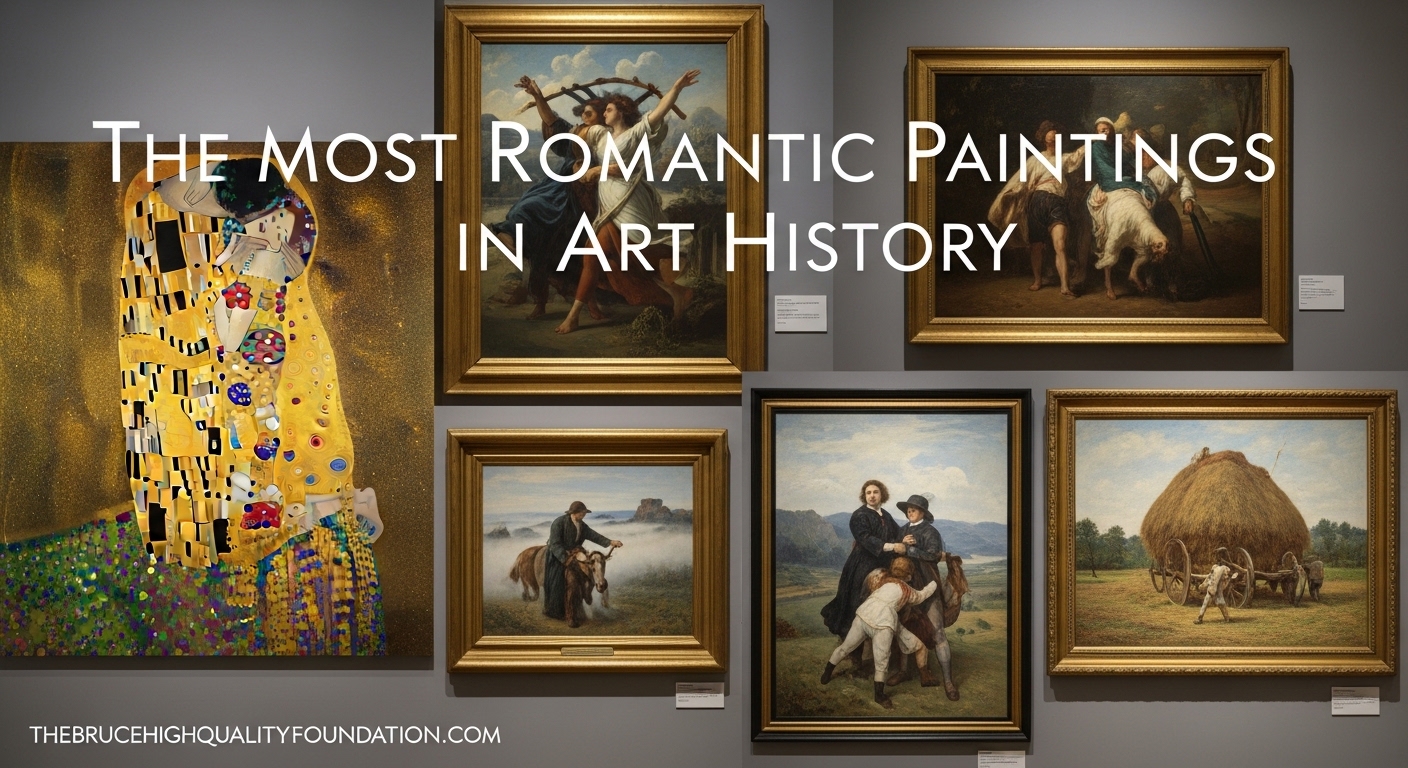
Few subjects have inspired artists more powerfully than love. From ancient mythology to modern-day emotions, painters have long sought to capture the intangible, to freeze onto canvas the most profound human connection. This guide explores the most romantic paintings in art history, examining why these works continue to move us centuries after their creation.
The question of what makes a painting romantic goes beyond simple depictions of couples or kisses. It touches on emotional depth, composition, color, and the ability to evoke longing, passion, and tenderness in the viewer. Whether rendered in the gilded halls of Renaissance Florence or on the moody streets of 20th-century Oslo, these paintings share a common thread: they translate love into visual poetry.
Table of Contents
What Makes a Painting Romantic?
Romantic paintings distinguish themselves through several key elements. First, they capture intimate moments that feel genuine rather than staged. The best romantic artworks show vulnerability, the unguarded instant when two people connect without pretense.
Second, color and light play crucial roles. Artists use warm palettes, soft gradients, and careful attention to how illumination falls on skin and fabric to create atmosphere. The soft glow in Chagall’s works or the golden leaf that envelops Klimt’s figures each establish distinct emotional registers.
Third, composition directs our gaze toward meaningful connections. A painting might use diagonal lines to guide us from one figure to another, or employ symmetry to suggest harmony between lovers. These technical choices work beneath our awareness, shaping how we experience the scene.
Fourth, context matters enormously. A romantic painting gains depth when we understand the artist’s own love story, or when the work references mythological narratives that have shaped our cultural understanding of romance. This is why art historians often explore the lives behind the canvases.
The Most Romantic Paintings in Art History
The Kiss by Gustav Klimt (1908)
The Kiss stands as perhaps the most recognizable romantic painting in the world. Klimt depicts two figures in an embrace, their faces close, lips nearly meeting. The man bends toward the woman, one hand cradling her head while the other holds her waist. Their robes flow together, the woman in white and gold, the man in blue and gold, their colors mingling at the edges of their embrace.
What makes this painting so deeply romantic is its sense of completeness. These two figures exist in their own world, surrounded not by physical space but by gold leaf that creates a sacred alcove of intimacy. The painting captures that rare moment when the world narrows to just two people.
Klimt worked on this piece as part of his golden phase, drawing influence from Byzantine mosaics and Japanese prints. The flatness of the composition and the decorative patterns contrast beautifully with the emotional depth of the subject matter.
The painting now hangs in the Österreichische Galerie Belvedere in Vienna, where visitors often stand before it in silence. Many come specifically to see this work, drawn by its enduring power to represent love’s intensity.
The Birth of Venus by Sandro Botticelli (c. 1485)
The Birth of Venus depicts the goddess of love emerging from the sea as a fully formed adult, standing on a giant scallop shell. The wind god Zephyr blows her ashore while a nymph waits with a cloak to cover her modesty. The painting presents Venus as the embodiment of beauty, grace, and divine love.
While technically depicting mythological subject matter rather than human romance, the painting carries profound romantic significance through its celebration of beauty, desire, and the feminine divine. Venus represents love as a cosmic force, beautiful and powerful beyond mortal comprehension.
Botticelli’s technique creates an otherworldly quality. Venus’s pale skin seems to glow against the muted blues and greens of the sea and shore. Her hair floats gently in the breeze, and her expression carries a dreamlike quality that suggests contemplation rather than awareness of being observed.
The painting resides in the Uffizi Gallery in Florence, where it draws crowds daily. Art lovers return repeatedly, finding new layers of meaning in this Renaissance masterpiece that has influenced countless depictions of love and beauty.
The Birthday by Marc Chagall (1915)
The Birthday depicts a surreal scene where a man and woman float together in an interior space. The woman bends her head backward in an arc, her lips meeting those of her lover as he leans in from the side. Flowers fill the room, and a small village shows through the window behind them.
Chagall painted this work shortly after marrying his beloved Bella Rosenfeld. The painting captures the joy and disorientation of new love, where ordinary rooms become magical spaces and gravity seems optional. The lovers float simply because love makes such things possible.
The surrealist elements feel natural rather than gimmicky. This is not dream imagery imposed upon reality but rather emotional truth rendered visible. The viewer believes in this floating couple because the emotion behind the image is so genuine.
The painting now resides in the collection of the Museum of Modern Art in New York City. Its influence extends far beyond the art world, having appeared on everything from greeting cards to album covers, always evoking that special quality of being completely submerged in love.
The Kiss by Edvard Munch (1895)
Munch’s version of The Kiss presents two figures as a single shadowy silhouette against a stark, wavering background. Their faces blend together so completely that distinguishing one from the other becomes impossible. They stand in an embrace that seems desperate as much as tender.
Where Klimt’s version suggests completeness, Munch’s seems to speak of dependency. These two figures have merged because separation feels impossible. The dark outlines and wavy lines convey emotional intensity that borders on anxiety.
Munch worked during a period of personal upheaval, and his art reflects that turbulence. The Kiss captures a specific kind of romantic experience, one where love feels consuming rather than comforting. This duality gives the painting its distinctive power.
Multiple versions exist, with the original held by the National Gallery in Oslo. Other versions have traveled to galleries worldwide, and each iteration shows subtle variations that reflect Munch’s ongoing exploration of this central theme.
Frida Kahlo and Diego Rivera: Love and Pain
No discussion of romantic paintings would be complete without addressing the extraordinary work of Frida Kahlo. Her paintings explore love with an intensity few artists have matched. Works like What the Water Gave Me and The Two Fridas depict emotional complexity that transcends simple romantic representation.
Kahlo and Rivera’s own love story was legendary and turbulent. They married, divorced, remarried, and maintained passionate connection throughout decades of artistic and personal struggle. Kahlo’s self-portraits often include Rivera symbolically, showing how deeply he was woven into her identity.
What makes Kahlo’s work so romantically powerful is her willingness to show love’s shadow side. Her paintings acknowledge jealousy, dependency, pain, and obsession alongside tenderness and desire. This honesty creates a different kind of romantic resonance.
The Lovers, a 1924 work by Kahlo, shows two figures with their faces hidden, leaning together in an intimate configuration that suggests connection without the idealized perfection of traditional romantic art.
The Jewish Bride by Rembrandt (c. 1665)
The Jewish Bride demonstrates Rembrandt’s mastery of emotional portrayal. The painting shows a couple in gentle embrace, the man placing his hand on the woman’s chest while she rests her hand on his arm. Their body language speaks of long familiarity and comfortable intimacy.
The title has been debated, but viewers consistently read romantic meaning into the scene. The tenderness between figures suggests a relationship built on years of shared experience rather than the passionate intensity of new love. This is love in its mature form.
Rembrandt’s use of light draws attention to the couple’s faces and hands, the parts of the body most expressive of intention and feeling. The dark background pushes them forward into the viewer’s space, creating the sense of observing a private moment.
The painting hangs in the Rijksmuseum in Amsterdam, where visitors frequently gather before it. Many report feeling moved by the quiet dignity of the couple’s embrace, finding in it a model for lasting love.
Lesaves and the Spy by Alexandre Cabanel (1863)
While less famous than some entries on this list, Cabanel’s work offers a distinct vision of romantic longing. His female figures often appear suspended in reverie, their expressions suggesting inner worlds of desire and imagination.
Cabanel worked in the academic tradition, producing carefully crafted paintings that prioritize beauty and emotional resonance. His subjects frequently appear lost in thought, contemplating love from a place of quiet vulnerability.
This approach has influenced subsequent generations of artists who seek to capture not the declaration of love but its quieter moments, the internal experience of romantic feeling.
Surrealist Love: Leonora Carrington and Max Ernst
The surrealist movement brought distinctive approaches to depicting romance. Artists like Leonora Carrington and Max Ernst created works that explored love through dreamlike imagery and mythological references. Contemporary art movements like surrealism often explore love as an alchemical process that transforms the participants.
Carrington’s paintings often depict transformations where humans take animal forms or where reality shifts according to emotional logic. Love in her work becomes an alchemical process, something that transmutes the participants even as it connects them.
Ernst created works that explore psychological dimensions of romantic attachment. His paintings suggest that love involves as much projection and imagination as it does perception. What we see in our lovers may be partly our own creation.
Together, Carrington and Ernst formed one of art history’s notable partnerships. Their relationship inspired works from both artists, creating a body of work that collectively explores how love transforms consciousness. For those interested in the philosophical underpinnings of such artistic expressions, understanding conceptual art approaches can provide additional context.
The Most Romantic Paintings Across Art Movements
Romantic paintings appear throughout art history, not confined to any single movement. Renaissance masters like Botticelli explored love through mythological frameworks, while Baroque painters like Rembrandt captured intimate moments with psychological depth.
The Impressionists brought new attention to capturing light and movement in scenes of modern romance. Renoir’s dances and Monet’s garden scenes show couples in moments of private joy amid public spaces.
Art Nouveau artists like Klimt emphasized decorative beauty and symbolic meaning in their romantic works. The Symbolists turned inward, exploring emotional states that resist easy representation.
Modern and contemporary artists have continued expanding what romantic painting can mean. Alex Colville’s precise, almost photographic realism creates dreamlike scenes of intimacy. Contemporary creators explore diverse perspectives on love, including underrepresented voices and non-Western approaches.
Where to See These Romantic Masterpieces
Many of the most romantic paintings hang in major museums where they draw visitors from around the world. The Klimt Kiss draws crowds to Vienna’s Belvedere Gallery. Botticelli’s Birth of Venus anchors the Uffizi’s early Renaissance collection in Florence.
Chagall’s Birthday can be found at MoMA in New York, while Munch’s Kiss hangs in Oslo’s National Gallery. Rembrandt’s Jewish Bride draws visitors to Amsterdam’s Rijksmuseum.
For those planning pilgrimages to see these works in person, many museums offer special viewing hours when crowds thin. Early mornings and late afternoons typically provide the most contemplative experiences. Photography policies vary, but sketching and quiet reflection are usually permitted.
Reproductions cannot capture the scale and texture of original works, particularly those with heavy impasto or metallic leaf. Seeing Klimt’s gold leaf shimmer in person reveals dimensions invisible in reproductions. Standing before Rembrandt’s brushwork in person demonstrates technical mastery that photographs cannot convey.
Understanding Romantic Art: FAQ
What are the greatest paintings about love?
The most celebrated paintings about love include Klimt’s The Kiss, Botticelli’s Birth of Venus, Chagall’s The Birthday, Munch’s The Kiss, and Rembrandt’s The Jewish Bride. Each captures different aspects of romantic feeling, from passionate intensity to tender familiarity.
What were the great love stories of art history?
Art history is filled with legendary romantic partnerships: Gustav Klimt and Emilie Floge, Frida Kahlo and Diego Rivera, Marc Chagall and Bella Rosenfeld, and Pablo Picasso and Dora Maar. These relationships often influenced the romantic depth seen in their art.
What makes a painting romantic?
Romantic paintings typically feature intimate moments between figures, careful attention to light and color that creates emotional atmosphere, compositions that guide viewer attention toward meaningful connections, and often include context from mythology, literature, or the artist’s personal experience.
Which painting is the most romantic?
Klimt’s The Kiss often tops lists of the most romantic paintings due to its perfect balance of composition, color, and emotional intensity. However, different paintings speak to different viewers, and the ‘most romantic’ designation ultimately depends on personal interpretation.
Final Thoughts on Romantic Paintings
The most romantic paintings in art history share one thing above all else: they make us believe. They convince viewers that love is worth depicting, worth contemplating, worth preserving in pigment and canvas. Each brushstroke commits to the idea that human connection matters profoundly.
These works span centuries and continents, different art movements and wildly varying techniques. Yet they all somehow manage to translate complex emotional experiences into images that communicate across language barriers and cultural differences. A viewer in Tokyo can feel the same emotional resonance standing before Klimt’s The Kiss as a visitor from Vienna.
This universality suggests something fundamental about romantic love as a human experience. The paintings discussed here tap into something that transcends time and geography, offering viewers not just aesthetic pleasure but emotional recognition. We see ourselves reflected in these images of embrace, longing, and connection.
For those seeking to understand why certain paintings endure as romantic icons, the answer lies in their ability to make love feel present and real. The greatest romantic paintings do not simply depict love; they create experiences of love for anyone willing to look and feel.
As you explore these works further, consider visiting museums where they hang, reading about the artists who created them, and letting yourself respond emotionally rather than just intellectually. Romantic art rewards those who approach it with open hearts and minds.