
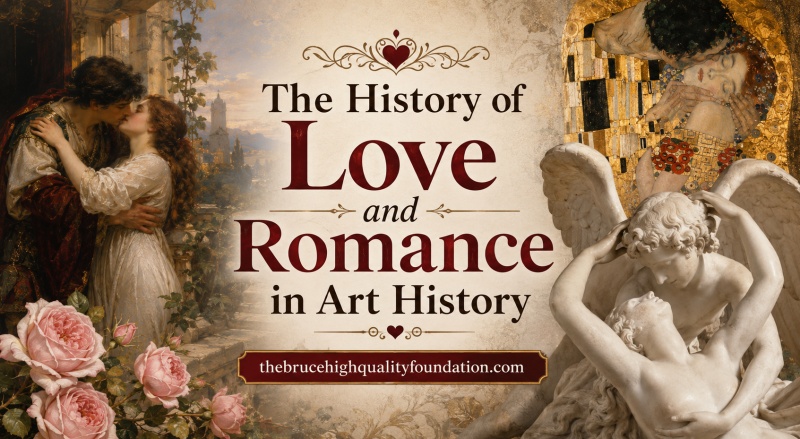
Love has been one of the most enduring subjects in the visual arts, appearing in countless paintings, sculptures, and decorative works across every major culture and historical period. The history of love and romance in art history spans more than thirty thousand years, evolving from ancient fertility symbols to the deeply personal expressions of romantic passion we recognize today. This comprehensive guide explores how artists have interpreted love, desire, devotion, and intimate relationships from prehistoric times through the contemporary era.
What makes love such a timeless subject for artists? The answer lies in its fundamental nature as a universal human experience that transcends cultural and temporal boundaries. Whether depicted through mythological narratives, courtly allegories, or deeply personal moments between lovers, love in art reflects and shapes how societies understand this most complex of emotions.
Table of Contents
Ancient Art and the Origins of Love Depiction
The earliest known depictions of love and sexuality in art date back to the Paleolithic era, with the famous Venus of Willendorf standing as one of humanity’s oldest representations of fertility and physical love. This small figurine, carved approximately 25,000 to 30,000 years ago, emphasizes attributes associated with reproduction and physical desire, suggesting that even our most ancient ancestors recognized the power of visual art to celebrate and communicate love themes.
Ancient Greek and Roman art expanded these themes considerably, placing love at the center of their mythological universe. The Greeks depicted love through their goddesses Aphrodite and Eros, creating countless sculptures that explored physical beauty, desire, and romantic attachment. The famous Venus de Milo, created around 130 BCE, exemplifies the Greek approach to love in art: an idealized, physically beautiful form that embodies romantic and erotic desire while maintaining artistic dignity.
Roman art continued this tradition but added greater narrative complexity. Love scenes from mythology, such as the story of Psyche and Cupid, became popular subjects for frescoes and sculptures in private homes throughout the Roman Empire. These works often depicted intimate moments between lovers, suggesting that ordinary Romans valued romantic love as a subject for their personal art collections.
Medieval and Renaissance Love Art
The medieval period brought significant changes to how love appeared in art, largely through the development of courtly love traditions. During the Middle Ages, European aristocracy embraced the concept of refined romantic devotion, where a knight would worship his lady from afar, performing noble deeds in her name. This tradition generated an entire iconographic language for love in art.
Manuscript illuminations from this period show lovers exchanging glances across crowded courts, knights pledging their devotion, and ladies receiving tokens of affection. These works established visual conventions that would influence art for centuries, including the depiction of love as a kind of spiritual elevation rather than merely physical desire. Courtly love in medieval art represented the idea that romantic attachment could inspire moral improvement and noble behavior.
The Renaissance completely transformed love in art through the revolutionary concept of humanism. Renaissance artists began treating human figures, emotions, and relationships with unprecedented realism and psychological depth. Jan van Eyck’s Arnolfini Portrait from 1434 demonstrates this shift, depicting a wealthy couple in what appears to be an intimate domestic setting with remarkable psychological complexity.
Botticelli’s Primavera, painted around 1482, offers another magnificent example of Renaissance love art. This complex allegorical work brings together mythological figures associated with love, springtime, and fertility in a composition that balances mythological tradition with Renaissance innovations in perspective and naturalism. The painting reflects the era’s fascination with classical texts on love while introducing new techniques for representing the human form and emotional states.
The Evolution of Romantic Love in Western Art
During the Renaissance, romantic love began emerging as a distinct artistic category, separate from purely religious or mythological interpretations. Artists started depicting personal moments between lovers rather than idealized mythological encounters. This shift reflected broader social changes, including increased emphasis on individual emotional experience and the growing importance of personal relationships outside strict family arrangements.
Titian and other Venetian painters further developed romantic love as an artistic subject, creating intimate portrait studies and mythological scenes that emphasized sensory experience and emotional connection. These works presented love as both physical and spiritual, celebrating the beauty of the beloved while acknowledging the depths of romantic devotion.
Baroque and Rococo: Passion and Pleasure
The Baroque period (approximately 1600 to 1750) introduced dramatic intensity and emotional power to love in art. Baroque artists sought to move viewers through powerful emotional appeals, and romantic love became a subject for exploring extreme states of passion, longing, and devotion. Caravaggio’s revolutionary use of light and shadow created dramatically intimate scenes that emphasized the emotional intensity of romantic encounters.
Artemisia Gentileschi, one of the most significant Baroque painters, brought particular power to subjects involving love and women. Her works often explore emotional complexity in relationships, presenting love not as idealized fantasy but as lived experience with all its attendant tensions and desires. Her paintings reveal how Baroque art could address romantic themes while engaging with broader questions of power, gender, and desire.
The Rococo period that followed brought greater lightness and playfulness to love in art. Artists like Antoine Watteau and Jean-Honore Fragonard created works celebrating romantic encounters, playful seductions, and the pleasures of aristocratic love affairs. These paintings emphasized sensory delight, elegant composition, and sophisticated symbolism rather than intense emotional drama.
Rococo love art often depicted lovers in garden settings, ballrooms, and private chambers, surrounded by decorative elements that reinforced the refined, pleasurable nature of romantic experience. The style reflected the values of an aristocracy that viewed love as a cultivated art form rather than a primal force, and the visual language of Rococo continues to influence how we represent romance today.
The Romantic Movement and Emotional Expression
Romanticism, which emerged as a major artistic movement around 1800, represented perhaps the most significant transformation in how art depicted love. The Romantic movement prioritized emotion, individualism, and personal experience, and romantic love became one of its central subjects. Romantic artists believed that intense emotional connection between lovers represented the highest form of human experience, capable of transcending the limitations of ordinary existence.
This movement also clarified an important distinction that many readers find confusing: Romanticism as an art movement versus romantic love as a general theme. Romanticism emphasized intense emotion, individualism, and often dramatic scenarios involving nature, the supernatural, or extreme psychological states. Romantic love, meanwhile, refers broadly to the Western concept of love as personal emotional attachment between individuals. Both traditions influenced art profoundly, but they are distinct concepts that sometimes overlap.
The Romantic period produced some of the most famous love artworks in history. Antonio Canova’s Psyche Revived by Cupid’s Kiss (1787) exemplifies Neoclassical Romanticism at its finest, presenting an intimate moment of romantic connection with exquisite technical refinement. The sculpture captures the precise moment when Cupid’s kiss awakens Psyche to love, combining classical mythological subject matter with Romantic emotional intensity.
Eugene Delacroix and other Romantic painters created dramatic scenes of passionate love, often drawing on literary sources that emphasized forbidden romance, tragic love affairs, and the power of love to transform human experience. These works presented love as a force capable of transcending social boundaries, physical limitations, and even death itself.
The Kiss in Art History: A Focus on Intimacy
No single motif better represents romantic love in art than the kiss. Artists across every period have been fascinated by this simple gesture, which encapsulates intimacy, desire, connection, and vulnerability in a single visual moment. The kiss as an artistic subject allows artists to explore physical closeness while suggesting emotional depth that words cannot express.
August Rodin’s The Kiss (1889) stands as perhaps the most famous sculptural representation of romantic love. This powerful work depicts Paolo and Francesca, characters from Dante’s Divine Comedy who were condemned to hell for their adulterous love. Rodin presents their kiss with remarkable physical immediacy, showing two bodies merging into one form in an embrace that seems simultaneously passionate and tender.
Francesco Hayez’s The Kiss (1859) offers a different approach, presenting a couple in what appears to be a stolen moment of intimacy. The painting’s dark background and dramatic lighting create theatrical intensity, while the figures’ elegant costumes suggest the social constraints that make their love both thrilling and dangerous. Hayez was working during Italy’s Romantic period, and his painting reflects that era’s fascination with passionate emotion constrained by social convention.
Gustav Klimt brought gold leaf and decorative elegance to the kiss in his famous painting of 1907-1908. Klimt’s couple appears almost mythical, their bodies adorned with elaborate patterns that suggest both physical passion and spiritual transcendence. The shimmering gold background removes the scene from ordinary reality, presenting romantic love as a kind of sacred or mystical experience that transcends the material world.
Modern and Contemporary Love Art
The modern era expanded artistic approaches to love beyond the Western traditions that dominated earlier periods. Artists began exploring diverse relationship structures, non-normative sexuality, and cultural variations in how love could be expressed and understood. This expansion reflected broader social changes, including movements for gender equality, LGBTQ+ rights, and cross-cultural understanding.
Egon Schiele’s work represents the early modern period’s honest approach to physical love. His paintings and drawings depict the human figure with unflinching directness, exploring desire, vulnerability, and intimate connection. Schiele’s couples appear genuinely present with each other, stripped of the mythological or allegorical justifications that earlier artists often used to justify depicting physical love.
Pierre-Auguste Renoir and the Impressionists brought a different quality to love in art, emphasizing the pleasure of physical closeness and the joy of romantic encounter. Renoir’s paintings celebrate lovers enjoying each other’s company, often in sunlit garden settings that reinforce the light, joyful quality of his vision of romantic love. His work suggests that love brings happiness rather than tragedy, passion, or social transgression.
Contemporary artists have continued expanding what love in art can mean. Robert Indiana’s LOVE sculpture, first appearing in 1964, became one of the most recognized symbols of romantic love in modern art. The simple, bold letters arranged in stack formation present love as both universal ideal and personal commitment. The sculpture has appeared in numerous variations and locations worldwide, demonstrating how contemporary art can distill complex emotional experience into visually striking symbols.
Love Symbolism and Iconography in Art
Understanding love in art requires familiarity with a rich symbolic vocabulary that artists developed over millennia. The heart shape, for example, became associated with romantic love during the medieval period and remains one of the most instantly recognizable symbols of love in visual art. Artists frequently included hearts in paintings and sculptures as shorthand for romantic affection, often placing them in the hands of Cupid or other love figures.
Cupid, the Roman god of desire and affection, appears throughout art history as a symbol of love’s playful, sometimes mischievous nature. Depictions of Cupid range from the adorable infant with bow and arrows to more complex representations of desire as a powerful, sometimes dangerous force. The goddess Venus similarly appears frequently, embodying physical beauty, fertility, and romantic love in all its manifestations.
Roses carry rich symbolic meaning in love art, associated with beauty, passion, and secrecy (when held close to the chest). The color of roses carries significance, with red roses symbolizing romantic love and white roses representing purity or spiritual love. Artists frequently included roses in love scenes to reinforce the romantic significance of their compositions.
The embrace itself became one of art’s most powerful symbols of love, representing protection, comfort, and emotional connection. Whether depicted between heterosexual or same-sex couples, lovers in art frequently appear in embrace, their bodies touching in ways that suggest both physical pleasure and emotional intimacy. This motif continues to appear in contemporary art, photography, and popular imagery.
Famous Love Stories and Artist Couples in Art History
Some of art history’s most compelling love stories involve the artists themselves. The relationships between famous artists and their partners often inspired works that rank among the greatest depictions of love in any medium. These partnerships reveal how personal experience of romantic love could directly inform and transform artistic practice.
Frida Kahlo and Diego Rivera shared one of art history’s most famous relationships. Both major Mexican artists, their marriage involved intense creativity, political commitment, and considerable personal turmoil. Kahlo’s numerous self-portraits, many addressing her relationship with Rivera and her physical suffering, represent some of the most emotionally honest art about love, pain, and dependence ever created. Rivera also painted Kahlo numerous times, and their mutual artistic influence remains a subject of scholarly interest.
Georgia O’Keeffe and Alfred Stieglitz maintained one of American art’s significant modern relationships. Their correspondence reveals a deep intellectual and emotional connection that informed both artists’ work. O’Keeffe’s flower paintings, with their intimate scales and suggestive forms, often appear to address themes of femininity, desire, and romantic attention. Stieglitz’s photographs of O’Keeffe rank among the most intimate portraits in American art.
Wassily Kandinsky and Gabriele Munte, later known as Gabriele Münter, played crucial roles in the development of German Expressionism. Their relationship spanned several years and involved significant artistic collaboration, though their story ended tragically when Münter preserved much of Kandinsky’s work during the Nazi period while he was abroad. This preservation ensured that important love art from the Expressionist movement survived to influence later generations.
Non-Western Perspectives on Love in Art
While Western art traditions have dominated much art historical scholarship, artists from cultures worldwide have created powerful depictions of love that deserve attention and appreciation. Japanese woodblock prints, for example, developed distinctive approaches to depicting romantic love that influenced Western Impressionists and continue to inspire contemporary artists worldwide.
Japanese ukiyo-e prints often depicted romantic encounters between lovers, often in private settings removed from the social constraints that shaped Western depictions. These works present love as a private experience, intimate and personal, while also acknowledging the transient nature of romantic pleasure. The famous love suicide scenes in Japanese art address romantic love’s power to transcend social boundaries, even leading to death.
Indian miniature paintings developed rich iconographic traditions for depicting romantic love, often drawing on literary sources like the Gita Govinda and other texts celebrating divine and human love. These works blend spiritual significance with physical beauty, presenting romantic love as a reflection of divine devotion. Mughal miniatures similarly explored romantic themes in courtly contexts, depicting emperors and their beloveds in elaborate, jewel-like compositions.
African and Oceanic art traditions also developed powerful approaches to love themes, though these have received less attention in conventional art historical scholarship. Contemporary curators and scholars increasingly work to integrate these traditions into broader narratives about love in art, expanding understanding beyond the European-centric approaches that dominated earlier periods.
Conclusion
The history of love and romance in art history demonstrates how this most human of experiences has inspired artists across every culture and period. From the fertility figures of prehistoric times through the mythological narratives of ancient Greece and Rome, the courtly traditions of medieval Europe, the emotional intensity of Romanticism, and the diverse approaches of contemporary art, love has remained a vital subject for visual artists.
What this journey through love in art reveals is that romantic love itself is a historical construction, changing significantly across periods and cultures. The intensely personal, emotionally focused romantic love we recognize today differs substantially from the communal, fertility-focused love symbolism of ancient cultures or the aristocratic, performative courtly love of medieval Europe. Art not only reflects these changing conceptions of love but actively shapes how societies understand and value romantic relationships.
As you explore love in art, whether visiting museums, studying art history, or creating your own work, consider how these historical representations continue to influence contemporary understanding of romance, intimacy, and human connection. The artists who depicted love across millennia faced similar challenges to those working today: how to represent complex emotional experience through visual means, how to balance idealization with honesty, and how to create works that resonate with viewers across cultural and temporal boundaries. In meeting these challenges, they produced some of humanity’s most moving and memorable art.
FAQs
How has love been depicted in art throughout history?
Love in art has evolved from ancient fertility symbols like the Venus of Willendorf through Greek and Roman mythology featuring Venus and Cupid, medieval courtly love traditions, Renaissance humanist approaches to personal relationships, Baroque dramatic intensity, Romantic emotional depth, and finally modern diverse expressions including abstract and non-Western perspectives.
What were the great love stories of art history?
Art history contains many famous love stories including the myth of Psyche and Cupid, Paolo and Francesca from Dantes Divine Comedy (depicted by Rodin), and real-life artist couples like Frida Kahlo and Diego Rivera, Georgia OKeeffe and Alfred Stieglitz, and Wassily Kandinsky and Gabriele Münter.
How did romantic love emerge as a subject in Western art?
Romantic love emerged as a distinct artistic subject during the Renaissance through humanism, which emphasized individual emotional experience and personal relationships. This shift moved away from purely religious or mythological interpretations toward depicting personal moments between lovers, a trend that intensified during the Romantic period of the early 19th century.
What is Romanticism in art history?
Romanticism was an artistic movement that emerged around 1800, prioritizing emotion, individualism, and personal experience. Romantic artists believed intense emotional connection between lovers represented the highest form of human experience. This is distinct from but related to romantic love as a general theme about personal emotional attachment.
Which artists were inspired by their personal relationships?
Many major artists drew inspiration from their personal relationships including Frida Kahlo (who created powerful self-portraits addressing her relationship with Diego Rivera), Canova (whose Psyche Revived by Cupid was inspired by his own romantic experience), and Georgia OKeeffe (whose intimate flower paintings were influenced by her relationship with Alfred Stieglitz).