
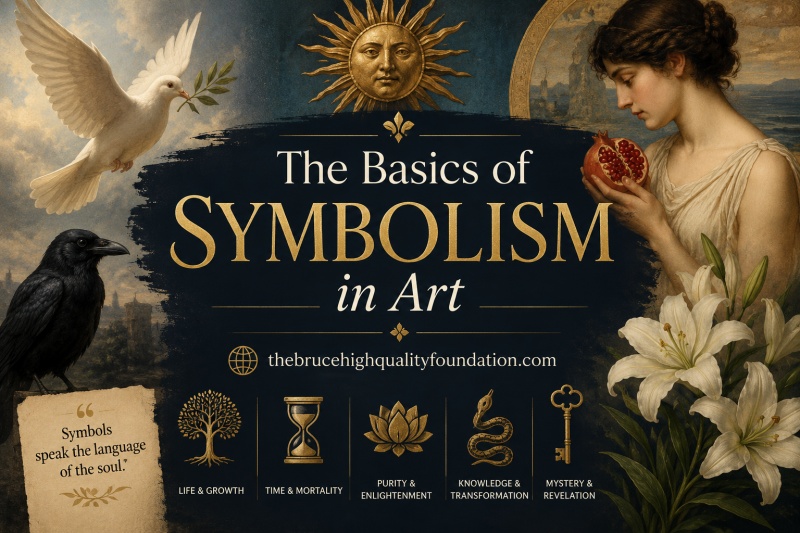
Have you ever stood in front of a painting and felt like it was trying to tell you something beyond what you could see? That feeling is not accidental. Artists have been embedding hidden layers of meaning into their work for thousands of years, and understanding the basics of symbolism in art opens up an entirely new way to experience paintings, sculptures, and even digital media.
When I first started studying art, I treated every work like a flat surface. A rose was just a rose. A skull was just a skull. Then a professor pointed out that the wilted flower in a Dutch still life was not decorative; it was a reminder that life is temporary. That single moment changed how I look at art, and it is exactly what this guide will do for you.
By the end of this article, you will know how to identify symbols, understand their cultural and historical roots, and build your own symbolic literacy so you can walk into any gallery with confidence. If you want to go even further and put your interpretations into words, check out our guide on how to write about art like a professional critic.
Table of Contents
What Is Symbolism in Art?
Symbolism in art is the practice of using visual elements like objects, colors, figures, and arrangements to represent ideas and emotions that go beyond their literal appearance. A dove painted on a canvas is not just a bird. In Western art, it carries centuries of association with peace, the Holy Spirit, and renewal.
The key distinction here is between a sign and a symbol. A stop sign means exactly one thing: stop. There is no room for interpretation. A symbol, on the other hand, carries layers of meaning that shift depending on context, culture, and the viewer’s own experience. That is what makes symbolism so powerful and sometimes frustrating to pin down.
The elements of symbolism in art include objects, colors, animals, plants, body language, composition, light, and spatial relationships. Any visual element can function as a symbol if the artist intends it to carry additional weight, or if the viewer’s cultural framework assigns it meaning. In many cases, both happen at once.
Consider a simple example: a painting of a woman holding an apple. In a religious context, that apple might reference Eve and the fall of humanity. In a mythological context, it could be a prize awarded by Paris, hinting at the Trojan War. In a modern portrait, it might suggest temptation or knowledge. The same object takes on different symbolic weight depending on everything surrounding it.
The Three Types of Symbols in Art
Not all symbols work the same way. Understanding the three main categories helps you avoid one of the most common mistakes in art interpretation: assuming every symbol means the same thing to every person in every era.
Universal Symbols
Universal symbols tap into archetypal imagery that seems to cross cultural boundaries. A circle often represents wholeness or infinity. Fire commonly signals passion, destruction, or transformation. Water frequently suggests purification, birth, or the subconscious. These associations appear in art from ancient Egypt to contemporary installations, which is why scholars like Carl Jung argued they stem from a shared collective unconscious.
That said, universal does not mean absolute. Even symbols that feel instinctive have cultural variations. The circle might mean unity in one tradition and the cyclical nature of suffering in another. The important takeaway is that universal symbols provide a starting point for interpretation, not a final answer.
Cultural Symbols
Cultural symbols derive their meaning from specific traditions, religions, or societies. A lotus flower in Buddhist art represents spiritual awakening and purity, because the plant grows from muddy water into something pristine. In ancient Egyptian art, the same flower symbolized the sun and creation. Without knowing the cultural context, you would miss the specific nuance even if you recognized that the flower was significant.
This is where art history education really matters. The canon of Western art leans heavily on Christian iconography and Classical mythology, which means viewers unfamiliar with those traditions miss enormous amounts of meaning. At the same time, non-Western traditions like Chinese brush painting, Islamic geometric art, and Indigenous Australian dot painting carry their own rich symbolic systems that are often overlooked in mainstream art education.
Personal Symbols
Personal symbols are those an individual artist develops or adopts for their own expressive purposes. Frida Kahlo’s repeated use of monkeys, broken columns, and thorns was deeply tied to her personal suffering and identity. These symbols do not necessarily map onto any shared cultural dictionary, which makes them harder to decode but incredibly rewarding when you understand the artist’s biography.
When you encounter a symbol that does not fit into a universal or cultural framework, it is worth investigating the artist’s life and statements. Many contemporary artists explicitly provide symbolism clues in their exhibition descriptions or interviews. Others prefer to leave the interpretation open, trusting the viewer to bring their own meaning to the work.
How Symbolism Works in Art
Symbolism operates through a basic mechanism: a concrete, visible element stands in for an abstract concept or emotion. The connection between the two is not random. It is built through cultural tradition, personal association, or deliberate artistic choice. Understanding this mechanism is the foundation of symbolic literacy.
It helps to distinguish between three related but different tools artists use. An allegory is a complete narrative where every element carries symbolic weight, like Botticelli’s “Primavera” where each figure represents a season, a virtue, or a mythological concept. A metaphor is a direct substitution where one thing stands for another, like using chains to represent oppression. A symbol is more open-ended and can carry multiple layers of meaning simultaneously.
Layers of interpretation are what make symbolism so compelling. A single painting can operate on literal, cultural, historical, and personal levels at the same time. Jan van Eyck’s “Arnolfini Portrait” is literally a couple in a room. Culturally, every object in that room (the single lit candle, the dog, the removed shoes) carries specific symbolic meaning about marriage and fidelity. Historically, the painting may function as a legal document. And personally, the expressions on the figures’ faces invite speculation about their relationship.
Color Symbolism in Art
Color is one of the first places artists deploy symbolism because it works on viewers almost instantaneously, before they have time to think. You feel red before you interpret it. That immediacy makes color symbolism one of the most effective tools for conveying ideas and emotional responses in visual art.
In Western art traditions, red commonly signals passion, danger, power, or blood. Blue often represents the divine, sadness, or distance. Gold suggests wealth, holiness, or eternal light. White can mean purity, death, or emptiness depending on the context. Black frequently carries associations with mourning, mystery, or authority. Green can symbolize nature, growth, envy, or inexperience.
But color symbolism shifts dramatically across cultures. In China, white is the color of mourning, not purity. In India, red is associated with marriage and fertility. In many African traditions, gold connects to royalty and spiritual power in ways that differ from European usage. This is a reminder that when interpreting color in art from a culture other than your own, you need to check your assumptions.
Artists also use color relationships symbolically. Complementary colors placed side by side create visual tension that can mirror narrative conflict. A single spot of warm color in a cool-toned painting draws the eye and marks that element as symbolically important. Some painters use a dominant color to establish mood and reserve a contrasting accent color for the symbolic focal point, a compositional strategy sometimes called the 70/30 approach.
Animal and Floral Symbolism
Animals and plants appear in art across every culture and era, and they almost always carry symbolic weight. Recognizing the most common animal and floral symbols gives you a running start on interpreting any artwork that features them.
Animal Symbolism
The dove is one of the most widely recognized animal symbols in Western art, representing peace, the Holy Spirit, or purity depending on the context. The serpent carries associations with temptation, evil, and the devil in Christian art, but also with wisdom, healing, and rebirth in other traditions. The lion represents courage, strength, and nobility across many cultures. Eagles often symbolize power and divine authority. Butterflies signal transformation and the soul.
In Eastern traditions, animal symbolism follows different patterns. The crane represents longevity and good fortune in Chinese and Japanese art. The koi fish symbolizes perseverance and strength. The dragon, far from being a menacing creature, represents auspicious power and control over water in Chinese tradition. These distinctions matter because applying Western symbolic associations to Eastern art leads to misinterpretation.
Floral Symbolism
Flowers have their own rich symbolic language, sometimes called floriography. Roses in Western art often represent love, beauty, or the Virgin Mary when depicted without thorns. Lilies commonly symbolize purity and are strongly associated with the Annunciation in Christian art. Sunflowers can represent devotion and faithfulness because they turn to follow the sun. A wilted or decaying flower in a still life usually serves as a memento mori, a reminder of mortality.
In Japanese art, the cherry blossom carries deep symbolic meaning tied to the transient nature of life. The lotus, as mentioned earlier, holds central importance in Buddhist and Hindu artistic traditions. In Mexican art influenced by Day of the Dead celebrations, marigolds guide spirits back to the living world. Each of these examples demonstrates how floral symbolism is inseparable from the cultural soil in which it grows.
Major Symbolic Traditions
Throughout art history, several major symbolic traditions have developed their own visual vocabularies. Learning even the basics of these traditions unlocks meaning in thousands of artworks.
Christian Iconography
Christian art produced one of the most elaborate symbolic systems in human history. A lamb represents Christ. A halo indicates holiness. Specific saints carry identifying attributes: Saint Peter holds keys, Saint Lucy carries eyes on a plate, Saint Sebastian is depicted pierced by arrows. Colors have liturgical significance: purple for Advent and Lent, white for Christmas and Easter, red for martyrs. Even the direction figures face or the gestures they make can carry theological meaning.
This tradition dominated European art for over a thousand years, which means that understanding even basic Christian symbolism is essential for interpreting Renaissance, Medieval, and Baroque paintings. Without it, you are missing the entire narrative layer the artist intended.
Classical Mythology
Ancient Greek and Roman mythology provided another vast symbolic vocabulary that artists have drawn on for centuries. Zeus’s eagle, Athena’s owl, Poseidon’s trident, and Hermes’s winged sandals are not just attributes of specific deities. They function as shorthand for the concepts those deities represent: power, wisdom, the sea, and communication or commerce. When a Renaissance painter includes an owl in a portrait, they may be invoking Athena’s association with learning and intellect.
Mythological scenes also served as vehicles for political and philosophical commentary. A painting of the judgment of Paris was rarely just about mythology. It was often a meditation on choice, desire, and the consequences of human vanity, themes that resonated with contemporary audiences.
Eastern Traditions
Eastern artistic traditions developed their own sophisticated symbolic systems. In Chinese art, the four gentlemen (plum blossom, orchid, bamboo, and chrysanthemum) represent the virtues of resilience, refinement, flexibility, and endurance. The yin-yang symbol expresses cosmic duality and balance. Cloud patterns, waves, and mountains carry philosophical meaning rooted in Taoist and Buddhist thought.
Islamic art, which generally avoids figural representation in religious contexts, developed an extraordinary symbolic language of geometric patterns and calligraphy. Complex star patterns can represent the infinite nature of the divine. Arabic calligraphy transforms religious text into visual art where the beauty of the lettering itself carries spiritual meaning.
Indigenous and Global Traditions
Indigenous art traditions around the world use symbolism that is deeply tied to specific lands, stories, and spiritual practices. Australian Aboriginal dot painting uses patterns and symbols to represent Dreamtime stories, water sources, and ancestral journeys. The symbols are not abstract decorations but maps of real places and narratives. West African Adinkra symbols from the Akan people of Ghana each carry specific proverbial meanings, and they appear on textiles, pottery, and architecture.
Learning about these traditions is not just an academic exercise. It expands your understanding of what symbolism can do and challenges the assumption that Western symbolic systems are universal.
Symbolism in Art Movements
While symbolism as a general practice exists across all art, the Symbolist movement was a specific late 19th-century movement that emerged as a reaction against realism and impressionism. Artists like Gustave Moreau, Odilon Redon, and Edvard Munch believed that art should express ideas, emotions, and spiritual truths rather than depict the visible world accurately.
Surrealism, led by artists like Salvador Dali and Rene Magritte in the 20th century, took symbolism in a different direction. Drawing on Freudian psychoanalysis, Surrealists used dreamlike imagery and impossible combinations of objects to explore the unconscious mind. Melting clocks, floating apples, and impossible architectures are not random. They are deliberate symbolic disruptions of rational thought intended to reveal deeper psychological truths.
Contemporary art continues to use symbolism in evolving ways. Artists like Kehinde Wiley reinterpret classical symbolic traditions to address race, identity, and power. Kara Walker uses silhouettes, a seemingly simple visual form, as symbols loaded with historical and political meaning. Ai Weiwei uses everyday objects like sunflower seeds and backpacks as potent symbols of collective experience, mass production, and political resistance.
How to Interpret Symbolism in Art
Interpreting symbolism is a skill, not a talent you are born with. It improves with practice and the right approach. Here is a step-by-step method you can use the next time you encounter an unfamiliar artwork.
Step 1: Start with what you see. Before searching for hidden meaning, describe the literal content of the work. What objects, figures, colors, and spatial arrangements are present? Write them down or say them out loud. This grounds your interpretation in evidence rather than guesswork.
Step 2: Identify the context. When and where was the work made? What culture does the artist belong to? What was happening historically at the time? Context is essential for interpretation because the same symbol means different things in different eras and traditions.
Step 3: Research specific symbols. Once you have identified key visual elements and the cultural context, look up the symbolic associations of those elements. Art dictionaries, museum websites, and academic sources are more reliable than random internet searches. As forum discussions about symbolism frequently point out, there is no single universally accepted symbolism reference, so cross-check multiple sources.
Step 4: Consider the artist’s intent. Did the artist write or speak about this work? Many artists provide symbolism clues in titles, exhibition statements, or interviews. This does not mean the artist’s interpretation is the only valid one, but it provides important grounding for your analysis.
Step 5: Form your interpretation. Bring together your observations, contextual knowledge, and symbolic research to construct an interpretation. Be willing to hold multiple readings at once. The best symbolic art rewards returning to it and finding new layers each time.
One common pitfall to avoid: forcing symbolism onto everything. Not every element in a painting is symbolic. Sometimes a blue curtain is just a blue curtain. As viewers, our impulse to decode hidden meanings can lead us to over-interpret, assigning symbolic weight to elements that the artist included for compositional or decorative reasons. Balance your symbolic analysis with an appreciation of the work’s formal qualities like color, line, and texture.
Practical Exercises to Build Your Symbolic Literacy
Reading about symbolism is useful, but the skill develops fastest when you practice it. These exercises are designed to help you train your eye and build confidence in your interpretive abilities. I have used versions of each of these with students and seen real improvement in just a few sessions.
Exercise 1: Single Object Analysis
Choose one object from a painting and spend fifteen minutes writing everything you associate with it. Do not look anything up yet. Just brainstorm from your own knowledge and experience. Then research the object’s symbolic history in the culture and time period of the artwork. Compare your initial associations with what you found. The gaps between the two are where learning happens.
For example, take the skull in Holbein’s “The Ambassadors.” Before researching, you might associate it with death or danger. After researching, you learn that anamorphic skulls like this one were common in Northern Renaissance portraits as memento mori reminders, and that the distorted perspective means the image only resolves when viewed from a specific angle, suggesting that mortality is always present but not always visible.
Exercise 2: Cross-Cultural Comparison
Select a single symbol that appears in multiple cultural traditions, such as the tree, the snake, or the circle. Research how it is used in at least three different cultures. Create a comparison noting similarities and differences. This exercise trains you to think beyond your own cultural framework and recognize that symbolic meaning is constructed, not inherent.
The snake is a perfect candidate. In Christian tradition, it represents temptation and evil. In Hindu tradition, the serpent deity Shesha supports the god Vishnu and represents cosmic balance. In ancient Greek art, the serpent associated with Asclepius represents healing and medicine. In some African traditions, the python is a symbol of royal power. One animal, radically different meanings, each tied to a specific cultural narrative.
Exercise 3: Gallery Walk Interpretation
Visit a gallery or browse an online museum collection. Select three artworks from different periods or cultures. For each one, apply the five-step interpretation method outlined earlier. Write a short paragraph summarizing your interpretation of each work’s symbolic content. This builds the practical habit of systematic analysis that becomes faster and more intuitive over time.
I recommend starting with works that have established symbolic interpretations so you can check your reasoning against scholarly sources. As you build confidence, move to less documented contemporary works where your interpretation carries more weight because there are fewer established readings to lean on.
Exercise 4: Develop Your Own Symbol Vocabulary
As an artist or viewer, developing personal symbols enriches your relationship with art. Choose three objects, colors, or natural elements that carry personal meaning for you. Write down what each one represents and why. Then create a small sketch, collage, or written description that incorporates these personal symbols into a composition.
This exercise is valuable even if you are not an artist. It helps you understand how personal symbols function from the inside, which makes you a more empathetic interpreter of other artists’ symbolic choices. Many of the most powerful symbols in art history started as personal associations that happened to resonate with a wider audience.
Frequently Asked Questions About Symbolism in Art
What are the elements of symbolism in art?
The elements of symbolism in art include objects, colors, animals, plants, body language, light, composition, and spatial relationships. Any visual element can function as a symbol when it carries meaning beyond its literal appearance, either through cultural tradition, universal association, or the artist’s personal intent.
What is the 70/30 rule in art?
The 70/30 rule in art generally refers to a compositional guideline where roughly 70 percent of a work uses a dominant visual element (such as a primary color or tone) and the remaining 30 percent provides contrast. In color symbolism, this approach allows artists to establish a symbolic mood with the dominant portion while drawing attention to a specific symbolic focal point using the contrasting accent.
How do you interpret symbolism in art?
To interpret symbolism in art, start by identifying the literal elements you see. Then research the cultural and historical context of the work. Look up the symbolic associations of key objects, colors, and figures in that specific tradition. Consider the artist’s stated intentions if available. Finally, construct your interpretation by combining observation, research, and context, while remaining open to multiple readings.
What is the difference between symbolism and iconography?
Symbolism is the broader practice of using visual elements to represent abstract ideas. Iconography is a more systematic study of specific symbols and their established meanings within a particular tradition, such as Christian iconography. Think of symbolism as the general concept and iconography as the specific dictionary of symbols used within a given cultural framework.
Why is symbolism important in art?
Symbolism is important because it allows artists to communicate complex ideas, emotions, and narratives that go beyond what literal representation can achieve. It adds layers of meaning that reward repeated viewing, connects individual works to broader cultural and philosophical traditions, and gives viewers an active role in constructing meaning rather than passively receiving a surface-level image.
Conclusion
Understanding the basics of symbolism in art transforms you from a passive viewer into an active participant. You now know the difference between universal, cultural, and personal symbols. You can identify how color, animals, flowers, and objects function as symbolic tools across traditions. And you have a step-by-step method for interpreting symbolism along with practical exercises to sharpen your skills.
The most important thing I can leave you with is this: symbolism is not about finding the one correct answer. It is about building the skills to engage deeply with art, ask better questions, and discover meanings that enrich your experience. Start with the exercises above, revisit artworks you thought you knew, and see what new layers you find. If you want to take your analysis further and learn to communicate your interpretations in writing, our guide on how to write about art is a natural next step.