
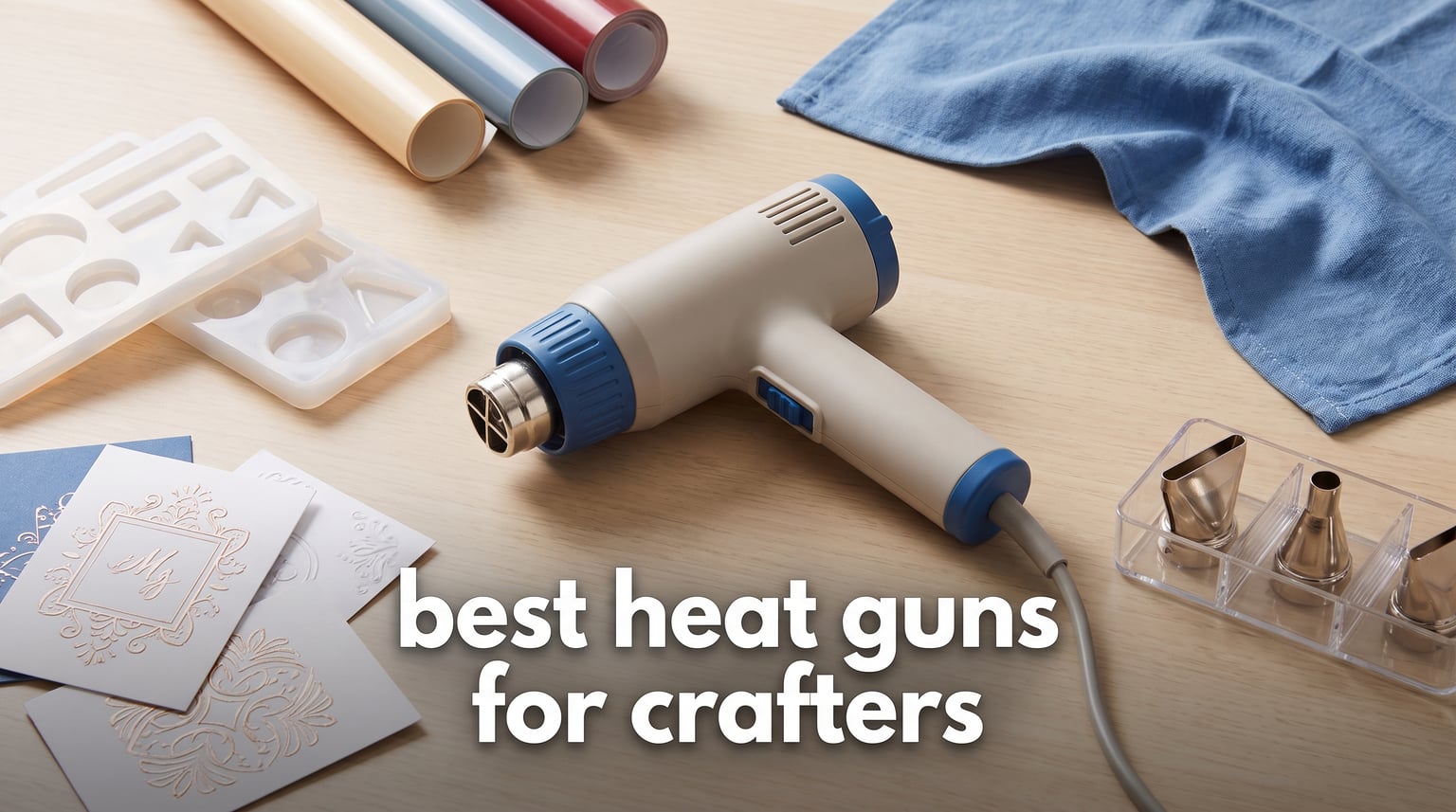
The best heat guns for crafters give you controlled heat without turning a small work surface into a wind tunnel. For resin bubbles, embossing powder, shrink wrap, vinyl, and detail work, the most useful choice is usually a compact tool with a stable stand and a heat setting that matches the material.
I reviewed the real specifications, included accessories, and buyer feedback for 10 current models. The short version is simple: choose a mini craft heat gun when precision and comfort matter most, and move to a full-size unit only when you also need broad airflow, high heat, or a variable temperature range for larger DIY jobs.
That distinction matters. Craft communities repeatedly mention delicate pieces blowing around, hot handles, and tiring wrist angles, so I gave extra weight to low-output settings, stands, cords, nozzle guards, and ergonomics rather than just wattage. If your projects include stencil work too, see our guide to airbrush stencils for artists; for equipment that supports painted finishes, our roundup of airbrush compressors is a useful next read.
Table of Contents
The top 3 picks answer most crafting needs in 2026
My editor’s choice is the Chandler Tool mini because its dual heat-and-speed settings, insulated housing, and craft-first size suit detailed work. The SEEKONE 1800W is the better option when you need adjustable temperature and four nozzles, while the Genesis kit makes sense for crafters who want nozzle variety and a conventional full-size layout.


These heat guns for crafters cover every major use case in 2026
The overview below includes every model in this guide. Use it to narrow the field by tool type, temperature control, output, and included accessories, then read the reviews for the practical distinction behind each choice.
| Product | Specifications | Action |
|---|---|---|
 BLACK+DECKER HG1300 BLACK+DECKER HG1300 |
|
View on Amazon |
| SEEKONE 1800W |
|
View on Amazon |
| Chandler Tool Mini |
|
View on Amazon |
 Master Appliance EC-MINI Master Appliance EC-MINI |
|
View on Amazon |
| Genesis GHG1500A |
|
View on Amazon |
 Homidic Mini 300W Homidic Mini 300W |
|
View on Amazon |
 SEEKONE Mini HG350 SEEKONE Mini HG350 |
|
View on Amazon |
 Yeegewin HG501 Yeegewin HG501 |
|
View on Amazon |
 Resiners R-030E Resiners R-030E |
|
View on Amazon |
 WORKPRO W125248AE WORKPRO W125248AE |
|
View on Amazon |
1. The BLACK+DECKER HG1300 is best for tough full-size craft jobs
BLACK+DECKER Heat Gun for Crafts, Corded, Dual Heat Settings up to 1000 Degrees, 1350 Watt (HG1300)
- Dual heat settings
- Built-in stand
- Lightweight compact body
- Three-position handle
- Corded runtime
- Very hot minimum setting
- Cord limits reach
The BLACK+DECKER HG1300 is a full-size heat gun that fits craft rooms where the work occasionally spills into repair or restoration jobs. Its 1,350W motor and two fixed settings of 750F and 1000F make it much more forceful than a mini heat tool, so I would reserve it for heavier shrink wrap, adhesive softening, and larger vinyl tasks rather than close resin work.
Its 3-position side handle is meaningful for users who have reported awkward wrist angles with heat guns. The built-in stand also gives the tool a defined place during cooldown instead of leaving a hot nozzle against the bench.
The supplied glass-protect nozzle is the accessory that makes this model more craft-friendly than its temperature figures suggest. It can help shield nearby glass during directed heating, although the two high settings leave little room for delicate paper or thin embellishments.
The output fits broad-area work rather than close detail
I would pick this model for a big shrink-wrap project, thick vinyl, or a DIY task that needs a quick blast of heat. At 750F even the lower setting is intense, so start farther away and move the tool continuously.
The stand supports safer pauses between passes
The stand is useful when you need both hands for positioning a project or when the tool is cooling. Keep the nozzle pointed away from your work, cord, and anything combustible; a stand reduces risk but does not make an unattended hot tool safe.
2. The SEEKONE 1800W is best for wide temperature control and nozzle work
- Variable temperature
- Two airflow modes
- Four nozzles
- Overheat protection
- Fast heat-up
- High airflow can disturb light pieces
- Corded design
The SEEKONE 1800W has the broadest specified temperature range here, from 122F to 1202F, controlled with a dial. That range is why I would choose it when a craft desk also serves vinyl wrapping, PVC work, electronics repair, or other jobs that call for different levels of heat.
It reaches its stated maximum in 1.5 seconds and provides two modes with different airflow ranges. Those figures are impressive, but they also explain why this is not my first pick for an unweighted scrapbooking piece or a tiny resin bezel.
The kit includes a deflector, two concentrators, and a reflector. A concentrator directs air into a smaller area, a reflector wraps heat around tubing, and a deflector is helpful where adjacent surfaces need some shielding.
The dial gives experienced makers more adjustment room
This variable temperature heat gun is the most flexible selection for a maker who changes materials often. Begin at the low end and test on an offcut because the dial offers range, not a material-specific preset.
The airflow calls for a stable and clear workspace
Mode II is listed at up to 500L per minute, which can move lightweight material before it heats it. Secure the piece, keep the nozzle moving, and use the included attachments only after they have cooled fully.
3. The Chandler Tool mini is best for resin, embossing, and comfortable detail work
- Dual heat and speed
- Lightweight form
- Quiet operation
- Insulated housing
- Ergonomic grip
- Slower on large areas
- No stated temperature figures
The Chandler Tool is the strongest all-around mini heat gun for crafts in this group because it combines dual temperature and speed settings with a compact, low-noise body. Its listed uses span epoxy resin, embossing, shrink wrap, vinyl, candle making, sublimation, and electronics, which is the kind of range most dedicated crafters actually need.
I like that the low setting is specifically intended for delicate or detailed work and the high setting for heavier jobs. The insulated housing is another practical advantage when a session runs longer than expected, especially given the forum concern about tools becoming uncomfortable to hold.
More than 21k buyer reviews accompany its 4.7 rating, and the feedback highlights lightweight handling and suitability for detailed projects. The limitation is scale: a small nozzle and compact motor naturally take longer to warm a broad sheet or a large wrapped item.
The low setting suits controlled surface passes
For resin bubbles, hold the tool at a distance and make brief sweeping passes instead of dwelling over one spot. I would also use its lower setting first for embossing and small vinyl accents, then increase only if the material’s instructions support it.
The compact shape suits makers who work for longer stretches
This is a sensible choice for a seated desk setup where wrist comfort and low noise matter. It is not a replacement for a wide-output DIY gun when the job requires heating a large surface quickly.
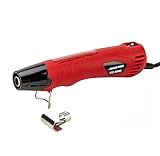
4. The Master Appliance EC-MINI is best for hands-free tubing and precision
- Pen-like precision
- Wire stand
- Reflector included
- 6.5 foot cord
- Impact-resistant housing
- Single heat level
- Lower output for large work
The Master Appliance EC-MINI brings a pen-like format to a 350W craft heat gun. Its specified 640F maximum and 9.9 CFM airflow put it in the precision camp, and the included heat-shrink reflector makes it especially relevant for wire connectors, shrink tubing, and small assemblies.
The built-in wire stand is more than a storage detail. It lets you rest the tool between short passes and can support hands-free positioning when the project needs careful alignment, provided the surrounding area remains clear and supervised.
This model has a 6.5-foot cord and weighs 15 ounces, two sensible details for a bench where outlets are not directly beside the work. Its fixed output means there is no lower setting to fall back on, so practice distance and movement on scrap material.
The reflector makes tubing work more even
A reflector nozzle directs heat around a tube rather than concentrating it on one face. That is useful for heat shrink and wire work, where an even wrap matters more than fast coverage.
The fixed setting rewards careful technique
I would choose the EC-MINI for repeatable small tasks rather than an assortment of highly heat-sensitive crafts. The 640F maximum is lower than full-size guns, but it can still scorch paper, melt plastic, or injure skin.
5. The Genesis GHG1500A is best for a multi-nozzle full-size kit
- Four nozzle kit
- Two heat settings
- 17 CFM airflow
- 6.5 foot cord
- Two-year warranty
- Plastic housing
- High heat for delicate crafts
The Genesis GHG1500A is a conventional 1,500W tool packaged with four accessories: two deflectors, a reflector, and an air-reduction nozzle. That is a practical collection for a maker who wants one tool for shrink wrap, broad vinyl work, surface protection, and occasional household use.
Its two settings are specified as 572F and 1000F, with 17 CFM airflow. The lower option is still hot by craft-tool standards, but it offers more restraint than a full-size gun that begins at 750F.
The 6.5-foot cord provides a little more bench reach than many mini models, and the listed two-year warranty adds reassurance. I would treat its plastic housing as a reason to store it carefully and avoid dropping it rather than as a reason to dismiss the tool.
The nozzle kit suits projects with changing shapes
The air-reduction attachment focuses heat for a smaller area, while a deflector can help protect an adjacent glass or surface. Pick the attachment for the shape of the task, not simply for the strongest stream of air.
The 17 CFM airflow suits secured materials
This output is useful for larger pieces but can move paper, thin film, and loose decorations. Clamp or weight the work and leave enough clear space around the tool’s hot end before turning it on.
6. The Homidic 300W is best for simple occasional mini projects
- Lightweight mini size
- Long cable
- Built-in stand
- Fast warm-up
- Good for embossing
- Ten-minute continuous-use limit
- Single output
The Homidic mini puts 300W into an 8.8-ounce body with a notably long 6.56-foot cable. It is a straightforward tool for embossing, small shrink-wrapping tasks, clay, rubber stamps, and quick drying jobs where a larger gun would feel excessive.
Its nozzle is listed to reach 200C in seconds, which is roughly 392F. That is a meaningful amount of heat for a small craft tool, so its mini dimensions should never be mistaken for a toy-like safety level.
The maker recommends no more than 10 minutes of continuous use. I see that as a clear selection boundary: choose it for short focused passes and allow cooling breaks, not as the main tool for an afternoon of high-volume projects.
The long cable helps when the outlet is not beside the desk
A 6.56-foot cable gives more placement freedom than many compact models. Route it away from the heated work zone and avoid creating a trip loop around a chair or table leg.
The duty limit suits brief and deliberate sessions
This is a sensible backup or entry-level tool for occasional use. If your craft routine calls for sustained heat, a model with dual settings and overheat protection is the more appropriate direction.
7. The SEEKONE Mini HG350 is best for a guarded two-setting mini tool
- Two temperature settings
- Overheat protection
- Reflector nozzle
- Retractable stand
- Long cable
- High setting is intense
- No stated airflow
The SEEKONE Mini HG350 is a 350W option with clearly stated settings of 500F and 842F. That makes it easier to understand than a mini tool with an unspecified output, and its overheat protection, nozzle safety shield, and retractable stand address several concerns that come up in craft discussions.
The 500F setting gives this model a more approachable starting point for careful heating than many full-size tools. The 842F setting can take on vinyl, shrink tubing, and more demanding work, but it is still a setting that requires distance and constant movement.
A reflector nozzle is included, and the cord measures 4.9 feet. Buyer feedback supports the appeal of its dual settings and safety features, while the compact form keeps it practical for a normal craft desk.
The two settings create a simple low-to-high workflow
Start with 500F for a test pass, then switch only when the material response calls for more heat. This approach respects the fact that the right setting depends on the resin, film, vinyl, or powder manufacturer’s directions.
The retractable stand supports organized desk work
The stand helps during pauses, but give the nozzle a dedicated heat-safe area and wait for full cooldown before storage. Overheat protection is a backup feature, not permission to leave the gun running unattended.
8. The Yeegewin HG501 is best for a safety-conscious dual-temperature mini
- UL certification
- Two heat settings
- Overheat protection
- Built-in bracket
- Long cable
- First-use odor possible
- High airflow at high setting
The Yeegewin HG501 is a 380W mini heat gun with 480F and 850F settings, overheat protection, a built-in bracket, and UL certification. For a maker who wants a clear safety credential alongside two outputs, those facts make it a persuasive candidate for resin, shrink wrap, vinyl, and general DIY crafts.
Its stated airflow changes substantially between settings: 100L per minute on the lower setting and 500L per minute on the higher one. I would read that as a reason to make the lower setting the default near light materials, not just a reason to celebrate the upper setting’s power.
The product information notes that smoke or odor can occur initially because of an anti-rust coating. Run a new unit in a ventilated area before bringing it close to a craft project, and stop if odor persists or the tool behaves abnormally.
The lower setting favors measured work around small pieces
At 480F and 100L per minute, the first mode is the sensible place to begin for controlled work. Secure loose pieces anyway, because even lower airflow can shift lightweight paper or decorations.
The certification adds one useful safety signal
UL certification is useful product information, while safe use still depends on the operator. Keep the nozzle away from hands, cords, solvents, and flammable scraps, and let the tool cool on its bracket.
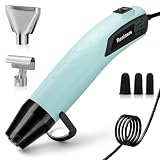
9. The Resiners R-030E is best for a resin-focused accessory set
- Resin-focused nozzle set
- Silicone finger covers
- Dual temperatures
- Integrated stand
- Pen-style grip
- Limited to two settings
- Compact output for small areas
The Resiners R-030E is purpose-built around resin and small craft jobs rather than adapted from a general DIY gun. Its 350W output, 482F and 662F settings, three nozzles, silicone finger covers, and pen-style grip create a well-matched package for makers who want directed heat with compatible accessories.
The round, reflector, and deflector nozzles are a more varied mini-tool assortment than most of the compact options here. I would use the round nozzle for direct work, the reflector for tubing-shaped materials, and the deflector where nearby surfaces benefit from shielding.
The integrated stand and overheat protection help with safer pauses, while the 4.9-foot cord is typical for this class. Its 4.6 rating is drawn from more than 1k reviews, a smaller sample than the largest listings but still meaningful buyer feedback.
The accessories make task-specific heat easier to aim
For resin, use the lowest suitable output and fast passes over the surface rather than holding the nozzle above one area. The goal is to release surface bubbles without overheating, rippling, or scorching the resin.
The pen grip suits controlled placement over brute force
This tool makes the most sense for a dedicated resin or detail-craft station. A larger unit with variable heat will be better if your work also includes broad vinyl or high-output household tasks.
10. The WORKPRO W125248AE is best for a long-cord 400W craft tool
- Fast heat-up
- Two settings
- Nozzle safety guard
- 5.9 foot cable
- Overload protection
- Not for soldering
- Limited temperature steps
The WORKPRO W125248AE is a 400W mini option with 482F and 842F settings, a reflector nozzle, overload protection, and a 5.9-foot cable. It heats in a stated 1.5 seconds and gives crafters a bit more output than 300W or 350W models without moving into full-size heat-gun territory.
Its listed airflow is 100L per minute at level one and 200L per minute at level two. That is a more restrained top airflow than the high-output figures on some mini models, which I see as an advantage for controlled shrink wrap and embossing tasks.
The nozzle safety guard is a welcome detail for a shared workspace, though it does not remove the burn hazard. The manufacturer does not recommend it for soldering, so do not treat it as an electronics bench tool for every heated task.
The 400W rating bridges basic and demanding craft sessions
This is a sound middle ground when a 300W tool feels slow but an 1,800W gun feels excessive. Its two-step control remains simpler than a dial, so confirm material behavior with a test piece before committing to the full project.
The longer cable supports flexible craft-table placement
A 5.9-foot cable can reach across a wider desk without an extension lead in many setups. Keep excess cable away from the nozzle and avoid draping it over the project area.
The right craft heat gun depends on precision, heat range, and workspace
For most resin, embossing, card-making, and small shrink-wrap work, start with a 300W to 500W mini tool. The compact size and generally lower airflow give you more control at close range, which responds directly to the common complaint that powerful guns scatter delicate materials.
Choose a full-size model when you need broad coverage, variable temperature, substantial airflow, or accessories for larger vinyl, PVC, paint, and repair jobs. The trade-off is obvious: more output makes the work faster but leaves less margin for thin film, paper, and small pieces.
The best mini-versus-full-size choice starts with the project size
A mini heat gun for crafts is the better fit for a resin coaster, a card front, a shrinky-dink piece, a small candle project, or a few heat-shrink connectors. Its lightweight body also helps if you work seated for long sessions or have felt hand fatigue with a larger tool.
A full-size gun fits a broad vinyl panel, heavy shrink wrap, a large surface, or a mixed craft-and-DIY workspace. Pick one with a stand and begin with its lowest available setting, because its airflow can be as important as its wattage.
The temperature guide begins with the material maker’s instructions
There is no single safe heat-gun temperature for epoxy resin, paper, vinyl, embossing powder, or shrink film. Product formulas and thicknesses vary, so the reliable method is to follow the material manufacturer’s instructions, test an offcut, and start with the lower setting of a dual-temperature tool.
For resin bubbles, brief, moving passes from a distance are safer than prolonged direct heat. For embossing, keep the stream moving until the powder changes, and for vinyl or shrink wrap, work in small zones so you can stop at the first sign of distortion.
The nozzle choice changes how heat reaches the work
A concentrator reduces the target area for detail work. A reflector directs heat around curved tubing, while a deflector helps direct heat away from a nearby surface; use the tool’s included instructions to attach and remove any nozzle safely.
Do not treat an accessory as a way to make any heat setting safe for any material. The nozzle itself becomes hot, and a focused stream can heat a tiny area faster than expected.
The safety routine prevents the failures crafters report
Start with a nonflammable, uncluttered surface and good ventilation, especially when heating coatings, plastics, adhesives, or resin-related materials. Hold the gun by its insulated grip, never point it at skin, and keep the stream moving.
Place the tool on its stand or bracket during pauses, allow a complete cooldown before storage, and never leave it plugged in and unattended. If a tool has a first-use smell, visible smoke that does not clear, damaged cord, or unusual behavior, stop using it.
If heat is part of your vinyl workflow, pair this decision with our roundup of vinyl cutting machines for small business. Matching the cutter, material, and heat tool helps prevent wasted blanks and uneven finishes.
These direct answers cover common craft heat-gun questions
What is the best heat gun for crafts?
The Chandler Tool mini is the best all-around pick for focused craft work because it combines dual heat-and-speed settings, a compact low-noise body, insulated housing, and listed compatibility with resin, embossing, vinyl, shrink wrap, candles, and sublimation. Choose the SEEKONE 1800W instead when you need a variable temperature range and four nozzles for larger DIY tasks.
Can I use a hair dryer instead of a heat gun for crafts?
A hair dryer is not a substitute when a project needs directed, controlled heat. It produces a broad airstream and can blow light materials around, while a craft heat gun directs hotter air through a smaller nozzle. Follow the material maker’s instructions and use a low setting first on delicate work.
What temperature do I need for resin bubble removal?
There is no universal temperature for resin bubble removal because resin formulas and project sizes differ. Use the resin manufacturer’s instructions, begin on the lowest suitable tool setting, hold the gun at a distance, and make quick moving passes. Prolonged heat in one area can overheat or distort the resin.
What is the difference between a heat gun and a heat tool?
A heat gun is the broad term for a powered tool that blows heated air. A craft heat tool is usually a compact, lower-output heat gun designed for precise tasks such as embossing, resin bubbles, shrink wrap, and small vinyl work. Full-size heat guns provide more output and often more airflow for larger DIY jobs.
How do I remove bubbles from epoxy resin with a heat gun?
Follow the resin directions, select the lowest suitable heat setting, and secure the piece on a heat-safe surface. Hold the heat gun back from the resin and sweep quickly across the surface rather than stopping in one place. Repeat only as needed, allowing the resin to settle between passes.
The Chandler Tool is the best starting point for most crafters
For the best heat guns for crafters in 2026, I would start with the Chandler Tool for close, detailed projects, select the Resiners for a resin-focused nozzle set, and move to the SEEKONE 1800W when adjustable temperature and large-project capacity matter more. Choose the tool around your material, airflow tolerance, and workspace, then test on scrap before the finished piece.