
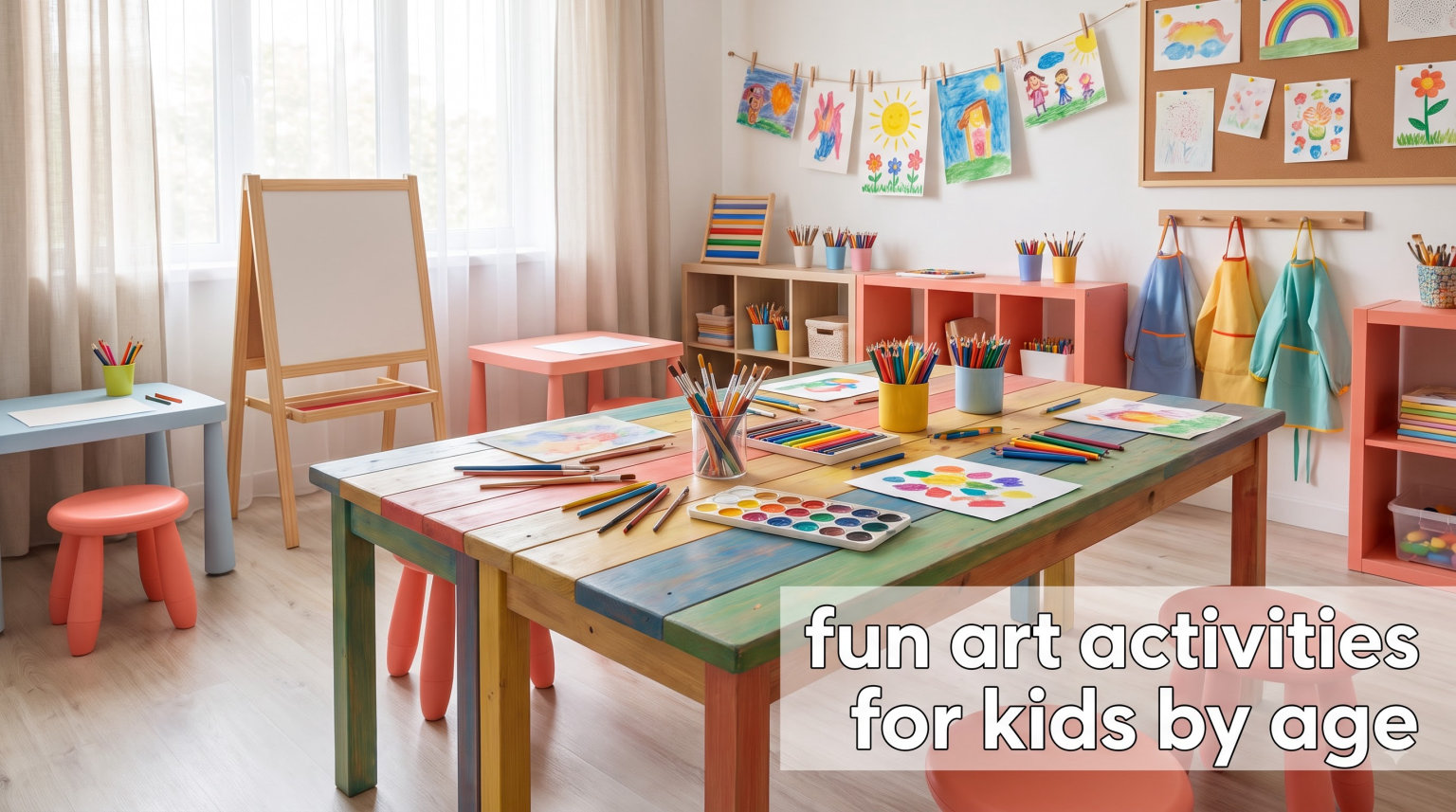
Watching a toddler dip their finger in paint and discover the joy of leaving a mark on paper. Seeing a preschooler proudly present a collage they made “all by myself.” These moments capture why art activities matter so much at every age. Whether you are a parent looking for weekend activities, an educator planning curriculum, or a caregiver navigating screen-free afternoons, finding the right art activities for your child’s developmental stage transforms frustration into flow.
This guide organizes fun art activities for kids by age, starting from age 1 through 12. Each section includes specific activities matched to what children can physically and cognitively accomplish at that stage. We cover sensory-rich projects for curious toddlers, school-readiness crafts for preschoolers, skill-building projects for early elementary students, and meaningful creative expression for pre-teens. You will also find practical tips for managing mess, working with limited budgets, and choosing activities that grow with your child.
Table of Contents
Why Age-Appropriate Art Activities Matter
Not all art activities suit every child. A project designed for a 6-year-old will likely frustrate a 2-year-old, while activities for toddlers bore older children who crave more complexity. Age-appropriate art activities match three things: the child’s physical abilities (like fine motor control and hand-eye coordination), their cognitive development (how they understand cause and effect, sequencing, and representation), and their emotional readiness (patience for multi-step projects, tolerance for imperfection).
Research shows that when art activities match a child’s developmental stage, they experience what educators call “productive struggle” – challenging enough to build skills, but achievable enough to complete. This balance keeps children engaged and coming back for more creative exploration. Child development experts emphasize that the goal is never a perfect product. Process art, which focuses on the experience rather than the outcome, produces better developmental results and fewer power struggles.
For non-artistic parents, this approach removes the pressure of needing art teaching skills. You do not need to know how to draw or craft. You simply need to set up age-appropriate materials and let your child explore. This guide does the planning for you, giving you specific activities organized by age group plus tips to adapt them as your child grows.
Art Activities for Toddlers Ages 1-2
Toddlers are in a stage called “scribble territory.” Their fine motor control is still developing, so they grip crayons with their whole fist and produce abstract marks rather than recognizable images. This is completely normal and developmentally appropriate. Art activities for toddlers should focus on sensory exploration, big movements, and discovering what happens when materials interact.
Finger Painting Adventures
Finger painting ranks among the best art activities for toddlers because it requires no tools beyond their fingers, eliminating the frustration of holding brushes or crayons. Use washable, non-toxic paints on a high chair tray or a plastic-covered table. Talk through what they feel: “The paint feels cold and squishy!” This sensory description builds vocabulary while they explore.
Want to make finger painting even more engaging? Try painting on plastic bags. Tape a sheet of paper inside a gallon ziplock bag, add small drops of paint, and seal it shut. Toddlers push the paint around through the plastic, creating beautiful abstract designs without the mess on their hands. You can reuse these artworks by scanning or photographing them for a digital art collection.
Big Crayon Scribbling
Large chunky crayons designed for toddlers (often called ” jumbo crayons”) are easier for little hands to grip than standard crayons. Provide large paper taped to the table or a standalone easel. At this age, scribbling is the activity itself – not a warm-up for “real” drawing. Scribbling exercises the same hand muscles used for writing later and teaches cause-and-effect (mark on paper = mark appears).
Our team observed that toddlers who scribble on vertical surfaces (like easels) tend to make larger arm movements, which actually builds gross motor strength alongside the fine motor work. If your toddler only wants to color horizontally, that works too – both planes of movement develop different muscle groups.
Playdough and Texture Exploration
Playdough is perfect art activities for 2 year olds because it combines sensory exploration with motor skill building. Squeeze it, pound it, roll it into snakes, and cut it with plastic scissors. Look for natural playdough recipes you can make at home using flour, salt, and oil – this gives you complete control over ingredients and costs pennies compared to store-bought.
Add texture items for exploration: plastic cookie cutters, wooden spoons, plastic animals that make tracks, or rolling pins with patterns. Describe what you see together: “You made flat pancakes and pointy snakes!” This language-rich art time builds vocabulary alongside creativity.
Taste-Safe Art for Exploration
Toddlers explore with their mouths, which means any art materials need to be taste-safe. Edible finger paint made from natural ingredients like pureed fruit or yogurt satisfies this developmental need while still creating colorful art. Whip up a batch of yogurt-based paint in primary colors – it washes off easily and tastes like a healthy snack.
Crushed graham crackers make excellent “paint” on foil. The shiny surface creates interesting visual effects when the cracker crumbs are smashed and spread around. Clean up is effortless – just crumple up the foil and throw it away.
Art Activities for Preschoolers Ages 3-5
Preschoolers move beyond scribbling into what educators call “intentional representation.” They might tell you their scribble is “Mommy at the beach” – a huge cognitive leap where abstract marks stand for real things. Art activities for 3-5 year olds should support this emerging representational thinking while continuing to build fine motor skills needed for writing and school readiness.
Collage Making Adventures
Collage art activities for preschoolers work because children can create meaningful artwork without needing advanced drawing skills. Provide pre-cut shapes in various colors, textured papers (crumpled newspaper, foil, corrugated cardboard), fabric scraps, and child-safe scissors. Show them how to apply glue with a brush or sponge dauber – the spreading motion builds fine motor control.
Ask open-ended questions rather than directing the outcome. Instead of “Make a house,” try “What can we build with these shapes?” or “I see you are sorting the red pieces – will you tell me about your art?” This approach validates the process while encouraging creative thinking.
Brush Painting Practice
Preschoolers often transition from finger painting to brush painting around age 3 or 4. Provide good-quality brushes sized for small hands, washable paints in limited color choices (too many colors overwhelm young children), and sturdy paper that can handle wet brushstrokes without curling.
Start with single-color paintings before introducing color mixing. Set up three jars of water for rinsing brushes between colors, or demonstrate how to clean one brush thoroughly before switching colors. This teaches both art technique and cause-and-effect reasoning – mixing red and yellow makes orange.
Playdough Sculpture Projects
By age 4, many preschoolers can create recognizable sculptures in playdough rather than just smooshing it. Provide tools like plastic knives for cutting, toothpicks for adding detail, and craft sticks for smoothing surfaces. Challenge them to make specific items: “Can you make something that has a head, a body, and legs?” This scaffolds the transition from sensory play to representational art.
Incorporate small loose parts – buttons, beads, dried pasta, or pebbles – to add dimension and challenge fine motor precision as children carefully press tiny objects into clay.
Sticker Art and Peeling Practice
Peeling stickers strengthens the exact muscles needed for writing grip. Sticker art activities for preschoolers require almost no setup: provide sheets of stickers in various shapes and let children create scenes on paper. The challenge comes from peeling the stickers themselves, not from artistic technique.
Mix stickers with drawing for more complex projects. “First draw the background with crayons, then add stickers for the important parts.” This combination of media keeps children engaged longer than single-material projects, which is helpful for parents since attention span for art typically ranges from 10-20 minutes at this age.
Cutting Practice with Scissors
Child-safe scissors with spring-loaded blades build the hand strength needed for writing. Cutting art activities for preschoolers should focus on the process rather than producing recognizable shapes. Provide strips of paper in various colors and let children cut freely. The resulting “confetti” can become collage material for another project.
Practice strips work better than full sheets because straight cuts are easier for developing hands. Once children master cutting strips, move to cutting along wavy lines drawn with thick markers on paper. This progression builds confidence while developing motor skills.
Art Activities for Early Elementary Ages 6-8
Children in early elementary years can follow multi-step directions, sustain attention longer, and create increasingly detailed artwork. Art activities for 6-8 year olds should challenge their growing capabilities while remaining achievable. At this age, many children develop strong preferences for specific art mediums or styles – support these interests while introducing new techniques.
Pencil Sketching Foundations
Around age 6, children can begin using standard pencils with guidance. Start with simple observational drawing – place an object on the table and ask children to draw what they see, not what they think the object should look like. This shifts thinking from symbolic representation to observation, a crucial skill for artistic development.
Use “easy-to-draw” prompts to build confidence: a favorite object from home, a still life arrangement of common items, or simple shapes that stack into more complex compositions. We have found that children respond well to “draw with your non-dominant hand first” as a warm-up that loosens up their drawing style.
Watercolor Painting Techniques
Watercolor painting opens up new artistic possibilities for school-age children. Teach basic techniques like wet-on-wet painting (applying wet paint to wet paper for soft blends), dry brush (using minimal water for textured strokes), and resist methods (using crayons to create barrier designs that watercolor will not penetrate).
Set up watercolor projects with clear instructions so frustration stays low. “First we wet the paper and let it dry until the shine is gone. Then we paint our sky from light blue at the horizon to darker blue at the top.” Breaking down the process into steps prevents the common problem of children flooding their paper with water.
Papier-Mache Projects
Papier-mache projects teach patience and multi-step craftsmanship while producing impressive results. Start simple: inflate balloons for round forms, tear newspaper into strips, and build up layers of flour-and-water paste over several sessions. Each layer must dry before adding the next, so plan for 3-4 sessions of work.
This technique works well for seasonal projects like pumpkins in fall or gift boxes that children can paint and give as presents. The long project timeline also helps build sustained attention – each session starts with checking and continuing last week’s work, a skill that transfers to homework and other multi-step tasks.
Recyclable Material Construction
Art projects with recyclables tap into the upcycling trend that parents love and children find genuinely interesting. Cardboard tubes become telescopes, robots, or castle towers. Egg cartons transform into caterpillars, flowers, or sea creatures. Plastic lids become shields, mirrors, or game pieces.
The problem-solving required when constructing with found materials builds cognitive skills alongside creativity. “My tube is too short to reach the box lid – what can I do?” Engineering challenges embedded in art activities make learning feel like play.
Simple Printmaking
Printmaking introduces children to the concept that art can be reproduced, which is both historically significant and practically engaging. Simple methods include stamp printing (potato or foamcore shapes dipped in paint), leaf printing (gathered leaves with paint on the back), and styrofoam plate printing (scratching designs into styrofoam trays with dull pencils).
Printmaking pairs well with writing projects – children create the artwork, then write about what they made, combining literacy with visual arts education. Multiple prints from one block create natural sharing opportunities: “One for me, one for Grandma, one for my teacher.”
Art Activities for Pre-Teens Ages 9-12
Pre-teens can handle complex projects with many steps and longer timelines. They often have strong opinions about what they want to create and may resist activities that feel “babyish.” Art activities for 9-12 year olds should respect their maturity while still providing structure and skill-building opportunities. This age group often develops genuine artistic passions that benefit from guided exploration.
Sketchbook Practice and Observation Drawing
Pre-teens benefit from having their own dedicated sketchbook. Encourage daily or near-daily quick sketches – 5 to 10 minutes of observational drawing from life. Place interesting objects on the table: leaves collected from the yard, kitchen items, or photographs of nature. The goal is not beautiful artwork but consistent practice that builds visual perception.
Introduce techniques like value shading (using pencil pressure to create light-to-dark transitions), perspective basics (overlapping shapes to create depth), and composition principles (placement of elements on the page). Online tutorials work well at this age since pre-teens can follow video instructions independently.
Mixed Media Art Projects
Mixed media combines multiple art materials in single pieces, allowing pre-teens to explore different techniques while creating cohesive artwork. Collage plus paint, pencil plus ink, found objects embedded in clay – the combinations are endless. This approach prevents the perfectionism that can make single-medium art stressful.
Challenge pre-teens with themed mixed media projects: “Create a self-portrait using at least five different materials” or “Interpret a favorite song as an abstract artwork.” These open-ended assignments respect their growing creativity while providing enough structure to get started.
Upcycled Art and Environmental Themes
Pre-teens often care deeply about environmental issues, making upcycled art projects especially meaningful. Transform old magazines into fashion design mockups, turn damaged electronics into steampunk art, or create functional items from plastic waste. The environmental motivation provides intrinsic engagement that art-for-art’s-sake sometimes lacks.
Community-focused upcycling projects extend learning beyond individual artwork. Create greeting cards from cereal box cardboard for a local senior center, or organize a neighborhood cleanup where collected recyclables become raw materials for a community art installation.
Introduction to Digital Art
Many pre-teens are interested in digital art creation. Free apps like IbisPaint, MediBang Paint, or Procreate (iPad) offer professional-quality tools accessible to beginners. Start with basic brush work, layer management, and color selection before introducing more complex features.
Digital art complements rather than replaces traditional art skills. Encourage pre-teens to sketch digitally AND on paper – each medium develops different aspects of visual perception. Digital art also creates easy sharing opportunities through social media platforms designed for creators their age.
Themed Series Projects
Pre-teens often enjoy creating cohesive series rather than individual pieces. A character design series with variations, a landscape series depicting the same location in different seasons, or a mixed media series exploring a concept like “journeys” or “memories.” Series work teaches consistency, planning, and sustained creative effort.
Help pre-teens document their creative process with photos of work-in-progress and written artist statements explaining their intent. This practice builds reflective thinking skills and provides material for future portfolio development if they pursue art academically.
Benefits of Art for Child Development
Art activities support development across multiple domains simultaneously, making them exceptionally efficient learning experiences. Research in child development consistently shows that regular art engagement produces measurable improvements in motor skills, cognitive abilities, emotional regulation, and social competence.
Cognitive Development Through Art
Creating art exercises problem-solving, planning, sequencing, and flexible thinking. When a child decides “I need a bigger piece for this part” or “that color does not look right next to the blue,” they are practicing analytical thinking. Multi-step art projects require children to hold goals in mind while executing smaller tasks – a skill that transfers directly to academic learning.
Studies show that children who engage in regular art activities demonstrate stronger performance in math and reading comprehension, likely because art builds the same cognitive flexibility and pattern recognition skills those subjects require.
Fine Motor Skills and Physical Development
Art activities that involve grasping crayons, manipulating brushes, cutting with scissors, and squeezing playdough build the small muscle control needed for writing, buttoning, and self-care tasks. These motor skills develop through repeated practice during creative play – no drills required.
The hand-eye coordination developed through art activities also supports sports, musical instrument playing, and other physical pursuits. Art is one of the most accessible ways to build these foundations without specialized equipment or training.
Emotional Expression and Regulation
Art provides a safe way for children to express emotions they cannot yet articulate in words. A child who is angry might pound clay aggressively, creating something powerful. A child processing a divorce might draw their family in various configurations. Art therapy research documents these emotional benefits extensively.
Beyond expression, art activities build emotional regulation through the calm focus they require. The repetitive motions of drawing, painting, or sculpting activate the nervous system’s relaxation response. Children who struggle with anxiety often find art sessions centering, even when the subject matter is energetic.
Social Skills Through Collaborative Art
When children create art together, they practice negotiation, sharing, compromise, and appreciation of others’ work. Collaborative projects require discussing plans, dividing tasks, and integrating individual contributions into a cohesive whole – skills that benefit all social interactions.
Art observation skills transfer to social contexts as children learn to notice details in others’ work that they might otherwise overlook. This attention to detail extends to reading facial expressions and body language, improving social perception.
Creativity as a Lifelong Skill
Perhaps most importantly, regular art practice builds creative confidence – the belief that you can generate original ideas and bring them into reality. This creative self-efficacy applies far beyond art itself. Children who know they are creative approach academic challenges, social situations, and future careers with the confidence that comes from knowing they can innovate.
Creativity also involves tolerance for ambiguity and imperfection. Art teaches that not every project turns out as envisioned, that revisions are normal, and that “failures” often become interesting new directions. These resilience skills serve children throughout their lives.
Tips for Mess-Free Art Activities
Parents consistently rank mess management as a top concern when doing art activities with children. The good news: with some preparation, art can be joyful rather than stressful. These strategies come from parent communities and our own testing – they actually work in real home environments.
Strategic Surface Protection
Cover your work surface with plastic tablecloths secured with painter’s tape. This creates a contained work zone that cleans up in minutes. For toddlers especially, work on a vinyl tablecloth on the floor rather than a table – it contains drips and splatters more predictably than vertical surfaces.
Keep baby wipes or a wet cloth within arm’s reach for quick clean-ups during the activity. Establish the rule upfront: “Paint stays on the paper” becomes a natural boundary when you are right there to redirect.
Clothing and Aprons
Old t-shirts sized up (yours or theirs) work better than expensive aprons for children under 6. Toddlers find straps and ties frustrating, so a large shirt that slips over the head without fuss reduces interruptions. Keep a stash of these specifically for art time so the “good clothes” rule never applies.
For infants and mouth-oriented toddlers, dress in as little clothing as weather allows during paint activities. A diaper is plenty for finger painting sessions – the mess washes off small bodies easily and washing clothing with dried paint is never fun.
Contained Material Systems
Present art materials in containers rather than open trays. A small cup with watercolor cakes, a sectioned plate with paint dots, or a closed container with playdough limits how much material can escape the work zone. Open containers invite dumping, pouring, and spreading that multiplies clean-up time.
Baking sheets make excellent contained work surfaces. Everything stays on the tray, including paper, tools, and any escaped materials. At the end of art time, simply carry the tray to the sink or trash.
Timing and Pacing
Art activities for young children work best when they are short (10-20 minutes) and followed by a predictable transition. “After you finish painting, we will rinse your brushes and go outside” gives children closure and makes clean-up feel like part of the activity rather than an interruption.
Some families find success with “art smocks” that stay on hooks near the art area, creating a visual cue that art time is available. Children can initiate art time by putting on their smock, giving them autonomy within established boundaries.
Budget-Friendly Art Supplies
You do not need expensive art kits to provide rich creative experiences. In fact, many the best art activities use materials you already have. Building a home art supply collection gradually, focusing on versatile basics, costs far less than one packaged kit and lasts much longer.
Essential Starter Supplies
A basic art supply kit for young children needs very little: washable paints in primary colors, assorted brushes in a few sizes, good crayons (look for the triangular ones that teach proper grip), white paper in various sizes, and child-safe scissors. These items cover 80% of activities children will want to do at home.
Add playdough or a recipe to make your own. Natural playdough keeps for weeks in the refrigerator and costs pennies to make in bulk. Food coloring lets you tint it any color, and adding extracts creates scented variations that children love.
Free and Found Materials
The best art materials are often free. Cardboard boxes, paper towel and toilet paper tubes, egg cartons, cereal box cardboard, old magazines, fabric scraps, and bottle caps all make excellent art supplies. Collect these materials in a dedicated bin and rotate them seasonally.
Nature provides endless free materials: leaves, twigs, pebbles, pinecones, flowers, sand, and shells all create interesting art. A nature collection becomes raw material for collage, printing, and construction projects.
Seasonal and Holiday Materials
Many families already have seasonal craft supplies without realizing their art potential. Holiday gift wrap becomes collage material. Seasonal decorations (pumpkin guts, easter eggs, valentine hearts) become art ingredients. Coordinate seasonal materials with nature walks to build themed collections.
After holidays and birthdays, save leftover supplies in labeled containers organized by season or theme. This prevents the “we need something for art class tomorrow” scramble and makes last-minute projects possible.
How to Choose Age-Appropriate Art Activities
Selecting the right art activity for your child involves considering developmental stage, personal interests, and practical constraints. This framework helps you evaluate any activity, whether it comes from this guide, a classroom assignment, or a spontaneous idea.
Developmental Markers by Age
Toddlers (ages 1-2) can: grip writing tools with whole hand, spread substances with fingers, pour liquid from containers with help, and identify colors with accuracy.
Preschoolers (ages 3-5) can: use child-safe scissors with some control, trace basic shapes, name primary colors confidently, follow two-step directions, and sustain attention for 10-20 minutes on preferred activities.
Early elementary (ages 6-8) can: write with standard pencils, follow multi-step sequences, sustain attention for 30-45 minutes, use rulers and basic geometric tools, and describe their creative process in words.
Pre-teens (ages 9-12) can: plan and execute multi-session projects, use tools with precision, evaluate their own work critically, teach techniques to others, and create cohesive series of related works.
When to Adapt Up or Down
Every child develops at their own pace. A 4-year-old might be ready for 6-year-old activities in one domain while needing easier work in another. Trust your observation of your specific child rather than rigid age boundaries.
If an activity frustrates your child consistently, simplify it or choose something easier. If activities for younger children bore your child, move up without waiting for “the right age.” The goal is productive challenge, not age conformity.
Signs of Good Fit
An activity is well-matched when your child: stays engaged longer than typical attention span, completes projects without excessive frustration, shows pride in results, asks to do the activity again, and talks about what they made.
Watch for the frustrated quit versus the genuinely finished. “I am done” can mean either “I finished what I wanted to do” or “This is too hard and I want to stop.” A child who is comfortably finished will engage in cleanup willingly. A frustrated child will resist cleanup and express negative emotions about the activity.
Frequently Asked Questions About Art Activities by Age
What age should kids start art activities?
Kids can start art activities as young as 12-18 months with supervised sensory experiences like finger painting with taste-safe paints. Even before they can hold crayons, babies explore materials and make marks, building foundational sensory and motor experiences that support later art development.
What art activities are good for 3-5 year olds?
Good art activities for 3-5 year olds include finger painting, collage with pre-cut shapes, playdough sculpting, sticker art, and cutting practice with child-safe scissors. At this age, focus on process over product and allow plenty of time for sensory exploration and creative experimentation without predetermined outcomes.
How do art activities help child development?
Art activities help child development by building fine motor skills, cognitive flexibility, emotional expression, and social skills. Regular art practice improves hand-eye coordination, problem-solving abilities, and creative confidence. Art also provides a safe outlet for processing emotions and practicing the sustained focus needed for academic success.
How can I do art activities with my child at home?
You can do art activities with your child at home by setting up a dedicated creative space with basic supplies, choosing age-appropriate activities, and focusing on process rather than product. Start with short sessions (10-20 minutes), provide positive feedback on effort rather than results, and let your child lead the creative direction while you serve as assistant and conversation partner.
What are mess-free art activities for toddlers?
Mess-free art activities for toddlers include painting inside sealed plastic bags, using stickers, playing with playdough, and exploring texture boards. Watercolor books with perforated pages, reusable stickers, and playdough all provide creative experiences without the cleanup stress of traditional paint and glue.
Final Thoughts on Art Activities for Kids by Age
Art activities for kids by age provide a roadmap for developmental creativity from toddlerhood through pre-adolescence. The key insight: children do not need artistic parents or expensive supplies to benefit from creative experiences. They need age-appropriate materials, patient facilitation, and freedom to explore.
Start with one or two activities from your child’s current age range and expand from there. Notice what captures their attention and what frustrates them. Let their responses guide future activity selection. Your observations are more valuable than any expert recommendation because they come from knowing your specific child.
The goal is not to produce talented artists but to support development across cognitive, motor, emotional, and social domains. When children create art regularly in ways matched to their abilities, they build skills that serve them in school, relationships, and future careers. They also develop creative confidence – the belief that they can generate original ideas and bring them into reality.
Enjoy the process alongside your child. The moments of discovery, the pride in completed projects, the calm focus during sensory play – these are the gifts art activities provide. The developmental benefits are real, but they come wrapped in fun, exploration, and joyful creativity.