
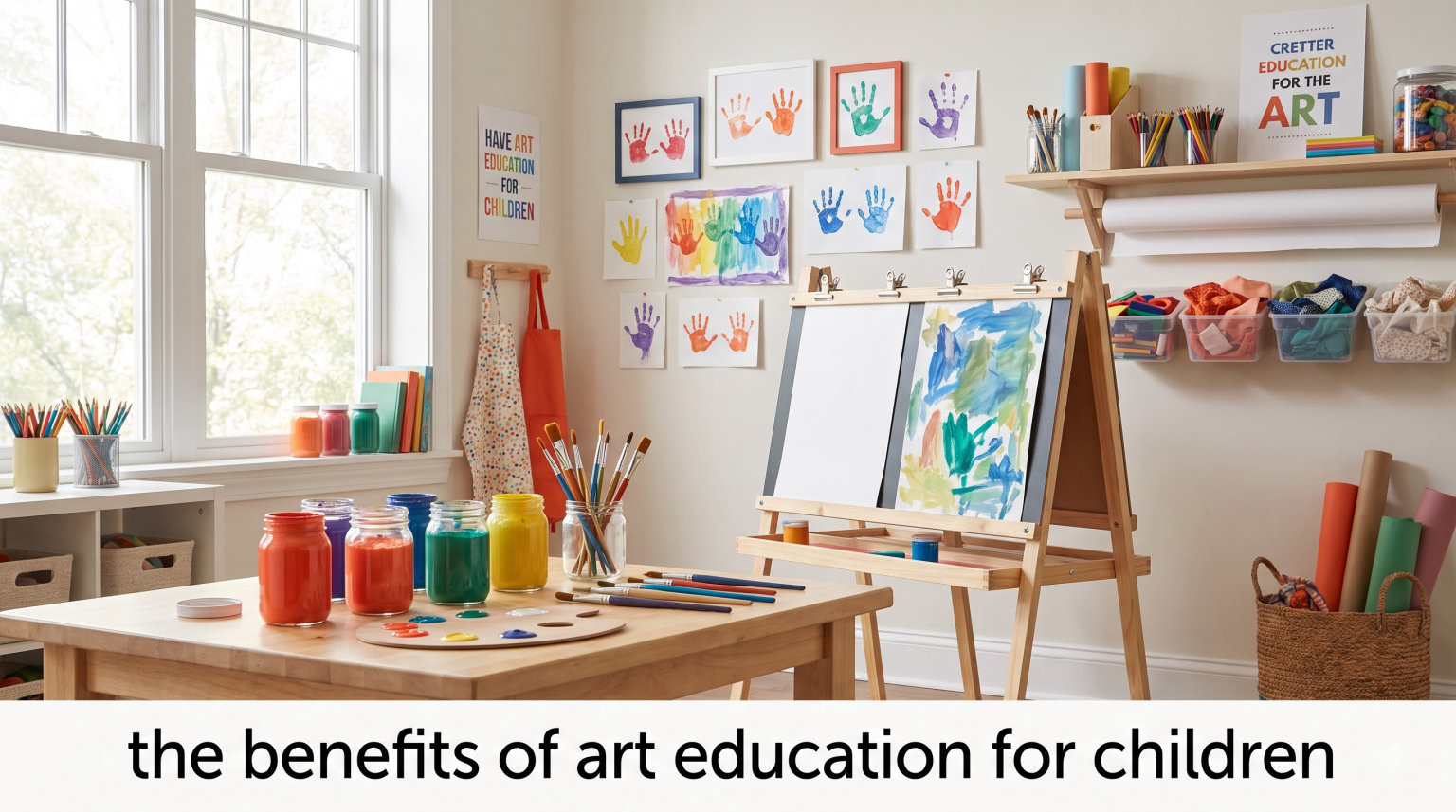
When my daughter brought home her first finger painting at age three, she could not stop talking about how the colors mixed together. That moment stuck with me because it was not just about the painting. It was about the pride, the confidence, and the excitement of creating something from nothing. That is the power of art education for children, and it goes far deeper than most people realize.
Art education for children is a structured approach to teaching creative expression through mediums like painting, drawing, sculpture, music, dance, and digital arts. It is designed to support cognitive, social, and emotional development during the most critical years of a child’s growth. And the research backing this up is stronger than ever.
In this guide, I am going to walk you through the benefits of art education for children, backed by research, real parent and teacher experiences, and practical tips you can start using today. Whether you are a parent looking for ways to encourage creativity at home or an educator making the case for art programs, you will find everything you need right here.
Table of Contents
What Is Art Education for Children?
Art education for children refers to any structured or guided creative activity that helps young people develop skills through visual arts, performing arts, or digital media. This includes everything from painting and drawing in a classroom to music lessons, theater programs, dance classes, and even digital design projects.
There are two main approaches to childhood art development. Structured art education happens in schools, studios, and community programs where a teacher guides students through specific techniques and concepts. Unstructured creative play, on the other hand, happens when children are given materials and the freedom to explore on their own. Both are valuable, and the best art education combines elements of each.
The scope of art education is broader than many people think. It covers visual arts like painting, drawing, printmaking, and sculpture. It includes performing arts such as music, theater, and dance. And increasingly, it involves digital arts like photography, animation, and graphic design. Each of these forms offers unique developmental benefits for children at every age.
10 Key Benefits of Art Education for Children
Research from the National Endowment for the Arts, the Wallace Foundation, and dozens of longitudinal studies paints a clear picture: art education changes how children learn, grow, and interact with the world. Here are the ten most significant benefits of art education for children, each one grounded in evidence.
1. Builds Cognitive Development and Critical Thinking
Art education directly strengthens cognitive development by engaging both hemispheres of the brain simultaneously. When a child decides how to compose a painting or chooses which colors to blend, they are exercising critical thinking skills that transfer to every other area of learning.
A study published by the NEA found that students with consistent arts exposure showed measurably higher levels of creative thinking and analytical reasoning compared to peers without arts access. The neural pathways built during creative activities support stronger cognitive processing across the board.
Art asks children to observe, analyze, interpret, and make decisions. These are not just art skills. They are life skills that help kids think more clearly about math problems, reading comprehension, and scientific inquiry.
2. Develops Fine Motor Skills and Hand-Eye Coordination
One of the most visible benefits of art education for children is the development of fine motor skills. Holding a paintbrush, cutting with scissors, molding clay, and drawing precise lines all require small, controlled movements that strengthen the muscles in a child’s hands and fingers.
Parents on forums like r/Parenting consistently report improved fine motor control in children who engage in regular art activities. Hand-eye coordination improves as children learn to translate what they see into what their hands create on paper or in three dimensions.
For toddlers and preschoolers especially, these physical skills are foundational. The dexterity gained through art activities directly supports handwriting readiness, typing skills, and even self-care tasks like buttoning clothes or tying shoes.
3. Fosters Creative Thinking and Imagination
Creative thinking is one of the most sought-after skills in the modern workforce, and it starts in childhood art education. When children are given the space to imagine, invent, and create without strict rules, they develop the ability to generate original ideas and think outside conventional boundaries.
Teachers on art education forums consistently note that students with regular arts exposure show greater flexibility in their thinking. They approach problems from multiple angles and are more willing to take intellectual risks.
Imagination is not just about daydreaming. It is the foundation of innovation. Every inventor, scientist, and entrepreneur relies on the ability to envision something that does not yet exist. Art education nurtures this capacity from an early age.
4. Supports Emotional Regulation and Self-Expression
Parents across multiple forums report that art helps children process difficult emotions. Art therapy research confirms this: creative expression provides a safe, nonverbal outlet for feelings that children may not have the words to articulate.
When a child draws an angry picture after a frustrating day, they are not just scribbling. They are processing emotions in a healthy way. Art education gives children tools for emotional regulation that serve them throughout their lives.
Studies have shown that students who participate in regular art activities demonstrate lower levels of anxiety and stress. The meditative quality of focusing on a creative project calms the nervous system and provides a sense of control that many children find deeply comforting.
5. Builds Self-Confidence and a Sense of Accomplishment
Students in art education programs frequently express feeling proud and accomplished after completing projects. This is not accidental. Art education is uniquely positioned to build self-confidence because every child can succeed at their own level.
Unlike math or reading, where there is often a single correct answer, art allows for multiple valid approaches. A child who struggles academically can excel in art and experience the deep satisfaction of creating something meaningful. That sense of accomplishment ripples into other areas of their life.
Teachers note improved behavior and engagement in students who have regular access to art. When children feel competent and valued in one area, they carry that confidence into the classroom, the playground, and beyond.
6. Strengthens Social Skills and Collaboration
Group art projects teach children how to share materials, negotiate creative decisions, and work toward a common goal. These social skills are essential for success in school and in life, and art education provides a natural context for developing them.
In performing arts especially, children learn to cooperate, listen to others, and contribute to something larger than themselves. A theater production requires every participant to support the ensemble, whether they are on stage or behind the scenes.
Research shows that arts-engaged students demonstrate stronger interpersonal skills and greater empathy. They are better at reading social cues and more comfortable working with peers from diverse backgrounds.
7. Improves Academic Achievement Across Subjects
The connection between art education and academic achievement is one of the most well-documented findings in education research. The Wallace Foundation released a study showing that arts education can boost students’ writing skills and increase overall school engagement.
NEA longitudinal datasets reveal that students involved in the arts consistently outperform their peers on standardized tests, have higher high school graduation rates, and achieve higher college GPAs. These are not small effects. They represent meaningful differences in academic outcomes.
The reasons are multifaceted. Art strengthens cognitive processing, builds confidence, increases engagement, and develops critical thinking. All of these factors contribute directly to stronger academic performance across every subject area.
8. Cultivates Cultural Awareness and Empathy
Art from different cultures introduces children to perspectives and experiences beyond their own. When students study African textile patterns, Japanese ink painting, or Mexican folk art, they are not just learning techniques. They are learning about people, histories, and worldviews.
This exposure builds cultural awareness and empathy in a way that textbooks alone cannot achieve. Children who engage with diverse artistic traditions develop greater social tolerance and a more nuanced understanding of the world around them.
The University of Florida’s art education research highlights that arts-engaged students show stronger civic engagement and more positive attitudes toward cultural diversity. These are qualities that benefit individuals and communities alike.
9. Sharpens Problem-Solving Abilities
Every art project is a series of problems waiting to be solved. How do I mix the color I want? What happens if my clay sculpture collapses? How can I show movement in a still drawing? These challenges require children to experiment, iterate, and find creative solutions.
Art education teaches a specific kind of problem-solving that differs from academic subjects. There is no answer key. Children must rely on their own judgment, test ideas, and learn from mistakes. This builds resilience and flexible thinking that applies far beyond the art room.
Research consistently ranks problem-solving as one of the top skills developed through arts participation. Children who regularly engage in creative activities become more resourceful, more persistent, and more willing to tackle complex challenges.
10. Enhances Communication and Visual Literacy
Visual literacy is the ability to interpret, negotiate, and make meaning from visual information. In a world saturated with images, advertisements, and digital media, this skill is more important than ever. Art education teaches children how to read and create visual messages with intention.
Through art, children learn that colors, shapes, lines, and composition all communicate meaning. They discover how to express complex ideas visually and how to critically analyze the images they encounter every day.
Communication abilities extend beyond the visual. Art education also strengthens verbal communication as children learn to describe their creative choices, critique artwork constructively, and articulate the stories behind their creations.
How Art Education Benefits Children at Different Ages
The benefits of art education for children shift and deepen as kids grow. Here is how creative development looks at each stage, and what parents and educators can focus on for maximum impact.
Toddlers (Ages 1-3)
For toddlers, art is all about sensory exploration. Finger painting, playing with clay, and scribbling with crayons develop fine motor skills and hand-eye coordination. At this stage, the process matters far more than the product. Let toddlers explore freely without worrying about what the final piece looks like.
Preschoolers (Ages 3-5)
Preschoolers begin to use art intentionally. They start drawing recognizable shapes, choosing specific colors, and telling stories through their creations. Art education at this age supports language development, pre-writing skills, and early social-emotional growth. Simple projects with clear steps help build focus and following-direction skills.
Elementary Students (Ages 6-11)
Elementary school is when art education really accelerates cognitive benefits. Children at this age can learn specific techniques, study art history, and begin critiquing their own work. Problem-solving, critical thinking, and creative expression all deepen during these years. Collaborative art projects strengthen social skills and teamwork.
Secondary Students (Ages 12-18)
Teenagers use art to explore identity, process complex emotions, and develop personal style. Art education at this stage supports career preparation, portfolio development, and advanced technical skills. It also provides a healthy outlet for stress during an intense developmental period. Many students who struggle academically find their footing through arts programs.
What the Research Says About Art Education
The evidence supporting art education is not anecdotal. It is built on decades of rigorous research from some of the most respected institutions in the country.
The National Endowment for the Arts analyzed longitudinal datasets tracking students over multiple years. Their findings show that arts-engaged students have higher high school graduation rates and achieve higher college GPAs compared to peers without arts exposure. The effects are strongest for students from lower socioeconomic backgrounds, suggesting that arts education plays an equity role in academic outcomes.
The Wallace Foundation funded a major study that found arts education boosts writing skills, builds social and emotional competencies, and increases school engagement. These findings held across diverse student populations and school settings.
The School Pulse Panel survey data indicates that while 94 percent of elementary schools offer some form of music instruction, only 62 percent offer visual arts, and access is far from equitable. Schools in lower-income communities are significantly less likely to provide comprehensive arts programming.
Teachers on art education forums consistently report improved behavior, engagement, and attendance in students with regular arts access. Parents observe better fine motor skills, emotional processing, and creative thinking at home. The convergence of research data and real-world experience makes a compelling case.
How Parents Can Support Art Education at Home
You do not need to be an artist to support your child’s creative development. Here are practical, low-cost strategies that any parent can implement right away.
Create a Dedicated Art Space
Set up a small corner or table where your child can access art supplies independently. Keep it stocked with basic materials: paper, crayons, washable markers, safety scissors, glue, and clay. The key is making art available whenever inspiration strikes, not just during scheduled craft time.
Focus on Process Over Product
One of the biggest mistakes parents make is directing children toward a specific outcome. Instead, encourage exploration. Ask open-ended questions like “What happens if you mix these colors?” or “Tell me about what you are making.” This builds creative confidence far more effectively than trying to recreate a Pinterest-perfect project.
Use Low-Cost and Recycled Materials
Quality art education does not require expensive supplies. Cardboard boxes become sculptures. Old magazines become collages. Kitchen ingredients like flour and salt make homemade play dough. Nature provides free materials: leaves, rocks, sticks, and flowers all become art supplies with a little imagination.
Join Community Programs
Libraries, community centers, and museums often offer free or low-cost art programs for children. These provide structured learning opportunities and social interaction that complement what you do at home. Check your local listings for weekend workshops, summer camps, and after-school programs.
Model Creative Behavior
Children learn by watching. When they see you drawing, painting, building, or crafting, they internalize the message that creativity is valued. Sit down and create alongside your child. It does not matter if you consider yourself artistic. What matters is the shared experience.
The State of Art Education in Schools
Despite the overwhelming evidence supporting art education, access remains deeply unequal. Budget cuts disproportionately affect arts programs, and schools in underserved communities are hit hardest.
The NEA’s data shows significant disparities in arts access based on school location, funding levels, and student demographics. Rural schools and high-poverty urban schools are far less likely to offer comprehensive arts programming compared to their affluent suburban counterparts.
Forum discussions among art educators reveal a familiar pattern: administrators often view art programs as expendable when budgets tighten. Teachers struggle to prove the return on investment of art education to decision-makers who prioritize standardized test scores over holistic development.
But there are solutions. Integrating art across the curriculum, rather than treating it as a standalone subject, can maintain arts exposure even in tight budget environments. Partnerships with local museums, artist residencies, and community organizations can supplement school-based programs at minimal cost. Digital art tools also provide affordable alternatives to traditional materials.
The bottom line is that every child deserves access to quality art education regardless of their zip code. Advocating for equitable arts access is not just an education issue. It is a justice issue.
FAQs
Why is art education important for kids?
Art education is important for kids because it strengthens cognitive development, builds fine motor skills, supports emotional regulation, and improves academic achievement across all subjects. Research from the NEA shows that arts-engaged students have higher graduation rates, stronger critical thinking skills, and better social-emotional outcomes compared to peers without arts access.
How can children benefit from learning art?
Children benefit from learning art in multiple ways: improved fine motor skills and hand-eye coordination, stronger problem-solving abilities, enhanced creative thinking, better emotional regulation, increased self-confidence, and higher academic achievement. Arts education also develops social skills through collaborative projects and builds cultural awareness through exposure to diverse artistic traditions.
What are the 5 C’s of art?
The 5 C’s of art education refer to critical thinking, communication, collaboration, creativity, and cultural awareness. These five competencies represent the core skills that arts education develops in children, preparing them for success in school, careers, and life beyond the classroom.
Can art help children with emotional difficulties?
Yes, art can help children with emotional difficulties. Art therapy research demonstrates that creative expression provides a safe, nonverbal outlet for processing complex feelings. Children who engage in regular art activities show reduced anxiety, improved emotional regulation, and healthier coping strategies. Many parents report that art helps their children work through frustration, sadness, and stress in a constructive way.
What age should children start art education?
Children can start art education as early as 12 to 18 months through sensory-based activities like finger painting and playing with clay. Structured art instruction typically begins around age 3 to 4 in preschool settings. The key is matching the activity to the child’s developmental stage, starting with free exploration for toddlers and gradually introducing more structured techniques as they grow.
Does art education improve academic performance?
Yes, art education improves academic performance. Longitudinal research from the NEA shows that arts-engaged students consistently score higher on standardized tests, have higher graduation rates, and achieve better college GPAs. The Wallace Foundation also found that arts education specifically boosts writing skills and increases overall school engagement across diverse student populations.
How can I encourage my child’s creativity at home?
You can encourage your child’s creativity at home by creating an accessible art space with basic supplies, focusing on the creative process rather than the final product, using low-cost and recycled materials, joining community art programs at libraries and museums, and modeling creative behavior by making art alongside your child. The most important thing is giving children freedom to explore without judgment.
The Bottom Line on Art Education for Children
The benefits of art education for children are not theoretical. They are measurable, well-documented, and far-reaching. From stronger cognitive development and academic achievement to better emotional regulation and social skills, art education shapes children into more capable, confident, and creative people.
Every child deserves access to quality arts programming, whether that happens in a school classroom, a community center, or at the kitchen table. The research is clear, the parent testimonials are compelling, and the developmental science is settled: art education matters.
If you are a parent, start small. Set up an art corner, stock it with basic supplies, and let your child explore. If you are an educator, keep advocating for the programs you know make a difference. The creative skills children build today will serve them for the rest of their lives.