
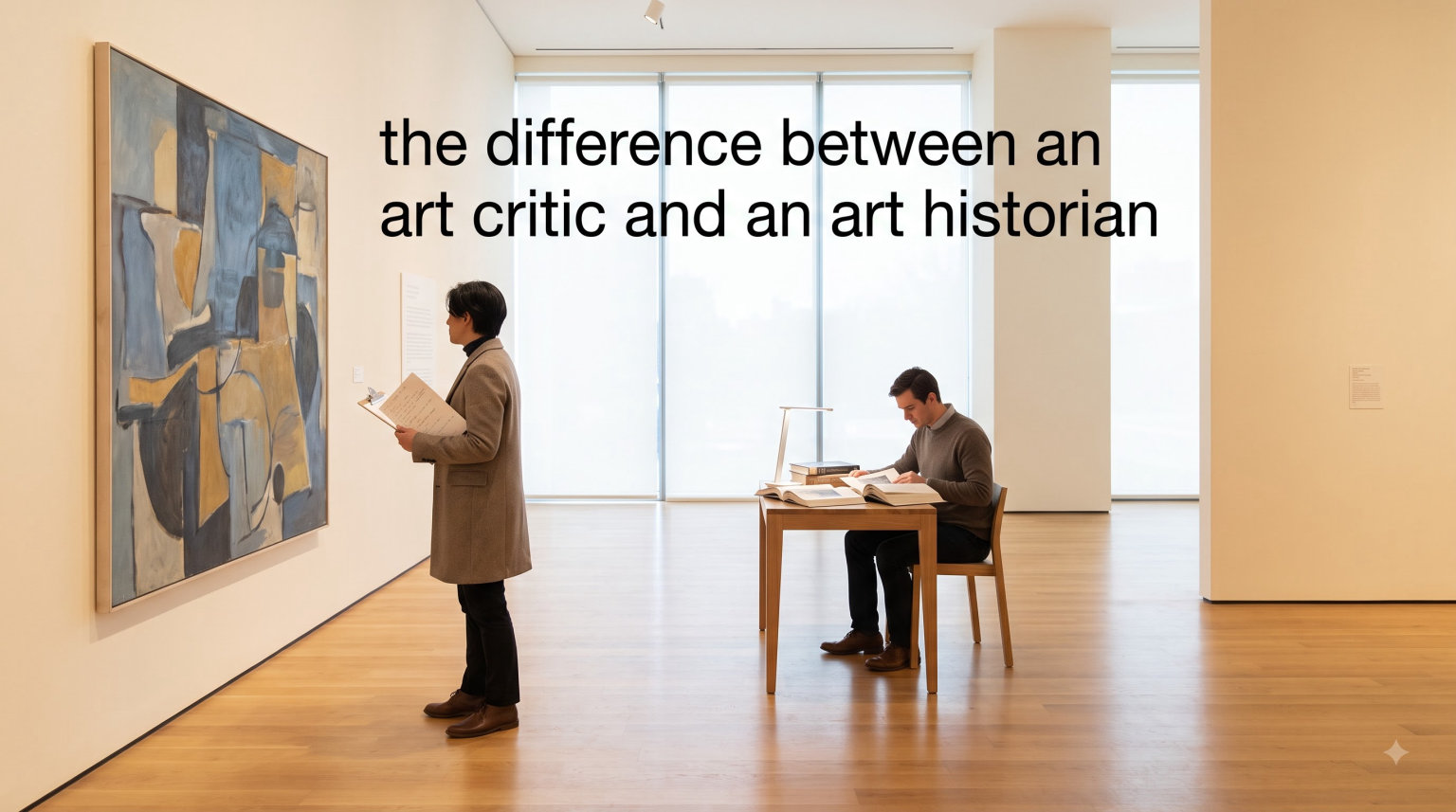
When you walk through a museum or flip through an art magazine, you might wonder who is behind those thoughtful analyses and evaluative judgments. Two professions often get lumped together, but understanding the difference between an art critic and an art historian matters more than you might think. Both roles involve deep engagement with art, yet their purposes, methods, and audiences diverge significantly. This guide breaks down exactly what separates these two essential voices in the art world.
Table of Contents
What Is an Art Historian?
An art historian is a scholar who studies artworks within their historical context. We spend years researching the when, where, and why behind artistic creation. Our work focuses on establishing facts about art objects, including their provenance, authorship, and cultural significance.
The methodology we use draws heavily from hermeneutical approaches. This means we interpret artworks through the lens of historical evidence and theoretical frameworks. When I examine a Renaissance painting, I am not just looking at the surface composition. I am tracing connections to patronage systems, religious conventions, and artistic conventions of the period.
Art historians typically work in academic settings, museums, or research institutions. We publish our findings in scholarly journals and monographs that undergo peer review. The goal is to build cumulative knowledge about art history, one research project at a time. Our audience tends to be other scholars, students, and institutions.
What Is an Art Critic?
An art critic evaluates contemporary art and shares that evaluation with the public. Where art historians look backward, critics focus on the present moment. We assess new exhibitions, emerging artists, and current movements with an eye toward helping audiences understand what matters now.
The critic’s role is inherently evaluative. We make judgments about quality, significance, and meaning. This does not mean our work lacks rigor, but our purpose differs from scholarship. A critic like Jerry Saltz has built a career on passionate, experience-driven evaluation that resonates with general audiences.
Art critics work in diverse settings. Some write for major newspapers and magazines. Others publish independently online or work within galleries and institutions. The common thread is public-facing evaluation of living artists and current exhibitions. You can learn more about art criticism methodology and how critics develop their frameworks.
Core Methodological Differences
The methodological gap between these two professions is substantial. Art historians use research-driven approaches to establish facts and build interpretations. Critics employ evaluative frameworks to judge and contextualize contemporary work.
Historical research forms the backbone of art historical work. We trace provenance, authenticate attributions, and reconstruct the original contexts where artworks functioned. This requires archival research, technical analysis, and theoretical sophistication. The discipline demands patience and systematic attention to evidence.
Art critics operate with different priorities. We prioritize immediate response to artworks and exhibitions. Our evaluations blend aesthetic judgment with cultural commentary. The best criticism feels urgent and engaged, offering readers a lens for understanding work they might encounter themselves.
Timeline Focus: Past Versus Present
One of the clearest distinctions involves temporal focus. Art historians concentrate on historical art, typically defined as works created at least twenty-five years in the past. Critics focus on contemporary art, which is generally classified as work from the past quarter-century.
This difference shapes everything about how each profession approaches its work. When studying medieval manuscripts or Baroque altarpieces, art historians must reconstruct contexts from fragmentary evidence. Critics enjoy direct access to living artists and current art scenes, but must process new work without the benefit of historical distance.
The relationship between these temporal focuses is not always antagonistic. Many professionals move between both domains, and understanding modern and contemporary art periods helps illuminate the broader landscape. Contemporary critics often draw on art historical knowledge to contextualize new work, while historians increasingly recognize that their scholarly frameworks emerged from ongoing critical debates.
Evaluation Versus Research
Art historians conduct research to establish facts and construct interpretations. We ask questions like: Who created this work? When was it made? How did it function in its original context? What influences shaped the artist’s approach? The goal is cumulative scholarly understanding.
Art critics engage in evaluation. We ask different questions: Is this work successful? What does it contribute to contemporary discourse? How does it compare to other recent work? What should audiences take away from experiencing it? The goal is immediate, public judgment that helps viewers navigate the current art world.
This distinction manifests in writing style as well. Art historical writing tends toward measured, evidence-based argumentation with extensive citations. Critical writing often embraces more personal, direct voice. Both require expertise, but the communicative purposes differ substantially.
Education and Career Paths
Most art historians follow a well-defined academic path. We typically earn undergraduate degrees in art history, followed by master’s degrees and often doctorates. Graduate training involves rigorous coursework in methodologies, historiography, and specialized periods. Many art historians complete dissertations that make original contributions to scholarly knowledge.
Career settings for art historians include universities, museums, auction houses, and cultural institutions. Museum curators often hold art historical credentials and split time between research and public programming. The academic job market is competitive, with many PhD holders pursuing positions at smaller institutions or in related fields like publishing and cultural administration.
Art critics follow less standardized paths. Some, like Roberta Smith of The New York Times, hold formal art historical training. Others, like Jerry Saltz, come from artistic backgrounds or build expertise through sustained practice. There is no required degree to become an art critic, though understanding art history and contemporary practice remains essential.
Critics work as freelancers, staff writers at publications, or institutional voices for galleries and museums. The rise of independent online criticism has democratized access to the field, allowing passionate writers to build audiences without institutional backing. You can explore how museum curation and art expertise intersect with both fields.
Where the Fields Overlap
Despite their differences, art historians and art critics share more common ground than is sometimes assumed. Both professions require deep visual literacy and sustained engagement with artworks. Both draw on art historical knowledge, even if they apply it differently.
Many art historians write criticism, particularly about historical subjects. Exhibition catalog essays often blend scholarly research with evaluative commentary. Conversely, some critics develop deeply historical approaches, situating contemporary work within longer trajectories of artistic development.
The boundaries between fields remain permeable. Artists become critics, and critics sometimes pursue historical research. Graduate programs in art history typically include critical writing components, recognizing that these skills complement rather than contradict each other. The contemporary art world benefits from both scholarly and critical perspectives working in dialogue.
Famous Art Historians to Know
Several figures have shaped the discipline of art history through their scholarship and methodological innovations.
Giorgio Vasari (1511-1574) wrote the foundational Lives of the Most Excellent Painters, Sculptors, and Architects, establishing biographical approaches to art history that remained influential for centuries. His work established the narrative framework many still use for understanding Renaissance art.
Heinrich Wölfflin (1864-1945) pioneered formal analysis methods, teaching us to analyze artworks through their formal properties rather than biographical details alone. His Principles of Art History remains a foundational text in graduate programs worldwide.
Erwin Panofsky (1892-1968) developed iconographic and iconological methods that revealed deeper layers of meaning in Renaissance art. His approach to interpreting symbolic content transformed how scholars understand the relationship between artworks and their intellectual contexts.
John Ruskin (1819-1900) combined art historical scholarship with critical advocacy, arguing passionately for the importance of Gothic architecture and Pre-Raphaelite painting. His work demonstrates how art historical and critical approaches can intertwine productively.
Famous Art Critics to Know
Art critics have shaped how audiences understand and appreciate contemporary art through their writing and advocacy.
Clement Greenberg (1909-1986) was perhaps the most influential American critic of the twentieth century. His defense of Abstract Expressionism and formalist approach to criticism established frameworks that still influence how we discuss postwar American art.
Jerry Saltz (born 1956) represents contemporary criticism’s more accessible, experience-driven approach. As New York Magazine’s senior art critic, he has built a broad audience by combining passionate evaluation with genuine engagement with artists and audiences alike.
Roberta Smith (born 1956) has shaped discourse about contemporary art through her long tenure at The New York Times. Her criticism demonstrates how scholarly depth can inform public-facing evaluation without sacrificing accessibility.
Katherine Gleason (born 1960) has contributed significant critical writing about contemporary sculpture and installation art. Her work exemplifies how critics develop specialized expertise while maintaining broad cultural engagement.
Art Historian vs Art Critic: A Comparison
Understanding the difference between an art critic and an art historian becomes clearer through direct comparison. Here is a summary of key distinctions:
| Aspect | Art Historian | Art Critic |
|---|---|---|
| Primary Focus | Historical art and context | Contemporary art and evaluation |
| Main Activity | Research and scholarship | Judgment and commentary |
| Typical Audience | Scholars, students, institutions | General public, collectors, artists |
| Education Path | Graduate degrees (MA, PhD) | Variable; often self-taught |
| Work Settings | Universities, museums, archives | Publications, galleries, freelance |
| Time Orientation | Past (historical art) | Present (contemporary art) |
| Key Methodology | Hermeneutical interpretation | Evaluative analysis |
| Output Style | Scholarly, cited arguments | Accessible, often personal |
Conclusion
The difference between an art critic and an art historian comes down to purpose and perspective. Art historians build scholarly knowledge about historical art through rigorous research and interpretation. Art critics help audiences navigate contemporary art through informed evaluation and commentary.
Both professions contribute essential voices to how we understand and appreciate visual culture. Whether you are considering career paths, seeking to understand art writing you encounter, or simply curious about how these roles differ, recognizing these distinctions enhances your engagement with the art world.
As you continue exploring art, pay attention to whether the writing you read leans toward scholarly research or public evaluation. That single distinction reveals much about the author’s purpose and background.
FAQs
What is the main difference between art historians and art critics?
Art historians study and interpret historical art through research and scholarly analysis, while art critics evaluate contemporary art through public-facing judgment and commentary. Historians focus on establishing facts about past works, while critics assess current work’s quality and significance.
Do art historians get paid well?
Art historian salaries vary widely based on institution, location, and career stage. Museum curators and university professors typically earn between $50,000 and $100,000 annually in the United States. Academic positions offer benefits and stability, while freelance work varies significantly.
Do art critics need a degree?
No formal degree is required to become an art critic, though most successful critics have substantial art historical knowledge. Many critics, like Jerry Saltz, built expertise through experience and passion rather than formal education. A strong portfolio of published work matters more than credentials.
What makes someone an art historian?
An art historian is someone who studies artworks within their historical context using scholarly methodologies. Most hold graduate degrees in art history and work in universities, museums, or research institutions. The role involves establishing facts about artworks and constructing interpretive frameworks.