
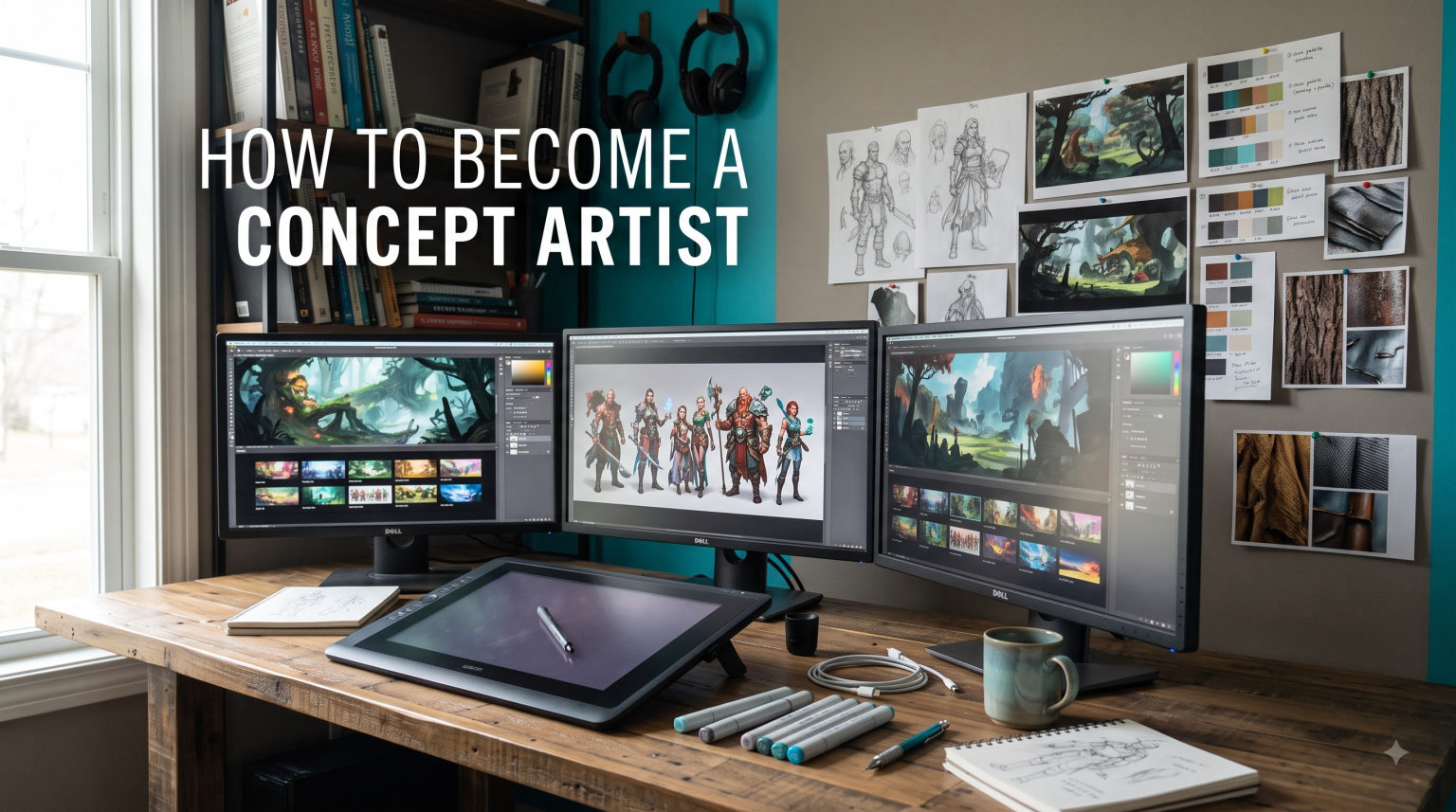
Learning how to become a concept artist feels overwhelming at first. I remember staring at professional portfolios wondering how anyone could possibly reach that level. After researching this career path and talking with industry professionals, I discovered that concept art is a skill anyone can develop with the right approach and consistent practice.
This guide will walk you through everything you need to know about starting a concept art career in 2026. We will cover the essential skills, the best software to learn, how to build a portfolio that gets noticed, and realistic paths to landing your first job.
Whether you are completely new to art or looking to transition from another creative field, the steps in this article will give you a clear roadmap to follow.
Table of Contents
What Is a Concept Artist
A concept artist is a visual designer who creates the initial ideas and designs for characters, environments, props, and other elements used in video games, films, animation, and other media. These artists translate written descriptions and creative briefs into visual references that guide the entire production team.
Concept art serves as the foundation for all visual development in entertainment projects. Before a single 3D model gets built or a costume gets sewn, concept artists establish the look, feel, and style of the world being created. Directors, game designers, and producers rely on these visuals to communicate their vision to the larger production team.
The role differs from illustration in important ways. While illustrators create finished artwork for final consumption, concept artists focus on exploration and problem-solving. They produce multiple variations of designs, iterate based on feedback, and create art that serves as a blueprint rather than a final product. Speed and clarity matter more than polished perfection.
Concept artists work across several industries. The video game industry employs the largest number, followed by film and television production, animation studios, and publishing. Some artists specialize in specific areas like character design, environment design, vehicle design, or prop design, while others work as generalists handling various types of projects.
How to Become a Concept Artist
Becoming a concept artist requires developing a specific combination of artistic skills, technical knowledge, and professional presentation. Here is the step-by-step path that working professionals recommend.
Step 1: Master the Art Fundamentals
Strong fundamentals separate amateur work from professional concept art. Start with anatomy study because understanding how the human body works allows you to design believable characters and creatures. Focus on proportions, skeletal structure, and how muscles create form.
Perspective drawing comes next. Every environment and prop you design needs to exist in three-dimensional space. Practice one-point, two-point, and three-point perspective until you can draw convincing depth without thinking about it.
Lighting and value control how viewers perceive your designs. Learn to render forms using light and shadow to show volume and material properties. Study how different surfaces reflect or absorb light.
Step 2: Practice the 70/30 Rule
The 70/30 rule is a guideline many concept artists follow when building skills. Spend 70 percent of your practice time on fundamental studies like anatomy, perspective, and still life drawing from reference. Use the remaining 30 percent for imaginative drawing and applying what you have learned to create original designs.
This balance prevents the common trap of only drawing from imagination without building the technical foundation to support your ideas. It also keeps practice sessions engaging by mixing structured study with creative exploration.
Step 3: Learn Digital Painting Software
While traditional drawing skills matter, the industry runs on digital tools. Adobe Photoshop remains the standard for 2D concept art, though Clip Studio Paint offers excellent features at a lower price point. Both programs handle the layers, brushes, and photo-bashing techniques concept artists use daily.
Learning 3D software gives you a significant advantage. Blender is free and powerful for creating base meshes and simple environments. ZBrush dominates digital sculpting for character and creature design. Even basic 3D knowledge helps you create more accurate perspectives and complex designs faster.
Step 4: Build a Focused Portfolio
Your portfolio determines whether you get hired. Include 10 to 15 pieces that showcase your best work across different categories. Most employers want to see character designs, environment pieces, and prop designs. Show process work like sketches and iterations to demonstrate your thinking.
Quality matters more than quantity. One stunning piece impresses more than ten mediocre ones. Be ruthless about removing older work as you improve. Present your portfolio on ArtStation, the industry standard platform where recruiters actively search for talent.
Step 5: Choose Your Education Path
You do not need a degree to become a concept artist. The industry cares about your portfolio, not your diploma. Many successful artists are completely self-taught using online resources, tutorials, and consistent practice.
Art school provides structure, feedback from instructors, and networking opportunities. Programs specifically focused on entertainment design or concept art offer relevant coursework and industry connections. Online courses and bootcamps from schools like CG Spectrum provide focused training without the full degree commitment.
The self-taught route requires discipline. Create a curriculum for yourself using free resources like YouTube tutorials, Proko for anatomy, and Ctrl+Paint for digital fundamentals. Join online communities for feedback and accountability.
Step 6: Network and Apply Strategically
Getting your first industry job takes persistence. Start with entry-level positions like junior concept artist, intern, or even 3D generalist roles that include design work. Apply to game studios, animation companies, and freelance opportunities.
Networking accelerates your search. Join Discord servers for concept artists, participate in ArtStation challenges, and attend industry events when possible. Many jobs come through referrals rather than cold applications.
Essential Skills Every Concept Artist Needs
Concept artists need a combination of technical artistic abilities and professional soft skills to succeed.
Technical Art Skills
Drawing ability forms the foundation. You need to communicate ideas quickly through sketches that others can understand and build upon. This means confident line work, clear silhouettes, and readable forms.
Design principles guide your creative decisions. Understanding composition, color theory, shape language, and visual hierarchy helps you create appealing and effective designs. Study industrial design, fashion, architecture, and nature to build your visual library.
Speed matters in professional settings. Concept artists often work under tight deadlines, producing multiple design options in a single day. Developing efficient workflows and learning to suggest detail without rendering every pixel helps you meet production demands.
Software Proficiency
Adobe Photoshop remains essential for most 2D concept art work. Learn to use layers effectively, create custom brushes, and employ photo-bashing techniques to work quickly. Keyboard shortcuts and custom workspaces save hours over the course of a project.
3D skills increasingly separate good artists from great ones. Blender offers a free entry point to 3D modeling and scene building. Even basic 3D blocking helps you establish complex perspectives and lighting setups faster than drawing from scratch.
Professional Skills
Interpreting briefs is a skill that takes time to develop. Clients and art directors provide written or verbal descriptions of what they need. You must ask clarifying questions, understand the project constraints, and translate abstract ideas into concrete visuals.
Receiving feedback gracefully is essential. Your designs will be critiqued, rejected, and revised constantly. Learn to separate your ego from your work and see feedback as a tool for improvement rather than personal criticism.
Communication skills help you present your ideas and understand project requirements. Concept artists work within larger teams and must articulate their design choices to directors, producers, and other artists.
Software and Tools for Concept Artists
The right tools help you work efficiently and produce professional results. Here are the programs and hardware most concept artists use.
2D Digital Painting Software
Adobe Photoshop has been the industry standard for decades. It offers unmatched flexibility for photo manipulation, digital painting, and creating final presentation pieces. The monthly subscription costs around $20 for individuals, though many artists access it through student discounts or employer licenses.
Clip Studio Paint provides excellent brush engines specifically designed for illustration and comic work. Many concept artists prefer its natural drawing feel and one-time purchase pricing. The program handles perspective rulers, 3D figure references, and animation features that Photoshop lacks.
Krita offers a completely free alternative with professional-grade features. While less common in studios, it handles all essential painting tasks and supports the PSD file format for compatibility.
3D Software
Blender has transformed the 3D industry with its zero-cost, open-source model. Concept artists use it for blocking out scenes, creating base meshes for over-painting, and rendering quick lighting studies. The learning curve is steep but the community provides excellent tutorials.
ZBrush dominates digital sculpting for organic forms like characters and creatures. Its price puts it in professional territory, though Pixologic offers discounts for students and hobbyists. Many concept artists learn ZBrush after establishing their 2D skills.
Unreal Engine and Unity help concept artists create real-time environments and test designs in actual game engines. These skills are increasingly valuable as the industry moves toward real-time production workflows.
Hardware Recommendations
A drawing tablet is essential. Wacom remains the industry standard with their Intuos and Cintiq lines. Huion and XP-Pen offer budget alternatives that perform well for beginners. A tablet with a screen makes the transition from traditional drawing easier, though non-screen tablets work fine once you adjust.
Computer specifications depend on your workflow. 2D painting requires less power than 3D work. Aim for at least 16GB of RAM, a modern multi-core processor, and a dedicated graphics card if you plan to use 3D software or game engines.
How to Build a Professional Concept Art Portfolio
Your portfolio represents you when you cannot be there in person. Building it thoughtfully increases your chances of getting noticed by recruiters and art directors.
What to Include
Show variety across design categories. Include character designs, environment pieces, and prop designs to demonstrate range. If you want to specialize, weight your portfolio toward that area while still showing some breadth.
Process work adds value. Include sketches, thumbnails, and iteration sheets that show how you develop ideas. This demonstrates your thinking process and ability to explore options before settling on a final design.
Polished presentation matters. Frame your work consistently, use simple backgrounds that do not distract, and present pieces at appropriate sizes. Label each piece with the project type and any relevant context.
Portfolio Platforms
ArtStation is the essential platform for concept artists. Create a clean, professional profile and organize your work into projects. Use relevant tags so recruiters can find your work when searching for specific skills.
Your own website offers more control over presentation. Squarespace, Wix, and WordPress provide templates designed for artists. Keep navigation simple and prioritize your best work on the homepage.
Social media supplements your main portfolio. Instagram and Twitter help you build an audience and connect with other artists. Post work-in-progress pieces, sketches, and finished designs regularly to maintain visibility.
Building a Portfolio Without Professional Experience
Everyone starts somewhere. Create personal projects based on your own ideas or reimagine existing properties for practice. Participate in art challenges and community events that provide prompts and deadlines.
Redesign existing games or movies as portfolio pieces. Choose well-known properties and create concept art showing how you would approach them differently. This demonstrates your skills while giving viewers familiar reference points.
Collaborate with others. Join game jams, team up with writers, or contribute to mod projects. These collaborations give you real project experience and pieces for your portfolio that show you can work within team constraints.
Education Paths: Degree vs Self-Taught
There are multiple ways to learn concept art, each with advantages and trade-offs.
Traditional Art School
Bachelor programs in illustration, entertainment design, or game art provide structured curricula and access to instructors with industry experience. You receive regular feedback on your work and develop alongside peers who share your goals.
The downsides include cost, with many programs charging $30,000 to $60,000 per year, and time, with most degrees taking four years to complete. The curriculum may include courses irrelevant to your specific career goals.
Schools known for concept art include ArtCenter College of Design, FZD School of Design in Singapore, and various programs at Ringling College and Sheridan College. Research each program’s alumni success and industry connections before committing.
Online Courses and Bootcamps
Focused online programs offer targeted training at lower costs. CG Spectrum, Schoolism, and Learn Squared employ working professionals as instructors. These courses teach current industry workflows and provide portfolio reviews.
Bootcamps condense learning into intensive programs lasting weeks or months rather than years. They suit motivated learners who can dedicate significant time to practice. The focused nature helps you build skills quickly without unrelated coursework.
The Self-Taught Route
Teaching yourself requires discipline but offers complete flexibility. Start with free resources like Proko for anatomy, Ctrl+Paint for digital fundamentals, and YouTube channels like Marco Bucci and Dave Greco for painting techniques.
Create a structured curriculum for yourself. Dedicate specific time to figure drawing, perspective studies, and design exercises. Track your progress and set milestones to maintain motivation.
Communities provide support and feedback. Join Discord servers, participate in Reddit critiques, and connect with other learners through social media. Feedback from more experienced artists accelerates your improvement.
How to Get Your First Concept Art Job
Breaking into the industry requires persistence, strategy, and a bit of luck.
Entry-Level Positions
Junior concept artist roles specifically target newcomers. These positions expect less experience but require solid fundamentals and growth potential. Studios hiring juniors typically provide mentorship and training.
Internships offer foot-in-the-door opportunities. Many game and film studios run summer internship programs for students and recent graduates. These positions often convert to full-time roles for performers.
Related roles can lead to concept art positions. Starting as a texture artist, 3D modeler, or junior illustrator gets you into studios where you can learn from concept artists and transition internally. Some artists begin in QA or production roles.
Freelance vs Studio Work
Studio employment provides stability, benefits, and team collaboration. You work regular hours, receive feedback from art directors, and contribute to large projects. The downside includes less creative control and potential crunch periods.
Freelancing offers flexibility and variety. You choose your projects, set your schedule, and work from anywhere. However, you handle business tasks like finding clients, negotiating rates, and managing taxes. Income fluctuates, especially when starting out.
Many artists mix both approaches. They maintain studio jobs for stability while taking freelance work on the side. Others transition gradually from full-time employment to full-time freelancing as their client base grows.
Networking Strategies
Online communities connect you with working professionals. Join ArtStation, participate in Twitter art threads, and engage with Discord communities like Level Up and Art Cafe. Genuine participation builds relationships over time.
Industry events provide face-to-face networking. Attend conventions like Comic-Con, GDC, and LightBox Expo when possible. Portfolio reviews at these events give you direct feedback from art directors.
Personal projects attract attention. Create work that showcases your unique interests and style. When your art resonates with people, opportunities often follow organically through shares and recommendations.
Concept Artist Salary and Career Outlook
Understanding compensation helps you set realistic expectations and negotiate effectively.
Salary Ranges
Entry-level concept artists in the United States typically earn between $45,000 and $65,000 annually. Mid-level artists with several years of experience command $65,000 to $90,000. Senior concept artists and leads earn $90,000 to $130,000 or more, depending on the studio and location.
Freelance rates vary widely. Beginners might charge $25 to $50 per hour, while established artists command $75 to $150 or more. Project-based pricing often works better for freelance concept art, with individual pieces ranging from $500 to several thousand dollars depending on complexity.
Industry Variations
Video game studios employ the most concept artists and offer competitive salaries. AAA game studios in major cities pay the highest rates, though cost of living offsets some of the advantage. Indie studios pay less but offer more creative freedom.
Film and television concept artists often work through VFX houses. These positions can pay well but may involve less job security due to project-based employment. Union positions in animation provide better benefits and protection.
Location significantly affects compensation. Studios in San Francisco, Los Angeles, and Seattle pay more than those in smaller cities. Remote work has expanded opportunities, though some studios still require or prefer local artists.
Career Progression
Concept art careers typically progress from junior to mid-level to senior positions. Senior concept artists often specialize in specific areas like character design or environment design. Some transition into art director roles, overseeing visual direction for entire projects.
Many concept artists become educators later in their careers, teaching at schools or creating online courses. Others start their own studios or focus on personal art projects and gallery shows.
The demand for concept artists remains strong. Video games continue growing as an industry, streaming services need constant content, and virtual production techniques create new opportunities in film and television.
Common Mistakes Beginners Make
Avoiding these pitfalls will accelerate your progress and prevent frustration.
Neglecting Fundamentals
Many beginners rush to advanced techniques before mastering basics. Fancy brushes and rendering tricks cannot compensate for weak anatomy or incorrect perspective. Spend your early months on fundamental studies even when it feels less exciting than creating finished pieces.
The temptation to draw only from imagination is strong. Resist it. Use reference for everything, especially when learning. Professional concept artists constantly reference photos, 3D models, and real-world objects.
Portfolio Mistakes
Including too much work dilutes your portfolio. Ten excellent pieces impress more than twenty mediocre ones. Be selective and update your portfolio regularly as you improve.
Poor presentation hurts otherwise good art. Cropped images, distracting watermarks, and inconsistent framing distract from your work. Present your art professionally with clean backgrounds and consistent sizing.
Showing only fan art limits your opportunities. While fan art demonstrates technical skill, original designs prove you can create from imagination. Balance personal projects with professional-looking original work.
Mental Game
Comparing yourself to professionals destroys motivation. Remember that senior artists have years of practice. Compare your current work to your past work, not to someone else’s best pieces.
Burnout derails many promising artists. Schedule rest days, maintain hobbies outside art, and remember that sustainable careers require sustainable habits. Pushing yourself too hard for too long reduces creativity and enjoyment.
Ignoring Feedback
Isolation slows improvement. Seek critiques from artists ahead of you in skill level. Online communities, mentorship programs, and art school instructors provide valuable perspectives you cannot see in your own work.
Defending your work against critique wastes learning opportunities. Listen to feedback, try the suggestions, and evaluate results objectively. You can always reject advice after testing it, but dismissing it outright prevents growth.
FAQs
What qualifications do you need to become a concept artist?
You do not need formal qualifications to become a concept artist. The industry cares about your portfolio and skills, not degrees. Many successful concept artists are self-taught. However, art school can provide structure, networking, and feedback that accelerates learning.
What is the 70/30 rule in drawing?
The 70/30 rule suggests spending 70 percent of practice time on fundamental studies like anatomy, perspective, and still life drawing from reference. The remaining 30 percent goes to imaginative drawing and applying learned skills. This balance builds technical ability while keeping practice engaging.
How difficult is it to become a concept artist?
Becoming a concept artist requires dedication and consistent practice over several years. The difficulty depends on your starting point and learning intensity. Most artists need 2 to 5 years of serious study before landing professional work. Natural talent helps, but disciplined practice matters far more.
Do concept artists make money?
Yes, concept artists earn competitive salaries. Entry-level positions pay $45,000 to $65,000 annually in the United States. Mid-level artists earn $65,000 to $90,000, while senior artists and leads make $90,000 to $130,000 or more. Freelance rates vary but established artists can earn well.
Conclusion
Learning how to become a concept artist takes time, dedication, and consistent practice. Focus on building strong fundamentals in anatomy, perspective, and lighting before worrying about advanced techniques. Create a portfolio that showcases your best work and present it professionally on platforms like ArtStation.
Choose the education path that suits your learning style and budget, whether that means art school, online courses, or self-directed study. Network with other artists, seek feedback on your work, and apply strategically to entry-level positions.
The concept art industry offers rewarding careers for those willing to put in the work. Start with daily drawing practice, follow the steps in this guide, and remember that every professional artist started exactly where you are now. Your concept art career in 2026 begins with the first sketch.