
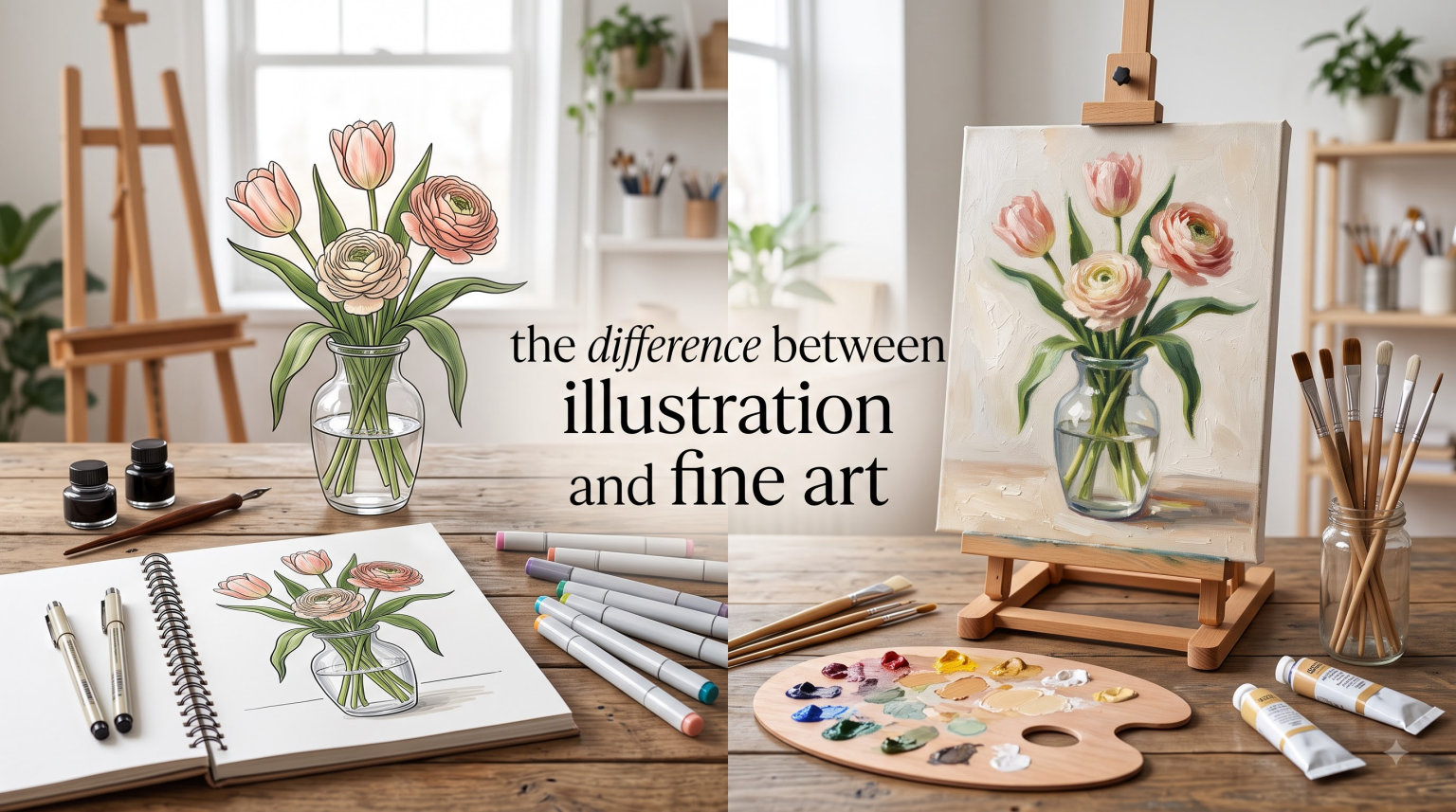
When I first started showing my work to galleries, a curator told me my pieces felt too illustrative. I had spent years developing my style, pouring emotion into every brushstroke, and yet something about my work read differently to the art establishment. That experience sent me down a rabbit hole that artists all over the world have navigated before me: understanding the real difference between illustration and fine art.
The distinction matters more than most beginners realize. It affects where you show your work, who collects it, and even which career path you choose. But here’s what I discovered after speaking with working artists, gallery owners, and collectors: the line between these two categories has never been as clear as the art world wants us to believe. The difference between illustration and fine art comes down to one primary factor, and once you understand it, everything else clicks into place.
In this guide, our team breaks down everything you need to know about these two distinct (yet sometimes overlapping) art forms. We’ll cover definitions, examples, the historical context of their separation, and real guidance for artists trying to decide which path aligns with their vision.
Table of Contents
What Is Fine Art?
Fine art refers to creative works made primarily for aesthetic appreciation and personal expression. The artist creates to communicate their own vision, emotions, or concepts. The piece exists because the artist felt compelled to bring it into being, not because someone commissioned it for a specific purpose.
Definition and Core Characteristics
The traditional definition of fine art centers on painting, sculpture, drawing, and printmaking. These disciplines have been taught in academies for centuries and were historically considered “higher” art forms than crafts or commercial work. A fine artwork prioritizes the artist’s personal vision above all else. The gallery visitor or museum viewer is meant to experience something through the work, but that something is not prescribed or spelled out.
When we look at fine art characteristics, several patterns emerge. First, the work typically exists as a standalone piece meant for contemplation. Second, the artist retains significant control over final output, rarely ceding creative decisions to outside parties. Third, fine art often addresses concepts, emotions, or narratives that matter deeply to the creator rather than to an assigned audience. Fourth, the boundaries of fine art are loosely defined and contested, which is part of what makes the form perpetually interesting.
Fine Art Examples
Consider the oil paintings of Rembrandt or the sculptures of Auguste Rodin. These represent classic fine art traditions where the artist’s expression drives the work. In contemporary contexts, fine art encompasses everything from abstract expressionist canvases to conceptual installations. Artists like influential contemporary artists working today continue to push the boundaries of what fine art can be.
Fine art lives in galleries, museums, private collections, and increasingly, digital spaces. The transaction between artist and collector often involves intermediaries like galleries, and the pricing reflects factors beyond mere labor: rarity, artistic significance, provenance, and cultural relevance all play roles.
What Is Illustration?
Illustration is visual art created to communicate specific messages, stories, or ideas. Where fine art asks “what does the artist want to say,” illustration asks “what does the audience need to understand.” This fundamental difference shapes every decision an illustrator makes, from composition to color palette to the amount of detail included.
Definition and Core Characteristics
Illustration serves a communicative function. Whether it’s a magazine cover, a children’s book spread, or a product label, the illustration exists to convey information or evoke a specific response in a defined audience. Illustrators often work from briefs provided by editors, art directors, or clients. The creative process involves problem-solving within constraints rather than pure self-expression.
Core characteristics of illustration include narrative content (the image tells a story or delivers information), audience awareness (the illustrator designs with viewers in mind), and functional beauty (the aesthetic serves the communication goal). Illustration can be stunningly beautiful, and many illustrators create work that transcends its functional origins, but the primary purpose remains communication rather than personal expression.
Illustration Examples
Think about the covers of The New Yorker, the artwork accompanying newspaper articles, or graphics in instructional manuals. These all represent illustration at work. Book illustration, editorial illustration, medical illustration, and commercial graphics all fall under this umbrella. The medium might be traditional (watercolor, ink) or digital, but the fundamental purpose remains consistent: visual communication in service of a specific message.
Our team has reviewed countless portfolios across both disciplines, and we consistently find that illustrators develop highly refined visual vocabularies for specific purposes. An editorial illustrator learns to convey complex stories quickly, while a children’s book illustrator masters the ability to connect with young audiences emotionally.
The Core Differences Between Illustration and Fine Art
After interviewing dozens of working artists and examining how galleries, publishers, and collectors categorize work, our team identified three primary differentiators between illustration and fine art.
Intent and Purpose
The most reliable way to distinguish between illustration and fine art is to ask: why does this work exist? Fine art exists primarily for the artist’s sake. The creator makes work because they cannot not make it, because they need to express something that has no other outlet. Illustration exists primarily for the audience’s sake. The illustrator makes work because someone needs to communicate something to someone else.
This distinction sounds simple but has profound implications. When you look at a fine art painting in a gallery, you’re witnessing one person’s attempt to process reality through their particular lens. When you look at an editorial illustration, you’re receiving optimized visual information designed to help you understand something quickly and memorably.
One artist we spoke with described it this way: “Fine art is asking a question. Illustration is answering one.” We found this framework resonates across different art communities and helps explain why the same piece of art might be categorized differently depending on context.
The Artist’s Role
Fine artists operate as autonomous creators. They decide what to make, how to make it, and when to consider it finished. Their relationship with their work is personal and often intense. Many fine artists describe their practice as essential to their mental health or sense of self, not merely a career but a necessity.
Illustrators, by contrast, often work as collaborators within larger systems. They translate briefs, incorporate feedback, and adjust their personal style to serve project goals. This doesn’t make illustration lesser work; it requires extraordinary flexibility and the ability to subordinate personal preferences to client needs. The best illustrators do this while still infusing their work with personality and craft.
The role difference extends to how each field approaches skill development. Fine artists often specialize in specific mediums and spend years (sometimes decades) mastering their particular approach. Illustrators typically develop versatile skills that allow them to work across styles and adapt to varying project requirements.
How the Work Is Used
Fine art typically enters the world through galleries, exhibitions, museums, art fairs, and private collections. The transaction often involves significant price negotiation and creates long-term relationships between artists and collectors. Fine art can appreciate in value based on critical reception, exhibition history, and cultural significance.
Illustration typically appears in commercial contexts: publications, advertising, product design, and digital media. Illustrators often work on assignment, creating work that serves editorial or marketing purposes. The work might be widely seen but poorly compensated, or (in the case of iconic illustrations) widely recognized but anonymized from its creator.
This difference in usage patterns creates different career structures. Fine artists often struggle for years before establishing collector relationships, while illustrators can build sustainable careers through consistent commercial work. However, fine artists who break through often achieve greater financial ceilings and cultural legacy.
The gallery art distinctions between fine art and illustration play out in practical terms through where and how work is sold, reviewed, and collected.
Artists Who Bridge Both Worlds
Here’s where the story gets interesting. Many of the most celebrated artists of the 20th and 21st centuries have deliberately rejected the binary between illustration and fine art. These crossover artists demonstrate that the distinction, while practically useful, is ultimately artificial.
Takashi Murakami blends Japanese pop culture imagery with fine art conventions. His work features the flat colors and playful characters of manga and anime, yet commands millions at auction and fills museum galleries worldwide. Murakami explicitly rejects hierarchical distinctions between commercial and fine art.
KAWS began as a commercial illustrator, creating artwork for brands and publications. He transformed his understanding of visual communication into fine art that now sells for substantial sums. KAWS demonstrates how commercial fluency can translate into fine art success.
Shepard Fairey built his career on the border between illustration and activism. His OBEY brand began as street art and evolved into a fine art practice, though Fairey continues to produce work with commercial applications. His trajectory illustrates how the distinction can be strategically navigated.
Norman Rockwell, long dismissed by fine art critics, is now recognized as a significant American artist. His illustrations for The Saturday Evening Post depicted American life with psychological complexity and technical mastery that rivals any fine art portrait. Contemporary viewers increasingly appreciate his work as profound social commentary disguised as accessible imagery.
These artists prove that rejecting the illustration/fine art binary can be a legitimate artistic choice. When appropriation art emerged as a major movement, artists deliberately blurred categories to challenge institutional gatekeeping about what constitutes legitimate art.
Why the Distinction Has Become Blurred
The separation between illustration and fine art intensified during the 19th and 20th centuries as art institutions sought to establish cultural hierarchies. Fine art was elevated; commercial and decorative arts were relegated to lower status. This stratification served economic and social interests but didn’t necessarily reflect how creative work actually functions.
In the contemporary art world, these categories matter less than they once did. Digital tools have collapsed traditional medium distinctions. Collectors increasingly value work that communicates across traditional boundaries. Young artists graduate from programs that train them in both disciplines, leaving them comfortable moving between commercial and personal work.
Our team has observed that many working artists maintain hybrid practices. They might take commercial illustration projects for income while pursuing fine art for personal expression. This diversification reflects both economic reality and creative curiosity. The artist who can move fluidly between modes often develops a richer practice than one constrained by categorical purity.
The art school education debate intersects with this question. Programs that train students in both illustration and fine art may better prepare them for contemporary practice, while specialized programs risk creating artists unprepared for the realities of creative careers.
Career Implications for Artists
If you’re deciding between illustration and fine art as a career path, consider these factors honestly. Neither path is inherently better; they suit different temperaments and goals.
Fine art careers typically require longer development periods before financial sustainability. Artists often spend years building collector relationships and critical recognition before earning enough to live on. However, successful fine artists can achieve significant income and cultural influence later in their careers.
Illustration careers offer more immediate income potential. The commercial illustration market provides steady work for skilled practitioners. However, illustrators may find themselves dependent on client relationships that can be disrupted by economic cycles or technological changes.
Both paths benefit from understanding the other’s territory. A fine artist who can communicate effectively about their work, present professionally to galleries, and navigate the art world insights that affect market dynamics has advantages over one who remains purely aloof. An illustrator who develops personal projects that push their commercial skills in new directions maintains creative vitality.
Our team recommends experimenting with both before committing to either identity. Many artists discover they prefer hybrid practices that combine elements of both disciplines. The artists who seem most fulfilled often describe themselves simply as “artists,” without further qualification.
FAQs
How is illustration different from fine art?
The primary difference lies in intent. Fine art exists primarily for the artist’s self-expression, created to fulfill the artist’s personal vision. Illustration exists to communicate specific messages or stories to an audience, often serving a client’s brief or editorial need. Fine art asks what the artist wants to say; illustration answers what the audience needs to understand.
What was Bob Ross’s art style?
Bob Ross worked in a naturalistic fine art tradition, specifically television instruction. His wet-on-wet oil painting technique allowed him to create landscape paintings relatively quickly. While critics sometimes dismissed his work as overly accessible, Ross’s approach reflected genuine fine art training combined with a unique ability to make art approachable for millions of viewers.
What is Erin Hanson’s style of art?
Erin Hanson is known for her ‘open impressionism’ style, which combines classical impressionist techniques with contemporary boldness. Her work features thick, visible brushstrokes, vivid colors, and landscape scenes rendered with energetic abstraction. Her style falls clearly within fine art traditions while appealing to broad audiences through galleries and prints.
What was Andy Warhol’s artistic style?
Andy Warhol’s style evolved from commercial illustration to pop art that blurred fine art and commercial imagery boundaries. His early career involved magazine illustration and advertising work before he developed his signature silkscreen technique exploring celebrity culture, consumer goods, and mass media. Warhol explicitly challenged the distinction between fine art and commercial art, making the boundary itself a subject of his work.
Conclusion
The difference between illustration and fine art ultimately comes down to intent. Fine art prioritizes the artist’s self-expression and personal vision. Illustration prioritizes communication with an audience and service to a client’s needs. Both require exceptional skill, creative problem-solving, and dedication to craft.
In contemporary practice, the boundary between these categories has never been more permeable. Artists like Murakami, KAWS, Fairey, and Rockwell demonstrate that refusing the binary choice can itself be an artistic statement. Whether you’re an aspiring artist choosing your path, a collector building a collection, or simply someone trying to understand the art world better, recognizing this distinction helps clarify how creative work functions in our culture.
The question isn’t really which is better. It’s which serves your purposes at this moment in your creative journey. Many artists find they need both.