
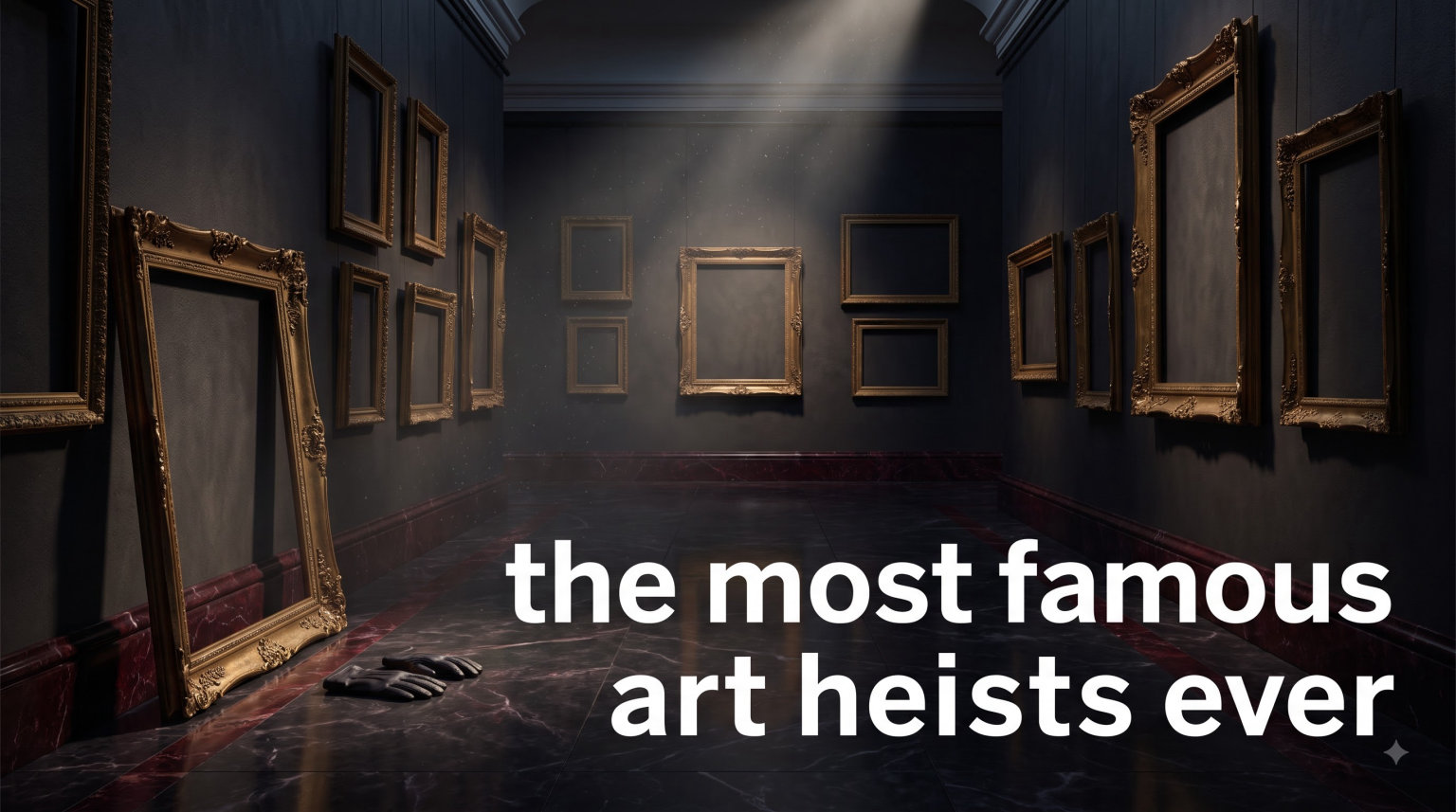
On March 18, 1990, two men dressed as Boston police officers walked into the Isabella Stewart Gardner Museum, tied up the night guards, and walked out with 13 masterpieces worth $500 million. It remains the single largest property theft in history, and not a single painting has been recovered. That night in Boston is just one chapter in a long, strange history of audacious art thefts that spans more than a century, and I have spent years studying every detail of these cases.
The most famous art heists ever are not just crime stories. They are tales of cultural loss, human audacity, and sometimes miraculous recovery. From the theft that made the Mona Lisa the most recognized painting on Earth to brazen daylight robberies that sound like movie scripts, these cases reveal how vulnerable our shared cultural heritage can be. Our team has researched every major art theft case from the past 150 years, and what we found is a pattern of surprisingly low-tech crimes with staggeringly high consequences.
In this guide, I walk you through the most famous art heists ever committed, covering how they happened, who was responsible, and what became of the stolen works. Along the way, we look at the psychology behind art theft, how museum security has evolved in response, and the unsolved cases that still haunt investigators in 2026. Whether you are a true crime fan, an art enthusiast, or simply curious about how someone walks out of a museum with a priceless masterpiece, this guide has the answers.
Table of Contents
The Mona Lisa Heist (1911): The Theft That Created a Superstar
The Mona Lisa theft of 1911 is the most famous art heist ever, and it is the reason Leonardo da Vinci’s small portrait became a global icon. Before the theft, the painting was well-known among art scholars but hardly a household name. That all changed on the morning of August 21, 1911, when a handyman named Vincenzo Peruggia walked out of the Louvre with the painting tucked under his coat.
Peruggia was not a master criminal. He was an Italian immigrant who had worked at the Louvre installing glass cases around the museum’s most valuable paintings. He knew the layout, the guard routines, and the building’s vulnerabilities. On a Monday, when the museum was closed to the public, Peruggia entered through a service door, walked to the Salon Carre, lifted the Mona Lisa off the wall, removed it from its heavy frame, and concealed it under his white work smock. He then walked out through the same service door and disappeared into the Paris morning.
What shocks me most about this case is that nobody noticed the painting was missing for a full 28 hours. The Louvre had no comprehensive inventory system, and guards simply assumed the painting had been moved for photography or cleaning. When a visiting artist asked about the empty spot on the wall, the staff initially shrugged it off. Only after searching the entire museum did they realize the Mona Lisa had been stolen.
The theft made headlines around the world. French newspapers ran front-page stories for weeks. Pablo Picasso was even brought in for questioning as a suspect, though he was quickly cleared. The French border patrol stopped trains, ships were searched, and the Louvre offered a reward. The public fascination was enormous, and that fascination never really faded.
Peruggia kept the painting in a trunk in his Paris apartment for over two years. His plan was to return the painting to Italy, which he saw as its rightful home, motivated by a mix of Italian nationalism and the belief that Napoleon had looted it from the country. In December 1913, Peruggia contacted Alfredo Geri, the owner of an art gallery in Florence, and offered to show him the Mona Lisa. Geri, suspicious but intrigued, contacted the Italian authorities. When Peruggia produced the painting from a false-bottomed trunk at his Florentine hotel, he was arrested on the spot.
The painting went on a brief tour of Italy before being returned to the Louvre in January 1914. Peruggia served only seven months in prison, partly because the court viewed his act as one of misplaced patriotism rather than calculated theft. And the Mona Lisa? It returned to Paris as the most famous painting in the world, a title it has held ever since. The theft that was supposed to be a quiet act of cultural repatriation accidentally created the most recognizable work of art on the planet.
The Isabella Stewart Gardner Museum Heist (1990): The Biggest Unsolved Art Crime
The Gardner Museum heist of 1990 is the largest unsolved art theft in history, and more than 35 years later, the case remains open with a $10 million reward for information leading to the recovery of the stolen works. On the night of March 17, 1990 (the early morning hours of March 18), two men dressed as Boston police officers rang the buzzer at the side entrance of the Isabella Stewart Gardner Museum on the Fenway.
The guards on duty, Rick Abath and Randy Hestand, had a specific instruction: never buzz in police after hours without verifying their identity. But that protocol was not followed. The guards let the officers in, and within minutes, the fake cops had restrained both men with duct tape and handcuffs, telling them, “Gentlemen, this is a robbery.” For the next 81 minutes, the thieves moved through the museum at a leisurely pace, selecting 13 works of art.
What they stole is staggering. The haul included three Rembrandt works, including his only known seascape, “The Storm on the Sea of Galilee.” They took Johannes Vermeer’s “The Concert,” one of only about 34 Vermeer paintings known to exist. They also stole five works by Edgar Degas, a painting by Edouard Manet, a landscape by Govaert Flinck, an ancient Chinese bronze beaker, and a bronze eagle finial from the top of a Napoleonic flag. In a particularly cruel detail, one of the thieves slashed two Rembrandt paintings from their frames rather than taking the time to remove them carefully, causing permanent damage.
The total value of the stolen works is estimated at $500 million, making it the single largest property theft in history. But the financial number barely captures what was lost. Vermeer’s “The Concert” alone is considered irreplaceable. With so few Vermeer paintings in existence, each one is a cultural treasure that cannot be duplicated or replaced.
I find one detail of this case especially haunting. The thieves bypassed some of the museum’s most valuable pieces, including a Titian and a Botticelli, while taking less valuable items like the Chinese bronze beaker and the eagle finial. This suggests they were working from a specific list rather than simply grabbing the most expensive works they could find. Investigators have long believed someone with inside knowledge of the museum’s collection and security guided the thieves.
Over the decades, investigators have pursued hundreds of leads. The FBI has identified the two thieves as members of a Boston criminal organization, but both men have since died. The prevailing theory is that the paintings passed through several hands within organized crime networks and may have been used as collateral for loans or bargaining chips for reduced sentences. In 1997, the museum increased the reward from $1 million to $5 million, and later to $10 million, but no credible recovery has been made.
The empty frames still hang on the walls of the Gardner Museum today. It is a deliberate choice by the museum, one that I think is profoundly effective. Walking through those galleries and seeing gilded frames surrounding nothing but blank wall is a visceral experience. It turns absence into a memorial, a constant reminder of what was taken from the public. The museum also allows visitors to see the condition of the galleries as they were left that night, which is a powerful act of institutional honesty.
If you want to go deeper into this case, the Netflix documentary series “This Is A Robbery: The World’s Biggest Art Heist” and the WBUR podcast “Last Seen” are both excellent resources that our team regularly recommends. They cover the investigation in gripping detail, including interviews with the FBI agents, museum staff, and family members of the suspects.
The Scream Thefts (1994 and 2004): Stolen Twice, Recovered Twice
Edvard Munch painted four versions of “The Scream,” and remarkably, two of them were stolen in separate heists a decade apart. No other major painting has been stolen and recovered twice, which makes The Scream thefts among the most famous art heists ever recorded.
The first theft occurred on February 12, 1994, the opening day of the Lillehammer Winter Olympics in Norway. While the world’s attention was focused on the Games, two thieves broke into the National Gallery in Oslo through a window, grabbed the 1893 painted version of “The Scream,” and left a note reading, “Thanks for the poor security.” The entire operation took less than a minute. The painting was valued at approximately $72 million.
The Norwegian government refused to pay the $1 million ransom demanded by the thieves, but a complex sting operation was set up with the help of Scotland Yard. An undercover British detective posing as a representative of the Getty Museum in Los Angeles engaged the thieves in negotiations. After months of communication, the exchange was arranged, and Norwegian police recovered the painting in May 1994, undamaged. Four men were eventually convicted, but the sentences were notably light, with the ringleader serving less than two years.
Then, in August 2004, it happened again. Armed robbers stormed the Munch Museum in Oslo in broad daylight, threatening museum staff at gunpoint. They stole two paintings: the 1910 painted version of “The Scream” and Munch’s “Madonna.” The masked gunmen ripped the paintings from the walls in front of terrified visitors and escaped in a waiting car. A museum officer was threatened with a gun, and a panic alarm that should have sounded failed to go off.
This time, recovery took much longer. The paintings were not found until 2006, when Norwegian police recovered them after a series of raids connected to a broader investigation into organized crime. Both works had suffered damage. “The Scream” had moisture damage to its lower left corner, and “Madonna” had a scratch and some water damage. Both underwent extensive conservation work before going back on display in 2008, this time behind thick glass and with dramatically improved security.
What strikes me about the Scream thefts is how they expose the vulnerability of even well-known institutions. The 1994 theft happened because a window was left vulnerable. The 2004 theft happened because armed men simply overpowered the staff. In both cases, the security measures in place were inadequate for the value of what they were protecting. These twin thefts forced a global reckoning with museum security standards.
Van Gogh Museum Heists: The World’s Most-Targeted Artist
Vincent van Gogh’s work has been targeted by thieves more than almost any other artist, and the Van Gogh Museum in Amsterdam has been hit multiple times. The combination of extremely high value, worldwide name recognition, and relatively small canvas sizes makes Van Gogh paintings attractive targets for art thieves.
The first major Van Gogh theft occurred in April 1991, when a thief hid in the museum after closing time and stole 20 paintings with a combined value estimated at hundreds of millions of dollars. It was the largest art theft in Dutch history. Fortunately, the thief abandoned the works in a getaway car parked near the museum just 35 minutes after the alarm was raised. All 20 paintings were recovered, though some had sustained minor damage from being roughly handled and stacked in the vehicle.
In December 2002, two men used a ladder to climb to the roof of the Van Gogh Museum, broke through a skylight, and stole two paintings: “View of the Sea at Scheveningen” (1882) and “Congregation Leaving the Reformed Church in Nuenen” (1884). The thieves were in and out in just a few minutes, and the alarm system failed to trigger because the sensors on that particular skylight had been deactivated during a renovation and never reactivated. The paintings were valued at several million dollars each.
Dutch police identified the thieves relatively quickly. Octave Durham, a known art thief nicknamed “The Monkey” for his climbing abilities, and his accomplice Henk Bieslijn were convicted in 2004. Durham was sentenced to four and a half years in prison. However, the paintings themselves remained missing for 14 years. In September 2016, Italian authorities recovered both works during a raid on the Camorra organized crime group near Naples. The paintings were returned to Amsterdam, and after restoration work, they went back on display in 2019.
In March 2020, another Van Gogh painting was stolen, this time from the Singer Laren museum near Amsterdam. The Parsonage Garden at Nuenen in Spring (1884), which was on loan from the Groninger Museum, was taken in a late-night break-in. Police found a smashed glass door the next morning. The painting, valued at roughly $1.6 million, was recovered in September 2021 when a detective working undercover arranged to purchase it from a suspect. A 58-year-old man was later convicted of the theft.
The pattern is clear: Van Gogh’s work is uniquely vulnerable because of the enormous demand and the relatively portable size of many of his paintings. Our team has noted that each successful theft seems to inspire copycat attempts, which is why the Van Gogh Museum has invested heavily in security upgrades over the past two decades, including reinforced display cases, motion sensors, and facial recognition technology.
The Kunsthal Rotterdam Heist (2012): Seven Masterworks Vanish
On the night of October 15-16, 2012, thieves broke into the Kunsthal museum in Rotterdam and stole seven paintings in a single raid. The stolen works included pieces by Pablo Picasso, Claude Monet, Paul Gauguin, Henri Matisse, Lucian Freud, and Meyer de Haan. Collectively, the paintings were valued at tens of millions of dollars, with some estimates placing the total as high as $130 million.
The break-in was surprisingly simple. The thieves exploited a weakness in the museum’s electronic security system, which had been temporarily deactivated due to a malfunction. They entered through a rear door, disabled the remaining physical barriers, and removed the paintings from the walls. The entire operation was completed in roughly three minutes. Security cameras recorded blurred images of the intruders, but the footage was not clear enough for immediate identification.
Romanian authorities eventually arrested three suspects: Radu Dogaru, Adrian Procop, and Dogaru’s mother, Olga Dogaru. The investigation revealed that the theft was carried out by an organized Romanian criminal network. What happened next is one of the most disturbing chapters in modern art theft history. Olga Dogaru, fearing that the paintings in her possession would be used as evidence against her son, claimed she burned all seven works in her wood-burning stove. Forensic analysis of ashes found at her home later confirmed traces of pigment consistent with oil paintings, though some experts have expressed doubt that all seven works were destroyed.
The fate of the Kunsthal paintings remains one of the most heartbreaking unresolved questions in the art theft world. If the works were truly burned, it represents an irreplaceable loss to cultural heritage. Picasso’s “Harlequin Head,” Monet’s “Waterloo Bridge, London,” and Matisse’s “Reading Girl in White and Yellow” are gone, potentially forever. The case prompted museums across Europe to review their security protocols, particularly around temporary electronic systems and overnight monitoring.
Why Do People Steal Art? The Psychology Behind Art Theft
One question that comes up constantly in discussions about the most famous art heists ever is simple: why? Why would someone risk years in prison for an object they can never publicly display or easily sell? Our team has looked into the research on art theft psychology, and the answers are more varied than you might expect.
The most common motivation is money, but not in the way most people assume. Stolen art cannot be sold on the open market. No legitimate auction house or gallery will touch a painting that appears on the Art Loss Register or Interpol’s stolen art database. The criminal market for stolen art is tiny compared to what the works are actually worth. Most experts estimate that a stolen painting can only be sold for 10 percent or less of its legitimate value on the black market, and even finding a buyer is extremely difficult.
So how do thieves profit? The primary methods are ransom demands, insurance fraud, and using stolen works as collateral in the criminal underworld. In some cases, thieves have offered to return paintings in exchange for immunity or reduced sentences for unrelated crimes. The Gardner Museum thieves reportedly tried to negotiate a deal through intermediaries, offering to return the paintings in exchange for the release of a convicted mobster from prison.
Other motivations go beyond money. Vincenzo Peruggia claimed he stole the Mona Lisa out of Italian patriotism. Some thieves are motivated by the thrill, the challenge, or the desire to prove they can outsmart sophisticated security systems. In cases involving organized crime, stolen art often serves as a kind of criminal currency, a tangible asset that can be held, traded, or used as leverage in negotiations between criminal organizations.
There is also a category of art theft driven by political or ideological motives. Artworks have been stolen as acts of cultural warfare, to make political statements, or to demand the release of political prisoners. The 1994 theft of “The Scream” from the National Gallery coincided with the Lillehammer Olympics, suggesting the thieves timed the crime for maximum media impact.
What I find most fascinating is the psychological profile of career art thieves. Unlike bank robbers or jewel thieves, many art thieves see themselves as cultured criminals, people who appreciate the beauty and significance of what they are taking. Several convicted art thieves have expressed genuine affection for the works they stole. Some have even visited the stolen paintings in their hidden storage locations over the years, treating them as personal treasures even though they can never show them to anyone. This strange blend of appreciation and destruction is one of the most distinctive features of art theft as a criminal enterprise.
How Art Security Has Evolved After These Heists
Before 1990, museum security in many institutions was shockingly lax. Guards carried flashlights and walked their rounds, but motion sensors, video surveillance, and controlled access systems were the exception rather than the rule. The Gardner Museum, for example, had a buzzer system that let guards remotely admit visitors to the side entrance, but no camera system to verify who was actually at the door. The Mona Lisa theft in 1911 happened partly because the Louvre did not have any system for tracking which paintings were on display at any given time.
The Gardner heist changed everything. After 1990, museums around the world poured millions of dollars into security upgrades. The changes were dramatic and widespread. Motion detectors, infrared sensors, pressure-sensitive display cases, and 24-hour video surveillance became standard. Access control systems were modernized so that no single guard could admit anyone without verification from a second staff member. Many museums installed mantraps, enclosed spaces with two interlocking doors that prevent anyone from entering the main gallery without passing through a security checkpoint.
Climate-controlled display cases with reinforced glass became common for high-value works. The Van Gogh Museum in Amsterdam, after being targeted multiple times, installed bulletproof glass displays, infrared motion sensors, and facial recognition cameras at all entrances. The Munch Museum in Oslo moved to a new, purpose-built facility with bank-vault-level security after the 2004 armed robbery, and the two recovered versions of “The Scream” are now displayed in individually alarmed, climate-controlled cases.
Modern museum security in 2026 also includes cyber security measures. Many museums use digital provenance tracking, encrypted communication channels, and networked alarm systems that are monitored off-site by professional security firms. GPS-enabled tracking devices are sometimes concealed within valuable frames or the paintings themselves. Some institutions have even explored the use of RFID chips embedded in artwork to create real-time inventory monitoring.
Despite all of these advances, art theft still happens. The 2020 Van Gogh theft from the Singer Laren museum proved that determined thieves can still find vulnerabilities, particularly in smaller institutions with limited security budgets. The challenge for museums is balancing public access with protection. Art exists to be seen, and every security measure that makes theft harder also makes the viewing experience more mediated and less intimate. That tension between openness and security is the central challenge of museum stewardship.
Unsolved Art Heists: Cases Still Open in 2026
The Gardner Museum heist is the most famous unsolved art crime, but it is far from the only one. Dozens of high-value artworks remain missing around the world, and some cases have been cold for decades. The FBI estimates that art theft and art fraud together represent a $6 billion to $8 billion annual criminal enterprise, and a significant portion of stolen works are never recovered.
Beyond the Gardner case, several other notable unsolved thefts remain active investigations. In 1969, a Caravaggio nativity scene was stolen from the Oratory of San Lorenzo in Palermo, Sicily. The painting, valued at roughly $20 million, has never been found. Italian investigators believe it was taken by the Sicilian Mafia, and there have been unconfirmed reports over the years that the painting was damaged by rats or pigs while in hiding. The empty frame still hangs in the church.
In 1988, thieves broke into the Russborough House estate in Ireland and stole 18 paintings, including works by Rubens, Goya, and Vermeer. While most were eventually recovered, some paintings from earlier thefts at the same estate remain unaccounted for. Russborough House holds the dubious distinction of having been robbed four separate times between 1974 and 2002.
The case of the missing Raphael “Portrait of a Young Man” is another enduring mystery. Stolen by the Nazis from the Czartoryski family collection in Poland during World War II, the painting was last seen in the possession of Hans Frank, the Nazi governor of occupied Poland. When Frank’s castle was liberated by American forces, many stolen artworks were recovered, but the Raphael portrait was not among them. It has been missing since 1945, and art historians consider it the most valuable painting still missing from the Nazi looting era. If recovered, it would likely be worth well over $100 million.
What keeps these cases alive is the enduring value of the stolen works and the determination of investigators, insurance companies, and museum officials. The $10 million reward offered by the Gardner Museum remains active, and tips still come in regularly. Art crime investigators, including the FBI’s Art Crime Team and Interpol’s Works of Art unit, maintain active databases and pursue new leads as they emerge. In recent years, social media has helped generate new public interest in cold cases, and several long-missing works have been recovered after anonymous tips.
The Most Famous Art Heists Ever: A Quick Timeline
Here is a chronological overview of the major art heists covered in this guide, making it easy to see how art theft has evolved over the past century.
1911 – Mona Lisa stolen from the Louvre by Vincenzo Peruggia. Recovered in 1913 in Florence.
1969 – Caravaggio’s Nativity stolen from the Oratory of San Lorenzo in Palermo. Still missing.
1974 – First Russborough House robbery in Ireland. Paintings recovered but future thefts followed.
1986 – Vermeer’s “The Concert” and other works still missing from various thefts over the years.
1990 – Isabella Stewart Gardner Museum heist in Boston. 13 works stolen worth $500 million. Still unsolved.
1991 – 20 Van Gogh paintings stolen from the Van Gogh Museum in Amsterdam. Recovered within 35 minutes.
1994 – “The Scream” stolen from the National Gallery in Oslo during the Lillehammer Olympics. Recovered in 1994.
2002 – Two Van Gogh paintings stolen from the Van Gogh Museum. Recovered in 2016 in Italy.
2004 – “The Scream” and “Madonna” stolen from the Munch Museum in Oslo at gunpoint. Recovered in 2006.
2012 – Seven paintings stolen from the Kunsthal Rotterdam. Believed destroyed by the mother of a suspect.
2020 – Van Gogh’s “Parsonage Garden at Nuenen in Spring” stolen from the Singer Laren museum. Recovered in 2021.
Famous Art Heists in Movies and Media
The most famous art heists ever have inspired countless films, documentaries, and books, and for good reason. Real art theft is often stranger and more dramatic than fiction. The Gardner Museum case alone has generated a Netflix documentary series, “This Is A Robbery,” and the popular WBUR podcast “Last Seen,” both of which I mentioned earlier and both of which are well worth your time.
Feature films have drawn heavily from real heists for inspiration. “The Thomas Crown Affair” (both the 1968 original and the 1999 remake) features a billionaire stealing art for the thrill of it. “Entrapment” (1999) dramatizes a high-tech art theft. More recently, “The Burnt Orange Heresy” (2019) explores the dark side of the art market, including forgery and theft. While these films take dramatic liberties, they often capture the essential tension that makes art theft so fascinating: the idea of owning something priceless that you can never share with anyone.
Books on the subject are equally compelling. “The Gardner Heist” by Ulrich Boser is a detailed account of the author’s own investigation into the Gardner Museum case. “Priceless” by Robert K. Wittman, the FBI’s founding agent of the Art Crime Team, provides an insider’s perspective on art theft investigations. Both books are excellent starting points if you want to understand how these cases are investigated and why so many remain unsolved.
FAQs: Common Questions About the Most Famous Art Heists Ever
What is the biggest art heist in history?
The biggest art heist in history is the March 18, 1990 theft from the Isabella Stewart Gardner Museum in Boston, Massachusetts. Two thieves disguised as police officers stole 13 works of art valued at approximately $500 million, including paintings by Rembrandt, Vermeer, Degas, and Manet. The case remains unsolved, and the museum still offers a $10 million reward for information leading to the recovery of the stolen works.
Who stole the Mona Lisa?
The Mona Lisa was stolen on August 21, 1911 by Vincenzo Peruggia, an Italian handyman who had worked at the Louvre installing protective glass cases. Peruggia hid inside the museum overnight, removed the painting from its frame the next morning, concealed it under his coat, and walked out through a service entrance. He kept the painting hidden in his Paris apartment for over two years before attempting to sell it to a Florence gallery owner, which led to his arrest in December 1913.
Do art heists still happen?
Yes, art heists still happen regularly. While high-profile museum thefts have declined due to improved security, art theft continues to affect galleries, private collections, churches, and smaller museums with limited security budgets. A Van Gogh painting was stolen from the Singer Laren museum in the Netherlands as recently as 2020. The FBI and Interpol maintain active art crime units that investigate ongoing thefts and track stolen works through databases like the Art Loss Register.
What are the 13 stolen paintings from the Gardner Museum?
The 13 stolen works from the Gardner Museum include Rembrandt’s ‘The Storm on the Sea of Galilee’ and ‘A Lady and Gentleman in Black,’ Rembrandt’s small self-portrait etching, Johannes Vermeer’s ‘The Concert,’ Edouard Manet’s ‘Chez Tortoni,’ five works by Edgar Degas (including drawings and a monotype), Govaert Flinck’s ‘Landscape with an Obelisk,’ an ancient Chinese bronze beaker, and a bronze eagle finial from a Napoleonic flag. The total estimated value is approximately $500 million.
What is the Boston art heist?
The Boston art heist refers to the March 18, 1990 robbery of the Isabella Stewart Gardner Museum in Boston. Two men posing as police officers gained entry by buzzing the side entrance after hours, restrained the two night guards with duct tape and handcuffs, and spent 81 minutes removing 13 works of art from the galleries. It is the largest unsolved property theft in United States history, and the museum continues to offer a $10 million reward for information leading to the recovery of the stolen works.
Has any stolen art ever been recovered?
Yes, many stolen artworks have been recovered, sometimes decades after the theft. The Mona Lisa was recovered in 1913, two years after it was stolen. Both versions of ‘The Scream’ stolen in 1994 and 2004 were recovered. Two Van Gogh paintings stolen in 2002 were recovered in Italy in 2016, 14 years after the theft. However, many works remain missing, including the 13 Gardner Museum paintings and Caravaggio’s ‘Nativity’ from Palermo.
Why is stolen art so hard to sell?
Stolen art is extremely difficult to sell because every major painting theft is reported to international databases like the Art Loss Register and Interpol’s stolen art database. No legitimate auction house, gallery, or dealer will purchase a work that appears on these lists. The black market for stolen art is tiny, and thieves typically receive only 10 percent or less of a painting’s actual value. This is why many stolen works end up being used as collateral in criminal networks, held for ransom, or traded for favors rather than sold directly.
What is the most famous art heist in history?
The most famous art heist in history is arguably the 1911 theft of the Mona Lisa from the Louvre in Paris by Vincenzo Peruggia. While the 1990 Gardner Museum heist involved a far greater financial loss, the Mona Lisa theft is the most widely known and culturally significant art crime ever committed. It transformed the Mona Lisa from a respected Renaissance portrait into the most famous painting in the world and established art theft as a subject of global public fascination.
Conclusion
The most famous art heists ever are more than crime stories. They are moments when our cultural heritage was ripped from public view, sometimes never to return. From the Mona Lisa theft that accidentally created the world’s most famous painting to the Gardner Museum heist that remains open after more than three decades, these cases remind us how fragile our shared artistic legacy truly is.
What stays with me after researching these cases is the human cost. The empty frames at the Gardner Museum are not just missing paintings. They represent a loss that belongs to everyone. Every stolen artwork is a piece of our collective story taken from public view and hidden away in darkness, sometimes destroyed, sometimes sold in secret, and sometimes, miraculously, recovered and returned.
Art theft will continue as long as art exists. But the security improvements triggered by these famous cases, the dedicated work of investigators at the FBI and Interpol, and the enduring public interest in solving these crimes give us reason for hope. If you want to learn more, I recommend starting with the Netflix documentary “This Is A Robbery” and the book “The Gardner Heist” by Ulrich Boser. The stories behind the most famous art heists ever are far from over, and new chapters are being written every year.