
When I first stood before Jan van Eyck’s Arnolfini Portrait at the National Gallery in London, I felt something shift. The painting is only about the size of a sheet of paper, yet it seems to contain an entire universe of meaning. Every object, every gaze, every shadow seems to whisper a secret. The question that kept returning was simple: what is the symbolism in the Arnolfini Portrait, and what did van Eyck want us to understand?
Painted in 1434, this small panel has puzzled scholars, fascinated visitors, and sparked debates for nearly six centuries. Some see a marriage contract frozen in oil and pigment. Others see a memorial for a woman who died in childbirth. I find both interpretations compelling, and after spending time with the research, I believe the truth may include elements of both.
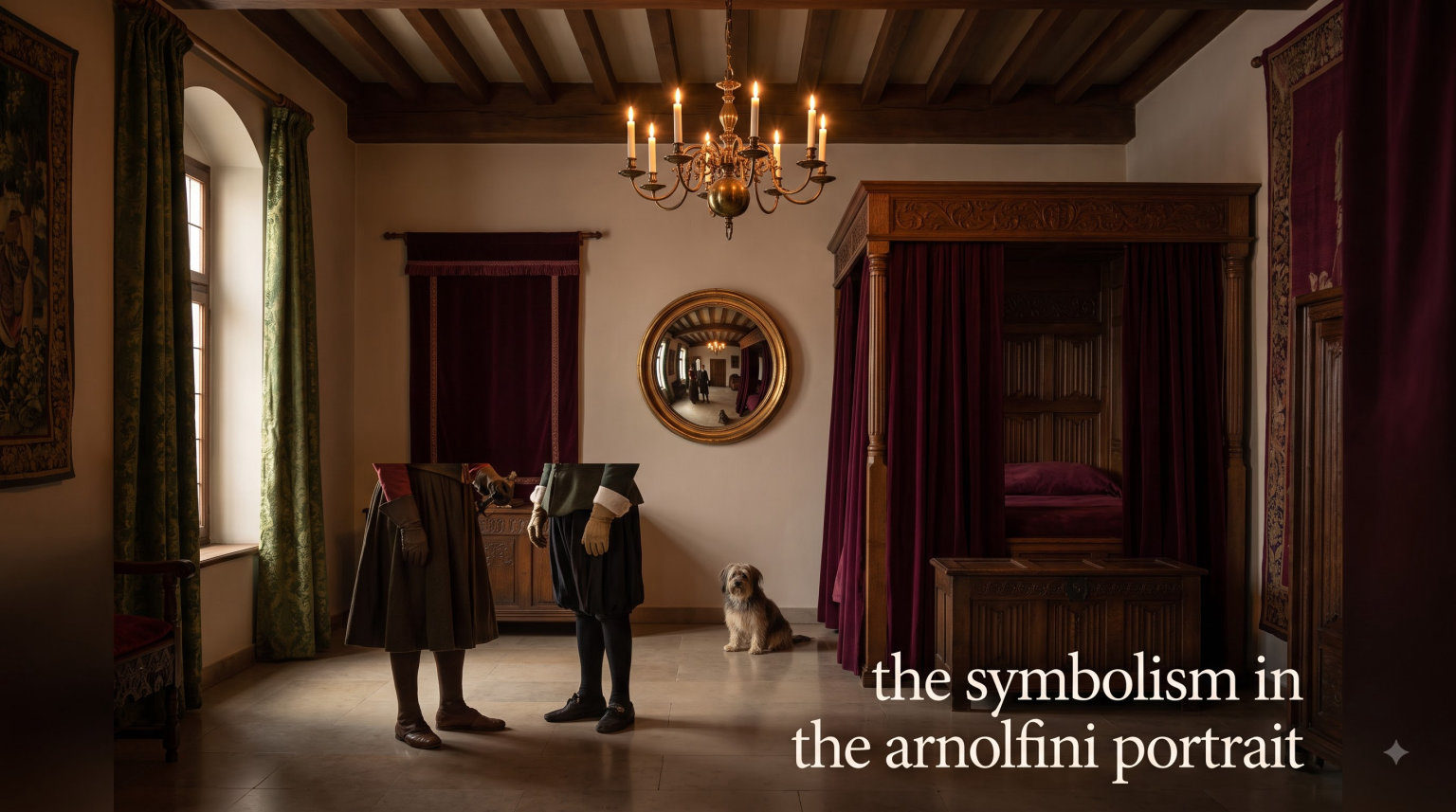
What makes this painting extraordinary is not just its technical mastery, but how van Eyck loaded every inch of canvas with meaning. The mirror, the chandelier, the dog, the oranges, the shoes left askew on the floor. Each element carries weight. Each detail speaks.
In this guide, I will walk you through every major symbol in the Arnolfini Portrait. I will explain what scholars believe each element represents, why the debates continue, and what questions you should ask yourself when looking at this remarkable painting.
Table of Contents
Historical Context of the Arnolfini Portrait
The Arnolfini Portrait was created by Jan van Eyck around 1434, during the height of the Early Netherlandish period. Van Eyck worked in Bruges, then one of the wealthiest cities in Europe, as court painter to Philip the Good, Duke of Burgundy. His technical innovations with oil paint transformed what was possible in representation, and the Arnolfini Portrait stands as one of his most ambitious achievements.
The painting depicts Giovanni Arnolfini, an Italian merchant who had relocated to Bruges, and his wife. The setting appears to be their private chamber in a Flemish city far from their native Italy. The precise date and occasion remain uncertain, which is part of what keeps scholars arguing to this day.
What we know is that van Eyck signed the painting and added a Latin inscription that translates to “Jan van Eyck was here 1434.” This statement feels like a declaration of presence, almost like an artist witnessing and recording an event. The signature hovers above a convex mirror in the background, placing the artist outside the scene he depicts.
The medium is oil on oak panel, and the dimensions are roughly 34 inches by 23 inches. Van Eyck’s mastery of the oil medium allows him to render textures with unprecedented realism: the sheen of silk, the depth of fur, the delicate structure of fruit. This technical brilliance serves the symbolic purpose. The more real the objects appear, the more weight they carry as signs.
The Subjects: Who Did van Eyck Paint?
Giovanni Arnolfini
Giovanni di Arrigo Arnolfini was an Italian merchant from Lucca who established himself in Bruges during the 1420s. He dealt in luxury goods, handling silks and other expensive textiles that appealed to the wealthy Burgundian court. His social position mirrors the kind of international commerce that made Bruges a crossroads of European culture in the 15th century.
The man in the painting wears a blue garment with fur trim, the kind of elaborate clothing that signaled wealth and status. His pose, one hand raised as if swearing an oath or offering a blessing, carries ceremonial weight. Scholars have noted that his expression seems grave, even somber, which has contributed to theories that the painting records a solemn occasion rather than a festive celebration.
The Female Subject: Costanza Trenta
The woman in the painting is generally believed to be Costanza Trenta, whom Giovanni Arnolfini married around 1420. Some scholars have challenged this identification, noting that no documents definitively confirm her as the subject. However, the name Costanza means “constancy” or “steadfastness,” and constancy would become a recurring theme in interpretations of the painting’s symbolism.
The woman wears a flowing green dress with elaborate draping, and her belly appears to bulge slightly. This has traditionally been read as a sign of pregnancy, leading some to interpret the painting as a celebration of an expected child. However, the pregnancy interpretation may be misleading. Fashion of the period featured high-waisted gowns that created volume where there was none. The apparent pregnancy may simply reflect how clothing was worn at the time.
Still, the ambiguity serves the painting well. Whether Costanza was actually pregnant or not, the visual effect creates an association with fertility, generation, and continuity that remains powerful regardless of what van Eyck originally intended.
Marriage or Memorial Portrait?
The most persistent debate about the Arnolfini Portrait concerns its purpose. Is it a wedding portrait, a contract made visible in paint? Or is it a memorial, a tribute to a wife who died in childbirth? Both interpretations have passionate advocates among art historians, and the evidence supports aspects of each.
Panofsky’s Marriage Contract Theory
The most influential interpretation comes from Erwin Panofsky, the great German art historian who wrote about the Arnolfini Portrait in 1934. Panofsky argued that the painting functions as a marriage contract. The joined hands of the couple represent the dextrarum iunctio, the traditional Roman gesture of joining right hands to seal a marriage agreement. The presence of witnesses, including the artist himself reflected in the convex mirror, would have given legal weight to the ceremony.
Panofsky saw the mirror as containing scenes from the Passion of Christ, which would add religious dimension to the contract. The single lit candle in the chandelier represented the seeing eye of God, observing and blessing the union. The dog symbolized fidelity, a common marital virtue in Renaissance art. Every element, in Panofsky’s reading, worked together to sanctify and seal the marriage.
Koster’s Memorial Portrait Theory
More recent scholarship, particularly by Patricia Koster, has offered an alternative reading. Koster and others have noted that the woman’s downward gaze and the man’s solemn expression might indicate grief rather than celebration. Some scholars believe Costanza died in childbirth in 1433, a year before the painting was made. If true, the portrait would be a memorial, a way of honoring a wife taken too soon.
This interpretation sees the oranges not as decoration but as symbols of purity and innocence, connecting to the Garden of Eden and to the hope of salvation. The mirror becomes a way of showing both the living and the dead, the present and the eternal. The signature “Jan van Eyck was here” might function as a witness statement, but for a different kind of ceremony altogether.
The memorial reading has found favor with many visitors to the National Gallery. Commenters online have noted that the painting feels “poignant” rather than celebratory, that the atmosphere is contemplative rather than joyful. Both readings may contain truth. Perhaps van Eyck himself intended multiple layers of meaning, inviting viewers to find whatever significance speaks to them.
The Mirror Symbolism in the Arnolfini Portrait
The convex mirror mounted on the back wall of the room is perhaps the most discussed element in the painting. It measures only a few inches in diameter, yet it contains an entire world. Look closely, and you will see not just the backs of Giovanni and Costanza but additional figures entering the room. The artist himself appears to be one of them, holding up his hand in a gesture of blessing or acknowledgment.
The mirror functions on multiple levels. Technically, it demonstrates van Eyck’s extraordinary ability to render reflection and space. The perspective compresses the room into a small curved surface, and the illusionistic skill required seems almost impossible. Van Eyck was showing off, and rightfully so.
Symbolically, the mirror represents several concepts. Panofsky argued that the border of the mirror depicts scenes from the Passion of Christ, though this remains disputed among scholars. Whether or not the biblical scenes are present, the mirror does reflect the entire room, suggesting a divine perspective that observes all within.
The mirror also creates a sense of double exposure. We see the couple from the front while simultaneously seeing them from behind. This duality invites us to consider what lies beneath surface appearances. The mirror asks us to look deeper, to consider what cannot be seen directly.
For modern viewers, the mirror also serves as a kind of time machine. It reflects a moment that happened nearly six centuries ago, preserving it in pigment and oil. The figures within it are frozen, eternalized, made present across decades. The painting itself becomes a mirror, reflecting a world that no longer exists but that we can still visit.
The Chandelier and Candle Symbolism
A brass chandelier hangs from the ceiling, holding nine candles. Only one candle burns. This single flame has drawn attention from every scholar who has written about the painting, and its meaning seems clear: the lit candle represents the eye of God, watching over the ceremony whatever that ceremony might have been.
In the context of 15th-century Christianity, candles carried powerful symbolism. They represented the presence of Christ as the light of the world. A single candle in an otherwise dark room could signify that God sees what happens in the private chamber, that the union has sacred significance. The candle transforms the room from a secular space into a sanctified one.
The chandelier itself would have been an expensive object, another marker of the Arnolfini household’s wealth. Van Eyck renders the brass with careful attention, giving it a warm glow that suggests candlelight even in the unlit portions. This realism serves the symbolism. The chandelier is both a real object and a sign of something greater.
One candle burning while the other eight remain dark raises questions. Some have suggested that the one lit candle indicates that this is a daytime scene, the candle present for symbolic rather than practical purposes. Others have wondered if the darkness represents mortality, the light representing hope in the face of death. Both interpretations have merit, and the ambiguity may be intentional.
What Does the Dog Symbolize?
A small brown dog appears in the lower left of the painting, looking up at the viewer or perhaps at its owners. The dog is typically read as a symbol of fidelity, representing the conjugal loyalty that should exist between husband and wife. In Renaissance art, dogs often appear in marital contexts, serving as visual pledges of mutual faithfulness.
The fidelity interpretation connects to other symbols in the painting. If the couple represents a marriage sealed before God, the dog reinforces the ideal of that union. Fidelity was considered a paramount virtue, especially for wives, and the dog serves as a visual reminder of what was expected in marriage.
Some scholars have noted that the dog might also represent the Arnolfini family’s wealth. Keeping a dog as a household pet required resources, and the small animal adds to the portrait’s display of prosperity. However, the symbolic reading seems primary. The dog appears too prominently to be mere decoration.
The dog’s placement near the woman’s feet creates a visual connection. She stands above the dog, as if the animal serves her specifically. This arrangement emphasizes her role as the keeper of fidelity within the marriage. Whether or not the dog directly symbolizes her virtue, its position reinforces her importance in the composition.
The Oranges: More Than Decoration
Oranges appear in two locations in the painting: on the windowsill and on the chest beneath the window. These fruits carry rich symbolic weight. In the context of 15th-century Europe, oranges were rare and expensive, imported from Mediterranean regions. Their presence signals wealth and the ability to obtain luxury goods from distant markets.
Beyond wealth, oranges symbolize purity and innocence. They recall the Garden of Eden, where fruit represented the innocence of humanity before the Fall. The oranges in the Arnolfini Portrait may represent the spiritual purity of the marriage, the hope that the union exists in a state of grace uncorrupted by sin.
The oranges also connect to fertility. Fruit generally symbolized fruitfulness in Renaissance art, and oranges might specifically reference the hope for children. If the painting celebrates an expected birth, the oranges would reinforce that theme. If the painting memorializes a wife, the oranges might represent her spiritual purity and her hope for resurrection.
Van Eyck painted the oranges with exceptional skill. Each fruit catches the light differently, and the textures feel almost tangible. This realism reinforces the symbolic weight. The oranges are not abstract signs but real objects imbued with meaning. Looking at them, we feel their weight and presence, and the symbolism becomes tangible rather than theoretical.
The Joined Hands Gesture
The gesture that Giovanni makes with his right hand has been analyzed extensively. His hand is raised, palm forward, as if swearing an oath or offering a blessing. The position resembles the dextrarum iunctio, the traditional joining of right hands that sealed marriage agreements in ancient Rome and continued into the Renaissance.
Scholars call this gesture fides manualis, the pledge of faith made through the hand. In a marriage context, the raised hand would symbolize the oath the couple takes to remain faithful to each other. The gesture transforms the image from a simple portrait into a ceremony made visible.
The raised hand also appears in legal and religious contexts of the period. A figure raising a hand in this way might be witnessing a contract, blessing an event, or invoking divine witness. The ambiguity of the gesture contributes to the painting’s multiple possible interpretations. Whether the occasion is a marriage or something else, the gesture signals something being sealed or confirmed.
The hand gesture connects to the mirror’s reflection. In the mirror, we see the back of Giovanni’s raised hand, confirming that this is indeed the same position from multiple angles. Van Eyck seems to be saying that the gesture is witnessed, observed, recorded from every angle. What happens in this room cannot be hidden. The divine eye sees it, the mirror captures it, and the painting preserves it.
Clothing, Wealth, and Gender Roles
The Houppelande and Ermine
Giovanni wears a long robe called a houppelande, a style popular among wealthy men of the period. The garment features fur trim, likely ermine, a luxury material that signified high status. The blue color of the robe would have been expensive to achieve in dye, and the elaborate draping suggests the wearer could afford fine tailoring.
Costanza wears a green dress with intricate folds and a train that extends onto the floor. Her hair is bound with a jeweled fillet, and she wears a separate coverchief over her head. The clothing creates volume and shape, and van Eyck renders each fabric type with precision. Silk, wool, and fur all receive individual attention.
The clothing establishes the couple as wealthy, successful, and able to participate in the consumer culture of late medieval Flanders. Displaying wealth was an important function of portraiture in this period. A painting like the Arnolfini Portrait would remind viewers of the couple’s status, reinforcing their social position even after they were gone.
Gender Dynamics in the Painting
The painting presents specific ideas about gender roles for its period. Costanza places her hand on her belly, a gesture sometimes read as pregnancy but also as simply resting her hand on her dress. Her downward gaze suggests modesty, a virtue expected of wives in 15th-century culture. She stands in the lighter portion of the room, while Giovanni occupies the darker space.
Some scholars have read these arrangements as reflecting patriarchal norms of the period. The man controls the space, initiates gestures, and appears to bless or sanctify the occasion. The woman receives rather than gives, receives blessing rather than extending it. These readings contextualize the painting within its historical moment, recognizing that the gender dynamics reflect the society that produced them.
Other scholars have noted ways that Costanza’s presence subverts or complicates these norms. She occupies significant visual space, her green dress dominating the lower portion of the composition. Her position near the bed suggests domestic authority. The interpretation of gender dynamics in the painting continues to evolve as scholars bring new perspectives to familiar questions.
The Signature and Its Meaning
Above the mirror, painted in small but legible letters, appear the words “Johannes de eyck fuit hic 1434.” This Latin translates to “Jan van Eyck was here 1434.” The inscription has puzzled viewers since the painting was made. Why would an artist sign his work with a statement of presence rather than a declaration of artistic achievement?
The most likely explanation connects to the painting’s function as a witness to an event. If the painting records a marriage ceremony, the artist’s signature would serve as testimony. He was there, he saw what happened, and his painting preserves the truth of the occasion. The signature transforms the image from a portrait into a legal document, a visual record that carries evidentiary weight.
The signature also places van Eyck within the painting. He stands reflected in the convex mirror along with other witnesses. The inscription and the reflection work together, establishing his role as both artist and observer. His hand appears raised in the mirror, perhaps blessing the event or acknowledging its significance.
Van Eyck was known for his technical innovations, and the signature may also function as a display of skill. Rendering text this small and legible in oil paint required exceptional control. The signature demonstrates van Eyck’s mastery, showing that he could do things other artists could not. Function and showing off merge, as they often do in this remarkable painting.
Technical Mastery: Van Eyck’s Oil Technique
The Arnolfini Portrait showcases the full range of van Eyck’s technical abilities. He worked in oil paint, a medium that allowed him to build up layers gradually, creating depth and luminosity impossible in tempera. His wet-on-wet glazing technique let him blend colors seamlessly, achieving transitions that look almost photographic by modern standards.
Van Eyck applied paint in thin layers, letting each dry before adding the next. This approach allowed him to create intense color saturation while maintaining detail. The reds glow, the blues deepen, and the skin tones feel alive. Light seems to emanate from the painting itself, as if the candlelight in the scene continues to burn.
Perspective receives careful attention throughout. The room is compressed into a believable space, with floor tiles receding toward a vanishing point behind the bed. The convex mirror creates an entirely different perspective, showing the scene from an angle we cannot see from our viewpoint. Van Eyck manages both perspectives without contradiction, creating a spatial logic that holds together despite its complexity.
Textures throughout demonstrate van Eyck’s obsession with material truth. The carved figure on the bedpost reads as wood. The carpet on the bed shows woven structure. The fruits on the windowsill look edible. Each texture invites touch, makes us wish we could reach into the painting and feel what van Eyck rendered. This push toward tactile realism serves his symbolic purposes. Real things carry real meaning.
Lasting Legacy of the Arnolfini Portrait
The Arnolfini Portrait has influenced generations of artists and viewers. Its approach to interior space, its use of symbolic objects, and its technical ambition set standards that echo through Western art. The painting helped establish oil paint as a major medium, proving that it could achieve effects impossible in other materials.
The work also established templates for marital portraiture that persisted for centuries. Later artists would borrow its vocabulary, adapting the gestures, objects, and compositions to new contexts. The image became a reference point, a touchstone that artists returned to repeatedly.
For modern viewers, the painting offers a window into the values and concerns of 15th-century Europe. We see how a wealthy merchant wanted to present himself and his wife, what symbols mattered to them, how they understood marriage and fidelity. The painting becomes a document as well as a work of art, preserving beliefs and practices that have since changed beyond recognition.
The continuing debates about the painting’s meaning ensure it remains alive. Each generation reinterprets the symbols, bringing new questions and new perspectives. What seemed clear to Panofsky seems less certain to later scholars, and future viewers will likely find meanings we cannot yet imagine. The Arnolfini Portrait rewards attention, invites inquiry, and refuses to give up all its secrets.
FAQs
What is the hidden symbolism in the Arnolfini portrait?
The hidden symbolism in the Arnolfini Portrait includes multiple layers of meaning. The mirror reflects divine observation of the scene. The dog symbolizes fidelity between spouses. The single lit candle represents the eye of God watching over the ceremony. The joined hands gesture (dextrarum iunctio) indicates a marriage contract or sacred oath. Oranges on the windowsill and chest represent purity, innocence, and the Garden of Eden.
What do the oranges symbolize in the Arnolfini portrait?
The oranges in the Arnolfini Portrait symbolize purity, innocence, and spiritual fertility. In Renaissance art, oranges represented the innocence of the Garden of Eden before the Fall. Their rarity and expense also indicate wealth, as imported citrus was costly in 15th-century Northern Europe.
What does the mirror symbolize in the Arnolfini Portrait?
The convex mirror in the Arnolfini Portrait symbolizes multiple concepts: divine observation of the ceremony, the presence of witnesses including the artist himself, and the eternalization of the moment. The mirror also creates a double perspective, showing both the front and back of the scene, inviting viewers to look beyond surface appearances.
What does the chandelier symbolize in the Arnolfini portrait?
The chandelier and its single lit candle symbolize the eye of God witnessing the scene. In 15th-century Christianity, candles represented the presence of Christ as light. The single burning candle among eight unlit ones transforms the domestic space into a sanctified environment, suggesting the marriage or ceremony has sacred significance.
Conclusion
The symbolism in the Arnolfini Portrait operates on multiple levels, rewarding careful study while resisting definitive interpretation. The mirror shows us reflected figures who cannot see themselves. The candle burns as witness to something we cannot quite name. The dog watches with unwavering attention, loyal to an oath we can only partially understand.
Whether you read the painting as a marriage contract, a memorial portrait, or something else entirely, the power of van Eyck’s achievement remains clear. He created a space where the material and spiritual interpenetrate, where every object carries weight and meaning. The Arnolfini household appears before us as if time had stopped, preserved in oil and oak.
Standing before the original in the National Gallery, you realize how small it is. The painting measures barely a square meter in total. Yet it contains infinity. Every glance reveals new details, new relationships, new questions. The symbolism in the Arnolfini Portrait continues to unfold, six centuries after van Eyck laid down his brush.
If you visit the painting in person, take time to look at the mirror. Study the reflection carefully. You will see figures entering the room, witnesses to whatever event van Eyck recorded. Among them, perhaps, stands the artist himself, his hand raised in acknowledgment. He was there. He saw. And through his extraordinary skill, we can still see what he saw.