
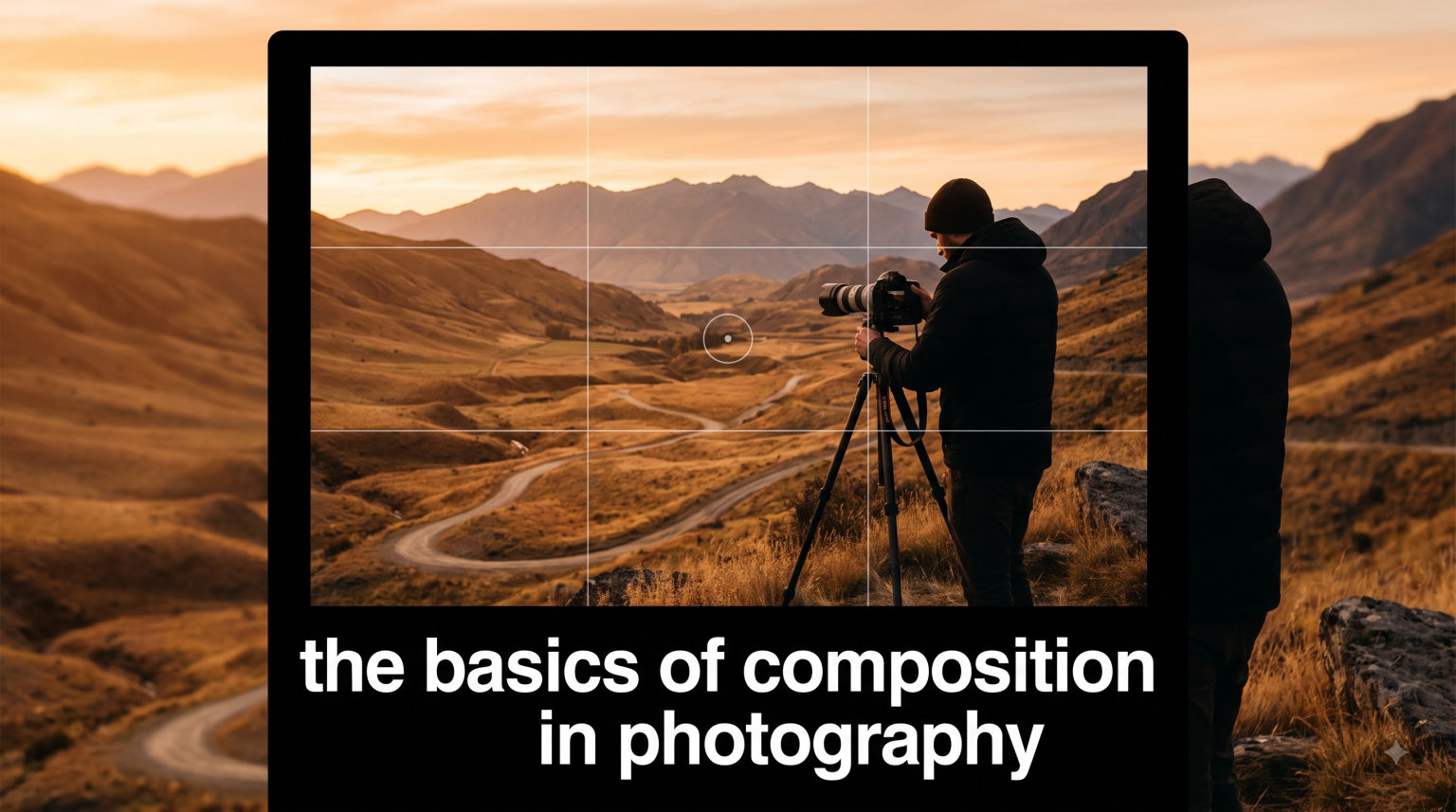
When I first picked up a camera, I thought the equipment was everything. Bigger lens, better camera, more megapixels. It took me years to realize that the real difference between snapshot and photograph lived in something far less tangible: composition. Understanding the basics of composition in photography transformed how I see the world through my viewfinder.
This guide walks you through the fundamental principles that underpin every compelling image. Whether you are just starting out or looking to solidify your foundation, these concepts will give you a framework for making intentional creative decisions. Photography composition is not about following rules rigidly. It is about understanding why certain arrangements feel right and learning to use them purposefully.
Table of Contents
What Is Composition in Photography?
Composition in photography refers to how you arrange the visual elements within your frame. It is the structure of your image, the way subjects, shapes, lines, and colors work together to create a cohesive photograph. A well-composed image guides the viewer’s eye naturally toward your focal point while creating visual interest and balance.
At its core, composition is about intentionality. Every element in your photograph either contributes to your message or distracts from it. When we talk about learning composition, we are really learning to see the potential in any scene. We train our eyes to notice relationships between objects, the flow of lines, and the weight of shapes. This skill develops over time, and it starts with understanding a few key principles.
Our team has spent hundreds of hours analyzing photographs that work and those that do not. The difference rarely comes down to expensive gear or perfect lighting. Instead, it comes down to whether the photographer understood how to arrange the elements in front of them. You can apply these fundamentals with any camera, any subject, in any lighting condition.
The Rule of Thirds: Your Foundation
The rule of thirds is probably the most well-known composition principle, and for good reason. It provides a simple framework that immediately improves most photographs. Imagine dividing your frame into a grid of nine equal sections using two horizontal and two vertical lines. The theory suggests placing your main subject or points of visual interest along these lines, or preferably at the intersection points, called power points.
Why does this work? Placing your subject dead center often creates static, uninteresting images. The rule of thirds creates visual tension and movement because it avoids perfect symmetry. Your eye naturally travels along those grid lines and settles on the intersection points. This creates a more dynamic, engaging experience for the viewer.
How to Apply the Rule of Thirds
Most cameras and smartphones can display a rule of thirds grid overlay in their viewfinder or on the LCD screen. Turn this on as you start learning. Position your primary subject near one of the four intersection points. For landscapes, consider placing the horizon along the upper or lower third line rather than through the middle.
The key is experimentation. Once you understand the basic idea, start noticing when breaking this rule serves your image better. Sometimes centering a subject creates exactly the symmetry you want. But for most situations, the rule of thirds gives you a reliable starting point that produces stronger results than arbitrary placement.
Balance and Symmetry
Balance in photography refers to the distribution of visual weight within your frame. Visual weight is how much attention an element draws relative to other elements. Large objects, bright colors, sharp contrast, and detailed textures all carry more visual weight than smaller, muted, or simple elements. A balanced composition feels stable and complete, while an unbalanced one can create tension or unease that either serves or undermines your intent.
Symmetrical Balance
Symmetrical balance occurs when elements on either side of a central axis mirror each other. This approach creates formality, order, and sometimes a sense of grandeur. Architecture lends itself naturally to symmetrical compositions. Reflections in water provide perfect symmetrical opportunities. Portraits with centered subjects and symmetrical backgrounds also achieve this balance naturally.
Symmetry feels harmonious and pleasing. It can also feel static if overused. Use symmetrical balance when you want to convey calm, stability, or elegance. A perfectly centered church aisle or a reflection in a still lake creates that dignified, ordered feeling that symmetry provides.
Asymmetrical Balance
Asymmetrical balance achieves equilibrium through unequal but visually equivalent elements. A small bright object on one side can balance a larger dark area on the other. A detailed texture can balance a solid color. This type of balance creates more dynamic, interesting images because it introduces visual tension that draws the eye through the frame.
Asymmetrical balance often feels more natural in street photography and documentary work. A large empty space on one side of your photograph can balance a small but visually heavy subject on the other. Learning to see these relationships takes practice, but it opens up more creative possibilities than relying solely on symmetry.
Leading Lines
Leading lines are one of the most powerful tools in photography composition. These are lines within your frame that guide the viewer’s eye toward your main subject or through the image. They create visual flow and can transform a flat, uninteresting photograph into one with depth and direction.
Natural leading lines appear everywhere once you learn to see them. Roads, fences, rivers, shadows, architectural elements, and even взгляд patterns can serve as leading lines. The key is identifying lines that point toward your subject and using them to direct attention.
Types of Leading Lines
Horizontal lines create a sense of calm and stability. They work well for landscapes and seascapes, suggesting vastness and continuity. Vertical lines suggest power, growth, and strength. They appear naturally in trees, buildings, and portraits. Diagonal lines introduce energy and movement. They create dynamic tension and work particularly well for action and sports photography.
Converging lines, where parallel lines appear to meet in the distance, create strong depth and perspective. Railway tracks stretching toward the horizon exemplify this technique. These lines draw the viewer into the image, creating a three-dimensional feel on a two-dimensional surface. Always look for lines in your scene and consider how they interact with your subject.
Positive and Negative Space
Understanding positive and negative space separates amateur photographs from intentional compositions. Positive space is the area occupied by your main subject. Negative space is the empty or open area surrounding it. Mastering the relationship between these two spaces gives you powerful control over the emotional impact of your images.
Negative space is not simply empty background. It provides breathing room that allows your subject to stand out. It creates visual separation and can suggest context about environment and scale. A single figure in a vast empty beach has a different feeling than that same figure surrounded by crowds. The negative space communicates the story.
Using negative space intentionally requires discipline. Beginners tend to fill every inch of the frame, afraid of wasted space. But empty space often communicates more effectively than crowded compositions. It draws attention to your subject, creates mood, and provides visual rest for the viewer. Learning to embrace negative space is one of the biggest breakthroughs in developing your compositional eye.
Framing Within Frame
Framing within frame is a technique where natural or architectural elements create a frame around your subject. This approach does several things simultaneously. It draws attention to your focal point by surrounding it with a visual boundary. It adds depth to your image by creating layers, a foreground frame and the main subject beyond. It also provides context, showing where and in what environment your subject exists.
Doorways, windows, arches, and tree branches all make excellent natural frames. Even shadows can frame subjects effectively. The frame does not need to surround the entire subject. Partial framing on one or two sides often works better than complete containment. The goal is to use environmental elements to enhance focus on your subject rather than distract from it.
Depth and Perspective
Two-dimensional photographs can feel flat and lifeless without careful attention to depth. Creating a sense of three-dimensional space involves managing layers within your image. The three primary layers are foreground, middle ground, and background. Including elements in all three layers creates dimension and draws the viewer into the scene.
Foreground elements anchor the viewer in the space. They provide a starting point for the eye and establish scale. A rock in the immediate foreground of a landscape gives a sense of proximity and presence. Without such foreground interest, landscapes can feel disconnected and abstract.
Middle ground provides the main subject and most of the compositional interest. Background elements establish context and atmosphere. They show location and provide environmental clues. Playing with perspective through wide-angle and telephoto lenses changes how these layers interact. Wide-angle lenses exaggerate distances and make foreground elements more prominent. Telephoto lenses compress layers, creating flatter, more abstract interpretations of depth.
Simplicity and Intentional Composition
One of the hardest lessons in photography is learning to simplify. Every element in your frame should earn its place. When we analyze photographs that fail, the most common problem is clutter. Too many competing elements confuse the viewer and dilute the message. Simplicity forces clarity of intent.
Intentional composition means knowing exactly why each element is present. You place something in the frame because it serves your message. Something else is excluded because it would distract from that message. This does not mean photographs must be minimal or empty. Complex scenes can work beautifully when all elements work together toward a unified purpose. But even complex compositions require intention and editing.
When you approach a scene, ask yourself what the photograph is about. If you cannot answer that question clearly, the composition likely needs refinement. Move your position, change your focal length, adjust your framing. Remove distracting elements or wait for them to move. The goal is a cohesive image where nothing contradicts your intended message. Simplicity is not about less content. It is about more clarity.
Practice Exercises for Beginners
Understanding composition concepts means nothing without practice. I have found that focused, deliberate exercises accelerate learning more than passive reading ever could. Photography Reddit communities consistently emphasize that intentional practice beats passive consumption. Here are exercises I recommend based on feedback from photographers who have developed their eyes through structured practice.
First, spend one week photographing using only the rule of thirds. Place every subject along grid lines or at intersection points. Do not break this rule for seven days. At the end of the week, review your images and notice how your sense of placement has developed. This foundational exercise trains your eye to naturally consider position within the frame.
Second, choose one compositional element per week to focus on. Week one: leading lines. Week two: negative space. Week three: symmetry versus asymmetry. Week four: framing within frame. Photograph with conscious attention to that single element. Review your results and identify what worked and what did not. This focused approach, suggested by experienced photographers in online communities, creates measurable improvement faster than unfocused practice.
Third, analyze your own photographs critically. Do not simply look at them. Identify exactly what works and what does not. If something distracts, name why. If the composition feels unbalanced, identify where the visual weight sits. Look at your photos, identify one composition issue, focus on that for a week or two. This iterative self-critique develops the analytical eye that separates consistent photographers from occasional shooters.
Fourth, experiment with breaking rules intentionally. Once you understand why a rule works, you can purposefully break it when doing so serves your image. Rules exist to guide, not to constrain. Knowing when symmetry beats asymmetry, when centering trumps rule of thirds, requires understanding the principles deeply enough to bend them consciously.
Get low, get high, find unique angles. Anything which is not the normal eye-height straight on will create a more dynamic image. Challenge yourself to photograph familiar subjects from unusual perspectives. Lie on the ground. Climb on furniture. Shoot from above. These varied viewpoints train you to see beyond the obvious and develop the compositional versatility that marks advanced photographers.
FAQs
What is composition in photography for beginners?
Composition in photography is how you arrange visual elements within your frame to create a cohesive, intentional image. For beginners, it starts with understanding simple principles like the rule of thirds, balancing visual weight, and using leading lines to guide the viewer’s eye toward your focal point.
What are the basic rules of composition in photography?
The fundamental rules include the rule of thirds, which guides subject placement along grid intersections. Balance and symmetry help distribute visual weight. Leading lines direct attention. Positive and negative space create breathing room. Framing within frame adds depth and focus. These rules work together to create structured, intentional compositions.
How do you master composition in photography?
Mastering composition requires deliberate practice over passive reading. Focus on one technique per week, photographing with conscious attention to that element. Analyze your own work critically, identifying what works and what does not. Experiment with breaking rules once you understand why they work. Get unusual angles and perspectives to expand your visual vocabulary.
What is one tip about composition you would give to beginners?
Learn to see negative space. Beginners fill every inch of the frame, but empty space often communicates more effectively than crowded compositions. Start looking for opportunities to isolate your subject with breathing room around it. This single shift will dramatically improve your photographs.
Bringing It All Together
Composition in photography is both technical skill and artistic vision. The basics of composition in photography give you a framework for making decisions, but the magic happens when you internalize these principles so thoroughly they become instinctive. You stop thinking about the rule of thirds and start seeing the natural grid in every scene. You notice leading lines without searching for them. Negative space stops feeling like wasted space and starts feeling like intentional breathing room.
The photographers who develop the strongest compositions approach their work with intention. They know why they placed every element and why they excluded others. They understand the emotional message they want to convey and use compositional tools to achieve that effect. This intentionality develops through practice, through analyzing your own work, and through understanding the principles deeply enough to break them purposefully.
Start with the fundamentals outlined in this guide. Practice deliberately, focusing on one technique at a time. Review your work critically and honestly. Share your images and ask for specific feedback. Join communities where photographers discuss composition openly. These interactions accelerate learning in ways that reading alone cannot match.
Once you have the basics down, you can experiment. There are no set rules for how you should shoot anything. The principles exist to serve your vision, not to limit it. Use them as guides while you develop your own style. The goal is not to produce identical images to everyone else following the same rules. The goal is to develop your own compositional voice that uses these tools to express your unique perspective. For more on visual principles that apply across art forms, explore our guide on curatorial composition principles that bridge photography and gallery display.