
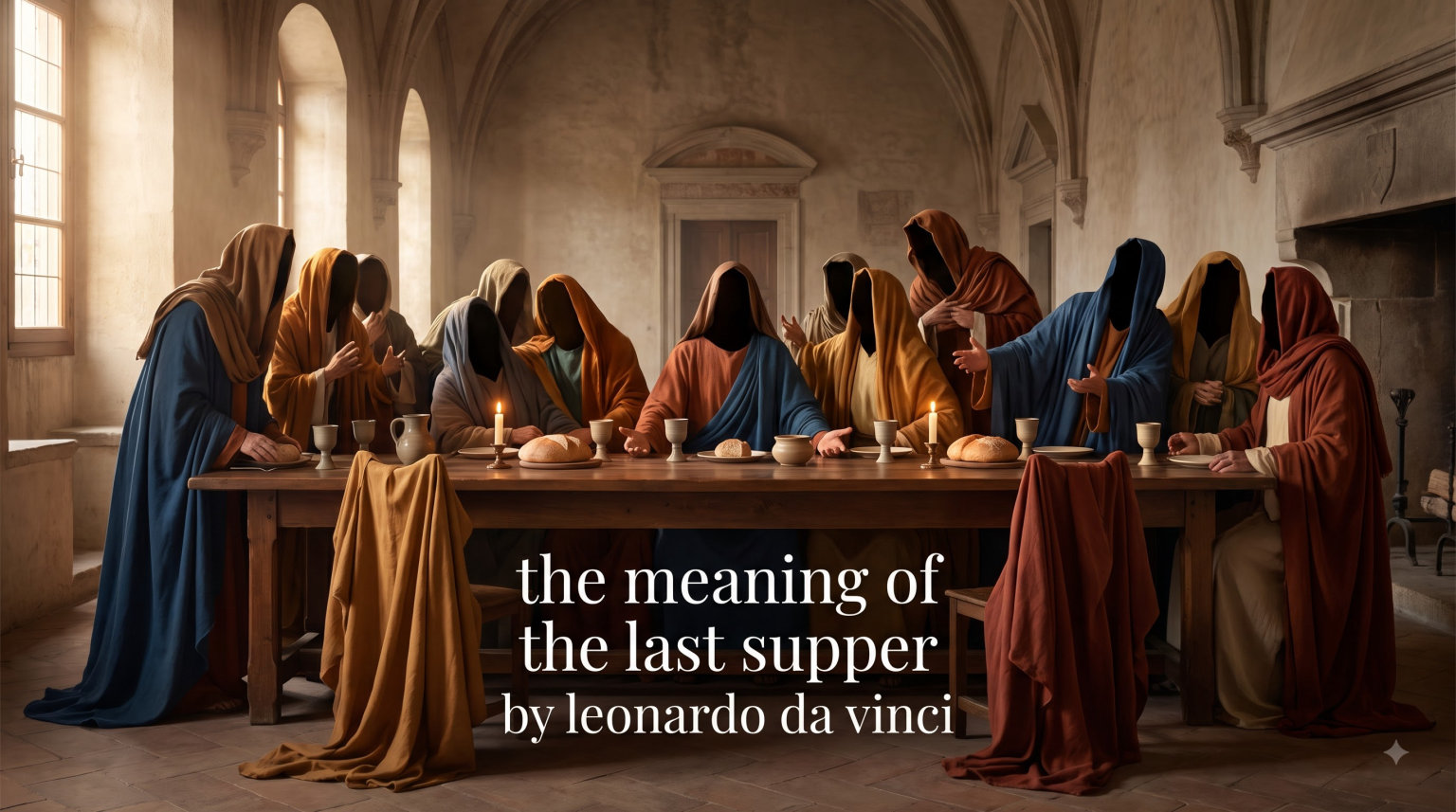
When I first stood before Leonardo da Vinci’s The Last Supper at the Santa Maria delle Grazie monastery in Milan, the crowd pressing around me faded into silence. There is something almost overwhelming about this painting that transcends its damaged state and centuries of restoration. The image of Christ and his twelve apostles frozen mid-conversation above a simple meal has captivated viewers for over five hundred years. But what does this Renaissance masterpiece actually mean? I spent months researching and analyzing this painting to understand its full significance.
Table of Contents
The Historical Context of The Last Supper
Duke Ludovico Sforza of Milan commissioned The Last Supper in 1495, and Leonardo completed it in 1498. This was a period of intense political maneuvering in northern Italy, and the Duke wanted a work that would celebrate both his patronage and the religious devotion of his court. Leonardo worked on the mural in the refectory (dining hall) of the Santa Maria delle Grazie monastery, a location that meant the painting would be seen daily by Dominican friars during their meals.
The timing of this commission coincided with a particularly turbulent era in Italian politics. Ludovico had just seized power in Milan, and he needed art that would legitimize his rule while appealing to the Catholic Church. The Last Supper became not just a religious image but a statement about divine order and the proper relationship between ruler and subjects. We can still see the subtle ways Leonardo embedded these themes in the composition today.
Unlike most artists who painted the Last Supper as a fresco, Leonardo chose to work with tempera on dry plaster. This experimental technique would ultimately contribute to the painting’s rapid deterioration, but it allowed Leonardo to achieve effects impossible in true fresco. The monks who dined beneath this painting for centuries understood they were witnessing something revolutionary in artistic technique as well as devotion.
The Moment Depicted: Announcement of Betrayal
The painting captures the exact moment described in the Gospel of John when Jesus announces that one of his twelve apostles will betray him. “Truly, truly, I say to you, one of you will betray me,” Jesus declares, and the reaction of each disciple becomes the focus of Leonardo’s composition. This is not a peaceful meal but the most emotionally charged moment in the story of Christ’s final days.
What makes Leonardo’s interpretation so powerful is his choice to freeze this moment rather than show its aftermath. Each apostle responds differently to the shocking announcement, creating a symphony of human emotion that viewers can read in their faces and gestures. The tension in the room becomes almost tangible as each man grapples with the possibility that he might be the betrayer or that someone he loves might commit this ultimate treachery.
This moment represents the founding of the Eucharist in Catholic theology. When Jesus takes bread and wine and asks his disciples to eat in remembrance of him, he institutes the sacred ritual that would become central to Christian worship. Leonardo chose to depict the announcement of betrayal because it creates the necessary dramatic tension that makes the institution of the Eucharist meaningful. Without the betrayal, there would be no need for the sacrificial death that the Eucharist commemorates.
Christ’s Central Composition and Triangular Design
Christ sits at the absolute center of The Last Supper, but what makes this composition extraordinary is how Leonardo uses triangular positioning to give Christ a sense of perfect stability. The apostles cluster around him in groups of three and four, yet none of them obscure or compete with his central presence. His figure forms the apex of an invisible pyramid that draws the eye and holds the composition together.
This triangular arrangement was revolutionary for its time. Most earlier Last Supper depictions showed apostles arranged in rigid rows or sitting in a straight line. Leonardo created dynamic movement within geometric order, allowing each apostle to have distinct emotional reactions while still maintaining overall harmony. The tension between individual expression and collective unity mirrors the theological themes of betrayal and fellowship.
The placement of Christ’s hands also carries symbolic weight. His palms face downward in a gesture of acceptance and blessing, rather than the demanding pose that might suggest he seeks to control the situation. This openness reflects his divine knowledge of what is to come and his willingness to accept the Father’s will. The apostles around him reach toward him or clutch their hands to their chests in gestures of shock and denial.
One-Point Perspective and the Vanishing Point
Leonardo employed one-point perspective to extraordinary effect in The Last Supper, creating a vanishing point that lies directly at the center of Christ’s head. All the lines in the painting’s architecture converge toward this single point, drawing the viewer’s eye inward and upward to the figure of Christ. This technique makes the painting feel like a window into another space, with Christ at the threshold between earthly and divine realms.
The orthogonals (diagonal lines) that create this perspective extend from the coffered ceiling, the windows in the back wall, and the edges of the table. When I first learned to analyze perspective in art, I was struck by how Leonardo used this mathematical technique to reinforce religious meaning. The converging lines pull us toward Christ not just visually but spiritually, as if the very structure of the painted world is organized around his presence.
What makes this particularly clever is how perspective serves the narrative. As your eye moves from the periphery toward the center, you pass through the emotional chaos of the apostles’ reactions. The journey from confusion and anger at the edges to the perfect peace at the center mirrors the spiritual journey a believer makes toward divine understanding. The perspective does not merely create illusionistic depth; it creates a path for contemplation.
The 12 Apostles: Identifying Each Figure
Identifying each apostle in The Last Supper has fascinated scholars and visitors for centuries. From left to right, the traditional identifications are: Bartholomew, James the Less (also called James son of Alphaeus), Andrew, Peter, Judas Iscariot, John, Jesus, Thomas, James the Greater, Philip, Matthew, and Thaddaeus (also called Jude). Each figure has distinctive features and gestures that Leonardo used to communicate their personalities as known from Gospel accounts.
The apostles divide into natural groupings that create rhythm in the composition. On Christ’s left, Bartholomew, James the Less, and Andrew form one cluster. Peter and Judas lean toward the right side of the group near Christ. On Christ’s right, Thomas, James the Greater, and Philip react together, while Matthew, Thaddaeus, and Andrew occupy the far right. This arrangement creates visual interest while allowing Leonardo to show how the apostles might naturally have been sitting together.
Peter’s aggressive gesture toward John has become one of the painting’s most recognizable details. The elderly fisherman appears to be rising from his seat and reaching across Judas toward John, perhaps whispering the question that Gospel accounts attribute to him. The interaction between these three figures creates a small drama within the larger scene that reveals Leonardo’s understanding of how people behave when shocked or frightened.
Judas Iscariot: Placement and Symbolism
Judas Iscariot occupies a unique position in The Last Supper that Leonardo crafted with deliberate symbolic intent. Rather than being physically separated from the other apostles, Judas remains part of the group, leaning forward with his elbow on the table. However, the angle of his body and his position in shadow distinguish him from the others. He is both inside and outside the fellowship he is about to betray.
The small money bag tucked in Judas’s belt has become his most recognizable attribute in art history, but Leonardo’s treatment is subtle compared to earlier depictions. The bag is visible but not obtrusive, requiring careful observation to notice. This restraint reflects Leonardo’s psychological approach to characterization. Rather than making Judas visually monstrous, he shows us a man whose guilt manifests in body language and facial expression more than in obvious symbols.
Judas’s pose of leaning forward with his hand clutching a piece of bread has also generated interpretation. He reaches for the same bread that Christ offers to all the disciples, creating a devastating parallel between the sacrament of communion and the act of betrayal. In the moment of institution, Judas accepts the bread while planning his treachery. Leonardo understood that the most horrifying aspect of betrayal is how normal the betrayer appears until the moment of revelation.
Psychological and Emotional Reactions
What set Leonardo’s Last Supper apart from all predecessors was its psychological depth. Each apostle reacts differently to Jesus’s announcement, creating a gallery of human emotional responses that viewers can read and relate to even without biblical knowledge. Some clutch their hands to their chests in alarm, others raise their hands in protest, and still others turn to their neighbors in confusion.
The variety of reactions reflects Leonardo’s careful study of human nature. He observed how people genuinely respond to shocking news and translated those observations into the faces and gestures of the apostles. Andrew raises both hands in a gesture of astonishment that seems almost comical in its exaggerated surprise. Matthew turns to Thomas with what appears to be a question in his gesture, creating a small narrative between these two disciples about what they have just heard.
These psychological reactions serve both artistic and theological purposes. Artistically, they create movement and interest that draw viewers deeper into the scene. Theologically, they demonstrate that the announcement of betrayal is genuinely shocking, disrupting the peace of what should be a celebratory meal. The varied responses also show that each apostle is an individual with distinct personality, making their subsequent choices in the Passion narrative more meaningful.
Artistic Technique: Why Leonardo Chose Tempera on Plaster
Leonardo’s choice to work with tempera on dry plaster rather than traditional fresco has puzzled art historians for centuries. True fresco requires painting onto wet plaster while minerals in the plaster bind the pigment, creating a durable surface that becomes part of the wall. Leonardo’s experimental technique involved applying pigment to dry plaster, which allowed him to blend colors gradually and achieve the subtle transitions impossible in true fresco.
The problem with this approach became apparent within a few decades of the painting’s completion. The tempera did not bond properly with the plaster, and the mural began to flake and deteriorate. Addicts, moisture, and poor ventilation all contributed to the damage over centuries. By the mid-sixteenth century, observers noted that the painting was already in poor condition, and various restoration attempts followed with mixed results.
The major restoration project completed in 1999 took over twenty years and revealed details that had been invisible for generations. The conservators discovered that Leonardo had actually used a technique closer to oil painting than traditional tempera, grinding his pigments with linseed oil and applying them in extremely thin layers. This experimental approach, which gave the painting its remarkable depth and luminosity, ultimately contributed to its fragility. The restoration revealed colors that surprised experts, including a vivid blue in Christ’s robe that had been hidden under centuries of grime.
Hidden Symbolism and Da Vinci’s Secrets
Various theories about hidden symbols in The Last Supper have circulated for decades, most notably through Dan Brown’s novel The Da Vinci Code. One popular claim suggests that the figure to Mary’s right in the painting is not John but Mary Magdalene, based on supposedly feminine features and a lower vantage point. However, art historians overwhelmingly reject this interpretation. The figure is consistently identified as John in historical documents from Leonardo’s era, and the feminine appearance reflects Leonardo’s general approach to depicting youthful, delicate features.
The spilled salt container near Judas’s elbow has generated various interpretations, with some claiming it symbolizes bad luck or the impending betrayal. However, salt spillages were common in Renaissance dining, and the container’s position near Judas may simply reflect practical placement rather than symbolic intent. Some later interpreters have found musical notes in the painting’s proportions, suggesting Leonardo encoded a sacred melody, though this remains speculative and not widely accepted among scholars.
Leonardo’s omission of halos from the figures represents a significant symbolic choice. In medieval art, halos clearly distinguished sacred from profane figures. By painting the apostles and Christ without these traditional markers, Leonardo emphasized their humanity rather than their divinity. This was consistent with Renaissance artistic philosophy, which sought to portray the divine through naturalistic human forms rather than through symbolic conventions. Christ’s divinity instead reveals itself through his composed posture and central positioning.
Religious and Eucharistic Significance
For Catholic viewers in Leonardo’s era, The Last Supper represented the moment of institution for the Eucharist, the sacrament that lies at the center of Christian worship. The bread and wine on the table are the literal body and blood of Christ, transformed through the words of consecration that Jesus speaks in the narrative. Leonardo depicts the moment just before this transformation, when the disciples still see only ordinary food.
The theological significance of this moment extends beyond the ritual itself. When Jesus announces his betrayal, he also predicts his death, which will become the sacrifice that the Eucharist commemorates. The betrayal is thus necessary for the Atonement that Christians believe redeems humanity from sin. In this light, Judas’s treachery becomes part of God’s plan rather than merely a human crime. Leonardo captures this terrible paradox in the frozen instant of the announcement.
The painting also references the Trinity through compositional elements. God the Father is not visibly depicted, but the coffered ceiling with its three-part divisions and the three windows behind Christ have been interpreted as Trinitarian symbols. The blue of Christ’s robe traditionally represents the divine, while the warmer reds and browns of the apostles suggest their humanity. These color choices reinforce the theological message that Christ stands between heaven and earth, mediating between divine and human realms.
Frequently Asked Questions
What is the meaning of the Last Supper by Leonardo da Vinci?
The painting depicts the moment when Jesus announces to his twelve apostles that one of them will betray him, as described in the Gospel of John. Leonardo captured this dramatic instant to show each apostle’s emotional reaction, creating a psychological study of human responses to shocking news. The painting also commemorates the institution of the Eucharist, the Christian sacrament of bread and wine representing Christ’s body and blood.
Was Leonardo da Vinci LGBTQ?
Historical records provide no definitive evidence about Leonardo’s sexual orientation. Some scholars have interpreted certain aspects of his personal life and works as suggesting he may have had relationships with men, while others argue the evidence is too ambiguous to draw conclusions. What we know is that Leonardo never married and lived most of his life in male-dominated environments where close emotional bonds between men were common and not necessarily viewed as unusual.
What is the message behind the Last Supper?
The primary message concerns the announcement of betrayal and its consequences. By depicting this specific moment, Leonardo emphasizes themes of loyalty and treachery, faith and doubt, and the human capacity for both virtue and sin. The painting also communicates the theological significance of Christ’s impending sacrifice and the establishment of the Eucharist as a memorial of that sacrifice.
Did Leonardo da Vinci believe in Jesus?
Leonardo lived and worked in a society where Catholic Christianity was ubiquitous, and his commissions came primarily from religious institutions. His personal beliefs remain a matter of scholarly debate, but his works generally reflect conventional Christian iconography. Some scholars note that his religious works show deep theological understanding, suggesting personal engagement with faith, while others point to his scientific approach to representation as suggesting a more rationalistic worldview.
What is the hidden symbolism in the Last Supper?
The most significant symbolic choices include Christ’s central positioning and triangular composition, which establish his spiritual authority. The one-point perspective with its vanishing point at Christ’s head draws viewers toward him both visually and spiritually. Judas’s placement in shadow and his money bag distinguish him from the other apostles. Leonardo also omitted traditional halos, emphasizing the humanity of the figures while using composition and color to suggest their sacred roles.
Conclusion
Standing before The Last Supper today, visitors see a painting that has survived wars, neglect, and imperfect restoration attempts. Yet what Leonardo created in that Milanese monastery remains legible after five centuries. The psychological drama he depicted continues to move viewers who may know nothing of Renaissance art or Catholic theology. That accessibility is part of the painting’s genius. On the simplest level, we see people reacting to shocking news. On deeper levels, we discover layers of meaning that reward sustained contemplation.
Leonardo combined artistic innovation with theological sophistication in ways that had never been attempted before. His use of perspective to direct spiritual attention, his psychological understanding of human emotional responses, and his technical experiments with painting materials all served a higher purpose. The Last Supper was meant to teach viewers about faith, betrayal, sacrifice, and redemption. That it continues to fulfill this purpose in the age of mass tourism and digital reproduction is a testament to its enduring power as both art and religious expression.
If you visit the Santa Maria delle Grazie monastery today, you will see a painting that requires careful viewing in controlled lighting. The colors have faded, and damage has claimed some details. But the essential meaning remains visible in Leonardo’s masterful composition. Christ at the center, surrounded by his grieving and confused apostles, awaits his fate with a composure that we can still recognize as divine. That recognition is what The Last Supper has meant for over five hundred years, and what it will continue to mean for generations to come.