
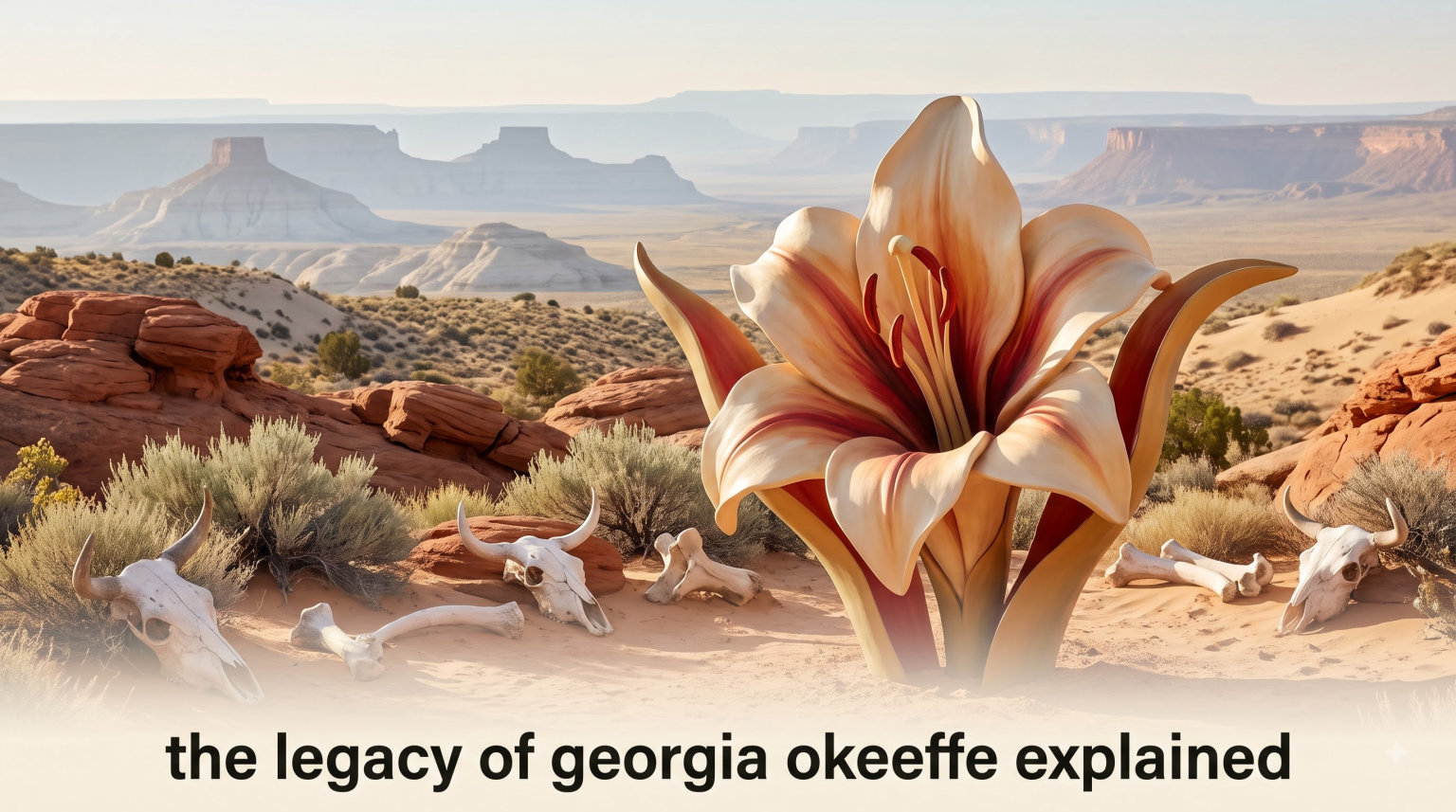
Georgia O’Keeffe stands as one of the most significant figures in American art history. Called the Mother of American Modernism, she earned international recognition for her bold flower paintings and striking desert landscapes. Her career spanned nearly seven decades, beginning in the early twentieth century and continuing into the 1980s. Her work fundamentally reshaped how Americans understood art, artistic expression, and the role of women in creative fields. The legacy of Georgia O’Keeffe continues to influence contemporary artists, museum collections worldwide, and the broader cultural conversation about pioneering female artists who broke barriers in a male-dominated field.
Table of Contents
Early Life and Artistic Formation
Georgia O’Keeffe was born on November 15, 1887, on a farm in Wisconsin, the second of seven children in a farming family. From an early age, she showed a natural talent for drawing and painting that her family actively encouraged. Her father, a farmer and businessman, supported her artistic pursuits even when family finances were tight. This early encouragement planted the seeds for what would become one of the most remarkable careers in American art history.
After completing high school in Wisconsin, O’Keeffe attended the School of the Art Institute of Chicago in 1900. The institution provided rigorous training in traditional techniques, but she found the curriculum limiting and somewhat formulaic. She then moved to New York City in 1907 to study at the Art Students League, where she learned from prominent instructors. However, the formal academic approach left her deeply unsatisfied. She believed there was something more meaningful she needed to express through her art.
O’Keeffe made the difficult decision to leave formal art education behind in 1912. She took a teaching position in Texas, which gave her the solitude she craved. During her time in Texas, she began experimenting with abstract charcoal drawings that expressed pure emotion and idea. She created a series of radical abstract works, magnified to fill entire sheets of paper, that explored form and line in ways she had never been taught. She later described this period as a time when she discovered herself as an artist.
In 1915, O’Keeffe sent these abstract drawings to a friend in New York, who in turn showed them to Alfred Stieglitz, a pioneering photographer and owner of Gallery 291. When Stieglitz saw these works, he recognized immediately that he was looking at the work of a genuinely revolutionary artist. He exhibited her drawings at his gallery without her knowledge or permission. This exhibition marked the beginning of a relationship that would transform both O’Keeffe’s career and American art history.
Breakthrough to Modernism
The meeting between Georgia O’Keeffe and Alfred Stieglitz in 1916 proved transformative for American art. Stieglitz owned Gallery 291 in Manhattan, which had already introduced Americans to European avant-garde artists like Picasso, Matisse, and Rodin through exhibitions and his photographic journal Camera Work. When he encountered O’Keeffe’s abstract charcoal drawings, he understood immediately that American art was about to change. He began corresponding with her regularly, and his enthusiasm for her work convinced her to return to New York.
Stieglitz’s gallery became the venue for O’Keeffe’s first solo exhibition in 1917, displaying her abstract charcoal drawings. Their professional relationship quickly evolved into a personal one, and despite considerable age difference and complicated circumstances, they married in 1924. Their marriage would be tested by Stieglitz’s difficult personality, his relationship with other women, and his struggles with depression. Despite these challenges, their partnership propelled O’Keeffe into the center of the New York art scene during one of its most dynamic and creative periods.
During her New York years, O’Keeffe painted the urban landscape that surrounded her. She created iconic images of Manhattan skyscrapers rendered in her distinctive style of precisionism, using bold colors and simplified forms that transformed the buildings into something both familiar and entirely new. Her oil paintings from this period show buildings as abstract shapes rising from the city grid, their windows becoming patterns of light and color rather than architectural details. These works established her reputation as a modernist painter who could find extraordinary beauty in industrial subjects while maintaining her unique artistic vision.
Her paintings of flowers from the 1920s represented another breakthrough. She began painting flowers magnified to enormous scale, filling canvases so that a single bloom became a landscape unto itself. These flower paintings had never been attempted before at such scale and with such intensity of color. The magnified flowers forced viewers to see familiar subjects in entirely new ways, noticing details invisible to the naked eye and experiencing the vivid colors and forms that O’Keeffe found so compelling about nature.
The art world at that time was almost entirely male-dominated. Galleries, museums, and critical publications were controlled by men who determined what constituted serious art. Female artists were largely excluded from major exhibitions and were often dismissed as incapable of truly significant artistic achievement. O’Keeffe’s success was therefore not just artistic but also revolutionary from a social perspective. She became one of the first women to achieve major recognition in the American art establishment, paving the way for future generations of female artists who would follow her lead into exhibitions, museums, and critical discourse.
New Mexico and Desert Imagery
In 1929, O’Keeffe traveled to New Mexico for the first time and immediately felt a deep, almost spiritual connection to the landscape. The vast desert vistas, with their distinctive vermillion and orange rock formations, endless blue skies, and bleached bones scattered across the terrain, spoke to her artistic sensibilities in ways that the urban environment could no longer sustain. She found in the Southwest a landscape that matched her inner vision of art and nature in harmony.
She began dividing her time between New York and New Mexico, spending summers at various locations throughout the Southwest. Eventually, in 1949, she moved to New Mexico permanently, establishing her home at Ghost Ranch, a former cattle ranch north of Santa Fe. The dramatic landscape surrounding Ghost Ranch, with its towering cliffs and striated rock walls, provided endless inspiration for her painting for the remaining decades of her life.
The New Mexico period produced some of her most distinctive and celebrated work. She painted the red and orange hills surrounding her Ghost Ranch home, capturing their ever-changing colors under different lighting conditions. Her desert landscapes stripped away unnecessary details, reducing the vast terrain to essential forms and bold color fields that filled the canvas completely. These paintings demonstrated her remarkable ability to find abstraction within representational subjects, a hallmark of her mature style that distinguished her from contemporaries.
O’Keeffe became fascinated with the bones and skulls she found during hikes across the desert landscape. She collected them during her explorations and incorporated them into numerous paintings that became some of her most memorable images. The bleached bones, with their delicate structures and unexpected forms, became powerful subjects that connected the living world to mortality and the passage of time. Works like “Ram’s Head” paired these elements with desert flora to create compositions of striking visual tension and quiet contemplation.
The desert flowers also captured her attention with their resilient beauty. She painted Russian sage, desert marigolds, datura, and other native plants with the same meticulous close scrutiny she had once applied to her urban flowers. These paintings would become some of her most famous works, but they also became the source of one of the most persistent and controversial misinterpretations in American art history.
Artistic Techniques and Signature Style
Georgia O’Keeffe developed a distinctive artistic approach that set her apart from her contemporaries in both America and Europe. Her technique combined meticulous observation of natural forms with bold simplification and dramatic enlargement of details. She often painted flowers at extreme close range, filling the entire canvas so that viewers felt they were seeing the subject in a way they never had before. This approach transformed ordinary garden and desert flowers into monumental compositions that demanded attention and rewarded careful looking.
Her use of color was particularly innovative for its time. Rather than mixing colors on a palette to create subtle gradations, O’Keeffe applied bold, unmixed colors directly to the canvas, building up surfaces with layers of paint that created a sense of depth and luminosity. Her flowers seem to glow with an inner light that appears to emanate from within the petals themselves. This technical achievement, which allows her flowers to appear almost alive on canvas, still impresses artists and conservators today who study her methods.
O’Keeffe moved fluidly between watercolor and oil painting throughout her career, mastering both mediums with equal facility. Her early career work was predominantly watercolor, which she used to create delicate, transparent effects that captured light in ways that oil could not. She returned to the medium throughout her career, finding it particularly suited to capturing the subtle colors of the New Mexico landscape and the delicate translucency of desert flowers. Her oil paintings built richer surfaces, with thick impasto passages creating texture and depth that contrasted against smoother areas of color.
One aspect of her legacy that deserves careful clarification involves the widespread interpretation of her flower paintings. Many art critics, scholars, and general viewers have interpreted these works as representing female genitalia, suggesting hidden sexual meanings in her imagery. This interpretation became so widespread throughout the twentieth century that it has almost become accepted as established fact in popular understanding of her work. However, O’Keeffe herself consistently and explicitly rejected this reading of her paintings throughout her lifetime. She insisted that she was simply painting flowers as she saw them, enlarging their forms to show others what she found beautiful about them. This discrepancy between viewer interpretation and artist intention represents a fascinating example of how audiences can reshape the meaning of art in ways the creator never intended or desired.
O’Keeffe’s synthesis of abstraction and representation distinguished her from both the European avant-garde movements and American modernist movements of her time. She never fully abandoned recognizable subjects for pure abstraction, nor did she remain bound to realistic representation. Instead, she walked a careful path between these two approaches, creating works that were simultaneously recognizable and abstract, literal and symbolic. This balance gave her art broad appeal while maintaining its revolutionary edge, allowing her work to communicate effectively with both general audiences and sophisticated art critics.
Lasting Legacy and Influence
The legacy of Georgia O’Keeffe extends far beyond her individual works of art, however remarkable those works may be. She fundamentally changed how American art was perceived both domestically and internationally. Her success demonstrated that women could achieve the highest levels of recognition and commercial success in the visual arts, inspiring generations of female artists who followed in her footsteps. As one of the first women to have a solo exhibition at the Museum of Modern Art in New York, she broke barriers that seemed insurmountable to earlier generations of women artists.
Her influence on contemporary artists remains clearly visible in the work of many painters who continue to explore themes of magnification, natural forms, and the relationship between representation and abstraction. The bold colors and simplified compositions that characterized her style have become part of the fundamental visual vocabulary of American art. Museum collections worldwide include her work, from the O’Keeffe Museum in Santa Fe to major institutions like the Museum of Modern Art, the Whitney Museum of American Art, the Art Institute of Chicago, and countless other prestigious collections.
The commercial success of O’Keeffe’s work further demonstrates her enduring legacy and value. Her painting “Jimson Weed/White Flower No. 1” sold at auction for $44.4 million in 2014, setting a record for any work by a female artist at that time. This extraordinary price reflects not only the exceptional quality of her work but also the continuing strong demand from collectors, institutions, and museums that recognize her historical importance. Such commercial validation reinforces what scholars, critics, and general audiences have long understood about her singular contribution to American art.
O’Keeffe also demonstrated remarkable business acumen throughout her career that has contributed to her legacy. Around 1927, she began earning enough money from the sale of her paintings to support herself entirely as an artist, a rare achievement at that time for anyone, let alone a woman. She managed her own career with the same precision and intentionality that she brought to her painting, making strategic decisions about exhibitions, sales, and public appearances. This professional self-sufficiency as an artist made her a powerful model for generations of artists who would struggle with the challenge of making a living through their art while maintaining their creative integrity.
Today, the reframing of her legacy emphasizes her role as an independent thinker who refused to conform to external expectations or limitations. Recent museum exhibitions and scholarly reassessments have highlighted her distinctive artistic voice, her willingness to defy artistic conventions, and her remarkable courage in challenging social expectations placed on women. This ongoing reassessment connects her legacy to contemporary conversations about women artists, creative independence, and the value of following one’s own vision regardless of external pressures or societal limitations.
Conclusion
The legacy of Georgia O’Keeffe represents one of the most significant contributions to American art history in the twentieth century. She transformed how artists and audiences understood the relationship between natural forms and artistic abstraction, creating a visual language that remains influential and relevant today. As the Mother of American Modernism, she demonstrated that truly original and revolutionary art could emerge from anywhere, even from a young woman growing up on a Wisconsin farm who refused to accept limitations on what she could achieve.
O’Keeffe’s story reminds us that legacy is not simply about what we create but how we persist in creating it despite obstacles and challenges. She faced enormous obstacles throughout her career, from the male-dominated art establishment to the personal challenges of her complicated marriage and later life. Yet she continued painting until she was nearly 100 years old, adapting her technique when her eyesight began to fail due to macular degeneration. Her determination to pursue her vision on her own terms, regardless of external pressures or physical limitations, constitutes an inspiration that extends well beyond the art world into broader conversations about creative achievement, professional integrity, and personal perseverance.
Her influence will likely continue to grow as new generations discover her work and recognize in it qualities that feel remarkably contemporary and relevant. In an age when conversations about women artists and their proper place in art history continue to evolve, O’Keeffe’s example provides both historical grounding and enduring inspiration. The legacy of Georgia O’Keeffe is ultimately a testament to the power of vision, persistence, and unwavering commitment to artistic truth.