
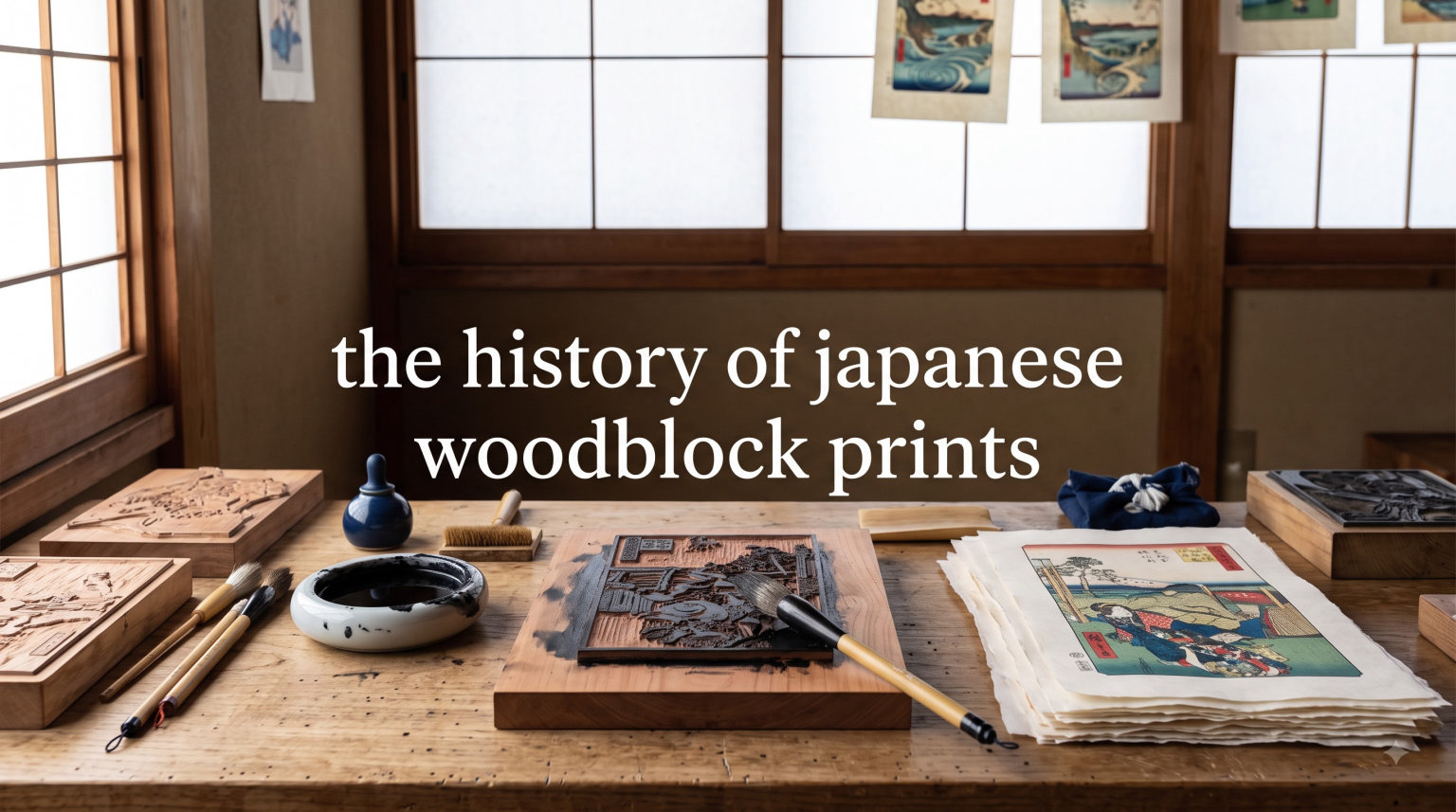
Japanese woodblock prints were never meant to be high art. When they first appeared in Japan’s Edo period, these vibrant images decorated ordinary households, lined the walls of modest shops, and served as affordable decorations for townspeople who had never owned an original painting. The fact that these mass-produced works now hang in the world’s greatest museums is one of art history’s most unexpected twists. Understanding the history of Japanese woodblock prints means tracing a journey from sacred Buddhist texts to themost influential artistic movement most Westerners have never studied in school.
What makes this story particularly fascinating is how completely these prints reflected their moment in time. They captured kabuki actors frozen mid-gesture, courtesans applying makeup in gilded brothels, and landscapes that seemed to shimmer in morning mist. These weredocuments of a society in rapid transformation, created through a collaborative craft tradition that turned wood, ink, and paper into something entirely new. The history of Japanese woodblock prints spans more than a millennium, yet its most celebrated achievements emerged from a relatively brief 250-year window that fundamentally changed how the world thought about art, reproduction, and accessibility.
Table of Contents
Origins in Buddhist Printing
Woodblock printing arrived in Japan during the early 7th century, carried along trade routes that connected the Japanese archipelago to mainland Asia. The technique itself had originated in China during the Tang dynasty, where it was used to reproduce Buddhist scriptures efficiently. Japanese religious institutions quickly adopted this method for spreading sacred texts across an archipelago where temples were spreading and literacy among monks was growing. The first major documented project was the creation of one million miniature pagodas called hyakumanto, each containing a printed Buddhist charm, commissioned by Empress Shōtoku in 770 CE. This ambitious undertaking represented one of the earliest large-scale printing operations in world history and established Japan as a practitioner of sophisticated print technology centuries before Gutenberg’s Bible would revolutionize European printing.
The materials chosen for these early Buddhist prints set the standard that woodblock printmakers would follow for over a millennium. Craftsmen used cherry wood (sakura) for the printing blocks because the wood’s tight grain held fine details without splitting, even after thousands of impressions. The paper came from mulberry bark (kozo), which was strong enough to withstand multiple printings yet absorbent enough to capture ink with remarkable clarity. These material choices were not arbitrary. Cherry wood became the standard because it was readily available in Japan’s forests, while mulberry paper could be produced domestically, reducing dependence on imported materials. The combination proved so effective that traditional Japanese woodblock prints still survive in excellent condition after hundreds of years, their colors remaining vivid despite their age.
For the next several centuries, woodblock printing remained primarily a religious and administrative technology. Buddhist temples used printed sutras for distribution to followers, while government offices printed official documents and calendars. The technical expertise accumulated during this period would prove essential when Japanese craftsman eventually shifted from sacred texts to secular imagery. Carvers learned to translate increasingly complex drawings into woodblock surfaces. Printers refined their ink application techniques and learned to achieve consistent results across thousands of impressions. These skills would form the foundation for Japan’s unique contribution to global art history.
The Rise of Ukiyo-e and the Floating World
The term ukiyo-e literally translates as “pictures of the floating world,” and understanding this concept is essential to grasping why these prints became so significant. In Buddhist philosophy, the “floating world” referred to the transitory, impermanent nature of earthly existence, the realm of shifting pleasures and fleeting beauty where enlightened beings refused to dwell. By the Edo period, however, the term had undergone a remarkable transformation. Urban merchants and townspeople appropriated the phrase to describe something entirely different: the glamorous, exciting world of kabuki theaters, teahouses, and the entertainment districts where one could escape the tedium of everyday commerce and social obligation. The floating world was not a spiritual concept to be transcended but a hedonistic reality to be savored.
This cultural shift occurred because Japan had entered a period of unprecedented peace and economic growth. The Tokugawa shogunate established its capital at Edo (modern Tokyo) in 1603, beginning an era of internal stability that would last until 1868. With samurai warlords permanently stationed in the capital and a vast bureaucracy administering the country from there, Edo’s population swelled from a small fishing village to over one million inhabitants, making it one of the world’s largest cities by the 18th century. This concentrated population included a wealthy merchant class that had accumulated significant resources despite their officially low social standing. These merchants and townspeople wanted art that reflected their experiences, their pleasures, and their values, and traditional Buddhist temple art simply did not speak to them.
The first true ukiyo-e prints emerged around the 1650s, created by a designer named Hishikawa Moronobu who worked in Edo’s bustling entertainment district. Moronobu specialized in illustrating the books and prints that appealed to his merchant-class patrons, depicting scenes from kabuki plays and images of the courtesans who dominated the entertainment quarter’s social hierarchy. His work established several conventions that would define ukiyo-e for centuries. The compositions featured flattened perspectives that drew from traditional Japanese painting rather than European linear perspective. The subject matter centered on contemporary urban life rather than religious themes or historical legends. The aesthetic emphasized decorative beauty and immediate visual appeal over subtle philosophical depth. These choices reflected the values of the floating world itself: present-minded, pleasure-seeking, and unconcerned with heavenly matters.
The Edo Period Golden Age
The Edo period (1603-1868) provided the perfect conditions for woodblock print culture to flourish, and the results transformed Japanese artistic tradition permanently. When Commodore Matthew Perry’s “Black Ships” arrived in 1853 and forced Japan to end its policy of isolation, ukiyo-e prints were among the first cultural products that Westerners encountered. European artists and collectors immediately recognized something revolutionary in these images. The bold compositions, the flat areas of pure color, the unconventional perspectives, and the frank depiction of everyday life seemed to point toward artistic possibilities that European tradition had never explored. What these Western admirers often failed to understand was how completely the prints reflected the unique social and economic conditions of Edo Japan.
The woodblock print industry developed as a distinctly democratic art form because of Japan’s peculiar social hierarchy. At the top stood the samurai aristocracy, whose military governance gave them legitimate claim to cultural authority. Below them came the farmers, whose labor fed the nation and whose taxes funded the shogunate. At the bottom of the official hierarchy sat the merchants, whose commercial success often made them wealthier than the samurai above them but whose occupation was considered socially base. Traditional art patronage flowed from the top of this pyramid, funding temple paintings, scroll artworks, and screened doors decorated by professional artists serving aristocratic tastes. The merchant class wanted art too, but commissioning original works from professional painters was prohibitively expensive. Woodblock prints offered an alternative that combined visual appeal with affordability.
Print publishers recognized this market opportunity and developed an efficient production and distribution system that brought images to a mass audience for the first time in Japanese history. Major publishing houses operated from Edo’s Nihonbashi district, coordinating the work of designers, block carvers, and printers into a streamlined operation. Publishers handled marketing and distribution through networks of booksellers who sold prints alongside popular novels and illustrated guides to the entertainment district. A single design could be carved into multiple blocks, each block representing one color, and these blocks could then produce thousands of prints that were sold for the price of a meal. The most popular prints sold in editions of thousands, creating a visual culture shared by people across the economic spectrum. A merchant’s wife could own the same print design as a samurai’s daughter, democratizing access to artistic imagery in ways that European commoners would not achieve for centuries.
The subject matter of Edo period prints reflected the full scope of urban culture, from the glamorous to the mundane, from the celebrated to the scandalous. Kabuki actors were among the most popular subjects, with prints documenting the latest sensations from the theater district, capturing famous poses and dramatic moments from current productions. Courtesans and their rivals the geisha appeared in elaborate compositions that displayed the latest fashion trends from the entertainment quarter’s exclusive world. Landscape prints documented the famous routes traveled by feudal lords on their required trips to Edo, celebrating famous views along the Tōkaidō road and other major highways. Even mundane subjects like vendors selling vegetables, ferry boats crossing rivers, and festivals celebrating local shrines found their way into the print tradition. Nothing in the floating world was considered too ordinary for documentation.
The Development of Color Printing
The evolution from monochrome to full-color prints represents one of the most significant technical achievements in the history of Japanese woodblock prints, and this transformation occurred remarkably quickly. Early ukiyo-e prints, such as those created by Moronobu in the 1650s, used only black ink, with details added by hand coloring certain areas with mineral pigments. These hand-colored prints, called beni-e (literally “pink pictures”), introduced soft accents of red, pink, and green to otherwise black-and-white compositions, but the hand-coloring process limited production speed and created inconsistencies between individual prints. A more efficient method was needed to meet growing demand from Edo’s increasingly art-hungry middle class.
The breakthrough came in 1765 when a designer named Suzuki Harunobu created the first true full-color woodblock print, which Japanese critics named nishiki-e (brocade pictures) because of their vibrant, multi-colored appearance. Harunobu’s innovation was not simply adding more colors but developing a systematic method for using multiple carved blocks, each dedicated to a specific color, in precise alignment. The printer would apply ink to the first block, lay paper over it, and rub with a tool called a baren to transfer the image. Then the paper would be aligned with the second block using guide marks called kento, and the process would repeat for each additional color. A typical nishiki-e might require ten or more separate blocks, one for each color in the design, but the resulting print captured a range of tones and hues that transformed the medium’s artistic possibilities.
Nishiki-e techniques evolved rapidly as printmakers experimented with new color combinations and printing methods. Traditional pigments included traditional mineral and plant-based colors: iron oxide for reds and browns, malachite for greens, azurite for blues, and calcium carbonate for whites. Printers developed sophisticated techniques for achieving subtle gradients by dabbing ink rather than applying it evenly, creating areas of soft transition between colors. Some prints incorporated actual gold or silver dust mixed into the ink, creating metallic effects that shimmered in candlelight. The technical vocabulary of nishiki-e expanded to include terms like tanmono (color matching), sankai (three-shade printing for creating depth), and kimedashi (outlining technique that made figures pop from backgrounds). These innovations occurred through practical experimentation rather than theoretical advance, driven by printmakers seeking competitive advantages in the marketplace.
The development of nishiki-e had profound implications for the visual culture of Edo Japan and ultimately for global art history. Suddenly, images could capture the subtle gradations of color found in nature, from the delicate pink of cherry blossoms to the deep indigo of twilight skies. This technical achievement expanded the range of subjects that prints could depict effectively. Landscape prints became possible, capturing the play of light across mountain valleys and the mist rising from morning rivers. Portrait series could render the intricate patterns of silk kimono with photographic accuracy. By the early 19th century, nishiki-e had reached a technical sophistication that would not be matched in Western printmaking until the invention of lithography. The prints were no longer simply affordable alternatives to paintings but had become art forms with unique capabilities that paintings could not replicate.
The Four-Artist Collaboration Model
One of the most distinctive features of traditional Japanese woodblock print production was its collaborative nature, which distinguished it sharply from Western artistic traditions where individual genius was celebrated. A single ukiyo-e print represented the combined efforts of four specialists, each contributing essential expertise, with none considered more important than the others. This system emerged not from philosophical principle but from practical necessity, and understanding it is essential to understanding how these prints achieved their remarkable combination of technical perfection and artistic vision.
The designer (yakimanji) was typically a trained painter who created the original composition, often working in watercolor or ink on paper before handing the design to the next specialist. Designers were often trained in the Kanō school of painting, which provided rigorous instruction in traditional Chinese and Japanese techniques, but many ukiyo-e designers developed distinctive personal styles that set them apart from academic tradition. The designer’s role was to conceive the overall composition, determine the color scheme, and ensure that the final print would achieve the intended emotional effect. This required understanding not just of artistic principles but of the printing process itself, since certain designs translated more effectively to woodblock than others.
Once the design was finalized, it was handed to the engraver (horishi), who carved the image into the woodblocks. This specialist worked from the back of the paper design, which was glued face-down onto a cherry wood block, typically made from the end grain of the wood for maximum durability. The engraver would cut away all the white areas of the design, leaving the black lines standing in relief. This required extraordinary precision, since a single mistake could ruin both the block and the original drawing. For nishiki-e prints, a separate block was carved for each color, requiring perfect registration so that colors would align precisely when printed. An experienced engraver could produce a set of ten or more blocks from a single design, each block capturing only the areas that would receive one specific color. The engraver’s skill directly affected the visual quality of the final print, and top engravers were highly valued specialists whose reputations could make or break a publisher.
The printer (surishi) applied ink to the blocks and transferred the image to paper, using a padding tool called a baren to rub the paper against the inked surface. This process required considerable physical skill and experience, since the amount of pressure applied determined how much ink transferred and thus how intense the color appeared. Printers developed specialized techniques for creating different effects, including soft gradients, bold saturations, and subtle textures. They also managed the registration process, ensuring that each color block aligned perfectly with the previous ones using the kento guide marks. After printing, the sheets were hung to dry, then assembled and trimmed before shipment to booksellers. The printer’s role was often underestimated by Western observers who saw woodblock printing as merely mechanical, but master printers possessed skills that directly affected the artistic quality of the final product.
The publisher (tonya) coordinated the entire operation, financing production, managing the business side, and often selecting which designs to produce based on market trends. Publishers like Tsutaya Juzaburo, who worked with many leading artists of the late Edo period, wielded enormous influence over the development of the tradition. They commissioned designs from artists, contracted with engravers and printers, and marketed the finished prints through distribution networks that reached throughout Japan. Publishers also served as cultural intermediaries, helping to shape public taste by choosing which subjects and artists to promote. The best publishers had sophisticated understanding of both artistic quality and market demand, and their decisions helped determine which visual themes dominated the floating world at any given moment.
Famous Artists of the Tradition
While the collaborative nature of woodblock print production means that no single artist had complete control over the final product, certain designers achieved such distinctive artistic vision that their prints became immediately recognizable and widely celebrated. These artists pushed the boundaries of what woodblock prints could achieve, developing styles that influenced generations of successors and ultimately transformed Western artistic tradition when their work reached Europe in the 19th century. Understanding the contributions of these major figures is essential to appreciating the full scope of the history of Japanese woodblock prints.
Katsushika Hokusai (1760-1849) stands as perhaps the most internationally famous of all Japanese woodblock print designers, whose work “Thirty-six Views of Mount Fuji” achieved such popularity that he added ten additional designs to the original series. Born in Edo as the son of a mirror-maker, Hokusai demonstrated artistic talent from childhood but did not achieve recognition until relatively late in life. He worked in an astonishing variety of styles and genres, producing illustrated books, single-sheet prints, paintings, and drawings throughout a career spanning more than seventy years. His landscape designs, exemplified by the iconic “Great Wave off Kanagawa” and “Fine Wind, Clear Morning” (known in the West as “South Wind, Clear Sky”), transformed the traditional landscape genre by emphasizing atmospheric effects and unusual viewpoints rather than conventional documentary accuracy. Hokusai approached Mount Fuji from angles and distances that made the mountain appear as a dynamic presence within swirling natural forces, and his bold compositions influenced generations of Western landscape painters.
Utagawa Hiroshige (1797-1858) took a different approach to landscape prints, emphasizing poetic mood and atmospheric suggestion over dramatic dynamism. His most famous work, “Fifty-three Stations of the Tōkaidō Road,” documents the journey between Edo and Kyoto along Japan’s most important highway, but his images are less documentary than dreamy evocations of the experience of travel. Hiroshige used rain, snow, mist, and moonlight as atmospheric elements that transformed ordinary scenes into something approaching the spiritual. His “One Hundred Famous Views of Edo,” completed in the final years of his life, captures the city during different seasons and weather conditions with extraordinary sensitivity to light and color. Where Hokusai’s landscapes felt heroic and timeless, Hiroshige’s felt intimate and moment-specific, conveying the particular quality of a particular place at a particular time.
Kitagawa Utamaro (1753-1806) specialized in portraits of beautiful women (bijin-ga), developing a style that emphasized elegant simplicity and psychological subtlety. His close-up studies of women’s faces, often shown engaged in private activities like applying makeup or preparing for bed, revealed emotional depths that earlier portrait styles had not attempted. Utamaro’s compositions often featured extended vertical formats that allowed for detailed rendering of elaborate hairstyles and intricate kimono patterns. His use of the mica printing technique, which added a subtle shimmering quality to backgrounds, created effects that seemed to glow with inner light. Though he faced government censorship late in life for producing prints that satirized the ruling shogun, Utamaro’s influence on subsequent bijin-ga designers remained profound.
Suzuki Harunobu (1725-1770), the artist credited with developing the nishiki-e full-color printing technique, deserves recognition not just for his technical innovation but for his artistic vision. His designs for erotic albums (shunga) demonstrated the full range of possibilities that multi-color printing offered, capturing intimate scenes with remarkable warmth and humanity. Harunobu’s compositions emphasized graceful, elongated figures in lyrical settings, creating an aesthetic of refined sensuality that influenced generations of successors. Though his career was cut short by his untimely death, Harunobu’s technical breakthroughs laid the foundation for the explosion of colorful prints that defined the late Edo period.
Modern Movements and the Hanga Revival
The Meiji Restoration of 1868 marked a turning point in Japanese history and created conditions that threatened to destroy the traditional woodblock print tradition entirely. When Japan opened to foreign contact, Western artistic styles flooded into the country, promoted by government policies that emphasized modernization and adoption of European techniques. Oil painting became the preferred medium for serious artistic expression, while woodblock prints were dismissed by cultural authorities as old-fashioned relics of a pre-modern era. Print publishers who had served the merchant class found their traditional markets shrinking as Japan’s new urban bourgeoisie embraced Western aesthetic values. By the early 20th century, the ukiyo-e tradition that had flourished for two centuries seemed destined for extinction.
A group of artists and printmakers responded to this crisis by launching the shin hanga (new prints) movement, which sought to revive traditional woodblock techniques while adapting them to contemporary subject matter. Led by publisher Watanabe Shozaburo, shin hanga artists combined the collaborative production methods of ukiyo-e with subjects that appealed to modern tastes and international collectors. Shin hanga prints featured traditional ukiyo-e subjects like bijin portraits and landscapes but executed with contemporary artistic sensibilities. The movement achieved considerable commercial success, particularly in the American market, where collectors appreciated the combination of authentic Japanese craft tradition and modern aesthetic refinement. Artists like Charles Shale Banks, whose seascapes and harbor scenes captured the flavor of early 20th-century Japan, demonstrated how the tradition could evolve without abandoning its technical foundations.
In contrast to shin hanga’s embrace of traditional collaboration, the sosaku hanga (creative prints) movement emphasized individual artistic expression above all other considerations. Led by artists like Ernest Fenollosa, Kiso Hizō, and later Onchi Kōshirō, sosaku hanga artists rejected the idea that printers and carvers should execute designs created by artists who never touched the blocks. Instead, the individual artist performed every stage of production, from drawing the design to carving the blocks to printing the final image. This approach drew inspiration from European expressionist printmaking traditions and emphasized personal artistic vision over technical perfection. Sosaku hanga prints often featured abstract compositions, introspective themes, and experimental techniques that broke from ukiyo-e conventions entirely.
Contemporary Japanese woodblock printmakers continue to work in both traditions, exploring new subjects and techniques while maintaining connection to the craft’s rich heritage. Artists like Osamu Sugiyama have created works that document modern urban life using traditional moku-hanga techniques, demonstrating that the medium remains capable of relevant artistic expression. Woodblock print workshops in places like Tokyo’s Nezu neighborhood preserve traditional methods, teaching younger generations the skills that ukiyo-e craftspeople developed over centuries. International interest in Japanese prints has grown steadily since the 19th century, with major museums worldwide building comprehensive collections and scholars continuing to uncover new aspects of this complex artistic tradition.
The enduring appeal of Japanese woodblock prints lies partly in their technical achievements but even more in their unique position as windows into a vanished world. These prints document Edo Japan with a immediacy that no other art form can match, capturing the faces of famous actors, the fashion of courtesans, the views along famous roads, and the daily rhythms of urban life with remarkable accuracy. When we look at a Hokusai landscape or a Hiroshige station, we see not just a technically sophisticated image but a record of how people in a specific time and place experienced their world. This documentary value combines with genuine artistic achievement to make the history of Japanese woodblock prints one of the most fascinating chapters in global art history.
Conclusion
The history of Japanese woodblock prints encompasses a remarkable journey from sacred Buddhist texts to globally celebrated artworks that fundamentally influenced Western artistic tradition. These prints emerged from a unique combination of technical innovation, cultural transformation, and democratic accessibility that no other art form has quite replicated. When we examine the history of Japanese woodblock prints, we find not just a record of artistic achievement but a window into an entire civilization’s self-understanding during one of history’s most remarkable periods of cultural florescence.
What makes this tradition particularly significant is how completely it democratized art access. Before woodblock prints, visual imagery in Japan was largely the province of the wealthy and powerful, who alone could afford original paintings and commissioned works. The printing revolution changed this equation entirely, putting images into the hands of people who had never owned an original artwork. This democratization had profound implications for Japanese visual culture, creating shared visual vocabulary that connected people across class boundaries. The same images that decorated merchant households also reached samurai estates, and the same kabuki actors who thrilled theater audiences appeared on prints throughout the city.
The international influence of Japanese woodblock prints represents one of art history’s most consequential cross-cultural encounters. When Japanese prints reached Europe in the 1850s and 1860s, artists like Monet, Van Gogh, and Whistler recognized possibilities that European tradition had never explored. The bold compositions, flat color areas, and unconventional perspectives seemed to point toward a different relationship between art and nature, one not bound by European Renaissance assumptions about perspective and representation. This influence, often called Japonisme, transformed Western art permanently, helping to inspire the Impressionist and Post-Impressionist movements that redefined artistic practice. Without the history of Japanese woodblock prints, modern art as we know it might have taken an entirely different form.
Today, the tradition continues through artists who navigate between historical technique and contemporary vision. The distinction between shin hanga and sosaku hanga reflects broader tensions in artistic practice between tradition and innovation, collaboration and individual expression, that remain relevant today. Museums worldwide continue to collect and exhibit Japanese woodblock prints, while scholars uncover new aspects of this rich tradition. For anyone interested in art history, Japanese culture, or the global exchange of artistic ideas, the history of Japanese woodblock prints offers inexhaustible material for exploration and discovery.