
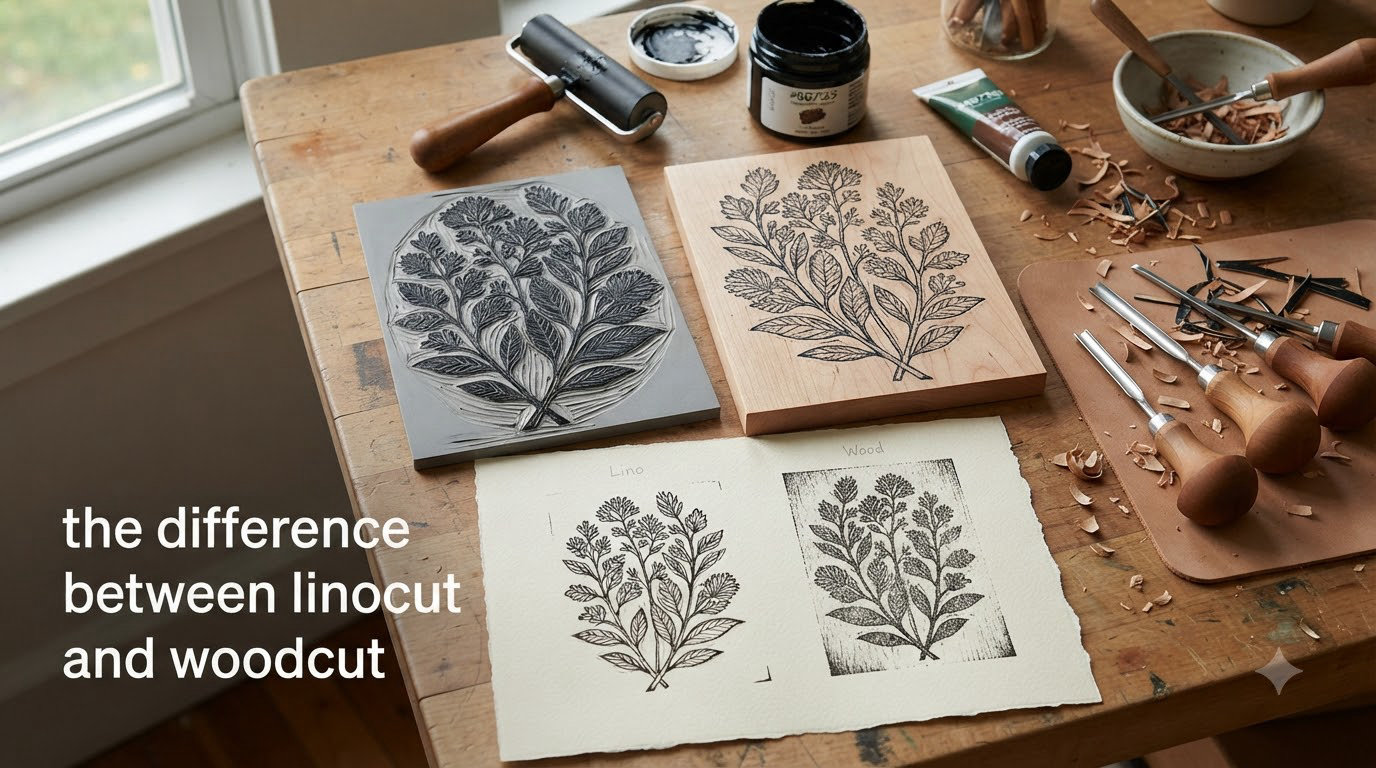
The difference between linocut and woodcut comes down to one fundamental factor: the material you carve. Linocut uses smooth, grain-free linoleum sheets that carve uniformly in any direction. Woodcut uses wooden blocks with visible grain that affects how you carve and what textures appear in your final print. Both are relief printing techniques where you carve away the negative space and ink the raised surface.
I spent three months learning both techniques side by side in my studio. What I discovered changed how I approach every printmaking project since. This guide shares everything I learned about material behavior, carving difficulty, and which technique suits different artistic goals.
Table of Contents
What Is Linocut?
Linocut is a relief printing technique where you carve a design into a sheet of linoleum, roll ink onto the raised surfaces, and press it onto paper. The material is smooth, uniform, and has no grain direction.
Artists typically use battleship linoleum (gray, firm, and durable) or Speedy Carve (soft, pink or beige, beginner-friendly). The smooth surface allows for fluid, curved cuts that look almost hand-drawn in the final print.
Because linoleum lacks grain, you can carve intricate details without fighting against wood fibers. The material cuts cleanly with gouges, and you can work in any direction without changing tools or technique.
What Is Woodcut?
Woodcut is the oldest relief printing technique, dating back to ninth-century China. You carve into a wooden block, leaving the design raised to receive ink. The wood grain becomes part of your aesthetic.
Common woods include basswood (soft and even-grained), birch plywood (affordable and stable), and end-grain maple (hard, used for fine detail in wood engraving). Side-grain cuts show bold, linear textures from the wood fibers. End-grain cuts allow for finer detail but require sharper tools and more pressure.
The grain direction matters immensely. Carving with the grain is smooth and fast. Carving against the grain risks splintering and losing control of your line.
Quick Comparison: Linocut vs Woodcut
| Feature | Linocut | Woodcut |
|---|---|---|
| Material | Linoleum (smooth, no grain) | Wood (has visible grain) |
| Ease of carving | Easy, cuts uniformly in all directions | Moderate, must carve with the grain |
| Detail level | Excellent for curves and fluid lines | Better for bold, graphic textures |
| Printing pressure | Hand-printing works well | Often needs a press for consistent results |
| Durability | Moderate (soft linoleum wears down) | High (hardwood lasts for large editions) |
| Cost | $8-25 per block | $5-40 depending on wood type |
| Safety | Low risk, soft material | Higher risk of slipping on hard wood |
Material Differences: Why It Matters
Linoleum is an isotropic material. That means it has the same properties in every direction. You can carve curves, straight lines, and intricate details without the material fighting back.
Wood is anisotropic. Its properties change based on grain direction. This creates both challenges and opportunities. The grain can add beautiful organic texture to your prints, but it also limits how freely you can carve.
Linoleum is non-porous and slightly flexible. It accepts ink evenly and releases it consistently onto paper. Wood is porous, especially soft woods like basswood. It can absorb ink into the carved-away areas if you use too much pressure, causing unwanted marks on your print.
How Grain Affects Your Results
Wood grain creates texture that becomes part of your image. Carve with the grain, and you get smooth, clean lines. Carve across the grain, and you get rough, broken textures. Some artists use this deliberately for expressive effects.
Linoleum gives you a blank slate. The surface is consistent, so your carved lines look exactly as you intended. This predictability appeals to artists who want precise control over their image.
Carving Differences: Tools and Technique
Both techniques use similar tools: gouges with V-shaped or U-shaped blades for cutting, and knives for detail work. However, how you use them differs significantly.
Linoleum is soft and forgiving. You can use inexpensive Speedball gouges and still get clean cuts. The material yields under moderate pressure, making it ideal for beginners who are still developing hand strength and control.
Wood requires sharper tools and more deliberate force. Pfeil or Flexcut gouges hold an edge better on hardwood. You need to sharpen frequently, especially with end-grain maple. Dull tools catch in the wood and can slip dangerously.
Safety Considerations
Carving injuries happen more often with woodcut. Hard wood resists the blade, and when the tool slips, it slips fast. I always wear a carving glove on my holding hand when working with wood.
Linoleum is safer for beginners because it offers less resistance. However, sharp tools are still sharp. Always carve away from your body and keep your non-carving hand clear of the blade path.
Printing Differences: Pressure and Process
Linocut prints beautifully by hand. You can use a baren (a flat disc for burnishing), a wooden spoon, or even your hand to transfer ink from block to paper. The flexible linoleum conforms to slight pressure variations, giving you consistent results without expensive equipment.
Woodcut often benefits from a printing press. Hard wood needs more pressure to release ink evenly. Hand-printing works for small editions, but you may get uneven inking or incomplete transfers, especially with larger blocks.
Ink and Paper Considerations
Both techniques work with oil-based and water-based relief inks. Water-based inks clean up easily and work well for beginners. Oil-based inks have longer working times and richer saturation but require solvent cleanup.
Paper choice matters too. Japanese Shina plywood pairs beautifully with thin, absorbent kozo paper. Linoleum works well with heavier cotton papers like Fabriano Rosaspina that can handle the pressure of hand-burnishing.
Pros and Cons of Each Technique
Linocut Advantages
Linocut is faster to learn. You can carve a simple design in an afternoon and print it the same day. The material is affordable and widely available. You do not need a press to get professional results.
The smooth surface excels at organic shapes, flowing lines, and patterns. Artists like Picasso and Matisse favored linocut for its ability to capture gestural, expressive marks similar to drawing or painting.
Linocut Disadvantages
Soft linoleum wears down over time. After 20-30 prints, fine details may start to lose definition. Battleship linoleum lasts longer but costs more and requires warming before carving.
The material can also be too soft for some artists. It does not offer the tactile feedback of wood, and some find it less satisfying to carve.
Woodcut Advantages
Wood blocks last for hundreds of prints. End-grain maple can produce editions of 500 or more with minimal degradation. The grain adds character and warmth that linoleum cannot replicate.
Woodcut connects you to printmaking history. Every technique you use has been used by artists for centuries. There is a meditative quality to carving wood that many artists find deeply satisfying.
Woodcut Disadvantages
The learning curve is steeper. You must learn to read grain direction and adjust your carving accordingly. Mistakes are harder to fix. If you carve too deep or against the grain, you cannot uncarve the wood.
Quality wood is more expensive and harder to source. You also need sharper tools and potentially a press, increasing startup costs.
Which Should Beginners Choose?
Start with linocut. The material is forgiving, the tools are affordable, and you can hand-print successfully from day one. A basic setup costs around $50: a 5×7 inch Speedy Carve block, a basic gouge set, a brayer, and water-based ink.
After you understand how relief printing works, transition to woodcut. The skills transfer directly. You will already know how to ink your block, register your paper, and pull clean prints. The only new challenge is learning how wood behaves.
I recommend carving at least three linocut projects before trying wood. By then, you will have muscle memory for tool control and a clear sense of what you want from the medium.
Historical Context and Notable Artists
Woodcut predates linocut by over a thousand years. The earliest known woodcuts date to ninth-century China, used for printing Buddhist texts. Albrecht Durer elevated woodcut to fine art in the Renaissance with works like the Apocalypse series.
Linocut emerged in the early twentieth century as linoleum became commercially available. The technique gained prominence through the Taller de Grafica Popular in Mexico and artists like Picasso, who created bold, colorful linocuts in the 1950s and 60s.
Today, both techniques thrive in contemporary printmaking. The choice between them is purely aesthetic and practical, not a matter of tradition versus modernity.
The Difference Between Linocut and Woodcut
To summarize the key differences: linocut uses smooth, grain-free linoleum that carves uniformly and prints easily by hand. Woodcut uses wooden blocks with visible grain that requires more skill to carve and often needs a press for consistent results.
Linocut offers faster learning, lower costs, and predictable results. Woodcut offers durability, historical connection, and unique organic textures. Both produce beautiful prints. Your choice depends on your priorities: ease and speed, or tradition and texture.
Frequently Asked Questions
Is linocut easier than woodcut?
Yes, linocut is generally easier for beginners. Linoleum has no grain, so it carves smoothly in any direction. Wood requires you to carve with the grain to avoid splintering. Linocut also needs less pressure to print, making hand-printing more forgiving.
Why do artists prefer linocut?
Artists prefer linocut for its speed, affordability, and ease of use. The smooth surface captures flowing, organic lines well. It is ideal for artists who want to sketch directly onto the block and carve quickly. Picasso and Matisse famously preferred linocut for its painterly qualities.
What are the 4 types of printmaking?
The four main types of printmaking are relief (linocut, woodcut), intaglio (etching, engraving), planographic (lithography), and stencil (screen printing). Relief printing, which includes both linocut and woodcut, involves carving away the negative space and inking the raised surface.
Can you tell if a print is linocut or woodcut?
Yes, you can usually tell by examining the texture. Woodcut prints show wood grain texture in the solid areas. Linocut prints have perfectly smooth, uniform surfaces. Woodcut lines may also show slight variations from grain direction, while linocut lines are consistently smooth.
Which lasts longer, linocut or woodcut blocks?
Woodcut blocks last significantly longer. End-grain maple can produce editions of 500 or more prints. Linoleum, especially soft varieties like Speedy Carve, may start degrading after 20-30 prints. Battleship linoleum lasts longer but still does not match hardwood durability.
Conclusion
The difference between linocut and woodcut shapes every decision in your printmaking practice. Linocut offers accessibility and speed. Woodcut offers tradition and texture. Neither is better, only different.
If you are new to relief printing, start with linocut. Master the basics of carving, inking, and printing. Then explore woodcut when you are ready for a new challenge and the unique aesthetic only wood can provide.
Both techniques have produced masterworks throughout history. Both await your creative contribution. Choose the one that matches your current goals, and know that the skills you build will serve you across any relief printing medium you explore.