
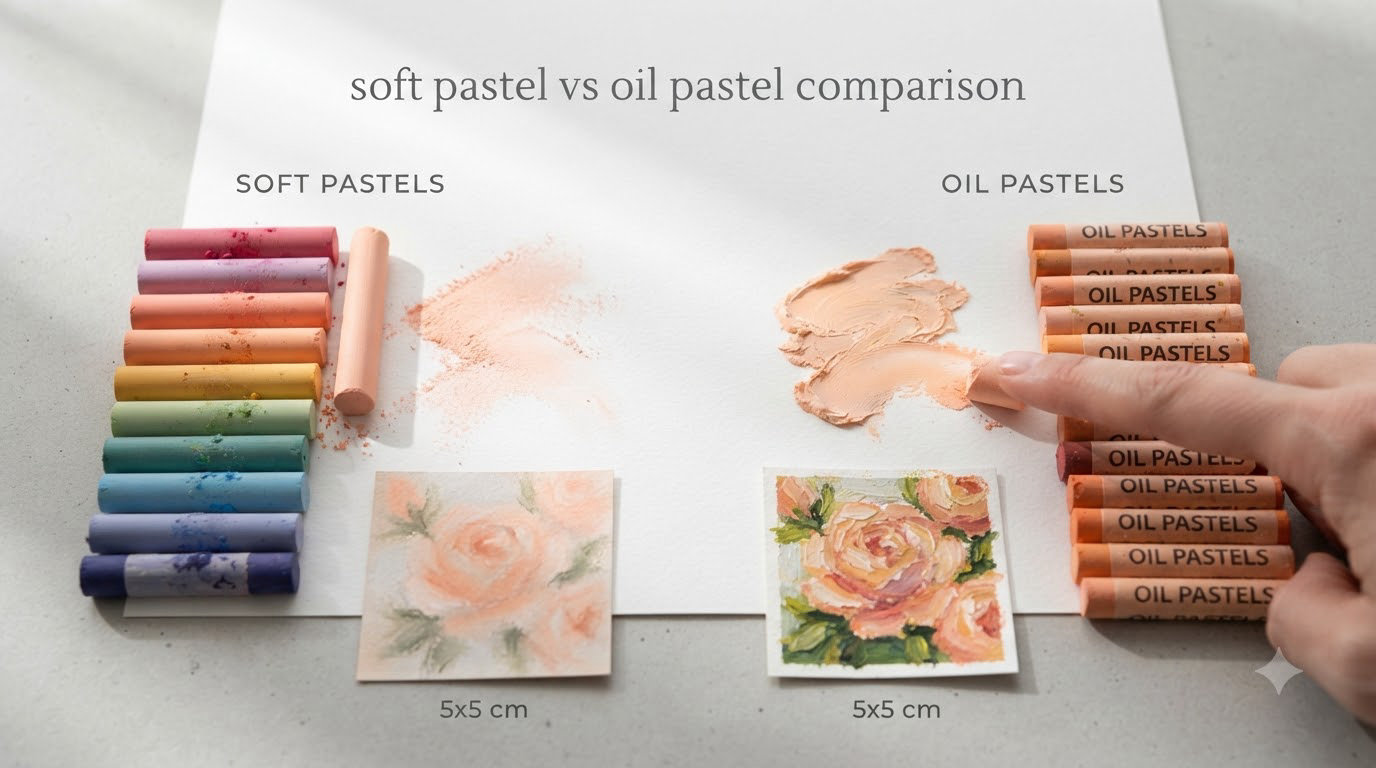
If you have ever stood in the art supply aisle staring at two boxes that both say “pastel,” you are not alone. The soft pastel vs oil pastel debate confuses plenty of new artists, and for good reason. Despite sharing the same name, these two mediums behave in completely different ways on paper.
Soft pastels are dry, powdery sticks made from pigment held together with a gum binder. Oil pastels use an oil-and-wax binder that gives them a creamy, crayon-like feel. Understanding the differences between them is the first step toward picking the right one for your art style and goals.
In this guide, I will break down everything you need to know about soft pastel vs oil pastel. By the end, you will have a clear answer to which medium fits your creative needs in 2026.
Table of Contents
Soft Pastel vs Oil Pastel: Quick Comparison
The table below gives you a fast side-by-side look at how these two mediums stack up across the categories that matter most.
| Feature | Soft Pastels | Oil Pastels |
|---|---|---|
| Binder | Gum (methyl cellulose or tragacanth) | Non-drying oil and wax |
| Texture | Powdery, chalk-like | Creamy, crayon-like |
| Blending | Easy with fingers, stumps, or cloth | Requires solvent or heavy pressure |
| Color Intensity | Soft, luminous, subtle gradients | Bold, vivid, opaque coverage |
| Drying | Dry to the touch immediately | Never fully dry |
| Dust/Mess | High dust, messy | Low dust, less messy |
| Best Surface | Sanded or textured paper | Heavy paper, canvas, wood, glass |
| Fixative Needed | Yes, to preserve work | No, but stays tacky |
| Layering | 3 to 4 layers before saturation | Multiple thick layers possible |
| Beginner Friendly | Moderate (requires control) | Yes (sturdy and forgiving) |
Keep this reference handy as you read through the deeper breakdowns below.
What Are Soft Pastels?
Soft pastels are dry drawing sticks made from pure pigment mixed with a minimal amount of gum binder, typically gum tragacanth or methyl cellulose. Because they contain so little binder, the pigment sits loosely on the surface of your paper, which is what gives soft pastels their signature powdery, velvety look.
When you drag a soft pastel across textured paper, it leaves behind a rich trail of color powder. That powder can be blended with your fingers, a blending stump, or a soft cloth to create smooth gradients and soft transitions. This is the reason many artists describe working with soft pastels as painting with dry color.
The downside is the dust. Soft pastels release fine pigment particles into the air and onto your workspace. Many artists lay newspaper under their work and wear gloves to manage the mess. You also need a fixative spray to keep your finished artwork from smudging over time.
Soft pastels come in a huge range of colors and are available in student-grade and artist-grade options. Artist-grade soft pastels contain more pigment and less filler, which translates directly to richer, more lightfast colors on paper.
What Are Oil Pastels?
Oil pastels are made from pigment suspended in a non-drying oil and wax binder. This combination gives them a smooth, creamy consistency that feels similar to a crayon but delivers far more intense color. Unlike soft pastels, oil pastels go on wet and never fully dry.
Because of that oil-wax binder, oil pastels stick to almost any surface. You can use them on paper, canvas, wood, glass, and even metal. This versatility makes them popular for mixed media projects and experimental art. The trade-off is that the surface stays slightly tacky indefinitely, which means you need to protect finished work with glass or a barrier sheet.
Oil pastels produce bold, opaque strokes with vibrant color. They layer thickly, allowing you to build up an almost impasto-like texture on your surface. Artists who enjoy sculptural, expressive mark-making tend to gravitate toward oil pastels for exactly this reason.
For beginners, oil pastels are often the easier starting point. They do not crumble or snap under pressure, they are easy to control, and the clean-up is far simpler compared to soft pastels. Many art teachers recommend oil pastels as the entry point into pastel art.
Key Differences: Soft Pastel vs Oil Pastel
Now that you know what each medium is, let me walk you through the specific differences that actually matter when you are working at your easel or desk.
Binder and Composition
The binder is the single biggest difference between these two mediums, and it affects everything else downstream. Soft pastels use a water-soluble gum binder that holds the pigment together just enough to form a stick. The binder ratio is low, often 10 percent or less, which means you are working with almost pure pigment.
Oil pastels use a non-drying mineral oil combined with wax as their binder. This oil-wax mix is what gives oil pastels their creamy feel and prevents them from ever fully hardening or drying. The binder ratio is significantly higher than in soft pastels, which is why oil pastels feel more solid and less fragile in your hand.
This compositional difference explains why the two mediums behave so differently on paper, even though both deliver pigment to a surface. The binder determines the texture, the blending behavior, and how the artwork ages over time.
Texture and Consistency
Soft pastels feel like compressed chalk. When you press them onto paper, they crumble slightly and deposit a layer of pigment dust. The texture is dry, powdery, and light. This fragility means you need to handle soft pastels carefully to avoid breaking them, especially the softer artist-grade sticks.
Oil pastels feel firm and waxy, closer to a thick crayon or a lipstick. They glide across the surface without shedding dust or crumbs. The creamy consistency allows you to lay down thick, juicy strokes of color that sit on top of the paper rather than sinking into its fibers.
Artists on Reddit frequently mention this tactile difference as the thing that makes or breaks their preference. Some love the powdery feel of soft pastels and the painterly results. Others find the mess frustrating and prefer the clean, controlled application of oil pastels.
Blending and Layering
Soft pastels blend effortlessly. You can use your fingertip, a paper stump, a piece of felt, or even a soft brush to push the pigment around and create smooth gradients. Layering works well too, but there is a limit. Most sanded papers hold about three to four layers of soft pastel before the tooth fills up and cannot accept more pigment.
Oil pastels are trickier to blend. Because the binder is waxy, you cannot simply smudge the color with your finger the way you can with soft pastels. Many artists use a solvent like turpenoid or mineral spirits to dissolve the oil binder and blend colors together. Without a solvent, you are limited to pressure blending, which works but gives less refined transitions.
Where oil pastels shine is layering thickness. You can build up many layers of oil pastel, creating a textured, almost three-dimensional surface. Techniques like sgraffito, where you scratch through the top layer to reveal the color underneath, work beautifully with oil pastels because of that buildable thickness.
Color Vibrancy and Longevity
Both mediums deliver strong color, but in different ways. Soft pastels offer a luminous, light-filled quality because the pigment sits on the paper surface and reflects light directly. The colors can appear softer and more natural, which is why landscape and portrait artists often prefer them.
Oil pastels produce bolder, more saturated color. The oil-wax binder creates a slightly glossy finish that intensifies the pigment. However, some lower-quality oil pastels can shift in color over decades because the non-drying oil may yellow slightly with age.
For professional work, lightfastness matters. Both mediums are available in artist-grade options with excellent lightfastness ratings, but you should always check the individual pigment ratings on the brand you choose. Student-grade pastels of either type tend to fade faster when exposed to sunlight.
Best Surfaces and Paper
Soft pastels need a surface with “tooth,” which means texture that can grab and hold the pigment powder. Sanded pastel paper, pastel board, and velour paper are the top choices. Watercolor paper with a rough finish can work, but it holds fewer layers. Smooth paper is essentially useless for soft pastels because the pigment just slides off.
Oil pastels are far less picky. Because of their adhesive oil-wax binder, they stick to almost anything. Heavy drawing paper, canvas boards, gessoed panels, and even wood or glass all work. This surface versatility is one of the biggest practical advantages of oil pastels.
If you plan to work large, keep in mind that soft pastel paper comes in large sheets and rolls specifically designed for the medium. Oil pastels can go on stretched canvas, which makes very large work more practical.
Techniques and Effects
Soft pastels excel at techniques like scumbling (lightly dragging a pastel over an existing layer to create a broken color effect), feathering (making small directional marks for fur or grass textures), and wet blending (applying water to soft pastel to create a watercolor-like wash).
Oil pastels are ideal for impasto (building up thick, textured strokes), sgraffito (scratching through layers to reveal color beneath), and solvent blending (using turpenoid or mineral spirits to create smooth washes and transitions). The rule of 3 in oil pastels refers to a common technique where you apply three tones of the same color (dark, mid, light) to create form and dimension.
Neither medium is better overall. They simply produce different visual effects, and many experienced artists use both depending on the subject matter and mood they want to convey.
Pros and Cons of Each Medium
Here is a straightforward breakdown of the advantages and drawbacks of each medium to help you weigh your options.
Soft Pastels: Pros
- Incredibly easy blending with fingers or stumps
- Luminous, painterly color quality
- Wide range of available colors, especially in artist-grade sets
- Dry to the touch right away
- Excellent for subtle gradients and soft transitions
- Easy to correct mistakes by lifting pigment with a kneaded eraser
Soft Pastels: Cons
- Very dusty and messy to work with
- Fragile sticks that break easily
- Require fixative spray to preserve finished artwork
- Limited layering before the paper tooth fills up
- Pigment dust can be an inhalation concern in poorly ventilated spaces
- Limited to textured surfaces only
Oil Pastels: Pros
- Bold, vibrant, opaque color
- Sturdy sticks that resist breaking
- Low dust and less mess overall
- Work on almost any surface including canvas, wood, and glass
- Excellent for thick, textured, and impasto effects
- No fixative required
Oil Pastels: Cons
- Never fully dry, so finished work stays slightly tacky
- Harder to blend without solvents
- Difficult to frame without glass or a protective barrier
- Can feel “childish” or crayon-like to some artists
- Oil binder may yellow slightly over many decades
- Mistakes are harder to erase once pigment is laid down
Soft Pastel vs Oil Pastel: Which Should Beginners Choose?
This is the question I see most often in art forums and Reddit threads. The honest answer is that it depends on what you want from the experience, but I can give you a clear decision framework.
Choose oil pastels if you are a complete beginner who wants a low-friction entry into pastel art. Oil pastels are sturdy, forgiving, and less messy. You can pick them up and start making satisfying art within minutes, and they work on regular heavy drawing paper without any special preparation. Many art educators recommend starting with oil pastels for these reasons.
Choose soft pastels if you are drawn to the painterly look and are willing to invest a bit more in setup. You will need sanded paper, a set of blending tools, and fixative spray from the start. The learning curve is steeper because soft pastels require more control, but the luminous, sophisticated results are worth it for many artists.
If budget is a concern, student-grade oil pastels from brands like Crayola or Cray-Pas cost less than student-grade soft pastels and do not require the additional investment in specialty paper and fixative. That said, both mediums are available at accessible price points for beginners.
My practical advice is to buy a small set of each. Spend a weekend experimenting with both on appropriate surfaces. Your hands will tell you which medium feels right, and that personal preference matters more than any recommendation I can give you.
How to Store and Care for Your Pastels
Proper storage makes a real difference in how long your pastels last and how enjoyable they are to use. The two types need different care routines.
Soft pastels should be stored in their original foam or cardboard inserts, or in a dedicated pastel box with divided compartments. Keep them in a dry, cool place because humidity can soften the gum binder and cause sticks to crumble. Label your colors clearly so you are not constantly handling them to find the right shade. Handle them gently to avoid snapping fragile sticks.
Finished soft pastel artwork needs to be stored flat with glassine paper between sheets. Never stack pastel paintings directly on top of each other, even if you have applied fixative. Fixative reduces smudging but does not eliminate it entirely. Frame finished pieces under glass for long-term display.
Oil pastels are more durable but still need thoughtful storage. Keep them in a cool place away from direct heat sources, because high temperatures can soften the wax binder and cause sticks to deform. A simple compartment box works well.
Finished oil pastel artwork should be stored with glassine paper or wax paper between sheets. Because oil pastels never fully dry, the surface remains slightly tacky for years. Framing under glass or storing with a protective barrier sheet prevents the surface from sticking to anything that touches it.
For both mediums, keep your work area clean between sessions. Soft pastel dust can contaminate oil pastel colors and vice versa, which leads to muddy, unintended color mixing.
Can You Use Soft Pastels and Oil Pastels Together?
Yes, you can combine both mediums in a single artwork, but it requires some planning. The key principle is to apply soft pastels first and oil pastels on top. Because soft pastels are dry and powdery, oil pastels will not adhere well to a surface covered in soft pastel dust.
Start by laying down your soft pastel base layers on sanded paper. Use fixative spray to set the soft pastel work in place. Once the fixative is dry, you can add oil pastel accents, outlines, or bold details on top. The oil pastel will grip the fixed soft pastel surface and add a different textural quality to the piece.
Do not try the reverse. Applying soft pastel over oil pastel does not work because the powdery pigment cannot adhere to the waxy, oily surface. The soft pastel just slides off without leaving usable color.
This mixed-media approach is underexplored by most artists, which makes it a great way to create unique, textured artwork that stands out. Some artists use oil pastels for bold foreground elements and soft pastels for atmospheric backgrounds, combining the strengths of both mediums in one composition.
Frequently Asked Questions
Are soft pastels better than oil pastels?
Neither medium is universally better. Soft pastels produce luminous, painterly results with easy blending, while oil pastels deliver bold, opaque color with less mess. The right choice depends on your artistic goals, preferred surfaces, and tolerance for dust and cleanup.
What is the rule of 3 in oil pastels?
The rule of 3 is a technique where you apply three values of the same color (a dark tone, a mid-tone, and a light tone) to create the illusion of form and dimension. It helps beginners build volume in their drawings without overcomplicating color choices.
What are the disadvantages of soft pastels?
Soft pastels create significant dust and mess, the sticks are fragile and break easily, they require fixative spray to preserve artwork, layering is limited to about 3 to 4 layers, and the fine pigment dust can be an inhalation concern without proper ventilation.
Did Basquiat use oil pastels?
Yes, Jean-Michel Basquiat frequently used oil pastels along with acrylic paint, markers, and crayons in his work. His raw, expressive style relied heavily on the bold, gritty marks that oil pastels and oil sticks can produce. He often combined them with other mediums on large canvases.
Final Thoughts on Soft Pastel vs Oil Pastel
The soft pastel vs oil pastel comparison comes down to one core difference: the binder. That single ingredient changes the texture, the blending behavior, the surfaces you can use, and the way your finished art looks and ages. Neither medium is objectively superior.
Soft pastels give you luminous, painterly results with effortless blending but demand textured paper, fixative spray, and tolerance for dust. Oil pastels deliver bold, vivid color on almost any surface with less mess, but they never fully dry and are harder to blend without solvents.
If you are still unsure, buy a small set of each and experiment. Spend a few hours with both mediums on the right surfaces. Your own hands-on experience will answer the question faster than any article can. Pick up the pastel that excites you most and start creating.